Garden Blog - Top Tropicals
Date: 11 Oct 2026
Daily Cat Lesson: Is Your Cat Too Fat?
🐾 Daily Cat Lesson: Is Your Cat Too Fat? ⚖️
A chubby cat may look adorable. Unfortunately, those extra pounds aren't just cosmetic.
🐾 What is a healthy weight?
There isn't one magic number. A small-framed cat and a big Maine Coon obviously shouldn't weigh the same. Body condition matters more than the scale. At an ideal weight, you should be able to feel the ribs easily under a thin layer of fat and see a waist from above.
A hanging belly isn't automatically obesity - the normal primordial pouch can fool you! It is the normal flap of loose skin and fat hanging along a cat’s lower belly - it can swing when they walk and doesn’t mean the cat is overweight.
🐾 Can cats really become obese?
Absolutely. And obesity increases the risk of diabetes, arthritis and mobility problems, and can make grooming and other health problems harder to manage. Cats can also develop high blood pressure, although obesity isn't its only - or necessarily primary - cause.
🐾 Food-motivated vs. food-obsessed
Some cats eat what they need and walk away. Others hear a can opening three rooms away and appear by teleportation.
Food motivation varies with personality, habits, activity and past experience.
Cats that once experienced unreliable access to food may remain particularly interested in the next meal even when food is now plentiful.
🐾 Should an overweight cat go on a diet?
Yes - but never a crash diet. Cats that suddenly stop eating or lose weight too rapidly can develop dangerous hepatic lipidosis (fatty liver disease). Weight loss should be gradual, ideally with your vet helping establish a target weight and calorie intake.
For the permanently hungry customer: measure the entire day's food, divide it into several small meals, use puzzle feeders or food-dispensing toys, increase play and don't let persuasive acting automatically earn extra calories. In multi-cat homes, feed separately if one professional food thief finishes everybody else's dinner.
💡Begging is evidence that your cat wants food. It is not necessarily evidence that your cat needs food. 🍗
🐈📸 TopTropicals rescued cats Wesley and Timo are not on a diet at PeopleCats.Garden.
🐈 Stay with us for your #DailyDoseOfCat!
#DailyCatLesson #PeopleCats
🟢 Join 👉 TopTropicals
Date: 11 Oct 2026
Monstera pinnatipartita: two different plants in one!
🌿 Monstera pinnatipartita: two different plants in one!
What starts as a modest little vine can turn into a spectacular tropical giant. And the leaves? You might not even recognize them!
🌿 A Monstera with a split personality
Most gardeners know the famous Swiss Cheese Plant, Monstera deliciosa. But its lesser-known relative, Monstera pinnatipartita, has a transformation trick of its own.
Young plants produce beautiful, solid leaves with prominent veins, a slightly quilted texture, and sometimes a subtle silvery sheen. Nothing particularly unusual at first glance.
But give this Monstera something to climb, and things get interesting!
As the plant matures, its leaves grow larger and develop increasingly deep cuts, eventually reaching almost to the central vein. The result is enormous, feather-like foliage that looks nothing like the original plant!
💡 Here's the secret: Climbing helps trigger the transformation.
A sturdy trellis, moss pole, or tree trunk encourages the plant to develop its spectacular adult foliage.
🌿 From two nodes to a Monster Monstera in one summer!
Our original plant came from Colombia, as a tiny two-node cutting obtained from a grower who had collected it in the jungle.
At first, it did absolutely nothing.
It just sat there. And sat there.
Then, one day, it apparently decided it was time to grow!
Suddenly, it was putting on what seemed like an inch a day. Within a single Florida summer, that tiny cutting had turned into a giant plant in a 7-gallon container, climbing all over a large trellis!
We had to prune it heavily just to keep it under control.
But that turned out to be a good thing.
Those cuttings became new plants, and now we finally have this rare Monstera available to share!
👉 Check availability
🌿 Born to climb
Native to tropical Central and South America, Monstera pinnatipartita is a hemiepiphytic climber. In the rainforest, it uses aerial roots to attach itself to tree trunks and climb toward the light.
Interestingly, if you let it trail instead of climb, it may continue producing smaller, juvenile-looking leaves. Give it vertical support, and you're much more likely to see those impressive mature leaves.
Unlike Monstera deliciosa, famous for its holes and splits, M. pinnatipartita develops deeply divided leaf blades that resemble giant green feathers.
🌿 Surprisingly easy to grow
Despite its rare, exotic appearance, this Monstera isn't particularly demanding.
Give it bright, filtered light, warmth, an airy, well-drained potting mix, and something sturdy to climb. It appreciates humidity but adapts well to ordinary indoor conditions. Water when the upper layer of soil begins to dry.
In frost-free tropical gardens, it can climb trees. Elsewhere, grow it in a container with a trellis or moss pole, and bring it indoors during cold weather.
And don't be discouraged if your little cutting seems to be doing nothing. It may simply be busy developing roots.
Once it gets going, you'd better have that trellis ready!
🌿 Grow your own transformation
Few plants offer such a dramatic change from juvenile to adult foliage. And watching that transformation is half the fun.
Our plants are propagated from the original Colombian cutting that surprised us with its incredible growth.
🛒 Get your Monstera pinnatipartita – start small, grow spectacular!
➕ Collect more rare Monstera plants
📚 Learn more:


• Monstera pinnatipartita in Plant Encyclopedia
• Monstera Tiny Cousin That Never Outgrows Your Wall
• Rare Philodendron tortum forgot who he is
• It looks like painted on the wall: Monstera dubia
• The Big Secret Behind the "Mini Monstera" - Rhaphidophora tetrasperma
• How mini is Mini Monstera?
• How to harvest and eat Monstera Ice Cream
• Monstera x adansonii - Baby Swiss Cheese Plant
#Shade_Garden #Nature_Wonders #Container_Garden #Discover
🟢 Join 👉 TopTropicals
Date: 10 Oct 2026
Best Mango Varieties for Florida: It is Not Just About Taste

🥭 Best Mango Varieties for Florida: It is Not Just About Taste
Ask mango lovers which variety is best, and you'll get plenty of opinions.
But when you're actually planting a mango tree in Florida, flavor is only part of the decision.
Productivity, disease resistance, growth habit, harvest season, and reliability matter too.
• 🌧 Anthracnose resistance matters
Florida's warm, humid weather is ideal for anthracnose, a fungal disease that can attack mango flowers, leaves, and fruit. Rainy weather during flowering can be especially troublesome and reduce fruit set.
Some varieties naturally handle anthracnose better than others.
💡UF/IFAS has identified cultivars such as Carrie, Edward, Florigon, Keitt, Saigon, and Tommy Atkins as resistant or moderately resistant choices. But don't treat that as a list of mangoes you can and cannot grow.
- UF/IFAS: Mango Growing in the Florida Home Landscape
Disease pressure depends on weather, location, and how the tree is maintained. Full sun, good air circulation, sensible pruning, and proper nutrition all help keep a mango tree healthy. When anthracnose pressure is high, properly timed copper fungicide treatments can also help protect flowers and developing fruit.
• 🥭 Productivity matters
A spectacular mango isn't quite as exciting if the tree rarely gives you fruit.
If you only have room for one or two trees, look for varieties known for consistent production as well as good flavor.
• 🌳 Know how the tree grows
You're not just choosing a mango. You're planting a tree.
Some varieties stay relatively manageable with annual pruning, while others are vigorous or sprawling. Coconut Cream, for example, produces phenomenal fruit but has a crazy growth habit. Keep up with pruning or it can become a landscaping nightmare.
• 📅 Don't forget the season
If you're planting several varieties, mix early, midseason, and late mangoes. Instead of getting your entire crop at once, you can stretch the harvest across much of Florida's mango season.
• ✅ So what's the best mango for Florida?
There isn't just one.
Look for the combination that matters to you: great flavor, good production, manageable growth, useful harvest timing, and reasonable disease resistance.
And don't be afraid of a variety you really want simply because it's more susceptible to anthracnose. With smart growing and disease management, Florida gardeners can successfully grow a huge range of mango varieties.
🛒 Shop mango varieties
📚 Learn more:
Mango Tree - Mangifera indica - in Plant Encyclopedia
Early, Midseason & Late Mangoes: How to Get Fruit for Months
6 Best-Tasting Mango Varieties
6 Best Thai and Southeast Asian Mango Varieties
5 Best Indian Mango Varieties and Their Flavors
5 Best Dwarf Mango Trees for Small Yards
5 Best Mango Trees for Beginners
Top 10 Dwarf "Condo" Mango, great for container culture
Top 5 recommended vigorous Mango tree varieties, reliable producers
Top 5 Favorite Mango we just love
10 steps how to grow a mango tree
#Mango_Rainbow - varieties you should try
#Food_Forest #How_to #Discover #Mango


Date: 9 Oct 2026
7 delicious ways to use Dragon Fruit: quick-n-fun exotic recipes
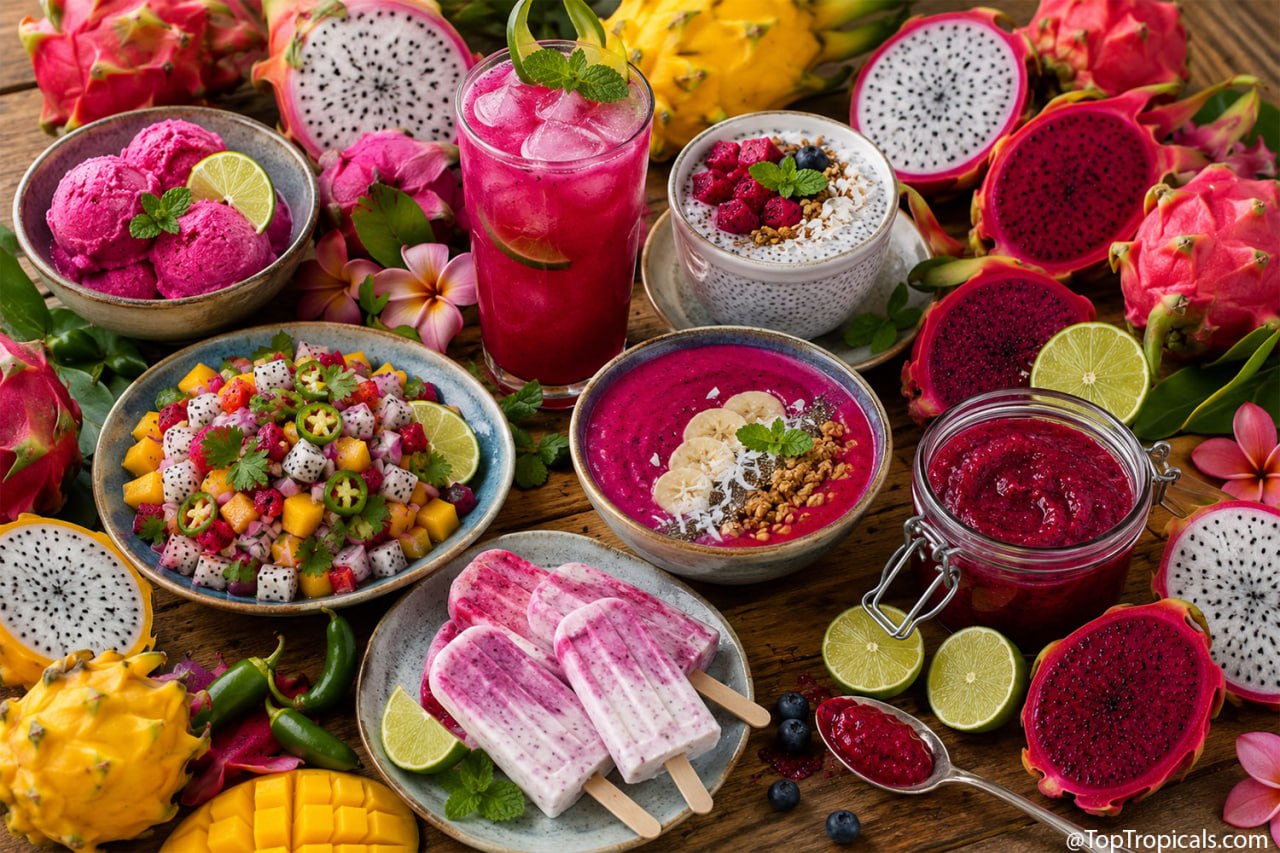
🍴 7 delicious ways to use Dragon Fruit: quick-n-fun exotic recipes
Dragon fruit looks spectacular - but the flavor can be surprisingly shy. It’s juicy, mildly sweet, and yes, sometimes downright watery. So what do you do with a beautiful fruit that doesn’t bring much flavor on its own? Give it some help. Lime, coconut, berries, honey, chili, and other stronger flavors can turn dragon fruit into something genuinely delicious while keeping that gorgeous tropical color and texture.
- 🍉 1. Dragon Fruit Lime Sorbet
Blend dragon fruit pulp with fresh lime juice, sugar or honey, and a tiny pinch of salt. Chill the mixture, then freeze in an ice-cream maker - or freeze in a shallow container and stir several times as it firms up. Lime is especially good here because it wakes up dragon fruit's mild flavor. - 🍉 2. Dragon Fruit Coconut Smoothie
Blend dragon fruit with coconut milk, banana, lime juice, and a little honey if needed. The banana adds body while coconut gives the watery fruit some richness. Serve very cold for an easy tropical breakfast or snack. - 🍉 3. Dragon Fruit Salsa
Dice dragon fruit and combine it with mango, red onion, cilantro, jalapeño, and plenty of fresh lime juice. Add a pinch of salt and let it sit for about 10 minutes before serving. It's colorful, fresh, sweet-spicy, and excellent with grilled fish, shrimp, or chicken. - 🍉 4. Dragon Fruit Chia Pudding
Mash or blend dragon fruit with coconut milk, chia seeds, and a little honey or maple syrup. Refrigerate for several hours or overnight until thick. Top with fresh fruit, toasted coconut, or nuts for extra texture. - 🍉 5. Dragon Fruit Lemonade
Blend dragon fruit with fresh lemon or lime juice, water, and sugar or honey, then strain if you prefer it smooth. Serve over lots of ice. Red-fleshed dragon fruit makes an especially spectacular naturally bright pink drink. - 🍉 6. Dragon Fruit Yogurt Pops
Blend dragon fruit with Greek yogurt, honey, and lime juice. Pour into popsicle molds and freeze until solid. The creamy yogurt fixes the fruit's watery texture, while lime gives the pops enough tang to keep them interesting. - 🍉 7. Dragon Fruit Jam with Lime
Dragon fruit alone can make a rather bland preserve, so add fresh lime juice and zest to give it some personality. Simmer chopped or mashed fruit with sugar and lime until thickened; use pectin if you want a firmer traditional jam. The result is bright, tropical, and much more flavorful than the fresh fruit suggests.
💡 The dragon fruit rule
Don't expect it to carry the recipe. Pair its beautiful color and juicy texture with something tart, creamy, spicy, or strongly aromatic - and suddenly this mild fruit gets a lot more interesting.
🛒 Collect Dragon Fruit varieties
📚 Learn more:


· Dragon fruit Hylocereus in Plant Encyclopedia
· You tried the fruit, but have you seen the Dragon Fruit flower?
· Pitaya Yellow Palora: dragon fruit beyond pink and white - A Collector's Guide
#Food_Forest #Dragon_Fruit #Discover #Recipes
🟢 Join 👉 TopTropicals
Date: 8 Oct 2026
Dwarf Mulberries Are Made for Small Gardens

🏡 Dwarf Mulberries Are Made for Small Gardens
Everybody loves mulberries. Until the mulberry becomes a TREE.
Traditional mulberries can become substantial shade trees. Great if you have the room. Less convenient when the berries are twenty feet above your head - or dropping all over the driveway.
That's why customers keep asking us for dwarf mulberries.
Small enough to manage. Easy to harvest. Excellent in containers. And they can produce an astonishing amount of fruit for their size.
🍇 Dwarf doesn't always mean the same thing
Some mulberries are genetically compact. Others simply respond beautifully to pruning and container culture.
Dwarf Everbearing is one of the easiest. Fast growing, dense and full, virtually pest-free for us - and very easy to keep at picking height.
Issai is a compact Japanese selection, known for fruiting young. In our experience, it also seems particularly happy with Florida heat.
And that's important.
🍇 Dwarf Burgundy really surprised us
Our Dwarf Burgundy Mulberry (in the video) was an experimental Mulberry seedling. We planted it in the ground and watched it produce abundantly for a couple of months.
Okay. We were convinced.
Now we have five growing in the ground, with more plants coming next spring.
Dwarf Burgundy appears to be a naturally compact hybrid, staying around 5-6 ft. Even more interesting, it can flower and fruit on both old and new wood, helping give it a long fruiting season. Young plants can begin producing surprisingly early.
Basically, a little bush trying very hard to behave like an orchard.
🍇 Small trees, reliable crops
Full-size mulberries can grow in Florida, but not every variety loves our long, hot climate. A tree may grow perfectly well while its fruit crop is less predictable.
Our dwarf varieties have been much more dependable. They don't seem bothered by the heat and produce reliably year after year.
And because they're small, harvesting is almost ridiculously easy.
No ladder.
No giant tree.
Just reach out and pick.
🍇 The fruit supermarkets can't handle
There's another good reason to grow mulberries at home.
Fresh ripe mulberries are soft and delicate. They don't store or ship particularly well, which is one reason you rarely see beautiful tree-ripe mulberries in a supermarket.
But in your backyard?
That's not a problem.
Pick. Eat. Repeat.
And with a dwarf mulberry, you don't even need an orchard. A sunny patio and a large container can be enough.
Same juicy mulberries. Much less tree.
🛒 Shop Dwarf Mulberry trees
📚 Learn more:
• Mulberry trees in Plant Encyclopedia
• What are the best Mulberry varieties
• Top 10 fast-fruiting trees: #7. Mulberry
• How Mulberry fruit helps with diabetes
• 3 Best Trees for a "Fast-Fruit" Garden
🎥
#Food_Forest #Discover #How_to
🟢 Join 👉 TopTropicals