Garden Blog - Top Tropicals
Date: 6 Oct 2026
Three gallons of instant jungle: Macaranga
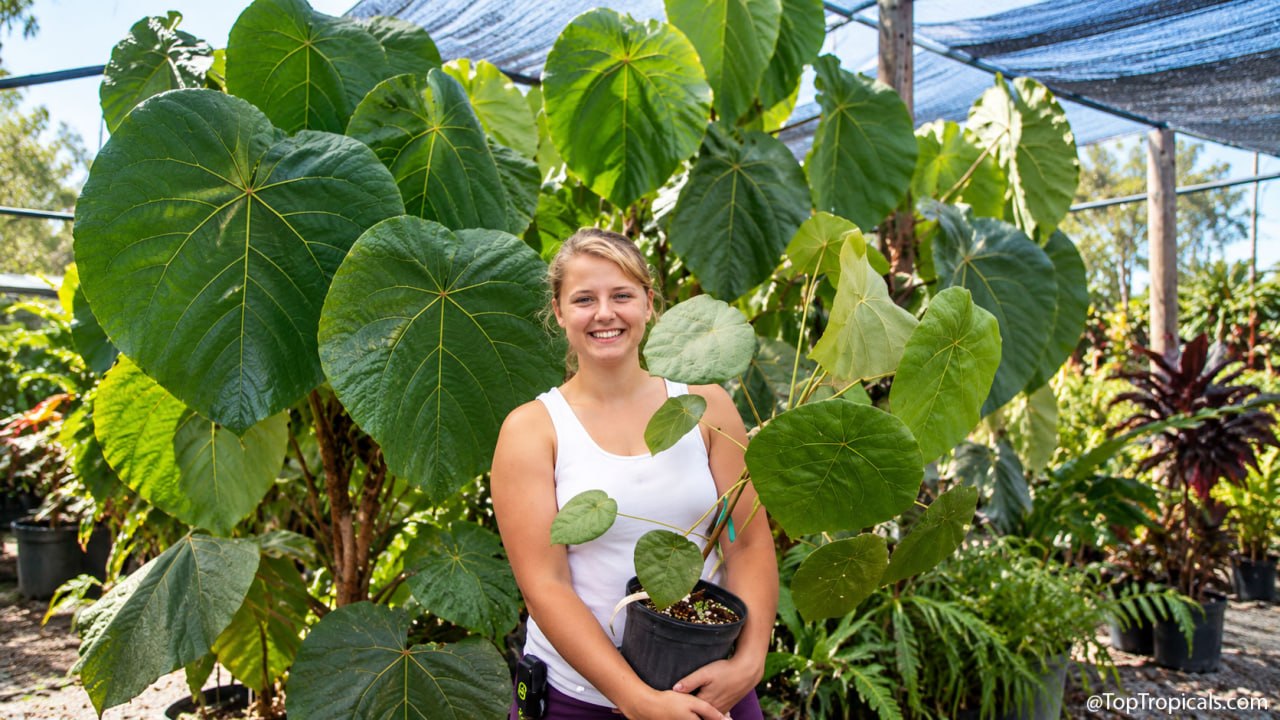
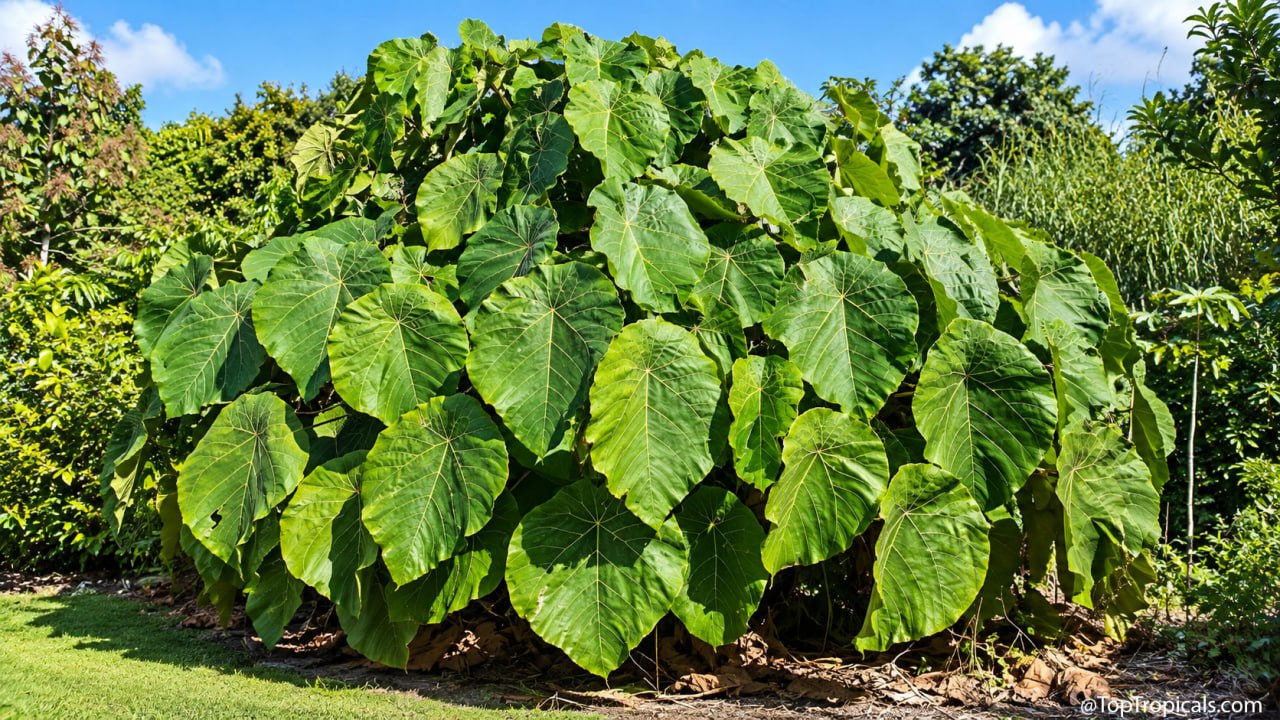
🌴 Three gallons of instant jungle: Macaranga
Some tropical gardens take years before they actually look tropical.
Macaranga grandifolia cheats.
Our current plants are growing in regular 3-gallon pots, but they're already producing those ridiculously oversized leaves that make everything around them look smaller. Plant one, and suddenly a young garden starts looking much more established.
🐘 The trick is scale
Macaranga is sometimes called the Elephant Ear Tree, and that's exactly what it looks like - almost as if an elephant ear decided to stop being an elephant ear and become a tree.
Instead of leaves rising individually from the ground like Alocasia or Colocasia, Macaranga develops woody upright stems carrying huge leaves overhead. As it matures, it becomes a living green canopy.
That's what makes it so useful in tropical landscaping.
🐘 Build your jungle in layers
Use Macaranga as the big green backdrop, then plant heliconias, gingers, crotons, bromeliads, aroids or orchids around and beneath it.
Those enormous simple leaves make colorful and finely textured plants stand out - and give the whole planting that layered rainforest look.
It's basically a shortcut to making a garden feel older, fuller and wilder.
🐘And it doesn't need acres
Despite all that foliage, Macaranga grows mostly upward and can be pruned to control its size. It also grows well in a large container, so you can create the same oversized tropical effect on a patio or around a pool.
Give it warmth, rich well-drained soil, regular moisture and sun to partial shade. Some protection from brutal afternoon sun can help produce especially lush, beautiful foliage.
🐘Yes, this really starts in a 3-gallon pot
And that's perhaps our favorite part.
The plants we have right now are already big, lush and making huge leaves.
You don't have to buy a little stick and imagine what it might become someday.
🛒 Three gallons. One plant. Instant jungle
📚 Learn more:
• Macaranga grandifolia in Plant Encyclopedia
• This Tropical Tree Has Leaves Bigger Than Your Head
• One look and you're hooked: Macaranga!
🎥
#Nature_Wonders #Trees #Discover


🟢 Join 👉 TopTropicals
Some tropical gardens take years before they actually look tropical.
Macaranga grandifolia cheats.
Our current plants are growing in regular 3-gallon pots, but they're already producing those ridiculously oversized leaves that make everything around them look smaller. Plant one, and suddenly a young garden starts looking much more established.
🐘 The trick is scale
Macaranga is sometimes called the Elephant Ear Tree, and that's exactly what it looks like - almost as if an elephant ear decided to stop being an elephant ear and become a tree.
Instead of leaves rising individually from the ground like Alocasia or Colocasia, Macaranga develops woody upright stems carrying huge leaves overhead. As it matures, it becomes a living green canopy.
That's what makes it so useful in tropical landscaping.
🐘 Build your jungle in layers
Use Macaranga as the big green backdrop, then plant heliconias, gingers, crotons, bromeliads, aroids or orchids around and beneath it.
Those enormous simple leaves make colorful and finely textured plants stand out - and give the whole planting that layered rainforest look.
It's basically a shortcut to making a garden feel older, fuller and wilder.
🐘And it doesn't need acres
Despite all that foliage, Macaranga grows mostly upward and can be pruned to control its size. It also grows well in a large container, so you can create the same oversized tropical effect on a patio or around a pool.
Give it warmth, rich well-drained soil, regular moisture and sun to partial shade. Some protection from brutal afternoon sun can help produce especially lush, beautiful foliage.
🐘Yes, this really starts in a 3-gallon pot
And that's perhaps our favorite part.
The plants we have right now are already big, lush and making huge leaves.
You don't have to buy a little stick and imagine what it might become someday.
🛒 Three gallons. One plant. Instant jungle
📚 Learn more:
• Macaranga grandifolia in Plant Encyclopedia
• This Tropical Tree Has Leaves Bigger Than Your Head
• One look and you're hooked: Macaranga!
🎥
#Nature_Wonders #Trees #Discover
Date: 5 Oct 2026
Early, Midseason
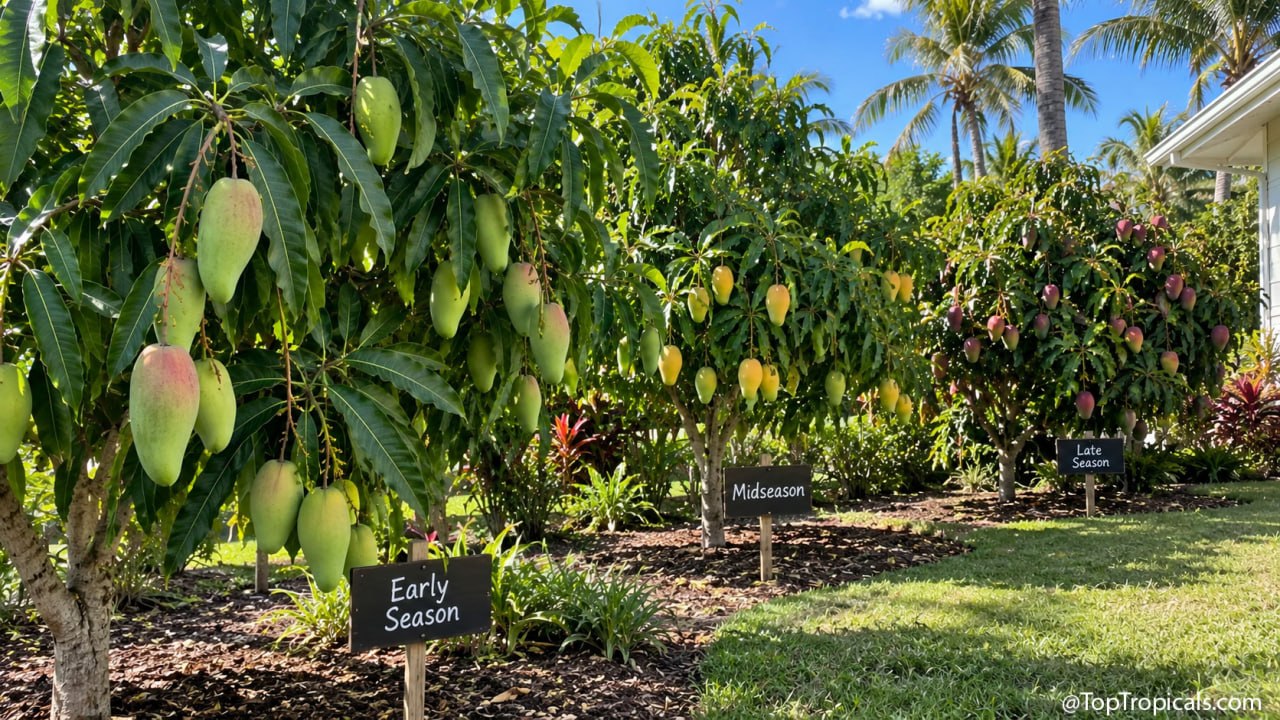
🥭 Early, Midseason & Late Mangoes: How to Get Fruit for Months
One of the smartest things you can do when planting several mango trees is not have them all ripen at once.
Mango varieties fruit at different times. Some are early, some hit right in the middle of mango season, and others keep producing when most trees are already finished.
🥭 Early-season mangoes
These are the ones that get mango season started. After months of waiting, they're especially appreciated because they're the first fresh mangoes coming off the trees.
📅 In Florida: Early-season mangoes generally ripen May through June.
👉 Examples: Rosigold, Dwarf Hawaiian, and Glenn.
🥭 Midseason mangoes
This is the main event. Many popular varieties ripen during the middle of the season, and this is usually when mango harvest is at its peak.
📅 In Florida: Midseason generally means June through July, the heart of Florida mango season.
👉 Examples: Carrie, Lemon Zest, and Sweet Tart.
🥭 Late-season mangoes
Late mangoes are particularly valuable in a home collection because they extend the fun. While earlier trees are already done, these varieties can still be carrying fruit.
📅 In Florida: Late-season mangoes generally ripen August through September, with some varieties hanging on especially late.
👉Examples: Keitt, Honey Kiss, and Neelam.
✅ The smart way to plan a mango collection
If you have room for several trees, don't choose them only by flavor.
Plant an early variety, a few midseason varieties, and at least one late variety. Instead of getting buried under mangoes for a few weeks, you can potentially enjoy fresh fruit over a much longer stretch of summer.
💡Remember, these aren't fixed calendar dates. Weather, location, bloom time, and the individual growing season can shift harvest timing, and there is plenty of overlap between the groups. That's actually part of the fun. With the right mix of varieties, when one mango tree finishes, another one may just be getting started.
🛒 Shop mango varieties
📚 Learn more:
Mango Tree - Mangifera indica - in Plant Encyclopedia
33 winter-proof mid-season mango varieties in 90-sec tour
6 Best-Tasting Mango Varieties
6 Best Thai and Southeast Asian Mango Varieties
5 Best Indian Mango Varieties and Their Flavors
5 Best Dwarf Mango Trees for Small Yards
5 Best Mango Trees for Beginners
Top 10 Dwarf "Condo" Mango, great for container culture
Top 5 recommended vigorous Mango tree varieties, reliable producers
Top 5 Favorite Mango we just love
10 steps how to grow a mango tree
#Mango_Rainbow - varieties you should try
#Food_Forest #How_to #Discover #Mango


Date: 4 Oct 2026
Daily Dose of Cat: The Mysterious Disappearing
🐾 Daily Dose of Cat: The Mysterious Disappearing
Jacques is hiding.
Very successfully, according to Jacques.
Unfortunately, Jacques forgot about his tail...
- 🐾 Every cat owner knows this phenomenon.
You search the whole house. Closets. Under beds. Behind the couch. Inside boxes. You call. Shake the treat bag. Search again. Eventually you become convinced the cat somehow escaped and is now three counties away.
Then suddenly...
He appears from nowhere, stretching and yawning.
And you still have absolutely no idea where he was. - 🐾 Cats take hiding seriously.
A small, enclosed place isn't just somewhere to nap. Cats evolved as both hunters and potential prey, so having a place where nobody can see - or bother - them feels safe.
That's why every cat should have at least one secret headquarters: a box, covered bed, closet shelf, under-the-bed bunker... wherever he chooses.
And here's the rule humans sometimes get wrong: - 🐾 If it's his safe place, leave him alone.
Don't reach in for a cuddle. Don't drag him out because you found him. Unless there's a safety reason, let that spot remain his.
⚠️ One exception: a cat who suddenly starts hiding much more than usual, especially with poor appetite or other behavior changes, may not be feeling well.
Otherwise - pretend you see nothing. Especially the tail.
You don't find the cat. The cat decides when the search is over.
🐈📸 TopTropicals rescued cat Jacques, expertly hidden at PeopleCats.Garden.
🐈 Stay with us for your #DailyDoseOfCat!
#DailyCatLesson #PeopleCats
🟢 Join 👉 TopTropicals
Date: 4 Oct 2026
From seed to flowers in eight months: Deinbollia - the Lychee relative from Africa
🍊 From seed to flowers in eight months: Deinbollia - the Lychee relative from Africa
Some fruit trees make you wait five years. Or ten.
Dune Soapberry (Deinbollia oblongifolia) apparently didn't get that memo.
We originally grew ours from seeds brought from Africa. From the beginning, they were unusually easy plants - fast growing, always happy, and flowering and setting fruit ridiculously young.
But this year they really surprised us!
🍊 Fruit During the Freeze
During the severe Florida freeze of February 2026, our established Dune Soapberries received only minimal protection under frost cloth.
While many tropical plants around them were struggling, these little trees were loaded with fruit.
We planted some of those seeds in February.
Now it's October.
Those seedlings are still sitting in 4-inch pots - and they're already covered with big flower clusters! Eight months from seed to flowers!
Apparently, waiting isn't their thing.
🍊 A Miniature Lychee Cousin
Dune Soapberry belongs to the Sapindaceae family, along with Lychee, Longan and Rambutan.
Its pale yellow fruits are small and have a large seed, so don't expect Lychee-sized mouthfuls. But what pulp is there is surprisingly good: sweet, aromatic and fruity. To us, it tastes like a miniature version of Lychee or Longan.
The flowers are another bonus. Creamy-white blooms appear in large terminal clusters - sometimes up to about 14 inches long - and attract bees, butterflies and other pollinators.
🍊 Built for Tough Conditions
The name Dune Soapberry gives away part of its story.
Native to southeastern Africa, it naturally grows in coastal dune forest and other sandy habitats.
That helps explain why it is such an easy plant in cultivation.
Deinbollia tolerates relatively poor, sandy soils, becomes drought tolerant once established, and handles some cold surprisingly well. South African horticultural references even recommend it for regions receiving light frost.
Its compact shrub-to-small-tree habit also makes it an excellent container fruit tree - especially unusual for something that can start producing so young.
🍊 And Yes, the "Soap" Is Real
The seeds contain natural compounds called saponins. When rubbed or shaken in water, they can produce a soapy lather and have traditionally been used as a soap substitute.
So this odd little African tree gives you flowers, pollinators, edible fruit - and soap seeds.
Not bad for something that can start doing all this before its first birthday.
🌱 Our current 1-gallon plants are well established and already at fruiting age! 🍊
🛒 Get your Dune Soapberry - no patience required!
📚 Learn more:
• Deinbollia oblongifolia in Plant Encyclopedia
• What is better - Lychee or Longan?
#Food_Forest #Fun_Facts #Discover
Date: 3 Oct 2026
The pretty pink vine with a Popcorn secret
💞 The pretty pink vine with a Popcorn secret
Antigonon leptopus, Mexican Coral Vine, looks almost ridiculously delicate - cascades of bright pink flowers, heart-shaped blooms, heart-shaped leaves, and bees buzzing all over it. Meanwhile, underground, it’s building a survival system. There is more under this vine than you think!
💞 Pretty above. Tough below.
Coral Vine develops a strong underground rootstock with tuberous roots. A hard freeze may knock the vine all the way to the ground, but don't assume it's gone. Those roots can survive and send up vigorous new growth when warm weather returns.
And vigorous really means vigorous. Give it sun and something to climb, and it can cover a fence, arbor or trellis with green foliage and masses of pink flowers in a single growing season.
💞 Listen to that buzzing
Those flowers aren't just decoration. Coral Vine produces plenty of nectar and attracts bees, butterflies and other pollinators 🐝
One Florida bee-botany reference even notes that large stands can provide enough nectar for a honey surplus - and describes the resulting honey as “dark colored honey.”
- Beekeeping: Florida Bee Botany
So that cloud of pink can actually become a serious bee restaurant!
💞 And now for the Popcorn secret
Here's the part we certainly didn't expect🍿
Ethnobiology of Baja California describes Coral Vine seeds being collected and stored, then toasted with hot coals, winnowed and ground for food.
The French National Museum of Natural History adds another curious detail, describing the seeds as traditionally prepared: in the same way as popcorn.
The underground tubers also have a history of being eaten as a vegetable.
This isn't a suggestion to raid your garden for dinner - just a fascinating piece of this plant's ethnobotanical history.
💞 Chain of Love
And take a closer look at those flowers. They're not perfect Valentine's hearts, but - kinda heart-shaped.
Add the unmistakably heart-shaped leaves and long cascading chains of pink, and some of its romantic common names suddenly make sense: Chain of Love, Hearts on a Chain, Love Vine and Queen's Wreath.
Delicate flowers above. A tough survival system below. Bees everywhere. An unexpected food history.
There's a lot more to this pretty pink vine than meets the eye.
🛒 Cover that fence - with Chain of Love
📚 Learn more:


• Antigonon leptopus in Plant Encyclopedia
• 5 Showy Vines to Plant This Fall for a Colorful Florida Winter
• Top 20 plants for a Butterfly Haven
• Top irresistible vines for a hummingbird haven: Part 1 • Part 2
#Hedges_with_benefits #Discover #Fun_Facts
🟢 Join 👉 TopTropicals