Date: 19 Dec 2025
Garden Blog - Top Tropicals
Date: 19 Dec 2025
Ten best shrubs for winter colors
💐 Ten best shrubs for winter colors
🛒 Explore Winter bloomers
#Hedges_with_benefits #Discover
🟢 Join 👉 TopTropicals
🛒 Explore Winter bloomers
#Hedges_with_benefits #Discover
🟢 Join 👉 TopTropicals
Date: 19 Dec 2025
13 festive shrubs with bright flowers that bring color to your Winter Garden when everything else is dormant
💐 13 festive shrubs with bright flowers that bring color to your Winter Garden when everything else is dormant
Southern Living points to colorful berries as winter garden standbys. Tropical plants take it a step further, filling the cool season with real flowers, not just fruit. From vivid reds to electric blues, these plants prove winter does not have to be dull.
👉 Learn more
👉 Learn more
👉 Learn more
👉 Learn more
👉 Learn more
👉 Learn more
👉 Learn more
👉 Learn more
👉 Learn more
👉 Learn more
👉 Learn more
👉 Learn more
🌈 13. Bauhinia trees - pink butterfly and Hong Kong orchid trees
Butterfly-shaped blooms open on leafless branches, giving bauhinias their signature winter elegance. The Hong Kong orchid tree stands out with especially large, vivid flowers.
🛒 Explore Winter bloomers
📚 Learn more:
#Hedges_with_benefits #Discover
🟢 Join 👉 TopTropicals
Southern Living points to colorful berries as winter garden standbys. Tropical plants take it a step further, filling the cool season with real flowers, not just fruit. From vivid reds to electric blues, these plants prove winter does not have to be dull.
🌈 1. Gloxinia sylvatica - Bolivian Sunset
This plant waits for cool weather, then suddenly lights up the shade with fire-red blooms. Flowers appear almost overnight and continue through fall and winter. It rests in summer, returns in fall, spreads gently, and makes an easy, festive ground cover that is perfect for sharing.
👉 Learn more
🌈 2. Pereskia aculeata - Barbados gooseberry
An unusual vine that surprises in cool weather with delicate, star-shaped blooms followed by tasty fruit. It flowers steadily from fall through winter, adding light, airy color to fences and trellises when most vines are quiet.
👉 Learn more
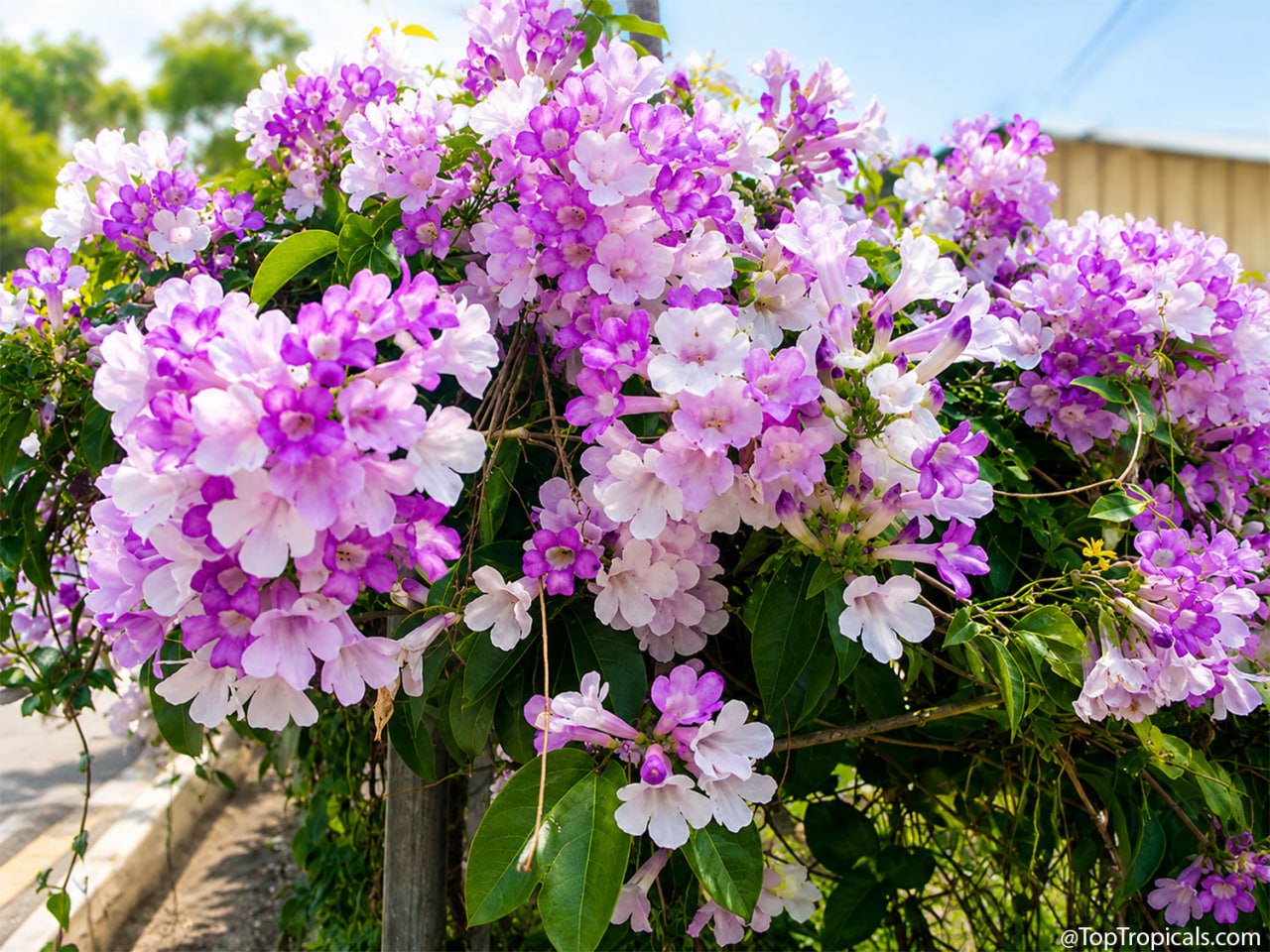
🌈 3. Mansoa alliacea - garlic vine
Best known for its garlicky scent, this vine really shines in winter. Cooler temperatures bring clusters of lavender-purple flowers that brighten fences and trellises with very little effort.
👉 Learn more
🌈 4. Dombeya wallichii - tropical hydrangea
Large pink pompom blooms hang from bare branches in winter, creating a true holiday look. Lightly fragrant and impossible to miss, it brings hydrangea-style drama to the cool season.
👉 Learn more
🌈 5. Brunfelsia pauciflora Compacta - dwarf yesterday-today-tomorrow
Compact and cheerful, this shrub opens purple flowers that fade to lavender and white. The color shift makes it look like several plants blooming at once, perfect for pots or small garden spaces.
👉 Learn more
🌈 6. Clerodendrums
Long, cascading sprays of white flowers of Clerodendrum minahassae - fountain clerodendrum - spill from the plant during the cooler months. It brightens shaded areas and adds movement when the garden slows down. Most clerodendrums bloom through Winter!
👉 Learn more
🌈 7. Tibouchina multiflora - glory bush
Soft, fuzzy purple blooms cover this shrub in winter, backed by velvety leaves that look good year-round. It adds strong color and texture during the cool season.
👉 Learn more
🌈 8. Holmskioldia sanguinea - Chinese hat
Bright red, orange or yellow, hat-shaped bracts surround small flowers and hold their color through the cool months. The shape alone makes this shrub a standout in winter.
👉 Learn more
🌈 9. Barleria cristata - Philippine violet
This tough shrub blooms heavily in winter with rich purple flowers. It delivers dependable color when many plants take a break. There is a golden variety too!
👉 Learn more
🌈 10. Eranthemum pulchellum - blue sage, lead flower
Few plants offer true blue in winter. Electric-blue flower spikes appear in cool weather, adding rare color with minimal care.
👉 Learn more
🌈 11. Petrea volubilis - queen's wreath
In winter, this woody vine erupts into cascading sprays of lavender star-shaped flowers. It creates a wisteria-like effect right when the garden needs it most.
👉 Learn more
🌈 12. Tabebuia varieties - dwarf golden and dwarf pink
These trees save their show for winter, blooming on bare branches. Golden forms glow yellow, while pink varieties cover themselves in soft trumpet-shaped flowers.
👉 Learn more
🌈 13. Bauhinia trees - pink butterfly and Hong Kong orchid trees
Butterfly-shaped blooms open on leafless branches, giving bauhinias their signature winter elegance. The Hong Kong orchid tree stands out with especially large, vivid flowers.
🛒 Explore Winter bloomers
📚 Learn more:
- ▫️8 best flowering trees that will bloom for you in Winter
- ▫️Ten shrubs you need to have for winter colors
- ▫️Cassia vs Bauhinia: which is better as an everblooming container tree?
#Hedges_with_benefits #Discover
🟢 Join 👉 TopTropicals
Date: 15 Dec 2025
9 tropical vegetables to grow indoors, or how to have garden-fresh produce all year
🌱 9 tropical vegetables to grow indoors, or how to have garden-fresh produce all year
Cold weather does not have to mean the end of homegrown food. According to Southern Living, vegetables like lettuce, carrots, and radishes can be grown indoors during winter. The downside is that most of these are annuals - you harvest once, then start over.
Tropical vegetables work differently. Many are perennial, long-living plants that grow well in containers and keep producing for years. Grow them indoors year-round, move them outside in summer for extra sun and growth, then bring them back indoors before cold weather. With enough light and regular care, these plants can provide fresh harvests in every season.
✅ Tropical vegetables to grow indoors
Tropical vegetables make indoor gardening more rewarding because they do not stop after one harvest. With containers, light, and basic care, these plants can become long-term food producers that move seamlessly between indoors and outdoors - keeping fresh flavors within reach all year.
🛒 Explore tropical edibles, herbs and spices
📚 Learn more:
🎥 Karkade Tea
Longevity Spinach
#Food_Forest #Remedies #Container_Garden #How_to #Discover
🟢 Join 👉 TopTropicals
Cold weather does not have to mean the end of homegrown food. According to Southern Living, vegetables like lettuce, carrots, and radishes can be grown indoors during winter. The downside is that most of these are annuals - you harvest once, then start over.
Tropical vegetables work differently. Many are perennial, long-living plants that grow well in containers and keep producing for years. Grow them indoors year-round, move them outside in summer for extra sun and growth, then bring them back indoors before cold weather. With enough light and regular care, these plants can provide fresh harvests in every season.
- ✅ Tips for growing tropical vegetables indoors
- 📍Place plants near a bright window or supplement with grow lights for steady growth
- 📍Use containers with good drainage and quality potting mix
- 📍Keep plants away from cold drafts and heating vents
- 📍Rotate pots and prune regularly to encourage fresh, tender growth
- 📍Feed regularly with natural Sunshine Boosters - they are formulated for edibles
✅ Tropical vegetables to grow indoors
- 🌿 Gynura procubens - Longevity Spinach, Cholesterol spinach - a fast-growing leafy green often called a superfood. The tender leaves are used fresh or lightly cooked and can be harvested repeatedly. This plant stays compact, handles containers easily, and regrows quickly after cutting.
- 🌿 Sauropus androgynus - Katuk, Tropical Asparagus. One of Southeast Asia’s most popular leafy vegetables. Katuk produces edible shoots and leaves that are cooked in soups and stews. It grows well indoors and rewards regular harvesting with constant new growth.
- 🌿 Cymbopogon citratus - Lemon grass: a tough, productive plant that adapts well to container growing. The stalks and leaves are used for teas, soups, and flavoring. Indoors, it grows more slowly but stays productive, especially when moved outdoors in summer.
- 🌿 Lippia dulcis - Aztec Sweet Herb, Sweetleaf: a low-growing herb with naturally sweet leaves. The foliage can be eaten fresh or used as a sugar substitute in teas and desserts. It stays compact, tolerates pruning, and performs well in pots indoors.
- 🌿 Piper sarmentosum - Vietnamese Pepper, Lalot: grown for its aromatic, edible leaves rather than peppercorns. The leaves are eaten fresh, cooked, or used as food wraps. This plant stays manageable indoors with light pruning.
- 🌿 Piper nigrum - Black Pepper: the true black pepper vine. Grows well indoors as a container vine with support. It prefers warm temperatures, steady moisture, and bright filtered light.
- 🌿 Piper auritum - Root Beer Plant, False Kava-Kava: close relative of Piper methysticum (Kava-Kava) known for its large, fragrant leaves with a spicy, root beer-like aroma. The leaves are used for wrapping foods and flavoring dishes. Best grown indoors with room for its bold foliage.
- 🌿 Piper betle - Betel leaf: a traditional edible and medicinal leaf used widely in Asia. The glossy leaves are harvested continuously and used fresh or as wraps. This vine grows well indoors with warmth, humidity, and a small trellis.
- 🌿 Piper longum - Indian Long Pepper, Pippali, Bengal Pepper: A tropical pepper relative grown for its elongated spice fruits and edible leaves. Slower to fruit indoors but easy to maintain as a leafy spice plant in containers with bright light and regular feeding.
Tropical vegetables make indoor gardening more rewarding because they do not stop after one harvest. With containers, light, and basic care, these plants can become long-term food producers that move seamlessly between indoors and outdoors - keeping fresh flavors within reach all year.
🛒 Explore tropical edibles, herbs and spices
📚 Learn more:
🎥 Karkade Tea
Longevity Spinach
#Food_Forest #Remedies #Container_Garden #How_to #Discover
🟢 Join 👉 TopTropicals
Date: 7 Dec 2025
Whats for breakfast? Guava versus Banana
Smokey: Guava for fiber, banana for power. Pick wisely. Sunshine: I pick whatever requires zero effort. Smokey: So... guava in a hammock. Perfect.
🍉🍌 What's for breakfast? Guava versus Banana
Some mornings you want something light. Some mornings you want something that hits like a tiny energy bomb. That’s why people always compare guava and banana. Both are everywhere, easy to eat, and trusted since forever - from Ayurveda scrolls to modern nutrition charts.
But they’re not the same kind of morning fruit. Let’s walk through them like we’re in the kitchen deciding what to slice first.
📊 What studies say - quick notes
🔮 What Ayurveda says
🏆 Guava or banana - which one wins?
Both win, just in different ways:
· light, high-fiber start
· instant energy
🍌 Busy mornings belong to banana.
For home growers
If you live in a warm climate, both fruits are incredibly rewarding to grow.
🍉 Why grow guava?
🍌 Why grow banana?
✍️ Scientific reference
🛒 Grow your perfect breakfast for any day - Guava and Banana
📚 Learn more:
📱 Watch YouTube short videos:
#Food_Forest #Bananas #Guava #Remedies #Discover
🟢 Join 👉 TopTropicals
Some mornings you want something light. Some mornings you want something that hits like a tiny energy bomb. That’s why people always compare guava and banana. Both are everywhere, easy to eat, and trusted since forever - from Ayurveda scrolls to modern nutrition charts.
But they’re not the same kind of morning fruit. Let’s walk through them like we’re in the kitchen deciding what to slice first.
- 🍉 Guava - the fiber champion
Guava looks innocent, but it’s one of the most nutrient-dense fruits.
Per 100 g: 68 calories, 5.4 g fiber, over 200 mg vitamin C, a little protein, and solid potassium.
Fiber does most of the work. It smooths digestion, keeps you full, and steadies blood sugar. Vitamin C boosts immunity, and antioxidants reduce inflammation. Studies suggest guava lowers LDL and triglycerides. Not bad for a tennis-ball-size fruit.
- 🍌 Banana - the quick energy classic
Bananas are the opposite personality: soft, sweet, ready in seconds.
Per 100 g: 89 calories, 22 g carbs, good potassium, and a little vitamin B6.
Bananas give fast energy without upsetting the stomach. Athletes eat them before workouts because carbs, sugars, and potassium wake up your muscles. Vitamin B6 helps mood and brain function, which is why a banana on a groggy morning works wonders.
They also pack antioxidants, polyphenols, and heart-protective compounds. Even the peel has nutrients (though not exactly breakfast-friendly).
📊 What studies say - quick notes
- · Guava: anti-inflammatory, anti-hypertensive, anti-obesity, antioxidant, antidiabetic, antidiarrheal, boosts hemoglobin, supports dental health.
- · Banana: antioxidants, fiber, vitamins C and E, carotenoids, flavonoids, and heart-protective compounds.
🔮 What Ayurveda says
- · Guava calms Pitta and Kapha - great for acidity or sluggish digestion.
- · Bananas balance Vata - grounding and nourishing - but can raise Kapha at night. Morning banana = good. Night banana = maybe skip.
🏆 Guava or banana - which one wins?
Both win, just in different ways:
- 🍉 Pick guava for:
· light, high-fiber start
- · better digestion
- · steady energy
- · low calories
- · weight control
- 🍌 Pick banana for:
· instant energy
- · easy digestion
- · pre-workout boost
- · quick carbs
- · soft, comforting fruit
- 🍉 Slow mornings love guava.
🍌 Busy mornings belong to banana.
For home growers
If you live in a warm climate, both fruits are incredibly rewarding to grow.
🍉 Why grow guava?
- · Fruits in 1-2 years.
- · Compact for small yards or containers.
- · Super productive when mature.
- · Needs only sun, warmth, and pruning.
- · Homegrown flavor is sweeter and more aromatic.
🍌 Why grow banana?
- · Grows fast and looks lush.
- · One mat can feed a whole household.
- · Dwarf varieties fit small gardens.
- · Homegrown bananas taste richer and creamier.
- · When a bunch ripens, breakfast is handled for a week.
Growing your own fruit means you’re never out of a healthy breakfast. Something is always ripening, always ready to pick, and always sweeter than anything you buy.
✍️ Scientific reference
- · USDA National Nutrient Database: Banana, raw. Guava, raw.
- · Journal of Food Biochemistry: Antioxidant and anti-atherosclerotic potential of Banana.
- · International Journal of Pharmaceutical Sciences Review and Research: Guava (Psidium guajava). A brief overview of its therapeutic and health potential
- · International Journal of Innovative Research in Engineering & Management: An analysis of health benefits of guava.
🛒 Grow your perfect breakfast for any day - Guava and Banana
📚 Learn more:
- 🟡More posts about #Bananas and #Guava
- 🟡From Plant Encyclopedia: Banana and Guava plants
- 🟡Guava beats banana in the potassium game
📱 Watch YouTube short videos:
- ✦ ' target="_blank" rel="noopener noreferrer">Six guava varieties that will keep you picking year-round.
- ✦ ' target="_blank" rel="noopener noreferrer"> Why every garden needs a Banana tree
#Food_Forest #Bananas #Guava #Remedies #Discover
🟢 Join 👉 TopTropicals
Date: 1 Dec 2025
What happens when you eat it every day: a bowl of Papaya for breakfast
🍲 What happens when you eat it every day: a bowl of Papaya for breakfast
A ripe papaya from your own garden isn’t just a sweet breakfast bowl. It’s a daily boost for digestion, immunity, skin, heart, and metabolic health. Growing papaya means you have a year-round supply of one of nature’s most complete morning foods - fresh, clean, and packed with bioactive compounds your body immediately puts to use.
✍️ Scientific reference
National Library of Medicine:
🛒 Grow your own medicine - Papaya
📚 Learn more:
📱 Watch YouTube short videos:
#Food_Forest #Papaya #Remedies #Discover
🟢 Join 👉 TopTropicals
- 🍊 If you grow your own papayas or just enjoy picking one from your food forest in the morning, a small bowl (about 140-150 g) can quietly transform your day - and your long-term health. This tropical fruit is naturally low in calories, high in fiber, and loaded with vitamins A and C, making it a perfect morning starter for metabolism, digestion, and immunity.
- 🍊 Why papaya works so well in the morning
- 🍊 Daily benefits at a glance
Papaya is famous for its natural enzyme, papain. It kick-starts digestion, eases bloating, helps break down proteins, and supports regular bowel movements. Ayurveda has praised ripe papaya for centuries as a cooling, Pitta- and Kapha-balancing fruit that clears toxins and improves gut function. Modern nutrition agrees: a fiber-rich, enzyme-rich fruit first thing in the day steadies appetite and helps prevent mid-morning cravings.
- ▫️ Weight support: Low calorie, high fiber, and keeps you full longer.
- ▫️ Heart and blood pressure: Rich in potassium, vitamins, and antioxidants that support healthy cholesterol, smooth blood flow, and normal blood pressure.
- ▫️ Liver support: Antioxidants, choline, and beta-carotene help reduce inflammation, regulate fats, and protect liver cells from oxidative stress.
- ▫️ Skin health: Papain and vitamin C help remove damaged cells, improve collagen formation, and support a clearer, smoother complexion.
- ▫️ Immunity: One medium papaya gives more than double the daily vitamin C requirement and helps stimulate white blood cells while protecting them from oxidative stress.
- ▫️ Constipation relief: Papaya’s fiber and enzymes gently improve regularity and support a clean, efficient gut.
- 🍊 What research shows
- 🍊 For home growers
According to the National Library of Medicine, papaya pulp and seeds contain vitamins A, C, and E; B vitamins; potassium; magnesium; carotenoids; glucosinolates; and unique phenolic compounds. Together, these show antioxidant, anti-inflammatory, hypoglycemic, and hypolipidemic actions. Studies link papaya extracts to reduced cholesterol and triglycerides, improved blood pressure regulation (ACE-inhibitory effects), and protection against oxidative stress.
Papaya seeds also demonstrate promising anti-cancer potential, including activity against colon, prostate, and liver cancer cells. Lycopene and other carotenoids further reduce oxidative damage linked to chronic diseases.
A ripe papaya from your own garden isn’t just a sweet breakfast bowl. It’s a daily boost for digestion, immunity, skin, heart, and metabolic health. Growing papaya means you have a year-round supply of one of nature’s most complete morning foods - fresh, clean, and packed with bioactive compounds your body immediately puts to use.
✍️ Scientific reference
National Library of Medicine:
- · Nutritional and bioactive profile of Carica papaya and its potential benefits for metabolic and inflammatory disorders.
- · Anticancer potential of Carica papaya Linn black seed extract against human colon cancer cell line: in vitro study.
🛒 Grow your own medicine - Papaya
📚 Learn more:
- 🟡more posts about #Papaya
- 🟡Papaya tree - Carica papaya - in Plant Encyclopedia
- 🟡Which fruit helps you lose weight faster: Mango or Papaya?
- 🟡Ten best fruit trees to grow in Florida and Southern landscapes. Papaya Tree.
- 🟡Carefree Garden: How Easy Is It to Grow a Papaya Tree?
- 🟡The truth about Papaya
- 🟡Top 10 fruit you'll ever need for your health benefits. Papaya.
📱 Watch YouTube short videos:
#Food_Forest #Papaya #Remedies #Discover
🟢 Join 👉 TopTropicals
Date: 24 Nov 2025
One fruit on this tray always stumps people
Tropical fruit on a tray
One fruit on this tray always stumps people
🛒 Explore rare tropical fruit
📚 Learn more:
#Food_Forest #Discover
🟢 Join 👉 TopTropicals
- 🍉 Another day, another fruit tray from the garden! Even at the end of November, something is always ripening here in Florida. This tray turned out especially fun - a mix of familiar fruits and a couple that always make people guess twice!
- 🍉 Today’s harvest includes: sweet Persimmons, Star fruit, a few different dragon fruits: yellow Palora and white with red skin - this is Seoul Kitchen. There's also Cocoplum, which makes great drinks. And - ta-da! - the little showstopper of the day: Curly Locks Orchid Cactus fruit (Epiphyllum guatemalense Monstrosa). It looks wild, but it's edible and tastes like a tiny dragon fruit.
- 🍉 If you live in Florida or any warm climate, growing your own fruit is one of the best gifts you can give yourself. Tropical fruit trees are generous plants - they don’t wait for a season, they give you something month after month. Some days it’s a handful, some days it’s a whole tray, but there’s always a fresh treat waiting. Once you start growing your own food, you realize how easy and rewarding it is to fill your garden with flavor.
- 🍉 Every tray has a new surprise. Come along and see what the garden gives us next!
🛒 Explore rare tropical fruit
📚 Learn more:
- ▫️Can you name all the fruits on this tray?
- ▫️Weird cactus looks like pasta with Dragon Fruit
- ▫️Cocoplum: secret fruit in your hedge
- ▫️Pitaya vs Dragon fruit - what is the difference and how to grow it?
- ▫️How soon will Persimmon tree fruit?
- ▫️10 best fruit trees to grow in Florida and Southern landscapes
- ▫️Top 10 fast-fruiting trees
#Food_Forest #Discover
🟢 Join 👉 TopTropicals
Date: 22 Nov 2025
Stop buying macadamias - plant this tree to enjoy your own nuts
Macadamia tree (Macadamia integrifolia)
🌰 Stop buying macadamias - plant this tree to enjoy your own nuts!
💖 Macadamia nut health benefits
🛒 Grow your own Macadamia Nuts
📚 Learn more:
📱 Video about growing Macadamia trees
#Food_Forest #Remedies #How_to #Discover
🟢 Join 👉 TopTropicals
- 🐿 How to grow a Macadamia tree and enjoy your own nuts - the priciest nuts in the world? Macadamia trees (Macadamia integrifolia) are surprisingly easy to grow once you know what they need. They handle a wide range of soils, prefer regular watering, and adapt well to warm, humid climates. Young trees appreciate consistent moisture, but once established, they can tolerate short dry spells and even brief flooding.
- 🐿 The most important step is nutrition. Macadamias are heavy feeders and rely on balanced microelements for strong roots, steady growth, and reliable nut production. Use a liquid fertilizer Sunshine C-Cibus and add microelements on a regular schedule. Sunshine SuperFood plant supplement is especially helpful for preventing the leaf yellowing and slow growth that happen when microelements run low.
- 🐿 Choose a sunny spot, give the tree room to grow, and mulch around the base to keep moisture steady. As the tree matures, it will bloom and form clusters of green husks that dry and split to reveal the sweet nuts inside.
- 🐿 With the right care, a single tree can reward you with a generous harvest of rich, expensive macadamias right from your garden.
💖 Macadamia nut health benefits
- 📍 Macadamia nuts are packed with healthy monounsaturated fats, antioxidants, vitamins, and minerals.
- 📍 They support heart health by lowering total and LDL cholesterol, help steady blood sugar thanks to low carbs and good fiber, and aid digestion and weight management by keeping you full longer.
- 📍 Their antioxidants, including tocotrienols, protect cells from damage and may reduce risks of diabetes, Alzheimer’s, and certain cancers.
- 📍 Macadamia oil is great for skin and hair, offering moisturizing, healing, and strengthening benefits.
- 📍 Even though they are calorie-rich, small daily portions can actually support healthy weight goals.
- 📍 Enjoy them raw, roasted, ground, as nut butter, or added to both sweet and savory dishes.
🛒 Grow your own Macadamia Nuts
📚 Learn more:
- ▫️Where do Macadamia nuts come from
- ▫️What are the flowers of Macadamia nuts
- ▫️Ten best fruit trees to grow in Florida and Southern landscapes. # 6: Macadamia Nut Tree.
- ▫️How to grow your own Sweet Macadamia Nuts
- ▫️ Macadamia: Hard Sweet Nut and Hardy Tree
📱 Video about growing Macadamia trees
#Food_Forest #Remedies #How_to #Discover
🟢 Join 👉 TopTropicals
Date: 19 Nov 2025
5 fruits that help manage gout (high uric acid)
🍒 5 fruits that help manage gout (high uric acid)
💥 High uric acid, hyperuricemia, also called gout, causes painful swelling in joints and can affect kidney health over time. Medicine helps, but so does what you grow and eat. Some fruits can naturally flush out excess uric acid and reduce inflammation. Here are five easy fruit trees and plants that can help:
🍋 Citrus
Citrus trees are great to grow in pots or sunny yards. Lemons and oranges are rich in vitamin C, which helps kidneys remove uric acid and keeps the body’s pH balanced. A glass of lemon water in the morning or a fresh orange during the day can help. Studies in Science Direct show lemon juice lowers uric acid levels in the blood.
Berries (mulberries, blackberries, blueberries, strawberries)
Berries are packed with antioxidants that fight inflammation and support kidney health. Mulberry trees are perennial trees and bushes that produce berries year after year. They grow well in both temperate and warm areas, and are an easy choice for all backyard gardeners. Mulberry high water content helps flush out toxins. Research from the National Institute of Health shows berries rich in polyphenols can lower uric acid naturally.
🍒 Cherries
Cherries are one of the best fruits for gout. They’re rich in anthocyanins, compounds that reduce inflammation and uric acid levels. National Institute of Health studies have found regular cherry intake helps lower gout attacks. Dwarf cherry trees can grow in large pots if space is limited.
🍌 Bananas
Bananas are rich in potassium, which helps the kidneys remove uric acid more efficiently, according to PubMed central. They’re also low in purines, the compounds that form uric acid. Dwarf banana varieties grow well in containers and add a tropical look while supporting healthy digestion and uric acid balance.
🍍Pineapple
Pineapple contains bromelain, a natural enzyme that eases swelling and pain caused by gout. It’s also refreshing and supports kidney function. Studies by global health science group show pineapple juice can help reduce inflammation and uric acid. It’s easy to grow in a pot or sunny garden bed.
These fruits won’t replace medicine, but they can support your body’s natural detox system. Grow them, eat them fresh, and enjoy both their flavor and health benefits.
🛒 Explore Fruit trees and grow your own natural remedies
📚 Learn more:
#Food_Forest #Mango #Remedies #Discover
🟢 Join 👉 TopTropicals
💥 High uric acid, hyperuricemia, also called gout, causes painful swelling in joints and can affect kidney health over time. Medicine helps, but so does what you grow and eat. Some fruits can naturally flush out excess uric acid and reduce inflammation. Here are five easy fruit trees and plants that can help:
🍋 Citrus
Citrus trees are great to grow in pots or sunny yards. Lemons and oranges are rich in vitamin C, which helps kidneys remove uric acid and keeps the body’s pH balanced. A glass of lemon water in the morning or a fresh orange during the day can help. Studies in Science Direct show lemon juice lowers uric acid levels in the blood.
Berries (mulberries, blackberries, blueberries, strawberries)
Berries are packed with antioxidants that fight inflammation and support kidney health. Mulberry trees are perennial trees and bushes that produce berries year after year. They grow well in both temperate and warm areas, and are an easy choice for all backyard gardeners. Mulberry high water content helps flush out toxins. Research from the National Institute of Health shows berries rich in polyphenols can lower uric acid naturally.
🍒 Cherries
Cherries are one of the best fruits for gout. They’re rich in anthocyanins, compounds that reduce inflammation and uric acid levels. National Institute of Health studies have found regular cherry intake helps lower gout attacks. Dwarf cherry trees can grow in large pots if space is limited.
🍌 Bananas
Bananas are rich in potassium, which helps the kidneys remove uric acid more efficiently, according to PubMed central. They’re also low in purines, the compounds that form uric acid. Dwarf banana varieties grow well in containers and add a tropical look while supporting healthy digestion and uric acid balance.
🍍Pineapple
Pineapple contains bromelain, a natural enzyme that eases swelling and pain caused by gout. It’s also refreshing and supports kidney function. Studies by global health science group show pineapple juice can help reduce inflammation and uric acid. It’s easy to grow in a pot or sunny garden bed.
These fruits won’t replace medicine, but they can support your body’s natural detox system. Grow them, eat them fresh, and enjoy both their flavor and health benefits.
🛒 Explore Fruit trees and grow your own natural remedies
📚 Learn more:
- ▫️Grow your own brain food: avocado and cacao
- ▫️Plant a fruit tree - and breathe easier: fruit might be the surprising key to healthier lungs
- ▫️11 tropical fruits to eat instead of taking a fiber supplement
- ▫️Tropical fruit health benefits guide - what fruit and edibles can help with health issues and vitamin deficiencies, Part 1 and Part 2.
- ▫️Top 10 fruiting plants you'll ever need for your health benefits
#Food_Forest #Mango #Remedies #Discover
🟢 Join 👉 TopTropicals
Date: 13 Nov 2025
Mangos hidden power: the orange fruit that helps your immune system fight cancer
Mango's hidden power: the orange fruit that helps your immune system fight cancer
🛒 Select from Mango varieties
📚 Learn more:
#Food_Forest #Mango #Remedies #Discover
🟢 Join 👉 TopTropicals
🔸 A new study from the University of Chicago (Cell Reports Medicine) found that zeaxanthin - a carotenoid that gives mangoes their golden color - may do much more than support eye health. It can actually make your immune system stronger against cancer!
🔸 Researchers discovered that zeaxanthin boosts the performance of the body’s CD8+ T cells, the immune cells that hunt down and destroy tumor cells. In lab and animal tests, diets rich in zeaxanthin slowed tumor growth, and when paired with cancer immunotherapy, the results were even more impressive.
🔸 Zeaxanthin helps T cells form stronger receptor structures and increases their signaling and tumor-killing power. The compound occurs naturally in colorful foods like Mango, orange peppers, corn, cantaloupe, and dark leafy greens.
🔸 Because it’s already known to be safe and available as a dietary supplement, scientists see zeaxanthin as a promising addition to future cancer therapies. So, eating mangoes and other orange or yellow fruits may not only brighten your plate but also help your body’s natural defenses stay sharp: Pineapple, Carambola, Canistel, Garcinia, Loquat and more.
🛒 Select from Mango varieties
📚 Learn more:
- ▫️Grow your own brain food: avocado and cacao
- ▫️Plant a fruit tree - and breathe easier: fruit might be the surprising key to healthier lungs
- ▫️11 tropical fruits to eat instead of taking a fiber supplement
- ▫️Tropical fruit health benefits guide - what fruit and edibles can help with health issues and vitamin deficiencies, Part 1 and Part 2.
- ▫️Top 10 fruiting plants you'll ever need for your health benefits
#Food_Forest #Mango #Remedies #Discover
🟢 Join 👉 TopTropicals