Garden Blog - Top Tropicals
Date: 15 Oct 2026
A cactus that traded thorns for red ribbons: Rhipsalis ramulosa
🎀 A cactus that traded thorns for red ribbons: Rhipsalis ramulosa
No desert. No prickly spines. Just cascading ribbons of red!
Red Rhipsalis (Rhipsalis ramulosa) is a cactus that looks nothing like its desert relatives. Its long, flat stems arch and cascade like colorful ribbons, turning brilliant red in bright light. And that's only the beginning of its surprises.
🎀 A cactus that blushes in the sunshine
Those beautiful red ribbons aren't leaves. They're actually flattened stems!
In bright light, the plant produces protective red pigments called anthocyanins. The stronger the light, the deeper the color - from green to bronze, crimson, and violet-red.
But don't overdo it! In Florida, bright filtered light or gentle morning sun can produce gorgeous colors without scorching the stems.
💡The red pigmentation is a response to light, but it doesn't necessarily mean that the plant is healthier under stronger sunlight.
🎀 A cactus that lives in trees
Forget sandy deserts! Red Rhipsalis comes from tropical forests, where it grows as an epiphyte, attaching itself to tree trunks and branches.
It doesn't steal nutrients from its host. Instead, its roots anchor it to bark and absorb moisture and nutrients from rainwater and accumulated organic debris.
That's why it loves airy, fast-draining potting mixes, good humidity, and moderate watering. No soggy roots, please!
🎀 Tiny pearls along the ribbons
Look closely at the stem edges. Small, delicate flowers appear there, followed by translucent white berries that resemble tiny pearls.
Against the deep red stems, they're especially striking.
Unlike the large, spectacular flowers of some other jungle cacti, Red Rhipsalis puts on a quieter show - with decorative stems and miniature fruits.
🎀 A living waterfall of red
This is where Red Rhipsalis really shines!
Plant it in a hanging basket, and its branching stems gradually spill over the edges, creating a cascading curtain of color.
Or hang the basket high on a pole, as we show in our video. The long red ribbons create a spectacular tropical display.
You can also grow it mounted on wood or let it creep through a shaded tropical garden.
And unlike plants that depend on a short flowering season, its colorful stems can provide interest year-round.
🎀 A cactus with an identity crisis
Botanists have moved this cactus around quite a bit! Over the years, it has been classified as Cereus, Rhipsalis, Disocactus, and Pseudorhipsalis.
🔬Today, its accepted scientific name is Kimnachia ramulosa, honoring cactus expert Myron Kimnach.
- Kew's Plants of the World Online
But gardeners still know it best as Red Rhipsalis. Whatever the name, those red ribbons are unmistakable!
🎀 There's a whole jungle of cacti!
Red Rhipsalis isn't the only cactus that abandoned the desert lifestyle.
Its tropical relatives include spectacular Orchid Cacti, night-blooming Epiphyllums, the unusual Blue Flame Cactus, and the wonderfully twisted Zig-Zag and Curly Locks Cacti. Some grow for their incredible flowers. Others for their strange stems. All prove that cacti can be much more than spines and desert sand!
🛒 Bring home your own waterfall of red ribbons!
Collect epiphytic jungle cacti:
· Epiphyllum hookeri - Large-Fruiting Night-Blooming Cactus
· Epiphyllum oxypetalum - Queen of the Night
· Epiphyllum (Selenicereus) chrysocardium - Marniera
· Pseudorhipsalis (Wittia) amazonica - Blue Flame
· Epiphyllum guatemalense Monstrosa - Orchid Cactus, Curly Locks
· Disocactus ackermanni - Red Orchid Jungle Cactus
📚 Learn more:
• Rhipsalis ramulosa in Plant Encyclopedia
• Why Red Cactus is better than Christmas Cactus
• Rhipsalis x pilocarpa - the Hairy Stemmed Jungle Cactus
• Epiphyllum hookeri Giant Cactus Flower Only Opens While You Sleep
• Rare Night-Blooming Cactus that Glows and Grows Large Edible Fruit
• Moonlight Cactus, the Night Blooming Wonder with a mystical twist: Epiphyllum oxypetalum FAQ
• The Best potting mix for Jungle Cactus
#Container_Garden #Discover
🟢 Join 👉 TopTropicals
Date: 14 Oct 2026
Daily Cat Lesson: Cats vs Shadows
🐾 Daily Cat Lesson: Cats vs. Shadows: Who Will Win?
A shadow moves across the curtain.
You see - a shadow.
Your cat sees PREY.
Cats are extremely sensitive to movement. Their hunting instinct can be triggered by tiny, quick changes - a shadow, reflection, flickering light or something moving behind a curtain.
🐾 Does the cat know there's nothing there?
Not necessarily at first. Cats investigate with several senses. Something that moves like prey gets attention, but once there's no smell, sound or satisfying object to catch, many cats eventually lose interest.
🐾 Is chasing shadows good play/exercise?
Sure! It's mental and physical stimulation. But unlike a toy, a shadow can never actually be caught. If your cat gets intensely frustrated, finish the game with a real toy he can stalk, pounce on and finally capture.
Meanwhile, Pelmen has discovered something moving suspiciously on the curtain.
The household is safe. The Shadow Monster is being dealt with.
🐈📸 Pelmen the Sphynx cat - a friend of TopTropicals PeopleCats.Garden.
🐈 Stay with us for your #DailyDoseOfCat!
#DailyCatLesson #PeopleCats
🟢 Join 👉 TopTropicals
Date: 14 Oct 2026
Mango Traditions From Around the World
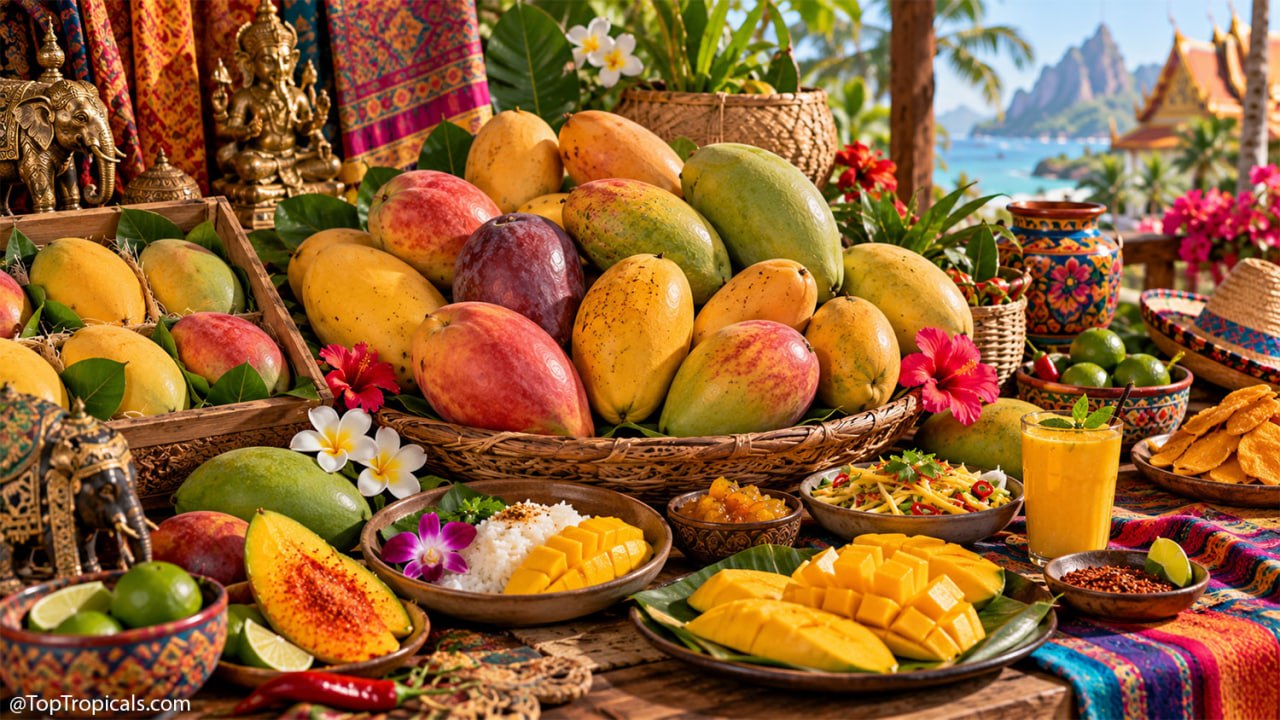
🌎 Mango Traditions From Around the World
Mango season is more than harvest time. Around the world, it means summer, family, favorite recipes, busy fruit markets, and boxes of mangoes shared with friends.
India may be the historic heart of mango culture, but from Thailand to Mexico, every region has its own traditions.
🥭 India: Mango Season Is an Event
In India, people don't simply buy mangoes. They wait for mango season.
Regions proudly claim their favorites: Alphonso, Kesar, Dashehari, Langra and Himsagar. Mangoes are eaten fresh, made into drinks, sweets, chutneys and pickles, and given to family and friends. Even green mangoes have their own traditions.
🥭 West Bengal: Mango Country
The region is famous for Himsagar, Fazli, Lakshmanbhog, Gopalbhog and Khirsapati.
Mango growing is part of local heritage, with orchards and varieties passed through generations. In season, markets fill with mangoes of different shapes, colors, aromas and flavors.
🥭 Thailand: Ripe, Green, Sweet and Savory
Ripe mango with coconut sticky rice may be Thailand's most famous mango dish. But firm green mangoes are equally at home in salads and savory snacks.
Nam Doc Mai is prized ripe and sweet, while Keo Savoy and Fralan are often eaten crunchy and green.
🥭 Philippines: Mangoes and Hospitality
In the Philippines, mangoes are eaten fresh, dried, blended into drinks and used in desserts. Good fruit is also served to visitors and shared at family gatherings.
🥭 Mexico: Mango With a Kick
Fresh mango is a favorite warm-weather street snack, often served with lime, chili and Tajín. It also appears in drinks, frozen treats and salsas.
Sweet mango, sour lime and hot chili may sound unusual until you try it.
🥭 Pakistan: The Gift of Mangoes
Summer means mango season in Pakistan. Mangoes are served after meals and at family gatherings, while beautiful boxes of premium fruit are popular gifts. Chaunsa and Sindhri have especially loyal fans.
🥭 Middle East: A Luxury Summer Fruit
Premium Indian and Pakistani mangoes are prized seasonal fruit in many Middle Eastern markets. Beautiful mango boxes are bought for family or brought as gifts, with varieties such as Alphonso, Kesar and Chaunsa especially sought after.
🥭 Australia: Celebrating the Harvest
In tropical Australia, local mangoes signal summer. Markets, festivals and community events celebrate the harvest, while mangoes appear in salads, desserts, chutneys, or simply eaten fresh.
🥭 One Fruit, Hundreds of Traditions
The same fruit can become Indian aamras, Thai mango sticky rice, Mexican mango with chili and lime, a Pakistani gift box, green mango salad, or simply a ripe mango eaten over the kitchen sink because it's too juicy for civilized dining.
Behind these traditions are hundreds of varieties preserved because each has something different worth keeping.
Growing an old or unusual mango isn't just about fruit. It keeps a little piece of mango history alive.
And, of course, you get to eat it.
🛒 Shop mango varieties
📚 Learn more:
Mango Tree - Mangifera indica - in Plant Encyclopedia
Best Mango Varieties for Florida: It is Not Just About Taste
Early, Midseason & Late Mangoes: How to Get Fruit for Months
6 Best-Tasting Mango Varieties
6 Best Thai and Southeast Asian Mango Varieties
5 Best Indian Mango Varieties and Their Flavors
5 Best Dwarf Mango Trees for Small Yards
5 Best Mango Trees for Beginners
Top 10 Dwarf "Condo" Mango, great for container culture
Top 5 recommended vigorous Mango tree varieties, reliable producers
Top 5 Favorite Mango we just love
10 steps how to grow a mango tree
#Mango_Rainbow - varieties you should try
#Food_Forest #How_to #Discover #Mango


Date: 13 Oct 2026
The surprise wasnt the flower - it was how this hibiscus grows: Fairy Dancer
🌺 The surprise wasn't the flower - it was how this hibiscus grows: Fairy Dancer
When Hibiscus 'Fairy Dancer' was first created, naturally everyone noticed the flowers. Those dangling red blooms, suspended on impossibly thin stems, were unlike anything we'd seen before.
But after growing Fairy Dancer for several years, we've discovered something else about Mark Hooten's unusual hybrid.
It seems to have taken the best growing traits from both parents.
🌺 Two very different parents
Fairy Dancer is a cross between Hibiscus grandidieri from Madagascar and the East African Coral Hibiscus, Hibiscus schizopetalus.
We grow both species, so we've had plenty of opportunity to compare them.
H. schizopetalus is vigorous and fast. But it loves making long, lanky shoots. Left to itself, it can become considerably more legs than bush.
H. grandidieri is almost the opposite. It has a naturally compact, branchy structure and beautiful little deeply lobed leaves. But in our experience, it's slower, more delicate and rather fussy about overwatering.
And then there's their offspring...
❗️Fairy Dancer grows fast AND branches!
🌺 Apparently, it chose wisely
Once established, Fairy Dancer takes off. It produces strong growth, branches readily and develops into a surprisingly full shrub.
It seems to have borrowed the vigor of H. schizopetalus without copying its lanky habit - and the bushiness and delicate foliage of H. grandidieri without inheriting its fussier personality.
Even the flowers landed somewhere beautifully in between, quite literally!
The tiny flowers of H. grandidieri measure about 1 inch across, while H. schizopetalus produces impressive 3-inch blooms.
Fairy Dancer settled right in the middle, at approximately 2 inches - twice the size of its Madagascan parent's flowers!
They retain the dangling, exotic character of H. schizopetalus, but have their own distinctive shape: bright red petals above an extraordinarily long staminal column that dances beneath the flower.
💡Hibiscus 'Fairy Dancer' is one of those cases where hybridization did much more than create a different bloom.
It created a better garden plant!
🌺 And now we can really see it
Our current Fairy Dancers have grown into big, full, beautifully branched plants.
We have excellent specimens in 3-gallon containers, with some already carrying buds and flowers.
So yes, we originally fell for Fairy Dancer because of those bizarre floating flowers.
But after actually growing it?
We may like the plant even more.
🛒 Get your Fairy Dancer – the best of both parents
📚 Learn more:


• Hibiscus grandidieri x schizopetalus in Plant Encyclopedia
• What happens when two rare hibiscus species meet: a flower unlike any other
• Skeleton Hibiscus with "crazy petals" - flower will blow your mind
• Many faces of hibiscus
• Much more than fancy flowers: discover the many faces of hibiscus
• How to get rid of pests on Hibiscus?
• How to make your Hibiscus plants thrive and bloom
#Fun_Facts #Hedges_with_benefits #Discover
🟢 Join 👉 TopTropicals
Date: 12 Oct 2026
When should I prune my Peach x Plum tree?

✂️ When should I prune my Peach x Plum tree?
Real questions from Top Tropicals customers - answered by Smokey and Sunshine.
Sunshine: Smokey, this tree is tall and skinny. What does it need?
Smokey: More sunshine. Sunlight, Sunshine. Not more of you. Pruning in late winter, repotting in spring.
Sunshine: And some coffee and donuts?
Smokey: Those are for the gardener, Sunshine. Not the tree.
❓ Q: My Peach x Plum tree is growing beautifully. When should I prune it, and which branches should I cut?
"I ordered two Peach x Plum trees from Top Tropicals in March.
Now she's growing tall and healthy. But I'm afraid of pruning the wrong branches. Could you please tell me exactly what to cut and when?
I also want to move her into a bigger pot next spring. And with nighttime temperatures already dropping to 51F here in North Carolina, should I use a grow light or heat lamp? I want my baby to thrive!"
✅ A: Smokey and Sunshine to the rescue!
First, let's talk about sunshine ☀️😸
Your tree looks healthy, but those long, thin branches and sparse foliage tell us something: it probably needs more sunlight.
Peaches and plums are sun lovers. Give them at least 6–8 hours of direct sunlight daily. More is even better.
A covered porch may actually make things worse if it blocks the sun.
✂️ When should you prune?
Not yet!
In North Carolina, late February or early March is generally a good time, while the tree is still dormant and the worst winter freezes are hopefully behind us.
But there's a little catch. Your Peach x Plum is a low-chill variety. A few warm February days may wake it up early.
Watch the buds and the weather, not just the calendar.
✂️ Which branches should you cut?
Here's Smokey and Sunshine's pruning plan:
1. Shorten the tall central shoot to encourage compact, bushy growth.
2. Cut the two longest side branches back by one-third, just above outward-facing buds.
3. Remove dead, damaged, or crossing branches.
4. Keep healthy side branches to gradually form an open, vase-shaped canopy.
Don't overdo it! A well-shaped tree takes time.
What about a bigger pot?
First, check the roots. If they're circling tightly around the inside of the container, it's time for more room.
Choose a pot about 2-4 inches wider than the current one, with generous drainage holes.
Use a loose, well-draining potting mix. Not heavy garden topsoil!
An oversized container isn't necessarily better. Too much wet soil around a small root system can cause trouble.
❄️ Do I need a heat lamp at 51F?
Absolutely not!
Peaches and plums are deciduous trees. They need a period of cool weather and winter dormancy.
Temperatures around 51F are perfectly fine. No heat lamp. No grow light. No tropical spa treatment!
Some yellowing and leaf drop are normal as winter approaches.
The main concern is prolonged freezing weather, especially for container-grown trees. Roots in pots are more exposed to cold than roots in the ground.
Move the container to a sheltered location or insulate it when serious freezes are expected.
🐾 Smokey and Sunshine's final verdict
More sunshine now. Pruning in late winter. A bigger pot when the roots need it.
And don't panic when the leaves fall. Your tree isn't dying. It's taking a winter vacation!
✍️ Have a question about a plant you purchased from Top Tropicals?
Send us a photo! Our gardening team - with Smokey and Sunshine supervision - is happy to help.
🛒 Shop Low Chill Peach Trees and Tropical Fruit Trees
📚 Learn more:


• Prunus persica in Plant Encyclopedia
• Full Sun Isn't Always Best for Peach Trees - Especially in Florida
• The One Peach Tree Every Florida Gardener Should Know About: Tropic Beauty
• What is the most rewarding hardy fruit tree suitable for hot climate
• Top Ten Fruit Tree Winners of Florida 2026 Record Freeze
• About Smokey & Sunshine
• Smokey & Sunshine interview
#Food_Forest #How_to #Discover #Smokey_Sunshine
🟢 Join 👉 TopTropicals