Garden Blog - Top Tropicals
Date: 12 Sep 2026
What Makes a Great Potting Mix Recipe? The Best Ingredients and Why They Matter
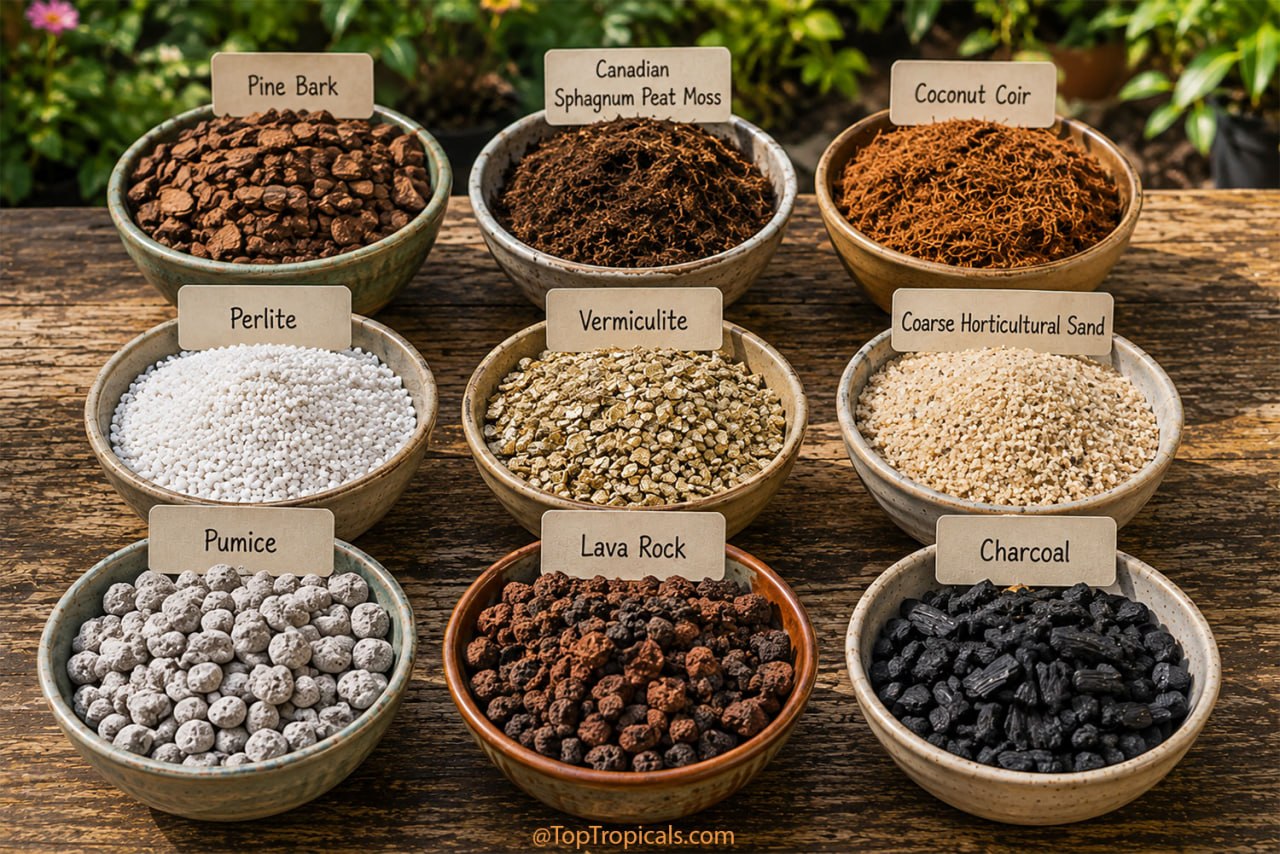
🍩 What Makes a Great Potting Mix Recipe? The Best Ingredients and Why They Matter
Walk into any garden center and you'll find dozens of bags labeled "potting soil."
Most look similar. They're not.
A professional potting mix isn't chosen because it's dark, rich, or cheap. Every ingredient has a specific purpose: creating healthy roots.
What makes a great potting mix?
A quality potting mix should:
✓ Drain quickly
✓ Hold enough moisture
✓ Contain plenty of air
✓ Stay loose for years
✓ Resist compaction
✓ Encourage healthy roots
✓ Be lightweight
✓ Be easy to re-wet
Remember: roots don't just absorb water - they breathe. Air is just as important as water.
Most tropical plants also prefer a slightly acidic potting mix (pH 5.5-6.5), which is one reason pine bark, Canadian peat moss, and coconut coir are widely used by professional growers.
The ingredients and what they do
Pine bark
The backbone of many professional mixes. Provides:
· structure
· drainage
· air pockets
· long-lasting texture
Excellent for tropical plants, fruit trees, orchids, and aroids.
Canadian peat moss
Provides:
· moisture retention
· light texture
· natural acidity
High-quality Canadian peat is preferred over heavier Florida peat (muck).
Coconut coir
One of our favorite ingredients. Provides:
· moisture retention
· aeration
· long-term structure
Advantages:
· re-wets easily
· stays evenly moist
· decomposes more slowly than peat
· excellent for seeds and rooting cuttings
· cleaner than ordinary soil
At Top Tropicals, we combine coconut coir with Canadian peat moss because each contributes something different to the mix.
Perlite
Expanded volcanic rock. Provides:
· drainage
· aeration
· permanent air spaces
Lightweight, sterile, and long-lasting.
Contrary to popular belief, perlite does not feed plants. Its job is to improve the physical structure of the potting mix.
Vermiculite
Best for:
· seedlings
· seed-starting mixes
· moisture-loving plants
· It holds more water than perlite, making it less useful in very airy tropical mixes.
Coarse horticultural sand
Useful for Plumerias, Adeniums, Cacti and Succulents
Never substitute coarse sand with beach sand or fine play sand.
Pumice or lava rock
Adds:
· permanent drainage
· permanent air space
Unlike shell rock or limestone, pumice and lava rock have very little effect on soil pH, making them excellent additions for tropical plants.
Other professional ingredients
Small amounts of wetting agents help fresh peat-based mixes absorb water evenly.
Dolomite lime helps balance the acidity of peat-based mixes.
Our proven potting mix - Abundance
The following formula has been proven in commercial production for decades.
At Top Tropicals, we've been growing tropical plants in containers for decades, and this is the mix we've found consistently produces healthy roots and vigorous growth.
Top Tropicals "Abundance" Mix key ingredients
50% pine bark
25% perlite
20% coconut coir
5% Canadian sphagnum peat moss
Excellent for most container-grown tropical plants
Why it works:
· Excellent drainage
· Excellent root aeration
· Holds enough moisture without becoming heavy
· Lightweight
· Long-lasting
Other mixes for special plants
Aroids and Epiphyllums
35% pine bark
30% coconut coir or peat moss
20% perlite
15% pumice
Adeniums and Plumerias
30% coarse horticultural sand
30% pine bark
20% perlite
20% coconut coir
The bottom line
Professional growers don't choose a potting mix because it looks rich.
They choose it because it grows healthy roots.
Every ingredient has a purpose.
When those ingredients work together, roots stay healthy, plants grow faster, and container gardening becomes much easier.
🛒 Get Our Proven Professional Potting Mix
📚 Learn more
· The complete guide to potting mix
· Potting Mix Explained: Why Garden Soil Kills Container Plants
· The #1 Rule for Mail-Order Plant: Don't Disturb the Roots
· How much water is too much?
· How to re-pot a plant properly
#Fertilizers #How_to #Discover
🟢 Join 👉 TopTropicals