Garden Blog - Top Tropicals
Date: 15 Aug 2026
The #1 Rule for Mail-Order Plant: Dont Disturb the Roots
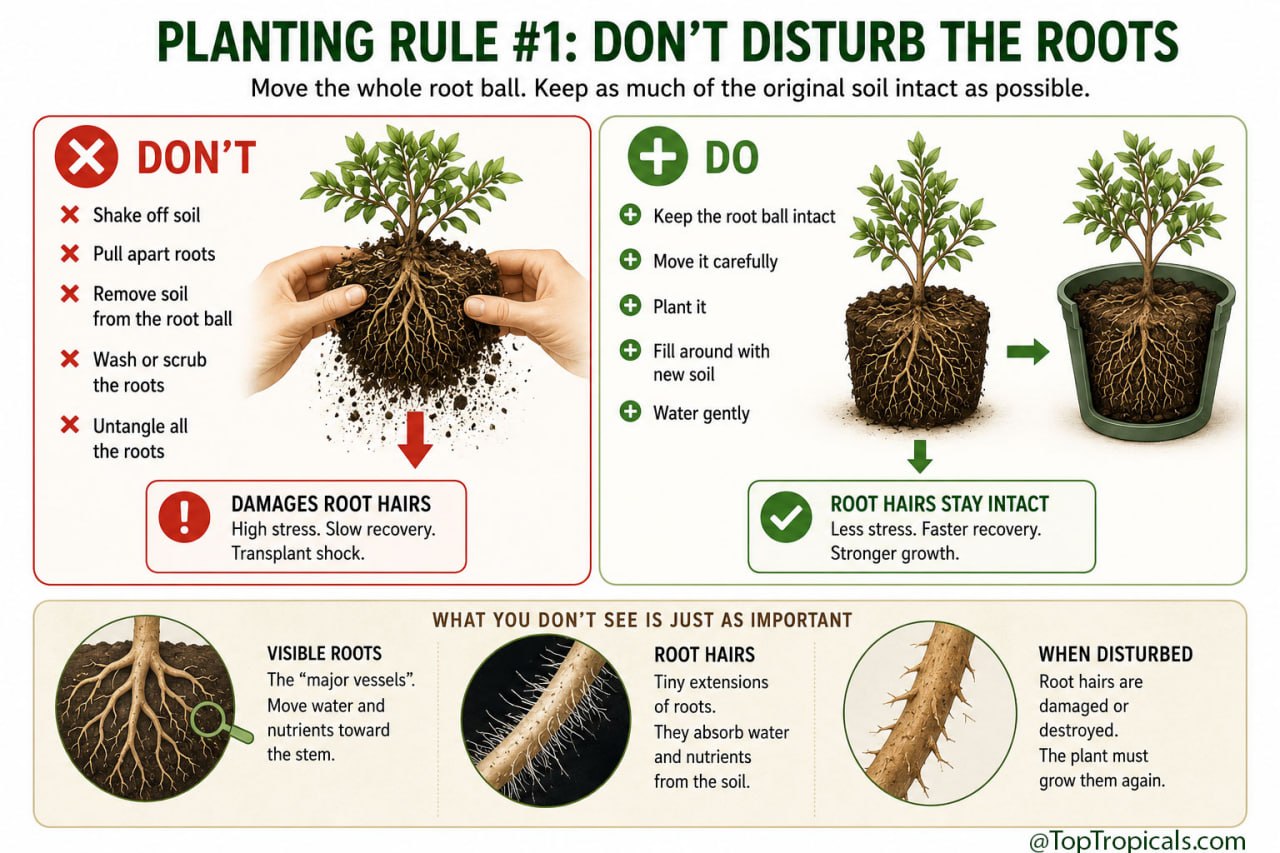
Keep the root ball intact. Disturbing the soil can damage tiny root hairs and increase transplant shock.
The #1 Rule for Mail-Order Plant: Don't Disturb the Roots
Your new plant just arrived in the mail. You open the box, unwrap it - and see a root ball surrounded by soil.
Your first instinct may be: "Clean it up? Shake off the soil? Pull it apart with your fingers? Untangle the roots so you can see what you're working with?"
❌ Don't!
Unless there's a specific problem that requires removing the old soil, one of the best things you can do for a newly arrived plant is leave its root ball alone.
✳️ The roots you can see aren't doing all the work
When you look at a root ball, you mostly notice the thicker roots. Think of these as the plant's plumbing - they transport water and nutrients toward the stem and hold the plant in place.
But much of the actual absorption happens through the youngest, finest roots and their root hairs: delicate extensions of root epidermal cells, some so tiny you can barely see them.
These root hairs dramatically increase the surface area available for absorbing water and dissolved minerals from the soil. And here's the important part - they're very easy to destroy.
When you shake, rub, scrape, wash, or pull soil away from the roots, you're not just removing dirt. You may be stripping away thousands of those tiny absorbing structures. The thicker roots can still look perfectly healthy while much of the plant's actual working surface has just been damaged.
✳️ Why this matters even more with a mail-order plant
A plant that's traveled through the mail has already been through some stress: darkness, jostling, temperature swings, and a brand-new environment on arrival.
This is not the moment for root surgery.
Once root hairs and fine feeder roots are damaged, the plant has to rebuild them. Until it does, its ability to take up water is reduced - right when it needs water most to recover and adjust. That can show up as wilting, leaf drop, stalled growth, or what gardeners call transplant shock.
✳️ Pot or plastic bag - the rule is the same
Some plants ship in their nursery pots. Others arrive with the pot removed and the root ball wrapped in plastic, since that makes shipping lighter, safer, and cheaper.
Either way, treat the root ball the same way:
Carefully remove the pot, bag, or wrapping without pulling the root system apart.
Set the whole root ball - with as much of its original soil intact as possible - into the new container.
Fill in around it with fresh potting mix.
Think of it as moving the root system, not rebuilding it.
✳️ But shouldn't I loosen the roots?
Sometimes - but not automatically.
If a plant is severely root-bound, with thick roots circling tightly around the outside of the pot, some gentle correction can help. Damaged, mushy, or rotten roots may also need attention.
But that's different from routinely breaking apart a healthy root ball. If the roots and soil look healthy, less handling is usually better.
✳️ Don't remove soil just to inspect the roots
Don't wash them clean. Don't massage the root ball. And don't assume spreading every root out will help the plant "take off faster." For a healthy plant, keeping those fine roots intact is worth far more than a tidy-looking root ball.
✳️ The simplest planting rule
When your plant arrives: unwrap it, move it, fill around it, water it - and leave the roots alone.
Keep as much of the original root ball intact as you reasonably can.
The roots you can see are only part of what's keeping your plant alive. The ones you may never even notice are doing some of the most important work.
Treat the root ball gently, and let the plant do the rest.
🛒 Shop Professional Potting Mix
📚 Learn more
· Planting instructions for mail order plants (PDF)
· How to re-pot a plant properly
· The complete guide to potting mix
#How_to #Discover
🟢 Join 👉 TopTropicals