Garden Blog - Top Tropicals
Date: 26 Aug 2026
Green in July, Variegated in January: Red-Stem Serissa
🌿 Green in July, Variegated in January: Red-Stem Serissa
At first glance, this little shrub looks like a mistake.
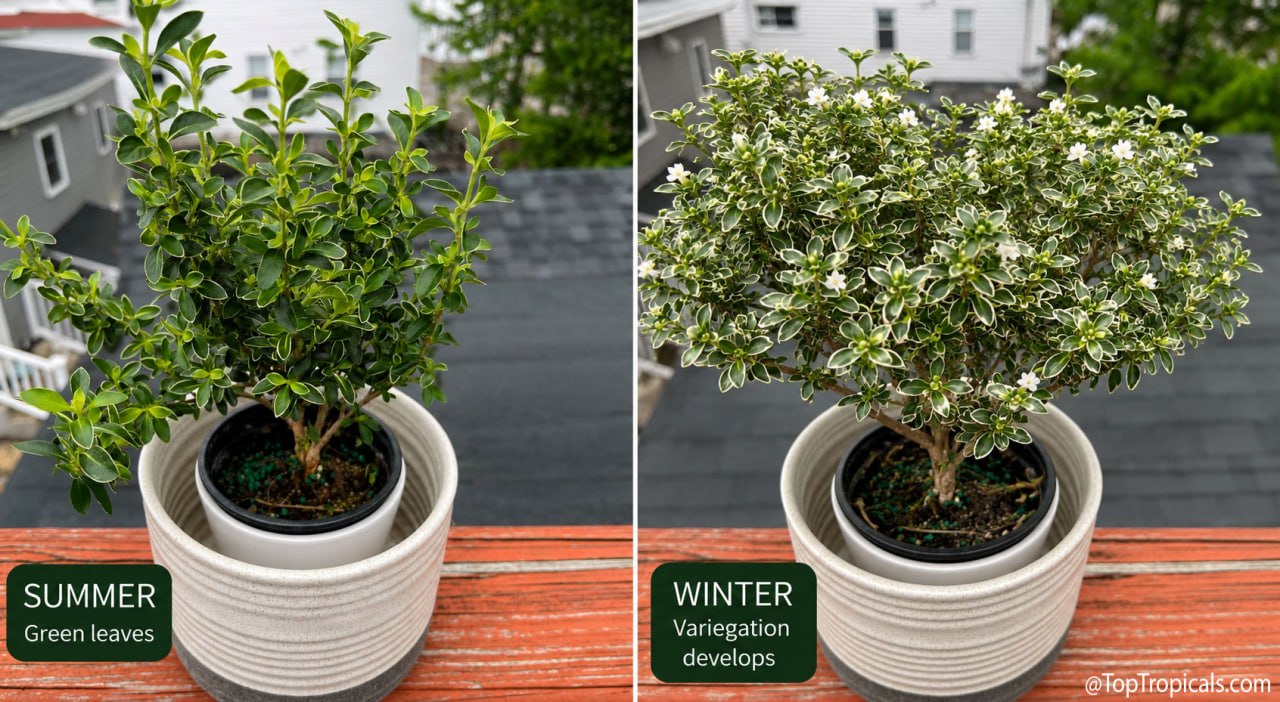
It came labeled as an "outer-variegated red stem" Serissa, yet in the dead of summer, its tiny leaves are completely, unremarkably green. Where is the pattern? Where is the variegated foliage?
The answer came directly from longtime rare-plant grower Sid Gardino: Wait until Winter.
🌿 The Winter-Variegated Serissa Experiment
This unusual Serissa selection holds back its visual showcase until the temperature drops. As cooler weather sets in, the foliage undergoes a seasonal shift, pushing out vivid cream margins off-set by rich, reddish young stems.
☀️ Summer: Deep Solid Green - Heavy star-shaped blooming
❄️ Winter: Cream-Variegated Edges - Frosted look with reddish stems
🌿 The Mystery of Seasonal Variegation
Seasonal foliage shifts sound like a classic "nursery myth," but the science backs it up.
Serissa japonica (still widely known in horticulture as Serissa foetida) has a documented history of temperature-dependent foliage:
'Mt. Fuji': A famous cultivar whose white-and-green striping expands or shrinks based on light, heat, and plant nutrition.
'Pink Mountain': A documented selection specifically noted for producing variegated foliage primarily during winter months.
While environmental triggers like day length, light intensity, and growth rate play a role, cool winter air is the primary switch that activates the cream-colored margins on this specific red-stem clone.
🌿 Why Gardeners & Bonsai Artists Love Serissa
Commonly called Tree of a Thousand Stars or Snow Rose, this Asian native in the Rubiaceae (coffee) family is prized far beyond its chameleon foliage.
Massive Bloom Cycles: The shrub gets its nickname from hundreds of tiny, white, star-like blossoms that bloom heavily from spring through autumn.
Natural Miniaturization: With tiny leaves, naturally fine branching, and ultra-short internodes, Serissa naturally scales itself down. Older plants quickly develop gnarled, woody trunks.
Versatile Sizing: While it reaches 2 to 4 feet in the ground, simple pruning easily maintains it as a compact patio container, miniature shrub, or indoor bonsai.
🌿 How to Care for the Red-Stem Serissa
Light: Bright, direct morning sun with afternoon shade protection. Full, brutal summer sun can scorch the delicate variegated leaf margins.
Watering: Keep the soil consistently moist, airy, and well-draining. Serissa is sensitive to abrupt moisture swings; bone-dry soil triggers massive leaf drop, while soggy mud rots the roots.
Hardiness: Typically evergreen in USDA Zones 7–9. Cold weather encourages its winter variegation, but potted plants should be protected from hard freezes to protect root systems.
💡Botanist's Note: Serissa earned its old species name, foetida, because its leaves release an earthy, sulfur-like odor—but only when crushed or pruned. Left alone on your patio, it smells completely neutral.
🌿 The Experiment Begins
The summer foliage photo is taken, solid green and waiting. As the cooler Florida months arrive, we will be tracking this exact red-stem selection to document its transition into full winter variegation.
🛒 See It Change: Get Yours Today
📚 Learn more


· Serissa japonica (foetida) in Plant Encyclopedia
#Container_Garden #Discover
🟢 Join 👉 TopTropicals
Date: 26 Aug 2026
Vines grow too fast. Good.
By Tatiana Anderson, Plant Expert, Top Tropicals

Smokey: That is exactly what you want when something needs hiding.
Sunshine: Give them an ugly fence, stand back, and eat a donut.
Smokey: Finally, a maintenance plan I can endorse.

That's the usual complaint. Vines spread, they climb, they get big, they take over. All true. And all of it turns into an advantage the moment you have something you'd rather not look at.
A chain-link fence. The utility area by the side of the house. An old shed. The neighbor's blank wall staring into your yard. A boring stretch of fence that does its job but looks like nothing. These are exactly the problems a fast, vigorous vine solves, and it solves them faster than almost anything else you could plant.
The thing that makes vines annoying in a tidy flower bed is the thing that makes them perfect here. You want fast. You want big. You want it to spread.
The guy who talked us into this
Mark runs our facilities at Top Tropicals. He's not a plant person. He'll tell you so himself. He doesn't enjoy the trimming, the feeding, the fussing. Most plants, to him, are a chore he didn't sign up for, and that's the thing: keeping the place up is his job, so when he makes an exception it's worth hearing.
But vines he likes. "Vines are my favorite," he said. "Plant one, give it something to climb, and you can see the result the same season."
That's the whole argument, and it lands harder coming from the man who keeps the place tidy than it would from any of us. For the right job, a fast vine might be the laziest landscaping you'll ever do.
Watch one do it
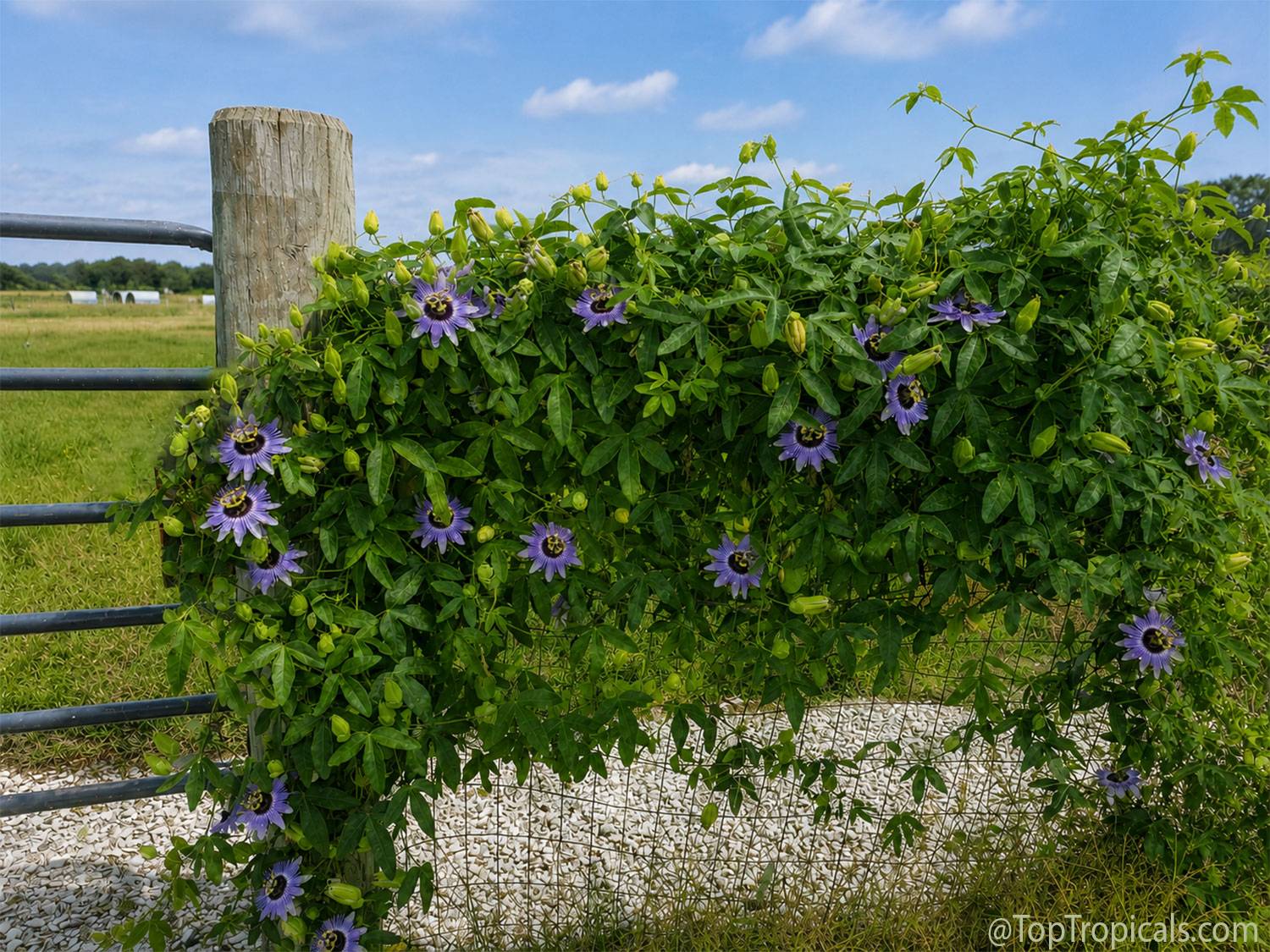
You can talk about coverage all day, but it's more convincing to watch. A vine can turn a plain or ugly structure into a wall of leaves and flowers much quicker than a shrub or a tree usually does, using an existing fence for height and coverage instead of spending years building its own. How fast depends on the vine, the climate, and the season, but a vigorous one in warm weather can close in a fence surprisingly quickly.
The one rule that matters: match the vine to the job
Here's where most vine regret comes from. People put a monster woody climber on a delicate little trellis, then blame the plant when it eats the trellis.
So skip the botany and think in sizes, based on how much territory you actually need to cover:
- XL - Big vigorous climbers for large fences and serious screening
- L - Fast growers for fences, pergolas, and large trellises
- M - More manageable flowering vines for smaller trellises, patios, and containers
- S - Smaller-scale, fragrant, or specialty climbers
Not every plant slots into a strict category, and that's fine. This is a gardening guide, not a taxonomy exam. Pick the size that fits the space and you've already avoided the most common mistake.
The rest of this is really one question, asked four ways: what do you need to cover, and how much vine do you need to cover it?
Before you plant: five minutes of thinking saves you a season
None of this is hard, but a little planning up front is exactly what makes a vine low-maintenance later.
Read the plant's requirements first. Every vine has its own preferences for sun, drainage, and space, and its own pace. Some are moderate; a few are genuinely aggressive growers that can spread further than you bargained for, so check before you buy rather than after. A quick look saves you from putting a sun-lover in shade, a big climber in a small spot, or a runaway vine somewhere it'll become a problem. The details are on each plant page.
Know whether it stays covered year-round. For a screening job this matters more than for a flowering accent. Some vines hold their leaves through the year; others thin out or drop them in cool weather and let the view back in. If the goal is hiding something, check whether your pick stays dense in winter before you commit.
Support it properly, and think ahead. The support has to hold the mature plant, not the little thing you're planting today. Several of these, Artabotrys included, start out looking modest and turn into heavy woody vines over time. A flimsy trellis that's fine in year one can be flattened by year three. For the XL group especially, use something sturdy: a real fence, a solid pergola, heavy wire. A chain-link fence is close to an ideal trellis already.
Space them to knit together. Covering a long run takes more than one plant. Spacing depends on the vine, so check the plant page, but the idea is to set them along the fence so the growth meets and closes the gaps rather than leaving bare patches between.
Give it sun and drainage. Most flowering vines flower best in good light and dislike sitting in soggy soil. If drainage is poor, amend the bed or plant a little high.
Feed for growth and flowers. A vine that's covering a fence is doing a lot of work. Regular feeding through the warm season keeps the growth going strong and the blooms coming.
Know your cold limits. Most of these are tropical. In cooler zones, plant where there's some protection, or grow the smaller ones in containers you can move when frost threatens. Check each plant's hardiness before it goes in the ground.
Trim to steer, not to fight. Occasional pruning keeps a vine going where you want and off where you don't, including keeping it off a neighbor's fence if you share a boundary. If you picked the right size for the space, this is light, seasonal work, not a constant battle.
SIZE XL: When you really need something covered
These are for the jobs where you genuinely want serious coverage. Large fences, big pergolas, real screening, structures with some heft to them. Give them room and strong support, then stand back. A few worth knowing by name:
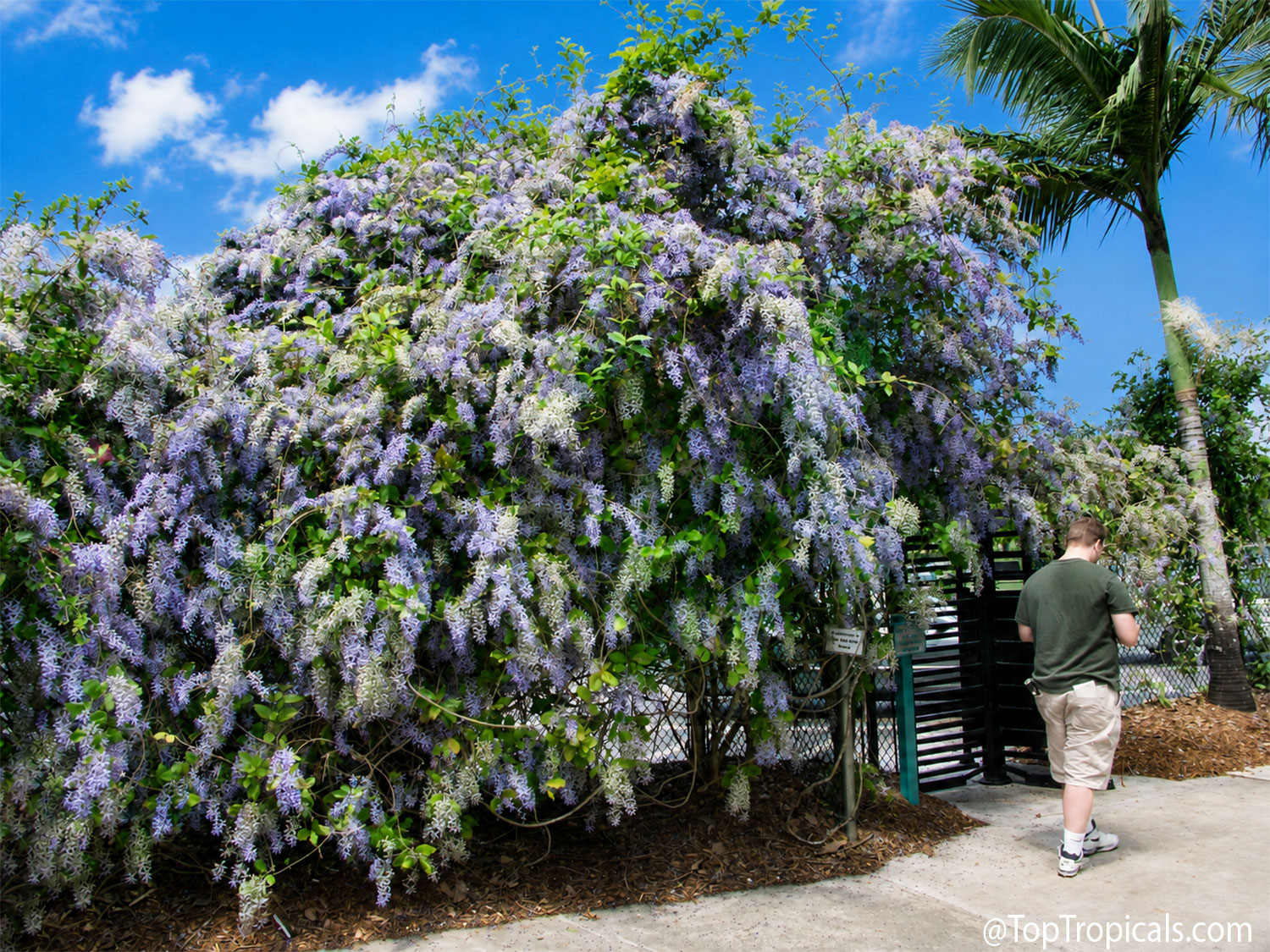
Petrea volubilis - Queen's Wreath / Sandpaper Vine / Tropical Wisteria. A twining woody vine with large rough leaves that feel like sandpaper, and spectacular cascading clusters of royal purple flowers that can run more than a foot long. It resembles northern Wisteria, hence the Tropical Wisteria name. The individual flowers last only a few days, but the blue-purple calyxes hang on much longer and new flowers keep opening, so the display carries on for weeks rather than flashing and fading. It draws butterflies, bees, and hummingbirds, grows fast enough to cover a large fence within a couple of seasons, and turns a plain fence into a dramatic flowering feature. There's also a rare white form, Petrea glandulosa 'Alba', with cascading white flowers.
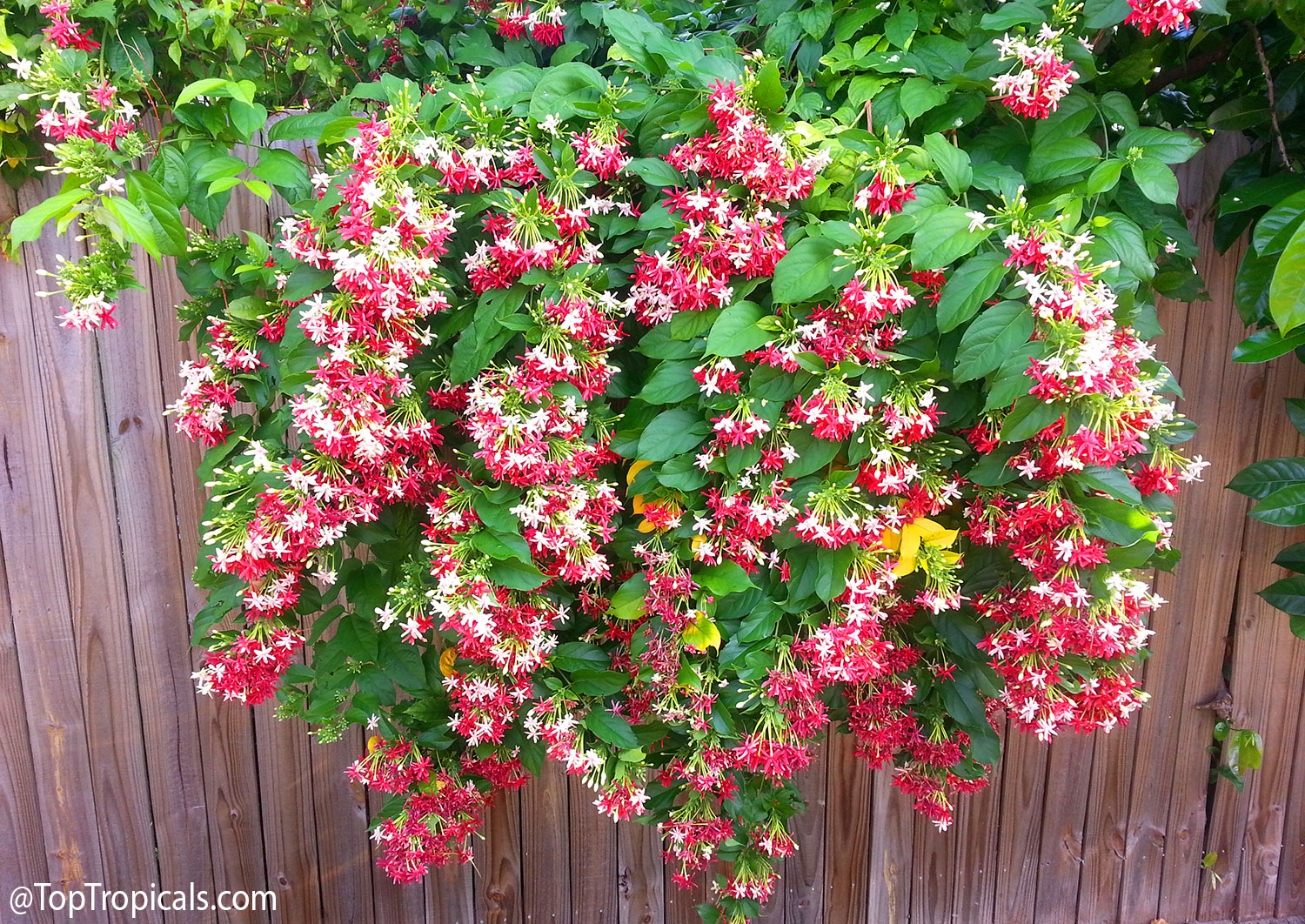
Quisqualis indica - Rangoon Creeper. This is the one you saw in the covering-eye-sore video. A large woody vine whose flowers come in clusters and change color as they age, opening light and deepening through pink to crimson. Because the blooms are different ages at once, you get several colors on the plant at the same time, plus a strong sweet, fruity fragrance. Excellent on big fences and trellises.
Hiptage benghalensis - Helicopter Flower / Madhavi. A fragrant vine we first found on a plant trip to Thailand, where we smelled it before we saw it. The perfume is strong, sweet, and fruity, and the flowers come in clusters with pink, white, and yellow tones, followed by distinctive three-winged seed pods that spin like tiny helicopters. It blooms especially well in winter and early spring, when a lot of other tropicals have gone quiet. Fast-growing and adaptable, it tolerates a range of soils and takes full sun or partial shade, and you can train it up a fence or trellis, prune it into a shrub or small tree, or keep it in a large container. In India it's known as Madhavi, the "Spring Herald," traditionally associated with mango trees.
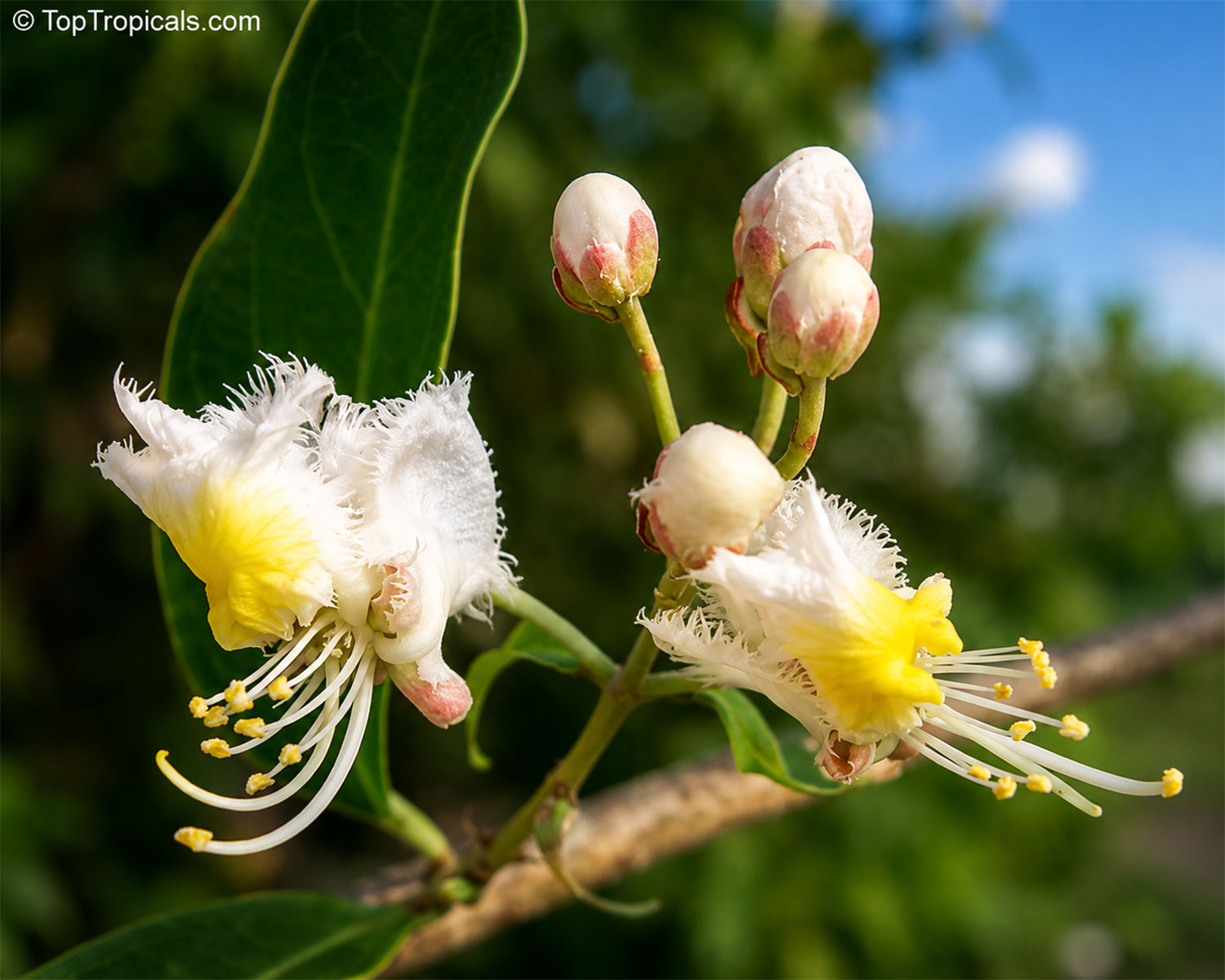
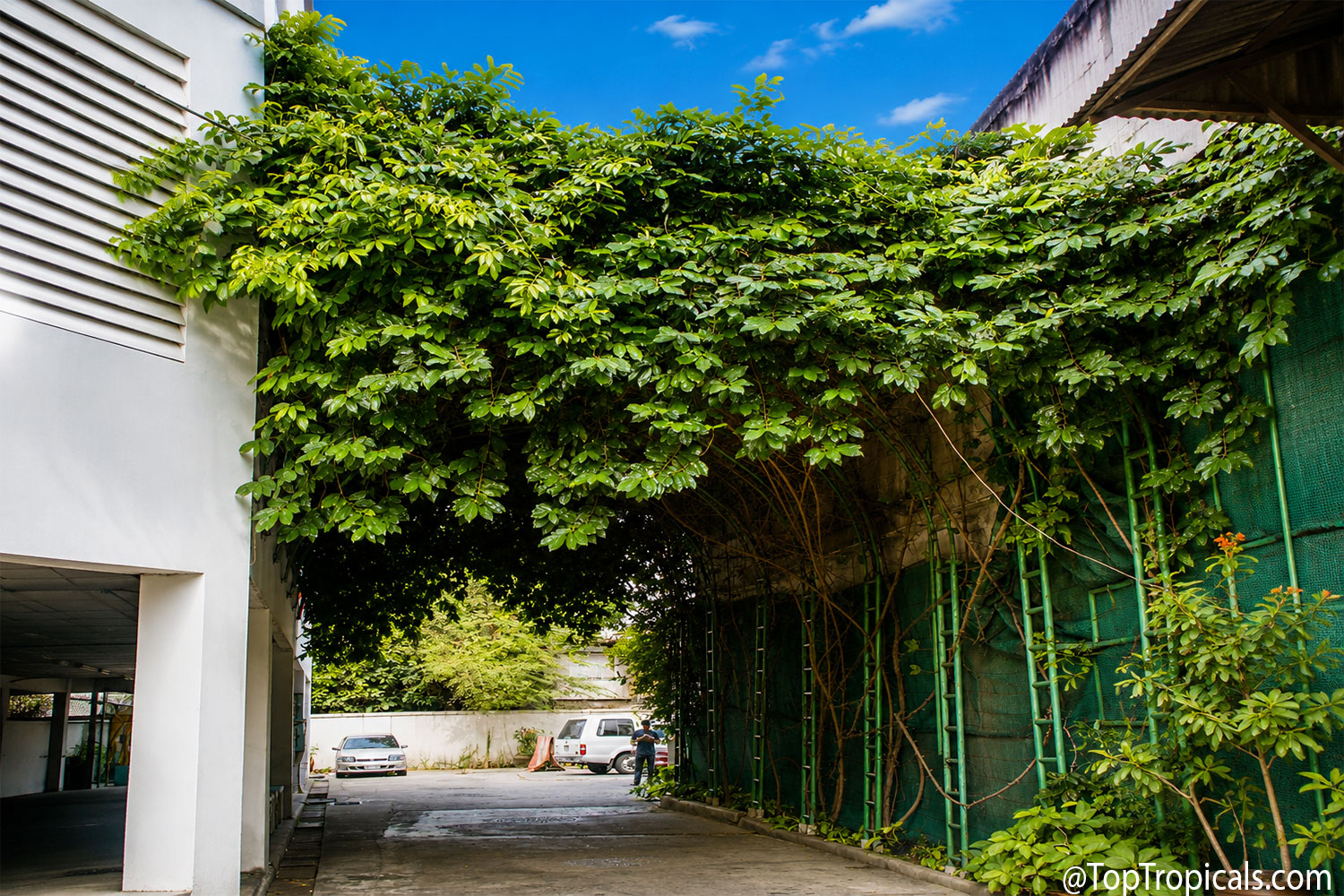
Artabotrys siamensis - Climbing Ylang-Ylang. A fragrant plant you can grow as a woody climbing vine or keep as a lush shrub with pruning. The flowers carry a pleasant lemon-like scent, which makes it a good pick where you want screening and fragrance at once.
Allamanda isn't rare at all, and that's its strength: fast, heat-loving, long flowering season, lots of colors and forms. Depending on the variety and how you prune it, you can run it as a vine or keep it more like a shrub. Proven. Everywhere. Coverage and flowers at once.
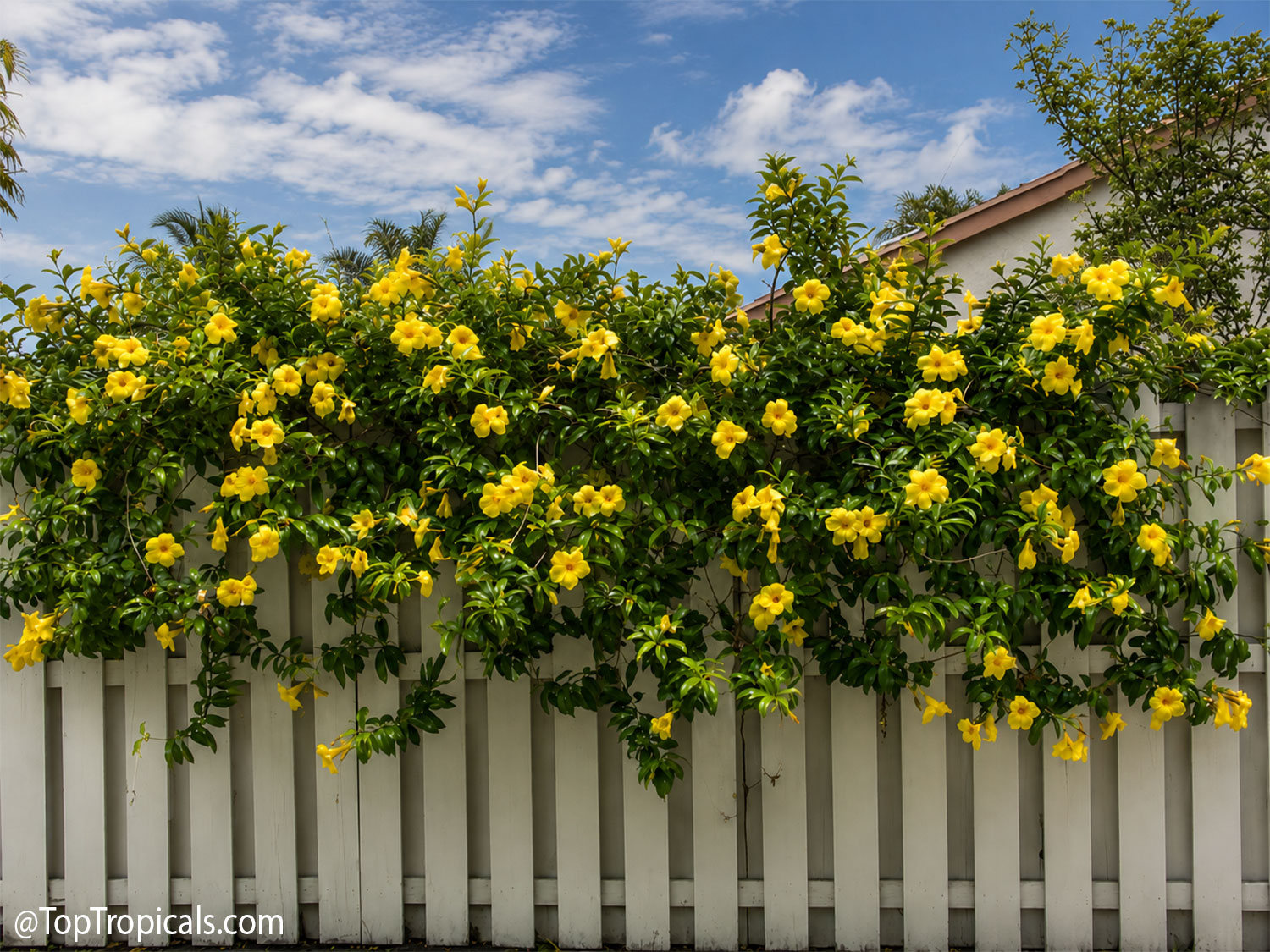
More XL choices if you want them: Lonicera, Bauhinia galpinii, Camptosema grandiflora, and Tecomaria capensis.
SIZE L: Fast coverage for impatient gardeners
Still fast, still good for a fence or pergola or large trellis, just not quite as massive as the XL crowd.
FEATURED VINE: Mexican Flame Vine
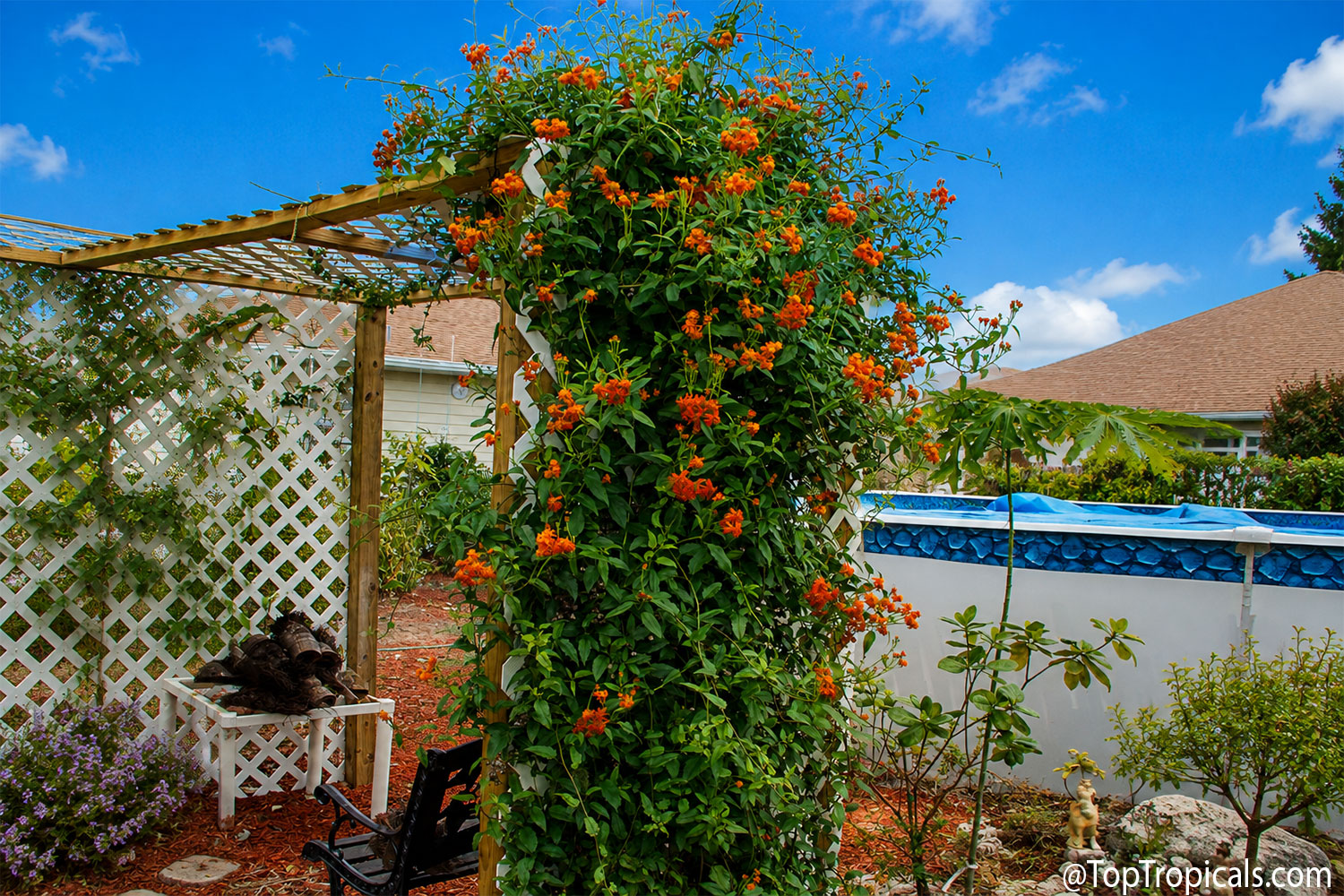
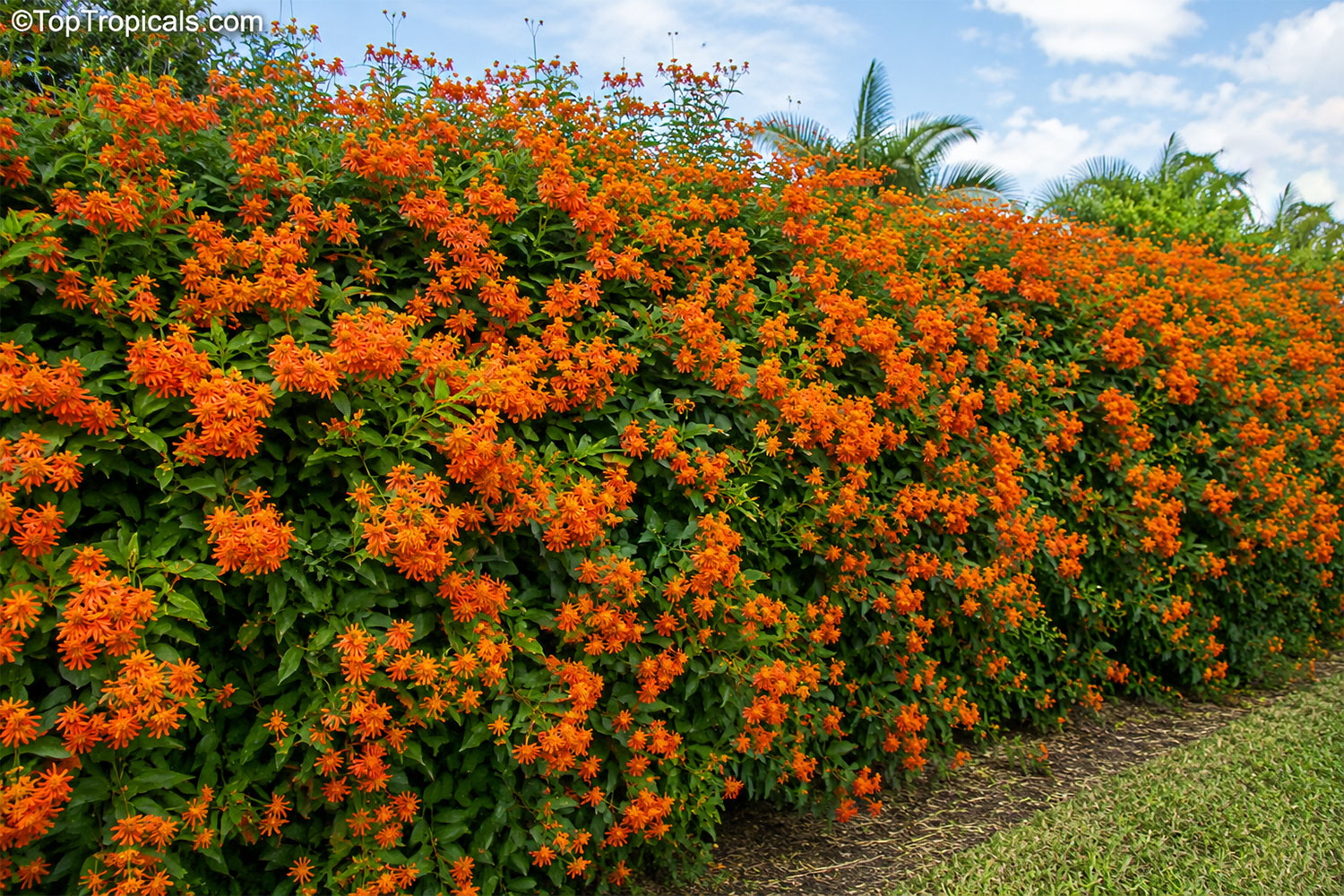
Mexican Flame Vine - Senecio confusus / Pseudogynoxis chenopodiodes, 'Sao Paulo'. If you want fast cover with real color, this is the one. The 'Sao Paulo' variety trades the usual orange for exceptionally bright, fire-engine-red flowers, with thick evergreen foliage and larger, darker leaves than the regular orange form, and it's more vigorous besides. It's fast-growing and easy to train over a fence, arbor, or trellis, which makes it excellent for quickly covering a boring fence or unwanted view. Once established it's drought-tolerant and thrives on relatively little attention. It draws bees, butterflies, and birds, and the flowering season is long, with strong winter color when you need it most.
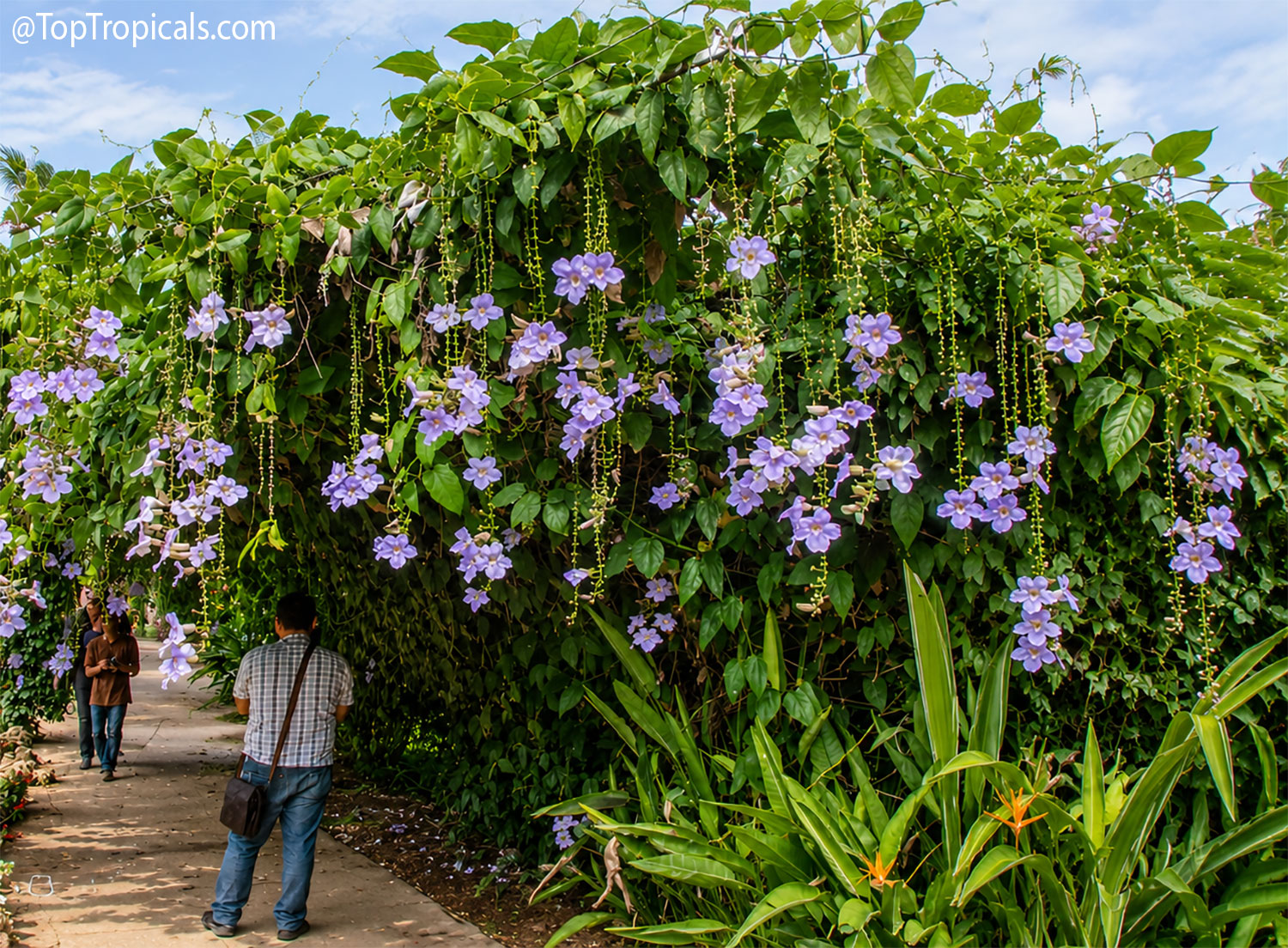
Thunbergias are your rapid-coverage-plus-flowers option, easy and generous with blooms. Passifloras bring the flowers too, along with butterfly value where the right species are around. Also in this range: Stictocardia beraviensis (Hawaiian Sunset Bell).
SIZE M: All the drama, less territory
For people who like the vine idea but don't want a plant swallowing a whole structure. This is the group that's easier to live with.
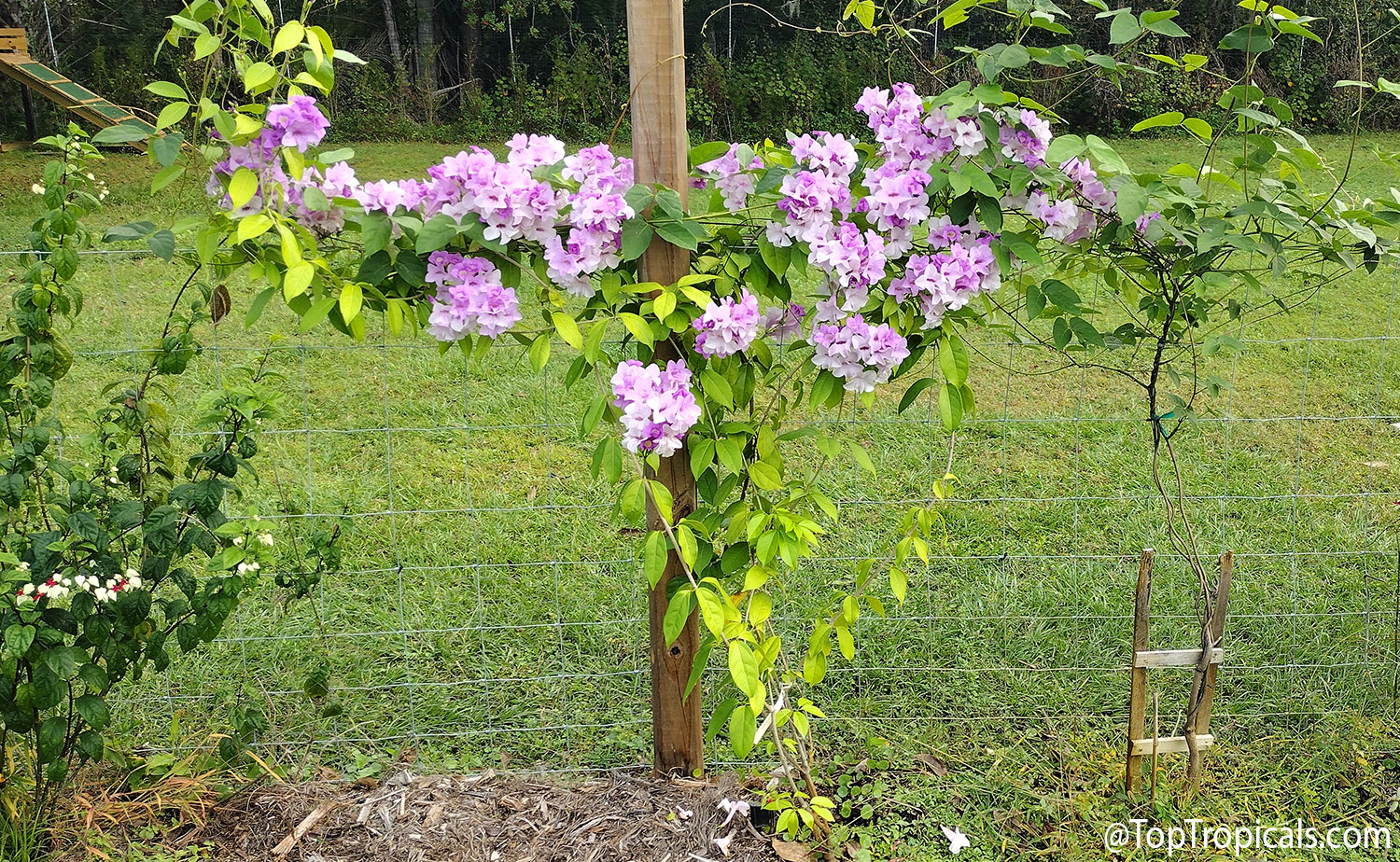
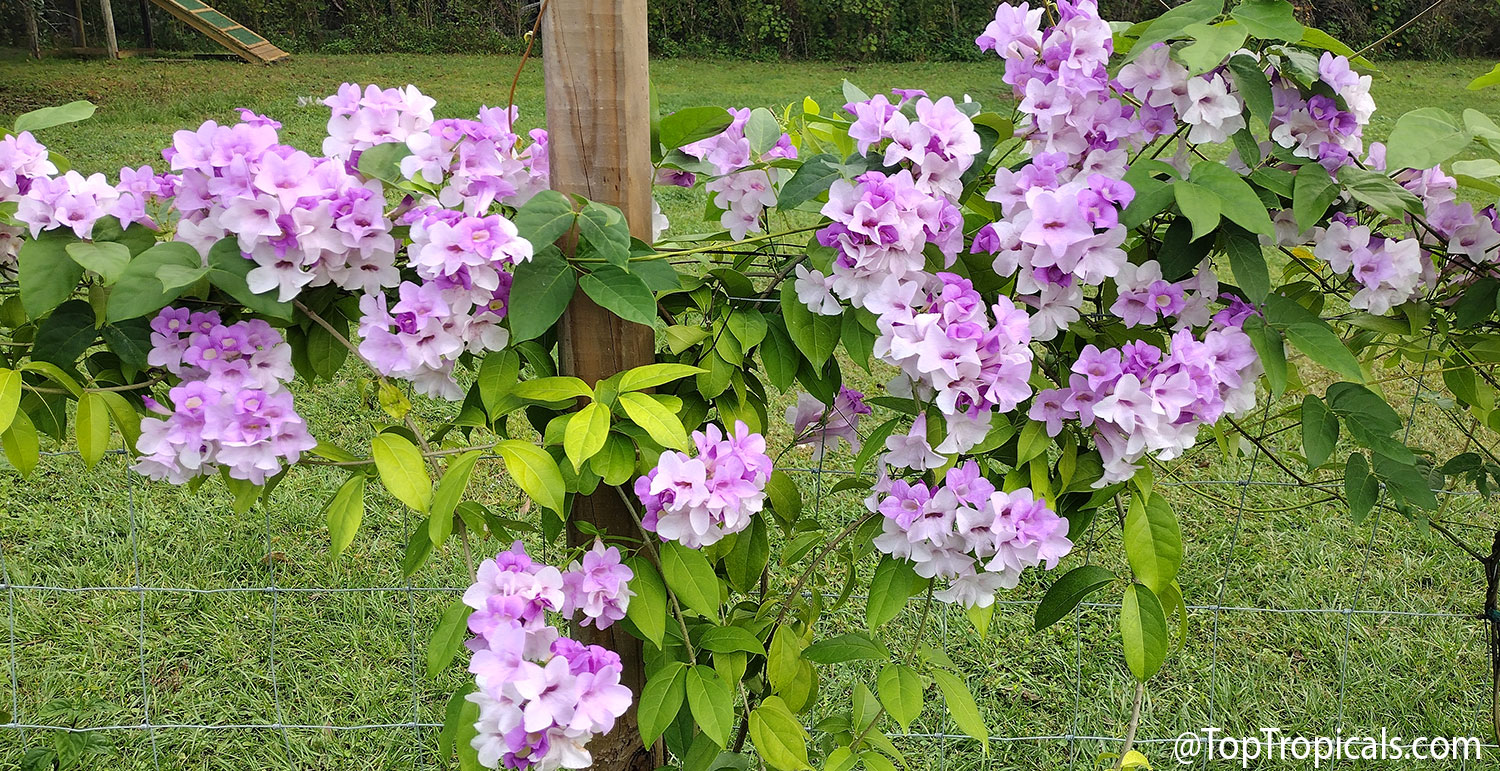
The star here is Mansoa alliacea - Garlic Vine. More moderate and manageable than the giant woody climbers, it's an excellent flowering vine for a smaller trellis and does well in a large container. Crush a leaf and it smells distinctly of garlic, which is where the name comes from, along with some old folklore (garlic scent, protection from bad luck and vampires, the usual). But the flowers are the reason to grow it: they change color with age, opening a stronger purple-lavender and fading toward paler shades, so several tones appear on the plant at once. Think of it as a living watercolor. It's the pick for an exotic vine when you don't want to hand over an entire fence.
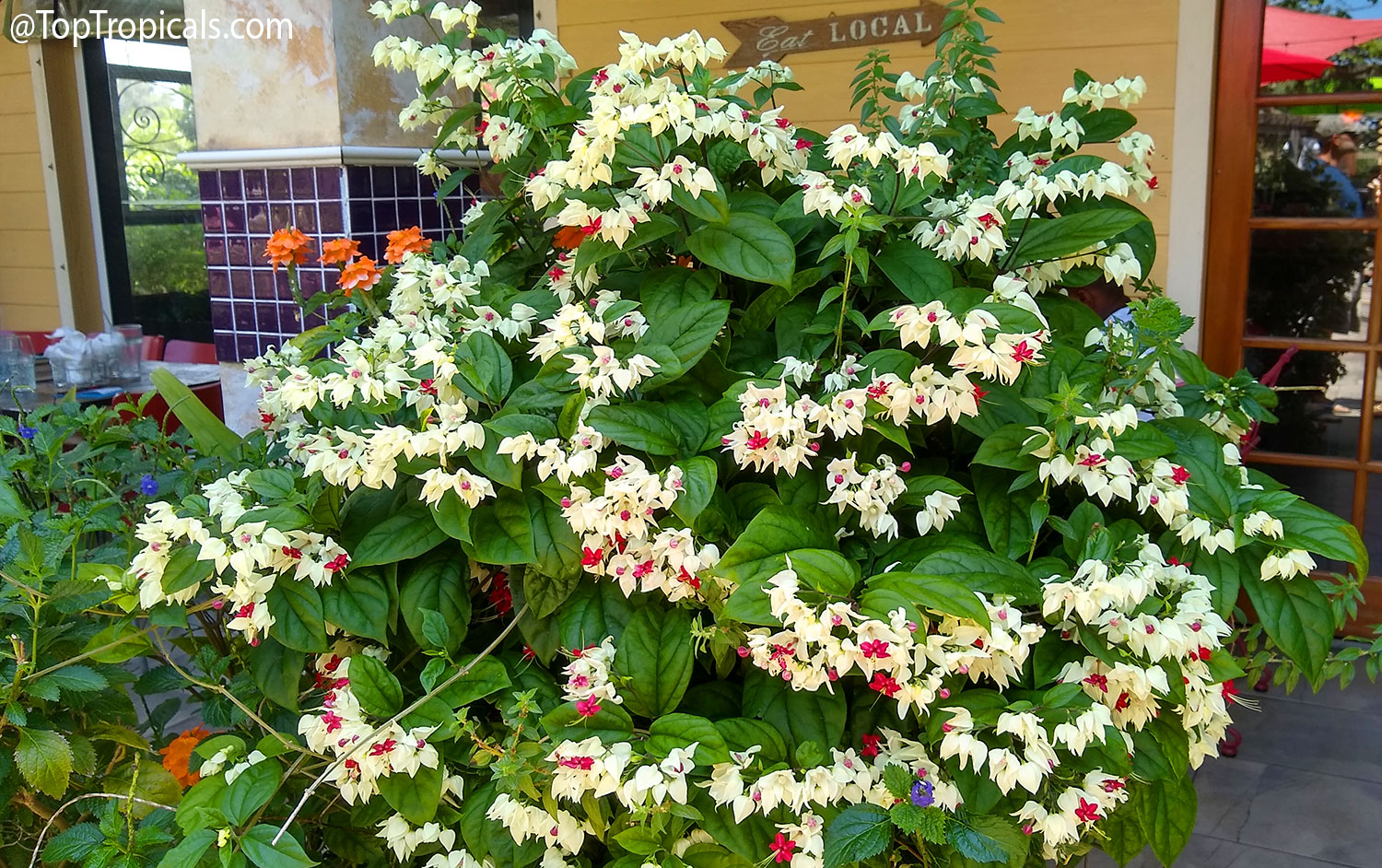
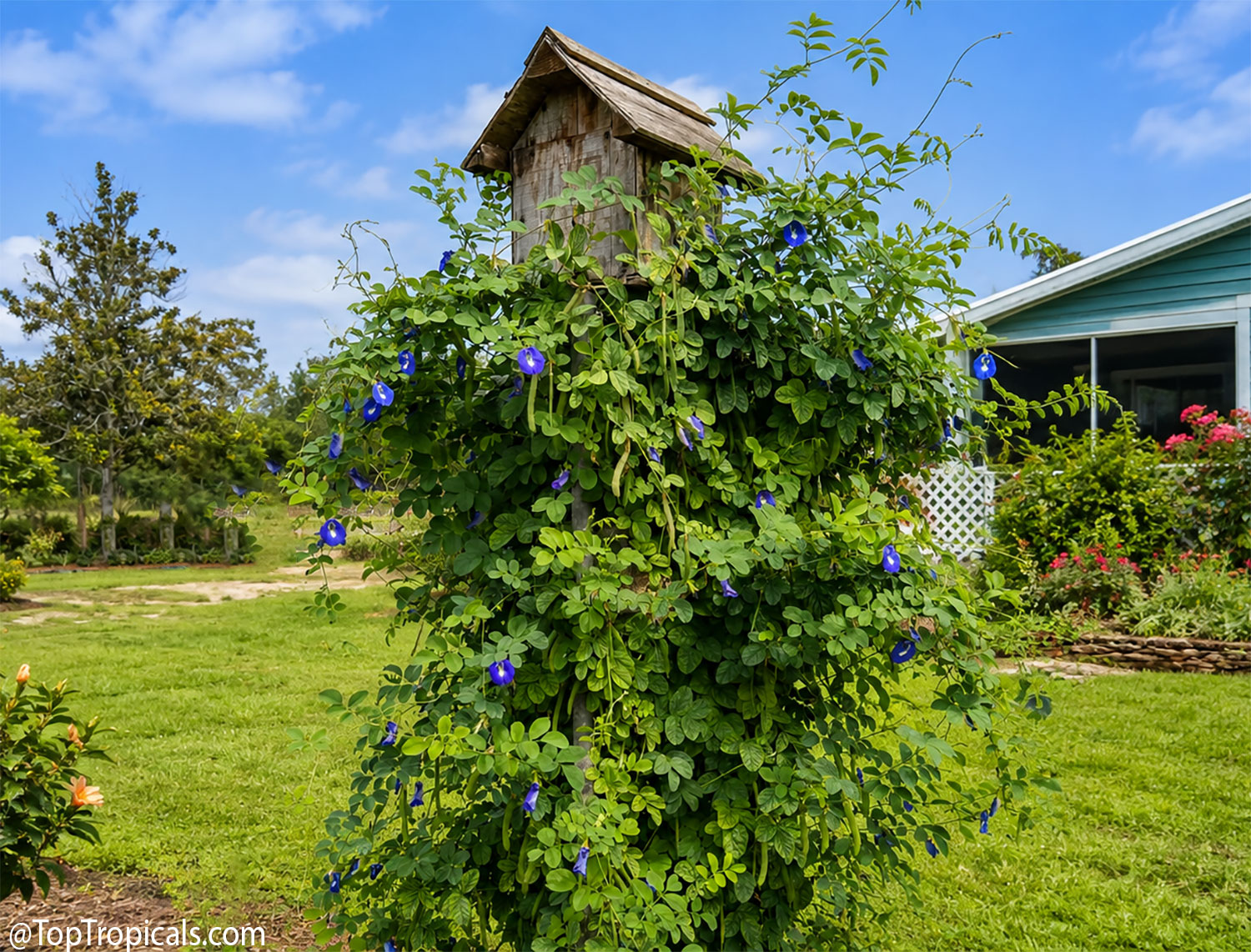
Also in this range: Clerodendrum thomsoniae (Bleeding Heart Vine) and Clitoria ternatea (Blue Butterfly Pea), both flowering vines that give you plenty without the land grab.
SIZE S: Not every vine has to hide a warehouse
Sometimes the priority is scent, or a patio, or a container, not screening.
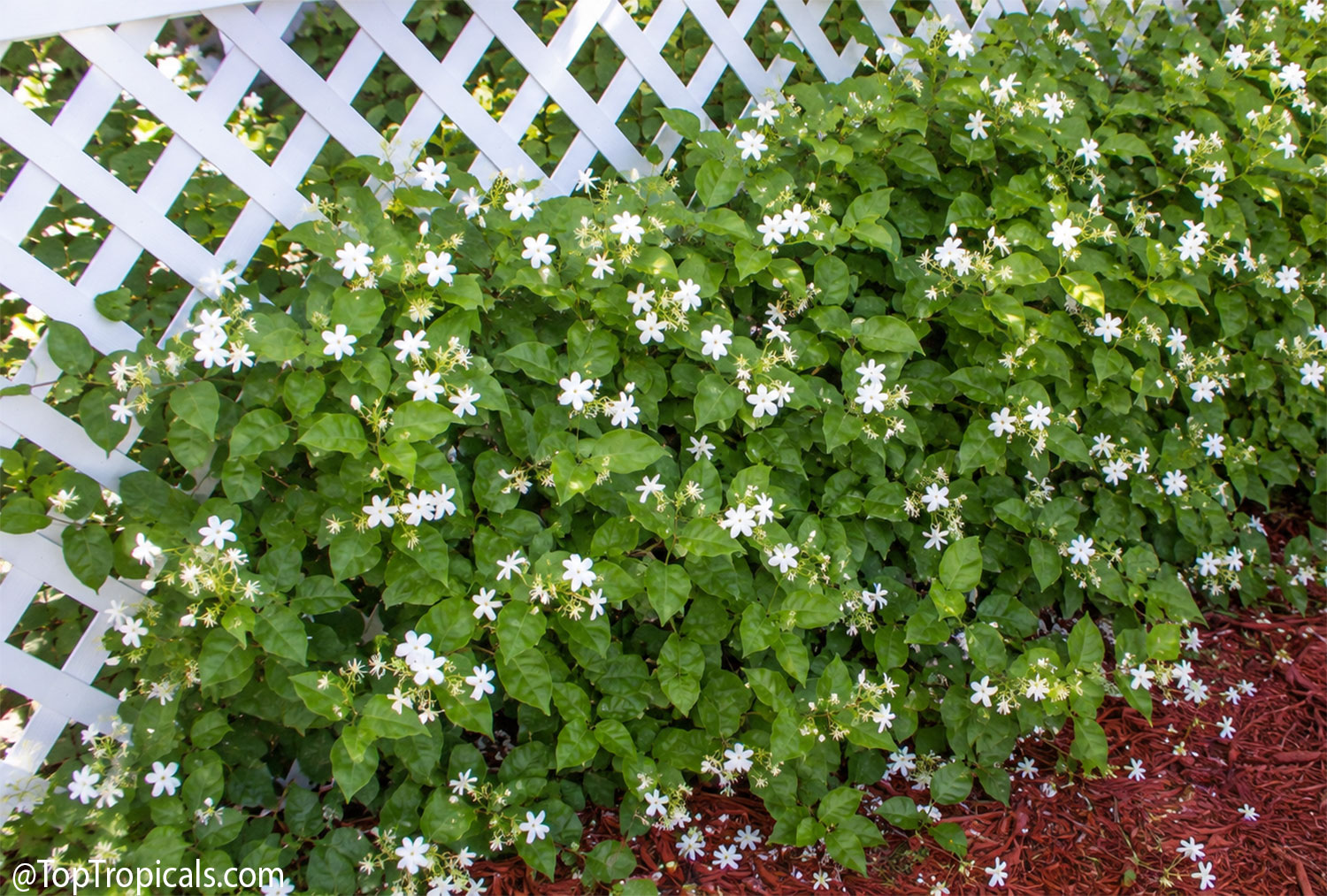
The fragrant jasmines live here: Jasminum sambac 'Belle of India' and 'Maid of Orleans', the French Perfume Jasmine (officinale x grandiflorum), plus mesnyi, humile, angulare, and tortuosum. Choose these when fragrance matters more than coverage. They're smaller-scale or easier to place, not necessarily tiny, so still give them a sensible spot.
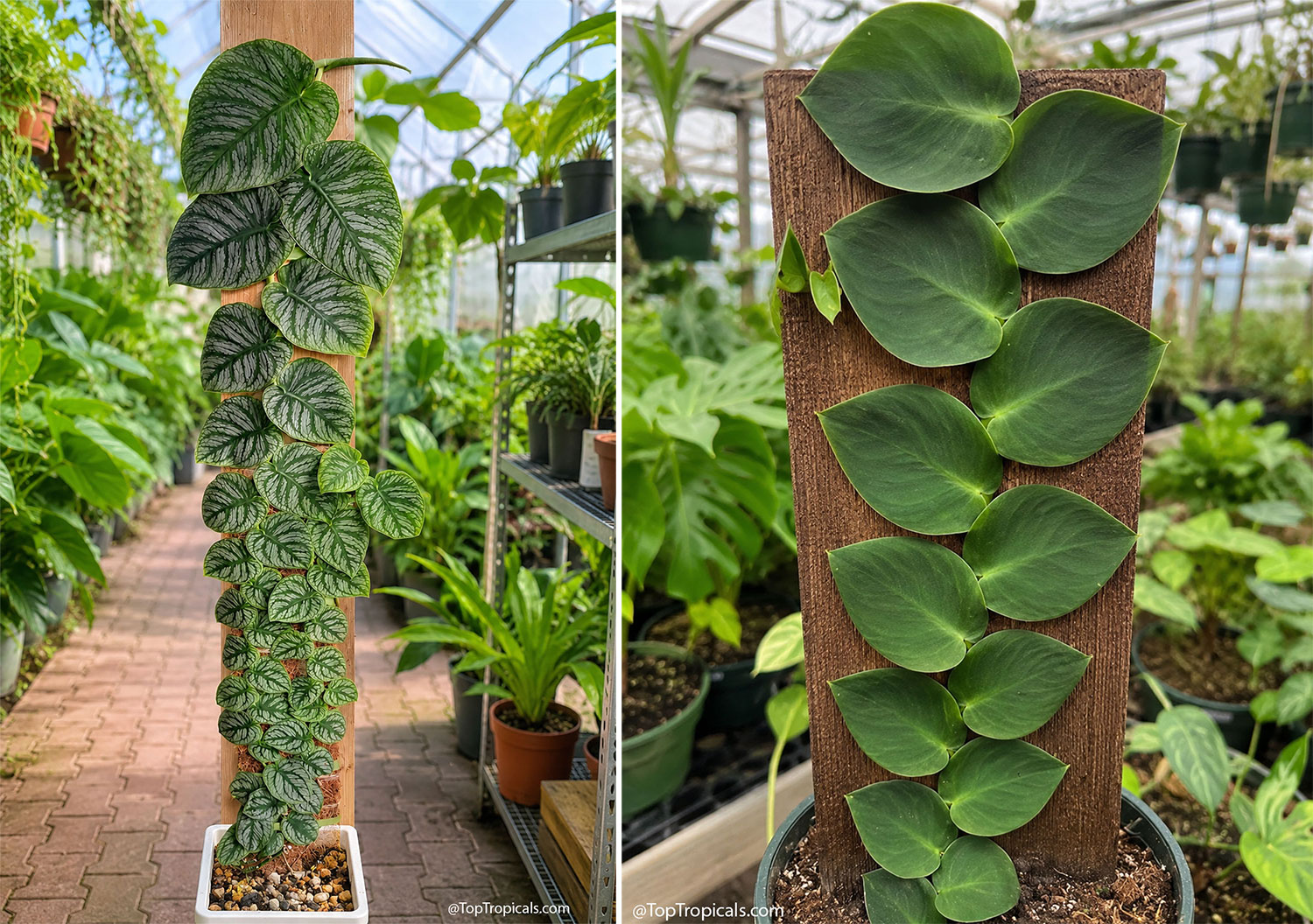
And for collectors, a couple of climbers grown purely for unusual foliage rather than flowers or screening: Monstera dubia and Rhaphidophora hayi, both shingle plants that press their leaves flat against a surface. Different reason to grow a vine entirely, but a good one.
Choose by what you actually want
Hide something fast: Petrea, Quisqualis, Mexican Flame Vine, Thunbergia, Allamanda
Fragrance: Quisqualis, Hiptage, Artabotrys, jasmines
Butterflies: Petrea, Passiflora
Something more manageable: Mansoa, Clerodendrum, Clitoria, selected jasmines
Something unusual: Hiptage, Mansoa, Petrea, Monstera dubia, Rhaphidophora hayi
But aren't vines high-maintenance?
Honest answer: some are, sometimes.
A few vigorous vines need occasional pruning. Some want sturdier support than others. And yes, if you plant a giant woody climber on a tiny decorative trellis, you've made work for yourself and it's not the plant's fault.
But most of the "maintenance problem" comes from a mismatch. When the goal is to cover a big fence or block an unwanted view, vigorous growth stops being a nuisance and starts being the whole point. Give the plant enough room to do what it already wants to do and most of the fuss disappears.
The easiest vine to maintain is usually the one whose natural size matches the job you gave it.
Don't take our word for it
Instead of imagining the result, watch what a vine actually does to an ordinary fence. That's the part that tends to change people's minds.
Sunshine: When do we start the covering?
Smokey: We don't. It does. We wait.
Sunshine: Great. Donuts while we wait?
✍️ More Vines from Top Tropicals Garden Blog
🎥 Playlist: Tropical Flowering Vines and Shrubs
🛒 Shopping links:
Date: 25 Aug 2026
Daily Cat Lesson #4: Why the Big Plate?

🐾 Daily Cat Lesson #4: Why the Big Plate?
Two cats. One plate. A mountain of crunchies. What could possibly go wrong?
- 🐾 Do cats prefer plates or deep bowls?
Many cats are more comfortable eating from a wide, shallow dish. A deep or narrow bowl can press against their sensitive whiskers while they eat. A plate also makes it easier to reach food without sticking their whole face into a bowl. - 🐾 Should cats share a food bowl?
They can, if they're comfortable together, but separate dishes are usually better in a multi-cat household. One cat may quietly eat faster, guard the food, or push the other one away without an obvious fight. - 🐾 How do you know how much each cat ate?
That's another advantage of separate portions. With one giant communal buffet, it's difficult to know who ate what. One cat may be dieting while his colleague is enthusiastically handling both portions. - 🐾 Can cats live on dry food alone?
A complete and balanced dry cat food can provide the required nutrients, but cats naturally have a relatively low thirst drive. Wet food is an easy way to add more water to the diet, so many cats benefit from having wet food as part of their menu.
And finally...
🐾 Does food taste better when stolen from somebody else's side of the plate?
According to extensive PeopleCats research: absolutely. 😼
🐈📸 TopTropicals rescued cats Klaksa and Jacques at PeopleCats.Garden.
🐈 Stay with us for your Daily Dose of Cat! #DailyCatLesson #PeopleCats
🟢 Join 👉 TopTropicals
Date: 25 Aug 2026
Avocado Planting Guide
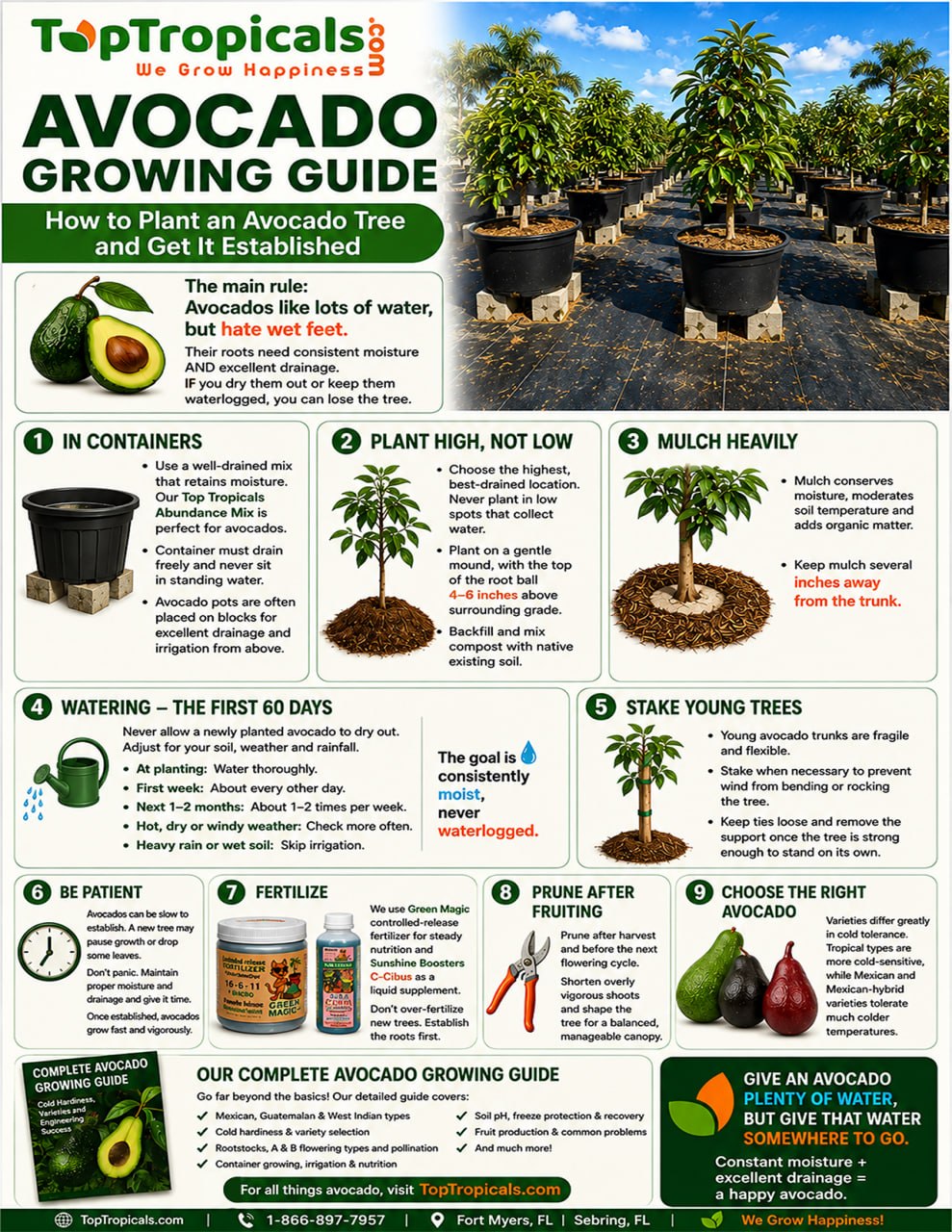
Avocado Planting Guide
📚 Learn more:


· Avocado tree (Persea americana) in Plant Encyclopedia
· Avocado Knowledge Hub and Growing Guide: Cold Hardiness, Varieties, and Engineering Success
· Avocado Variety Guide
· How to Plant an Avocado Tree and Get It Established
· Avocado Planting Guide (PDF)
· How to Plant a Tree - A Fun Guide
📖 Avocado Book:
· Hard copy · PDF File
#Food_Forest #Avocado #How_to
🟢 Join 👉 TopTropicals
Date: 25 Aug 2026
How to Plant an Avocado Tree and Get It Established
🌳 How to Plant an Avocado Tree and Get It Established
Avocados can be tricky to establish, but once established, they grow fast and vigorously.
Avocados like lots of water, but hate wet feet.
Their roots need consistent moisture AND excellent drainage. Dry them out and you can lose the tree. Keep the roots waterlogged and you can lose it just as easily.
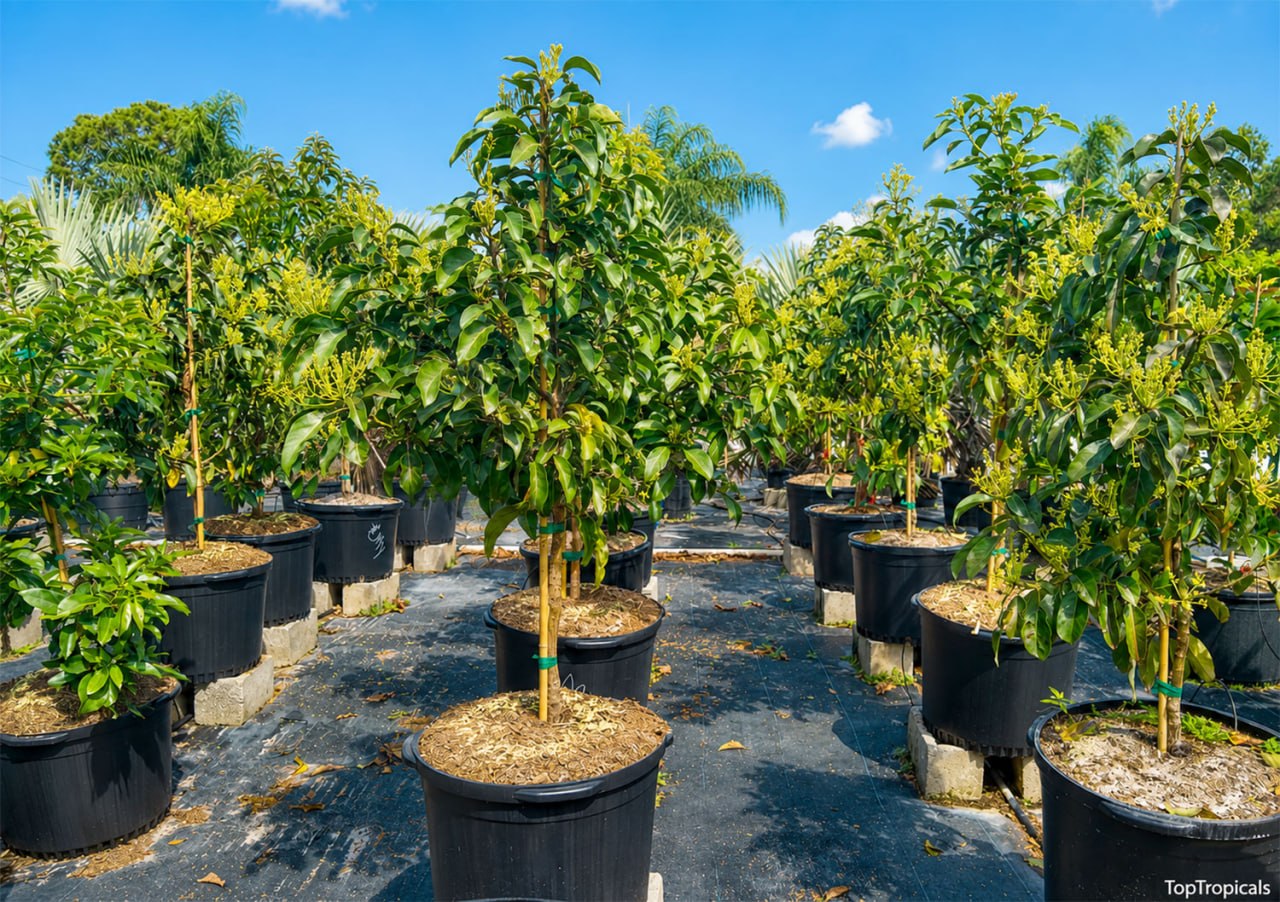
Avocados in containers
Use a well-drained mix that also retains moisture. Our Top Tropicals Abundance Mix works well for avocados. If making your own, use plenty of pine bark and perlite.
Make sure the container drains freely and never sits in standing water.
There is a reason avocado pots in professional nurseries are often placed on blocks (on the photo): excellent drainage underneath while receiving plenty of irrigation from above.
Plant high, not low
Choose the highest, best-drained location available. Never plant an avocado where water collects or occasional flooding occurs.
Plant on a gentle mound, with the top of the root ball about 4–6 inches above surrounding ground level. Poorly drained sites may require a larger mound.
Poor soil can be improved with finished compost or other organic matter, but mix it with the existing soil rather than creating a pocket of completely different soil around the roots.
Mulch
Apply plenty of mulch over the root zone. It conserves moisture, moderates soil temperature and gradually adds organic matter.
Keep mulch several inches away from the trunk.
Watering and the first 60 days
Water thoroughly when planting and never allow a young avocado to dry out. As a starting point:
First week: About every other day.
First 1–2 months: About 1–2 times per week.
Hot, dry or windy weather: Check more often.
Heavy rain or wet soil: Skip irrigation.
Adjust for your soil and weather. Sandy soil may dry quickly; heavier soil stays wet longer.
The goal is consistently moist, never waterlogged.
Stake young trees
Young avocado trunks are surprisingly fragile and flexible, especially compared with mango. Stake them to prevent wind from bending the trunk or rocking the root ball. Remove the support once the tree is strong enough.
Be patient
Avocados can be slow to establish after transplanting. A new tree may pause growth or drop some leaves.
Don't panic. Maintain proper moisture and drainage and give it time. Once established, avocados can grow remarkably fast.
Fertilizing
We use Green Magic controlled-release fertilizer for steady nutrition and Sunshine Boosters C-Cibus as a liquid supplement.
Don't try to force a newly planted avocado with excessive fertilizer. Let it establish first.
Pruning
Avocados tend to send vigorous branches in all directions. Pruning helps develop a balanced, manageable canopy.
For fruiting trees, prune after harvest and before the next flowering cycle. Shorten overly vigorous shoots and shape the tree.
Choose the right avocado for your climate
Varieties differ enormously in cold tolerance. Tropical West Indian types are much more cold-sensitive, while Mexican and Mexican-hybrid varieties can tolerate considerably lower temperatures.
Our Complete Avocado Variety Guide covers Mexican, Guatemalan and West Indian types; cold hardiness; variety selection; rootstocks; A and B flowering types and pollination; container growing; irrigation and nutrition; soil pH; freeze protection and recovery; fruit production and common problems.
If you're deciding which avocado to grow in your climate, start with Avocado Knowledge Hub.
💡 The avocado rule to remember
Give an avocado plenty of water, but give that water somewhere to go.
Constant moisture + excellent drainage = a happy avocado.
🛒 Explore Avocado varieties
📚 Learn more:
· Avocado tree (Persea americana) in Plant Encyclopedia
· Avocado Knowledge Hub and Growing Guide: Cold Hardiness, Varieties, and Engineering Success
· Avocado Variety Guide
· Avocado Planting Guide (PDF)
· How to Plant a Tree - A Fun Guide
📖 Avocado Book:
· Hard copy · PDF File
#Food_Forest #Avocado #How_to
🟢 Join 👉 TopTropicals