Garden Blog - Top Tropicals

Date: 26 Mar 2026

🌸 How to Grow Adeniums Without Overthinking It

By Tatiana Anderson, Horticulture Expert at Top Tropicals with Smokey & Sunshine help

Adenium  desert  roses  blooming  in  greenhouse  during  winter  freeze,  rows 
 of  potted  plants  with  colorful 
 flowers

Adeniums blooming inside the Top Tropicals greenhouse during the record freeze of February 2026 - protected from the cold, kept above 40F, and fed with liquid Sunshine Megaflor. They responded with a spectacular, synchronized winter bloom. Quite a surprize!

✅ Simple rules that actually make them bloom and grow well

  • Light - The more light, the better the growth and flowering. Full sun is ideal, but in very hot climates, filtered bright light keeps plants looking healthier.
  • Water - Water well, then let soil dry on the surface. Sitting in wet soil damages roots, but letting plants dry out too often can push them into early dormancy.
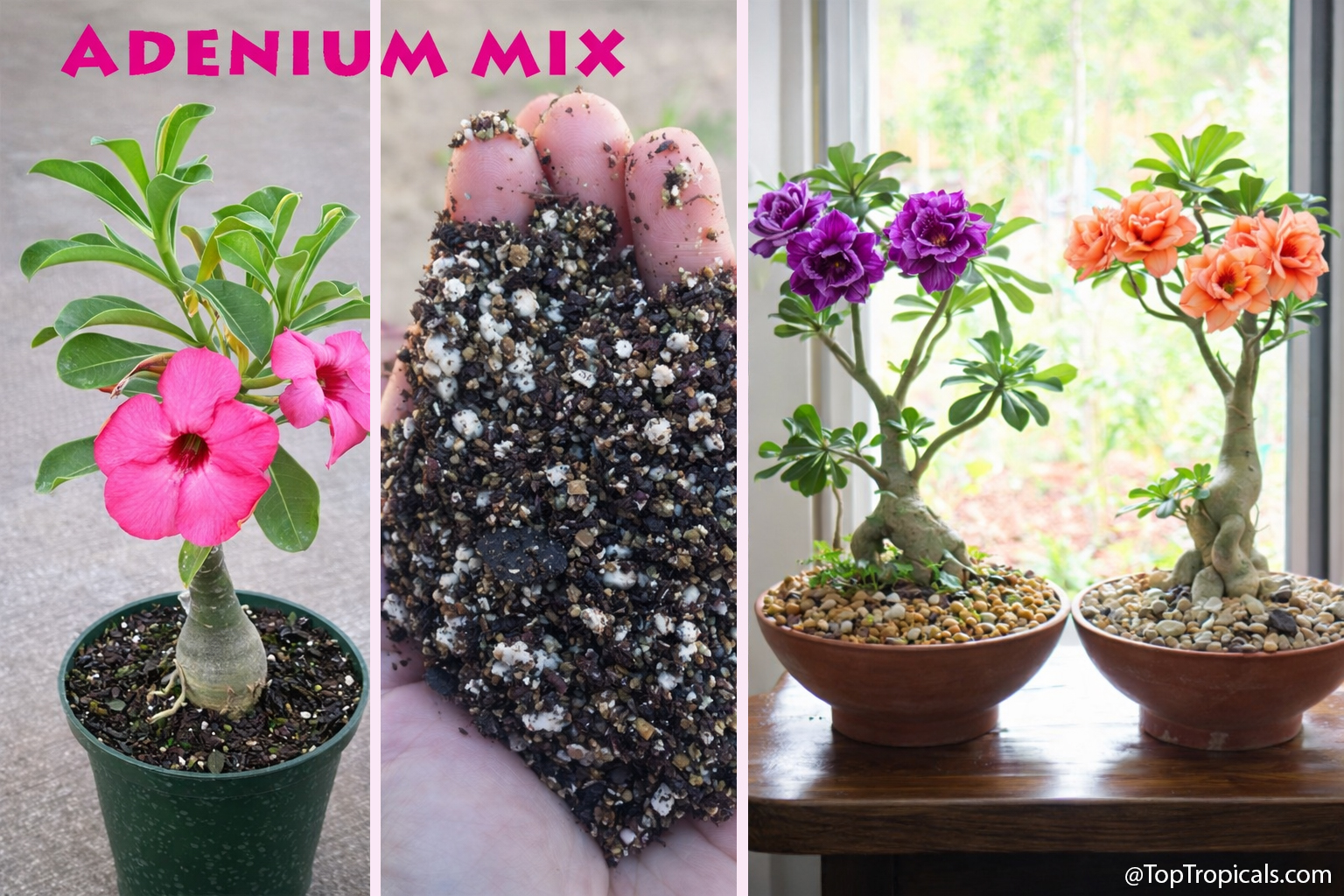
  • Pot and shaping - Use a shallow pot with excellent drainage. To develop a sculptural caudex, lift the plant slightly each time you repot and remove some of the top soil so upper roots become exposed. Over time, this creates a thicker, more prominent base.
  • Soil - Use a fast-draining Adenium potting Mix.
  • Adenium desert rose plant, fast draining soil mix in hand, and bonsai 
style adeniums blooming indoors

    Healthy adeniums start with the right foundation - a fast-draining soil mix and careful watering only when dry to avoid caudex rot.

  • Cold hardiness - Adeniums are tropical and do not tolerate frost. Keep above 40 F. Brief drops to mid 30s may be tolerated if dry, but cold and wet conditions can damage or kill the plant. In cooler climates, bring indoors or protect during cold nights.
  • Indoor winter care - Move plants indoors before cold nights. Place in the brightest spot possible, ideally a south-facing window. Or use additional lighting. Water very lightly and less often, as growth slows. Do not fertilize during dormancy. Some leaf drop is normal in winter.
  • Freshly grafted Adenium desert rose plants in dormancy arranged in 
greenhouse rows with bare branches

    Freshly grafted adeniums in dormancy - a crucial resting phase. Keep watering low (once a month) and avoid overcare; this is the time to let them rest and etablish.

  • Feeding - Adeniums respond best to liquid fertilizer. We apply Sunshine Megaflor Booster with each watering throughout the year. During dormancy, watering is reduced, so fertilizer use decreases accordingly. Consistent, light feeding promotes strong roots, a thicker caudex, and improved flowering.
  • Pruning - For multiple blooms, regular pruning is essential. After flowering, cut back long or leggy growth to stimulate branching. Each new branch can produce more buds, leading to a much fuller bloom in the next cycle.
Pruned  and  unpruned  Adenium  desert  rose  plants  showing  difference  in 
 branching  and  flowering

Pruned vs. unpruned - the difference is clear. The four plants on the left were trimmed 6 months ago, while the two on the right were not. Same species, very different results.

✍️ Learn more about Adeniums from our Blog

🎥 Watch videos of Adenium Rainbow

Free Shipping on Adeniums
Add bold color and unique forms to your collection with no extra shipping cost.

🛒 Explore Exotic Adenium varieties
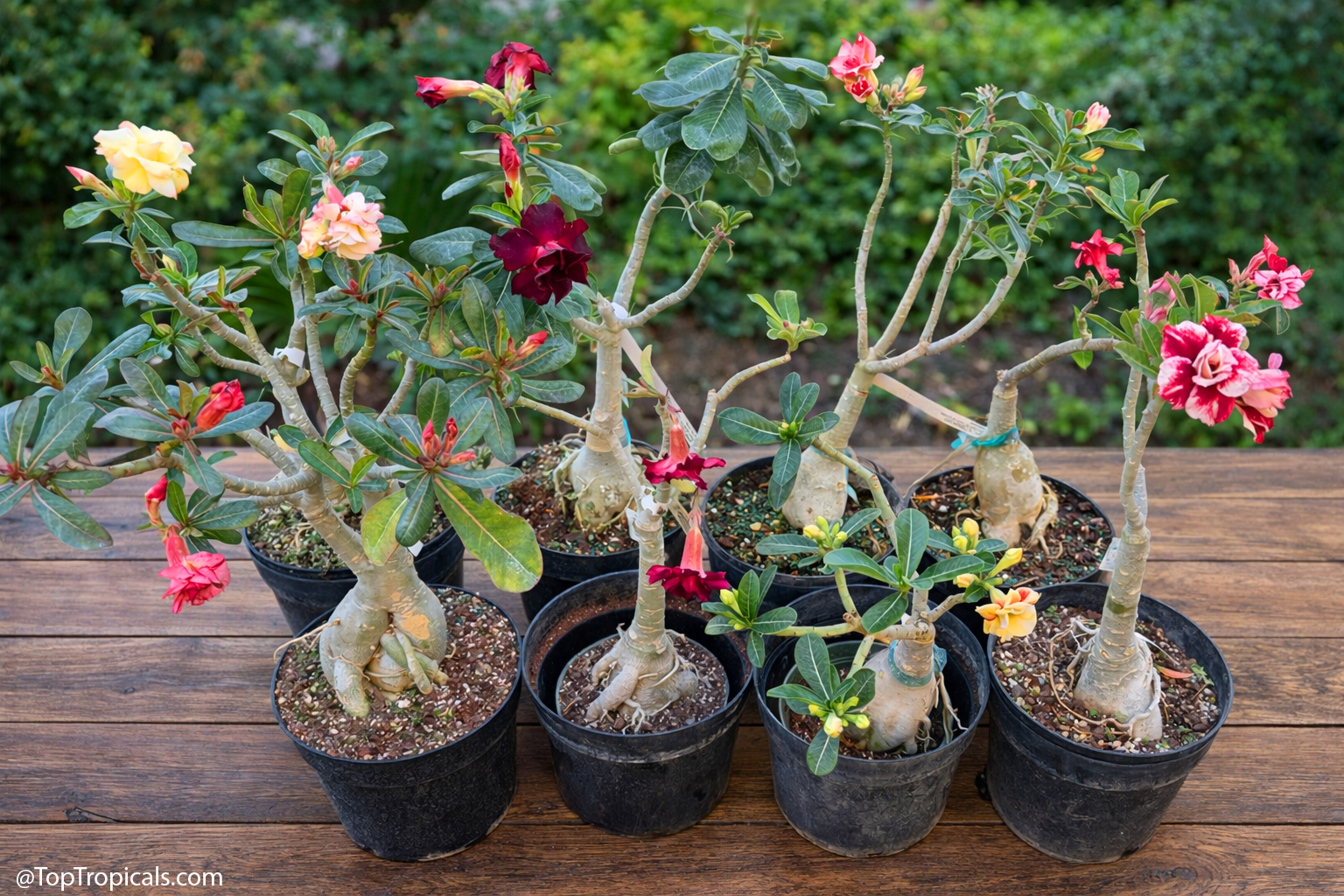
Leggy  Adenium  desert  rose  plants  with  sparse  branching  and  flowers, 
 ready  for 
 pruning

These Adeniums are screaming for pruning so they can bush out and produce more blooms

Date: 13 Apr 2026

🏖️ Aloha, Backyard Edition 🌈

Sunshine  ginger  tabby  cat  surfing  pool  wave  with  donuts  and  coffee 
 Smokey  tuxedo  cat  relaxing 
 nearby
Sunshine: Look what I can do. It all started with plumerias. Aloha, backyard edition.

Smokey: You are not just planting a tree - you are building a tropical island lifestyle around it. Not bad for staying home.

It usually starts simple. A plumeria in a pot by the patio. The flowers catch your eye first, then the scent follows you, soft but unmistakable. And that scent does something strange - it brings back places you have been, or places you wish you had. Warm evenings, ocean air, tropical vacations that stay with you long after they are over.

That is the part people do not expect. One plant changes how the space feels. But adding a few changes everything. Different colors, slightly different fragrances, layers that build on each other. It stops being a plant and becomes an atmosphere that pulls you outside without thinking.

Plumeria carries that tropical world with it. The same feeling people travel for can live right outside your door. Mix a few varieties, and your backyard starts feeling like a place you never want to leave.

plumeria  flowers  collage  multiple  colors  red  pink  yellow  white 
 frangipani  blooms  close  up

Plumerias are one of those plants you don't just grow - you start collecting. One turns into two, then five, then suddenly you want them all!

🛒 Explore plumeria colors

Date: 10 Sep 2024

We remember 9/11, and we always will

Two  kittens,  black  and  white,  with  American  Flag

"Darkness cannot drive out darkness; only light can do that. Hate cannot drive out hate; only love can do that." - Martin Luther King Jr.

As this day approaches, the weight of its memories fills our hearts - honoring the lives lost, the bravery of the heroes, and the resilience that carried us through such a difficult time.

In our journey of healing, let us stand united, supporting one another with love, kindness, and understanding. In times like these, tolerance and mutual respect, regardless of our differences, become gifts we share with the world.

Take a moment to appreciate what we have today, the people who surround us, and the ones who love us. Cherish them while they are here - today. Give a hug to those you love while you have the chance.

Nature offers us healing power in its quiet way. Fragrant flowers calm the mind, young fruiting trees represent renewal, every plant reminds us of life's resilience. As we reflect, may the beauty and growth around us help us find peace, and remind us of the strength that comes from standing together.

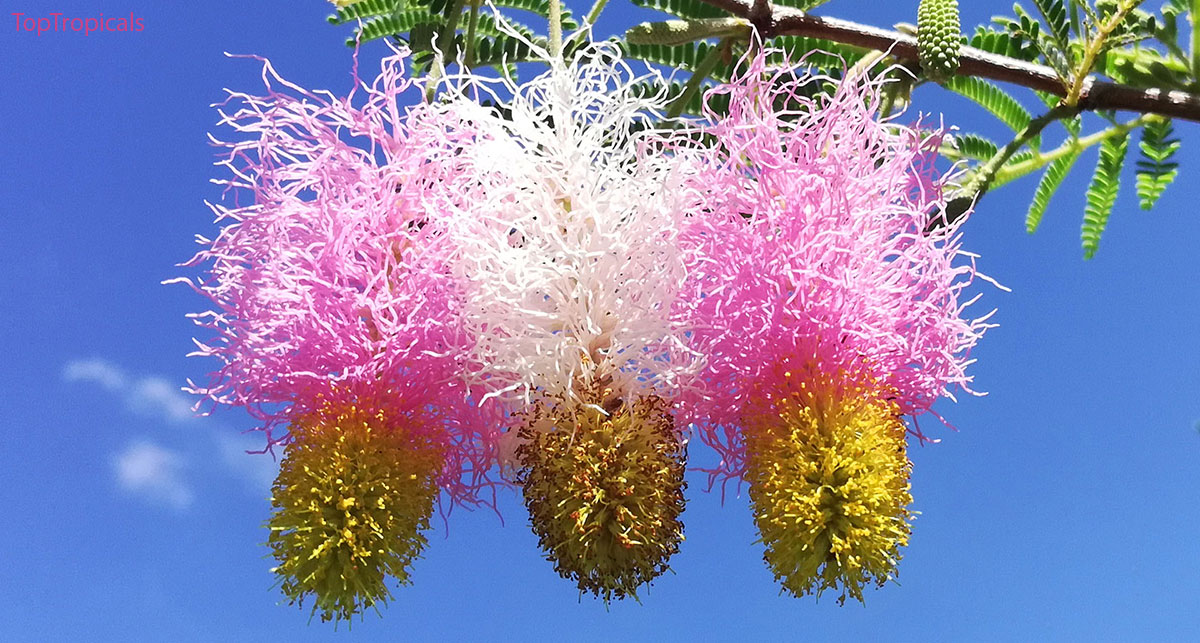
Dichrostachys  cinerea  -  Princess  Earrings,  Sickle  bush

In the photo above: Dichrostachys cinerea - Princess Earrings, Sickle bush from West Africa is one of the most unusual and unforgettable flowers of cheerful color combination... Let them bring hope, joy and sunshine into your day.

Date: 20 Oct 2025

11 tropical fruits to eat instead of taking a fiber supplement

Tropical fruits to eat instead of taking a fiber supplement

Tropical fruits to eat instead of taking a fiber supplement

🍑 11 tropical fruits to eat instead of taking a fiber supplement


When we think of tropical fruit, we picture sweetness, sunshine, and exotic flavors packed with vitamin C. But beneath all that juicy goodness lies another gift: dietary fiber - quietly working to support digestion, feed the gut microbiome, and help keep blood sugar steady.

Avocado leads the pack among tropical fruits for fiber content. One creamy, ripe fruit can provide around 10 grams of fiber, roughly a third of an adult’s daily need. And there’s more to avocado than fiber - it’s also rich in healthy fats, micronutrients, and that silky texture everyone loves.

Other tropical fruits bring their own kind of fiber strength. Guava delivers up to 9 grams per cup, plus a burst of vitamin C.

Mango offers about 3 grams in half a fruit, especially when eaten with some of the skin.

Pineapple, though not always seen as a fiber powerhouse, still contributes around 2 grams per cup, along with bromelain, the enzyme that helps digestion.

Jackfruit’s fibrous pulp makes it another standout - it’s so meaty, it’s even used as a plant-based substitute in savory dishes.

Sapote fruit (Mamey, Canistel) and Sapodilla add fiber with a smooth, custard-like texture.

Adventurous tropical varieties like Annona (custard apple, soursop) may not top the charts in fiber numbers, but their soft, fibrous flesh still adds value: about 1.3 grams of fiber per 100 grams of fruit.

Bananas contain both soluble and insoluble fiber; the soluble part (mainly pectin) helps control blood sugar and appetite, while the insoluble fiber aids regularity.

Mulberries are rich in insoluble fiber, especially in their skin, supporting digestion and promoting healthy bowel movements.

Dragon fruit offers a mix of soluble fiber in its juicy flesh and insoluble fiber from its tiny edible seeds, which help support gut health and feed good bacteria.

These fruits aren’t just delicious - they help you meet your daily fiber needs in ways that are far more enjoyable (and sustainable) than taking supplements. And when home gardeners, farmers, or tropical communities grow and share them, it’s a double win: nutrition and tradition hand in hand.

✔️ Tropical fiber power: tips for getting more fiber from tropical fruits


⏺Eat whole, not juiced. Most of the fiber is in the pulp, skin, and seeds. Juicing removes much of that goodness.
⏺Mix it up. Tropical fruits are great, but balance them with legumes, whole grains, nuts, and veggies for a full fiber range.
⏺Take it slow. If your diet is low in fiber, increase gradually to avoid bloating or discomfort.
⏺Drink plenty of water. Fiber works best when paired with hydration.
⏺Mind the ripeness. Unripe fruits can have more resistant starch, another form of fiber.
⏺Get creative. Toss tropical fruits into smoothies, salsas, breakfast bowls, or even desserts - a tasty stealth-fiber strategy.

🛒 Plant a fruit tree to harvest your fruit tomorrow

📚 Learn more:


Tropical fruit health benefits guide - what fruit and edibles can help with health issues and vitamin deficiencies, Part 1 and Part 2.

#Food_Forest #Remedies #Discover #How_to

🟢 Join 👉 TopTropicals

Date: 7 Dec 2025

Whats for breakfast? Guava versus Banana

Smokey: Guava for fiber, banana for power. Pick wisely.
Sunshine: I pick whatever requires zero effort.
Smokey: So... guava in a hammock. Perfect.

Smokey: Guava for fiber, banana for power. Pick wisely. Sunshine: I pick whatever requires zero effort. Smokey: So... guava in a hammock. Perfect.

🍉🍌 What's for breakfast? Guava versus Banana


Some mornings you want something light. Some mornings you want something that hits like a tiny energy bomb. That’s why people always compare guava and banana. Both are everywhere, easy to eat, and trusted since forever - from Ayurveda scrolls to modern nutrition charts.

But they’re not the same kind of morning fruit. Let’s walk through them like we’re in the kitchen deciding what to slice first.

🍉 Guava - the fiber champion


Guava looks innocent, but it’s one of the most nutrient-dense fruits.
Per 100 g: 68 calories, 5.4 g fiber, over 200 mg vitamin C, a little protein, and solid potassium.

Fiber does most of the work. It smooths digestion, keeps you full, and steadies blood sugar. Vitamin C boosts immunity, and antioxidants reduce inflammation. Studies suggest guava lowers LDL and triglycerides. Not bad for a tennis-ball-size fruit.

🍌 Banana - the quick energy classic


Bananas are the opposite personality: soft, sweet, ready in seconds.
Per 100 g: 89 calories, 22 g carbs, good potassium, and a little vitamin B6.

Bananas give fast energy without upsetting the stomach. Athletes eat them before workouts because carbs, sugars, and potassium wake up your muscles. Vitamin B6 helps mood and brain function, which is why a banana on a groggy morning works wonders.

They also pack antioxidants, polyphenols, and heart-protective compounds. Even the peel has nutrients (though not exactly breakfast-friendly).

📊 What studies say - quick notes


· Guava: anti-inflammatory, anti-hypertensive, anti-obesity, antioxidant, antidiabetic, antidiarrheal, boosts hemoglobin, supports dental health.
· Banana: antioxidants, fiber, vitamins C and E, carotenoids, flavonoids, and heart-protective compounds.

🔮 What Ayurveda says


· Guava calms Pitta and Kapha - great for acidity or sluggish digestion.
· Bananas balance Vata - grounding and nourishing - but can raise Kapha at night. Morning banana = good. Night banana = maybe skip.

🏆 Guava or banana - which one wins?


Both win, just in different ways:

🍉 Pick guava for:


· light, high-fiber start
· better digestion
· steady energy
· low calories
· weight control

🍌 Pick banana for:


· instant energy
· easy digestion
· pre-workout boost
· quick carbs
· soft, comforting fruit

🍉 Slow mornings love guava.
🍌 Busy mornings belong to banana.

For home growers


If you live in a warm climate, both fruits are incredibly rewarding to grow.

🍉 Why grow guava?


· Fruits in 1-2 years.
· Compact for small yards or containers.
· Super productive when mature.
· Needs only sun, warmth, and pruning.
· Homegrown flavor is sweeter and more aromatic.

🍌 Why grow banana?


· Grows fast and looks lush.
· One mat can feed a whole household.
· Dwarf varieties fit small gardens.
· Homegrown bananas taste richer and creamier.
· When a bunch ripens, breakfast is handled for a week.

Growing your own fruit means you’re never out of a healthy breakfast. Something is always ripening, always ready to pick, and always sweeter than anything you buy.

✍️ Scientific reference


· USDA National Nutrient Database: Banana, raw. Guava, raw.
· Journal of Food Biochemistry: Antioxidant and anti-atherosclerotic potential of Banana.
· International Journal of Pharmaceutical Sciences Review and Research: Guava (Psidium guajava). A brief overview of its therapeutic and health potential
· International Journal of Innovative Research in Engineering & Management: An analysis of health benefits of guava.

🛒 Grow your perfect breakfast for any day - Guava and Banana

📚 Learn more:


🟡More posts about #Bananas and #Guava
🟡From Plant Encyclopedia: Banana and Guava plants
🟡Guava beats banana in the potassium game

📱 Watch YouTube short videos:


' target="_blank" rel="noopener noreferrer">Six guava varieties that will keep you picking year-round.
' target="_blank" rel="noopener noreferrer"> Why every garden needs a Banana tree

#Food_Forest #Bananas #Guava #Remedies #Discover

🟢 Join 👉 TopTropicals