Garden Blog - Top Tropicals

Date: 10 Sep 2025

Pitaya vs Dragon fruit - what is the difference and how to grow it?

Pitaya vs Dragon fruit - what is the difference and how to grow it?

🌵 Pitaya vs Dragon fruit - what is the difference and how to grow it?

Both names refer to climbing cacti in the genus Hylocereus. The word pitaya is more common in Latin America, while dragon fruit is the name used in Asia and English-speaking countries. They come in different types: white-fleshed (Hylocereus undatus), red-fleshed (Hylocereus costaricensis), and yellow-skinned (Hylocereus, or Selenicereus megalanthus). All share the same growth habit and care needs. Pitaya or dragon fruit - whichever name you use, it's one of the easiest exotic fruits to grow at home.

  • 🍉 How to grow Dragon Fruit


  • Get a desired variety or start from a cutting - let the cut end dry for a few days before planting to prevent rot.
  • Plant in well-draining soil with lots of sun.
  • Give it a strong support to climb on - it's a vining cactus.
  • Water deeply but let the soil dry between waterings.
  • Flowers open at night and need pollination - some types are self-fertile, others need cross-pollination.
  • With care, you can enjoy fruit in 1-2 years. Remember to ferilize!


🍉 Dragon fruit varieties


  • 🔴 ⚪️ Red skin, white flesh (Hylocereus undatus) - The most popular type, and the biggest fruit. Mildly sweet, refreshing, and often compared to a kiwi crossed with a pear.
  • Varieties: David Bowie, Delight, Hana, Lake Atitlan, Seoul Kitchen, Vietnamese Jaina, Hana

  • 🔴🔴 Red skin, red flesh (Hylocereus costaricensis) - Sweeter, juicier, and more intense in flavor. The deep red juice can stain, but it’s loaded with antioxidants.
  • Varieties: American Beauty, Bloody Mary, Eureka Red, Costa Rican Sunset, Mac Edwin, Halleys Comet, Mac Edwin, Makisupa, Mega Red, Physical Graffiti, Sweet Red

  • 🔴🟣 Red flesh, purple/magenta flesh (Hylocereus x costaricensis) - Hybrids, usually between red and white varieties.
Varieties: Cosmic Charlie, Edgar's Baby, Halleys Comet, Natural Mystic, Physical Graffiti, Purple Haze, Tricia, Voodoo Child, Zamorano

🟡⚪️ Yellow skin, white flesh (Hylocereus, or Selenicereus megalanthus) - Smaller fruit, but the sweetest of all. Crisp, juicy, and tropical with notes of pineapple or honey.
Varieties: Amarilla (Kirin), Colimbiana, Godlen Dragon, Palora, Thai Gold (Hawaiian)

Each type looks stunning and tastes slightly different, but all are easy to grow once you give them sun, support, and patience.

🛒 Explore and collect Dragon Fruit varieties

📚 Learn more:


#Food_Forest #How_to #Dragon_Fruit

🟢 Join 👉 TopTropicals

Date: 13 Oct 2025

How long does it take for a mango tree to bear fruit?

How long does it take for a mango tree to bear fruit? How long does it take for a mango tree to bear fruit? How long does it take for a mango tree to bear fruit? How long does it take for a mango tree to bear fruit?
🥭 How long does it take for a mango tree to bear fruit?

  • 🥭 A Mango tree (Mangifera indica) grown from seed can take anywhere from 7 to 10 years to start fruiting, depending on conditions. Doesn’t sound too exciting, ah? Besides such a long wait, you never know how good the fruit will be – most likely it'll taste fibrous and not very sweet. Unless your cross-pollination was perfectly set between some top-notch parent cultivars, it's a gamble. Seedling results are always hit or miss.

  • 🥭 That's why you need a grafted tree – it fruits soon (in the ground or in a large container) and guarantees the quality of the fruit. There are hundreds of cultivated varieties to choose from: juicy, sweet, and flavorful. Some taste like pina colada, pineapple, or lemon meringue pie, others like peach sherbet or even guava! The mango flavor spectrum is broader than that of apples!

  • 🥭 So, you’ve got yourself a nice mango tree in a container and can’t wait for your first harvest. How soon?
  • Mango trees start flowering from early winter (early cultivars like Nam Doc Mai) to early spring (late cultivars like Keitt). One little tree can produce hundreds, even thousands of tiny flowers, but not all will set fruit. The younger the tree, the fewer fruits it can hold. Expect just a few the first year. Even if your mango sets a lot, don’t keep them all - let the young tree focus on establishing roots and strong growth. Leave 1-2 fruits and remove the rest. Your tree will thank you and grow fast and sturdy.

  • 🥭 By the second year, you can let your tree keep a bit more fruit. Young trees usually know their limits and will naturally drop any extra fruit they can’t support. Within 2–3 years, you’ll be harvesting good crops – enough to enjoy yourself and share with friends!

  • 🥭 Remember, a strong, healthy tree produces sooner and more. Feed it with Sunshine Mango Tango liquid booster or Green Magic controlled-release fertilizer, and protect it from frost, especially while young. Once established, your mango will reward you with reliable, abundant harvests year after year.


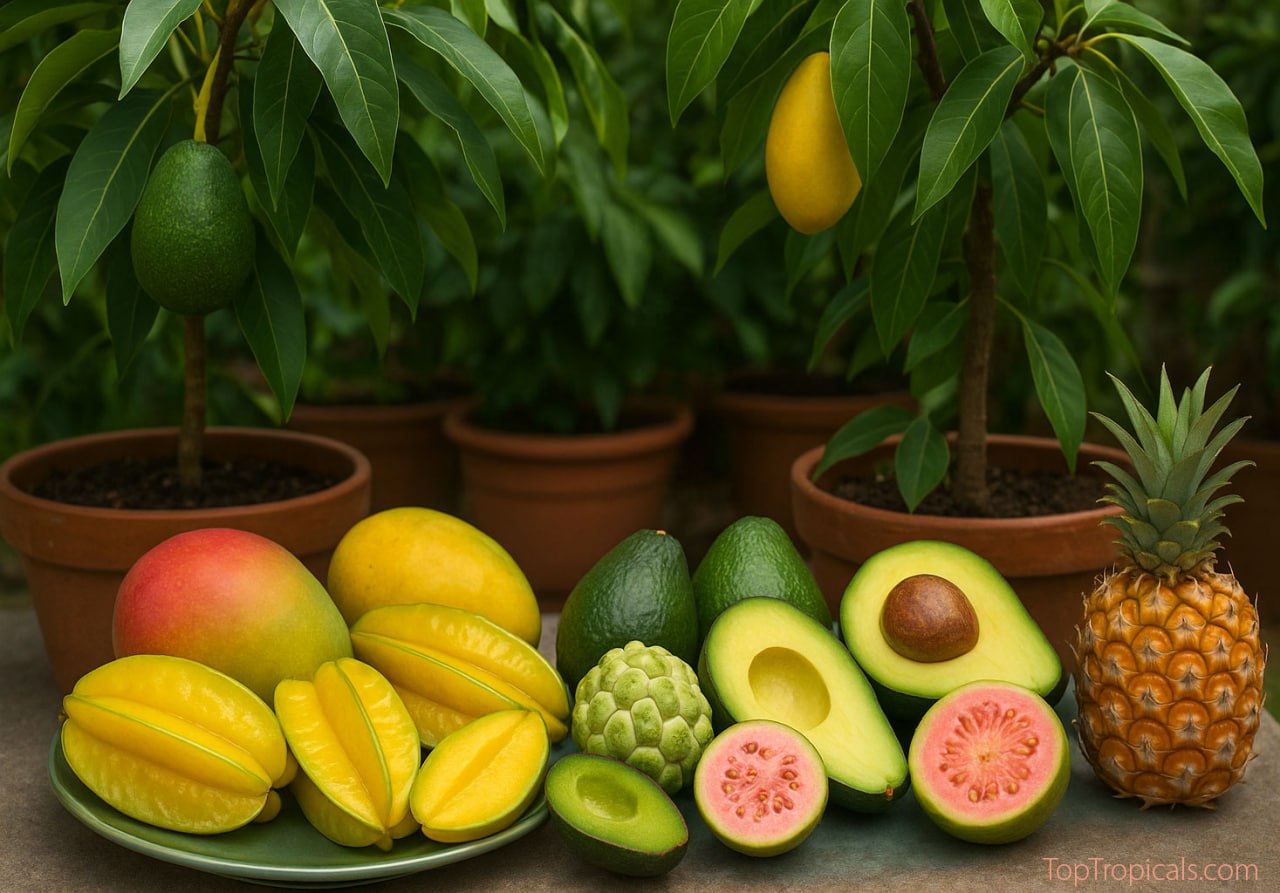
📸 In the photos: the trees in 7 gal pots are 2 years from grafting, and the trees in the ground are 1 year from the time of planting and 3 years from grafting.

🛒 Shop Mango varieties

📚 Learn more about #Mango and different varieties: #Mango_Rainbow

#Food_Forest #Mango

🟢 Join 👉 TopTropicals

Date: 23 Jul 2016

Leo Zodiac lucky plants

Leo - 7/23-8/22. Naturally, Leo is a FIRE sign ruled by the brilliant Sun. Leo's plants are usually large and gold or orange in color, have heart-shaped leaves or a radiating shape, or have association with victory (like the Bay Leaf). Leo loves this colorful and special spice, which is known for amplifying prosperity and abundance.

The part of the body ruled by Leo the Lion is the heart. Plants related to Leo are primarily associated with the cardiac system, but also with the spine, the thymus gland, and the eyes. They strengthen and tone the heart, regulate blood pressure, raise the spirits and have an uplifting effect. Keep in mind that all cardio-active medicinal herbs should be used only in consultation with a qualified professional.

Leo Zodiac lucky plants: Sunflower tree, Delonix, Hibiscus, Abutilon, Mahoe, Hawaiin Sunset Vine (Stictocardia), Campsis, Passion flower, Calendula, Mexican Flame Vine, Bay Leaf, Safflower, Mint, Rosemary, Ruda - Ruta graveolens, Marigolds, Sunflowers, Palm trees, Lemon and orange trees, Grapefruit, Dieffenbachia , Croton, Lemon Balm, Chamomile, Tarragon, Kaligottu (Stereospermum chelonoides), Bel Fruit, White Madaar, Peppers, Pineapple, Coconut, Anise, Heliotrope, Gingers, Lavender, Ashoka Tree, Dombeya, Jacquemontia, Lychee, Mulberry, Philodendrons, Macaranga, Anthuriums, Aphelandra, Orchid trees, Leonotis.

For other signs information, see full Plant Horoscope.

Date: 18 Aug 2023

Does Size Matter?

TopTropicals plants vs other mail order plants

Cat  shipping  plants

Q: I purchased various plants via mail order (including a Coffee tree and some flowering vines) from companies *** and ***, but they did not survive, possibly due to their small size and the stress of shipping. Could you provide information about the size of your plants, their resilience to shipping stress and the time required for establishment?

A: Plants, as living beings, may experience stress during a few days of travel in a dark box. However, the critical factor influencing their survival is the plant's size. Most of our plants are grown in pots ranging from 1 to 3 gallons, have established root systems and developed branches. Some even feature flowers and fruit, although these may drop during transit. We've included images comparing our 1 gallon size plants with those from other mail-order firms we previously obtained for our own collection.

Understanding that post-shipping plant establishment is a gradual process is crucial. Yet, most plants handle shipping well and commence new growth within days to a couple of weeks post-arrival. Here are some success pointers:

1) Opt for a container matching the root ball size, avoiding excessive sizing until growth initiates.
2) Begin in a shaded area, progressively transitioning to brighter spots.
3) Apply Sunsine Epi spray to lessen stress and enhance vitality. 4) Initiate fertilization once the plant displays fresh growth.

For more information on how to establish mail order plants, simply download our Plant Care Guide.

Side-to-side  pineapple  plant  from  Top  Tropicals

Side-to-side  coffee  tree  from  Top  Tropicals

Side-to-side  orchids  from  Top  Tropicals

Date: 2 Apr 2022

Grow Your Own Food:
Costa Rican Guava - Guava for Drinking!

Cas  Guava  -  Psidium  friedrichsthalianum,  Fruit

by Alex Butova, the Witch of Herbs and Cats

...Looking for a handsome, unusual fruit tree for container culture with healthy and flavorful fruit? Or simply want an easy fruit tree that is hardy and undemanding? Psidium friedrichsthalianum (family Myrtaceae), the Costa Rican Guava or Cas Guava, is a perfect small guava tree that can be very rewarding. In Nicaragua it is called "Guava for Drinking" or "Fresco de Guava". Despite the tartness, the flavor is excellent with passionfruit and pineapple tones and is much more pronounced than the subtle flavor of the common Guava. These fruits are very much a part of the culture and cuisine of Costa Rica. Also it has been successfully grown in California now and can be grown in many subtropical regions or as a container plant - "condo" fruit tree...

Cas  Guava  -  Psidium  friedrichsthalianum,  Tree