Garden Blog - Top Tropicals
Date: 28 Sep 2026
Our Jamun Tree is overflowing: 7 amazing ways to use hundreds of purple berries

🍆 Our Jamun Tree is overflowing: 7 amazing ways to use hundreds of purple berries
Our Jambolan (Syzygium cumini) tree has a problem I wish more fruit trees had: way too much fruit.
When the crop ripens, the branches are covered in glossy purple-black berries. They’re juicy, sweet-tart, and delicious fresh - but after eating a handful, you look at the rest of the tree and think, “OK, now what?”
People who have grown Jambolan (also widely known as Jamun, Java Plum, or Jambul) across South Asia for centuries have figured out plenty of answers.
First, Try the Salt Trick
In India, ripe Jamun is almost always paired with salt.
The trick: Place the berries in a covered bowl with a pinch of salt (or Black Salt / Kala Namak) and give them a vigorous shake.
It sounds strange, but salt cuts through the natural astringency, balances the sweet-tart profile, and enhances the rich berry flavor.
🍋🌶 Want to take it further? Add a squeeze of fresh lime juice and a dash of chili powder.
- 7 Delicious Ways to Use a Jambolan Surplus
• 1. Make a Refreshing Summer Drink: Mash the berries, strain the seeds, and blend the juice with cold water, lime, a dash of honey, and plenty of ice.
• 2. Simmer Sweet-Tart Jam or Jelly: Jambolan’s bold acidity makes it ideal for preserves, transforming a mountain of perishable fruit into shelf-stable jars.
• 3. Cook a Spicy Chutney: Simmer the fruit with fresh ginger, chili, vinegar, sugar, and spices. It yields a sweet, sour, and spicy condiment that pairs amazingly with grilled meats, rice, or curries.
• 4. Dehydrate into Fruit Leather: Puree the fruit, spread it thin on baking sheets, and dry it out. A huge bucket of berries quickly condenses into chewy, portable purple snacks.
• 5. Freeze Sorbet, Ice Cream, or Pulp: Jambolan’s intense natural color pops in frozen yogurt or sorbet. Alternatively, freeze portioned pulp in ice cube trays for year-round smoothies.
• 6. Brew Purple Vinegar: Fermenting overripe or bruised fruit into vinegar is a traditional preservation method—meaning even imperfect berries don't go to waste.
• 7. Ferment Jambolan Wine: When your harvest is measured in buckets rather than bowls, wine-making makes perfect sense. Jambolan has a long history of home-fermentation across India and the Philippines. - More Than Just a Fruit Tree
Even beyond the kitchen, Syzygium cumini is an extraordinarily useful tree:
• For Bees & Wildlife: The blossoms provide abundant nectar for local pollinators.
• For Landscaping: Very vast growing, branching and dense plant, it is historically planted for shade, windbreaks, and soil stabilization.
• For Craft & Household: The leaves serve as livestock fodder, the bark produces natural tannin and dyes, and the dense timber is used for woodworking.
So maybe the issue isn't that the tree produces too much fruit - we just need a bigger kitchen arsenal.
With another bucket waiting under the branches, it's time to start experimenting!
🛒 Plant a Jambolan - You’ll Need a Bigger Bucket!
📚 Learn more:
• Syzygium cumini in Plant Encyclopedia
• 10 reasons to grow this Indian secret tree - the miracle Fruit of the Gods you never knew about
• The Divine Berry - large, bushy, exotic fruit tree in no time
#Food_Forest #Hedges_with_benefits #Recipes #Discover


Date: 27 Sep 2026
Daily Cat Lesson: Cats Are Liquid
🐾 Daily Cat Lesson: Cats Are Liquid
Cats have an extraordinary talent for finding the smallest available space - and putting themselves in it.
There is a scientific fact: cats are LIQUID.
A liquid takes the shape of its container - and cats seem remarkably capable of doing exactly that.
- 🐾 Why do cats love tight spaces?
A small enclosed spot feels protected, holds warmth and provides a perfect hiding place from which to watch the world - or ambush something passing by. - 🐾 How do they squeeze in there?
Cats have extremely flexible spines and mobile shoulders. Their clavicles don't form the rigid shoulder framework ours do, helping them squeeze through surprisingly narrow openings. - 🐾 If I fits, I sits.
There is an important feline law:
An empty container cannot legally remain empty while a cat is present.
If I fits, I sits.
Because cats are liquid.
💡 Fun fact: "Are cats liquid?" actually became a published physics paper and won the 2017 Ig Nobel Prize in Physics.
Scientists have actually studied whether cats are liquid.
Physicist Marc-Antoine Fardin's On the Rheology of Cats explored how cats adapt their shape to containers. The research earned him the 2017 Ig Nobel Prize in Physics.
The paper was published in Rheology Bulletin in 2014. He used principles of rheology - the science of how materials deform and flow - to explore whether a cat can behave as both a solid and a liquid.
In 2017, Fardin received the Ig Nobel Prize in Physics “for using fluid dynamics to probe the question Can a Cat Be Both a Solid and a Liquid?"
- Official Ig Nobel winners - Improbable Research
⛔️ Just make sure unusual containers can't trap your little physicist inside.
🐈📸 Top Tropicals rescued cat Philemon sits where he fits at PeopleCats.Garden.
🐈 Stay with us for your Daily Dose of Cat! #DailyCatLesson #PeopleCats
🟢 Join 👉 TopTropicals
Date: 27 Sep 2026
FAQ: Potting Mix Questions Answered

✍️ FAQ: Potting Mix Questions Answered
Whether you're new to container gardening or have years of experience, these are some of the questions we hear most often at Top Tropicals.
- ❓ Perlite vs. Vermiculite - What's the difference?
Although they look similar, they do different jobs.
Perlite is expanded volcanic rock that improves drainage, aeration, and keeps potting mix loose for years. That's why we prefer it for most tropical plants.
Vermiculite holds much more water, making it better for seed-starting and moisture-loving plants than for fast-draining tropical mixes. - ❓ Can I reuse potting mix?
Yes, if it still drains well and came from a healthy plant. Remove old roots and refresh the mix if needed. Discard potting mix from diseased plants. - ❓ Does potting mix expire?
Not exactly. Over time, the organic ingredients slowly decompose, reducing air spaces and drainage. That's why older potting mix becomes denser. - ❓ Why does potting mix shrink?
Pine bark, peat moss, and coconut coir naturally break down over time, causing the soil level to drop. Refresh or replace the mix every few years. - ❓ Why does perlite float?
Because it's extremely lightweight. Some pieces naturally rise to the surface after watering. This is completely normal. - ❓ Should I sterilize old potting mix?
Usually not. If the mix came from a healthy plant, simply remove the old roots. Sterilization is rarely necessary. - ❓ Can I make my own potting mix?
Absolutely. Many professional nurseries do. Our proven "Abundance" mix contains 50% pine bark, 25% perlite, 20% coconut coir, and 5% Canadian peat moss - a formula we've successfully used for decades. - ❓ What soil pH do tropical plants prefer?
Most tropical plants grow best in slightly acidic soil with a pH of about 5.5-6.5. That's one reason professional mixes often contain pine bark, peat moss, and coconut coir. - ❓ Should I add sand?
Only if you're growing plants that need exceptional drainage, such as adeniums, plumerias, cacti, and succulents.
Always use coarse horticultural sand. Never use beach or fine play sand. - ❓ Why shouldn't I use shell rock?
Shell rock, limestone, crushed coral, and oyster shell raise soil pH. Most tropical plants prefer slightly acidic conditions, so clean river rock is a much better decorative choice.
💡 The bottom line
Healthy plants begin with healthy roots.
Give them an airy, well-drained potting mix, and everything else becomes much easier.
🛒 Get Our Proven Professional Potting Mix
📚 Learn more
· The complete guide to potting mix
· 12 Potting Mix Mistakes That Kill Container Plants
· What Makes a Great Potting Mix Recipe, the Best Ingredients
· Potting Mix Explained: Why Garden Soil Kills Container Plants
· How much water is too much?
· How to re-pot a plant properly
#Fertilizers #How_to #Discover
🟢 Join 👉 TopTropicals
Date: 26 Sep 2026
Daily Cat Lesson: Whats Inside That Cat Smile?
🐾 Daily Cat Lesson: What's Inside That Cat Smile?
- 🐾 How Many Teeth Does a Cat Have?
Adult cats have 30 teeth:
• 12 incisors: 6 tiny front teeth on top + 6 on the bottom. Used for nibbling, grooming, and delicate picking.
• 4 canines: the four big fangs for grabbing and puncturing prey.
• 10 premolars: 6 upper + 4 lower. Sharp teeth used mainly for cutting and shearing food.
• 4 molars: 2 upper + 2 lower, also primarily for slicing rather than grinding. - 🐾 Those big fangs are called canines.
They're designed for grabbing and holding prey. The smaller incisors between them help with delicate jobs - including grooming and nibbling things from the fur.
🐾 Kittens are born completely toothless.
Their 26 baby teeth start appearing at around 2–3 weeks old.
At about 3–4 months, those baby teeth begin falling out and 30 permanent teeth take their place.
🐾 Do kittens teethe like human babies?
They do! Their gums can be tender and uncomfortable, and many kittens develop a strong desire to chew things while their permanent teeth are erupting. Toys, cardboard, furniture, fingers, electrical cords - everything becomes a potential teething device.
💡Fun fact: owners often never find the lost baby teeth. Kittens frequently swallow them while eating, which is harmless.
By about 6-7 months, the transformation is complete:
From toothless potato to fully equipped miniature predator.
- 🐾 Cats don't really chew like we do.
Their sharp back teeth work more like scissors, slicing meat into pieces that can be swallowed. Their jaws are much better at moving up and down than grinding side to side. - 🐾 Cats can get cavities - but rarely.
The bigger dental problems are usually plaque and tartar, gum disease, broken teeth and tooth resorption, a painful condition in which the tooth structure begins to break down. - 🐾 Cats are very good at hiding dental pain.
Bad breath, drooling, dropping food, chewing on one side, pawing at the mouth or suddenly preferring softer food can be clues.
😸 Best prevention?
Regular dental checks and, if your cat permits such outrageous human interference, brushing with cat-safe toothpaste. Never use human toothpaste.
💡 One final fact:
Those impressive fangs belong to an animal who may still need you to open his pâté for him.
🐈📸Pelmen the Sphynx cat - a friend of TopTropicals PeopleCats.Garden.
🐈 Stay with us for your Daily Dose of Cat! #DailyCatLesson #PeopleCats
🟢 Join 👉 TopTropicals
Date: 26 Sep 2026
The Tree That Stinks and Flies: Shitwood
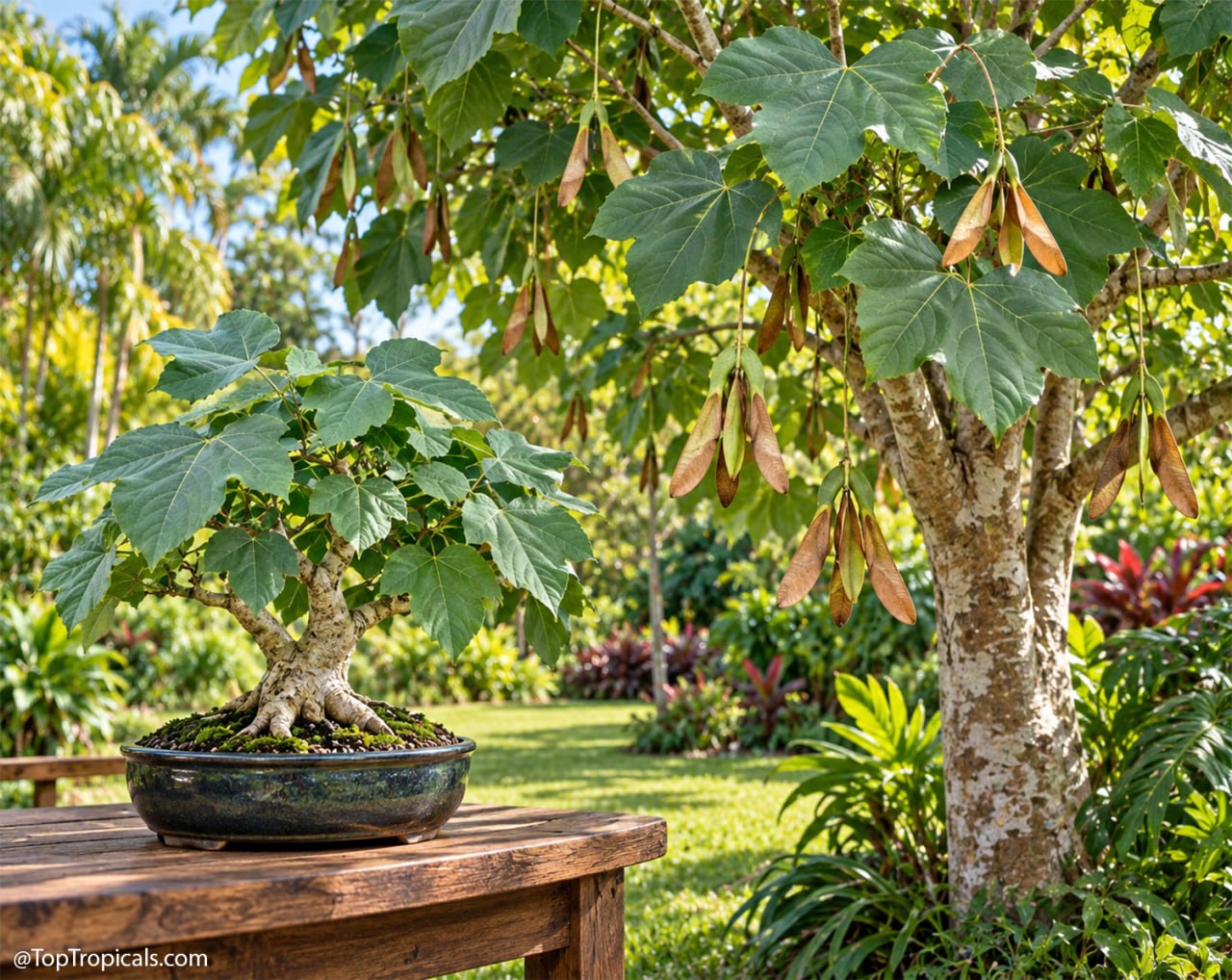
💩 The Tree That Stinks and Flies: Shitwood Gyrocarpus
Some plants attract you with perfume.
This one went in a completely different direction.
Gyrocarpus americanus has collected an impressive assortment of names: Helicopter Tree, Propeller Tree, Whirly Whirly Tree, Stinkwood - and, yes, Shitwood!
Our plant came from Thailand. And long before it flowers, you understand the name. Rub or crush a leaf and you'll notice a very distinctive smell. Not exactly jasmine.
🚁 A tree with its own helicopters
The name Gyrocarpus comes from Greek words referring to turning or rotating fruit.
Its woody fruits develop two long wings. When they fall, they spin like tiny helicopters, slowing their descent and helping the wind carry them away.
Across several Pacific islands, children traditionally tossed the fruits into the air just to watch them whirl back down. The original flying toy!
It may fly like a maple seed, but Gyrocarpus isn't related to maples at all - nature invented the helicopter more than once. Maple fruits are true samaras, while Gyrocarpus produces a pseudo-samara, with its propeller wings formed from persistent flower parts.
🚁 From Thailand to almost everywhere
Despite the name americanus, this isn't simply an American tree. Its enormous natural range stretches through tropical Africa, India and Sri Lanka, Southeast Asia - including Thailand - northern Australia and Pacific islands, as well as parts of Central and South America.
In Thailand it has local names including puu le and sao.
Older references may list it as Gyrocarpus asiaticus or Gyrocarpus jacquinii. Today these are generally treated under the accepted name Gyrocarpus americanus.
🚁 An ancient useful tree
Its history goes far beyond being a botanical oddity.
The wood is very light and easy to work. Aboriginal peoples in Australia traditionally carved it into coolamons - wooden vessels for carrying food, water and other materials. Gyrocarpus even appears in Indigenous Dreaming traditions, where a tree can represent an ancestral coolamon.
Elsewhere in the Pacific, its lightweight wood was used for canoes and traditional objects.
Not bad for a tree called Shitwood!
🚁 And then there's that smell
You don't have to wait for flowers.
Our young plants haven't bloomed yet, but the leaves themselves already have a strong, distinctive odor when handled or crushed. Historical Pacific descriptions even compare the foliage smell to garlic. Mature flowers reportedly add their own strong scent.
Stinkwood, apparently, earned its name.
🚁 A giant tree that makes a great bonsai
In nature, Gyrocarpus americanus can eventually become a substantial deciduous tree. But young plants have another talent:
They make fantastic bonsai.
The smooth pale trunk develops character quickly, with open architectural branching and unusual lobed leaves. With pruning and shaping, even a young plant can look like a strange miniature ancient tree.
And this isn't just another pretty bonsai.
It's a tree from Thailand with smelly leaves, ancient cultural history, lightweight wood once used for vessels and canoes - and fruits that fly like helicopters.
Weird name. Weird smell. Flying seeds. Great bonsai.
What more could a plant collector ask for?
🛒 I Need This Weird Tree!
📚 Learn more


· Gyrocarpus americanus in Plant Encyclopedia
· Green in July, Variegated in January: Red-Stem Serissa
· Gout Plant - the Ultimate Natural Bonsai
· Coral-blooming bonsai with a bottle-shaped trunk - perfect container plant
· Why in Thailand Wrightia religiosa is near all temples and homes
· Surprising Miniature Gardenia
· The crown of thorns with no thorns!
· How to make bonsai with Shaving Brush Tree
· Half-n-Half Parrot's Beak
· Ponytail Palm - The Quirky Plant with a Big Personality
· How to grow Bougainvillea bonsai
· Adog poo is a beauty from Argentina
#Container_Garden #Discover #Trees
🟢 Join 👉 TopTropicals