Garden Blog - Top Tropicals
Date: 26 Aug 2026
Green in July, Variegated in January: Red-Stem Serissa
🌿 Green in July, Variegated in January: Red-Stem Serissa
At first glance, this little shrub looks like a mistake.
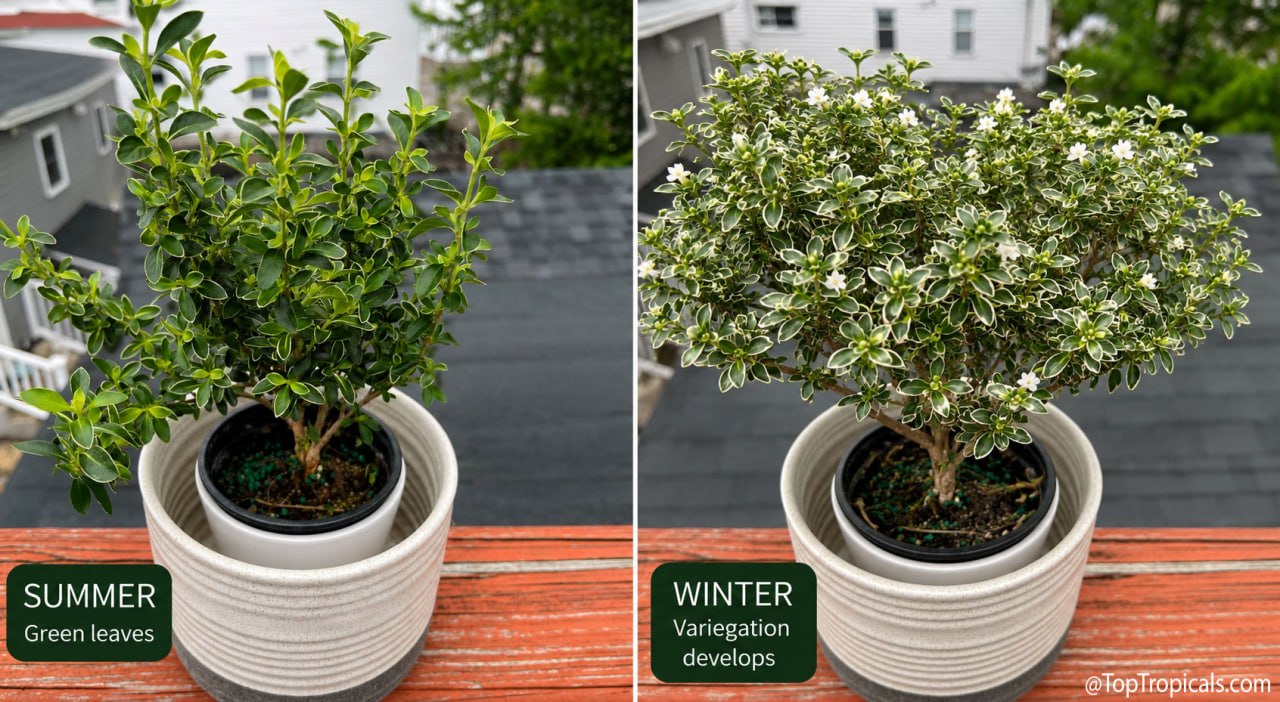
It came labeled as an "outer-variegated red stem" Serissa, yet in the dead of summer, its tiny leaves are completely, unremarkably green. Where is the pattern? Where is the variegated foliage?
The answer came directly from longtime rare-plant grower Sid Gardino: Wait until Winter.
🌿 The Winter-Variegated Serissa Experiment
This unusual Serissa selection holds back its visual showcase until the temperature drops. As cooler weather sets in, the foliage undergoes a seasonal shift, pushing out vivid cream margins off-set by rich, reddish young stems.
☀️ Summer: Deep Solid Green - Heavy star-shaped blooming
❄️ Winter: Cream-Variegated Edges - Frosted look with reddish stems
🌿 The Mystery of Seasonal Variegation
Seasonal foliage shifts sound like a classic "nursery myth," but the science backs it up.
Serissa japonica (still widely known in horticulture as Serissa foetida) has a documented history of temperature-dependent foliage:
'Mt. Fuji': A famous cultivar whose white-and-green striping expands or shrinks based on light, heat, and plant nutrition.
'Pink Mountain': A documented selection specifically noted for producing variegated foliage primarily during winter months.
While environmental triggers like day length, light intensity, and growth rate play a role, cool winter air is the primary switch that activates the cream-colored margins on this specific red-stem clone.
🌿 Why Gardeners & Bonsai Artists Love Serissa
Commonly called Tree of a Thousand Stars or Snow Rose, this Asian native in the Rubiaceae (coffee) family is prized far beyond its chameleon foliage.
Massive Bloom Cycles: The shrub gets its nickname from hundreds of tiny, white, star-like blossoms that bloom heavily from spring through autumn.
Natural Miniaturization: With tiny leaves, naturally fine branching, and ultra-short internodes, Serissa naturally scales itself down. Older plants quickly develop gnarled, woody trunks.
Versatile Sizing: While it reaches 2 to 4 feet in the ground, simple pruning easily maintains it as a compact patio container, miniature shrub, or indoor bonsai.
🌿 How to Care for the Red-Stem Serissa
Light: Bright, direct morning sun with afternoon shade protection. Full, brutal summer sun can scorch the delicate variegated leaf margins.
Watering: Keep the soil consistently moist, airy, and well-draining. Serissa is sensitive to abrupt moisture swings; bone-dry soil triggers massive leaf drop, while soggy mud rots the roots.
Hardiness: Typically evergreen in USDA Zones 7–9. Cold weather encourages its winter variegation, but potted plants should be protected from hard freezes to protect root systems.
💡Botanist's Note: Serissa earned its old species name, foetida, because its leaves release an earthy, sulfur-like odor—but only when crushed or pruned. Left alone on your patio, it smells completely neutral.
🌿 The Experiment Begins
The summer foliage photo is taken, solid green and waiting. As the cooler Florida months arrive, we will be tracking this exact red-stem selection to document its transition into full winter variegation.
🛒 See It Change: Get Yours Today
📚 Learn more


· Serissa japonica (foetida) in Plant Encyclopedia
#Container_Garden #Discover
🟢 Join 👉 TopTropicals