📅 Do Not Miss: March 21
- Spring Equinox Plant Market
🍩 Saturday, March 21, 2026: 9 am - 4 pm
Sunshine: Smokey, look at me! See what I can do on my bike? I'm
practicing to give people what they like: coffee and donuts.
Smokey: You'd be perfect for a Gulf beach cafe. But gardeners don't
come here for donuts.
Sunshine: Really? Then why do they come?
Smokey: Some gardeners lost plants to the freeze. Others want trees
that will handle winter better. Cold-hardy avocados. Macadamia. Grumichama.
And some just come for fun - to see the PeopleCats. Sunshine: And my charm... and my donuts will make it more fun.
🐱King is
back on gate duty - inspecting every vehicle for proper
plant-hauling capacity.
😺Paisley
is rearranging freeze survivors and new arrivals like a design
consultant.
😼Snitch is
supervising recovery efforts from a comfortable chair.
😸Persephone
is checking under tables for "hidden spring energy."
😻Sushi and
Loki are
preparing for guided garden tours - recovery edition.
This is not just a plant market. This is the spring reset.
👍 Why You Should Come
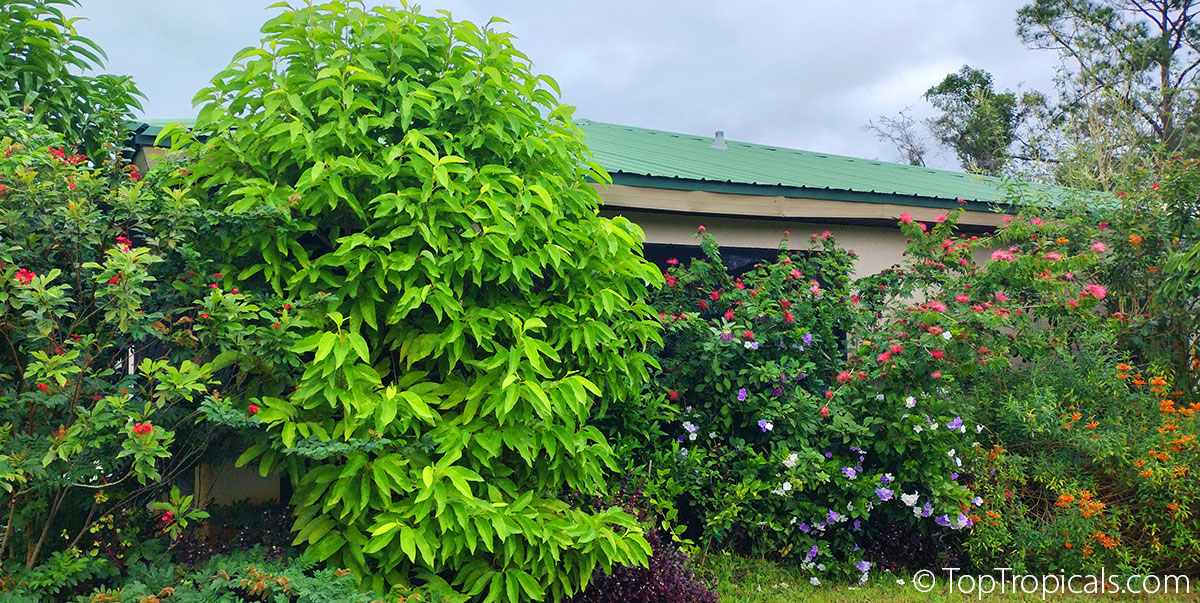
It is finally warm in Florida. After several nights of hard freeze, some
plants survived - and some didn’t. This event is your chance to see
real freeze champions in person.
If you lost plants, you are not alone. If you are ready to plant
smarter, this is your moment.
Walk the gardens.
See proven winter survivors.
Discover cold-hardy fruit trees and resilient ornamentals.
Get practical advice about replanting after freeze. This is rebuilding -
Florida style.
♥️ What Makes This Event Special
We are featuring:
Verified freeze survivors
Cold-hardy fruit trees
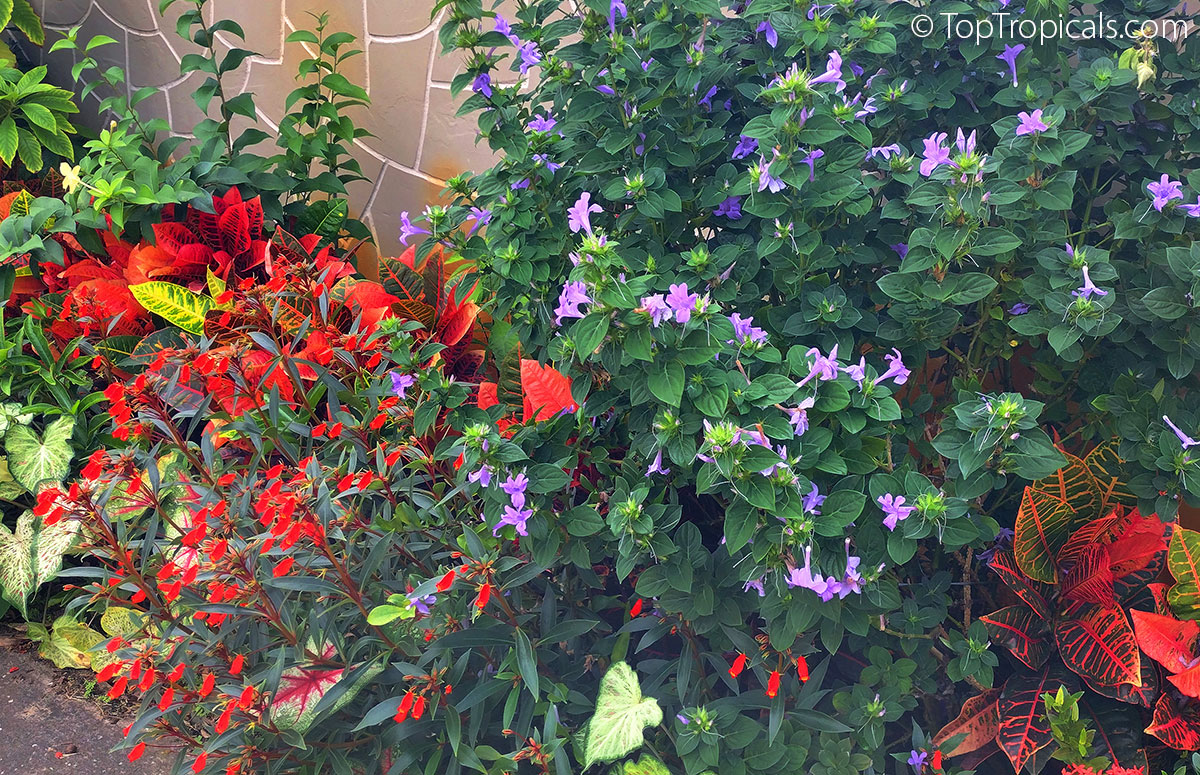
Tough flowering trees and shrubs
Replacement plants for damaged landscapes
Smart layering ideas for frost-resilient gardens
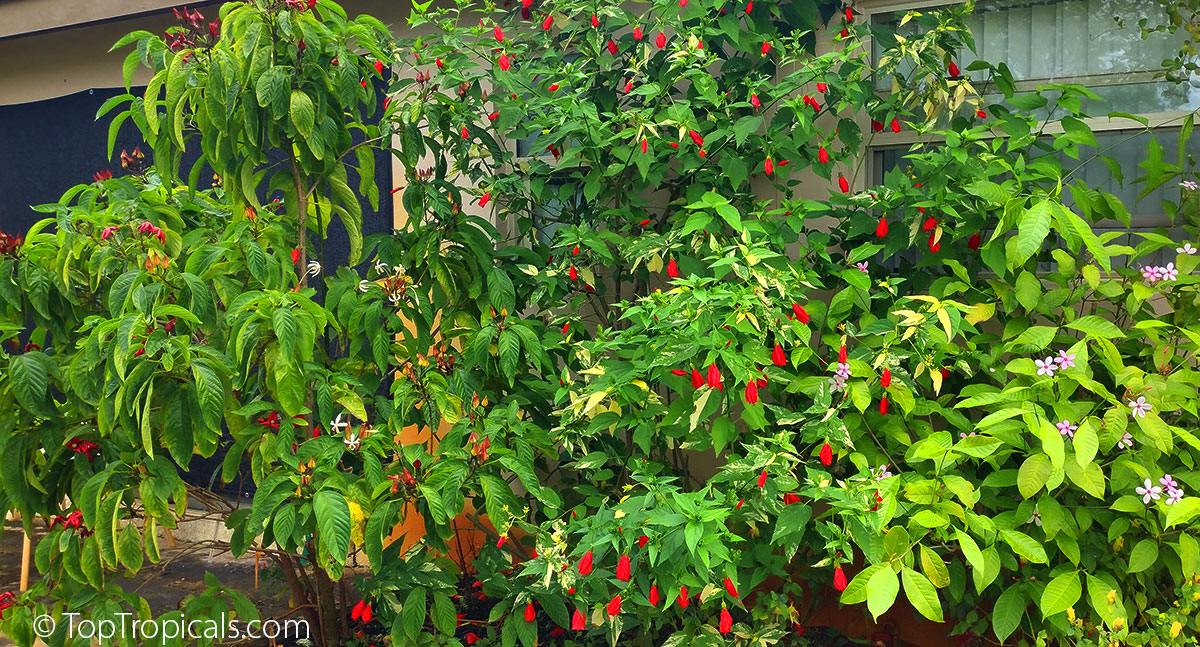
You will see which species handled 25F with wind and multiple nights of
freeze - with no protection.
Real-world test. Real results.
Cold hardy fruit favorites include:
Cold-hardy Avocado varieties, including varieties, which are cold hardy
to 15-20°F: Joey, Fantastic, Mexicola, Poncho, Brogdon and more.
Botanical name: Caesalpinia mexicana Also known as: Mexican Bird of Paradise, Dwarf Poinciana
USDA Zone: 9 - 11
Highligths
🎉Event Highlights
30% OFF online prices
FREE plants with purchase
$5-10 specials
Exciting raffle prizes
🌳Don't just mow - grow!
Start your food forest, beat rising prices, and plant a future your
family will thank you for.
🌿 Friendly Reminder
Just a quick reminder before we go: Sunshine Boosters are still
shipping free.
If you were thinking about stocking up for the season, now is a
great time to do it while the offer is still active.
Smokey Sunshine HIRING NOW: Customer service / sales in garden center
Smokey and Sunshine HIRING NOW
👨�Smokey and Sunshine HIRING NOW: Customer service / sales in garden center
Sunshine: Smokey, we need plant people. Smokey: Does your girlfriend know plants? Sunshine: Of course. She fertilized my donuts so they would grow larger. Smokey: Did it work? Sunshine: Kind of. I gained three pounds.
TopTropicals.com is looking for a part-time customer service and sales team member for our Ft Myers Garden Center.
If you genuinely love plants, enjoy helping people, and don't mind getting your hands dirty in a tropical nursery environment – then working with rare tropical plants, fruit trees, and fellow plant lovers can be fun and rewarding!
💼 Responsibilities
· Help walk-in customers select plants and check out
· Answer customer questions by phone, email, social media, and message board
· Open and close office, operate cash register
· General customer service and sales support
📚 Requirements
· Genuine love for plants and willingness to learn. We will train
· Friendly, patient, and polite with customers
· Strong work ethic and reliability; punctuality is essential
· Ability to follow instructions and work efficiently
· Must be able to lift up to 50 lbs and comfortable working outdoors in Florida heat and weather
· Drug-free - background check and drug test upon employment
· Valid Florida driver's license and reliable transportation
· Must love cats - our famous "PeopleCats" helpers patrol the gardens daily
� Preferred qualifications
· Basic computer skills (email, office, internet). We will train · Previous plant knowledge or nursery experience · Sales or customer service experience
💰 Pay
· Starting pay: $18/hour depending on experience and performance · Opportunity for growth based on performance
📅 Schedule
· Part-time to start, potential for full-time later · Friday and Saturday, 9 am - 4 pm
📍 Location:
Top Tropicals Garden Center
13890 Orange River Blvd
Ft Myers, FL 33905
✍️ How to apply:
Please email a brief resume and a short paragraph explaining why you'd like this job.
Resume guidelines: · Keep it brief; include job history and education · Please avoid long descriptions of unrelated experience · Tell us why working with plants and people interests you
🚶➡️ To apply in person:
You are welcome to visit our Garden Center during business hours:
Monday-Saturday, 9 am - 4 pm
To apply in person, ask for Kristi - our manager.
No phone calls please.
Thanks for applying - we hope to see you working alongside our plants, #PeopleCats, and fellow plant lovers soon.
🌿 The Vanilla Plant That Outgrew Its
100-Gallon Container.
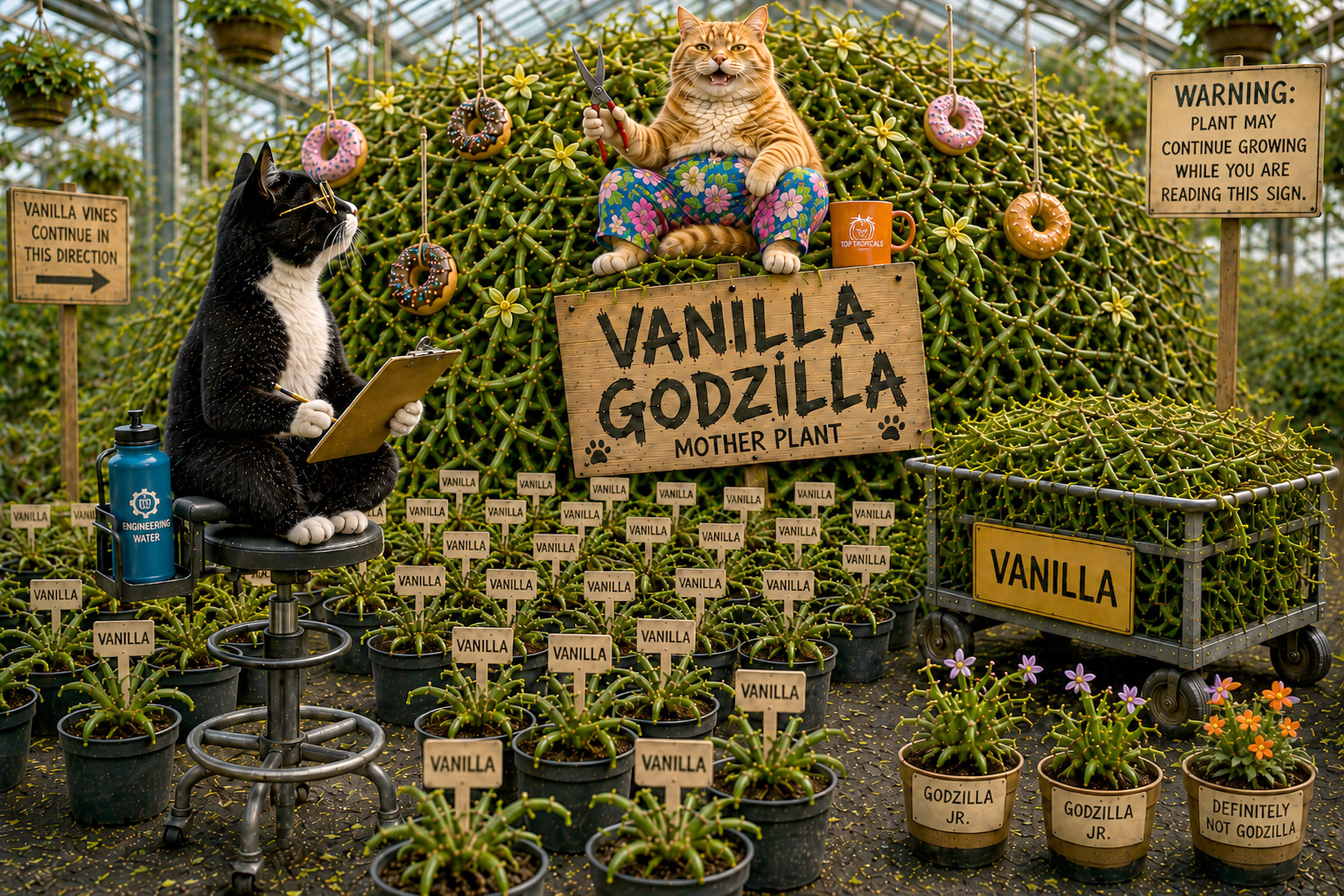
Smokey: Is that really the entire mother plant? Sunshine: Most of it. Smokey: What do you mean "most of it"? And why are there
donuts hanging from the plant? Sunshine: We still haven't found the other end. The donuts
attract pollinators. Smokey: Donuts do not attract pollinators. Sunshine: Then explain why I keep visiting the plant. Smokey: You work here. Sunshine: That's what the plant wants you to think. It's
called "Intelligent Design" for a reason.
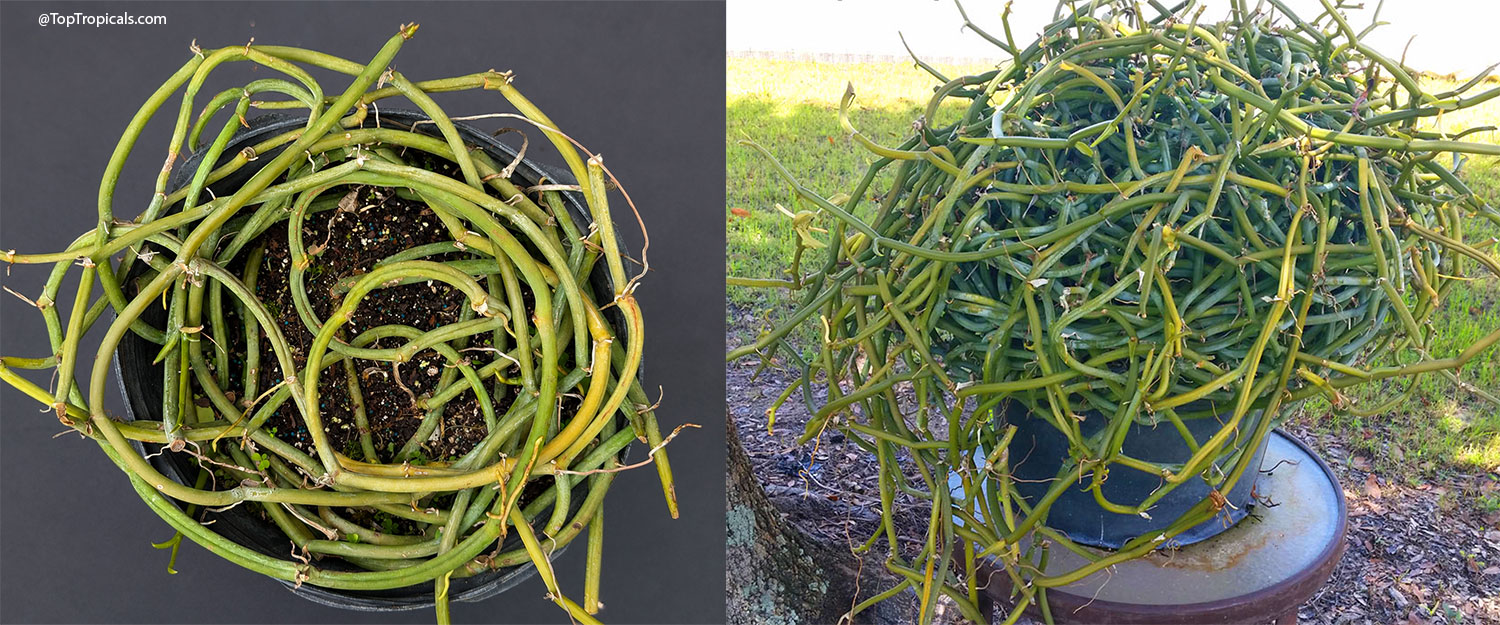
The plant Sunshine is perched on is not a hedge. It is not a wall. It is a
single specimen of Vanilla
dilloniana, Dillon's Vanilla, and it has a name:
Intelligent Design. Unlike the familiar Vanilla planifolia
— the commercial vanilla of ice cream and extract — dilloniana
produces no leaves. The plant is essentially a green vine, photosynthesizing
entirely through its stems. It is an unusual and striking grower, and in
good
conditions it can develop into an impressive, multi-branched specimen.
It is classified as rare, and is considered vulnerable or endangered across
portions of its native range.
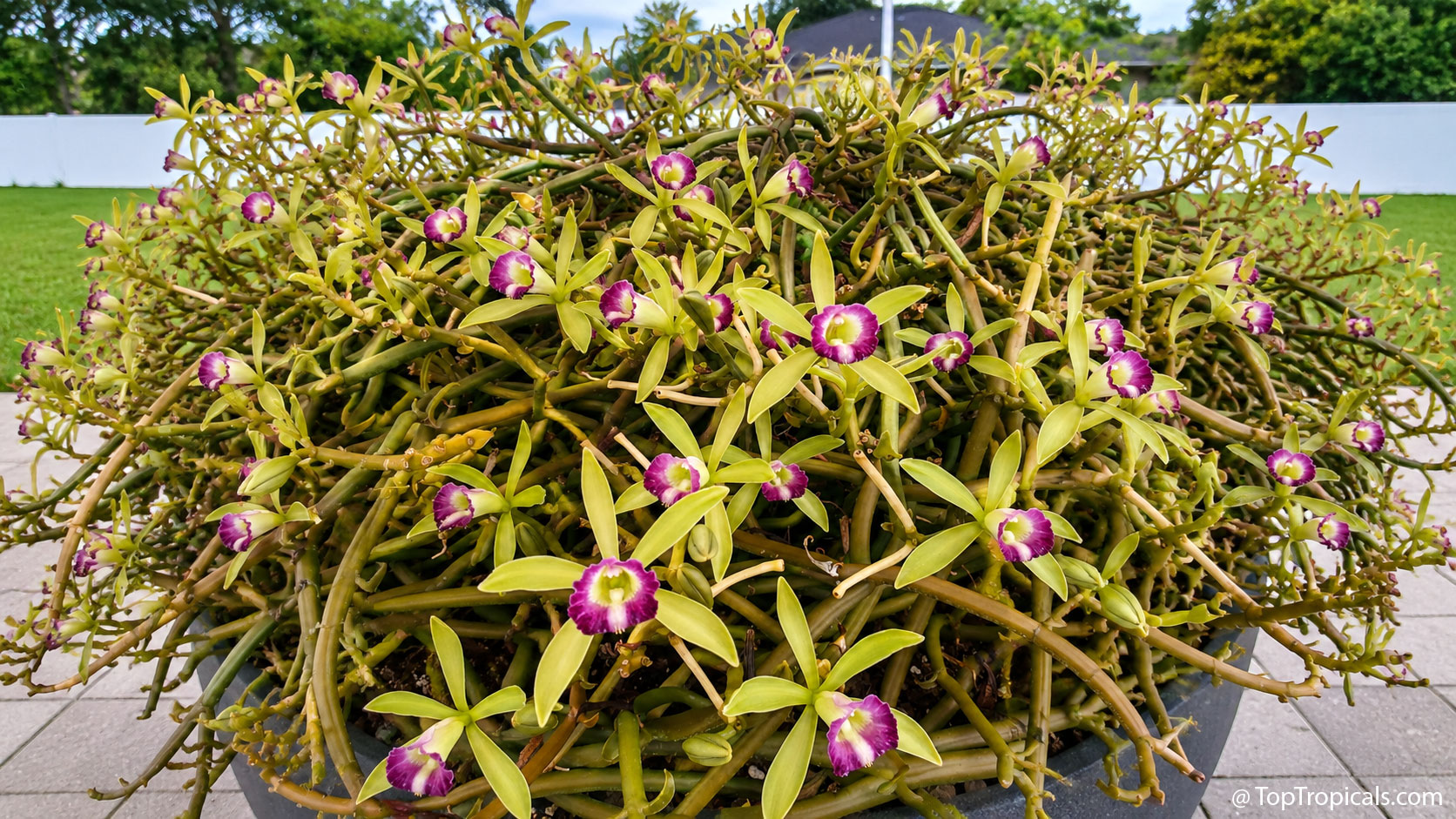
Vanilla dilloniana in full bloom before its next major
upgrade.
Intelligent Design was grown and lovingly tended for years by Robert
Riefer, a grower who is both a good friend of Top Tropicals and one of the
most
dedicated orchid collectors we know. The mother plant of this specimen
traces
its origins back to 1927 - nearly a century of continuous cultivation.
In 2011, the American Orchid Society recognized this remarkable plant with
a Certificate of Horticultural Merit (CHM), one of the society's formal
awards for plants of exceptional quality.
By 2017, the plant had already become well known in the orchid and tropical
plant community, appearing in a video that documented Robert moving it into
a 100-gallon container. That video became something of a legend among
collectors.
🎥 Video: the biggest Vanilla Orchid in the world moving to 100
gal pot
Then the plant kept growing.
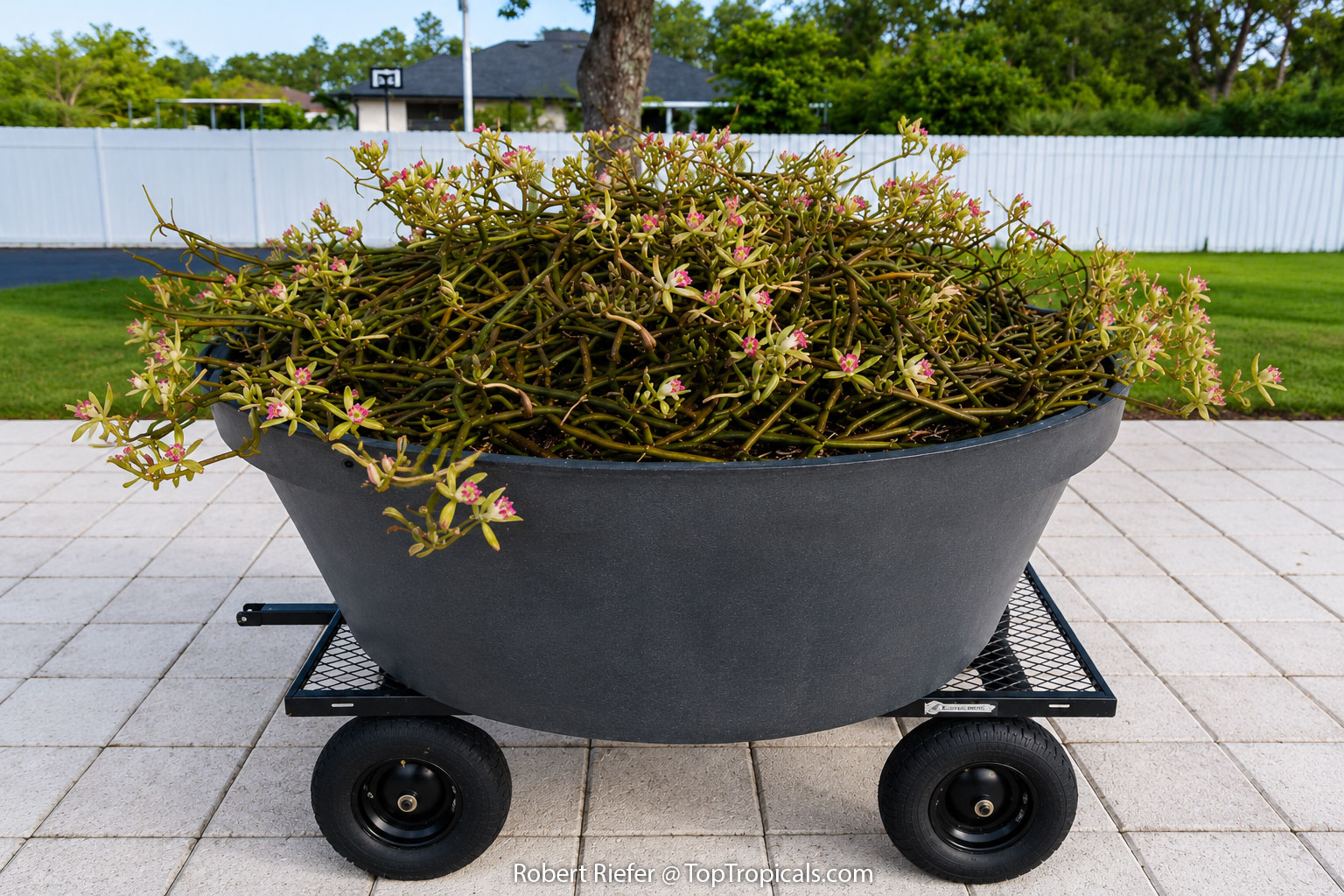
It outgrew the 100-gallon container. Robert eventually moved it into a
250-gallon pool on wheels - because when a plant refuses to stop, you give
it
room.
The move to a custom 250-gallon container allowed continued growth and
flowering.
The plant is currently on display at Edison Ford Winter Estates museum and botanical garden in Ft Myers,
Florida, during the month of June, where recent photographs show it larger
and
more floriferous than ever. It is, as best anyone can determine, the largest
known cultivated specimen of Vanilla dilloniana in the world. If you
are local or visiting Florida, don't miss the chance to see this
world-famous
orchid in person. It is expected to continue blooming through June.
And here's the remarkable part: the Vanilla
dilloniana plants available from Top Tropicals are
propagated directly from this exact plant - Intelligent Design itself.
👉 A Piece of Living History - Direct from the Source
Every legendary Vanilla dilloniana starts somewhere. On the
left are
young Vanilla dilloniana plants. On the right is a more mature specimen in a
7-gallon pot beginning the characteristic wrap-around growth habit that
eventually transforms this unusual orchid into a sprawling, sculptural
giant.
Vanilla dilloniana is a rare species, considered vulnerable to
endangered across parts of its native Caribbean range. Plants with
documented
provenance - especially provenance tied to a named, award-winning,
century-old
specimen - are genuinely uncommon in cultivation.
What you would be growing is a direct descendant of the famous
Intelligent Design mother plant, carrying the same historic lineage
recognized by
the American Orchid Society.
For collectors, opportunities to acquire plants with this kind of
documented history are exceptionally rare.
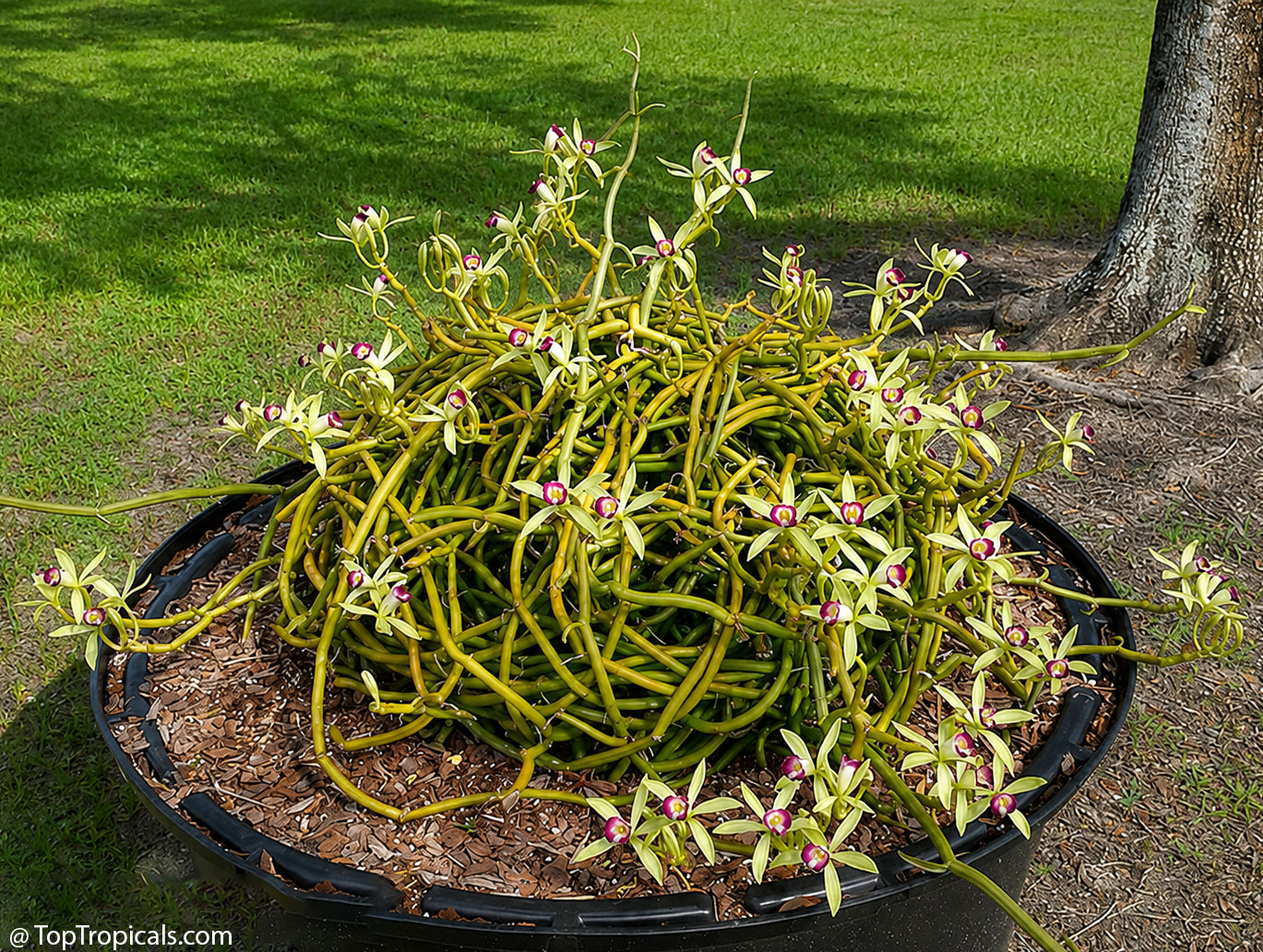
This is how the legendary Vanilla
dilloniana mother plant, Intelligent Design, started its
world-famous "Godzilla" journey in 50-gallon container. It's in full bloom,
and
its leafless stems form a living sculpture, dotted with dozens of striking
orchid flowers that make this rare vanilla one of the most unusual
cultivated
orchids in the world.
Light:
Bright filtered light is ideal. Morning sun is generally well tolerated.
Avoid intense afternoon sun, especially during summer.
Ideal: Dappled shade, eastern exposure, greenhouse conditions, or
30-50% shade cloth.
Cold Protection:
In USDA Zones below 10, grow in a container and move indoors or to a
protected greenhouse before temperatures drop below 40F.
Humidity:
Prefers moderate to high humidity with good air circulation. Avoid cold,
stagnant, damp conditions.
Watering:
Water thoroughly, then allow the potting mix to partially dry before
watering again. Do not keep constantly wet.
In cool weather and winter, keep the soil on the drier side. Overwatering when temperatures are low is the most common
mistake.
Potting Mix:
Plant in a very fast-draining medium.
Recommended:Top Tropicals Abundance Mix.
The open structure allows excellent root aeration while retaining enough
moisture for healthy growth.
Support & Growth Habit: Unlike most vanilla orchids that
are trained vertically on posts or trellises, Vanilla dilloniana can be
grown
using the "Intelligent Design" method. Start with a sturdy support while the
plant is young, then allow the stems to wrap around themselves in wide
circles. As new growth emerges, continue guiding the vines around the
container.
Over time, the plant forms an impressive sculptural mound of intertwined
stems.
Container Growing:
Excellent for wide containers. The larger the mass of stems becomes, the
more impressive the display and the greater the flowering potential. Unlike
traditional vanilla culture, extensive vertical space is not required.
Repotting:
Move to progressively larger containers as needed. Rather than growing
upward indefinitely, the plant can continue expanding into a larger circular
mass, making it well suited for long-term container culture.
Fertilizing:
Feed lightly but consistently during active growth.
Recommended:Sunshine Booster™ Orchidasm.
Apply according to label directions every 2-4 weeks during warm growing
weather. Reduce feeding during cool periods or when growth slows.
Read our Guide to Sunshine Boosters™
Growth Rate:
Moderate to fast under warm conditions. Established plants can branch
freely and become surprisingly large over time.
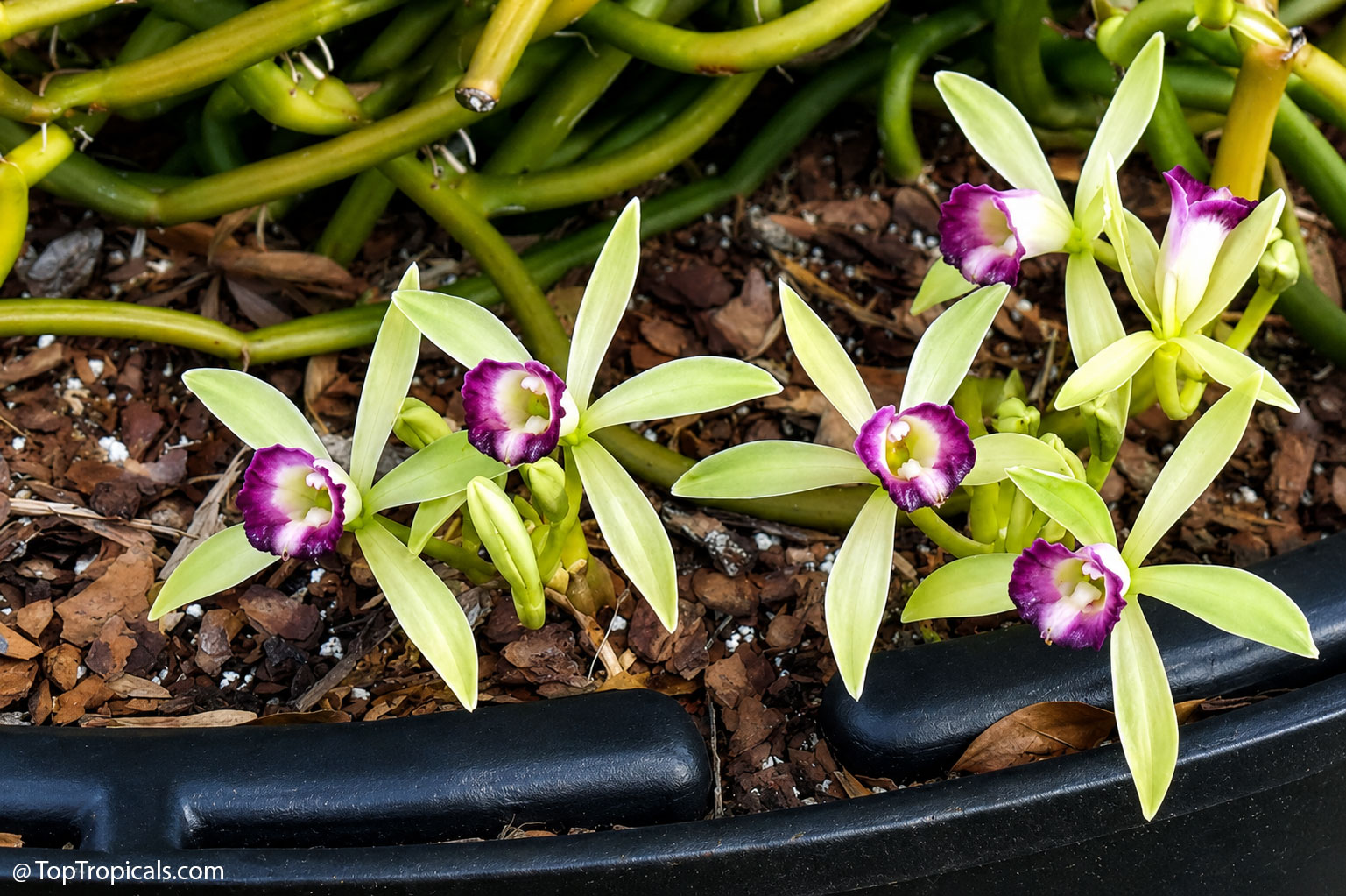
The Flowers:
Pale green to yellow-green flowers with a deeply fluted reddish-purple lip
and yellow crest. Mature plants in bloom are highly prized by orchid
collectors.
The making of Intelligent Design. As Vanilla
dilloniana grows, its long leafless stems naturally wrap
around themselves, creating a dense sculptural mass of living vines. Even in
a
7-gallon pot, the plant is already beginning to develop the unusual growth
pattern that would eventually make its famous mother plant one of the
largest
cultivated specimens of its species.
The famous mother plant was named Intelligent Design by its
grower, Robert Riefer. After decades of growth, countless blooms, container
upgrades, and an apparent determination to occupy every available square
foot of
greenhouse space, the name seemed increasingly appropriate.
Unlike commercial vanilla, Vanilla dilloniana is grown primarily as a
collector's orchid. Its leafless, sculptural stems create a living tangle of
green
architecture unlike almost any other cultivated vanilla species.
Ready to grow this remarkable Vanilla dilloniana? Start your own chapter
in the story of Intelligent Design.
The unusual flowers of Vanilla
dilloniana emerge directly from its leafless stems,
creating a stunning contrast of pale green petals and vibrant purple
throats.
Smokey: We cannot guarantee that your plant will
eventually require a 250-gallon pool on wheels. Sunshine: We also cannot rule it out. Smokey: Officially, we cannot confirm that the plant
possesses intelligence. Sunshine: The evidence is mounting. Smokey: What evidence? Sunshine: It convinced humans to build larger containers,
move it into a 250-gallon pool on wheels, transport it to museum
exhibitions,
and place its agents in collections across the country. Smokey: That's called excellent horticulture. Sunshine: That's exactly what the Intelligent Design
plant wants you to think.
Date: 20 Jun 2025
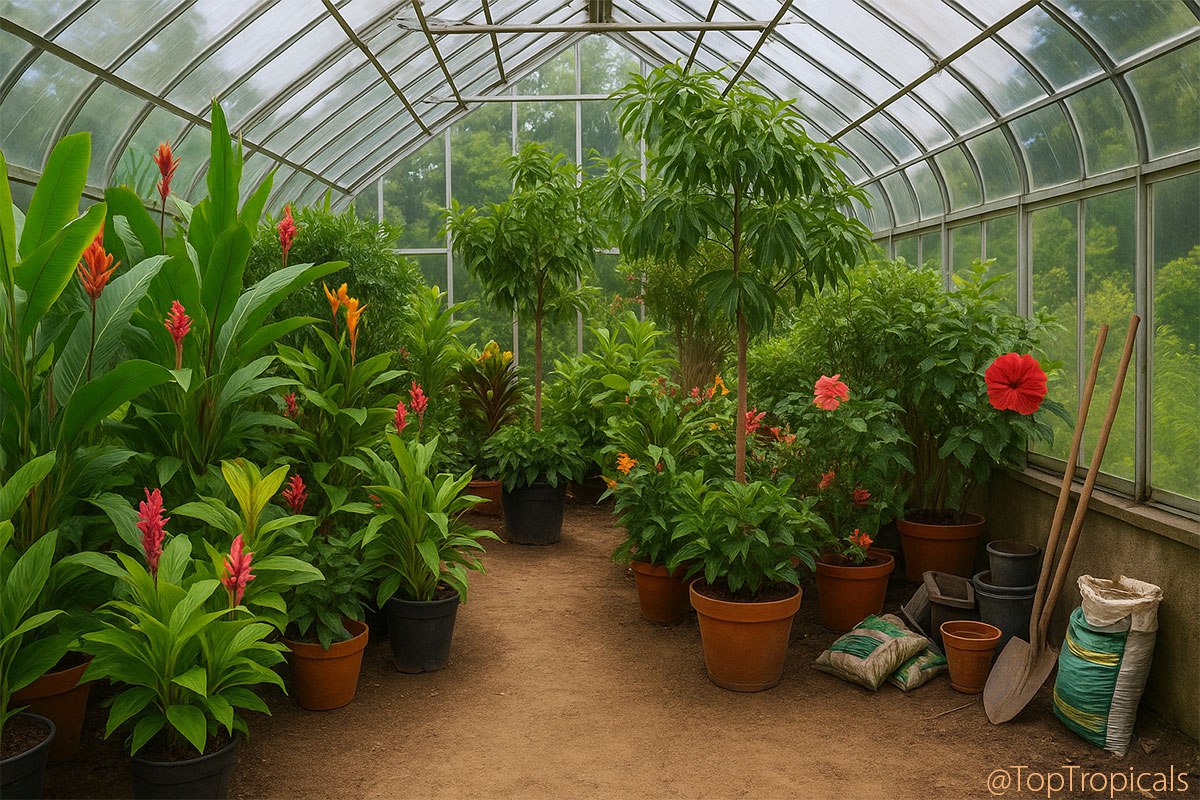
Ten common greenhouse mistakes and how to avoid them
Greenhouse with tropical plants
🏠 Ten common greenhouse mistakes and how to avoid them
1. Overwatering
It's easy to overwater in a controlled environment. Many greenhouse plants need less water than you think. Overwatering can lead to root rot, yellowing leaves, and fungal issues. Monitor soil moisture regularly and adjust watering based on the plant type, season, and current weather conditions.
2. Not enough light
Don’t block too much light - plants need full-spectrum light to thrive. Most greenhouse plants require as much light as possible to ensure healthy, vigorous growth. Lack of light causes leggy, weak plants and increases the risk of disease, pests, and fungal problems.
3. Too much of sun and heat
Greenhouses with plastic covers can trap intense heat, and during sunny afternoons, plants may get “cooked”. Direct sunlight can quickly overheat and damage foliage. Use shade cloth during the hottest months or to protect light-sensitive plants and prevent heat stress.
4. Overcrowding plants
Packing in too many plants reduces airflow, creating ideal conditions for disease and pest outbreaks. Give each plant enough space to breathe, grow, and receive light. Proper spacing also makes pest control and maintenance easier.
5. Poor ventilation
Lack of airflow leads to overheating, humidity buildup, fungal disease, and weak growth. Use fans, roof vents, or roll-up sides to improve circulation and maintain healthy growing conditions.
6. Skipping pest inspections
Greenhouses can trap pests in an ideal environment. Check plants regularly for aphids, spider mites, whiteflies, and fungus. Use systemic insecticides or organic treatments like neem oil at the first sign of trouble.
7. No consistent schedule
Inconsistent watering, feeding, and lighting can stress your plants and reduce productivity. Set a simple routine, and monitor conditions daily - even a quick walkthrough helps catch problems early.
8. Neglecting temperature and humidity control
Temperature and humidity can fluctuate dramatically between day and night. Use a thermometer (preferably with max/min memory) and a hygrometer to track conditions. Install heaters, shade cloth, misting systems, or dehumidifiers as needed.
Modern WiFi-based sensors that monitor temperature and humidity 24/7 are convenient tools - you can keep tabs on your greenhouse right from your smartphone.
9. Recycling old soil
Avoid reusing soil from plants that died, as it may harbor root diseases or pests. Always use fresh, high-quality soil for new plantings. Don't cut corners - healthy soil is key to healthy plants.
10. Dirty tools, containers, and covers
Reusing dirty pots or tools spreads disease. Clean and disinfect containers, trays, and tools regularly. Use a diluted bleach solution to clean clear plastic or ground covers if they show mold or algae buildup.
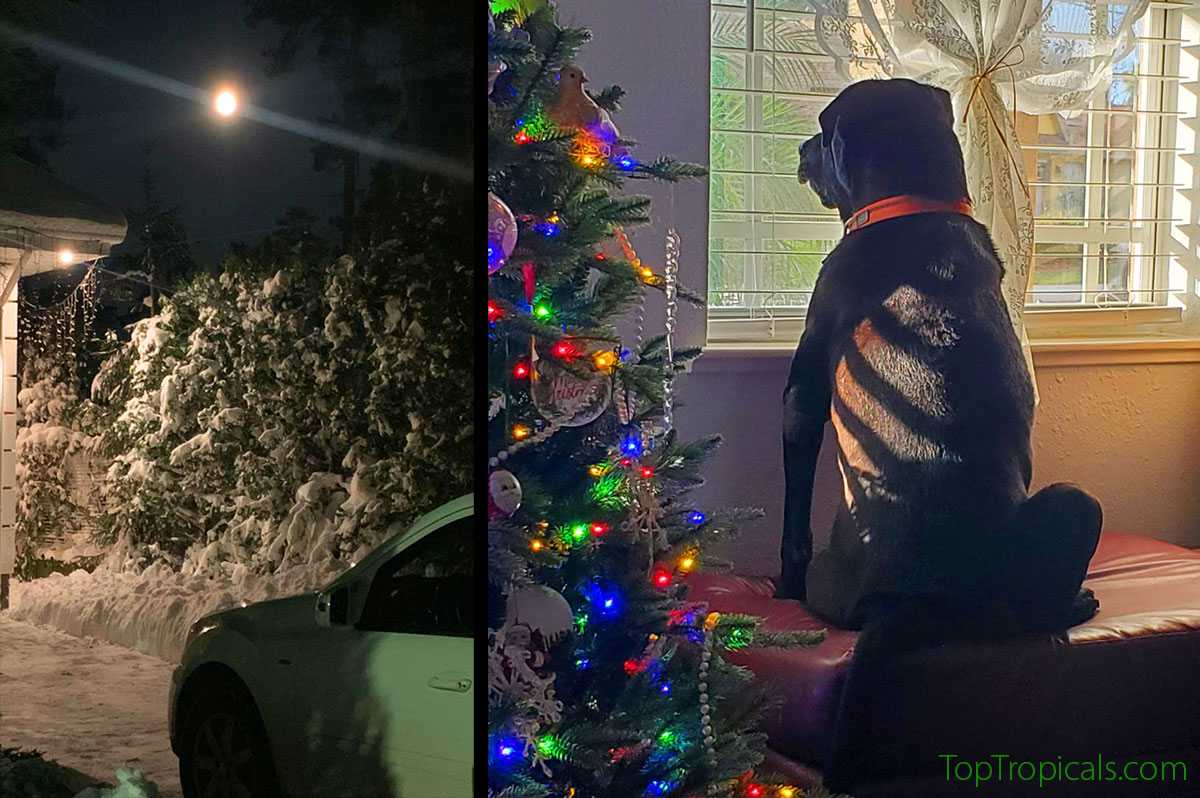
Photo above: Christmas time in Ukraine (left) and Florida (right)
Q: Are there any tropical plants that will do well if I order them in Winter?
We just bought a house in New Jersey with a large sunroom, and I can't wait to
fill it with tropical beauties! Should I wait until Spring, or do you have something for a Winter start?
A: This is indeed a very good question, as many tropical plant collectors grow their treasures
outside the tropics. The short answer is - yes! You can start filling your tropical sunroom any time of the year, but some plants
are easier to deal with in Winter than others. Below are some guidelines.
6. Winter plant care. During Winter the daylight is shorter and temperatures are
cooler.
- Reduce watering
- Use only liquid amino-acid based fertilizer Sunshine Boosters (safe to use year around)
- Monitor insects.
7. Shipping in Winter. We ship year around. However, if it gets
below freezing in your area, you may use FedEx Hold location, they are temperature controlled so you don't have
to worry about a box being dropped off at your cold porch outside.
8. A note for mild climate residents. Most tropical plants can be
planted in the ground year around. Some ultra-tropical tender species such
Chocolate tree, Ylang Ylang, or small size Mango trees can be grown in pots until Spring and planted out once
chances of cold spell are gone. Until then, they can be moved indoors for cold
nights.
Think outside the box and bring tropical paradise indoors during the
time when we need warmth the most! Tropical plants will brighten your short winter days and help you to have truly HAPPY HOLIDAYS!