Garden Blog - Top Tropicals

Date: 27 Jan 2026

🌸 Adenium, Coffee, and Donuts

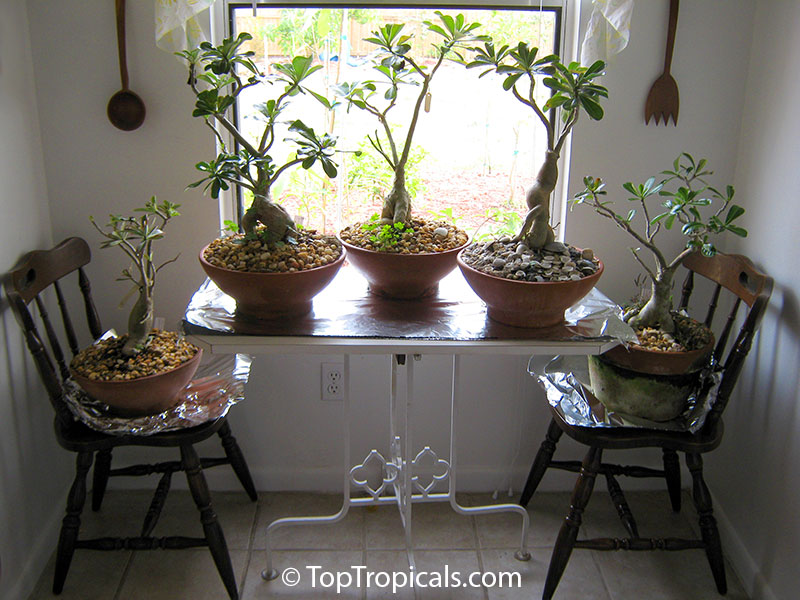
Smokey  and  Sunshine  with  a  blooming  adenium  desert  rose  on  a  worktable,
 
 
  surrounded  by  potted  adeniums  in  the  background.
Smokey: Desert rose. One caudex. Multiple grafts. Different flowers.
Sunshine: So it is a team plant. Everyone blooms, nobody agrees.
Smokey: Yet it grows just fine.
Sunshine: That is the secret. Coffee and donuts.

🌸Featured Adeniums

Recommended by our Horticulturist, Tatiana Anderson

Moung Kusuma Moung  Kusuma  adenium  flower  with  deep  magenta  velvety  petals  and  dark 


edging

Deep magenta flowers with a velvety look and a darker, almost black edge. A bold, elegant adenium that stands out immediately.

Sunshine Adenium  Sunshine  flower  with  pink  and  white  petals  and  bright  color 


contrast

Bright yellow and mauve swirls across layered petals create a warm, cheerful bloom that lives up to its name.

White Rabbit Adenium  White  Rabbit  flower  with  white  petals  and  bright  pink  streaks. Clean white petals brushed with playful pink streaks. A reliable bloomer with soft ruffled flowers.
Thong Samsee Adenium  Thong  Samsee  flower  with  creamy  yellow  petals  and  soft  pink 


edges

Known for its three-color effect, shifting from yellow to pink to nearly white on the same plant.

Candy Adenium  Candy  flower  with  creamy  white  petals  and  soft  pink  edges

Cheerful yellow petals dipped in cherry red with bold ruffled layers. Bright, playful, and impossible to miss.

Black Sheep Adenium  Black  Sheep  flower  with  nearly  black  petals  and  deep  red 


highlights

Nearly black petals with a glowing red center. Dark, dramatic, and different.

Free Adenium (Desert Rose) Shipping
Plant now, bloom soon. Get select Adenium (Desert Rose) varieties shipped to you with FREE S&H.
Offer valid through 02/06/2026. Limited quantities. While supplies last.
Free shipping applies to qualifying Adenium items only. Excludes other items and prior orders.

✍️ Learn About Adeniums

🎥 Watch Adenium Videos

🛒 Shop Adeniums

Date: 20 Feb 2026

What tropical plants survived Floridas historic freeze without protection

Florida historic freeze

What tropical plants survived Florida's historic freeze without protection

In the first week of February 2026, arctic air pushed deep into Florida. For many areas, this was the coldest event in over a century.
We received one question over and over: How did your gardens do?
Top Tropicals Farm in Sebring, Florida is up and running - and this freeze became a real-world hardiness test for tropical and subtropical plants. Below is our initial field report after inspecting established plantings.

📊 Weather data - February 1-6, 2026


Sebring, Florida - 132 years of recorded observations
This was not a light frost. It was prolonged, windy, penetrating hard freeze.


🌡 Minimum temperature: 25F
❄️ Wind chill: 14F
⏳ Duration: 3 nights of 8-10 hour hard freeze
☀️ Daytime temperatures: around 50F for 7 days
🌀 Wind: sustained 20 mph, gusts 40-50 mph
  • Cold protection


    In-ground trees: selected plants covered with frost cloth, especially mango and young avocado trees.
    Tender container plants: moved into greenhouses with propane heat above 34F.
    Hardy container plants: frost cloth and wind protection only - no plastic
    Nutrition support: plants fertilized regularly during the growing season with Green Magic and Sunshine Boosters to maintain vigor and hardiness.

    However, the plants listed below had no protection at all.
    All were established trees 2-3 years in the ground.
  • The plants below had NO PROTECTION, established trees 2-3 years old


✅ Survived with no damage
:
  • 🍑 Tropical Fruit Trees and Edibles:


    Citrus
    Loquats
    Mulberries
    Macadamia Nut
    Jaboticabas
    Pomegranates
    Avocado - cold hardy varieties
    Feijoa - Pineapple Guava
    Psidium littorale - Cattley Guavas
    Eugenias (Grumichama, Rio Grande, Surinam and more)
    Olive trees
    Bay Leaf (Laurus nobilis)
    Fig trees (Ficus carica)
    Prunus sp - Peaches, Plums, Nectarines
    Persimmons
    Rubus (Blackberries) including Tropical Mysore Raspberry
    Elderberry (Sambucus)
    Yerba Mate - Ilex paraguariensis
    Opuntia - Nopal Cactus, Prickly Pear


🌸 Flowering Trees and Shrubs:


Beaucarnea recurvata - Pony Tail
Callistemon - Bottlebrush
Yucca
Tabebuias
Magnolia figo and Little Gem
Calliandra tweedii - Red Powderpuff
Sophora tomentosa
Galphimia gracillis - Thriallis
Acacia trees
Osmanthus fragrans
Abutilon trees
Erythrina - several species
Monkey Ear tree - Enterolobium cyclocarpum
Bauhinia Orchid Trees - several species
Pseudobombax ellipticum - Shaving Brush Tree
Bulnesia arborea- Vera Wood
Caesalpinia mexicana, Mexican Bird of Paradise
Sansevieria - Snake Plant
Foxtail fern - Asparagus densiflorus
Lonicera - several varieties
Jacaranda tree
Eucalyptus
Plumbago Imperial Blue
Philodendron bipinnatum
Gardenias
Gingers (dormant rhizomes)

✳️ Minimal leaf damage only:
(These plants showed light cosmetic damage but no structural injury)

🍑 Tropical Fruit Trees and Edibles:


Glycosmis pentaphylla - Gin Berry
Black sapote tree
Tamarind tree
Syzygiums: Rose Apple and Java Plum

🌸 Flowering Trees and Shrubs:


Pandora vine
Jasminum - several species
Stenocarpus sinuatus - Firewheel Tree
Xanthostemon
Quisqualis indica
Schotia tree
Eranthemum pulchellum - Blue Sage
Hiptage benghalensis - Helicopter Flower

🏡 What this means for Florida gardeners


This freeze was a stress test few gardens are prepared for. Yet many species handled 25F, wind, and multi-night freeze conditions without protection.
Choosing proven survivors, planting in smart microclimates, and maintaining strong plant health during the growing season makes a measurable difference.
More updates will follow as full recovery continues - but these early results already help define a stronger plant palette for future winters.

🛒 Explore cold tolerant tropical plants and cold hardy Avocados

📚 Learn more:


🎥 These Avocados survived 3 nights of 25F hard freeze, Florida Record Freeze

#Discover #How_to

🟢 Join 👉 TopTropicals

Date: 15 Sep 2024

10 common mistakes to avoid with mail order plants

10 common mistakes to avoid with mail order plants

⚠️ 10 common mistakes to avoid with mail order plants


⁉️ Q: How to get happy and healthy plants from mail order? Will they survive the trip and grow well after transportation? What mistakes should I avoid?

A: At Top Tropicals, we have over 20 years of experience shipping plants. We know how to pack them properly and ensure the safest journey possible. We ship the biggest and healthiest plants, and our customers are often amazed at how great they look after a few days in a dark box. But receiving a healthy plant is only half the adventure. Now that the plant is in your hands, it's up to you to keep it thriving. The first couple of weeks after shipping are critical. With the right care, your new plant can reward you with beautiful flowers and fruit for years to come. Here are 10 common mistakes to avoid when buying plants by mail order.

  • ⏺1. Not unpacking plants immediately
  • Leaving plants in the box too long can cause stress or damage. Unpack them as soon as they arrive to let them breathe and adjust.

  • ⏺2. Ignoring acclimation
  • Plants need time to adjust to their new environment. Don't place them in full sun or extreme conditions (heat, wind) right away.

  • ⏺3. Overwatering right after arrival
  • Many people water their new plants too much. Plants often need time to recover from transit, and too much water can cause root rot.

  • ⏺4. Stepping up too soon
  • Repotting immediately in a large pot can cause root rot. Plant in a pot just the size of a root ball, step up only after the plant is showing new growth.

  • ⏺5. Ignoring the plant's needs
Research the specific needs of your plant before it arrives. Light, water, and soil requirements vary greatly, and misunderstanding them can lead to issues.

⬇️ Continued in next post 👇

#How_to

🔴 Join 👉 TopTropicals

Date: 31 Jan 2017

Plants of Love. TopTropicals Webinars

Plants of Love - Valentines Day Sale. For Valentines day, look beyond roses for a plant that will last a lifetime! It is not a surprise that the most popular plants that has been ordered from TopTropicals for Valentines day for the past 3 years, are: Vanilla, Chocolate, Grape, Strawberry tree, Rose apple - all things you get for your Valentines!

This year we are celebrating Valentines day with our special local event - "Aphrodisiacs, or Plants of Love".

When: Saturday, February 11, 2017, from 10 am to 2 pm
Where: Toptropicals Garden Center, 13890 Orange River Blvd, Ft Myers, FL 33905
Agenda:
10:00 am - Explore the grounds: Customers can come in to look through the nursery and guided tours through gardens.
12:00 pm - Aphrodisiac plants. Class on plants used for aphrodisiacs throughout history.
1:00 pm - Plant giveaway. Must be present to win one of the aphrodisiac plants in lecture.
2:00 pm - sale ends.
Special Love Discounts for local visitors! Snacks and drinks.

Just a few examples of the most famous plants of love that we will be talking about -
Coffea arabica - in East Africa and Arabia it was a sacred beverage to African sufis. For aphrodisiac results mix in cardamom and honey.
Banisteriopsis caapi, Ayahuasca - giant liana from tropical Amazon forests psychedelic, ritual inebriant that promotes potency. Drink is made from the bark and is taken in love rituals to revive the mythical past of the tribe.
Areca catechu, Betel Nut - seeds have stimulating effect on the entire body and eros. It's a traditional aphrodosiac in Ayurvedic medicine and is counted among the eight types of pleasure in the Brahmanic tradition. It has magical and religious properties and used as an offering to the Gods.
Theobroma cacao, Chocolate - mild stimulant, beans contain aphrodisiac. Antient Indian "recipe of chocolati" will be shared at the event! Cocoa was considered the "food of gods".
Cinnamon - in Southern Asia used as stimulant, in food or massage oil for erotic stimulation.
Cola nitida, Cola nut - used in love magic, was used as currency in W Africa.
Cananga odorata, Ylang-Ylang - increases eroticism with oil inhaled. Prescribed to treat impotency and frigidity.
Butea monosperma, Flame of The Forest - is traditionally used to manage male sexual disorders.
Mimosa pudica, Sensitive Plant - significantly increases the libido and hormonal levels of testosterone.
Satureja Viminea, Kama Sutra Mint Tree - used for love gel...
- and much more!

TopTropicals Webinars. Welcome to Top Tropicals Webinar! Discover the world of Rare Plants and surround yourself with a Tropical Paradise! Our plant experts will be answering your garden questions. Our next LIVE air time is just before Valentines Day - Saturday February 11, at 2 pm ET, with a topic of... of course, Aphrodisiac Plants! Get your questions ready!

Date: 15 Nov 2016

SUNSHINE in a bottle - your help during winter

Q: I have been using your new plant hormone SUNSHINE for plants after shipping, and I must admit it does make a big difference! They recover right away. I order plants online very often, and usually it takes up to a week or more until they start showing new growth. After SUNSHINE treatments, they look fresh within a day or two. My question would be, for improving cold tolerance, what do you recommend? I live in Florida and it is still warm here, should I start spraying my garden now or should I wait until cold spells?

A: SUNSHINE is very effective plant stimulant that helps tropical plants survive different kinds of stress, including cold, heat, drought, low light, etc. At TopTropicals gardens and nursery, we have been using this hormone for many years to protect our plants from unfavorable conditions, and it saved us many rare tender species, and lots of money!
The sooner in Fall you start treatments, the better. Don't wait until cold spell. SUNSHINE works slowly and in very low doses. The mechanism is actually about boosting, building up the plant's own immune system. Low doses once a week, even every other week will work just fine, so you will need very little of the product. For less than $5 you can help expensive rare plants to go through winter painlessly. Recommended application is only 2.5 ml/1 gal of water, to spray every 1-2 weeks throughout winter period.

Start spraying your plants with SUNSHINE now, to help them survive short winter days, build up insect resistance (especially for plants indoors), and what is most important, to remain strong through lower temperatures. These are our suggestions:

- SUNSHINE-T - thermo-protection booster. It is specially formulated for winter protection of tropical plants. To improve cold hardiness even more, spray 1-2 days prior to cold with 5 ml/1 gal solution and after that, continue applications with 2.5 ml/1 gal solution every 10-15 days throughout winter period.
- For large plant collections, and in-ground gardens in subtropical areas, take advantage of very cost effective bulk items 50 ml and 100 ml bottles of SUNSHINE.
- Don't forget that SUNSHINE is only a stimulant, and not a plant food. While regular fertilizer should be avoided during winter months, it is always beneficial to apply microelements through foliar spray. During cooler period, chances of chlorosis increase, because at low temperatures iron is difficult so absorb by roots especially in moist soil, hence iron deficiency! Our new Iron supplement SUNSHINE-Super-Iron microelement booster will help to avoid yellowing leaves and to maintain your plants strong and healthy during slow growth period. Ultra-potent, highly absorbable iron mix, with chelated Iron with DTPA (instead of usual EDTA) that is better soluble in hard water and more effective for chlorosis. This mix contains both EDTA + DTPA chelated iron in higher concentration than regular micro-elements mixes.

See all SUNSHINE booster products in our store. For advanced information on SUNSHINE plant boosters, history of use, formulation, and frequently asked questions, visit our manufacturer's website TTLaboratories.com.

Best plants suitable for containers. Check out our large selection of plants that are easily grown in containers. This week only, 20% off!