Date: 24 Aug 2019
How to keep iguanas away?
Q: Really enjoy all the plants that I have got from you, but having a hard time keeping iguanas eating everything! We are not on the water, any solution to keep them out?
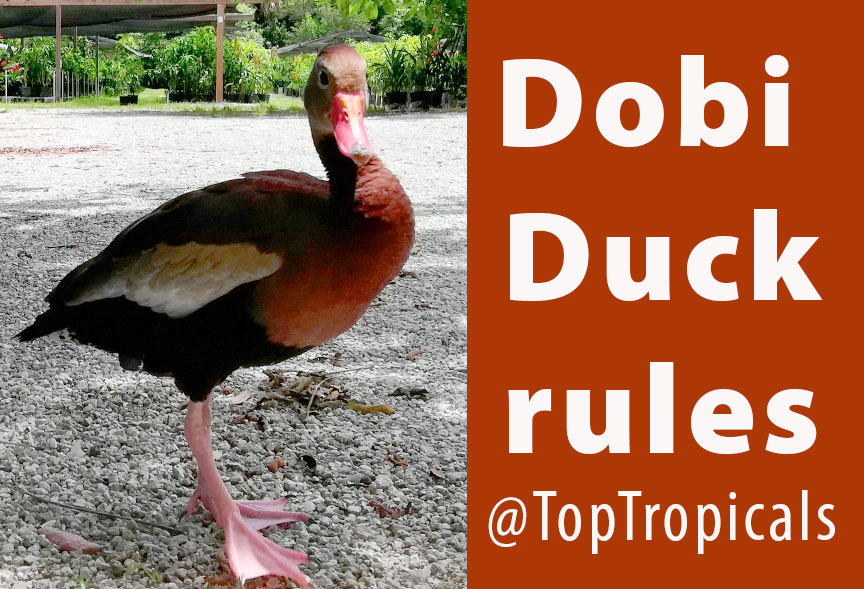
A: Iguanas may become quite a problem in the garden. Our first suggestion would be - get a Duck as we have (Duck Dobi), she is so dominant and keeps any wild animals away from the property, including gators... and cats! They are scared of her! Dobi thinks she owns the place.
Here are a few other ways to control iguana problem in your backyard:
1. Rid your lawn of dropped fruits. Iguanas love fruit. And they love
low-hanging fruit or fruit that's easy to get to. If you have fruit trees, take
the time to pick up your yard and dispose of any dropped fruit.
2. Keep a lid on a garbage can. Put your garbage cans in a place they
can't get to, or put a cinder block on your can lid.
3. Do not leave pet food out. If you're putting a bowl of dog food or a
plate of cat food out for your pets, you're inviting iguanas into your yard.
4. Fill iguana holes. Iguanas like to dig. Wherever you see a hole,
fill it. Stuff rocks into the hole first, then fill it with dirt and top it with
sod. The iguana may return to dig again, but he won't dig through large
rocks.
5 Do NOT feed the iguanas. Don't be friendly with them, so they won't
come back.
6. Wire netting around plants. You can use wire netting or screens to
prevent iguanas from entering plants and shrubs.
7. Spray them with a hose. When you see an iguana in the yard, spray
them with the hose. They also hate loud noises. Constant harassment can keep
them from returning.
8. Keep your yard clean. Excessive overgrowth or yard storage are great
places for iguanas to hide.
9. Do not leave food out, unattended. Iguanas are mainly herbivores but
that doesn't mean they won't smell something good and want to eat it. They
will TRY anything.
Hopefully these tips help keep your iguana problems to a minimum.
Date: 7 Dec 2025
Whats for breakfast? Guava versus Banana
Smokey: Guava for fiber, banana for power. Pick wisely. Sunshine: I pick whatever requires zero effort. Smokey: So... guava in a hammock. Perfect.
🍉🍌 What's for breakfast? Guava versus Banana
Some mornings you want something light. Some mornings you want something that hits like a tiny energy bomb. That’s why people always compare guava and banana. Both are everywhere, easy to eat, and trusted since forever - from Ayurveda scrolls to modern nutrition charts.
But they’re not the same kind of morning fruit. Let’s walk through them like we’re in the kitchen deciding what to slice first.
🍉 Guava - the fiber champion
Guava looks innocent, but it’s one of the most nutrient-dense fruits.
Per 100 g: 68 calories, 5.4 g fiber, over 200 mg vitamin C, a little protein, and solid potassium.
Fiber does most of the work. It smooths digestion, keeps you full, and steadies blood sugar. Vitamin C boosts immunity, and antioxidants reduce inflammation. Studies suggest guava lowers LDL and triglycerides. Not bad for a tennis-ball-size fruit.
🍌 Banana - the quick energy classic
Bananas are the opposite personality: soft, sweet, ready in seconds.
Per 100 g: 89 calories, 22 g carbs, good potassium, and a little vitamin B6.
Bananas give fast energy without upsetting the stomach. Athletes eat them before workouts because carbs, sugars, and potassium wake up your muscles. Vitamin B6 helps mood and brain function, which is why a banana on a groggy morning works wonders.
They also pack antioxidants, polyphenols, and heart-protective compounds. Even the peel has nutrients (though not exactly breakfast-friendly).
📊 What studies say - quick notes
- · Guava: anti-inflammatory, anti-hypertensive, anti-obesity, antioxidant, antidiabetic, antidiarrheal, boosts hemoglobin, supports dental health.
- · Banana: antioxidants, fiber, vitamins C and E, carotenoids, flavonoids, and heart-protective compounds.
🔮 What Ayurveda says
- · Guava calms Pitta and Kapha - great for acidity or sluggish digestion.
- · Bananas balance Vata - grounding and nourishing - but can raise Kapha at night. Morning banana = good. Night banana = maybe skip.
🏆 Guava or banana - which one wins?
Both win, just in different ways:
🍉 Pick guava for:
· light, high-fiber start
- · better digestion
- · steady energy
- · low calories
- · weight control
🍌 Pick banana for:
- · instant energy
- · easy digestion
- · pre-workout boost
- · quick carbs
- · soft, comforting fruit
- 🍉 Slow mornings love guava.
🍌 Busy mornings belong to banana.
For home growers
If you live in a warm climate, both fruits are incredibly rewarding to grow.
🍉 Why grow guava?
- · Fruits in 1-2 years.
- · Compact for small yards or containers.
- · Super productive when mature.
- · Needs only sun, warmth, and pruning.
- · Homegrown flavor is sweeter and more aromatic.
🍌 Why grow banana?
- · Grows fast and looks lush.
- · One mat can feed a whole household.
- · Dwarf varieties fit small gardens.
- · Homegrown bananas taste richer and creamier.
- · When a bunch ripens, breakfast is handled for a week.
Growing your own fruit means you’re never out of a healthy breakfast. Something is always ripening, always ready to pick, and always sweeter than anything you buy.
✍️ Scientific reference
- · USDA National Nutrient Database: Banana, raw. Guava, raw.
- · Journal of Food Biochemistry: Antioxidant and anti-atherosclerotic potential of Banana.
- · International Journal of Pharmaceutical Sciences Review and Research: Guava (Psidium guajava). A brief overview of its therapeutic and health potential
- · International Journal of Innovative Research in Engineering & Management: An analysis of health benefits of guava.
🛒 Grow your perfect breakfast for any day - Guava and Banana
📚 Learn more:
- 🟡More posts about #Bananas and #Guava
- 🟡From Plant Encyclopedia: Banana and Guava plants
- 🟡Guava beats banana in the potassium game
📱 Watch YouTube short videos:
- ✦ ' target="_blank" rel="noopener noreferrer">Six guava varieties that will keep you picking year-round.
- ✦ ' target="_blank" rel="noopener noreferrer"> Why every garden needs a Banana tree
#Food_Forest #Bananas #Guava #Remedies #Discover
🟢 Join 👉 TopTropicals
Date: 17 Nov 2023
Hedges
with Benefits
Reference Chart
Large and fast growing
Tithonia diversifolia - Sunflower tree
Acacia farnesiana
- Sweet Mimosa
Calliandra
surinamensis - Powderpuff
Aloysia virgata
- Almond Bush
Dombeya x wallichii - Tropical Hydrangea
Cornutia grandifolia - African lilac
Gmelina
philippensis - Parrots Beak
Hibiscus
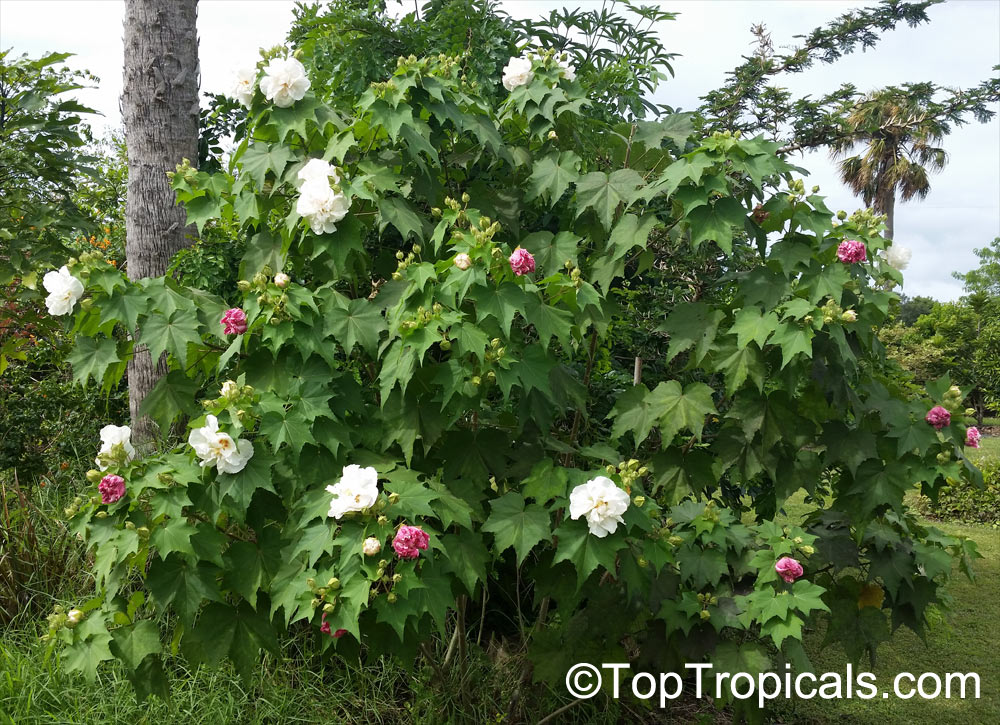
mutabilis Cotton Candy - Mallow Hibiscus
Senna alata -
Empress Candle, Candelabra Plant
Medium or easy-trim
Acalypha hispida - Cat tail, Chenille plant
Bauhinia galpinii - Pride of De Kaap
Cestrum nocturnum
- Night blooming jasmine
Dombeya seminole
- Tropical Rose Hydrangea
Gardenia thunbergia - Forest
gardenia
Hamelia patens - Fire Bush
Hibiscus variegated
Snow Queen
Jasminum sambac
Maid of Orleans
Ochna integerrima
- Vietnamese Mickey Mouse, Hoa Mai
Odontonema callistachyum - Lavender Butterfly Bush
Odontonema cuspidatum - Firespike, Red
Rondeletia
leucophylla - Panama Rose
Tecoma stans - Yellow Elder
Short or slow growing
Aglaia odorata - Chinese Perfume Plant
Allamanda
schottii - Dwarf Allamanda Bush
Brunfelsia pauciflora Compacta - Dwarf Yesterday-Today-Tomorrow
Clerodendrum
incisum - Musical Note
Calliandra schultzii -
Dwarf calliandra
Gardenia
vietnamensis - Vietnamese Gardenia
Leonotis leonurus
- Lions Ears
Neea psychotrioides - Pigeon Plum, Hoja de Salat
Plumbago auriculata Imperial Blue
Garden Specimens
Combretum constrictum Thailand, Ball of Fire
Caesalpinia
pulcherrima - Red Dwarf Poinciana, Bird of Paradise
Clerodendrum
quadriloculare - Winter Starburst
Euphorbia
leucocephala - Snows of Kilimanjaro, Pascuita
Gardenia nitida - Shooting Star Gardenia
Hibiscus schizopetalus - Coral Hibiscus
Jatropha integerrima compacta
Kopsia fruticosa - Pink Gardenia
Malvaviscus x penduliflorus
Variegata - Summer Snow
Mussaenda philippica
x flava - Calcutta Sunset (Marmelade)
Plumeria pudica - Bridal Bouquet
Semi-Shade to Shade
Clerodendrum bungei - Glory Bower
Clerodendrum
paniculatum - Pagoda Flower
Eranthemum pulchellum - Blue Sage, Lead Flower
Clerodendrum
speciosissimum - Java Glorybower Mary Jane
Justicia carnea
- Pink Brazilian Plume, Jacobinia
Magnolia figo -
Banana Magnolia
Megaskepasma erythrochlamys - Brazilian plume
Thunbergia erecta - Kings Mantle
Tibouchina lepidota - Ecuador Princess, Jules Dwarf
Edible Hedges
Eugenia uniflora - Black Surinam Cherry Lolita
Camellia sinensis
- Tea Leaf
Hibiscus
sabdariffa - Flor de Jamaica, Karkade Sorrel
Laurus nobilis - Bay Leaf
Manihot esculenta
- Yuca Root
Nashia inaguensis
- Moujean Tea, Bahamas Berry
Sauropus androgynus - Katuk, Tropical Asparagus
Sauropus Variegata - variegated Katuk
Date: 15 Mar 2019
Save Coffee from extinct!
The most popular kind of coffee for commercial production, Coffea arabica, is already on the endangered species list. According to research, Coffea arabica plant could become extinct in as little as 60 years.
Coffee requires a forest habitat for its survival. With so much deforestation going on around the world, wild coffee species are being impacted at an alarming rate. Coffee plants grow in very specific natural habitats, so rising temperatures and increased rainfall brought by climate change can make coffee impossible to grow in places the plants once thrived.
Read the whole article
See video: Top Tropicals Showcase: Coffee plant
To reserve a cup of coffee for yourself and your children, plant the Coffee tree now!
Date: 17 Jun 2024
Hamburger Bean:
Mucuna sloanei - Yellow Jade Vine or Hamburger Bean
Mucuna sloanei - Yellow Jade Vine or Hamburger Bean seeds
Mucuna sloanei - Yellow Jade Vine or Hamburger Bean flower
🛒 Shop Jade Vines
#Nature_Wonders #Hedges_with_benefits
🏵 TopTropicals