Garden Blog - Top Tropicals

Date: 7 May 2026

3 Best Trees for a Fast-Fruit Garden
3 Best Trees for a "Fast-Fruit" Garden

3 Best Trees for a "Fast-Fruit" Garden

3 Best Trees for a "Fast-Fruit" Garden 🍒

Want fruit without the wait? These tropical powerhouses deliver a "fast-food" garden in record time.

🍓 The Top 3 Speed Demons


1. The Favorite: Papaya 🍊
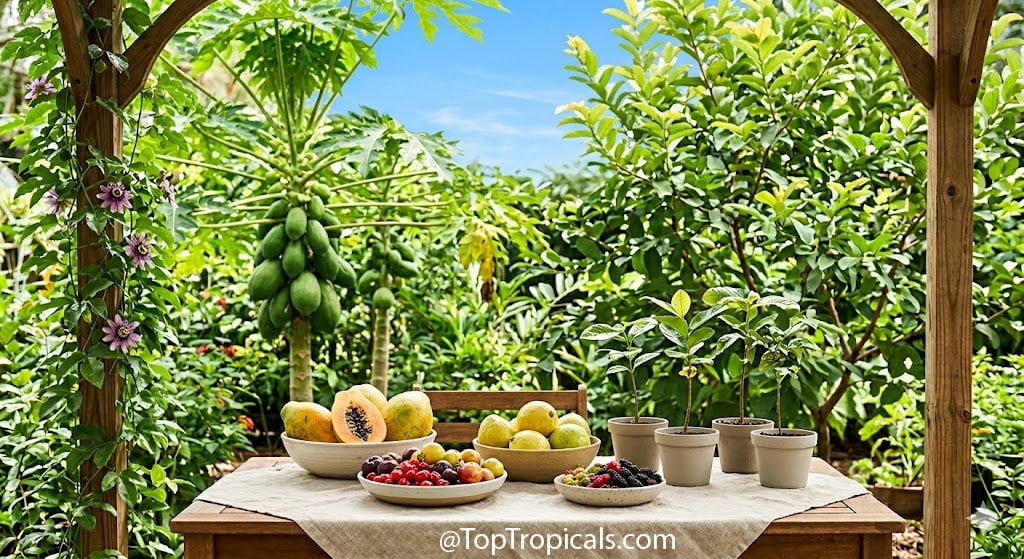
If you want speed, Papaya is king. It can go from a small seedling to heavy fruit in 6-10 months. It behaves more like a giant herb than a tree: it is fast, has shallow roots, and is incredibly responsive to water and fertilizer. In warm climates, it is a plant it and watch it go legend. More details

2. The Reliable: Guava 🍉
Guava is the most forgiving fruit tree you can own. It handles heat, poor soil, and the occasional week of neglect without missing a beat. Most varieties begin producing in just 1-2 years, staying compact enough for small yards or large pots. More details

3. The Surprise: Eugenias 🍒
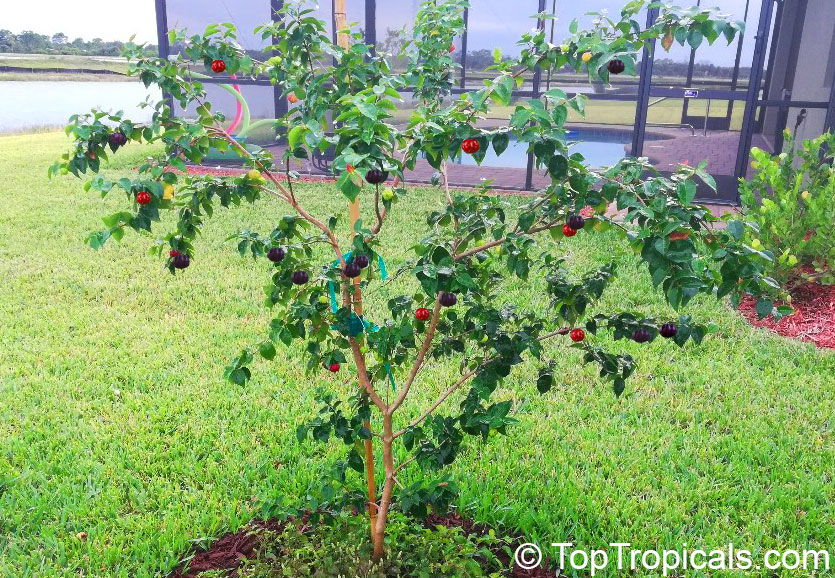
This family (including Surinam Cherry, Grumichama, Cherry of the Rio Grande, and Pitomba) often flies under the radar. They look like ornamental shrubs, but they establish quickly and can fruit within year two. They handle pruning beautifully, making them perfect for edible hedges. More details

🍓 The Fast-Fruit Honor Roll


🍓 Ultra-Fast (Under 1 Year)


Papaya and Banana: The heavyweight champions of speed.
Strawberry Tree (Muntingia calabura): Non-stop cotton candy berries.
Grafted Favorites: High-quality Mango, Avocado, Peach, Nectarine, and Persimmon.

Mango Plant Facts

Botanical name: Mangifera indica
Also known as: Mango
USDA Zone: 9 - 11
Highligths Large tree taller than 20 ftSmall tree 10-20 ftFull sunWatering: Moderate. Water when top soil feels dryYellow, orange flowersPink flowersEdible plantSeaside, salt tolerant plant
Get personalized tips for your region

Avocado Plant Facts

Botanical name: Persea americana, Persea gratissima
Also known as: Avocado, Alligator Pear, Aguacate, Abacate
USDA Zone: 9 - 11
Highligths Large tree taller than 20 ftSmall tree 10-20 ftFull sunWatering: Regular. Let topsoil dry slightlyEdible plantSubtropical plant. Mature plant cold hardy at least to 30s F for a short time
Get personalized tips for your region

Peach Plant Facts

Botanical name: Prunus persica, Amygdalus persica
Also known as: Peach
USDA Zone: 5 - 10
Highligths Small tree 10-20 ftFull sunWatering: Regular. Let topsoil dry slightlyWhite, off-white flowersPink flowersEdible plantDeciduous plantSubtropical plant. Mature plant cold hardy at least to 30s F for a short time
Get personalized tips for your region


🍓 Very Fast (1-2 Years)


The Berries: Mulberry (especially Everbearing), Fig, and Barbados Cherry.
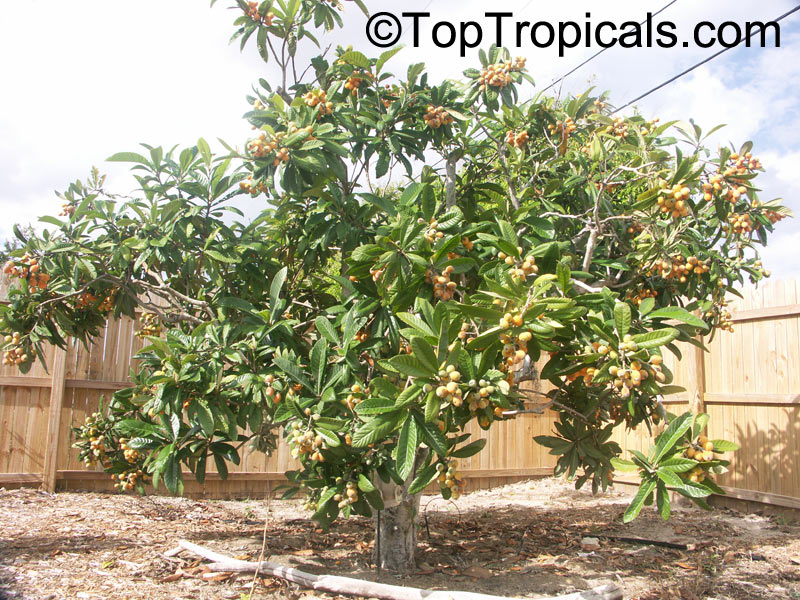
The Exotics: Strawberry Guava, Loquat, and the curious Peanut Butter Tree (Bunchosia).
The Sweet Treats: Blackberry Jam Fruit (Randia formosa).

🍓 Tropical Staples (2-3 Years)


Starfruit (Carambola): A heavy producer that looks stunning in the garden.
Annona Family: Sweet Sugar Apples and creamy Atemoyas.
Macadamia Nut: A long-term investment that starts surprisingly early.

🍓 Fast Climbers and Bush Fruit


Passionfruit: Will cover a fence and fruit in a single season.
Berries: Mysore Raspberry and classic Blackberries for quick returns.

🛒 Ready to harvest? Shop the "Fast-Fruit" Collection

📚 Learn more:


· Eugenia cherries in Plant Encyclopedia
· 10 best fruit trees to grow in Florida and Southern landscapes
· Top 10 fast-fruiting trees
· 5 fast-growing fruit trees and shrubs for quick, low-effort harvests (Top Tropicals experts for Martha Stuart)

#Food_Forest #How_to #Discover

🟢 Join 👉 TopTropicals

Date: 10 May 2026

🍑 From the Garden: Why I Always Recommend Growing Your Own Peaches

by Tatiana Anderson, Top Tropicals Garden Expert

A  peach  tree  growing  outdoors  under  a  blue  sky  with  ripe  red-orange 
 peaches  hanging  among  long  green  leaves.  The  image  also  shows  a  close-up 
 view  of  several  fuzzy  peaches  ripening  on  a 
 branch.

Peach trees are beautiful long before harvest day - glossy green leaves, colorful fruit, and that classic fuzzy peach look straight from the branch.

I'll be honest with you. The first time I bit into a peach straight off the tree, still warm from the afternoon sun, I understood why people get obsessed with this fruit. There is no comparison to what you find in a grocery store. Store peaches are picked hard, shipped cold, and by the time they reach you, something important is already gone. A tree-ripened peach is soft, fragrant, juicy, and sweet in a way store peaches rarely are. Eat it fresh, slice it into a cobbler, throw it on the grill - it holds up beautifully either way.

Peach Plant Facts

Botanical name: Prunus persica, Amygdalus persica
Also known as: Peach
USDA Zone: 5 - 10
Highligths Small tree 10-20 ftFull sunWatering: Regular. Let topsoil dry slightlyWhite, off-white flowersPink flowersEdible plantDeciduous plantSubtropical plant. Mature plant cold hardy at least to 30s F for a short time
Get personalized tips for your region

So let's talk about how to actually get there.

Planting

Peaches are not difficult. Give them sun, drainage, and room for air movement, and they will usually tell you very quickly that they are happy.

  • Full sun is essential - 8 hours minimum, and more is better.
  • Drainage matters - peach roots do not like sitting wet.
  • If your soil stays wet, plant on a mound - simple fix, big difference.
  • Water deeply, then pause - let the soil partially dry before watering again.
  • Prune every year - it keeps the tree open, improves airflow, and helps the tree put energy into fruit instead of tangled growth.

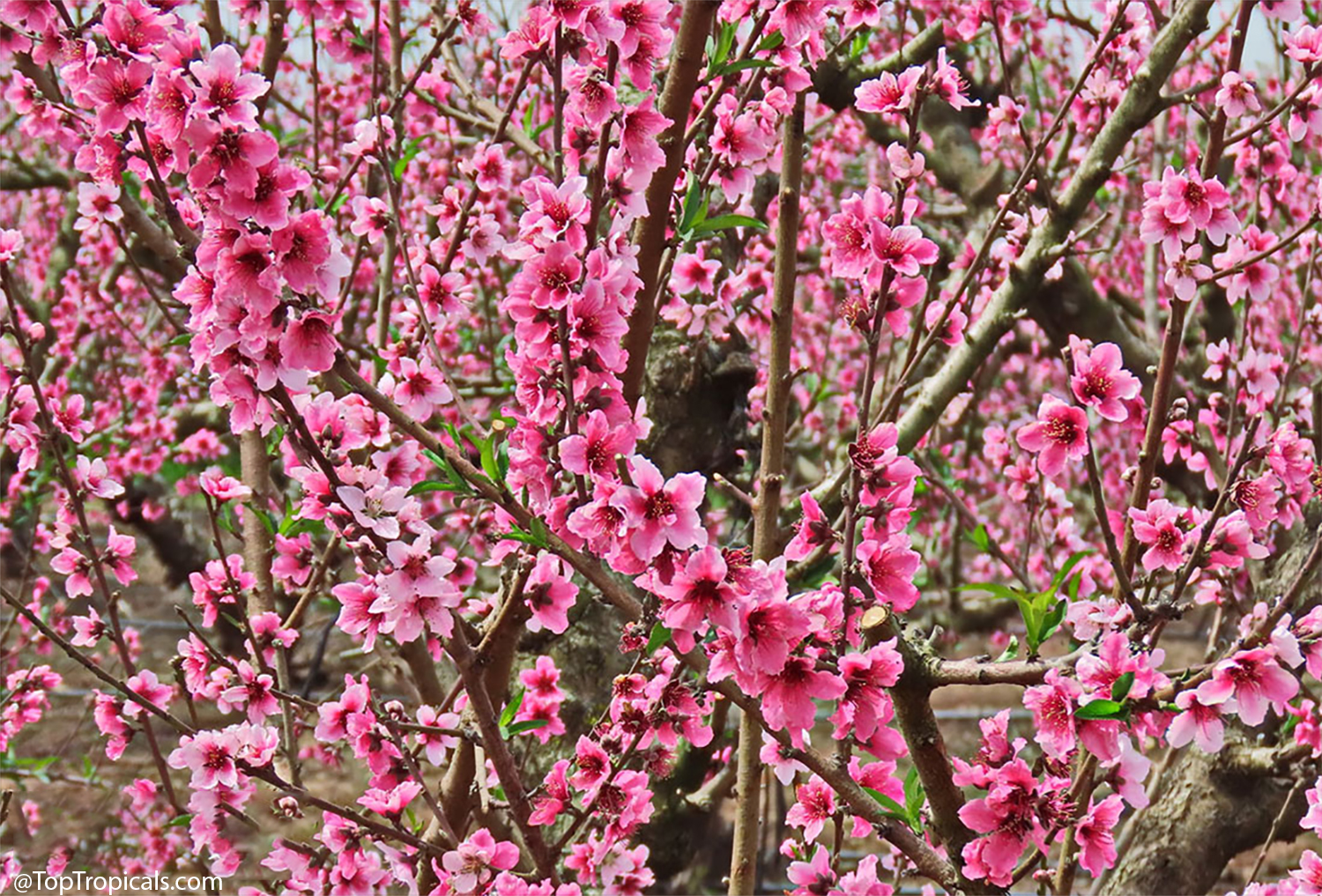
Branches  of  a  peach  tree  covered  in  masses  of  bright  pink  blossoms 
 during  spring  bloom.  The  flowers  densely  fill  the  tree,  creating  a  colorful 
 display  of  pink  petals  against  the  brown 
 branches.

Peach trees put on one of spring's prettiest shows - clouds of pink blossoms before the fruit season even begins.

What If You Do Not Have Room?

You can still grow peaches in a large container. This is a great option for patios, small yards, renters, or gardeners who want better control over soil and drainage.

  • Use a large pot with drainage holes.
  • Choose a fast-draining potting mix, not heavy garden soil. We recommend Sunshine Abundance potting mix.
  • Place the container in the sunniest spot you have.
  • Water more often than in-ground trees, but never let the pot stay soggy.
  • Prune to keep the tree compact and easy to manage.

Fertilizing

Peach trees are generous plants, but producing vigorous growth and a heavy crop of sweet fruit takes energy. Regular feeding makes a noticeable difference in tree health, flowering, and fruit quality.

I prefer a simple two-part approach that provides both steady background nutrition and quick, readily available nutrients when the tree is actively growing.

  • Green Magic controlled-release fertilizer provides a steady supply of nutrients for months and serves as the foundation of the feeding program.
  • Sunshine Boosters liquid fertilizers deliver amino acid-based nutrients that are quickly absorbed and especially useful during periods of active growth, flowering, and fruit development. Sunshine C-Cibus formula is the best for fruit trees.

During the growing season, this combination helps build stronger branches, healthier leaves, better flowering, and sweeter, higher-quality fruit.

If your tree shows yellowing leaves or weak growth, consistent feeding often makes a dramatic difference within a few weeks.

📚 More about low-chill peaches from our garden Blog

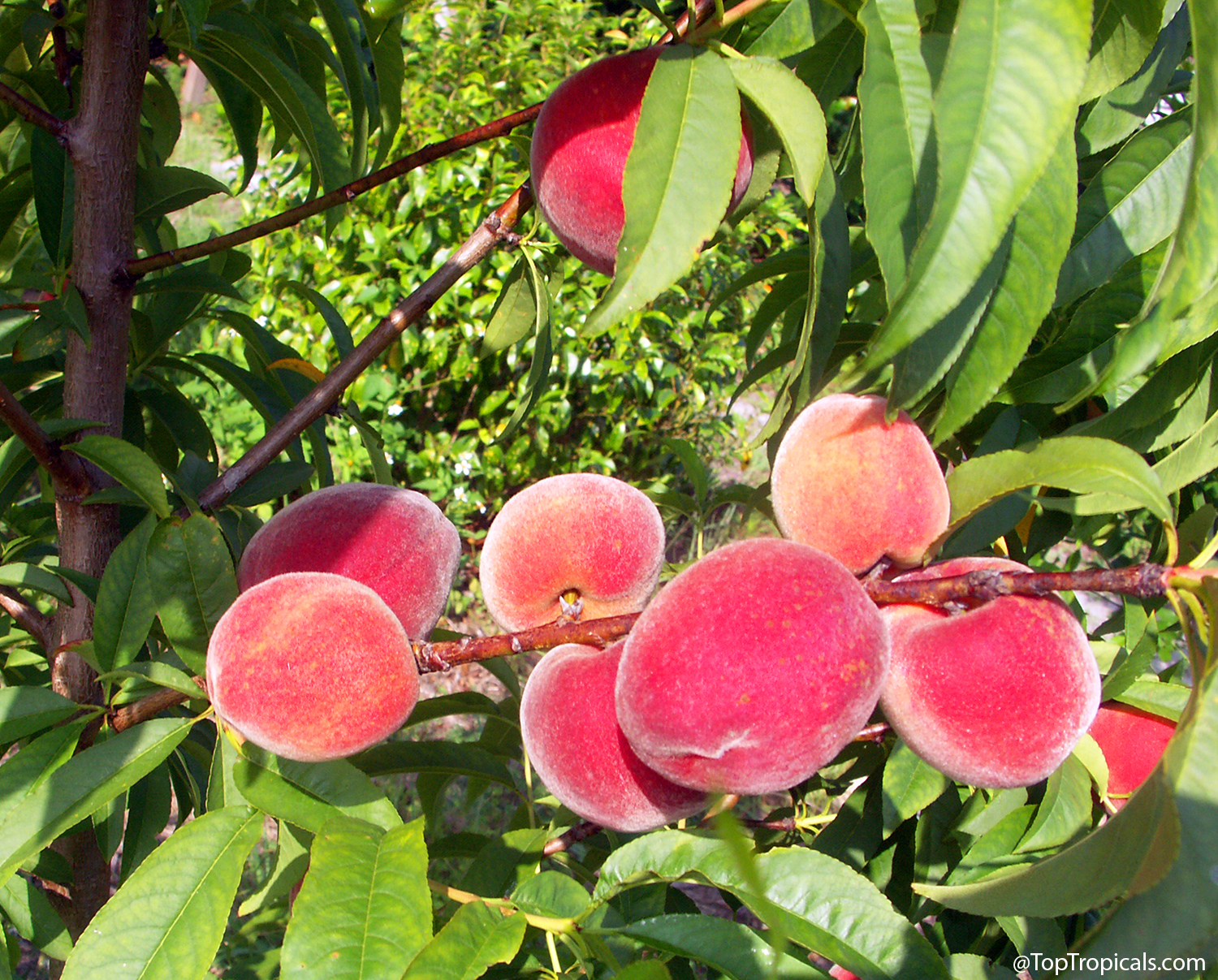
Clusters  of  ripe  fuzzy  peaches  growing  on  tree  branches  surrounded  by 
 long  green  leaves  in  bright  sunlight.  The  peaches  show  shades  of  pink,  red, 
 and  soft  yellow  as  they  ripen  on  the 
 tree.

Tree-ripened Tropic Beauty peaches warming in the sun - fuzzy, colorful, and almost ready to pick straight from the branch. Tropic Beauty variety is one of the most colorful and sweet.

📚 More about Tropic Beauty Peach

🛒 Shop Low-Chill Peach trees

Sunshine’s Philosophy: Lazy Peach Sundae 😺

Sunshine absolutely loves peach cobbler, especially when someone else does all the peeling, slicing, mixing, and baking. But when he is left to prepare dessert on his own, his standards become much more practical. Why turn on the oven when perfectly ripe peaches already taste amazing? His philosophy is simple: if a recipe takes less than five minutes and ends with peaches and vanilla ice cream in the same bowl, it is a masterpiece.

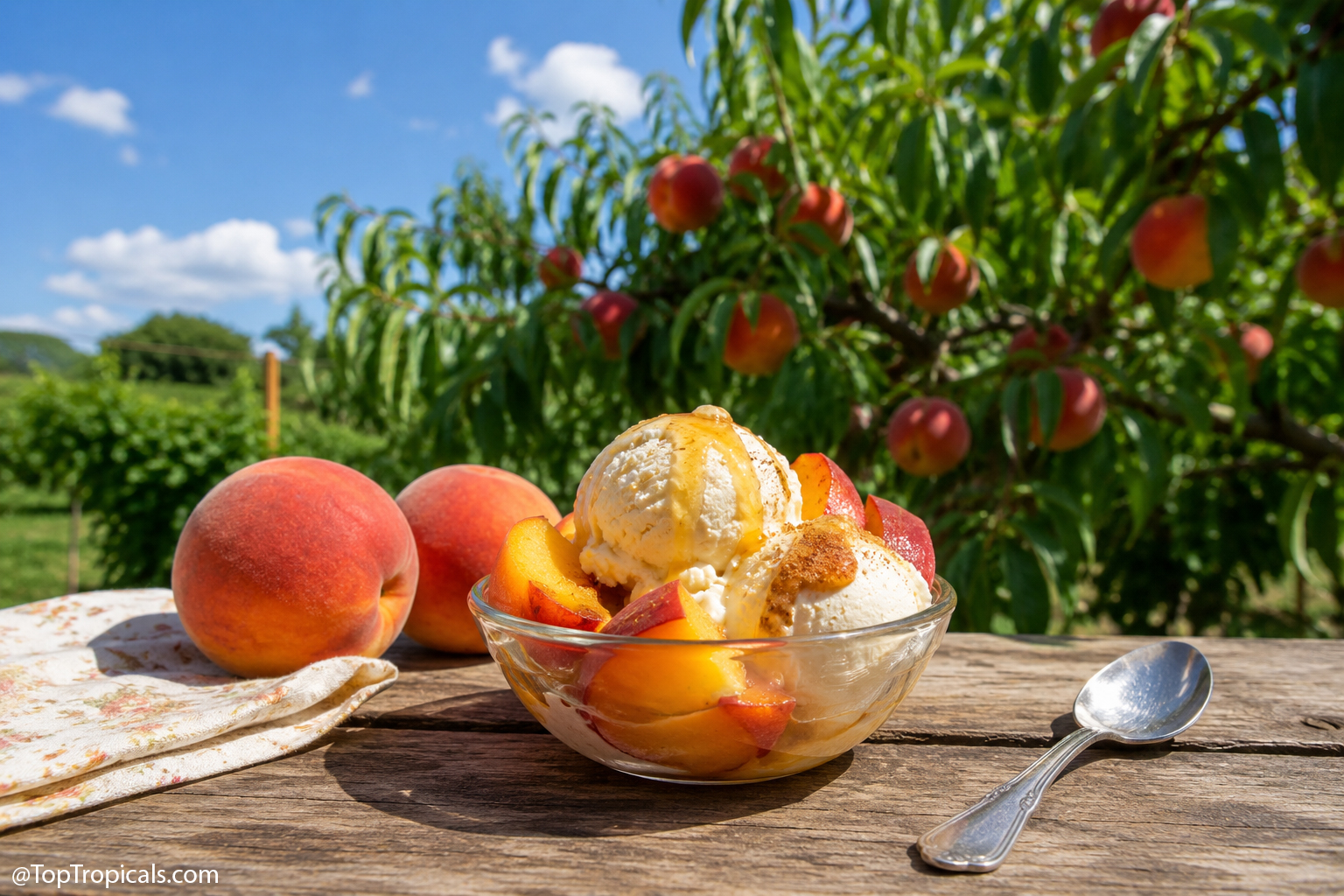
A  bowl  of  sliced  ripe  peaches  topped  with  two  scoops  of  vanilla  ice 
 cream,  drizzled  with  honey  and  lightly  sprinkled  with  cinnamon,  sits  on  a 
 rustic  wooden  table  outdoors.  Fresh  whole  peaches  rest  nearby,  with  a  sunny 
 peach  orchard  full  of  fruit  and  a  bright  blue  sky  in  the 
 background.

Sunshine's Lazy Peach Sundae - fresh peaches, cold ice cream, and zero effort on a perfect sunny day.

Sunshine's Lazy Peach Sundae

This is not cooking. This is assembly.

Ingredients

  • 2 ripe homegrown peaches
  • 2 big scoops of vanilla ice cream
  • A drizzle of honey (optional)
  • A pinch of cinnamon (optional)

Instructions

  1. Slice the peaches.
  2. Put them in a bowl.
  3. Add vanilla ice cream.
  4. Drizzle with honey and sprinkle with cinnamon if you feel ambitious.
  5. Eat immediately while smiling.

Sunshine's Review

"I peeled exactly nothing and still got dessert. This is my kind of gardening."

Want this?
Start with a low-chill peach tree. That is usually how it begins.

🛒 Plant your own Peach tree

Date: 8 Feb 2024

Mark your calendars: March 2, 2024

March  2,  2024  -  SATURDAY  -  Spring  Plant  Market:  March  into  Spring!

Plant Festival "March into Spring!"
Saturday, March 2, 9 am - 4 pm

Save the date! On March 2, 2024, join us for our vibrant Plant Festival, "March into Spring!"
Dive into a world of lush greenery, blooming delights, and rare fruit trees at our garden event. Discover unbeatable sales, exclusive deals, delightful gift bags, and receive free plants with every purchase.
Don't miss out on this opportunity to embrace the beauty of spring and elevate your garden to new heights!

Highlights of the event:

30% OFF online prices, one day only! (excluding 15 gallon material and rare plants)
Gift bags - for first 25 customers with $50 order
Secret Garden: Super savings area 50-70% off
$5 and $10 plants
Raffle
Free plant with any purchase as a token of our appreciation

Event discounts valid at both locations:

Ft Myers Garden Center: 13890 Orange River, Ft Myers, FL
Sebring B-Farm: 9100 McRoy Rd, Sebring, FL

Facebook event page - Download invitation

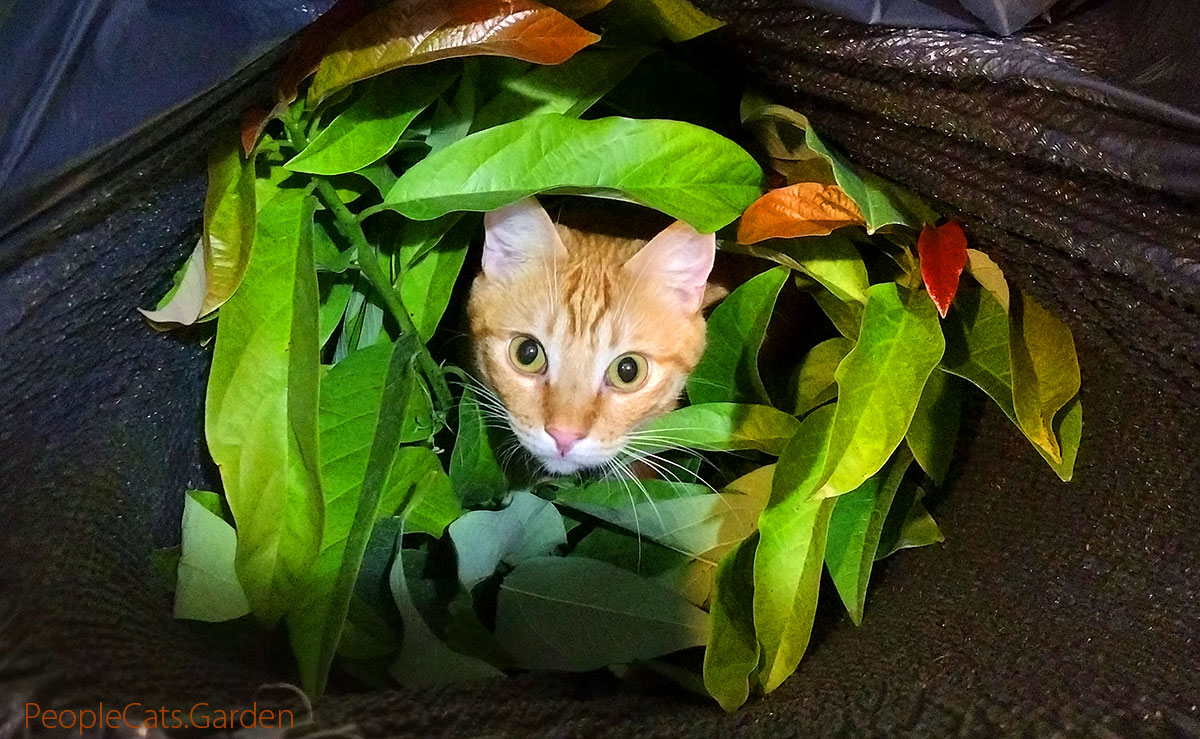
Cat  with  plants  in  a  bag

Date: 6 Oct 2021

Top Tropicals Top House Plants

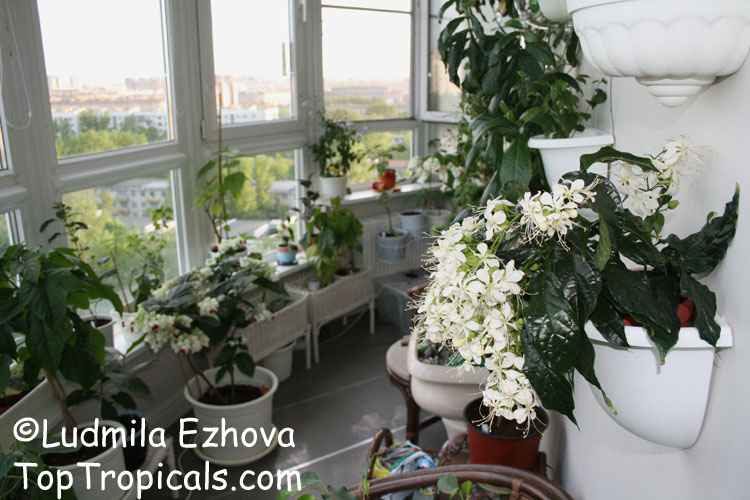
Photo above: Clerodendrum indoor garden of Ludmila Ezhova, St Petersburg, Russia.

Enjoy the Tropics Year round!
Bring them inside...

Q: I just discovered your amazing website and spent hours browsing your beautiful tropical plants! I wish I could have them all! But it's getting cold here (I live in Chicago area), too late? Can you recommend something of a small size, colorful, that I can easily overwinter indoors? Thanks for bringing this beauty into our lives!

A: Don't get discouraged even in colder climates. Yes, you can grow tropical plants indoors! Remember that all traditional houseplants are in fact tropical plants that grow in tropics in a wild habitat. Humans didn't invent them as indoor plants, they originally collected them from the rain forests and jungles! Most of tropical plants, including trees and fruit trees, can be grown in containers and even indoors. It's just a matter of space limitations and amount of time you are willing to spend caring of your exotic babies. Many gardeners up North are very successful with their tropical plant collections.
Below are a few suggestions of compact growing, easy species for your indoor collection. Enjoy the Tropics Year round!

See more plants well-suitable for indoor culture and our specials at the end of this newsletter.

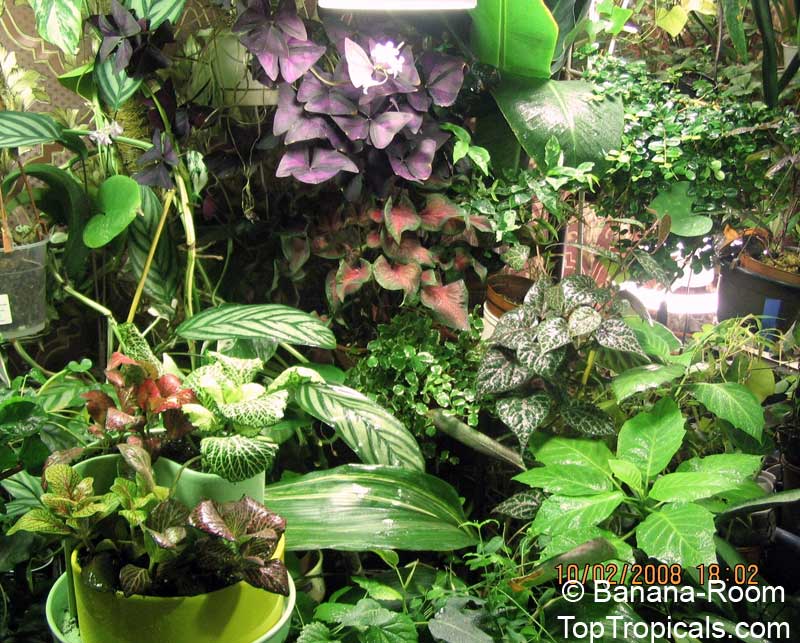
Photo above: small tropical indoor garden of Julia Nikolayeva, St Petersburg, Russia.

Date: 26 Sep 2021

Edible Landscape: fruit bearing hedge

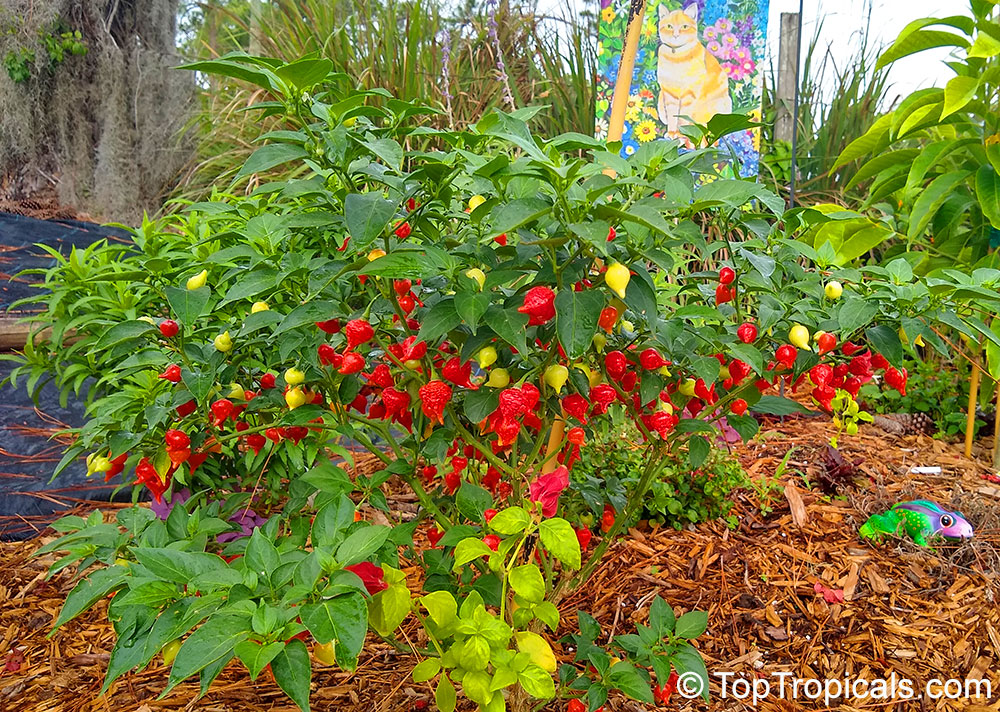
Photo above: Biquinho Pepper (2 months old plant)

Q: My mom had to remove a hedge for some renovations and after being heartbroken about losing my little bird haven, I've decided to plan on a fruit bearing hedge that offers some privacy and places for the little fledgling to wait for food. Any suggestions? I was thinking blueberries or citrus but open to any ideas.

A: Below are a few suggestions for a fruit bearing hedge planted with fast-growing, tropical species. They will contribute to a nice edible landscape for both your family and the birds - they will be very happy!

Larger size hedge (small trees), grows full-size within 1 season:
- Loquats
- Dwarf Mulberries (very cold hardy too) such as Dwarf Everbearing

Medium size hedge (shrubs or vines), 2-3 seasons to grow full size:
- Black Surinam Cherry Lolita
- Blackberries and raspberries

Low hedge (4-5 ft tall, 1 season, fast growing):
- Biquinho Pepper
- Wiri Wiri Pepper

Citrus is probably not a good idea, not bird's favorite, and blueberries require a special acidic soil here in Florida, so they will need extra maintenance, special soil, and heavy mulching.

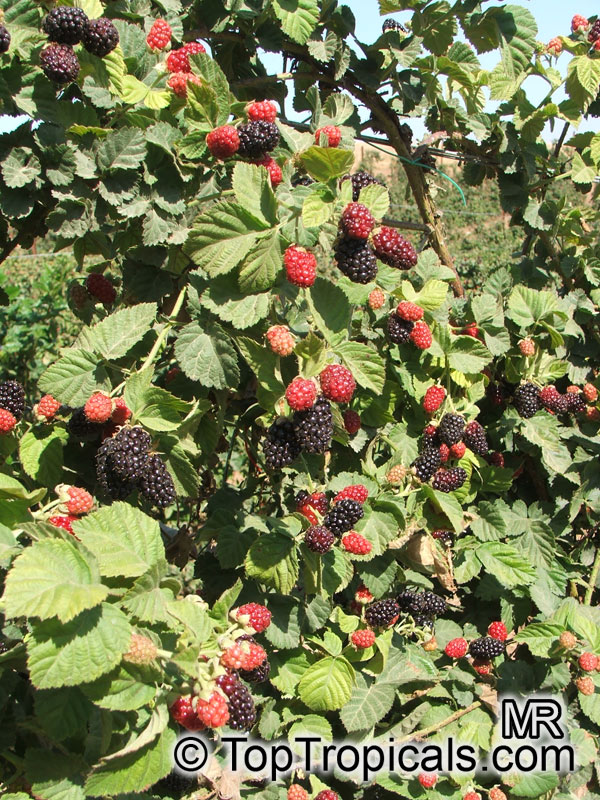
Blackberry hedge

Surinam Cherry Lolita, 2 year old plant

Loquat (5 years old bushy specimen)