Garden Blog - Top Tropicals

Date: 7 Mar 2017

Taking care of Guanabana (Soursop) after shipping
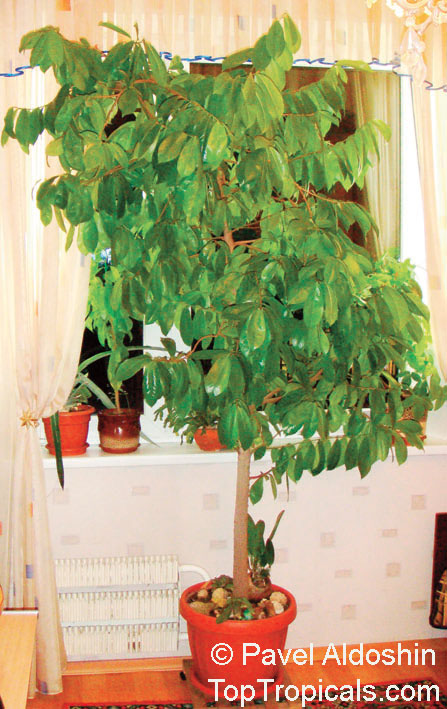
Q: Since I have never grown a soursop tree before I need some pro help. My tree was delivered absolutely beautiful, leaves were a pretty green. I potted it and gave it a good drink of water and put it in a shaded area outside. Then the weather here became cool so I brought it in for a few days until the weather warmed, and it lost all the leaves. Is it in shock and will come around eventually? Will I be able to grow this tree indoors during winter?

A: Soursop - Annona muricata trees are very sensitive to temperature drops. This always causes leaf loss. You seem to be doing everything right. Do not water until soil gets slightly dry; keep it in bright shade. The weather should be good now with high temperatures and humidity rising. No fertilizer until the plant shows active new growth. Be patient with your plant, it should recover soon.

Soursop is an ultra-tropical tree and doesn't take any freeze. If you live in cooler climate, keep the plant in a pot (the good news is, Annonas in general have compact nature and are perfect for container culture). Bring the tree indoors during cold period, providing bright light.

Remember that grafted trees start flowering and producing fruit right away, unlike seedlings of Soursop that may take a few years till fruiting.

We have very interesting article about growing and fruiting Soursop in apartment. Check out Tropical Treasures Magazine #7.
Date: 15 May 2024

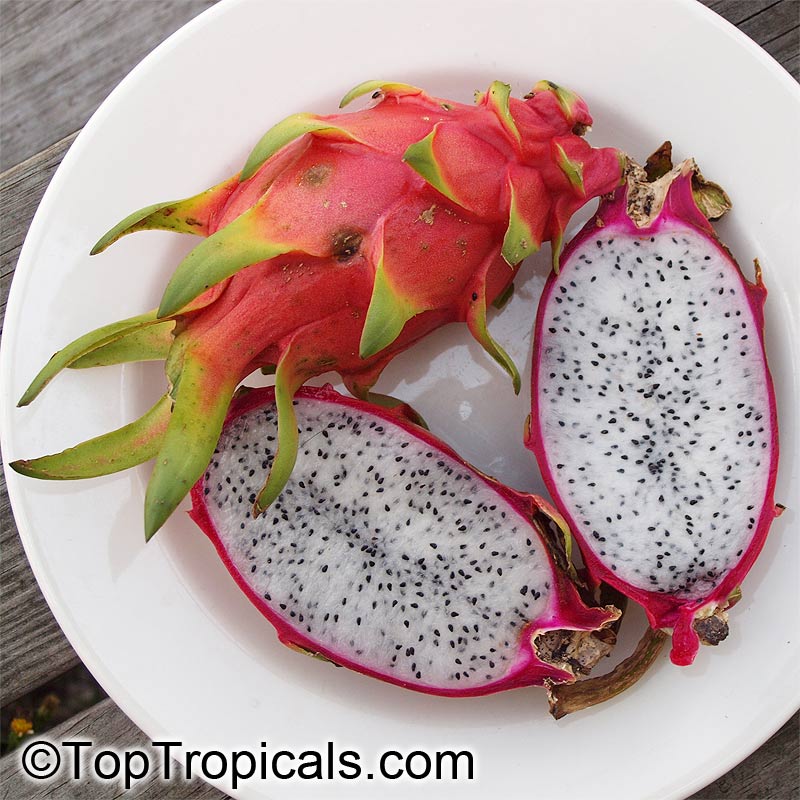
What does a dragon taste like? Does Dragon Fruit come from a monster cactus? Learn why you need to grow your own

Hylocereus and Selenicereus Dragon Fruit or Pitaya

Hylocereus and Selenicereus Dragon Fruit or Pitaya

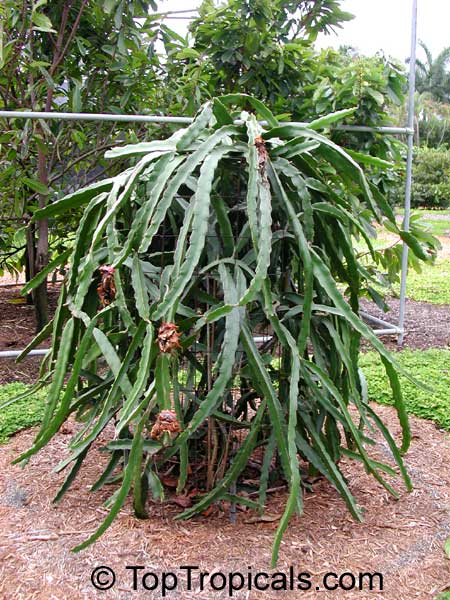
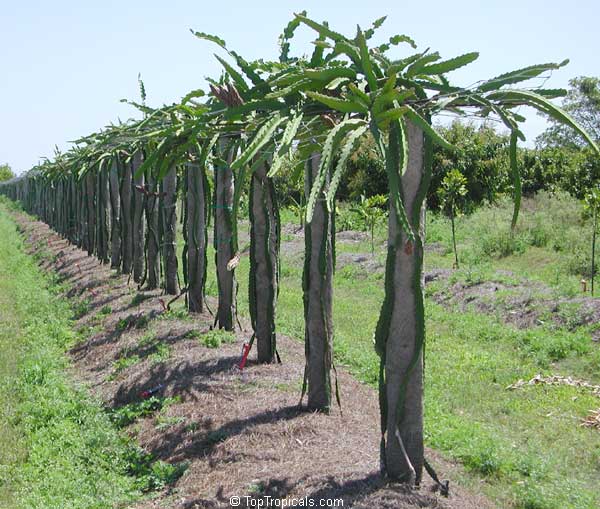
Hylocereus and Selenicereus Dragon Fruit or Pitaya trees on trellis

Hylocereus and Selenicereus Dragon Fruit or Pitaya trees on trellis

Hylocereus and Selenicereus Dragon Fruit or Pitaya on trellis

Hylocereus and Selenicereus Dragon Fruit or Pitaya on trellis

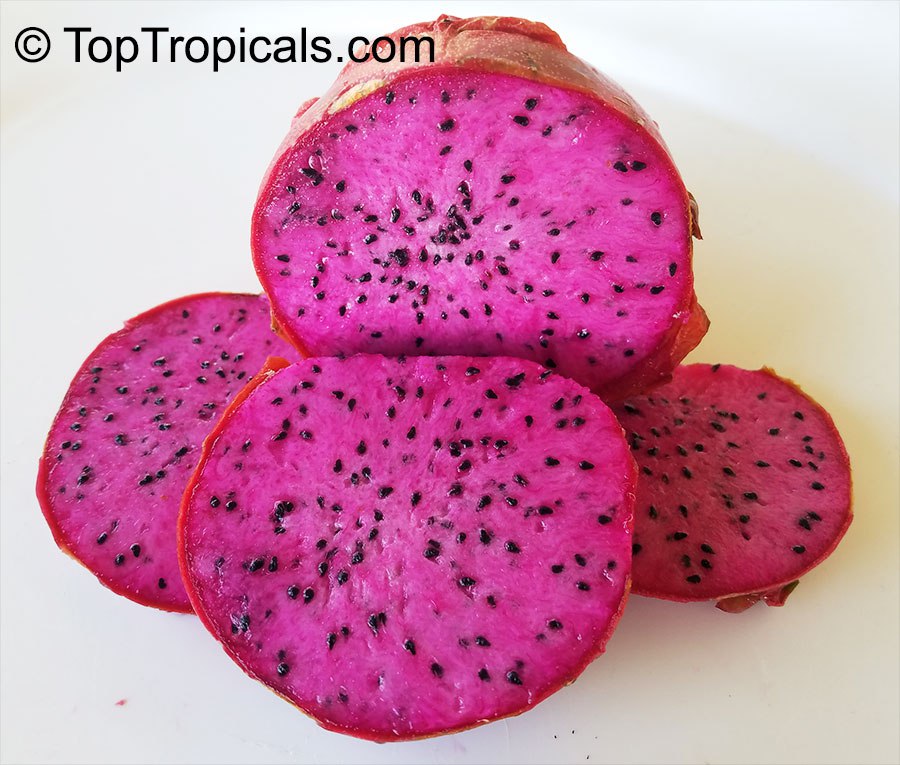
Hylocereus and Selenicereus Dragon Fruit or Pitaya red fruit

Hylocereus and Selenicereus Dragon Fruit or Pitaya red fruit

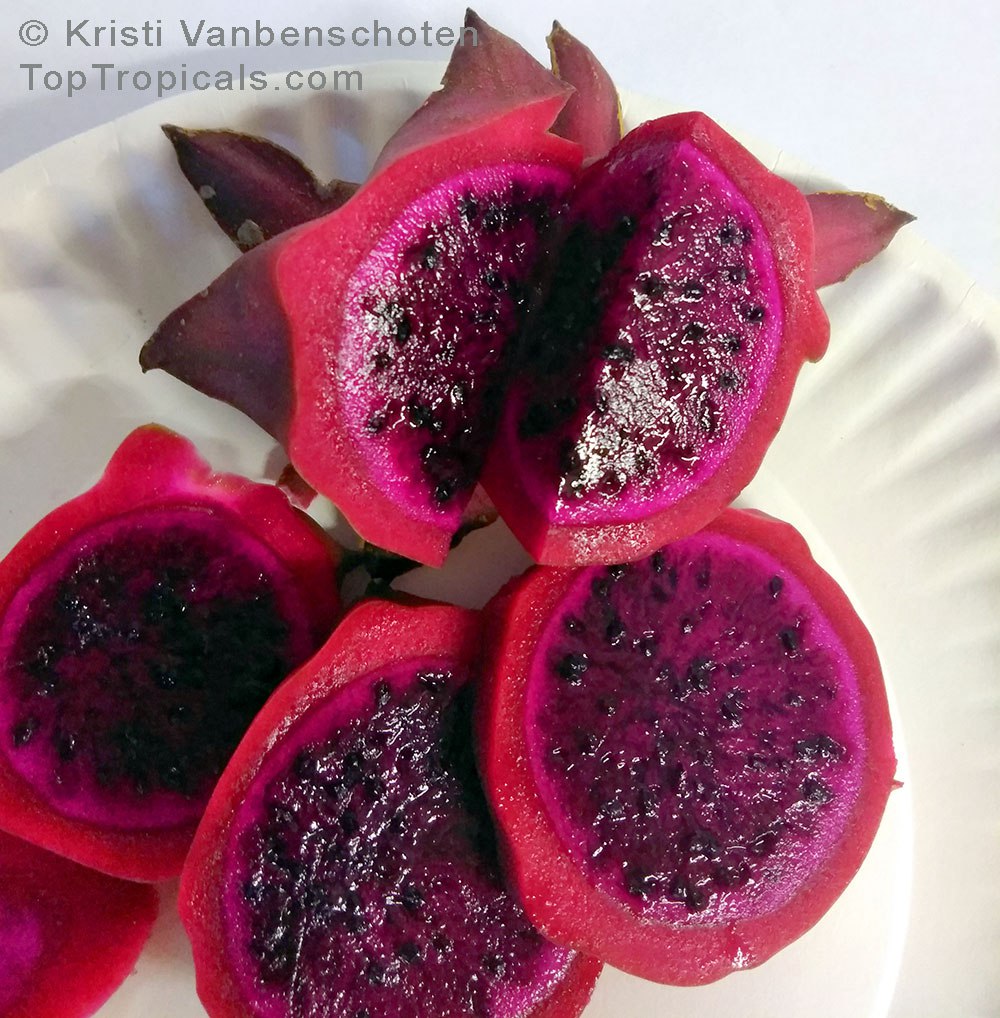
Hylocereus and Selenicereus Dragon Fruit or Pitaya purple fruit

Hylocereus and Selenicereus Dragon Fruit or Pitaya purple fruit

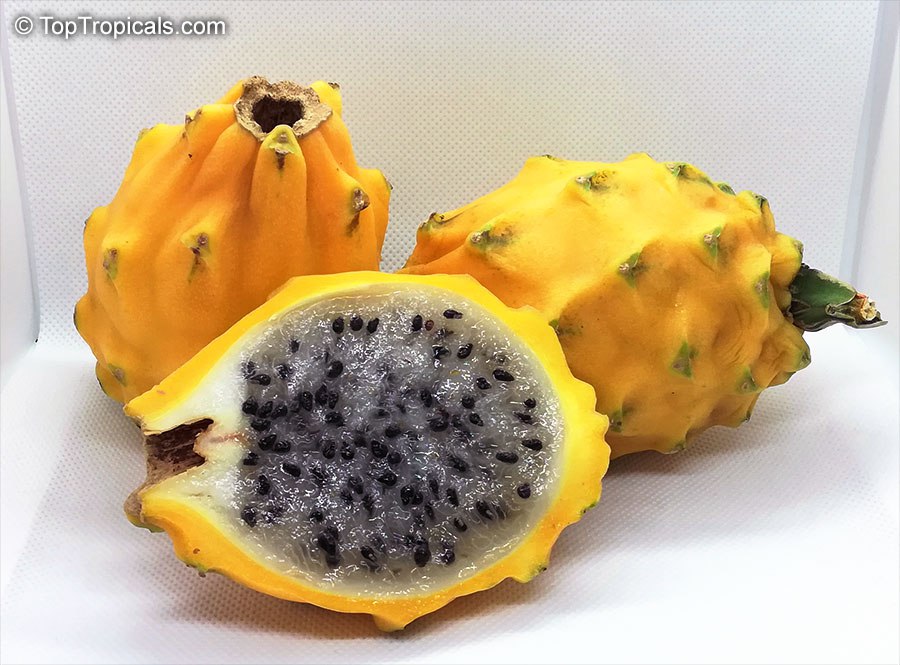
Hylocereus and Selenicereus Dragon Fruit or Pitaya Yellow Parlora

Hylocereus and Selenicereus Dragon Fruit or Pitaya Yellow Parlora

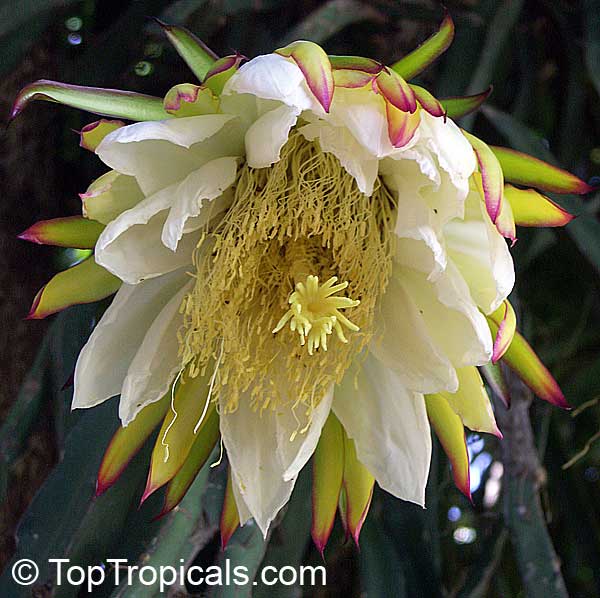
Hylocereus and Selenicereus Dragon Fruit or Pitaya flower

Hylocereus and Selenicereus Dragon Fruit or Pitaya flower

🐲 What does a dragon taste like? Does Dragon Fruit come from a monster cactus? Learn why you need to grow your own. 🌵

🔴 You may have tried a Dragon fruit from the store l, but do you know how it grows? On a cactus tree!

🔴 Names: varieties of Hylocereus and Selenicereus - these fruit bearing cactus plants are also called Dragon Fruit or Pitaya.

🔴 Commercially grown fruit sold in a grocery store may be tasteless. You need to grow your own good variety to have tasty, sweet, flavorful fruit!

🔴 Dragon fruit comes in many varieties. Colors of flesh differ: white, pink, dark red and even purple. The outside of the fruit can be red/pink or yellow.

🔴 In commercial groves, Pitayas grow like cactus trees, over a strong support - big "umbrella frames" ☂️

🔴 It is an easy plant, with low water needs, takes both sun and semi-shade.

🔴 Our favorite variety is Yellow Dragon Fruit Palora, (Selenicereus megalanthus). It is the sweetest and has the most flavor of all. We shared some recipes earlier.

🔴 Can be grown in container with a wooden trellis. And the flower is beautiful, too!

📚 Learn more about Dragon Fruit
🍹 Recipe: What to do with a Dragon fruit?

🛒Grow your own Tasty Dragon Fruits

#Food_Forest #Recipes #Nature_Wonders

🏵 TopTropicals

Date: 5 Jan 2026

☘️ What plants are easy to ship in Winter?

Lush  tropical  garden  with  a  bright  green  leafy  Magnolia  champaka  surrounded  by  flowering  shrubs,  such  as  Brunfelsia  grandiflora,  at  Top  Tropicals  nursery

Ordering plants in winter is often easier than people expect - and for many plants, it is actually better. Lush foliage plants like philodendrons and medinilla, fine-leaved trees such as moringa, jacaranda, and poinciana, and even sensitive fruit trees like papaya, jackfruit or starfruit ship more safely in cool weather without overheating stress.

Winter is also ideal for subtropical and cold-tolerant plants, dormant or deciduous plants like plumeria and adenium, orchids - including ground orchids and vanilla orchids, and winter bloomers that flower their best right now. Winter care is simple: water less, use gentle liquid amino-acid fertilizers like Sunshine Boosters, and monitor insects.

In mild climates, many tropicals can be planted anytime, while extra-tender plants can stay potted until spring. Winter is a perfect time to bring tropical warmth indoors and enjoy greenery when you need it most.

🌿Learn more: easy plants for Winter shipping

Date: 13 Sep 2025

🌸 Meet the Most Colorful Ground Orchids

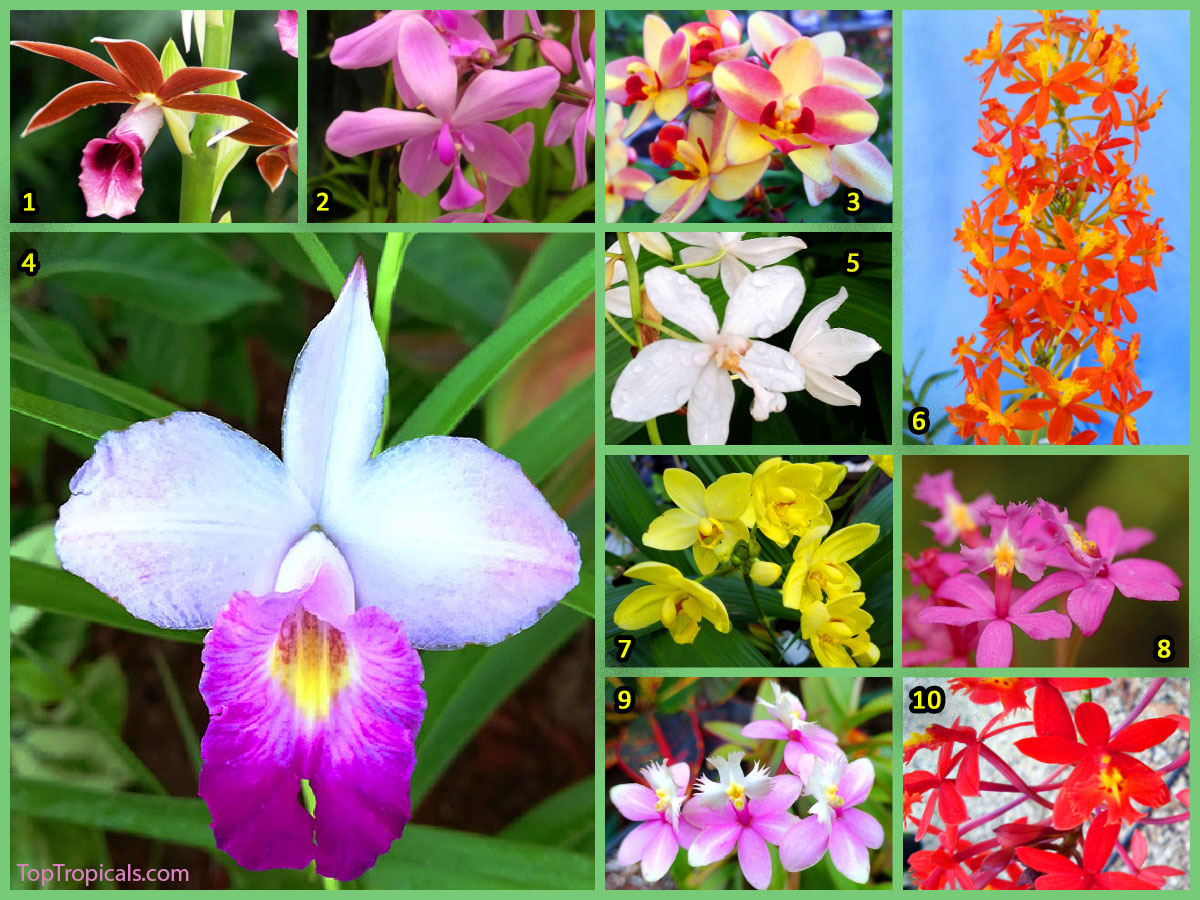
Collage  of  ground  orchids  –  Phaius  tankervilleae  (Nun  Orchid), 
 Spathoglottis  varieties  (purple,  yellow,  white,  pink),  Arundina  graminifolia
    (Bamboo  Orchid),  and  Epidendrum  species  (orange,  pink,  red  Reed 
 Orchids)

Ground Orchids – Spathoglottis, Phaius, Arundina, Epidendrum

  1. Chinese Nun Ground Orchid (Phaius tankervilleae)
  2. Yokohama Ground orchid Kate (Bletilla striata x formosana)
  3. Tropical Punch, Sorbet Ground Orchid (Spathoglottis plicata)
  4. Bamboo Orchid (Arundina graminifolia)
  5. Snow Angel, Coconut Cloud Ground Orchid (Spathoglottis alba)
  6. Orange Reed Ground Orchid (Epidendrum radicans Sunrise)
  7. Lemon Kiss, Sorbet Ground Orchid (Spathoglottis chrysanta)
  8. Pink Reed Ground Orchid, Violet Queen (Epidendrum radicans Fuchsia)
  9. Lavender Reed Ground Orchid (Epidendrum elongatum x radicans)
  10. Red Raspberry Reed Ground Orchid (Epidendrum radicans Red Glow)

Orchids have a mystique that sets them apart — elegant, exotic, almost unreal in their perfection. But let’s be honest, not everyone has luck with the fancy ones that cling to trees or need greenhouse tricks.

Ground orchids are different. They grow in regular garden soil, bloom in sun or shade, and come in all sorts of shapes and colors. They’re the orchids you don’t have to fuss over.

Nun Orchid (Phaius tankervilleae) – Ever wonder why it’s called the Nun Orchid? The flowers really do look like the white veil and brown habit nuns used to wear. The plants send up spikes 3–4 ft tall with 10–20 fragrant blooms that open one after another for weeks. I like them best tucked under trees where they just keep spreading year after year.

Spathoglottis – The nonstop bloomer – If you want flowers that just don’t quit, this one’s it. Spathoglottis clumps up and throws spikes of purple, pink, or yellow that last for weeks, then keep coming back through the summer. In warm spots they’ll bloom almost year-round. Honestly, it’s one of the easiest orchids you’ll ever grow.

💲 Special Offer – 20% off Ground Orchids!

Get 20% OFF ground orchids with code

ORCHID2025

Min order $100. Excluding S/H, valid online only, cannot be combined with other offers.

Hurry, offer expires September 17, 2025!

Shop ground orchids

Date: 17 May 2026

9 awesome accent plants and vines that love heat and dry conditions

9 awesome accent plants and vines that love heat and dry conditions 9 awesome accent plants and vines that love heat and dry conditions 9 awesome accent plants and vines that love heat and dry conditions 9 awesome accent plants and vines that love heat and dry conditions 9 awesome accent plants and vines that love heat and dry conditions

☀️ 9 awesome accent plants and vines that love heat and dry conditions


The hardest spots aren’t for trees - they’re for everything else. The toughest areas are often smaller spaces - along walls, patios, containers, or rocky patches where soil dries out fast. This is where most plants fail quickly.
These picks don’t just survive - they stand out. They bring texture, color, and structure - without needing constant watering or perfect soil.


Why containers are the toughest of all in heat


Growing in pots in hot, dry conditions is a different game. The soil heats up fast, roots can literally overheat, and moisture disappears much quicker than in the ground. If you’re using containers, protect the root zone - group pots together, tuck them into partial shade, or shield the container itself from direct sun. Choosing drought-tolerant plants helps, but don’t assume they can go totally without water - even tough plants in pots can dry out quickly, so check regularly and don’t let them go bone dry.

🔥 9 best smaller plants and vines for hot, dry spots


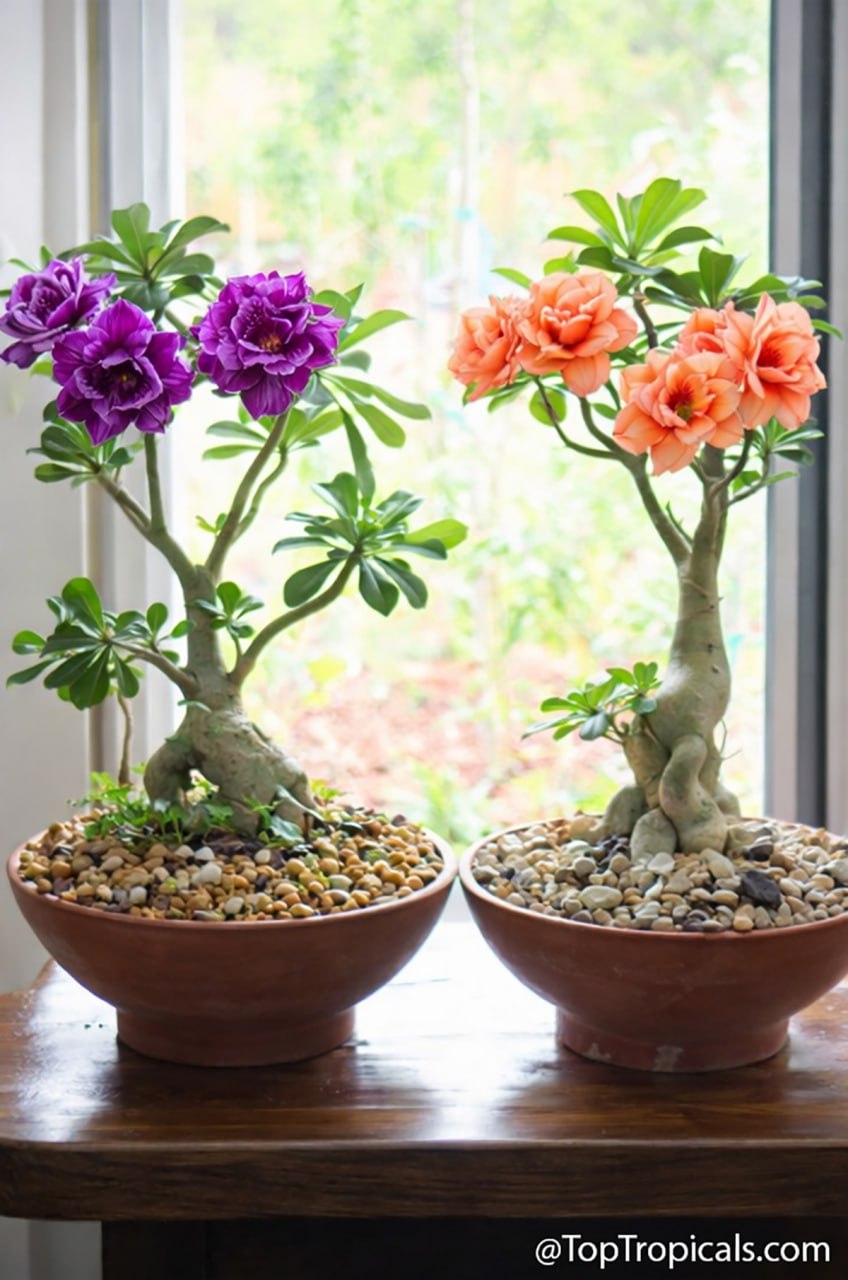
  1. ☀️ 1. Adenium - Desert Rose 📸
    Stores water in its caudex and thrives in heat - one of the best flowering plants for dry conditions.

    Adenium Plant Facts

    Botanical name: Adenium sp.
    Also known as: Adenium, Desert Rose, Impala Lily
    USDA Zone: 9 - 10
    Highligths Plant with caudexLarge shrub 5-10 ft tallSmall tree 10-20 ftFull sunWater Requirement: Low. Allow soil to dry out between wateringsWatering: Moderate. Water when top soil feels dryYellow, orange flowersRed, crimson, vinous flowersUnusual colorBlue, lavender, purple flowersWhite, off-white flowersPink flowersToxic or Poisonous
    Get personalized tips for your region
    More details
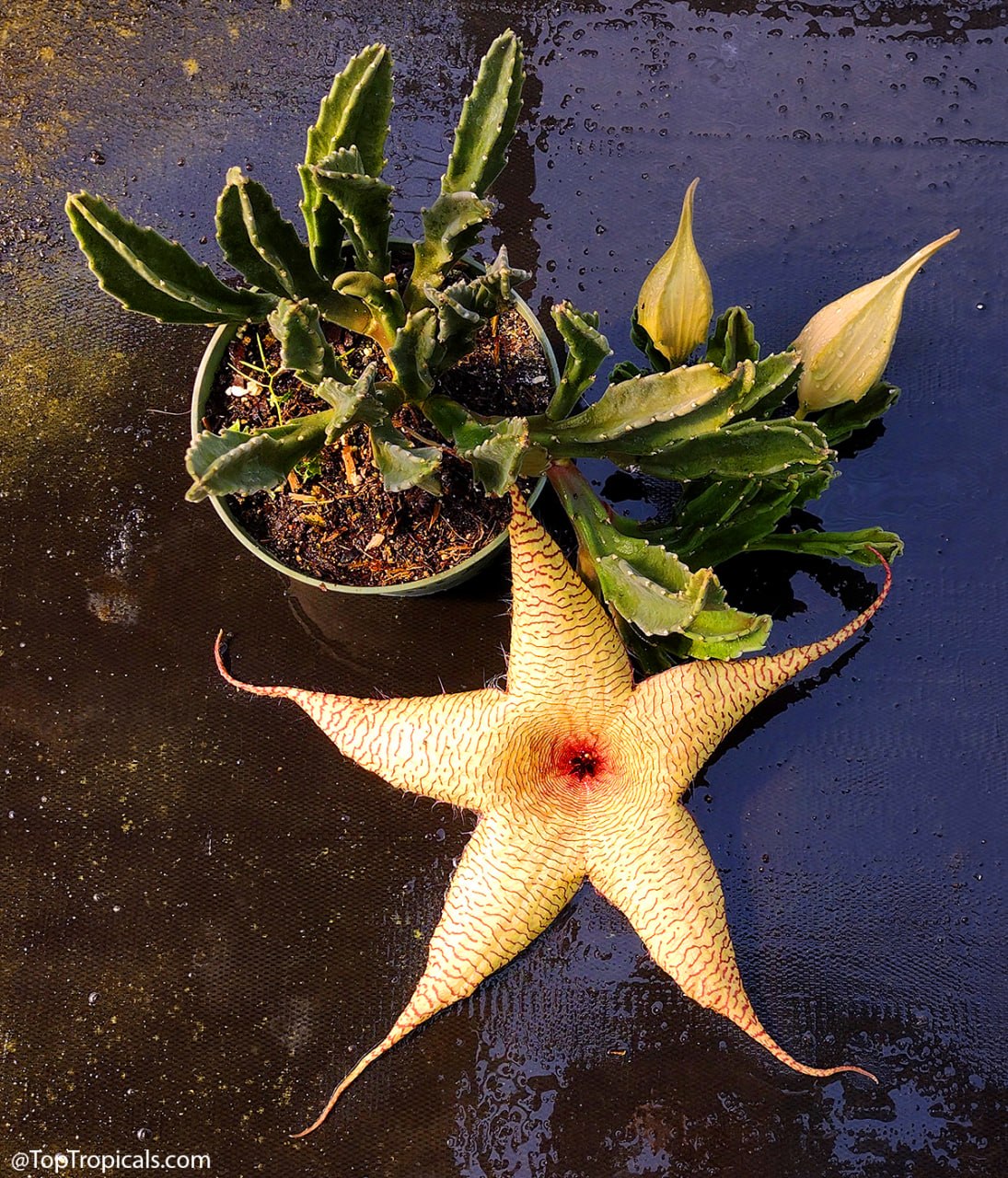
  2. ☀️ 2. Stapelia gigantea - Starfish Flower 📸
    Unusual and tough - thrives in dry soil and produces massive, eye-catching blooms.

    Zulu Giant Plant Facts

    Botanical name: Stapelia gigantea
    Also known as: Zulu Giant, Carrion Plant, Starfish Flower
    USDA Zone: 9 - 10
    Highligths Small plant 2-5 ftFull sunWatering: Moderate. Water when top soil feels dryUnusual colorPlant attracts butterflies, hummingbirds
    Get personalized tips for your region
    More details
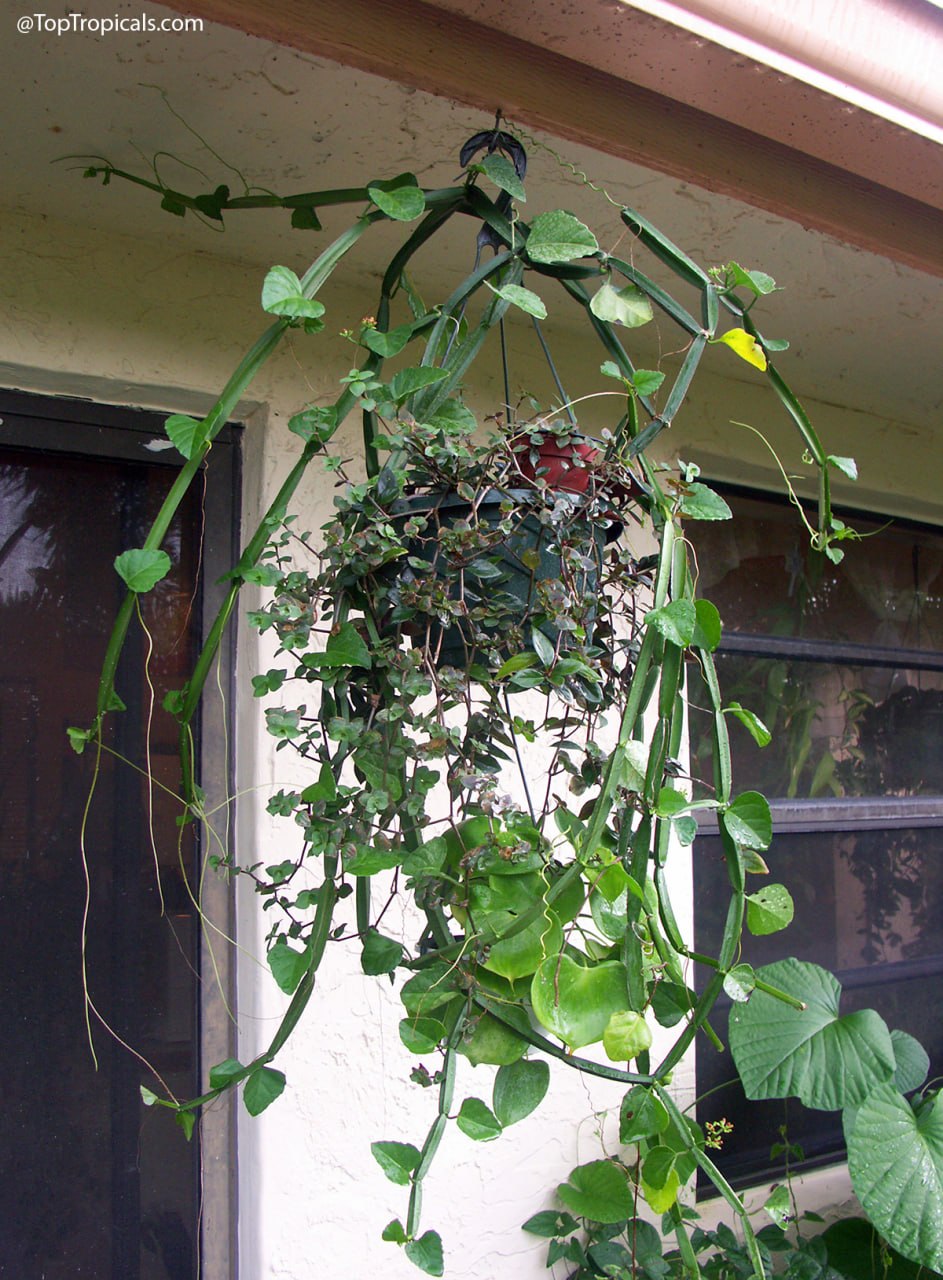
  3. ☀️ 3. Cissus quadrangularis - Veld Grape Vine 📸
    A succulent vine that handles heat and drought while adding a unique structural look.

    Veld grape Plant Facts

    Botanical name: Cissus quadrangularis, Vitis quadrangularis
    Also known as: Veld grape
    USDA Zone: 9 - 11
    Highligths Groundcover and low-growing 2ft plantVine or creeper plantSemi-shadeFull sunWatering: Moderate. Water when top soil feels dryOrnamental foliageEthnomedical plant.
Plants marked as ethnomedical and/or described as medicinal, are not offered as medicine but rather as ornamentals or plant collectibles.
Ethnomedical statements / products have not been evaluated by the FDA and are not intended to diagnose, treat, cure, or prevent any disease. We urge all customers to consult a physician before using any supplements, herbals or medicines advertised here or elsewhere.Subtropical plant. Mature plant cold hardy at least to 30s F for a short time
    Get personalized tips for your region
    More details
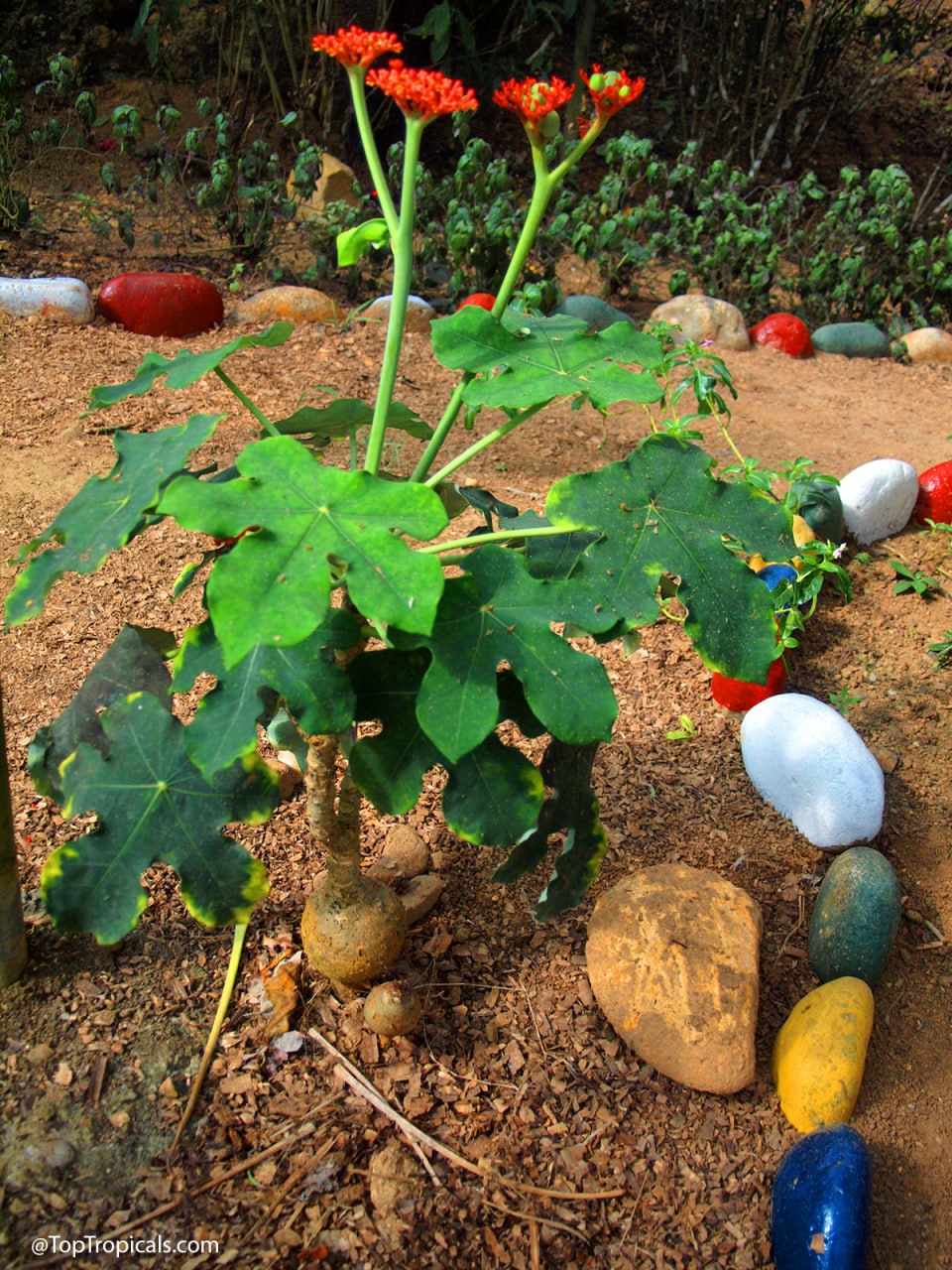
  4. ☀️ 4. Jatropha podagrica - Gout Plant 📸
    Thick stems store water, making it surprisingly drought tolerant with a bold tropical look.

    Gout Plant Facts

    Botanical name: Jatropha podagrica
    Also known as: Gout Plant, Gout Stick, Buddha Belly, Guatemala Rhubarb, Tartogo
    USDA Zone: 9 - 11
    Highligths Plant with caudexPlant used for bonsaiSmall plant 2-5 ftSemi-shadeShadeFull sunWatering: Moderate. Water when top soil feels dryYellow, orange flowersRed, crimson, vinous flowersOrnamental foliageToxic or PoisonousPlant attracts butterflies, hummingbirdsSubtropical plant. Mature plant cold hardy at least to 30s F for a short timeSeaside, salt tolerant plant
    Get personalized tips for your region
    More details
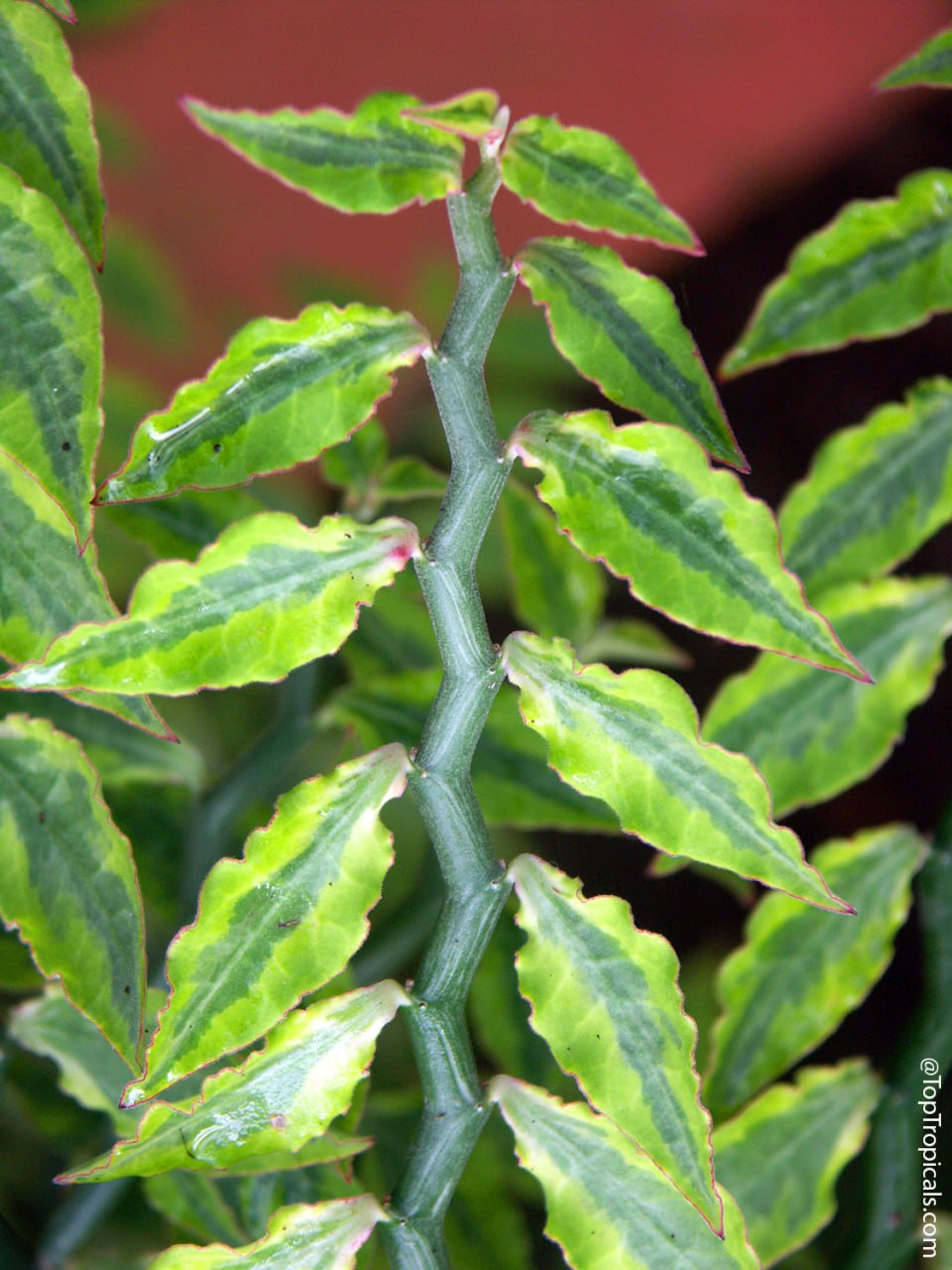
  5. ☀️ 5. Pedilanthus tithymaloides - Devil's Backbone 📸
    Extremely forgiving - thrives on neglect, heat, and dry soil.

    Devil's backbone Plant Facts

    Botanical name: Euphorbia tithymaloides, Pedilanthus tithymaloides
    Also known as: Devil's backbone, Zigzag plant, Jacob's ladder
    USDA Zone: 9 - 11
    Highligths Large shrub 5-10 ft tallSmall plant 2-5 ftSemi-shadeFull sunWatering: Moderate. Water when top soil feels dryOrnamental foliagePink flowersIrritating plantSubtropical plant. Mature plant cold hardy at least to 30s F for a short time
    Get personalized tips for your region
    More details
  6. ☀️ 6. Agave species - Tequila Agave, Century Plant
    Classic drought plants - architectural, extremely tough, and almost maintenance-free.

    Century plant Facts

    Botanical name: Agave americana
    Also known as: Century plant
    USDA Zone: 8 - 11
    Highligths Large shrub 5-10 ft tallFull sunWater Requirement: Low. Allow soil to dry out between wateringsWatering: Moderate. Water when top soil feels dryThorny or spinySubtropical plant. Mature plant cold hardy at least to 30s F for a short time
    Get personalized tips for your region
    More details
  7. ☀️ 7. Crocosmia species - Coppertips / Falling Stars
    Handles heat well once established and adds bright seasonal color with minimal care.

    Coppertips Plant Facts

    Botanical name: Crocosmia sp.
    Also known as: Coppertips, Falling Stars, Montbretia
    USDA Zone: 8 - 11
    Highligths Small plant 2-5 ftSemi-shadeFull sunWatering: Moderate. Water when top soil feels dryWatering: Regular. Let topsoil dry slightlyYellow, orange flowersRed, crimson, vinous flowersPlant attracts butterflies, hummingbirdsSubtropical plant. Mature plant cold hardy at least to 30s F for a short time
    Get personalized tips for your region
    More details
  8. ☀️ 8. Ipomoea platensis - Caudiciform Morning Glory
    A rare vine with a swollen base - built to handle dry cycles and intense sun.

    Plata Ipomoea Plant Facts

    Botanical name: Ipomoea platensis, Ipomoea platense, Ipomoea lineariloba
    Also known as: Plata Ipomoea, Caudiciform Morning Glory
    USDA Zone: 9 - 11
    Highligths Plant with caudexVine or creeper plantSemi-shadeWatering: Moderate. Water when top soil feels dryWatering: Regular. Let topsoil dry slightlyPink flowersSubtropical plant. Mature plant cold hardy at least to 30s F for a short time
    Get personalized tips for your region
    More details
  9. ☀️ 9. Plectranthus hadiensis tomentosus - Camphor Basil
    Soft, aromatic foliage that tolerates dry conditions better than most leafy plants.

    Camphor Plant Facts

    Botanical name: Plectranthus tomentosus, Plectranthus hadiensis var. tomentosus
    Also known as: Camphor Plant, Camphor Basil, Vicks Plant, Succulent Coleus
    USDA Zone: 9 - 10
    Highligths Groundcover and low-growing 2ft plantSmall plant 2-5 ftSemi-shadeFull sunWater Requirement: Low. Allow soil to dry out between wateringsWatering: Moderate. Water when top soil feels dryOrnamental foliageBlue, lavender, purple flowersPlant attracts butterflies, hummingbirdsSpice or herb plantEthnomedical plant.
Plants marked as ethnomedical and/or described as medicinal, are not offered as medicine but rather as ornamentals or plant collectibles.
Ethnomedical statements / products have not been evaluated by the FDA and are not intended to diagnose, treat, cure, or prevent any disease. We urge all customers to consult a physician before using any supplements, herbals or medicines advertised here or elsewhere.Fragrant plant
    Get personalized tips for your region
    More details


🛒 Shop drought tolerant plants - for hot and dry spots

📚
Learn more:
Jatropha podagrica - in Plant Encyclopedia
7 tough shrubs that handle heat and dry soil
9 tough trees for hot, dry spots that actually thrive
9 best tropical shrubs that bloom all summer long or year around
The bizarre bloom you cant stop staring at
Coral-blooming bonsai with a bottle-shaped trunk - perfect container plant
Caudiciform Morning Glory
Grows in neglect: tough plant for tough spots

#Discover #Hedges_with_benefits #How_to

🟢 Join 👉 TopTropicals