Plants as homeopathic remedies and happiness boosters. Many people know about health benefits of vitamin C which improves and boosts our immune system similar to SUNSHINE plant booster stimulating growth of plants. But not everybody realizes that this vitamin is responsible for overall happiness of our body, it brings many systems in balance. A number of tropical plants used in salads, as well as fruit with high content of vitamin C can play dual role in your life. You can use them as food, as well as enjoy their beautiful tropical appearance. Such plants will help you feel interest and joy in life when you feel apathetic and resigned to the situation you are in. Just to name a few:
Top Tropicals Video - Pesticide 101 Safe and Easy. Top Tropicals Plant Clinic with Robert Riefer (Certified Crop Adviser, ISA Certified Arborist). Many people are afraid of using harsh chemicals. We will discuss some pests you may find in your garden and what you can do about them, including using easy and safe household remedies.
Stay updated with TopTropicals Videos by subscribing to our channel at YouTube.com/TopTropicals and get our latest video news of what's fruiting and blooming!
Piper auritum - Root Beer Plant, Acuyo, False Kava-Kava - is a close relative of Piper methysticum (Kava-Kava), and Piper nigrum (Black Pepper). It is very often confused with Kava-Kava, and probably has some similar medicinal effects.
This herb originated from Tropical America and grows also in the South Pacific.
Large-leaved perennial, known for its leaves, which are used for their spicy aromatic scent and flavor, some liken to root beer, others to anise-clove. It can be used for making a root beer-flavoted drink.
This species is easily identified by its huge leaves which can grow over a foot long in older specimens.
The leaves are chopped and used for flavoring, as well as used whole, as wrappings for meats, tamales, etc.
🌸 Transform your garden with the Chinaberry Tree (Melia azedarach) - a fast-growing, fragrant beauty that doubles in size in just one season!
🌸 Its lilac flowers and sweet vanilla-like scent will fill your garden with elegance, while its hardy nature ensures it thrives even in colder climates.
🌸 Enjoy lush, green foliage and a lovely shade canopy, all with minimal care. Plus, it's low-maintenance, pest-resistant, and has medicinal benefits!
Ready to add this aromatic gem to your landscape? Don't wait bring home the Chinaberry Tree today!
How to get Canistel tree to produce
without dropping flowers and fruit
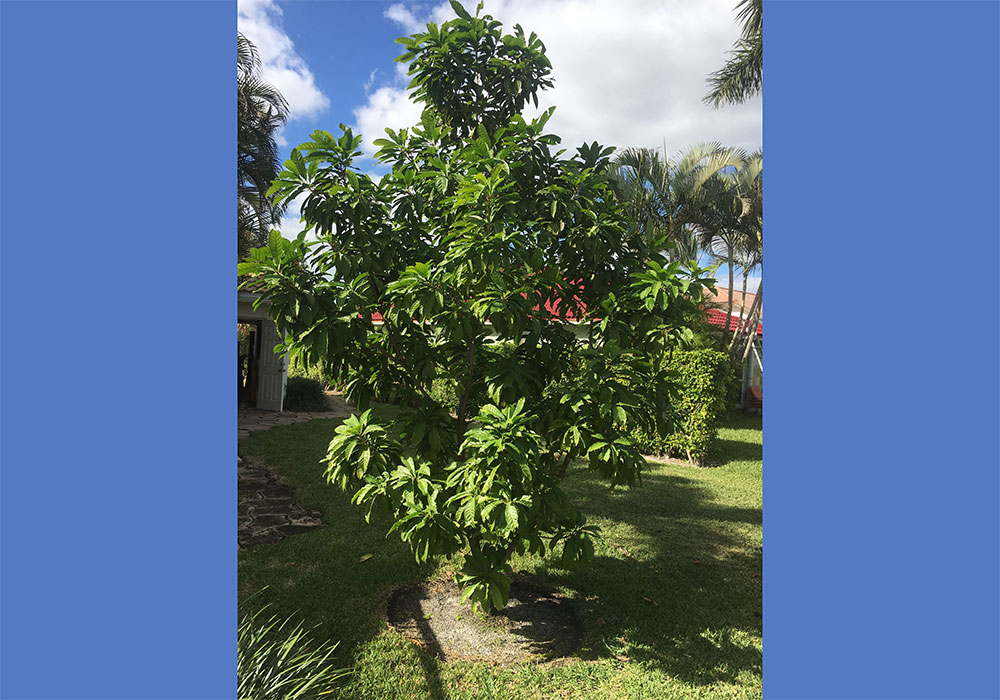
Q: My Canistel tree is 3 1/2 years old and is growing very well, see the
picture below. It gets hundreds of pea sized "berries" but then they fall off. No
canistel fruit. What's wrong?
A: You have such a nice looking tree, it is a shame you can't get
any fruit to ripen.
In our experience, Pouteria trees dropping fruit prematurely is a very common problem.
There may be one of the following reasons, or a combination of them:
- Cold winters may affect production, and while Canistel is generally
pretty hardy tropical plant that can easily withstand short periods of chill, the
fruit may never form properly if it had a cold winter.
- Lack of water. Canistel tree is pretty drought tolerant, but for the
proper production cycle it needs regular irrigation. Especially during hot
summer.
- The tree may be not strong enough; young trees drop fruit very often when
they don't have enough "fruiting energy" built up in their system.
Your tree looks well established and vigorous, however, flower/fruit drop
is often a sign of insufficient nutrients of particular kind, usually Boron
(B) and/or Molybdenum (Mo): either when a tree is too young and not strong
enough, or because of poor soils and lack of necessary elements.
Here is what can be done, considering you live in a warm, frost-free
climate.
1. Provide regular fertilizing program. We recommend liquid
fertilizers Sunshine Boosters that are safe to use with every watering and year
around. It is beneficial to switch plants from traditional "slow-release"
fertilizer to the liquid one because it makes a huge difference in plant growth
and flower/fruit quality and quantity. See also:
- Why liquid fertilizers are better than dry
- Article about benefits of liquid fertilizers.
2. Apply micro-element remediesthat are very effective for
improving fruit production, especially when flower or fruit drop occurs:
SUNSHINE Honey - promotes more efficient blossoming and pollination, makes
flowers bigger and reduces bud drop. SUNSHINE SuperFood - improves plant vigor and quality and size of
flowers
These are all natural, eco-friendly supplements that work great for fruit
trees and other edibles.