Garden Blog - Top Tropicals

Date: 2 Mar 2026

Eugenia Cherries 🍒

By Tatiana Anderson, Horticulture Expert at Top Tropicals with Smokey & Sunshine help

Eugenia brasiliensis - Grumichama fruit on the branch

Growing Eugenia Cherries (Cherry of the Rio Grande & Grumichama)

Cherry of the Rio Grande and Grumichama are compact, adaptable tropical fruit trees well suited to Southern landscapes. While forgiving, they perform best when planted correctly from the beginning.

Site and Planting

  • Drainage is essential. Avoid low areas where water collects. Plant on a slight mound if soil is heavy or clay-like.
  • Choose full sun for best flowering and fruit production. Partial shade is tolerated.
  • A south or southeast exposure near a wall improves cold resilience and reduces wind stress.
  • Dig a hole twice as wide as the container, but no deeper than the root ball.
  • Set the tree level with surrounding soil. Do not bury the trunk.

Water and Feeding

  • Water regularly during the first few months while roots establish.
  • Once established, trees tolerate short dry periods but fruit best with moderate, consistent moisture.
  • Feed lightly and consistenly. SUNSHINE Boosters Robusta liquid fertilizer is safe to use with with every watering. During hot season you may add controlled release Green Magic every 6 months. It is essential to apply micro elements: Sunshine Superfood micro nutrients complex

Cold Tolerance

  • Protect young trees during hard freezes.
  • Established Cherry of the Rio Grande can tolerate brief drops into the low 20s.
  • Established Grumichama tolerates temperatures into the upper 20s.

Harvest and Production

  • Cherry of the Rio Grande fruits from late spring into summer. Pick when fully dark and slightly soft.
  • Grumichama ripens quickly, often within four weeks after flowering. Pick when glossy and deep purple-black.
  • Both trees often begin fruiting within 2–3 years and increase production steadily with maturity.

Growing in Containers

  • Use at least a 10–20 gallon pot for long-term growth.
  • Ensure multiple drainage holes.
  • Use a high-quality, well-draining container mix. Avoid heavy garden soil. Top Tropicals Abundance soil-less mix is specially formulated for pot growing
  • Place in full sun for best fruiting.
  • Water deeply, then allow the top layer to dry slightly before watering again.
  • Move containers to a protected area during hard freezes.
  • Prune lightly to maintain shape and airflow.

Common Mistakes

  • Planting in poorly drained soil.
  • Overwatering and keeping soil constantly saturated.
  • Over-fertilizing with excessive nitrogen.
  • Planting too deep and burying the trunk.
  • Expecting heavy crops immediately instead of allowing time for maturity.
  • Skipping cold protection for young plants.

Learn more: Tropical Cherries – Eugenias
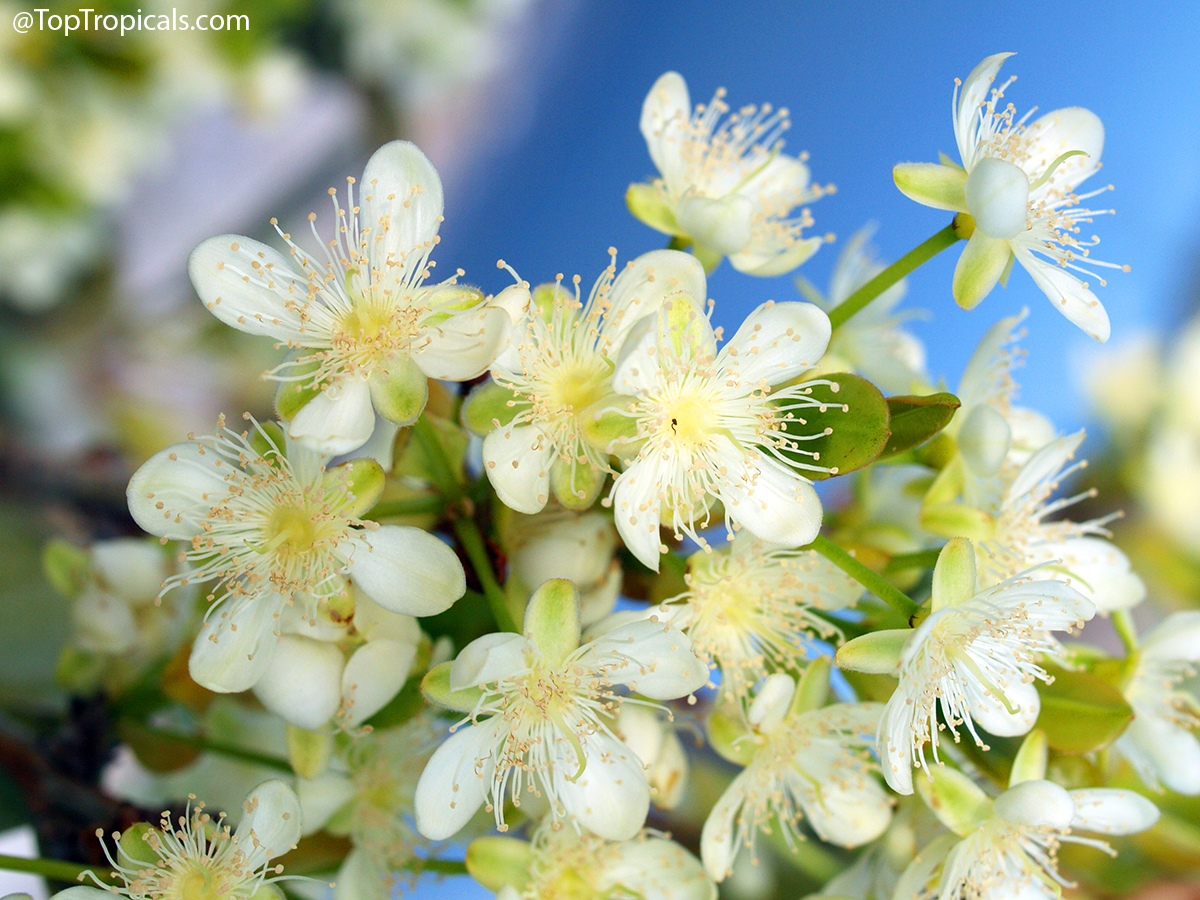
EGrumichama  flowers  (Eugenia  brasiliensis)  in  close-up  showing  white 
 petals  and  long 
 stamens

Eugenia brasiliensis - Grumichama flowers

❓Frequently Asked Questions: Eugenia cherries (FAQ)

  • Which one tastes better – Cherry of the Rio Grande or Grumichama?
    Cherry of the Rio Grande has a deeper, classic “sweet cherry” flavor with slight richness. Grumichama is softer, juicier, and often described as cherry with hints of grape and plum. Both are excellent fresh; Grumichama is especially popular for jam.
  • Which tree produces more fruit?
    Grumichama typically produces heavier crops once mature and can carry hundreds of fruits in a season. Cherry of the Rio Grande produces consistently but in slightly smaller volumes.
  • Do birds take all the fruit?
    Birds are attracted to both trees, especially Grumichama. Netting during peak ripening or harvesting promptly usually solves the issue.
  • Are these true "tropical" trees or subtropical?
    They are best described as subtropical tropicals. Unlike ultra-tender tropical fruits, Eugenia cherries tolerate occasional frost once established, making them more reliable in Southern landscapes.
  • Do they drop fruit messily?
    Fruit will fall if overripe, but the trees are compact and manageable. Regular harvesting prevents ground drop and keeps the area clean.
  • Can they be used for hedging or screening?
    Yes. Their dense evergreen foliage and upright growth make them suitable for edible hedges or privacy screens while still producing fruit.

Choosing between them is not about survival — both have proven resilient. It is about flavor preference, crop volume, and how you want to use the fruit in your kitchen and landscape.

Eugenia brasiliensis - Grumichama fruit close up

Eugenia aggregata (cv. Calycina), Cherry of the Rio Grande

🛒 Add Eugenia cherries to your garden

✍️ Top Ten Fruit Tree Winners of Florida 2026 Record Freeze

Date: 21 Aug 2025

🍒 Tropical Cherries – Eugenias

Two  cats  enjoy  Grumichama  fruit  indoors  —  a  tuxedo  cat  picks  berries  from  a  potted  tree  while  an  orange  fluffy  cat  smiles,  sitting  by  tea  cups  and  plates  of 
 fruit.

Tropical Tea Time with Grumichama

Eugenias have earned a spot in many Southern gardens because they’re easy, dependable, and surprisingly versatile. These small trees and shrubs grow well in the ground or in containers, and they don’t waste time before setting fruit.

15% Off Eugenias – Limited Time

Use code EUGENIA15 at checkout.
Excluding S/H. Offer expires 08/28/2025

👍 Popular Choices:

What Makes Eugenia Cherries Stand Out

  • Start producing fruit in just a couple of years
  • Compact size — easy to keep 6–12 ft tall, smaller in pots
  • Low-care — tolerant of most soils and resistant to common pests
  • Strong in hot weather, yet can handle a light frost down to the mid-20s °F
  • Plenty of fruit for people and birds alike

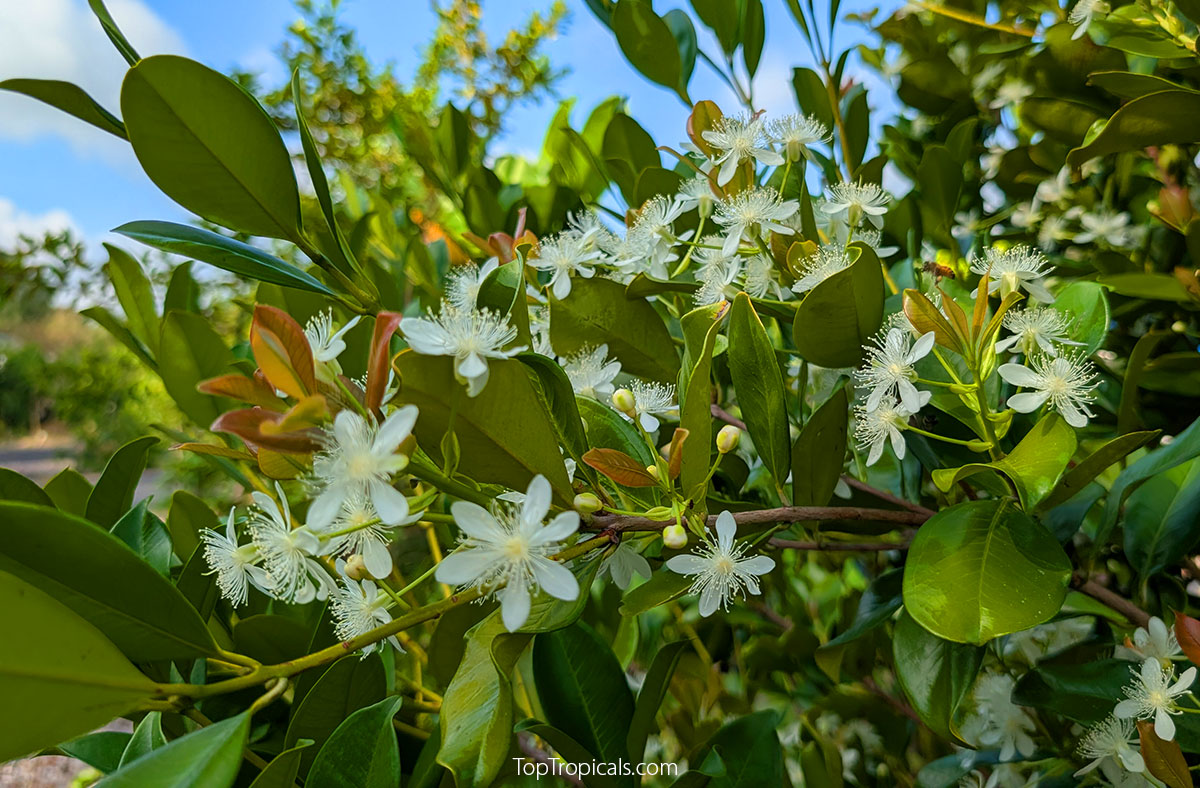
Close-up  of  Grumichama  tree  branches  with  clusters  of  small  white  flowers  among  glossy  green 
 leaves. Grumichama Tree in Bloom – Eugenia brasiliensis

Growing & Care

Outdoors

  • Best in USDA Zones 9–11
  • Sun or partial shade; more sun usually means sweeter fruit
  • Plant in well-drained soil; avoid heavy, wet spots
  • Withstands summer heat and humidity, and can take a light freeze

Container / Indoor

  • Do well in 5–10 gallon pots on patios or balconies
  • Need bright light indoors — a sunny window or grow lights
  • Can flower and fruit in containers if kept warm and well lit
  • In cooler zones, bring plants indoors for winter and back out in spring

General Care

  • Water: Keep soil evenly moist; drought-tolerant once established but best yields with regular watering
  • Soil: Use good potting mix - LINK TO SOIL
  • Fertilizer: Balanced slow-release LINKL TO FERTILIZER Sunshine Boosters
  • Pruning: Light trimming keeps plants bushy and productive
  • Pollination: Self-fertile; one plant will fruit on its own

Read Garden Blog about Tropical Cherries

Shop Tropical Cherries

Date: 12 Mar 2026

How to learn the secret meanings behind Thai flower names

Cats Smokey and Sunshine in Thai Adenoium garden

Cats Smokey and Sunshine in Thai Adenoium garden

How to learn the secret meanings behind Thai flower names 🔮

If you have ever looked at names of Adeniums or Plumerias from Thailand, you may have noticed something interesting. Many of them sound poetic, mysterious, or even magical. That is not accidental.
Thai plant breeders often give their hybrids meaningful names connected to jewels, wealth, beauty, and mythology. Instead of simple numbers or codes, the plants receive names that sound like something from a legend - Jade Swan, Golden Lotus, Rainbow Diamond.

Once you learn a few common Thai words, these names suddenly start to make sense. It is almost like decoding a secret language of flowers.
Below are some of the most common words you will see in Thai plant names.

🔠 Glossary of common Thai words used in plant names


Gems and precious stones 💎

Anyamanee - precious jewel or rare gem.
Gaew / Kaew - crystal or glass-like jewel.
Manee - jewel or gemstone. A classic word in elegant Thai names.
Noppakao - nine gems, a symbol of royal power and prosperity.
Petch - diamond. Symbol of brilliance and beauty.
Ploy - gem or precious stone. Often used for plants considered rare or jewel-like.
Yok - jade.

Wealth, luck, and prosperity 💰

Boon - merit, blessing, good karma.
Chok - luck or good fortune.
Kanjana / Kanjamapon - golden or noble.
Mongkol - auspicious or lucky.
Paruay / Pa Ruay - to become wealthy or prosperous.
Ramruay - to become rich or prosperous.
Sap / Sab - wealth or treasure.
Sedthee - wealthy person.
Tawee / Taweechok - to increase or multiply.
Thong - gold.
Yod - the best, the peak, or the finest.

Mythology and cultural symbolism 🐉

Bua - lotus.
Chai / Chai Lai - victory or triumph.
Hassadee - derived from the mythical Hatsadiling, an elephant-bird creature in Thai mythology.
Hong - mythical swan or phoenix.
Jai - heart or spirit.
Maha - great or grand.
Moradok - heritage, treasure, or legacy.
Orathai - heart of Thailand or beloved Thai.
Pratum / Pratuma - lotus blossom.
Siam - Thailand, the historic name of the country.

Colors and visual descriptions 🎨

Chompoo - pink color.
Lai - patterned or striped.
Lueng - yellow.
Moung / Muang - purple color.

Nature and poetic imagery

Chaba - hibiscus flower.
Dao - star.
Doung - heart, soul, or central essence.
Fah - sky. Example: Sai Fah - sky-colored.
Nam - water.
Namwhan - sweet water or sweetness.
Natee - river or flowing water.
Sai - thread, line, or ray.
Sairung - rainbow.
Sang Aroon - dawn or sunrise.
Suree - sun or sunlight.

🌸 Examples of plant names built from these words


Once you know the meanings, the names start to read like short poems.

Hong Yok - Jade Swan
Ploy Nappan - Celestial Jewel
Thong Hassadee - Golden Mythical Elephant
Ped Sairung - Rainbow Diamond
Som Paruay - Golden Prosperity
Sai Fah - Sky Blue
Pratum Thong - Golden Lotus
Ramruay - Becoming Rich
Chok Dee - Good Luck
Thong Yod - Peak of Gold

You will see these words frequently in the names of Thai-bred Adeniums, Plumerias, Orchids, and other tropical flowers. Once you recognize them, plant names become much easier - and more fun - to understand.

🛒 Explore Exotic Thai Adeniums

📚 Learn more:


#Container_Garden #Adeniums #Horoscope #How_to #Discover

🟢 Join 👉 TopTropicals

Date: 26 Feb 2026

Stop Sugar Crashes: 5 Tropical Fruit Hacks for Healthy Dessert

Exotic Tropical Fruits for Blood Sugar Management. Stop the sugar crash cycle. Learn how to manage glucose levels and insulin spikes using tropical fruits, healthy fats, and metabolic hacks for healthy dessert.

Exotic Tropical Fruits for Blood Sugar Management. Stop the sugar crash cycle. Learn how to manage glucose levels and insulin spikes using tropical fruits, healthy fats, and metabolic hacks for healthy dessert.

🍨 Stop Sugar Crashes: 5 Tropical Fruit Hacks for Healthy Dessert


The smarter way to handle sugar cravings - no restriction required

Tired of the post-cookie slump? Sugar cravings are a physiological response to blood glucose fluctuations, not a lack of willpower. Refined sugars trigger an insulin spike followed by a hypoglycemic crash, trapping you in a cycle of fatigue and hunger.
The secret to metabolic health is managing glycemic load. By choosing nutrient-dense tropical fruits, you satisfy your sweet tooth while maintaining stable energy homeostasis.
The solution is not to give up dessert. It is to change what dessert means. Here is how to use tropical horticulture to hack your biology and regulate insulin:
  • 🍭 1. Choose fruit that comes with fiber


    Whole tropical fruits deliver sweetness wrapped in fiber, water, and nutrients. That slows sugar absorption and keeps energy steady.
    Try:

· Mango, chilled and sliced
  • · Sapodilla - naturally caramel-sweet
  • · Mulberries by the handful
  • · Loquat halves straight from the fridge
  • · Dragon Fruit for light, clean sweetness
Same pleasure. Less crash.
  • 🍭 2. Pair sweet with fat to blunt the glucose spike


    Healthy lipids are a biological hack for your metabolism. Fats slow gastric emptying, ensuring a steady glucose release rather than an inflammatory spike. Furthermore, lipids trigger cholecystokinin (CCK) - the hormone that signals satiety to the brain - effectively "turning off" cravings at the source.

· Avocado blended into a chocolate-style mousse: The monounsaturated fats create a creamy texture while blunting the sugar response.
  • · Banana with nut butter: Combining fast-acting fruit sugars with dense protein and fats.
  • · Pineapple with raw nuts: The bromelain in pineapple aids digestion, while the fats in nuts provide long-lasting satiety.
  • · Mango mixed into full-fat yogurt: The combination of probiotics, protein, and lipids turns a simple fruit into a complete, low-glycemic snack.
When fruit is balanced with fat, cravings calm down instead of escalating.
  • 🍭 3. Use naturally rich fruits in place of sugar


    Some tropical fruits taste like dessert already.

· Jackfruit has candy-like sweetness
  • · Sapote is creamy and custard-like
  • · Guava brings floral depth
  • · Cherries add brightness
  • · Mash Banana into baking instead of white sugar.
  • · Blend Mango into yogurt instead of syrup.
  • · Top oatmeal with Mulberry instead of brown sugar.
Dessert stays. The crash disappears.
  • 🍭 4. Balance sweet with tart


    Adding contrast reduces the urge to overeat sweetness.

· Carambola adds crisp tang.
  • · Pineapple brightens the palate.
  • · Loquat gives gentle acidity.
Balanced flavors satisfy faster.
  • 🍭 5. Start the day right


    Skipping breakfast increases late-day sugar cravings.
    A morning smoothie with Avocado, Banana, and Mango prevents the afternoon energy dip. Hydration also matters - thirst often disguises itself as a sweet craving.
  • 🍭 In essence


    Dessert is not the enemy. Refined sugar is.
    When sweetness comes from nature's bounty, it nourishes instead of draining energy.
    You do not need to quit dessert.
    You just need to let nature handle it.

    Consult with a healthcare professional before making significant dietary changes, especially if you have diabetes or metabolic conditions


🛒 Start your tropical fruit journey

Annona · Guava · Mango · Sapodilla · Mulberry · Pineapple · Avocado · Banana · Loquat · Dragon fruit · Jackfruit · Sapote · Cherries · Carambola

📚 Learn more:


#Food_Forest #Remedies #Discover

🟢 Join 👉 TopTropicals

Date: 21 Mar 2026

Today: Spring Equinox Plant Festival 🌿

Smokey  the  tuxedo  cat  holding  Sunshine's  coffee  while  Sunshine  carries 
 a  large  stack  of  donut  boxes  in  a  tropical  nursery  with  lush  plants  and  an 
 equinox  sale  poster
Sunshine:Smokey, hold my coffee. Donuts are coming. Big day today.

Smokey: Under control. Try not to drop half of them.

Both: Friends, come over today.

Everything is ready for today at our Spring Equinox Plant Festival. The garden is full and we would love to see you. Come over today and enjoy it with us. SEE FULL EVENT DETAILS