Garden Blog - Top Tropicals

Date: 29 Jan 2026

How to make Sapodilla fruit profusely?

Sapodilla - Manilkara or Achras zapota, the Brown Sugar Fruit

🍊 How to make Sapodilla fruit profusely?


Sapodilla - Manilkara or Achras zapota), the Brown Sugar Fruit is a warm-climate evergreen fruit tree that can produce a lot of fruit once conditions are right. So why do so many sapodilla trees grow beautifully, flower heavily, and still refuse to set fruit?

Sapodilla Fruit Production - What Really Matters

1. 🌳 Choose the Right Tree
Grafted or air-layered trees fruit much sooner - typically in 1-2 years - and more reliably than seedlings, which may take 6–8+ years.
Some varieties are more profuse producers than others. For example, Silas Woods is virtually everbearing, Hasya is commercial prolific producer, Oxkutzcab (or Ox) -is also heavily productive (learn more about varieties).

2. ☀️ Environment: Heat, Sun & Water Balance

Temperature and Humidity
Excessive heat above 90F and low humidity can cause flowers to dry up and fall before setting fruit.
Solution: Provide filtered light or shade during the hottest part of the day to reduce heat stress on blossoms.

Water
Sapodillas are drought tolerant, but consistent moisture during flowering and fruit set improves fruit retention.
Avoid waterlogged conditions - soggy soil can stress roots and reduce yield.

Sun Exposure
Full sun is best for growth and flowering - but for hot climates, protection during peak afternoon heat helps reduce flower drop.
Young trees can also suffer sunburn.

3. Fertilization: Feed for Fruit, Not Just Foliage
Good nutrition is critical for flowers to turn into fruit. Apply a routine feed through the growing/flowering season - contolled-release (Green Magic) or liquid (Sunshine C-Cibus) both work.
Balanced fertilizer with trace elements like Boron (B), Molybdenum (Mo), Iron (Fe), and Copper (Cu) is essential for fruit set and development. Boron & Molybdenum deficiency as a frequent cause of flower/fruit drop in container-grown trees (nutrients get depleted quickly in pots).
Micro-nutrient sprays 2-3 times per year help improve fruit retention and quality. Some growers use sugar boosters (Sunshine Honey) or micronutrient blends that include Mo & B to help fruit set (Sunshine Superfood).

4. 🐝 Pollination - Often Overlooked
Sapodilla flowers are small and often require pollinators for best fruit set.
In some regions, small insects like thrips are key pollinators.
In places with low insect activity, hand pollination dramatically increases fruit set - brushing pollen from one flower to another with a small paintbrush during peak bloom times can help.
Placing fruit scraps (apple peels/banana peels) under the tree to attract beetles is an inexpensive way to boost insect activity.

5. ✂️ Pruning and Tree Structure
Moderate pruning can help open the canopy for better light penetration and air circulation, which supports flowering and reduces stress. Training young trees promotes a strong branch structure that can carry more fruit later. Sapodilla flowers on young growth (tips of the branches).

6. Pot vs Ground: Size Matters
If your sapodilla is in a container, root bound trees struggle with fruit set because roots run out of space and nutrients - stepping up to a larger container or planting in the ground can help.
Root-bound trees often bloom but fail to develop fruit.

7.

📅 Patience & Timing


Even healthy trees can take years to start fruiting well.
Trees often flower repeatedly but only set fruit when environmental conditions and pollination align - especially important for young or newly planted trees.

📌 Summary Checklist for Better Sapodilla Fruiting

  • ✔️ Choose a grafted variety (faster, more reliable fruit).
  • ✔️ Manage heat & humidity - shade during hot hours.
  • ✔️ Water consistently but avoid waterlogging.
  • ✔️ Fertilize balanced NPK + micronutrients (include B & Mo).
  • ✔️ Encourage pollination


🛒 Grow your own Sugar Fruit

📚 Learn more:


#Food_Forest

🟢 Join 👉 TopTropicals
Date: 2 Mar 2026

Eugenia Cherries 🍒

By Tatiana Anderson, Horticulture Expert at Top Tropicals with Smokey & Sunshine help

Eugenia brasiliensis - Grumichama fruit on the branch

Growing Eugenia Cherries (Cherry of the Rio Grande & Grumichama)

Cherry of the Rio Grande and Grumichama are compact, adaptable tropical fruit trees well suited to Southern landscapes. While forgiving, they perform best when planted correctly from the beginning.

Site and Planting

  • Drainage is essential. Avoid low areas where water collects. Plant on a slight mound if soil is heavy or clay-like.
  • Choose full sun for best flowering and fruit production. Partial shade is tolerated.
  • A south or southeast exposure near a wall improves cold resilience and reduces wind stress.
  • Dig a hole twice as wide as the container, but no deeper than the root ball.
  • Set the tree level with surrounding soil. Do not bury the trunk.

Water and Feeding

  • Water regularly during the first few months while roots establish.
  • Once established, trees tolerate short dry periods but fruit best with moderate, consistent moisture.
  • Feed lightly and consistenly. SUNSHINE Boosters Robusta liquid fertilizer is safe to use with with every watering. During hot season you may add controlled release Green Magic every 6 months. It is essential to apply micro elements: Sunshine Superfood micro nutrients complex

Cold Tolerance

  • Protect young trees during hard freezes.
  • Established Cherry of the Rio Grande can tolerate brief drops into the low 20s.
  • Established Grumichama tolerates temperatures into the upper 20s.

Harvest and Production

  • Cherry of the Rio Grande fruits from late spring into summer. Pick when fully dark and slightly soft.
  • Grumichama ripens quickly, often within four weeks after flowering. Pick when glossy and deep purple-black.
  • Both trees often begin fruiting within 2–3 years and increase production steadily with maturity.

Growing in Containers

  • Use at least a 10–20 gallon pot for long-term growth.
  • Ensure multiple drainage holes.
  • Use a high-quality, well-draining container mix. Avoid heavy garden soil. Top Tropicals Abundance soil-less mix is specially formulated for pot growing
  • Place in full sun for best fruiting.
  • Water deeply, then allow the top layer to dry slightly before watering again.
  • Move containers to a protected area during hard freezes.
  • Prune lightly to maintain shape and airflow.

Common Mistakes

  • Planting in poorly drained soil.
  • Overwatering and keeping soil constantly saturated.
  • Over-fertilizing with excessive nitrogen.
  • Planting too deep and burying the trunk.
  • Expecting heavy crops immediately instead of allowing time for maturity.
  • Skipping cold protection for young plants.

Learn more: Tropical Cherries – Eugenias

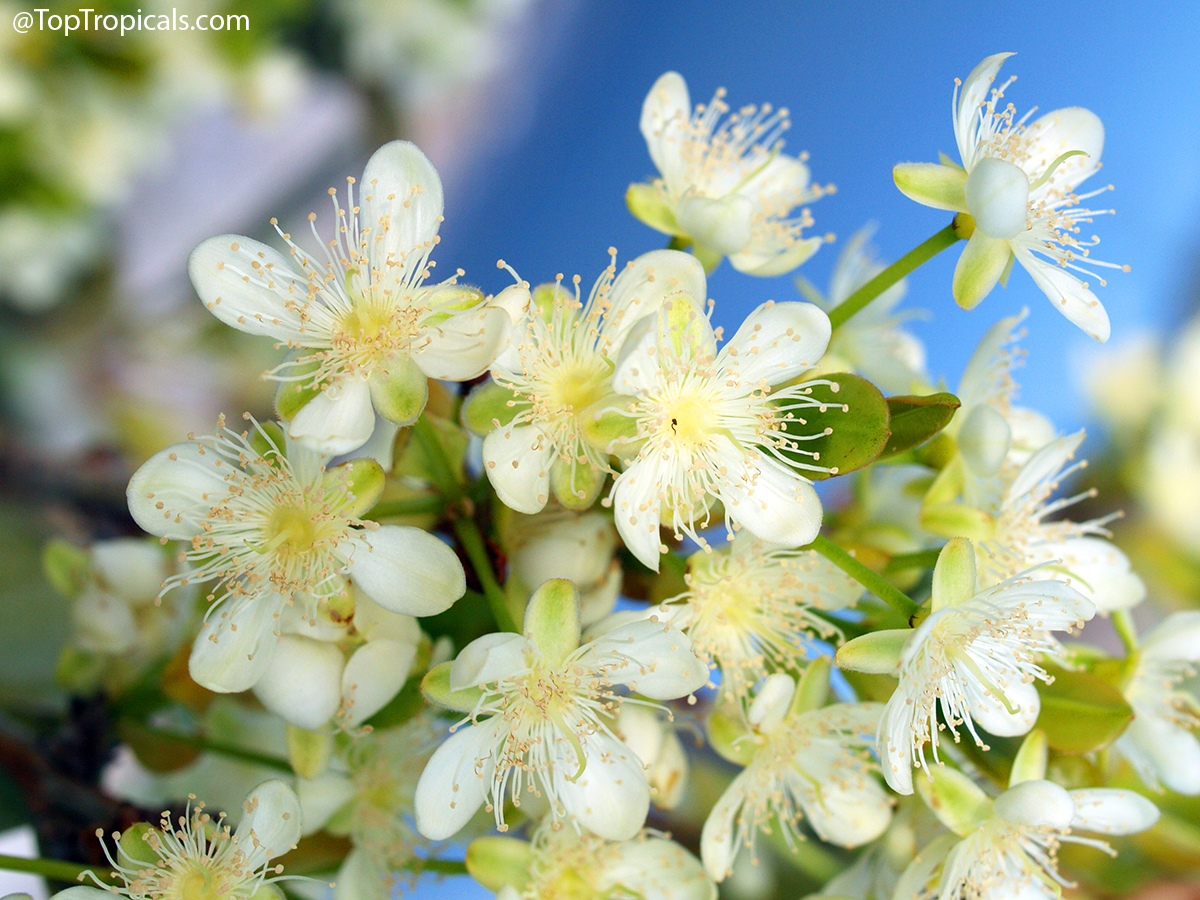
EGrumichama  flowers  (Eugenia  brasiliensis)  in  close-up  showing  white 


petals  and  long 


stamens

Eugenia brasiliensis - Grumichama flowers

❓Frequently Asked Questions: Eugenia cherries (FAQ)

  • Which one tastes better – Cherry of the Rio Grande or Grumichama?
    Cherry of the Rio Grande has a deeper, classic “sweet cherry” flavor with slight richness. Grumichama is softer, juicier, and often described as cherry with hints of grape and plum. Both are excellent fresh; Grumichama is especially popular for jam.
  • Which tree produces more fruit?
    Grumichama typically produces heavier crops once mature and can carry hundreds of fruits in a season. Cherry of the Rio Grande produces consistently but in slightly smaller volumes.
  • Do birds take all the fruit?
    Birds are attracted to both trees, especially Grumichama. Netting during peak ripening or harvesting promptly usually solves the issue.
  • Are these true "tropical" trees or subtropical?
    They are best described as subtropical tropicals. Unlike ultra-tender tropical fruits, Eugenia cherries tolerate occasional frost once established, making them more reliable in Southern landscapes.
  • Do they drop fruit messily?
    Fruit will fall if overripe, but the trees are compact and manageable. Regular harvesting prevents ground drop and keeps the area clean.
  • Can they be used for hedging or screening?
    Yes. Their dense evergreen foliage and upright growth make them suitable for edible hedges or privacy screens while still producing fruit.

Choosing between them is not about survival — both have proven resilient. It is about flavor preference, crop volume, and how you want to use the fruit in your kitchen and landscape.

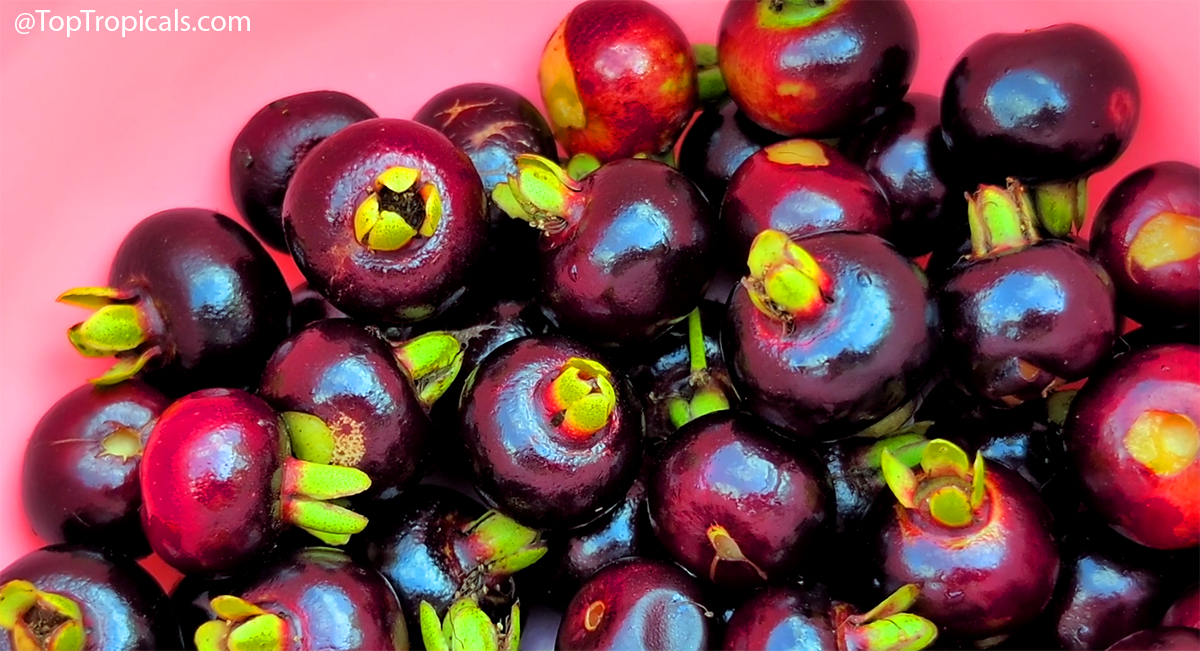
Freshly  harvested  Grumichama  fruits  (Eugenia  brasiliensis)  showing  dark
 
 
  purple  skin  and  green 


calyx

Eugenia brasiliensis - Grumichama fruit close up

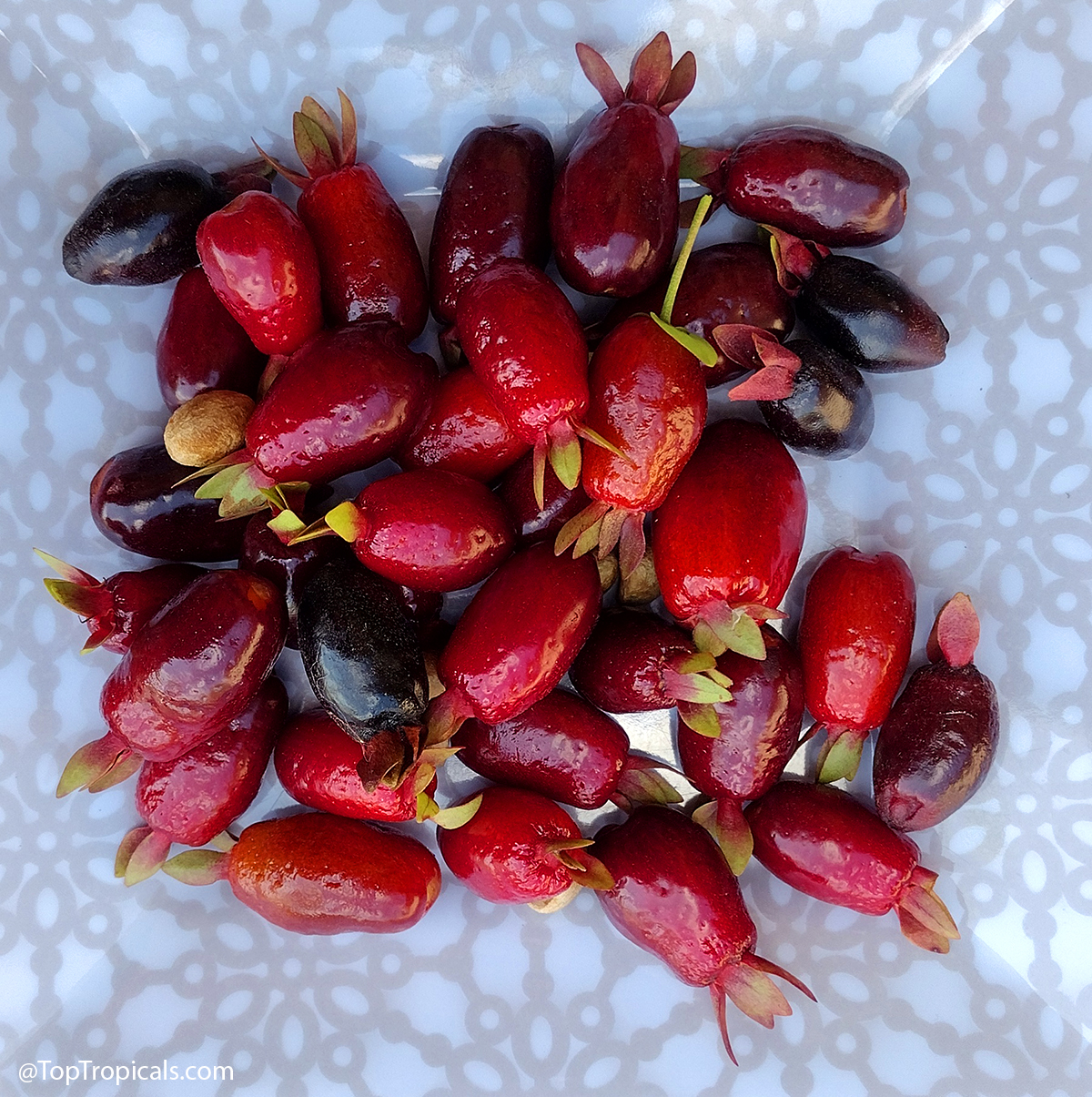
Harvested  Cherry  of  the  Rio  Grande  fruits  (Eugenia  aggregata  cv. 


Calycina)  showing  red  to  dark  purple  ripening  stages


Caption:

Eugenia aggregata (cv. Calycina), Cherry of the Rio Grande

🛒 Add Eugenia cherries to your garden

✍️ Top Ten Fruit Tree Winners of Florida 2026 Record Freeze

Date: 28 Mar 2019

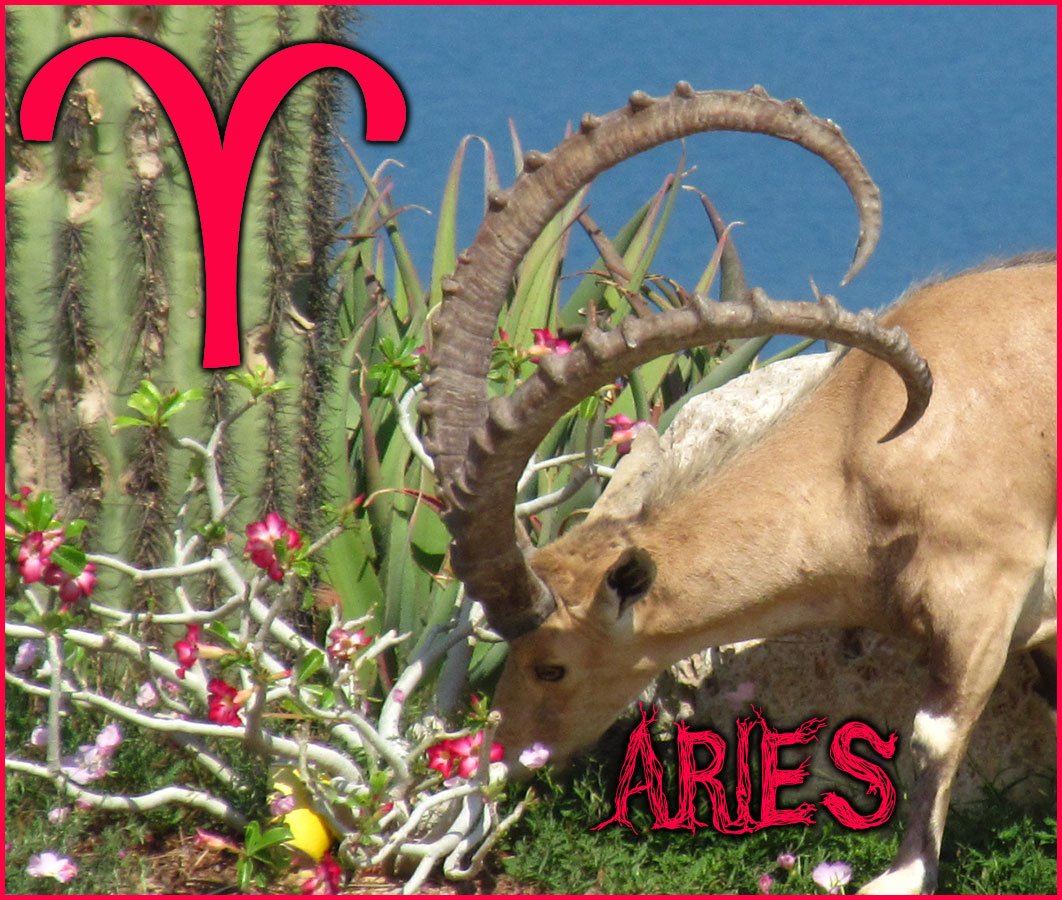
Plant Horoscope. Aries Zodiac lucky plants: Red Oleander and Maple

TopTropicals.com

Aries - 3/21-4/19

Aries is a FIRE sign ruled by the planet Mars. Plants associated with this element and planet very often have thorns or prickles. They can be also spicy or bitter in flavor, or red in color. Because Aries rules the head, eyes, and face, the plants for Aries purify the blood, stimulate the adrenal glands, and/or are high in iron (Mars rules the mineral iron). Mars-ruled Aries is assertive, energetic and fearless. Mars rules the red blood cells, the muscles, and metabolic processes, as well as the motor nerves and the head. These plants help you when you want more get-up-and-go and the courage to take on the world.

Aries Zodiac lucky plants:

Governors plum, Hibiscus Karkade, Tapioca, Mamey Sapote, Ruda, Baobab, Euphorbia, Acanthus, Aloe, Caesalpinia, Erythrina, Opuntia, Dragon Fruit, Pachypodium, Pomegranate,Chilli peppers, Syngonium, Begonia, Geranium, Red Sandalwood, Jamiaca pepper (Pimenta, Allspice), Camphor, Jujube, Anise, Red Roses, Tiger Lily, Impatiens, Calendula, Tarragon, Ginger, Coriander, Basil,Ruda, Amaryllis, Wild Indigo, Gooseberries, Sesbania, Campsis, Red Oleander, Maple, Schotia brachypetala, Momordica, Coffee, Amla , Ephedra, Red Kapok.

For links to these plants and other signs information, see full Plant Horoscope.

Date: 12 Sep 2025

What flowers do NOT attract bees?

Butterfly on a flower that doesn't attract bees

❌ What flowers do NOT attract bees?


Most tropical flowers bring in pollinators, and bees are usually first in line. But what if you’d rather avoid them? Maybe you’re allergic, or just don’t want bees buzzing around. Good news: some flowers attract butterflies, hummingbirds, moths, or even flies - but not bees.
  • 👉 Quick rules:


  • ✔️ Night-blooming + strong fragrance = moths or bats, not bees.
  • ✔️ Red tubular flowers with little scent = hummingbirds or butterflies, not bees.
  • ✔️ Rotten or fermented smell = flies, not bees.
  • ✔️ Carnivorous plants = trap insects, no bee nectar.

1.

Night-blooming, fragrant - moth and bat flowers


Bees forage by day, so many night-fragrant flowers skip them.
  • Brugmansia - Angel’s Trumpet - big, hanging blooms, moth and bat pollinated.
  • Cestrum nocturnum - Night-blooming Jasmine - powerful night scent, moths only.
  • Hylocereus Dragon Fruit - huge cactus flowers, bats and moths.
  • Brunfelsia - Lady of the Night - sweet fragrance at dusk, no bee interest.

2.

Hummingbird and butterfly flowers


Bees don’t see red well. Tubular reds, oranges, and yellows usually go to birds and butterflies.
3.

🐱 Fly-pollinated oddballs


Some flowers smell bad to us but irresistible to flies.
  • Amorphophallus (Voodoo Lily) - rotting meat scent.
  • Tacca (Bat Head Lily) - spooky black flowers, fly-pollinated.
  • Stapelia (Carrion Flower) - also fly-pollinated.
  • Aristolochia (Pelican Flower) - giant, bizarre fly-traps.

4.

🌸 Specialized orchids


Not all orchids rely on bees. Many use moths, butterflies, or beetles instead.
  • Vanilla orchid - its natural bee pollinator is absent in most regions, so no bee appeal elsewhere.
  • Brassavola nodosa and others - open at night for moths, not bees.

5.

🕷 Bonus: carnivorous curiosities


Carnivorous plants don’t offer nectar. They trap insects instead, so bees stay away.

Nepenthes (Pitcher Plant) - uses pitchers of liquid to lure and digest insects.

These flowers keep the beauty, fragrance, and wildlife appeal - but without making your garden a bee hotspot.

🛒 Explore butterfly attractors

#Butterfly_Plants #How_to #Discover

🟢 Join 👉 TopTropicals

Date: 25 Mar 2017

Plant Horoscope. Aries Zodiac lucky plants: Pomegranate and Chilli peppers

Radio Top Tropicals Live Webcast upcoming event: Saturday March 25, at 11 am EST.
Topic: You need a brown thumb TO BE A GREAT GROWER!Manure, Sheeeeeee........it , Fertilizer, What ever you call it. Proper understanding of nutrient plant needs will give YOU great returns. At Top Tropicals, we know our Sheee..... uh, fertilizer. Our Host Robert Riefer - Internationally Certified Crop Adviser and Weed Scientist - answering all your gardening questions.

Listen to Radio Top Tropicals, every Saturday, at 11 am EST! You may use our website radio player DURING AIR TIME. To ask questions using live chat, you need to log in at Mixlr.com or simply call our office 239-887-3323 during air time!
If you missed a live webcast, you may listen to recording by following Showreel item link.

Check out our upcoming radio shows and get your gardening questions ready!

Aries Zodiac lucky plants

Aries - 3/21-4/19. Aries is a FIRE sign ruled by the planet Mars. Plants associated with this element and planet very often have thorns or prickles. They can be also spicy or bitter in flavor, or red in color. Because Aries rules the head, eyes and face, the plants for Aries purify the blood, stimulate the adrenal glands, and/or are high in iron (Mars rules the mineral iron). Mars-ruled Aries is assertive, energetic and fearless. Mars rules the red blood cells, the muscles, and metabolic processes, as well as the motor nerves and the head. These plants help you when you want more get-up-and-go and the courage to take on the world.

Aries Zodiac lucky plants: Governors plum, Hibiscus Karkade, Tapioca, Mamey Sapote, Ruda, Baobab, Euphorbia, Acanthus, Aloe, Caesalpinia, Erythrina, Opuntia, Dragon Fruit, Pachypodium, Pomegranate,Chilli peppers, Syngonium, Begonia, Geranium, Red Sandalwood, Jamiaca pepper (Pimenta, Allspice), Camphor, Jujube, Anise, Red Roses, Tiger Lily, Impatiens, Calendula, Tarragon, Ginger, Coriander, Basil,Ruda, Amaryllis, Wild Indigo, Gooseberries, Sesbania, Campsis, Red Oleander, Maple, Schotia brachypetala, Momordica, Coffee, Amla , Ephedra, Red Kapok.

For links to these plants and other signs information, see full Plant Horoscope.