Garden Blog - Top Tropicals
Date: 8 Oct 2026
Dwarf Mulberries Are Made for Small Gardens

🏡 Dwarf Mulberries Are Made for Small Gardens
Everybody loves mulberries. Until the mulberry becomes a TREE.
Traditional mulberries can become substantial shade trees. Great if you have the room. Less convenient when the berries are twenty feet above your head - or dropping all over the driveway.
That's why customers keep asking us for dwarf mulberries.
Small enough to manage. Easy to harvest. Excellent in containers. And they can produce an astonishing amount of fruit for their size.
🍇 Dwarf doesn't always mean the same thing
Some mulberries are genetically compact. Others simply respond beautifully to pruning and container culture.
Dwarf Everbearing is one of the easiest. Fast growing, dense and full, virtually pest-free for us - and very easy to keep at picking height.
Issai is a compact Japanese selection, known for fruiting young. In our experience, it also seems particularly happy with Florida heat.
And that's important.
🍇 Dwarf Burgundy really surprised us
Our Dwarf Burgundy Mulberry (in the video) was an experimental Mulberry seedling. We planted it in the ground and watched it produce abundantly for a couple of months.
Okay. We were convinced.
Now we have five growing in the ground, with more plants coming next spring.
Dwarf Burgundy appears to be a naturally compact hybrid, staying around 5-6 ft. Even more interesting, it can flower and fruit on both old and new wood, helping give it a long fruiting season. Young plants can begin producing surprisingly early.
Basically, a little bush trying very hard to behave like an orchard.
🍇 Small trees, reliable crops
Full-size mulberries can grow in Florida, but not every variety loves our long, hot climate. A tree may grow perfectly well while its fruit crop is less predictable.
Our dwarf varieties have been much more dependable. They don't seem bothered by the heat and produce reliably year after year.
And because they're small, harvesting is almost ridiculously easy.
No ladder.
No giant tree.
Just reach out and pick.
🍇 The fruit supermarkets can't handle
There's another good reason to grow mulberries at home.
Fresh ripe mulberries are soft and delicate. They don't store or ship particularly well, which is one reason you rarely see beautiful tree-ripe mulberries in a supermarket.
But in your backyard?
That's not a problem.
Pick. Eat. Repeat.
And with a dwarf mulberry, you don't even need an orchard. A sunny patio and a large container can be enough.
Same juicy mulberries. Much less tree.
🛒 Shop Dwarf Mulberry trees
📚 Learn more:


• Mulberry trees in Plant Encyclopedia
• What are the best Mulberry varieties
• Top 10 fast-fruiting trees: #7. Mulberry
• How Mulberry fruit helps with diabetes
• 3 Best Trees for a "Fast-Fruit" Garden
🎥
#Food_Forest #Discover #How_to
🟢 Join 👉 TopTropicals
Date: 7 Oct 2026
Daily Cat Lesson: Did Somebody Open the Fridge?

🐾 Daily Cat Lesson: Did Somebody Open the Fridge?
Your cat can be sound asleep three rooms away.
You quietly open the refrigerator...
CAT.
How did he know?
🐾 Cats are excellent at learning associations.
Cats quickly connect ordinary household sounds with what happens next: the refrigerator opening, a can popping, the treat drawer, the kibble container - or even the particular cabinet where you keep their favorite food.
If opening the refrigerator occasionally produces a piece of ham or cheese, the sound itself eventually becomes exciting:
Fridge opens → human gets food → maybe I get food.
This is associative learning. The same principle explains why cats appear at feeding time, run to the kitchen when they hear a can opener, or recognize the sound of the treat bag from an apparently impossible distance.
🐾 And those ears help.
Cats have excellent hearing, particularly at higher frequencies, and their movable ears help locate tiny sounds remarkably well. But the real trick isn't simply hearing the refrigerator.
It's remembering what that sound means.
And cats are very good at training their humans through association, too:
I appear at refrigerator → I look adorable → human gives cheese
Who exactly is being trained here?
🐈📸 TopTropicals rescued cat Bob at PeopleCats.Garden.
🐈 Stay with us for your #DailyDoseOfCat!
#DailyCatLesson #PeopleCats
🟢 Join 👉 TopTropicals
Date: 7 Oct 2026
The Magic Number 65 (Part 2): When Tropicals Go to Sleep

💤 The Magic Number 65 (Part 2): When Tropicals Go to Sleep
Discover how the "Magic 65" rule works in reverse! Learn the nighttime temperature threshold that signals your tropical plants to enter winter dormancy and when to stop fertilizing...
As fall approaches and nights turn crisp, every tropical plant owner asks the same question: "When should I bring my plants inside, and when do I stop feeding them?"
Just like in spring, tropical plants don't read a calendar to decide when winter is coming - they rely on a single, reliable trigger. The "Magic Number" works both ways: 65F
🍂 The 7-Day Reverse Rule for Fall
The rule of thumb for winding down is simple: when minimum nighttime temperatures fall to or stay consistently below 65F for at least one full week, your tropicals receive the signal to shut down active growth and prepare for dormancy.
🍂 Why 65F Signals Sleep Mode 🌡
Tropical species are engineered for warm soil and humid nights. When night temperatures drop below 65F for seven consecutive days, soil temperatures cool down and plant metabolism naturally slows to a crawl. You’ll notice:
• Branch elongation stops
• Leaves turn slightly paler or drop off
• Buds cease forming
• Sap flow declines
🍂 Should You Try to Keep Them Awake?
While you can’t stop autumn, you can ease the transition:
• Maximize Soil Warmth: Keep potted plants on warm pavers or concrete pads that retain heat overnight.
• Indoor Move: If you plan to overwinter sensitive tropicals indoors, start acclimating them to lower light before nights dip into the 50s to avoid sudden leaf-drop shock.
🍂 When to STOP Fertilizing
❌ Stop feeding dry fertilizers once nights hover around 65F. Feeding a plant heading into dormancy forces weak, soft growth that is instantly damaged by the first mild frost.
👉 The Signal: 7 consecutive nights below 65F.
✅ The Action: Hold off on dry regular food. Liquid amino-acid based boosters, stimulants and micro-nutrients are safe to use with every watering year around. Just cut out active growth dry fertilizers until spring returns.
🍂 Watering Adjustments: The Dormancy Trap
Cold, wet roots are the #1 killer of tropical plants in winter. Because a dormant plant's metabolic "engine" is off, it drinks significantly less water.
• Reduce frequency: Allow soil to dry out much deeper between waterings.
• Watch for cold rain: A prolonged soak in 50F weather will rot dormant roots fast. Protect dormant plants from cold rains.
🍂 Prepare for the Big Freeze Ahead!
Don’t wait for a freeze warning to safeguard your garden investment. Protect root systems and boost plant immunity before cold weather locks in:
🛒 Shop Cold-Hardiness Boosters & Supplies
📚 Learn more:
• The Magic Number 65: when tropicals finally wake and the 7-Day Rule you should know
• Your tropical plants are moving indoors. Are they ready?
• How to protect tropical plants in Winter
• How to overwinter tropical plants indoors
• 10 key tips for successful overwintering of tropical plants indoors
• How to take care of a mango tree in winter
• Why is my Champaka Tree dropping leaves?
🎥
#How_to #Discover
🟢 Join 👉 TopTropicals
Date: 6 Oct 2026
Three gallons of instant jungle: Macaranga
🌴 Three gallons of instant jungle: Macaranga
Some tropical gardens take years before they actually look tropical.
Macaranga grandifolia cheats.
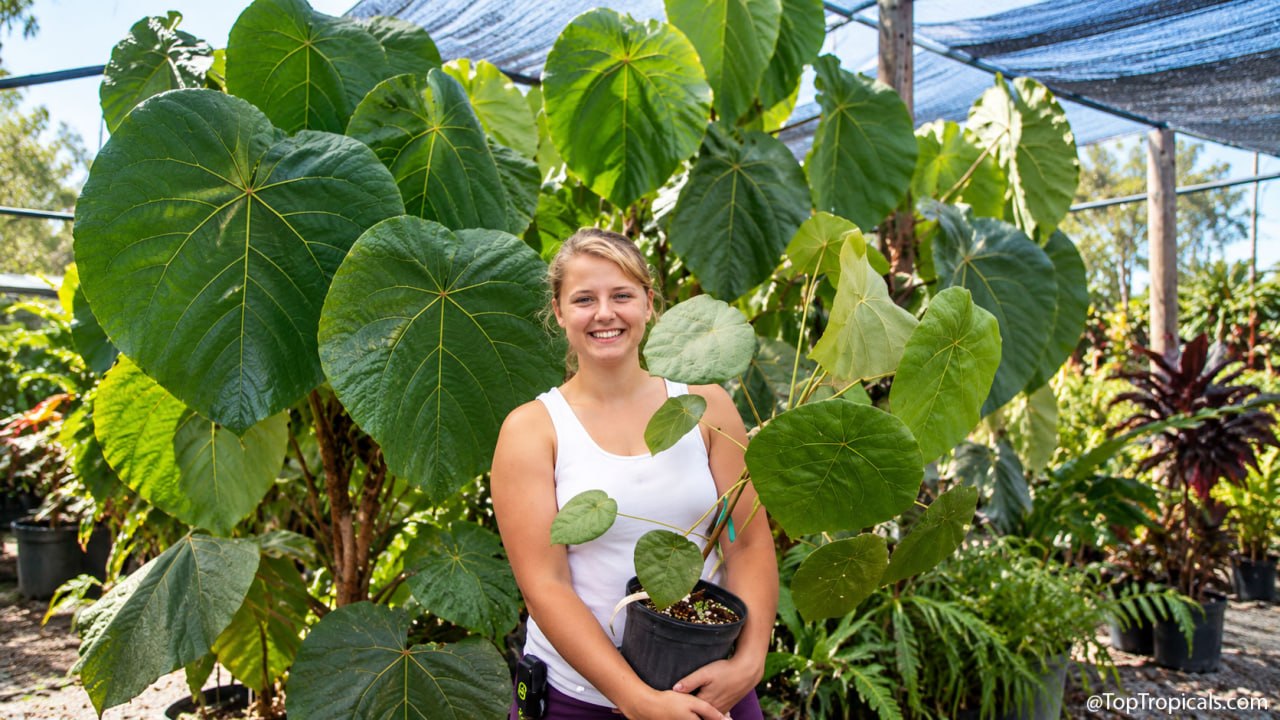
Our current plants are growing in regular 3-gallon pots, but they're already producing those ridiculously oversized leaves that make everything around them look smaller. Plant one, and suddenly a young garden starts looking much more established.
🐘 The trick is scale
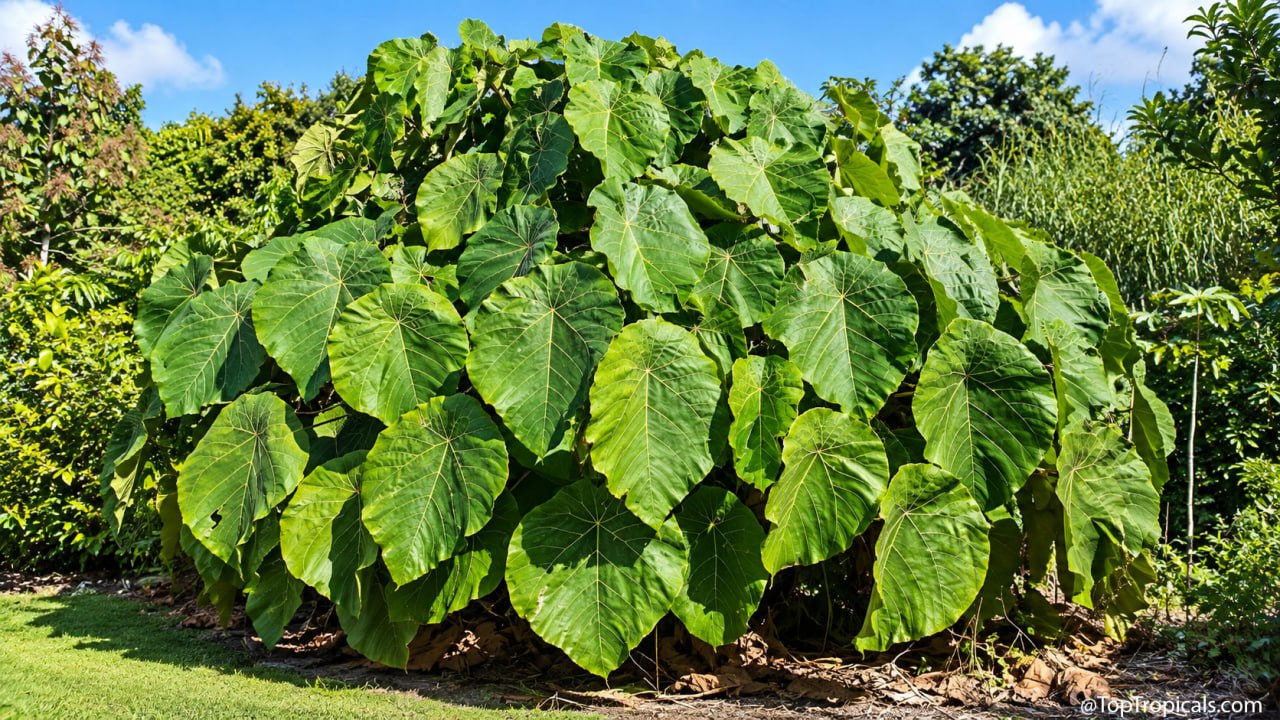
Macaranga is sometimes called the Elephant Ear Tree, and that's exactly what it looks like - almost as if an elephant ear decided to stop being an elephant ear and become a tree.
Instead of leaves rising individually from the ground like Alocasia or Colocasia, Macaranga develops woody upright stems carrying huge leaves overhead. As it matures, it becomes a living green canopy.
That's what makes it so useful in tropical landscaping.
🐘 Build your jungle in layers
Use Macaranga as the big green backdrop, then plant heliconias, gingers, crotons, bromeliads, aroids or orchids around and beneath it.
Those enormous simple leaves make colorful and finely textured plants stand out - and give the whole planting that layered rainforest look.
It's basically a shortcut to making a garden feel older, fuller and wilder.
🐘And it doesn't need acres
Despite all that foliage, Macaranga grows mostly upward and can be pruned to control its size. It also grows well in a large container, so you can create the same oversized tropical effect on a patio or around a pool.
Give it warmth, rich well-drained soil, regular moisture and sun to partial shade. Some protection from brutal afternoon sun can help produce especially lush, beautiful foliage.
🐘Yes, this really starts in a 3-gallon pot
And that's perhaps our favorite part.
The plants we have right now are already big, lush and making huge leaves.
You don't have to buy a little stick and imagine what it might become someday.
🛒 Three gallons. One plant. Instant jungle
📚 Learn more:
• Macaranga grandifolia in Plant Encyclopedia
• This Tropical Tree Has Leaves Bigger Than Your Head
• One look and you're hooked: Macaranga!
🎥
#Nature_Wonders #Trees #Discover


🟢 Join 👉 TopTropicals
Some tropical gardens take years before they actually look tropical.
Macaranga grandifolia cheats.
Our current plants are growing in regular 3-gallon pots, but they're already producing those ridiculously oversized leaves that make everything around them look smaller. Plant one, and suddenly a young garden starts looking much more established.
🐘 The trick is scale
Macaranga is sometimes called the Elephant Ear Tree, and that's exactly what it looks like - almost as if an elephant ear decided to stop being an elephant ear and become a tree.
Instead of leaves rising individually from the ground like Alocasia or Colocasia, Macaranga develops woody upright stems carrying huge leaves overhead. As it matures, it becomes a living green canopy.
That's what makes it so useful in tropical landscaping.
🐘 Build your jungle in layers
Use Macaranga as the big green backdrop, then plant heliconias, gingers, crotons, bromeliads, aroids or orchids around and beneath it.
Those enormous simple leaves make colorful and finely textured plants stand out - and give the whole planting that layered rainforest look.
It's basically a shortcut to making a garden feel older, fuller and wilder.
🐘And it doesn't need acres
Despite all that foliage, Macaranga grows mostly upward and can be pruned to control its size. It also grows well in a large container, so you can create the same oversized tropical effect on a patio or around a pool.
Give it warmth, rich well-drained soil, regular moisture and sun to partial shade. Some protection from brutal afternoon sun can help produce especially lush, beautiful foliage.
🐘Yes, this really starts in a 3-gallon pot
And that's perhaps our favorite part.
The plants we have right now are already big, lush and making huge leaves.
You don't have to buy a little stick and imagine what it might become someday.
🛒 Three gallons. One plant. Instant jungle
📚 Learn more:
• Macaranga grandifolia in Plant Encyclopedia
• This Tropical Tree Has Leaves Bigger Than Your Head
• One look and you're hooked: Macaranga!
🎥
#Nature_Wonders #Trees #Discover
Date: 5 Oct 2026
Early, Midseason
🥭 Early, Midseason & Late Mangoes: How to Get Fruit for Months
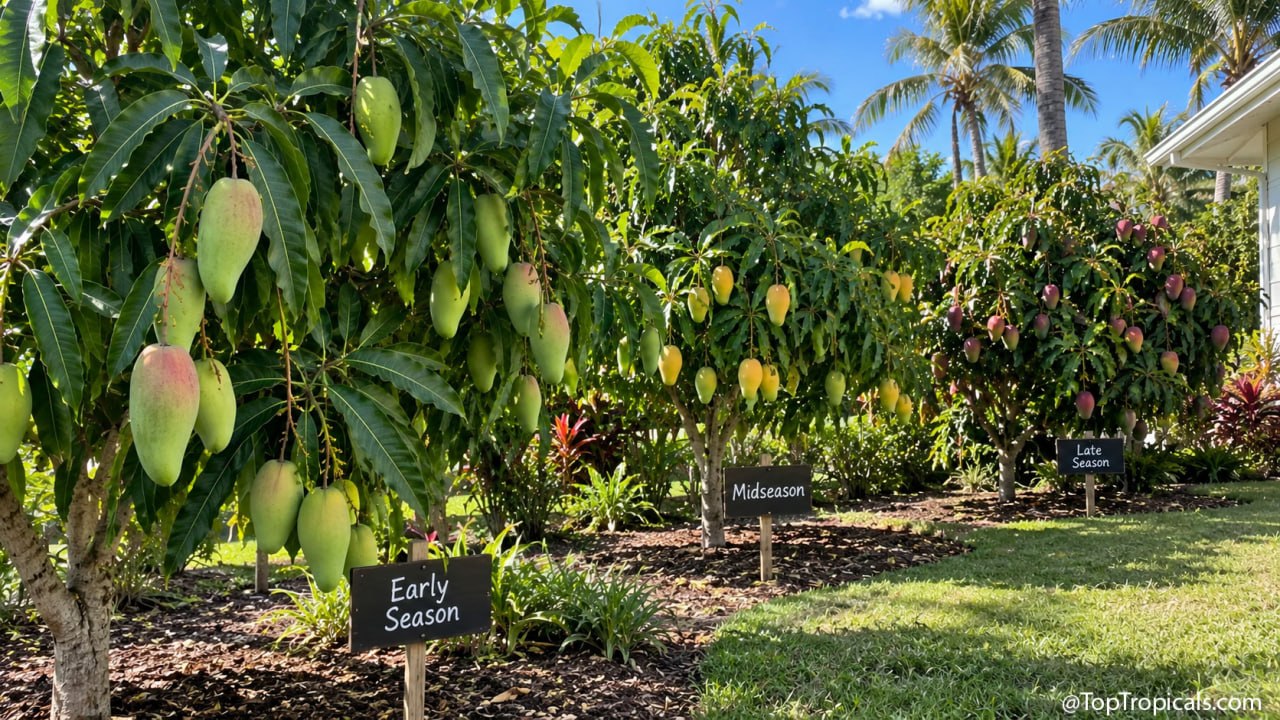
One of the smartest things you can do when planting several mango trees is not have them all ripen at once.
Mango varieties fruit at different times. Some are early, some hit right in the middle of mango season, and others keep producing when most trees are already finished.
🥭 Early-season mangoes
These are the ones that get mango season started. After months of waiting, they're especially appreciated because they're the first fresh mangoes coming off the trees.
📅 In Florida: Early-season mangoes generally ripen May through June.
👉 Examples: Rosigold, Dwarf Hawaiian, and Glenn.
🥭 Midseason mangoes
This is the main event. Many popular varieties ripen during the middle of the season, and this is usually when mango harvest is at its peak.
📅 In Florida: Midseason generally means June through July, the heart of Florida mango season.
👉 Examples: Carrie, Lemon Zest, and Sweet Tart.
🥭 Late-season mangoes
Late mangoes are particularly valuable in a home collection because they extend the fun. While earlier trees are already done, these varieties can still be carrying fruit.
📅 In Florida: Late-season mangoes generally ripen August through September, with some varieties hanging on especially late.
👉Examples: Keitt, Honey Kiss, and Neelam.
✅ The smart way to plan a mango collection
If you have room for several trees, don't choose them only by flavor.
Plant an early variety, a few midseason varieties, and at least one late variety. Instead of getting buried under mangoes for a few weeks, you can potentially enjoy fresh fruit over a much longer stretch of summer.
💡Remember, these aren't fixed calendar dates. Weather, location, bloom time, and the individual growing season can shift harvest timing, and there is plenty of overlap between the groups. That's actually part of the fun. With the right mix of varieties, when one mango tree finishes, another one may just be getting started.
🛒 Shop mango varieties
📚 Learn more:
Mango Tree - Mangifera indica - in Plant Encyclopedia
33 winter-proof mid-season mango varieties in 90-sec tour
6 Best-Tasting Mango Varieties
6 Best Thai and Southeast Asian Mango Varieties
5 Best Indian Mango Varieties and Their Flavors
5 Best Dwarf Mango Trees for Small Yards
5 Best Mango Trees for Beginners
Top 10 Dwarf "Condo" Mango, great for container culture
Top 5 recommended vigorous Mango tree varieties, reliable producers
Top 5 Favorite Mango we just love
10 steps how to grow a mango tree
#Mango_Rainbow - varieties you should try
#Food_Forest #How_to #Discover #Mango


