Garden Blog - Top Tropicals
Date: 11 Sep 2026
Miracle Fruit Loves Florida Heat - Why Is It Fighting the Soil?
Miracle Fruit Loves Florida Heat - Why Is It Fighting the Soil?
This small tropical shrub - Synsepalum dulcificum is captivating Florida gardeners with a bizarre botanical trick: eat a single red berry, coat your tongue in its pulp, and bite into a raw lemon. Instead of a sour shock, your taste buds experience pure sweetness.
While Florida’s humid weather seems ideal for the Miracle Fruit (Synsepalum dulcificum), many gardeners discover a frustrating obstacle hidden right beneath their feet.
💊 The Chemistry Behind the Flavor Trick
The magic behind Miracle Fruit comes down to a specialized glycoprotein called miraculin.
When consumed, miraculin binds tightly to the sweet receptors on your tongue. At a neutral pH, it does nothing. However, the moment an acidic food - like a lemon, lime, or grapefruit - enters your mouth, the acidic environment changes the physical shape of the miraculin molecule.
This structural shift forces your brain to register sour foods as intensely sweet. The chemical composition of the food hasn't changed - only your perception of it.
💊 The Florida Soil Problem: An Alkaline Trap
Native to tropical West Africa, Miracle Fruit thrives in heat and high humidity, making sunshine-state weather a natural fit. However, the plant faces a severe underground conflict with South Florida's geology.
Miracle Fruit is strictly acid-loving, requiring a soil pH between 4.5 and 5.8. Much of South Florida rests on alkaline limestone bedrock, raising ground pH levels above 7.0.
In high-pH soil, essential micro-nutrients like iron and manganese lock up chemically. Even in fertile soil, the shrub's roots cannot absorb these locked nutrients, leading to yellowing leaves (chlorosis) and stunted growth.
💊 The Solution: Growing Miracle Fruit in Containers
Because in-ground soil modification in limestone regions can be a constant battle, container growing offers a far simpler solution. Potting the shrub gives you full control over the root ecosystem.
For soil mix, aim for an acidic pH between 4.5 and 5.5 by mixing 50% peat moss with 50% perlite or pine bark. Sunshine Abundance Mix with extra perlite works perfectly.
Use rainwater or distilled water if your municipal tap water is hard and alkaline. Provide morning sun with protection from intense afternoon heat, and apply water-soluble fertilizers: Sunshine C-Cibus, otherwise any liquid fertilizer for azalea or camellia at half strength.
Because Miracle Fruit is a naturally slow-growing shrub, a single container can comfortably house the plant for years. Better yet, even compact plants measuring under two feet tall can produce abundant harvests of brilliant red berries.
💊 And that's when the real fun starts
Pick a ripe berry and eat the pulp around the seed. Then start experimenting.
✅ Try a Miracle Fruit berry followed by:
🍋 lemon or lime
🍊 grapefruit
🍓 tart strawberries
🍒 tart cherries
🍍 pineapple
🍊 calamondin
other naturally tart fruits
Half the fun is experimenting. Suddenly your garden has become a laboratory!
💡 Safety Lab Tip: Transforming sour citrus into sweet treats makes garden tasting fun, but keep one detail in mind: miraculin neutralizes flavor, not acid.
Limes and lemons retain their full citric acid content regardless of how sweet they taste.
💊 Miracle Fruit never gets boring
It's a tropical fruit you can grow in a pot, a fascinating lesson in soil chemistry, and one of the few plants capable of making you seriously question whether you can trust your own tongue.
You absolutely can grow Miracle Fruit - just don't assume Florida dirt is tropical-plant dirt.
🛒 Plant your own Miracle Fruit
📚 Learn more:


Synsepalum dulcificum in Plant Encyclopedia
The complete guide to potting mix
It's a miracle: Miracle Fruit messes with your tongue
Why does everyone want a Miracle fruit plant?
What is the miracle behind the Miracle fruit?
Everyday Miracle - Grow the Dream!
#Food_Forest #Nature_Wonders #Remedies #Discover #How_to
🟢 Join 👉 TopTropicals
Date: 10 Sep 2026
Remember. Begin Again. Plant Something.
Twenty-five years ago, September 11 changed America.
We remember the people who were lost. We remember the firefighters, the police officers, the first responders, and the ordinary people who ran toward the danger instead of away from it.
And there is something else. For a little while, we seemed to know that we belonged to one another.
Twenty-five years is a long time. Children born that year are grown now. The saplings planted in 2001 are trees you can sit under. Gardens have been planted, lost to storms, cleared away, and planted again.
This year the calendar does something unusual. At sunset on September 11, Rosh Hashanah begins - the Jewish New Year, a time for reflection and for beginning again.
One day asks us to remember. The evening asks us to begin again.
Gardeners know something about this. A garden is never finished. Storms come. Branches break. Plants die. We clear away what was lost, protect what survived, and decide what to plant next. We cannot change what happened yesterday. We do have some say over what grows tomorrow.
And that question reaches well past the garden. What do we want to grow in the year ahead? More trees. More shade. More places where people can sit together. More kindness. More things that will still be alive after today's arguments are forgotten.
To plant something is to bet on a future you may not see. You put a young tree in the ground knowing that someday someone else may sit in its shade. You plant knowing the storms will come.
So on this September 11, we remember what was lost. As a new year begins at sunset, we are grateful for what remains. And then we begin again.
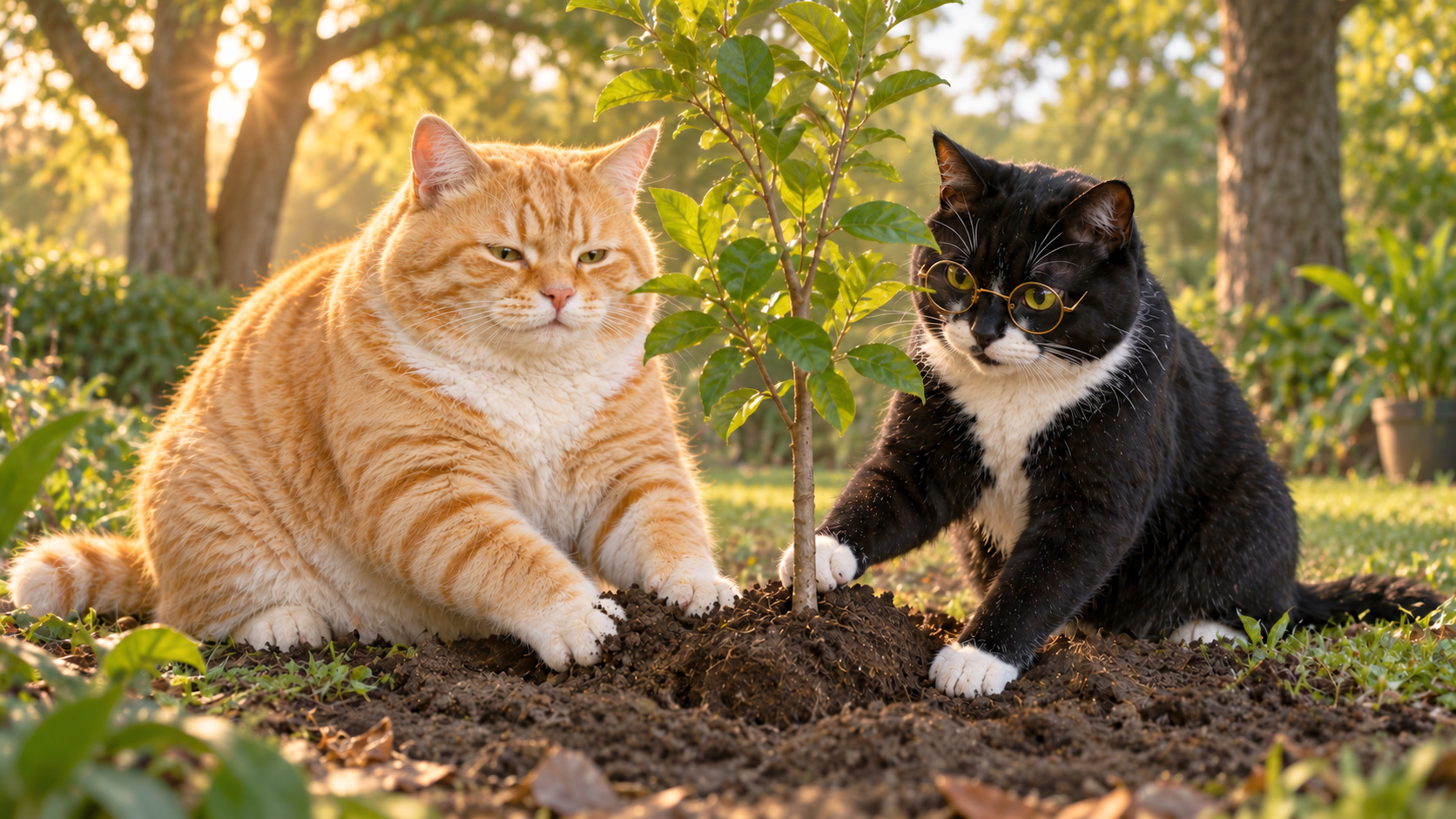
Smokey: Maybe not. But that was never the reason to plant it.
Date: 10 Sep 2026
Daily Cat Lesson #20: How Smart Is Your Cat?

🐾 Daily Cat Lesson #20: How Smart Is Your Cat?
Probably smarter than he lets you know!
For a long time cats were less studied than dogs, partly because they are notoriously uncooperative experimental subjects. Modern cognition research has found some surprisingly sophisticated abilities.
- 🐾 Cats recognize familiar human voices.
They can distinguish their owner's voice from unfamiliar people. - 🐾 Cats keep track of where you are.
In one clever experiment, cats heard their owner's voice from one location and then suddenly from another. The cats appeared surprised, suggesting they had been mentally tracking where their invisible human was supposed to be.
💡 In the "Mental map of the human" experiment, the researchers essentially teleported the owner with speakers, and the cats noticed that something impossible had happened. That's much more interesting than saying "cats are smart." - PLOS ONE cat cognition study - 🐾 Cats understand that hidden things still exist.
Cats show object permanence: something doesn't cease to exist simply because it disappeared from view. - 🐾 And they are very good at learning us.
Cats learn routines, sounds and associations: which cupboard contains food, what the can opener means, when you normally get up and which particular meow gets a response. - 🐾 So why are cats difficult to test?
Because intelligence and willingness to participate in somebody else's experiment are two entirely different things.
Your cat may understand the assignment perfectly.
He just doesn't see what's in it for him.
🐈📸 Top Tropicals rescued cat Bob at PeopleCats.Garden.
🐈 Stay with us for your Daily Dose of Cat! #DailyCatLesson #PeopleCats
🟢 Join 👉 TopTropicals
Date: 10 Sep 2026
5 Best Mango Trees for Beginners
🥭 5 Best Mango Trees for Beginners
If you're planting your first mango tree, start with a variety that doesn't make life unnecessarily difficult. Look for reliable fruiting, manageable growth, good fruit quality, and a tree that responds well to normal pruning and care.
Here are five good choices for beginners.
🥭 Ice Cream
One of the smallest mango trees you can grow. Ice Cream is a true dwarf with a naturally compact habit, making it especially easy to manage in a container or very small yard. The fruit is sweet, rich and fiberless.
👍 Why beginners like it: small tree, easy to reach, easy to prune, and container-friendly.
🥭 Glenn
A classic Florida mango and a very good first backyard tree. Glenn is productive, relatively easy to grow, and produces sweet, mild fruit with a pleasant peachy flavor.
👍Why beginners like it: dependable, productive, and not particularly difficult to manage.
🥭 Carrie
Carrie combines excellent fruit with a fairly compact tree. The mangoes are fiberless, soft, aromatic, and have a strong, rich mango flavor.
👍Why beginners like it: manageable tree size and excellent fruit quality without needing a huge tree.
🥭 Nam Doc Mai
One of the best-known Thai mangoes. The fruit is long, very sweet, smooth and nearly fiberless. The tree responds well to pruning and can be maintained at a practical backyard size.
👍Why beginners like it: excellent eating quality and a tree that can be kept manageable.
🥭 Cogshall
Cogshall has a naturally compact growth habit and produces attractive, sweet fruit. It is much easier to maintain in a small yard than many vigorous mango varieties.
👍Why beginners like it: compact growth, good production, and easy harvesting.
✅ Which one should you choose?
✓ For a container or the smallest tree, choose Ice Cream.
✓ For a dependable Florida backyard mango, try Glenn.
✓ For strong, rich mango flavor, choose Carrie.
✓ For very sweet, smooth fruit, try Nam Doc Mai.
✓ For a compact, easy-to-maintain backyard tree, Cogshall is a great choice.
💡 Your first mango doesn't need to be the rarest or most exotic variety. Start with a tree that's easy to manage and gives you good fruit. Once that first homegrown mango ripens, finding room for tree number two usually becomes the bigger problem.
🛒 Shop beginner-friendly mango trees
📚 Learn more:
Mango Tree - Mangifera indica - in Plant Encyclopedia
Does a Mango Tree Need Special Soil?
How big does the Condo Mango grow?
Forget the Tropics: These 5 "Condo Mango" Varieties Thrive in Your Living Room
Mango varieties and Condo Mango
Yes, you can grow a mango tree on your patio - here is how to do it right
Mango Tree for Zone 5: top 15 Condo Mango for growing in cold areas
How long does it take for a mango tree to bear fruit?
What are the Condo Mangos - a practical guide
Top 10 Dwarf "Condo" Mango, great for container culture
Top 5 recommended vigorous Mango tree varieties, reliable producers
Top 5 Favorite Mango we just love
10 steps how to grow a mango tree
#Mango_Rainbow - varieties you should try
#Food_Forest #How_to #Discover #Mango


Date: 9 Sep 2026
Daily Cat Lesson #19: Does Your Cat Have a Sweet Tooth?

🐾 Daily Cat Lesson #19: Does Your Cat Have a Sweet Tooth?
Macaron the Cat apparently enjoys his jam served in crystal. But here's the strange part:
- 🐾 Cats can't really taste sweetness.
Cats lack a functional sweet-taste receptor. They're obligate carnivores, and evolution apparently decided dessert wasn't necessary.
So why do some cats go crazy for ice cream, cake or other sweets? They may actually be attracted to the fat, protein, texture or smell, not the sugar. - 🐾 Can cats eat sweets?
A tiny lick of plain jam isn't likely to hurt a healthy cat, but sugary foods offer cats no benefit and can upset their stomach. They're best left off the menu. - 🐾 And chocolate? Absolutely not.
Chocolate contains theobromine and caffeine, which are toxic to cats. Dark chocolate and baking chocolate are especially dangerous.
Cats can have some wonderfully strange food preferences. Melon. Corn. Bread. Olives. Cucumber. Pumpkin. Beets. Avocado. Cheese. Peas. Apparently jam!
❓ What's the weirdest food YOUR cat is obsessed with?
🐈📸 Top Tropicals rescued cat Macaron at PeopleCats.Garden.
🐈 Stay with us for your Daily Dose of Cat! #DailyCatLesson #PeopleCats
🟢 Join 👉 TopTropicals