Garden Blog - Top Tropicals
Date: 28 Aug 2026
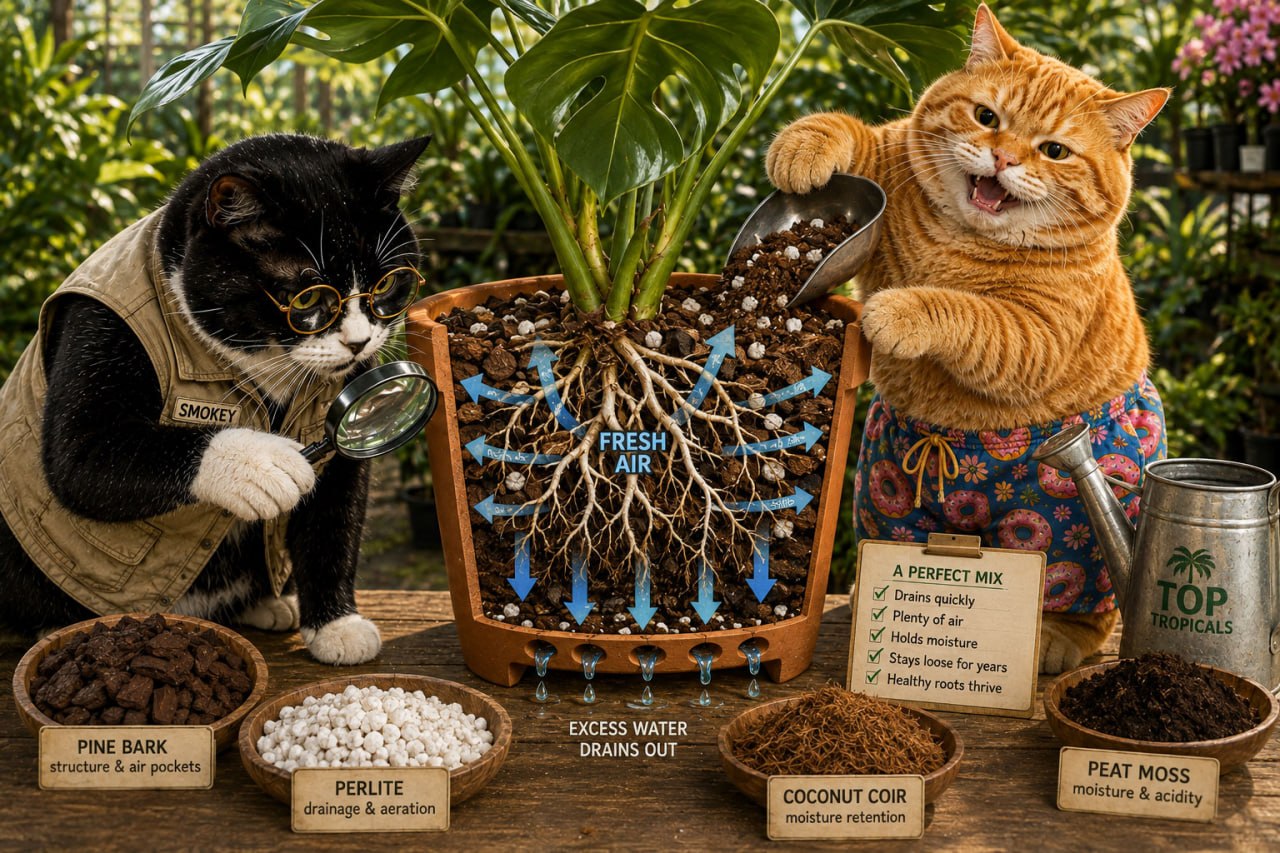
Potting Mix Explained: Why Garden Soil Kills Container Plants
Potting Mix Explained: Why Garden Soil Kills Container Plants
Most people assume soil is soil.
If it's black, rich, and full of organic matter, it must be perfect for every plant, right?
Actually, that's one of the biggest mistakes in container gardening.
You can grow a healthy tree in almost pure sand.
You can also kill that same tree in rich black compost.
The difference isn't nutrients - it's oxygen.
🔸 Garden soil and potting mix have different jobs
Garden soil is designed for nature.
Rainwater drains deep into the ground, roots can spread in every direction, worms create air channels, and excess moisture eventually disappears.
A container is completely different.
The roots are confined, water has only a few drainage holes to escape through, and if the growing medium stays too wet, oxygen disappears. That's when bacteria and fungi begin attacking the roots.
The problem isn't the pot.
The problem is using a heavy soil that wasn't designed for containers.
🔸 Water isn't the enemy
One of the best pieces of horticultural advice I ever received came from tropical fruit expert Murray Corman:
"Always overwater your plants. Improve your soil drainage."
It sounds backwards, but it's true.
Healthy roots need two things:
✅ Water
✅ Oxygen
Without oxygen, roots suffocate, diseases develop, and root rot begins.
A well-drained potting mix allows you to water generously because fresh air replaces excess water after each watering.
🔸 Why it's called a "soilless" mix
Professional potting mixes contain no actual soil.
Instead, they're carefully engineered from lightweight ingredients such as pine bark, coconut coir, peat moss, perlite, and other materials that create the perfect environment for roots.
Notice what's missing:
❌ Garden soil
❌ Clay
❌ Topsoil
❌ Muck
❌ Compost
The goal isn't to imitate nature.
The goal is to give roots plenty of air while holding just enough moisture.
🔸 Tropical plants like acidic, airy soils
Most tropical plants grow best in a slightly acidic potting mix with a pH around 5.5 to 6.5.
That's one reason professional mixes often contain pine bark, Canadian peat moss, and/or coconut coir. These ingredients create an airy root zone while naturally supporting the slightly acidic conditions many tropical plants prefer.
Avoid adding alkaline materials such as shell rock, limestone, crushed coral, or oyster shell unless the plant specifically requires them.
🔸 The secret is below the surface
Many gardeners focus on what's happening above the soil. Professional growers focus on what's happening below it.
The healthiest roots don't grow in the richest-looking soil. They grow in a potting mix that breathes.
That's why the secret behind healthy container plants isn't watering less. It's using the right potting mix.
🛒 Get Our Proven Professional Potting Mix
📚 Learn more
· The complete guide to potting mix
· The #1 Rule for Mail-Order Plant: Don't Disturb the Roots
· When Is the Best Time to Water Your Plants?
· How much water is too much?
· Container Gardening in Hot Climate
· How to re-pot a plant properly
#Fertilizers #How_to #Discover
🟢 Join 👉 TopTropicals
Date: 27 Aug 2026
Daily Cat Lesson #6: Who Is THAT Cat?!

🐾 Daily Cat Lesson #6: Who Is THAT Cat?! 😳
You walk past a mirror and see yourself.
Your cat walks past a mirror and discovers - ANOTHER CAT IN THE HOUSE!
🐈📸 Top Tropicals rescued cat James Coconuts at PeopleCats.Garden.
🐈 Stay with us for your Daily Dose of Cat! #DailyCatLesson #PeopleCats
🟢 Join 👉 TopTropicals
You walk past a mirror and see yourself.
Your cat walks past a mirror and discovers - ANOTHER CAT IN THE HOUSE!
- 🐾 Do cats recognize themselves in mirrors?
Most cats don't appear to recognize the reflection as "me" the way humans do. They may stare, investigate, look behind the mirror, ignore it, or initially react as though another cat has suddenly appeared. - 🐾 How do scientists test this?
One classic experiment is called the mirror test. An animal is given a mark on its body that it can see only in a mirror. If it uses the reflection to investigate the mark on its own body, that's considered evidence of mirror self-recognition.
Cats generally don't show convincing evidence of passing this test. - 🐾 But does that mean cats don't know who they are?
Not necessarily. The mirror test is heavily based on vision, while cats understand much of their world through smell, sound and other sensory information.
That mysterious mirror cat looks like a cat - but it has no smell.
Makes no independent sounds.
And strangely copies EVERYTHING. - 🐾 Why do cats eventually ignore mirrors?
After enough investigation, many cats learn that the reflection isn't a real intruder and simply stop responding to it.
So your cat may not be thinking:
"Oh! That's me."
It's possibly closer to:
"Whatever that thing is, I've determined it's useless." 😼
🐈📸 Top Tropicals rescued cat James Coconuts at PeopleCats.Garden.
🐈 Stay with us for your Daily Dose of Cat! #DailyCatLesson #PeopleCats
🟢 Join 👉 TopTropicals
Date: 27 Aug 2026
You tried the fruit, but have you seen the Dragon Fruit flower?
🐉 You tried the fruit, but have you seen the Dragon Fruit flower?
Oh my gosh, did I miss the blooms AGAIN?
Nope! Walked by our dragon fruit corner at the TopTropicals farm and caught a total BLOOM BOOM! These flowers are literally as big as my head - bright white petals, wild yellow starburst centers, and so many of them popping at once. The craziest part? They’re thriving in just 3-gallon pots!
The fruit sets super fast after this, so stay tuned - I’ll be posting a follow-up video as soon as these bad boys ripen!
🛒 Explore and collect Dragon Fruit varieties
📚 Learn more:


· Dragon fruit Hylocereus in Plant Encyclopedia
· Why white-flesh Dragon fruits deserve more attention
· What is the best Red Dragon fruit and what does it taste like
· Pitaya Yellow Palora: dragon fruit beyond pink and white
· Pitaya Vietnamese Jaina White: dragon fruit beyond pink and white
· Pitaya Tricia: dragon fruit beyond pink and white
· Pitaya "Sweet Red": dragon fruit beyond pink and white
· Pitaya Purple Haze: dragon fruit beyond pink and white
· Pitaya Hana: dragon fruit beyond pink and white
· Pitaya Eureka Red: dragon fruit beyond pink and white
· Pitaya David Bowie: Dragon Fruit Beyond Pink and White
· A Quick Guide to Dragon fruit varieties: Red, White, Yellow, Purple and more...
· What is the best Dragon fruit with red flesh?
· Planting your own Dragon Fruit plantation
· Do-It-Yourself Support Structure for Dragon Fruit
· Why you need to grow your own dragon fruit
· Do red, white and yellow Dragon fruit taste differently?
#Food_Forest #Dragon_Fruit
🟢 Join 👉 TopTropicals
Date: 26 Aug 2026
Daily Cat Lesson #5: Why Is Your Cat Staring at You?

🐾 Daily Cat Lesson #5: Why Is Your Cat Staring at You? 👀
You look up.
Your cat is staring directly into your soul.
Five minutes later - still staring.
- 🐾 Why do cats stare at their humans?
Usually because they're watching, communicating, or waiting for something. Cats are excellent students of human behavior. They learn your routines and quickly figure out which look gets food, attention, an open door - or whatever service they currently require. - 🐾 Is staring a sign of affection?
It can be. A relaxed cat who looks at you with soft eyes and slowly blinks is showing trust and comfort. Try slowly blinking back. It's about as close as we get to saying "I like you" in Cat.
So when your cat stares at you, don't just stare back. Soften your eyes and slowly blink. Your cat may even blink back.
It's a little feline conversation without saying a word - the cat version of a kiss. 💋 - 🐾 But isn't staring aggressive in cat language?
A hard, unbroken stare between unfamiliar cats can be a warning. Look at the whole cat: stiff posture, flattened ears, twitching tail or huge pupils tell a very different story from relaxed ears and sleepy eyes. - 🐾 Why does my cat stare at me when I'm eating?
This remains one of science's easier mysteries.
You have food.
The cat does not have your food.
The situation clearly requires immediate correction. 😼
🐈📸 Top Tropicals rescued cat Lilimon at PeopleCats.Garden.
🐈 Stay with us for your Daily Dose of Cat! #DailyCatLesson #PeopleCats
🟢 Join 👉 TopTropicals
Date: 26 Aug 2026
Green in July, Variegated in January: Red-Stem Serissa
🌿 Green in July, Variegated in January: Red-Stem Serissa
At first glance, this little shrub looks like a mistake.
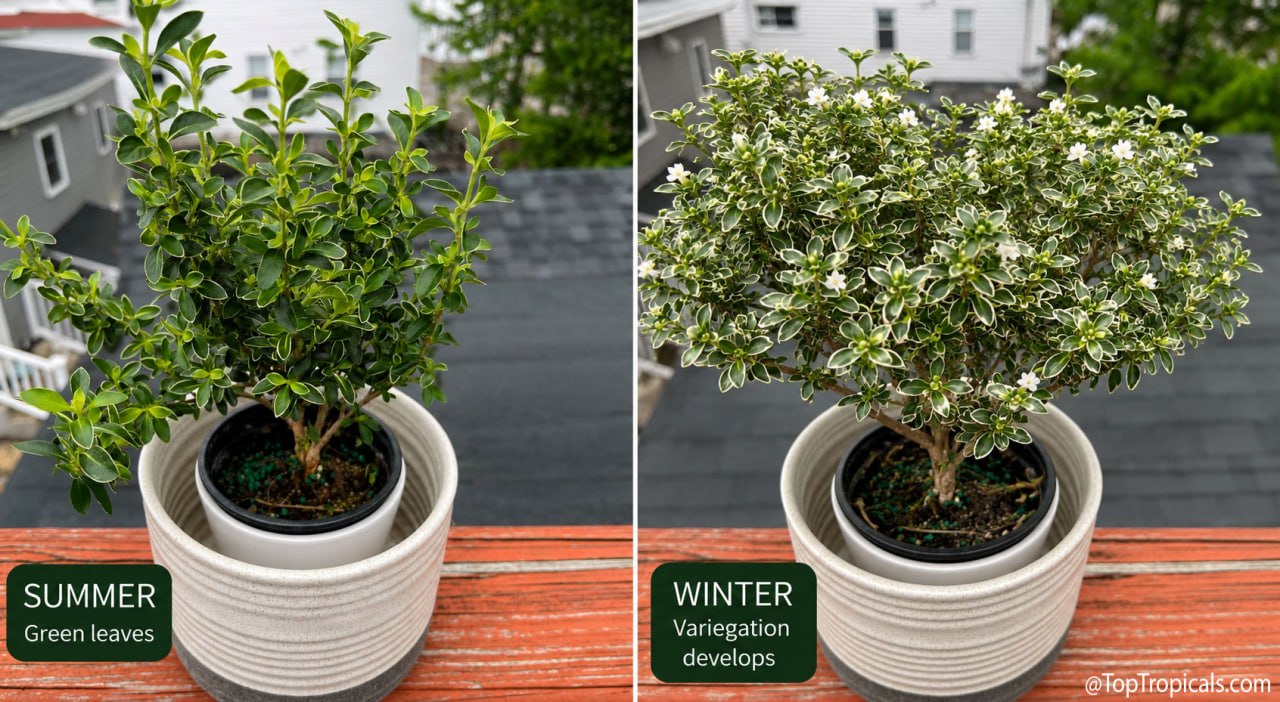
It came labeled as an "outer-variegated red stem" Serissa, yet in the dead of summer, its tiny leaves are completely, unremarkably green. Where is the pattern? Where is the variegated foliage?
The answer came directly from longtime rare-plant grower Sid Gardino: Wait until Winter.
🌿 The Winter-Variegated Serissa Experiment
This unusual Serissa selection holds back its visual showcase until the temperature drops. As cooler weather sets in, the foliage undergoes a seasonal shift, pushing out vivid cream margins off-set by rich, reddish young stems.
☀️ Summer: Deep Solid Green - Heavy star-shaped blooming
❄️ Winter: Cream-Variegated Edges - Frosted look with reddish stems
🌿 The Mystery of Seasonal Variegation
Seasonal foliage shifts sound like a classic "nursery myth," but the science backs it up.
Serissa japonica (still widely known in horticulture as Serissa foetida) has a documented history of temperature-dependent foliage:
'Mt. Fuji': A famous cultivar whose white-and-green striping expands or shrinks based on light, heat, and plant nutrition.
'Pink Mountain': A documented selection specifically noted for producing variegated foliage primarily during winter months.
While environmental triggers like day length, light intensity, and growth rate play a role, cool winter air is the primary switch that activates the cream-colored margins on this specific red-stem clone.
🌿 Why Gardeners & Bonsai Artists Love Serissa
Commonly called Tree of a Thousand Stars or Snow Rose, this Asian native in the Rubiaceae (coffee) family is prized far beyond its chameleon foliage.
Massive Bloom Cycles: The shrub gets its nickname from hundreds of tiny, white, star-like blossoms that bloom heavily from spring through autumn.
Natural Miniaturization: With tiny leaves, naturally fine branching, and ultra-short internodes, Serissa naturally scales itself down. Older plants quickly develop gnarled, woody trunks.
Versatile Sizing: While it reaches 2 to 4 feet in the ground, simple pruning easily maintains it as a compact patio container, miniature shrub, or indoor bonsai.
🌿 How to Care for the Red-Stem Serissa
Light: Bright, direct morning sun with afternoon shade protection. Full, brutal summer sun can scorch the delicate variegated leaf margins.
Watering: Keep the soil consistently moist, airy, and well-draining. Serissa is sensitive to abrupt moisture swings; bone-dry soil triggers massive leaf drop, while soggy mud rots the roots.
Hardiness: Typically evergreen in USDA Zones 7–9. Cold weather encourages its winter variegation, but potted plants should be protected from hard freezes to protect root systems.
💡Botanist's Note: Serissa earned its old species name, foetida, because its leaves release an earthy, sulfur-like odor—but only when crushed or pruned. Left alone on your patio, it smells completely neutral.
🌿 The Experiment Begins
The summer foliage photo is taken, solid green and waiting. As the cooler Florida months arrive, we will be tracking this exact red-stem selection to document its transition into full winter variegation.
🛒 See It Change: Get Yours Today
📚 Learn more


· Serissa japonica (foetida) in Plant Encyclopedia
#Container_Garden #Discover
🟢 Join 👉 TopTropicals