Garden Blog - Top Tropicals

Date: 7 May 2026

3 Best Trees for a Fast-Fruit Garden
3 Best Trees for a Fast-Fruit Garden
3 Best Trees for a "Fast-Fruit" Garden 🍒

Want fruit without the wait? These tropical powerhouses deliver a "fast-food" garden in record time.

🍓 The Top 3 Speed Demons


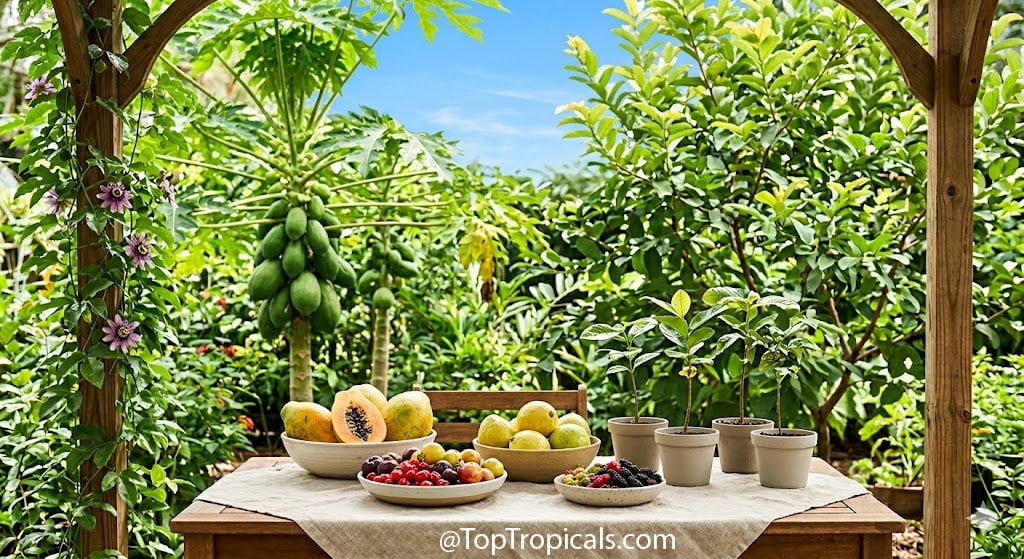
1. The Favorite: Papaya 🍊
If you want speed, Papaya is king. It can go from a small seedling to heavy fruit in 6-10 months. It behaves more like a giant herb than a tree: it is fast, has shallow roots, and is incredibly responsive to water and fertilizer. In warm climates, it is a plant it and watch it go legend. More details

2. The Reliable: Guava 🍉
Guava is the most forgiving fruit tree you can own. It handles heat, poor soil, and the occasional week of neglect without missing a beat. Most varieties begin producing in just 1-2 years, staying compact enough for small yards or large pots. More details

3. The Surprise: Eugenias 🍒
This family (including Surinam Cherry, Grumichama, Cherry of the Rio Grande, and Pitomba) often flies under the radar. They look like ornamental shrubs, but they establish quickly and can fruit within year two. They handle pruning beautifully, making them perfect for edible hedges. More details
  • 🍓 The Fast-Fruit Honor Roll
  • 🍓Ultra-Fast (Under 1 Year)
    Papaya and Banana: The heavyweight champions of speed.
    Strawberry Tree (Muntingia calabura): Non-stop cotton candy berries.
    Grafted Favorites: High-quality Mango, Avocado, Peach, Nectarine, and Persimmon.

    Mango Plant Facts

    Botanical name: Mangifera indica
    Also known as: Mango
    USDA Zone: 9 - 11
    Highligths Large tree taller than 20 ftSmall tree 10-20 ftFull sunWatering: Moderate. Water when top soil feels dryYellow, orange flowersPink flowersEdible plantSeaside, salt tolerant plant
    Get personalized tips for your region

    Avocado Plant Facts

    Botanical name: Persea americana, Persea gratissima
    Also known as: Avocado, Alligator Pear, Aguacate, Abacate
    USDA Zone: 9 - 11
    Highligths Large tree taller than 20 ftSmall tree 10-20 ftFull sunWatering: Regular. Let topsoil dry slightlyEdible plantSubtropical plant. Mature plant cold hardy at least to 30s F for a short time
    Get personalized tips for your region

    Peach Plant Facts

    Botanical name: Prunus persica, Amygdalus persica
    Also known as: Peach
    USDA Zone: 5 - 10
    Highligths Small tree 10-20 ftFull sunWatering: Regular. Let topsoil dry slightlyWhite, off-white flowersPink flowersEdible plantDeciduous plantSubtropical plant. Mature plant cold hardy at least to 30s F for a short time
    Get personalized tips for your region
  • 🍓Very Fast (1-2 Years)
    The Berries: Mulberry (especially Everbearing), Fig, and Barbados Cherry.
    The Exotics: Strawberry Guava, Loquat, and the curious Peanut Butter Tree (Bunchosia).
    The Sweet Treats: Blackberry Jam Fruit (Randia formosa).
  • 🍓Tropical Staples (2-3 Years)
    Starfruit (Carambola): A heavy producer that looks stunning in the garden.
    Annona Family: Sweet Sugar Apples and creamy Atemoyas.
    Macadamia Nut: A long-term investment that starts surprisingly early.
  • 🍓Fast Climbers and Bush Fruit
    Passionfruit: Will cover a fence and fruit in a single season.
    Berries: Mysore Raspberry and classic Blackberries for quick returns.


🛒 Ready to harvest? Shop the "Fast-Fruit" Collection

📚 Learn more:


· Eugenia cherries in Plant Encyclopedia
· 10 best fruit trees to grow in Florida and Southern landscapes
· Top 10 fast-fruiting trees
· 5 fast-growing fruit trees and shrubs for quick, low-effort harvests (Top Tropicals experts for Martha Stuart)

#Food_Forest #How_to #Discover

🟢 Join 👉 TopTropicals
Date: 19 May 2026

The Tree That Looks Photoshopped (But Isnt)

The Tree That Looks Photoshopped (But Isnt) The Tree That Looks Photoshopped (But Isnt)
The Tree That Looks Photoshopped (But Isn't) 🌈

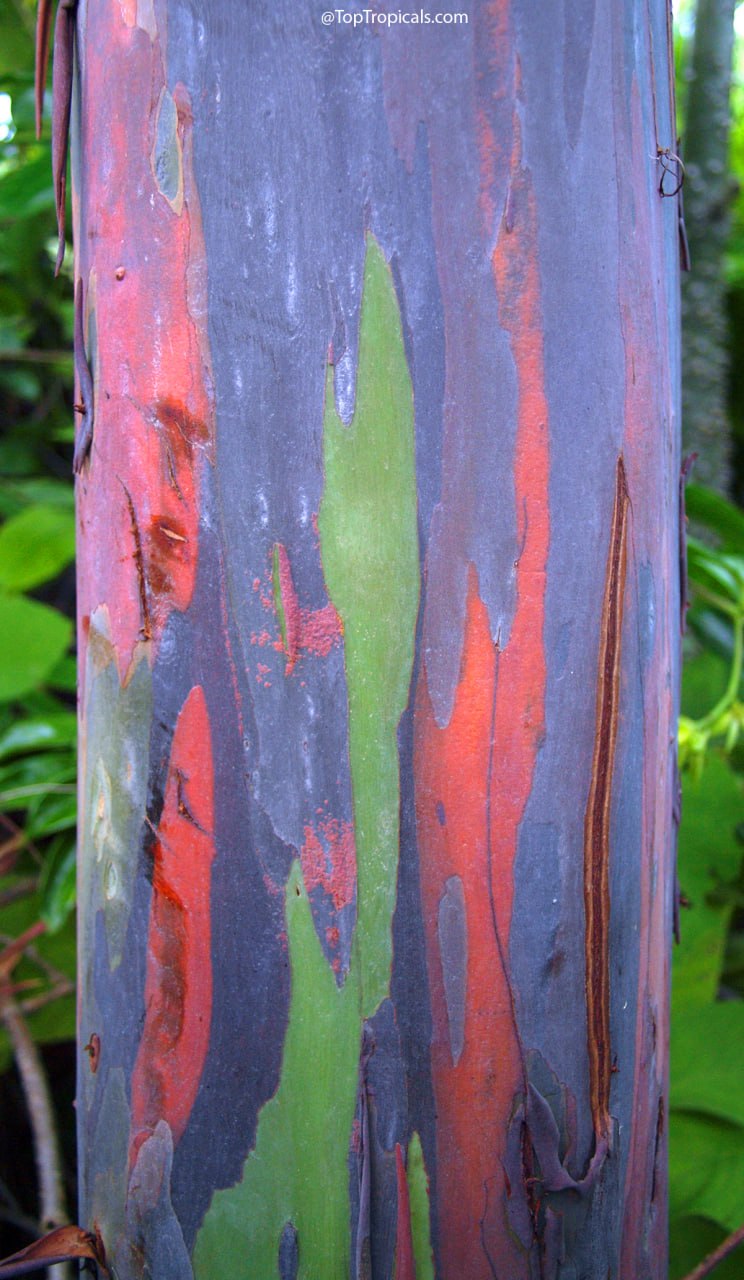
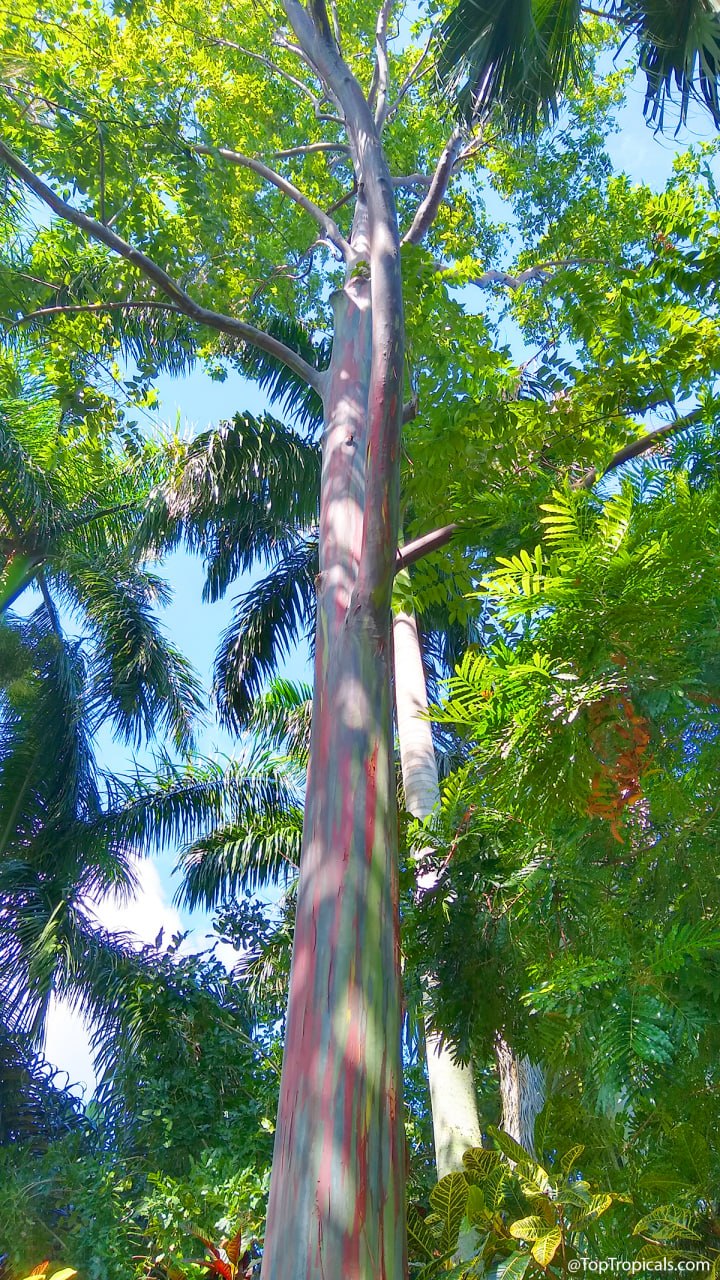
Most people see a photo of the Rainbow Eucalyptus and assume someone went heavy on the saturation filters. The trunk looks like an abstract artist got loose with neon greens, deep blues, purples, and burnt oranges - all on the same tree, all at once. It doesn't look real. But it is. And if you live in the right climate, you can actually grow one.

🎨 The Chemistry Behind the Watercolor Trunk


Eucalyptus deglupta does something no other tree quite pulls off at this scale: it sheds its bark in patches and strips throughout the year. While it seems entirely alien, this multi-colored, peeling bark is actually a family trait shared by many other members of the Myrtaceae (Myrtle) family - including common guava trees.

Rainbow Eucalyptus Plant Facts

Botanical name: Eucalyptus deglupta
Also known as: Rainbow Eucalyptus, Mindanao Gum, Rainbow Gum
USDA Zone: 10 - 11
Highligths Large tree taller than 20 ftFull sunWatering: Moderate. Water when top soil feels dryKeep soil moistRed, crimson, vinous flowersWhite, off-white flowersSpice or herb plantFlood tolerant plant
Get personalized tips for your region


However, the Rainbow Eucalyptus takes this family tradition to an absolute extreme. This constant shedding reveals a living, shifting canvas underneath:
The Fresh Layer: New bark starts out a shocking, vivid green because of the chlorophyll sitting just beneath the surface.
The Shift: As the bark is exposed to air, it oxidizes. Time and oxygen push the colors through a spectrum of blues, purples, and eventually into warm oranges and deep, reddish-browns.
The Living Canvas: Because different sections of the trunk shed at different times, the tree is never just one color. It looks like a living watercolor painting that's still drying.

🎨 A Rainforest Giant That Grows at Breakneck Speed


Native to the humid tropical rainforests of the Philippines, Indonesia, and Papua New Guinea, this isn't your average backyard sapling. In the wild, it can tower at nearly 200 feet tall.
While it stays a bit more manageable in residential landscapes, it remains fast-growing. If you give it full sun, rich soil, and plenty of humidity, a young tree can put on several feet of height per year.
Unlike its drought-tolerant Australian cousins, the Rainbow Eucalyptus loves water and can even handle occasional flooding. As a bonus, its leaves release a pleasant, spicy aroma when crushed, adding a sensory layer to its visual drama.

🎨 The Catch: It Hates the Cold


Before you run out to buy one, there is a major catch. While many eucalyptus species are surprisingly tough against the hard freeze, the Rainbow Eucalyptus is the tropical outlier of the family.

The Safe Zones: It thrives best in USDA Zones 10-11 (like South Florida and Southern California), where winters stay mild.
❄️ The Cold Threat: Hard freezes, frost, and biting cold winds will badly damage or kill it.

Can you grow it in colder climates? Yes, but you'll need a big container and a tall space to move it in. Many gardeners outside the tropics grow them in large pots so they can drag them indoors or into a greenhouse for the winter. It limits their ultimate size, but it keeps the theatrical effect alive.

🎨 Why It's Worth the Hype


If you are lucky enough to live in a climate where it can thrive, the Rainbow Eucalyptus makes the ultimate landscape centerpiece. Because its canopy is tall and airy rather than dense, it won't completely black out the sun for the rest of your garden. Instead, it just stands there looking impossible.

Photos actually undersell it. Standing next to the trunk in person, you find yourself looking for the trick. But there isn't one - just nature showing off.

🛒 Plant the Impossible Rainbow Eucalyptus

📚 Learn more: 


Eucalyptus deglupta - Rainbow Eucalyptus in Plant Encyclopedia

#Trees #Discover #Nature_Wonders #Fun_Facts

🟢 Join 👉 TopTropicals

Date: 27 Apr 2026

Rainbow plumerias - the wild side of color

Plumeria Mui Rainbow

Plumeria Mui Rainbow

Plumeria Pink Jaopraya

Plumeria Pink Jaopraya

Plumeria Sunset Symphony

Plumeria Sunset Symphony

Plumeria Dook

Plumeria Dook

Rainbow plumerias - the wild side of color. Winter dormancy tip 🌈

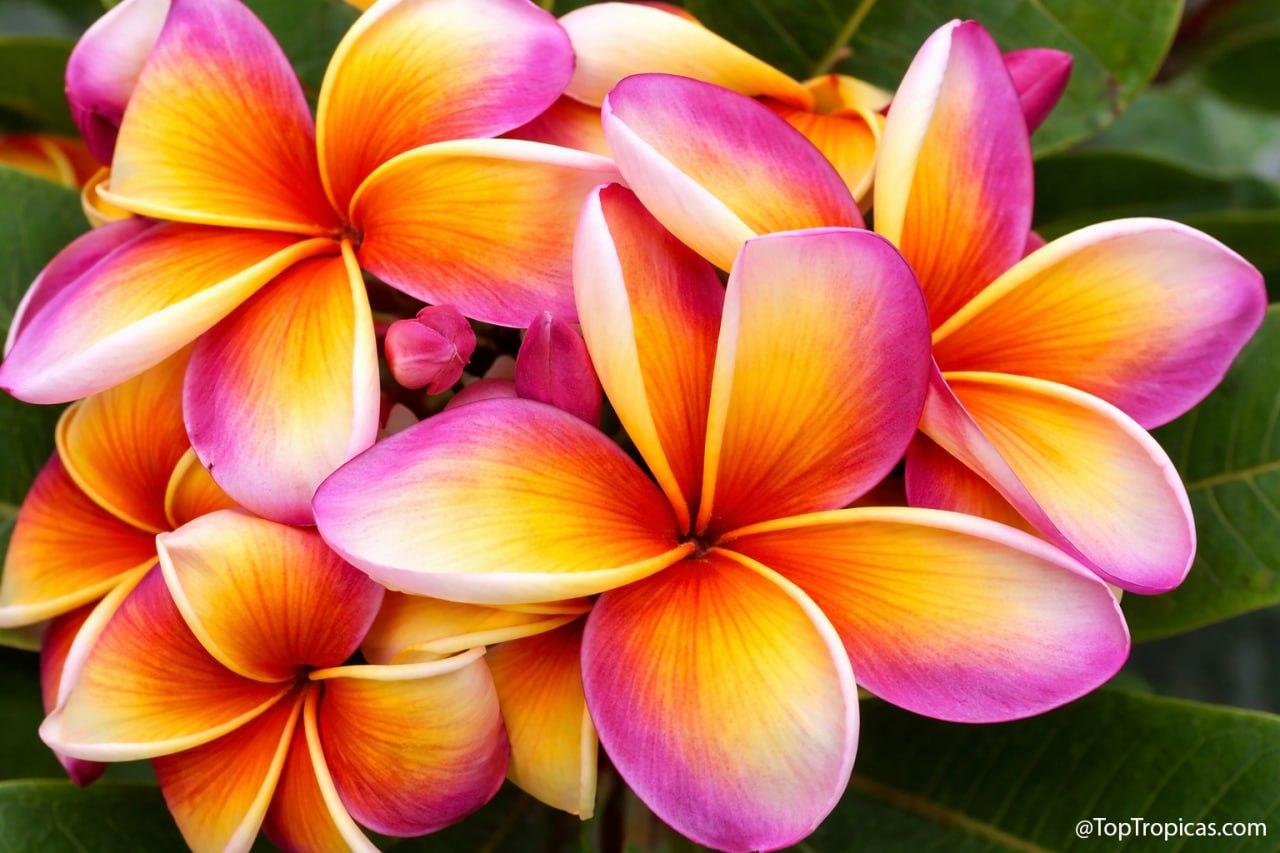
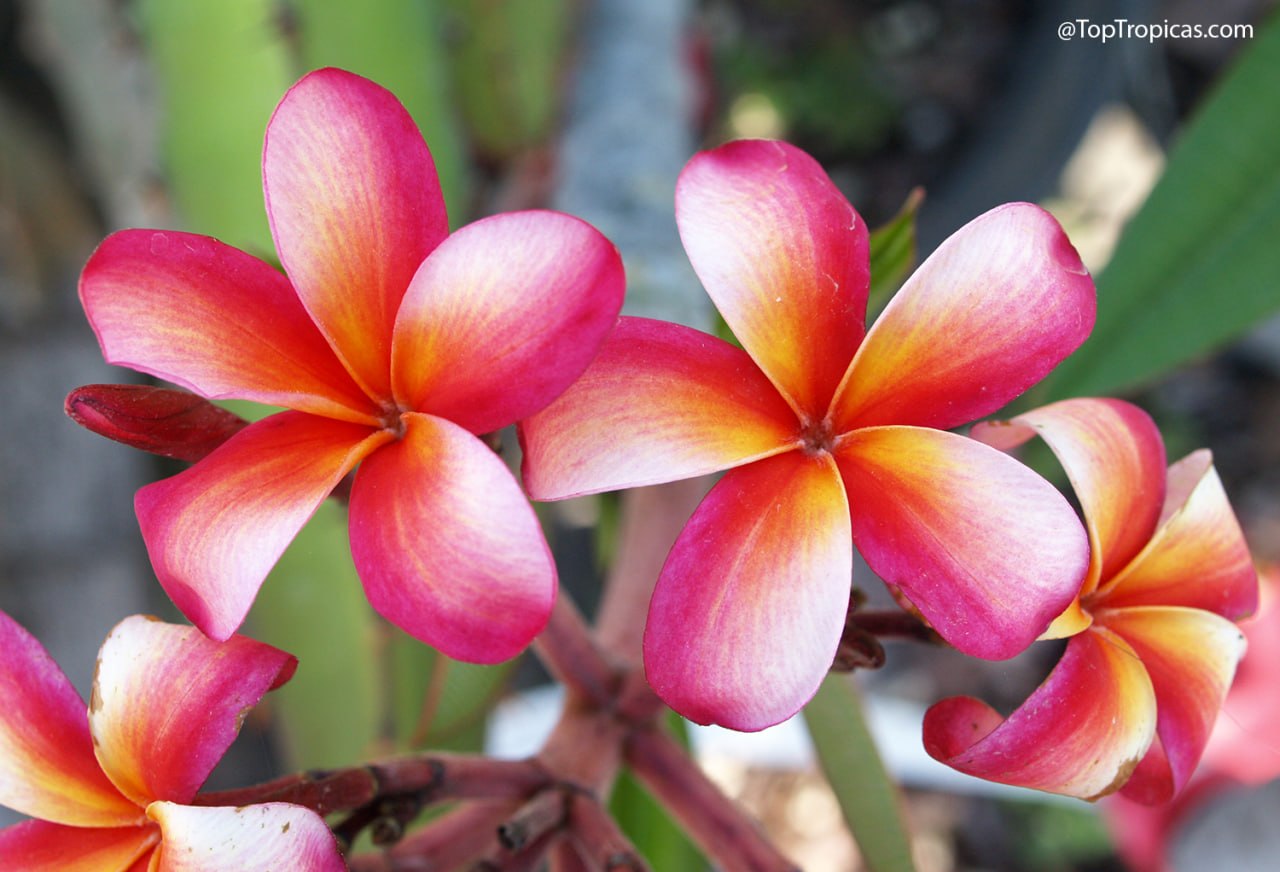
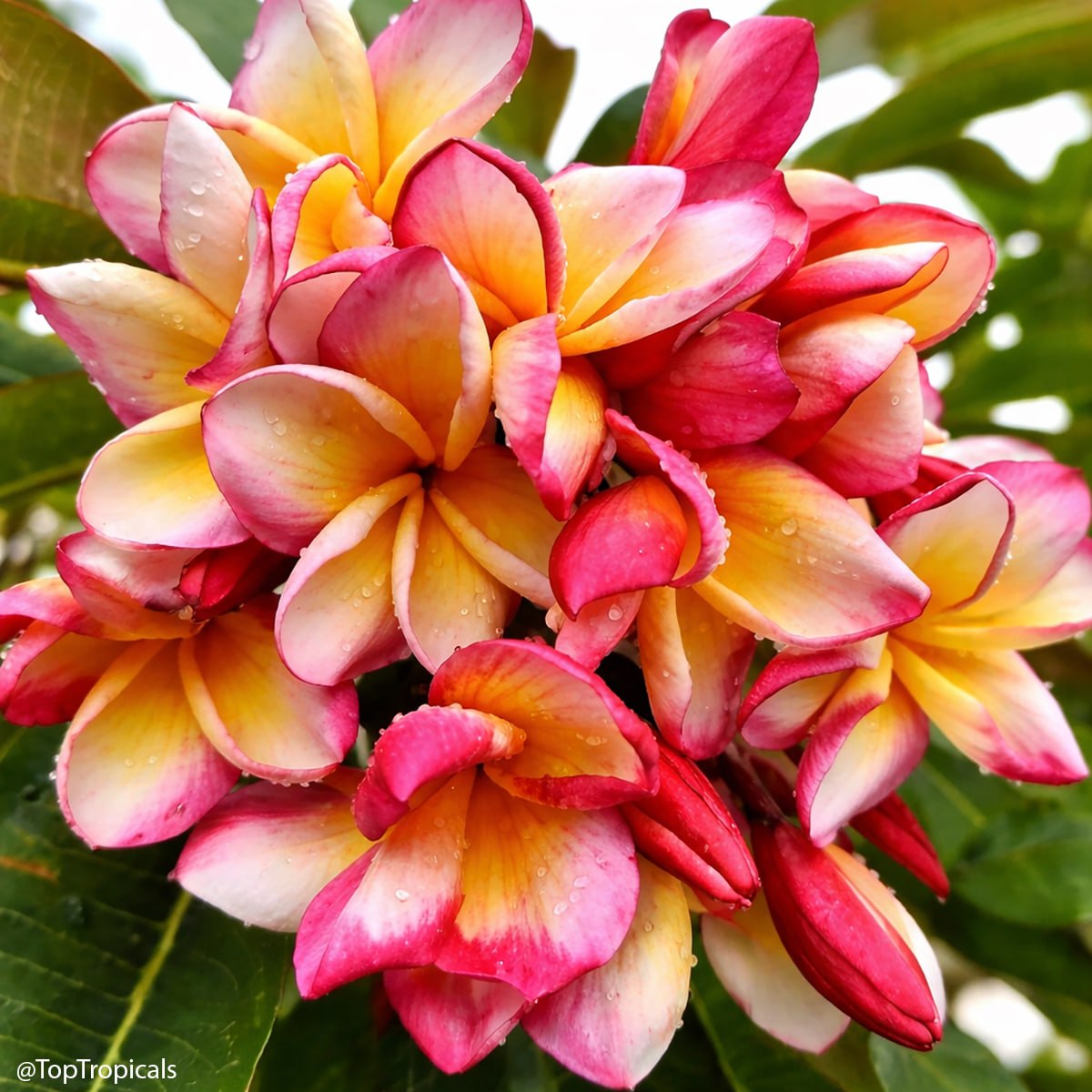
Some plumerias don’t follow rules - they mix, swirl, and splash colors all over the petals like a tropical sunset in motion. These “rainbow” types are the most playful and unpredictable, with every bloom looking a little different from the next.

Plumeria Plant Facts

Botanical name: Plumeria sp.
Also known as: Plumeria, Frangipani
USDA Zone: 9 - 11
Highligths Large shrub 5-10 ft tallSmall tree 10-20 ftFull sunWatering: Moderate. Water when top soil feels dryYellow, orange flowersRed, crimson, vinous flowersWhite, off-white flowersPink flowersPlant attracts butterflies, hummingbirdsDeciduous plantFragrant plantSeaside, salt tolerant plant
Get personalized tips for your region


🌸 Today's featured plumerias:


 ✦ Plumeria Mui Rainbow - deep orange-red center blending into golden yellow and finishing with pink to magenta edges. Bright, fiery colors with a smooth, glowing transition.
 ✦ Plumeria Pink Jaopraya - a bold swirl of red, white, pink, and yellow all in one flower. Complex, eye-catching, and impossible to ignore.
 ✦ Plumeria Sunset Symphony - creamy ivory, golden yellow, and coral-pink tones with deeper rose edges, creating a layered sunset effect that shifts from bloom to bloom.
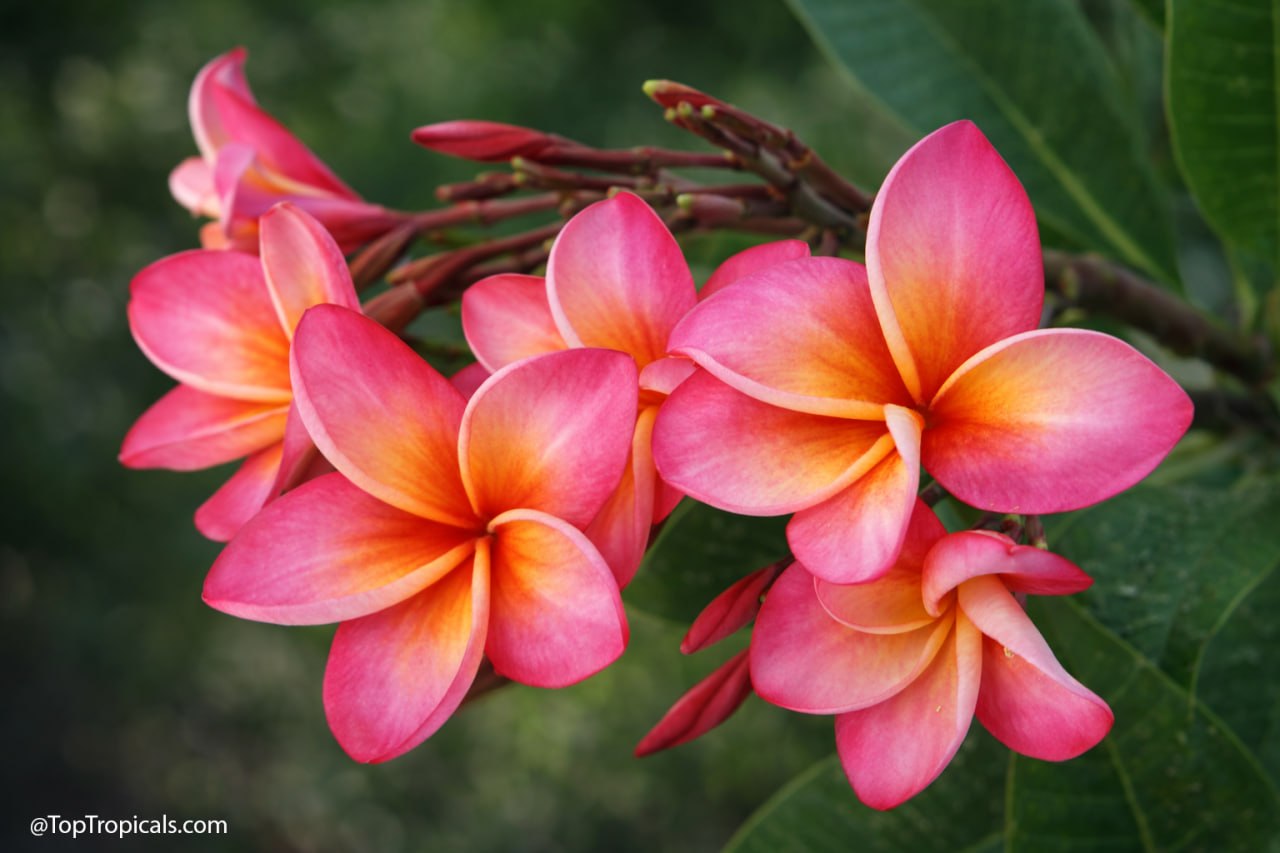
 ✦ Plumeria Dook - rich pink petals melting into a glowing orange and golden center. Bright, warm, and full of tropical energy that stands out from a distance.

💡 Plumeria tip: winter dormancy


In cooler months, plumerias slow down and may drop all leaves. That’s normal.
During this rest period, cut watering way back and let the plant sleep.
Growth will restart when temperatures rise.

🛒 Shop Plumeria Collection and Enjoy the fragrant blooms

📚 Learn more:
· Plumeria varieties in Plant Encyclopedia
· Bold reds and ruby tones - plumerias with real intensity. Feeding tip
· Dwarf plumerias - big blooms in small spaces. Sun tip
· Plumerias that stand out: bold colors and clean contrasts. Pot size tip
· 5 striking variegated plumerias you can’t ignore. Soil tip
· Plumeria rainbow: Symbol of the Tropics
· 5 simple rules to grow a fragrant plumeria and make it bloom like the pictures
· What is the most celebrated fragrant flower?
· Thailand Plumerias
🎥 How to get endless Plumeria Blooms

#Perfume_Plants #Container_Garden #How_to #Discover #PlumeriaRainbow

🟢 Join 👉 TopTropicals

Date: 26 Apr 2026

Mango Rainbow - Coconut Cream

Coconut Cream Mango

Coconut Cream Mango

Mango Rainbow - Coconut Cream 🌈

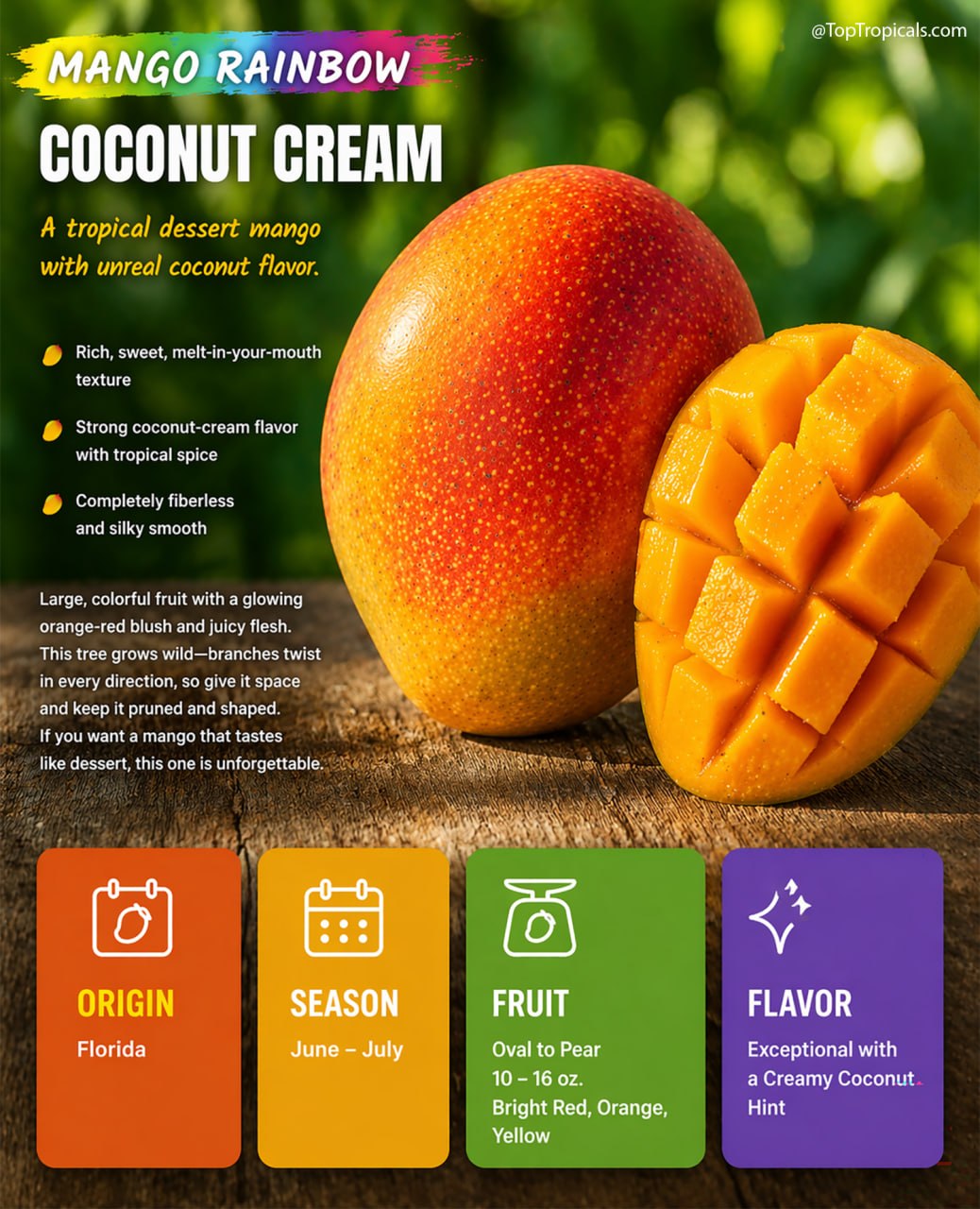
🥭 Coconut Cream - a tropical dessert mango with unreal coconut flavor.

Mango Plant Facts

Botanical name: Mangifera indica
Also known as: Mango
USDA Zone: 9 - 11
Highligths Large tree taller than 20 ftSmall tree 10-20 ftFull sunWatering: Moderate. Water when top soil feels dryYellow, orange flowersPink flowersEdible plantSeaside, salt tolerant plant
Get personalized tips for your region


🔸Rich, sweet, melt-in-your-mouth texture
🔸Strong coconut-cream flavor with tropical spice
🔸Completely fiberless and silky smooth

🥭 Large, colorful fruit with a glowing orange-red blush and juicy flesh.
This tree grows wild - branches twist in every direction, so give it space and keep it pruned and shaped.
If you want a mango that tastes like dessert, this one is unforgettable. More 👉

🛒 Shop Mango varieties

📚 Learn more:
Mango Tree - Mangifera indica - in Plant Encyclopedia
#Mango_Rainbow - varieties you should try

#Food_Forest #Mango #Mango_Rainbow

🟢 Join 👉 TopTropicals
Date: 4 May 2026

🍲 Where the Garden Becomes the Kitchen

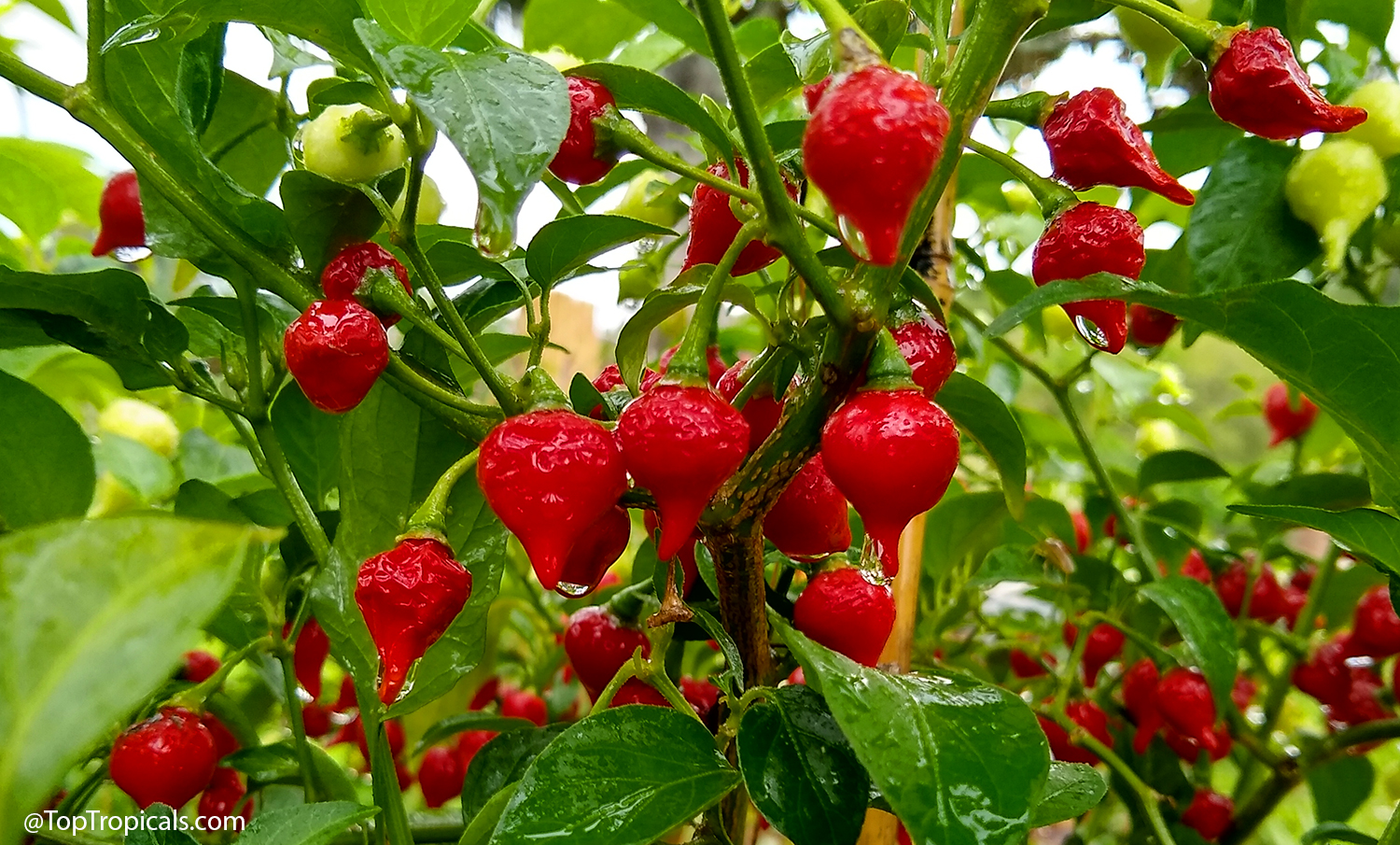
Close-up  of  Capsicum  annuum  x  chinense  Biquinho  pepper  plant  with 
 clusters  of  small,  bright  red,  teardrop-shaped  fruits  hanging  among  glossy 
 green  leaves,  some  still  green,  with  water  droplets  visible  after  rain.

Biquinho pepper loaded with fruit - small, beak-shaped peppers ripen from green to bright red, offering intense fruity habanero flavor with little to no heat on a compact, heavy-producing plant.

Sweet Pepper Plant Facts

Botanical name: Capsicum annuum
Also known as: Sweet Pepper, Chilli Pepper, Cayenne Pepper, Paprika, Ornamental pepper
USDA Zone: 4 - 10
Highligths Small plant 2-5 ftFull sunWatering: Regular. Let topsoil dry slightlyBlue, lavender, purple flowersWhite, off-white flowersEdible plantEthnomedical plant.
Plants marked as ethnomedical and/or described as medicinal, are not offered as medicine but rather as ornamentals or plant collectibles.
Ethnomedical statements / products have not been evaluated by the FDA and are not intended to diagnose, treat, cure, or prevent any disease. We urge all customers to consult a physician before using any supplements, herbals or medicines advertised here or elsewhere.Irritating plantSubtropical plant. Mature plant cold hardy at least to 30s F for a short time
Get personalized tips for your region

A lot of plants that thrive in Florida heat have deep roots in Mexico, and not just as ornamentals. Think coral vine or flame vine climbing a fence in summer, or bird of paradise sitting at the edge of a patio like it owns the place. These are not plants that need coaxing. They grow fast, full, and unapologetically. Then there are the plants you actually eat: peppers, prickly pear , sweetleaf, and fruit trees like avocado, guava, and sapodilla. They do not just decorate the yard. They change how the yard works, and how the kitchen feels all year.

Avocado Plant Facts

Botanical name: Persea americana, Persea gratissima
Also known as: Avocado, Alligator Pear, Aguacate, Abacate
USDA Zone: 9 - 11
Highligths Large tree taller than 20 ftSmall tree 10-20 ftFull sunWatering: Regular. Let topsoil dry slightlyEdible plantSubtropical plant. Mature plant cold hardy at least to 30s F for a short time
Get personalized tips for your region

That is the part that sneaks up on you. Gardening stops being about having a pretty yard and starts becoming a way of living. Mango tacos taste different when you picked the mango yourself. Everything does.

Mango Plant Facts

Botanical name: Mangifera indica
Also known as: Mango
USDA Zone: 9 - 11
Highligths Large tree taller than 20 ftSmall tree 10-20 ftFull sunWatering: Moderate. Water when top soil feels dryYellow, orange flowersPink flowersEdible plantSeaside, salt tolerant plant
Get personalized tips for your region

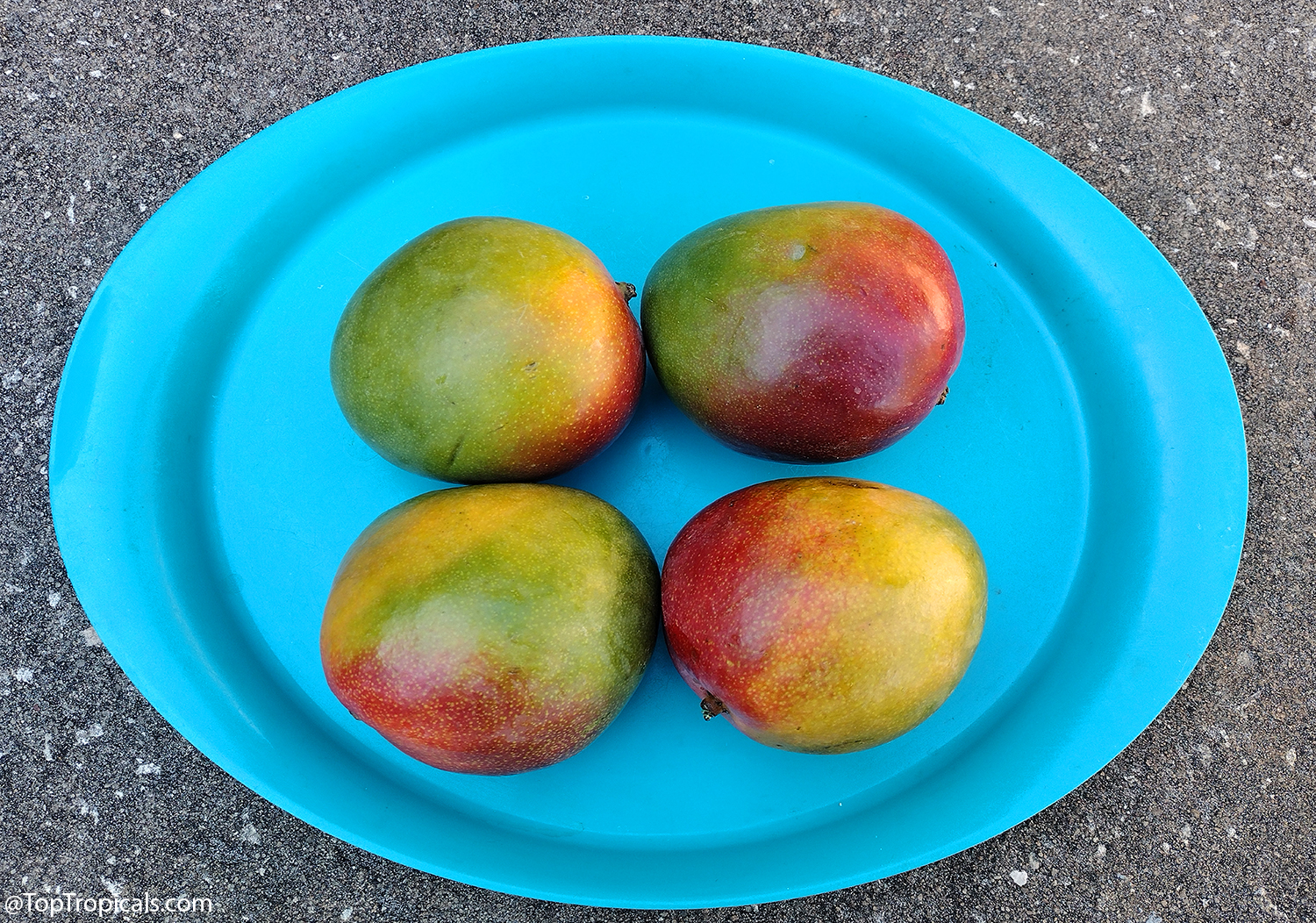
Four  Kent  mangoes  with  red,  green,  and  yellow  blush  arranged  on  a 
 plate.

Kent mango - classic late-season variety with smooth, fiberless flesh and rich, sweet flavor.

🍀Mexican Plants That Thrive With Minimal Effort

by Tatiana Anderson, Top Tropicals Garden Expert

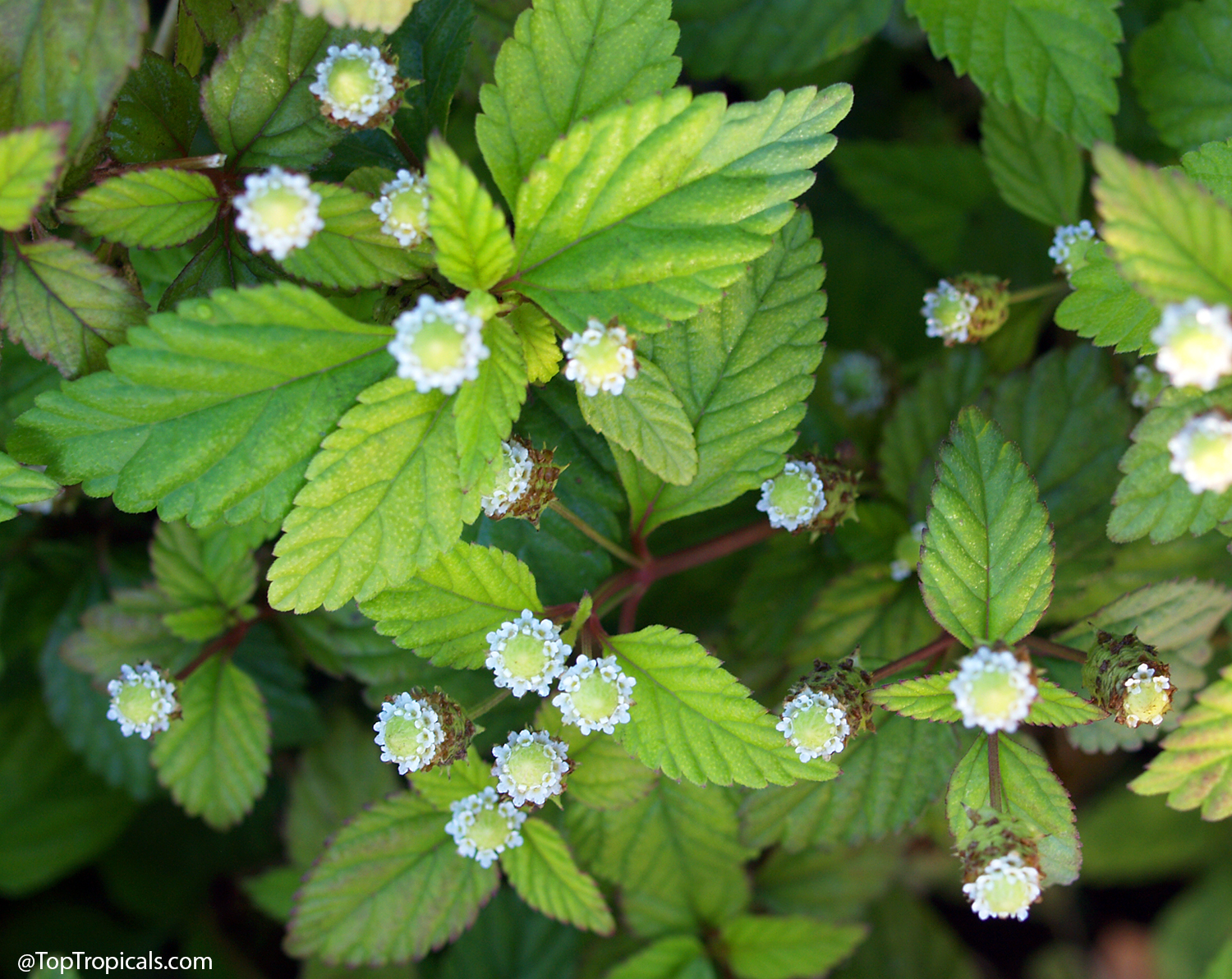
Close-up  of  Lippia  dulcis  (Aztec  Sweet  Herb)  showing  small  white 
 button-like  flowers  with  pale  green  centers  surrounded  by  serrated  bright 
 green  leaves  on  a  low-growing  plant.

Lippia dulcis - Aztec Sweet Herb in bloom - a low-growing Mexican herb with tiny white flowers and remarkably sweet leaves that can be eaten fresh or added to fruit dishes, traditionally used since Aztec times for coughs and colds.

Aztec Sweet Herb Plant Facts

Botanical name: Phyla dulcis, Lippia dulcis, Phyla scaberrima, Lippia mexicana
Also known as: Aztec Sweet Herb, Sweetleaf
USDA Zone: 9 - 11
Highligths Groundcover and low-growing 2ft plantSmall plant 2-5 ftSemi-shadeFull sunWatering: Regular. Let topsoil dry slightlyOrnamental foliageWhite, off-white flowersEdible plantSpice or herb plantEthnomedical plant.
Plants marked as ethnomedical and/or described as medicinal, are not offered as medicine but rather as ornamentals or plant collectibles.
Ethnomedical statements / products have not been evaluated by the FDA and are not intended to diagnose, treat, cure, or prevent any disease. We urge all customers to consult a physician before using any supplements, herbals or medicines advertised here or elsewhere.Fragrant plantSubtropical plant. Mature plant cold hardy at least to 30s F for a short time
Get personalized tips for your region

These Mexican plants are surprisingly easy to grow if you give them what they expect: sun, heat, and good drainage. Most of them are built for tough conditions and will grow fast with minimal care once established.

The one rule that matters: fill the planting hole with water. If it does not drain in 5-10 seconds, plant on a mound or use a container.

Flowering vines will take off quickly, edibles like peppers and sweetleaf lippia are very forgiving, and cactus types prefer to be left alone rather than overwatered.

For full, step-by-step growing tips and plant-specific advice, read our blog - we break everything down in practical, real-world terms.

📚 Top Tropicals Garden Blog

Large,  dense  Senecio  confusus  (Mexican  Flame  Vine)  covered  in  clusters 
 of  bright  red-orange  daisy-like  flowers  climbing  over  a  trellis  against  a 
 blue  sky.

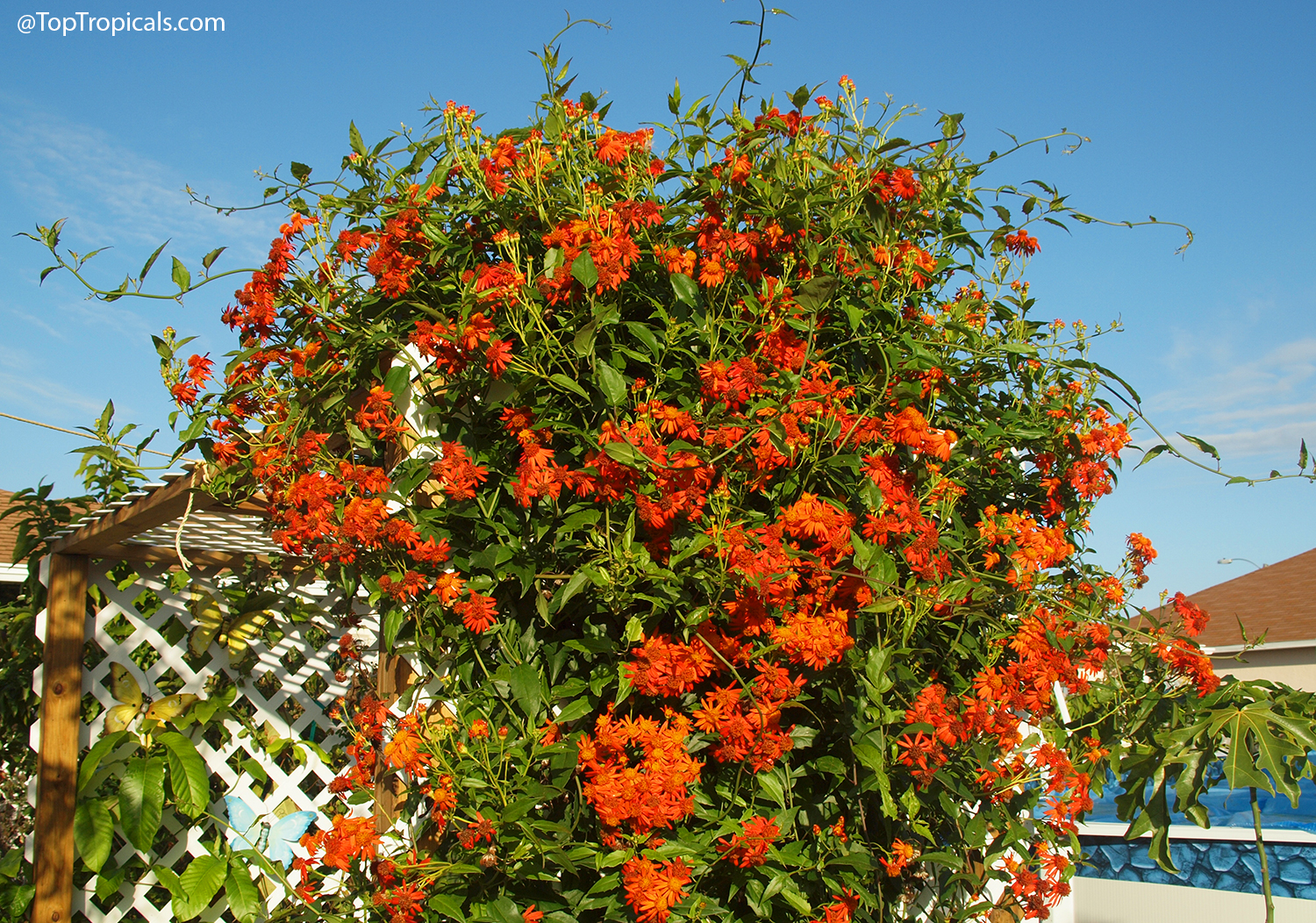
Mexican Flame Vine in full bloom - a fast-growing, drought-tolerant climber that quickly covers fences with vivid red flowers, attracting pollinators and adding bold color with minimal care.

Mexican Flame Vine Plant Facts

Botanical name: Pseudogynoxys chenopodioides, Senecio confusus
Also known as: Mexican Flame Vine, Orangeglow Vine
USDA Zone: 9 - 11
Highligths Groundcover and low-growing 2ft plantVine or creeper plantFull sunWater Requirement: Low. Allow soil to dry out between wateringsWatering: Moderate. Water when top soil feels dryYellow, orange flowersRed, crimson, vinous flowersInvasive plantPlant attracts butterflies, hummingbirdsSubtropical plant. Mature plant cold hardy at least to 30s F for a short timeFlood tolerant plantSeaside, salt tolerant plant
Get personalized tips for your region

🛒 Shop heat tolerant plants

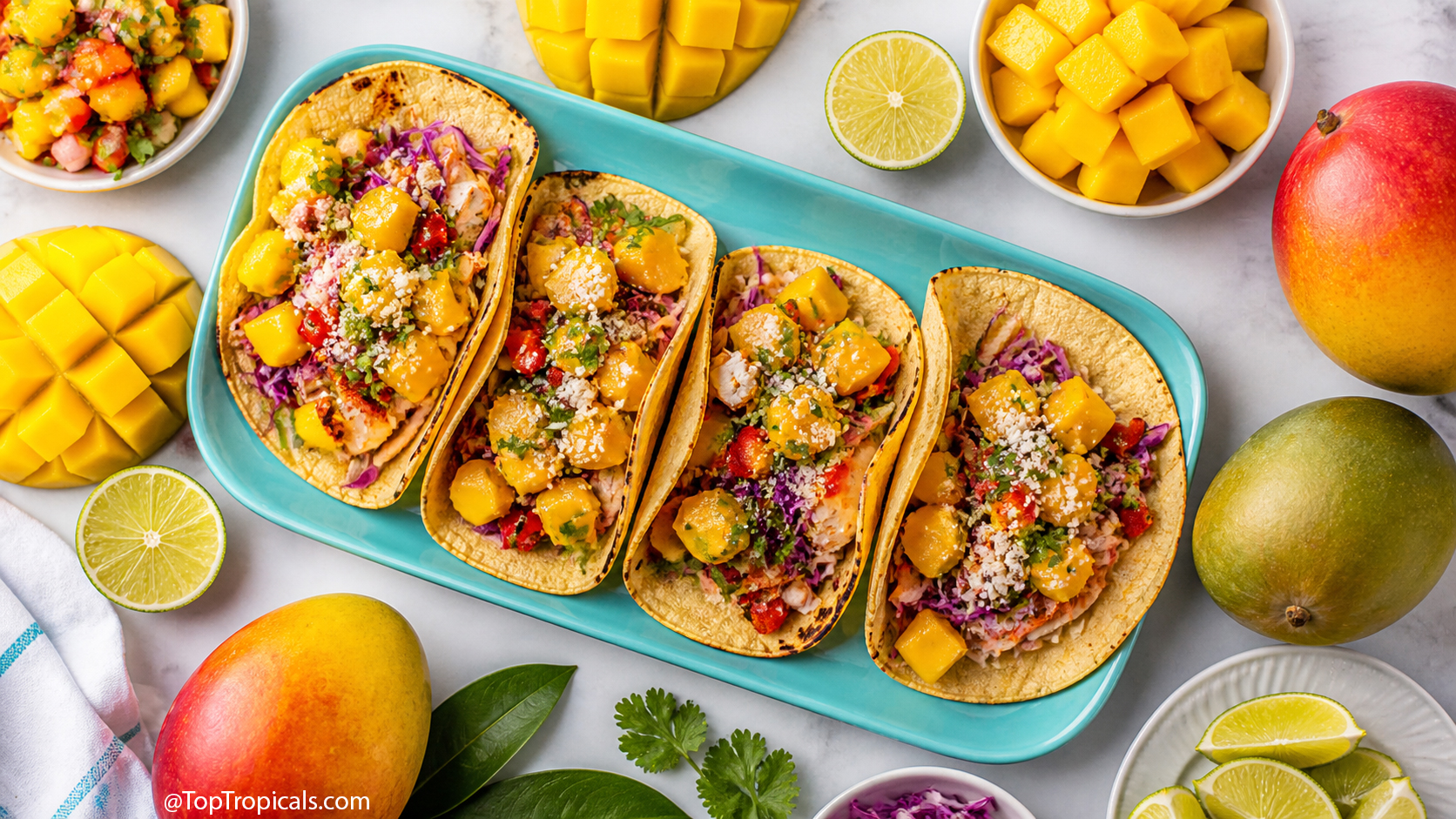
🌮 Sunshine’s Mango Taco 😺

Fresh  mango  tacos  loaded  with  juicy  chunks  and  bright  toppings, 
 surrounded  by  whole  and  sliced  mangoes  for  that  tropical  feel.

Mango Tacos

This is not cooking. This is assembly.

What you need

  • Tortillas
  • 1 ripe mango (diced)
  • Something warm (sweet potato, chicken, or leftovers)
  • A little onion (optional)
  • Lime (or bottled lime juice)
  • Sour cream or yogurt
  • Salt and pepper

How Sunshine does it

  1. Heat whatever you have in a pan
  2. Put mango in a bowl, add lime and a pinch of salt
  3. Mix sour cream with lime (this is your sauce)
  4. Put everything into a tortilla
  5. Enjoy with a margarita

Sunshine's rules

  • No measuring
  • No recipes
  • If it tastes good, it is correct

Want this to be normal?
Start with a mango tree. That is usually how it begins.

🛒 Plant your own mango tree

💌 Mother's Day is one week away

Still deciding? A gift card is the easiest option. With our bonus, it is also the best value.

Mother’s  Day  themed  Top  Tropicals  gift  certificate  with  a  pink 
 decorative  frame  filled  with  jasmine,  plumeria,  magnolia,  and  champaka 
 flowers,  tropical  fruits  across  the  center,  and  a  Happy  Mothers  Day  banner 
 at  the  top,  with  space  for  certificate  details  and  message.

Mother’s Day Top Tropicals gift certificate

🎁 Get a Gift Card