Garden Blog - Top Tropicals

Date: 24 Jun 2018

TopTropicals

SUNSHINE boosters for recovering plants after shipping

Q: I live in Garden City, NJ and have a sun room with a tropical plant collection that I keep at about 40-45 degrees in winter. I used Sunshine booster during winter for my plant collection and results were amazing! I haven't lost a single plant. Now I see you have more products and I am planning to purchase more plants, how should I use Sunshine boosters to help plants recover after shipping?

A: Spray SUNSHINE-E solution right after receiving a plant from shipping. It will boost up the plant and make it 50-60% stronger and easier to recover after shipping stress. After that, apply SUNSHINE-SuperFood microelement booster to provide everything necessary for the plant to grow vigorously and happily. SUNSHINE-E is indeed a wonderful plant stimulant and stress reliever, although it is not a "magic-cure-all" medicine where one can't find its active ingredient. The hormone (epibrassinolide) is well-known and used in different countries along with other hormones for promote growth, fruiting, blooming, rooting, etc. One of the most amazing properties of SUNSHINE is that it works in extremely low dozes. Only a few drops will be enough to make a solution in distilled water, to treat a large size plant. If you want to try it out, one 5 ml bottle will last for several applications. Large bottles of SUNSHINE 50 ml and 100 ml - great for small and big gardens. It is a good idea to start bi-weekly applications to improve your plants tolerance to Summer heat, drought and improve disease resistance. The formula works through plant metabolism within 2-4 days, repeat application not sooner than in one week. After application of SUNSHINE-E, don't forget to boost your plants with SUNSHINE-SuperFood .

Check out SUNSHINE boosters... We offer FREE shipping on them, so you can make your plants happy!

Date: 12 Dec 2021

Golden Sugar Apple and Jackedak Cheena
50% OFF and MORE!

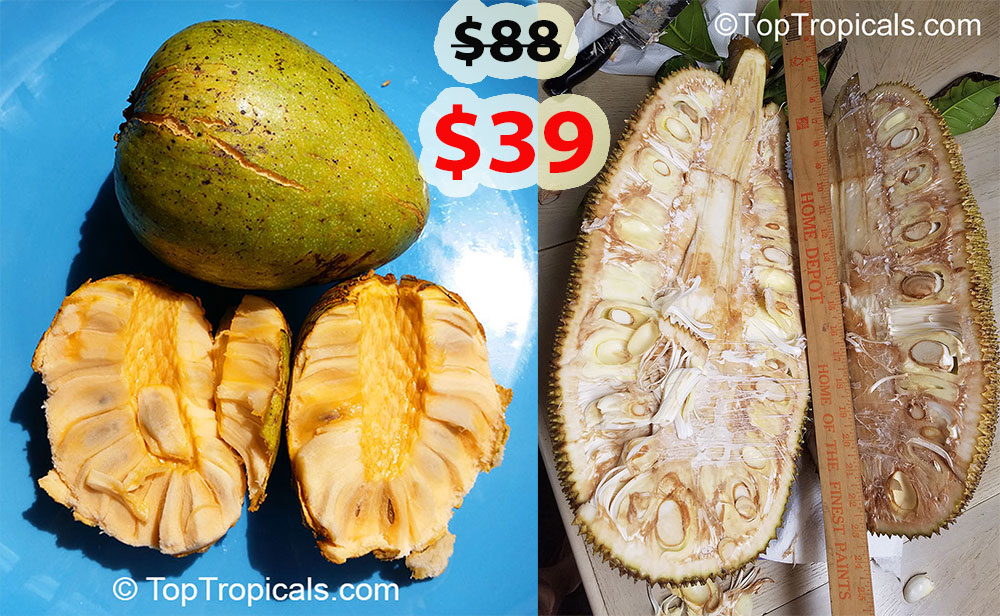
We've combined the exotic fruit of this rare Annona from Costa Rica - Golden Sugar Apple with the sweet, crunchy and excellent flavor of the Jackedak Cheena. Both rare and unique plants can be yours at considerable savings, but don't delay as there are limited quantities in stock.

Rare Fruit Collection:
two Jackfruit-textured rare fruit!

For this Easy Sunday we have priced these at incredible savings:
The Golden Sugar Apple regularly $39, is on Easy Sunday sale for only $19
The Jackedak Cheena, regularly $49, is on Easy Sunday Sale for only $24 .
Combine the two for your own Rare Fruit Collection and save even more, only $39 for the set!

Jackedak Cheena

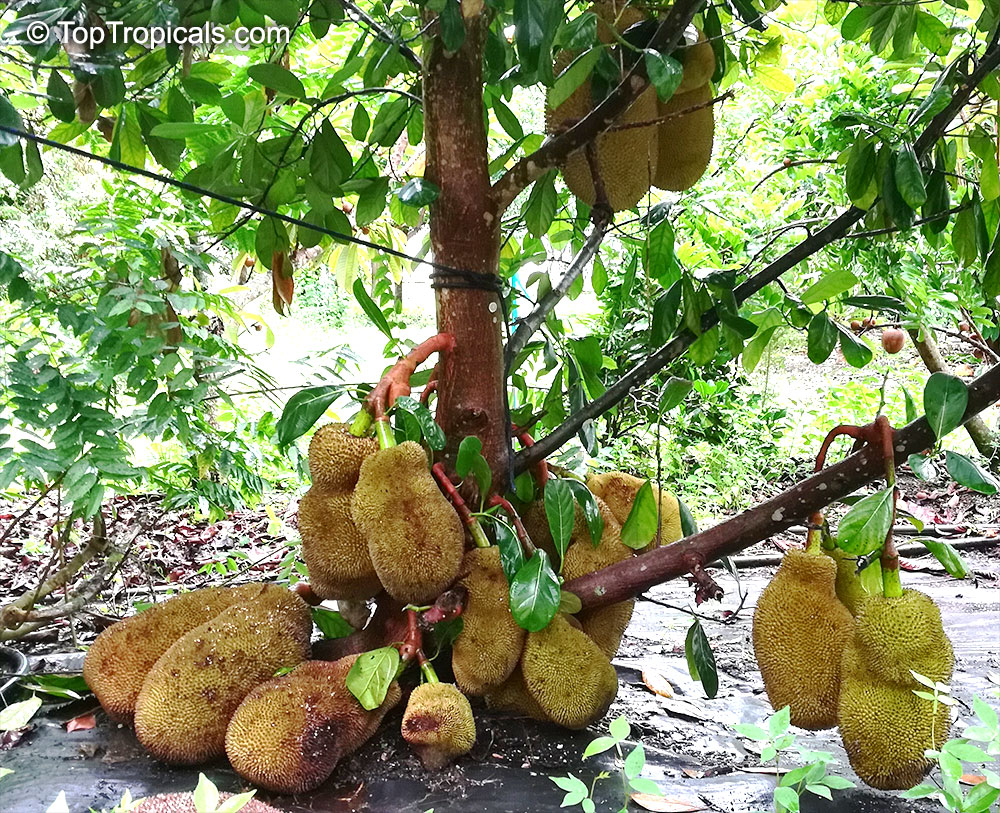
Artocarpus x integer (Jackfruit x Chempedak) - Jackedak Cheena has been grown in TopTropicals garden from a seedling and fruited within 3 years from planting. The fruit is the best we ever tasted! It is super sweet, crunchy, with a rich, excellent flavor, with very little latex which makes it easy to handle when cutting up. Our tree survived light frosts as well as 48 hours of 3 ft flooding, with no damage! Cheena is a natural hybrid between Jackfruit and Chempedak with low and spreading growth habit, can be maintained at 8 ft with annual pruning.

Picture of 3 y.o. Cheena at Top Tropicals garden, loaded with fruit:

Golden Sugar Apple

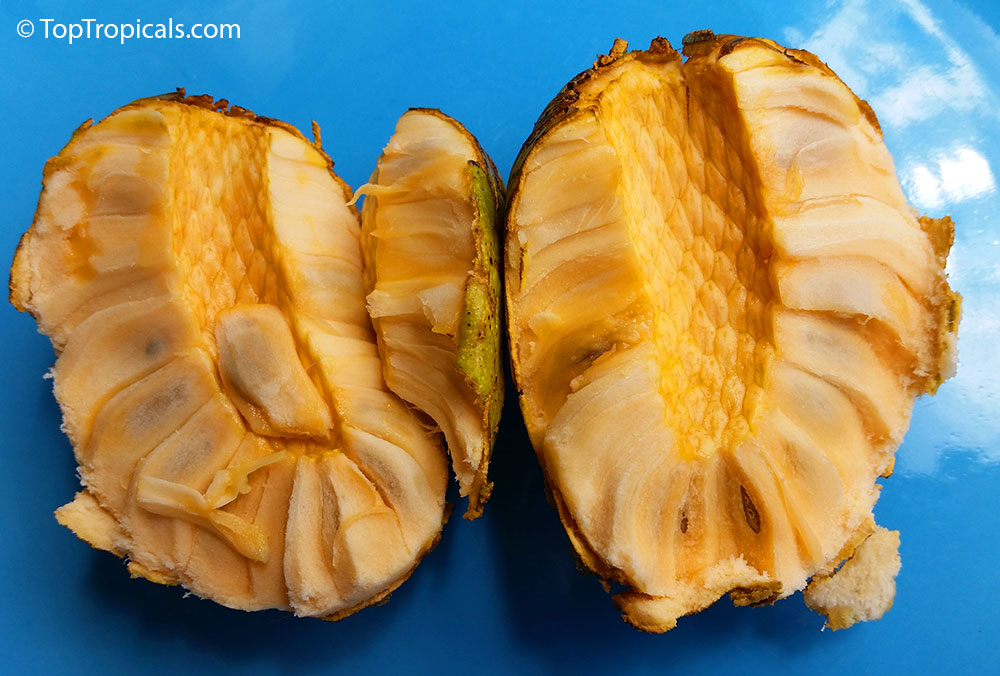
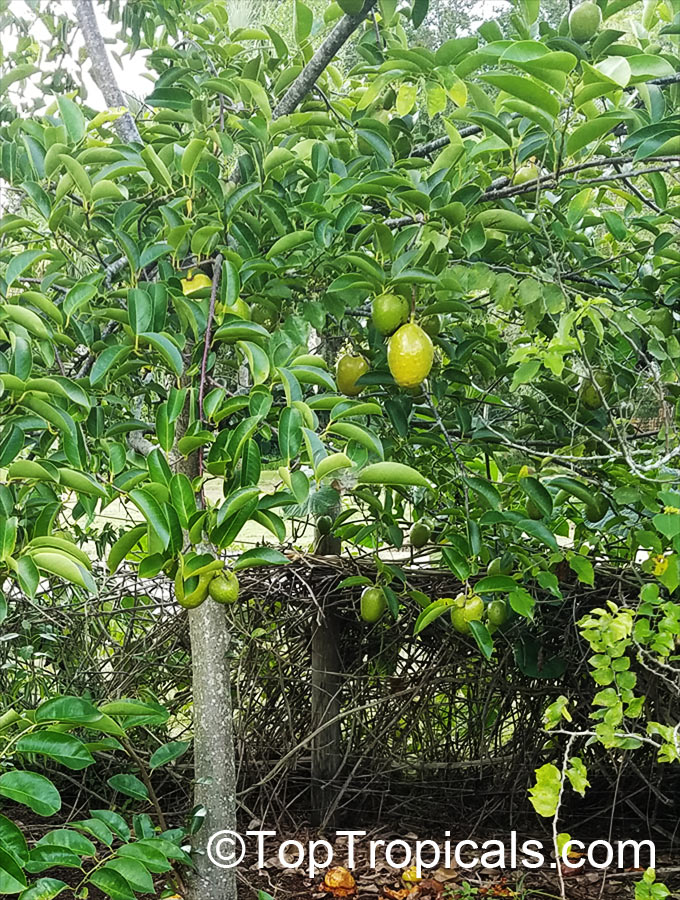
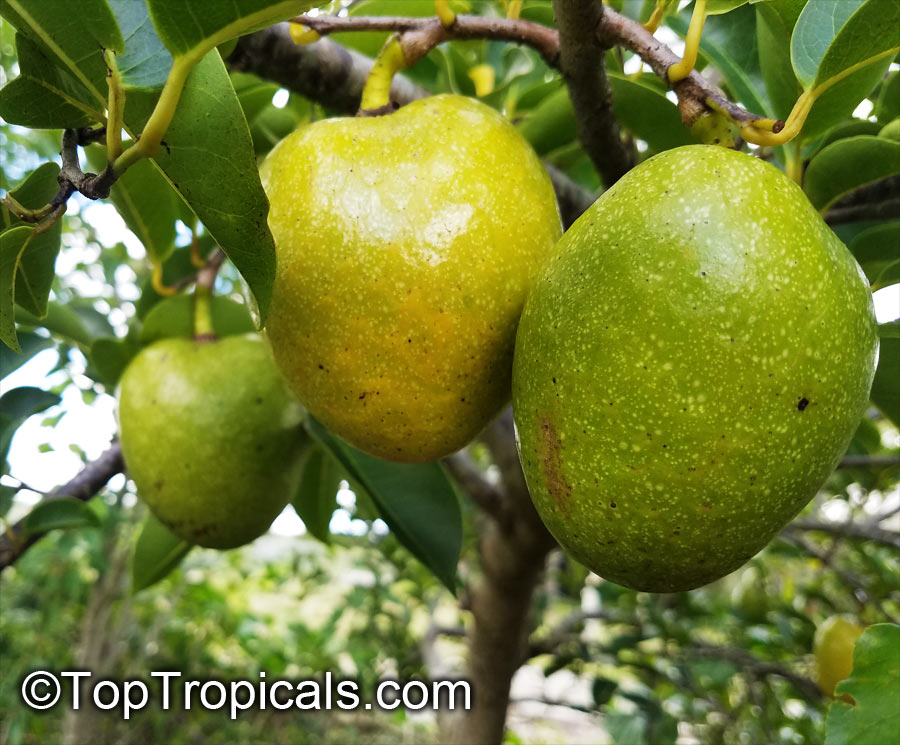
The Golden Sugar Apple or Pineapple Annona originally was brought to us by our customer from Costa Rica. We believe it to be a natural hybrid between A. muricata and A. glabra. It is a very ornamental small tree similar in growth habit to A. muricata, A. montana or Rollinia. Fast growing, forms nice bushy specimen. Fruit is very large, up to 1 lb, golden to orange when ripe, with strong Pineapple scent, and resembling Jackfruit in texture, with pineapple, papaya, apricot and melon overtones. The tree tolerates flooding and is cold hardy at least to upper 20's. Very interesting for rare fruit collectors as much more hardy and water tolerant alternative to its sensitive relatives Soursop and Rollinia.

Picture of 3 y.o. tree full of fruit:

Remember, the Easy Sunday special has been extended through Wednesday, December 15th. Limited availability, hurry up! All orders over $75 (excluding S&H) are eligible for 20% off!

For 20% off - use code YEAREND20

Min. order $75 (excluding S&H). Good through December 15th

Enjoy your Holiday Tropical Fruit!

Photo above: Jim is Holiday decorating with super-sweet tropical fruit balls - Pom-Poms!

Date: 13 May 2022

New Video:
Golden Sugar Apple - Pineapple Annona

In this video we talk about a rare hybrid of Annona - Golden Sugar Apple. This rare Annona is a species originally brought to us from Costa Rica. We believe it to be a natural hybrid between A. muricata and A. glabra...
Fast growing, it forms a nice bushy specimen. It has a large, up to 1 lb fruit, green when unripe, turning dark yellow to orange on ripening. The pulp is golden to orange when ripe, with a strong Pineapple scent, and resembling Jackfruit in texture. Flavor is like the custard apple but with pineapple, papaya, apricot and melon overtones. Note that some people dislike the taste, others find it good... The tree tolerates flooding. It is also cold hardy! The plant would be very interesting for rare fruit collectors as it offers a large, exotic fruit of unusual color and taste, and appears to be much more hardy and water tolerant than similar looking but sensitive A. muricata, A. montana and Rollinia.

Annona  -  Golden  Sugar  Apple  youtube  video

Subscribe to our Channel:

Stay updated with TopTropicals Videos by subscribing to our channel at YouTube.com/TopTropicals and get our latest video news of what is fruiting and blooming!

Date: 20 Oct 2025

11 tropical fruits to eat instead of taking a fiber supplement

Tropical fruits to eat instead of taking a fiber supplement

Tropical fruits to eat instead of taking a fiber supplement

🍑 11 tropical fruits to eat instead of taking a fiber supplement

  • When we think of tropical fruit, we picture sweetness, sunshine, and exotic flavors packed with vitamin C. But beneath all that juicy goodness lies another gift: dietary fiber - quietly working to support digestion, feed the gut microbiome, and help keep blood sugar steady.
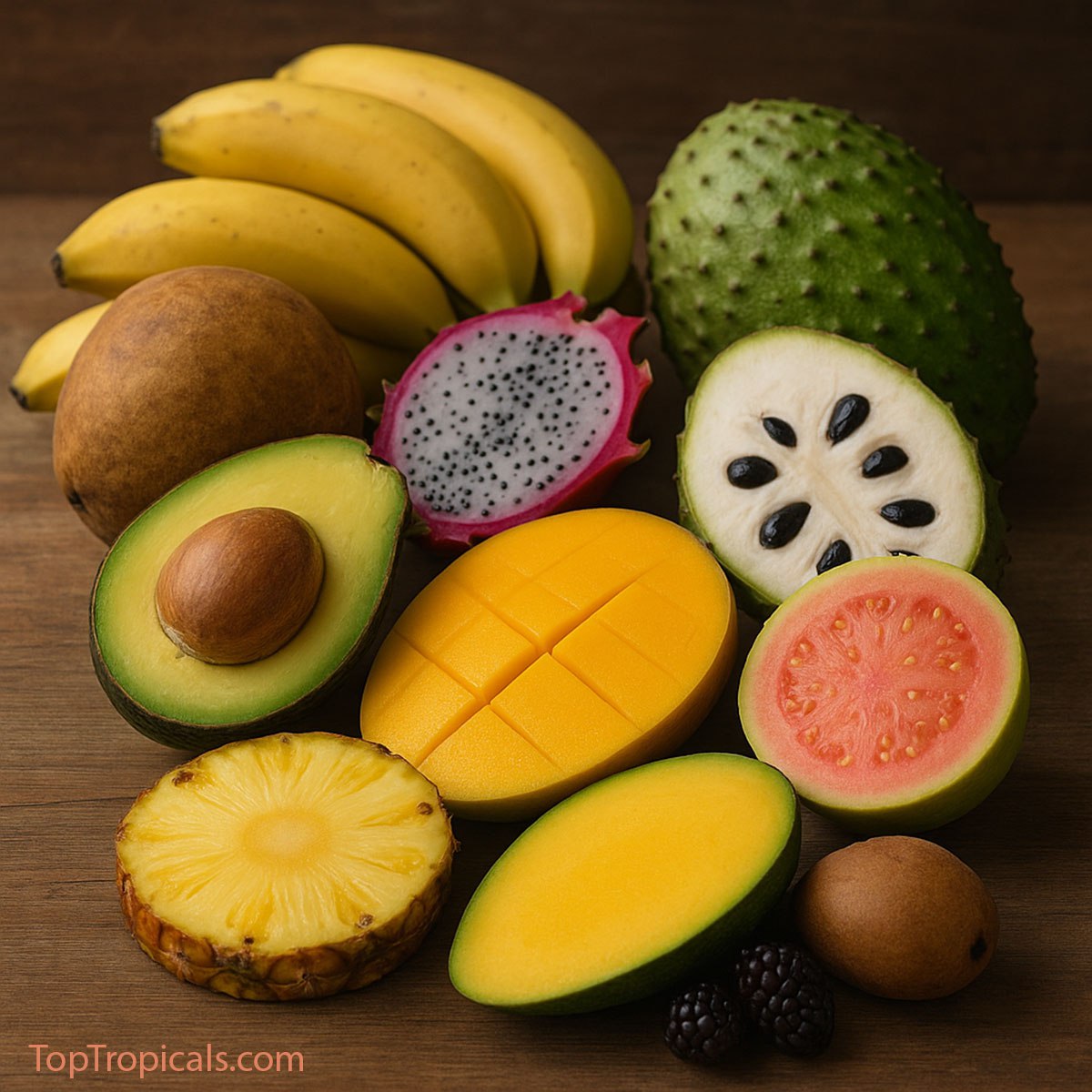
  • Avocado leads the pack among tropical fruits for fiber content. One creamy, ripe fruit can provide around 10 grams of fiber, roughly a third of an adult’s daily need. And there’s more to avocado than fiber - it’s also rich in healthy fats, micronutrients, and that silky texture everyone loves.
  • Other tropical fruits bring their own kind of fiber strength. Guava delivers up to 9 grams per cup, plus a burst of vitamin C.
  • Mango offers about 3 grams in half a fruit, especially when eaten with some of the skin.
  • Pineapple, though not always seen as a fiber powerhouse, still contributes around 2 grams per cup, along with bromelain, the enzyme that helps digestion.
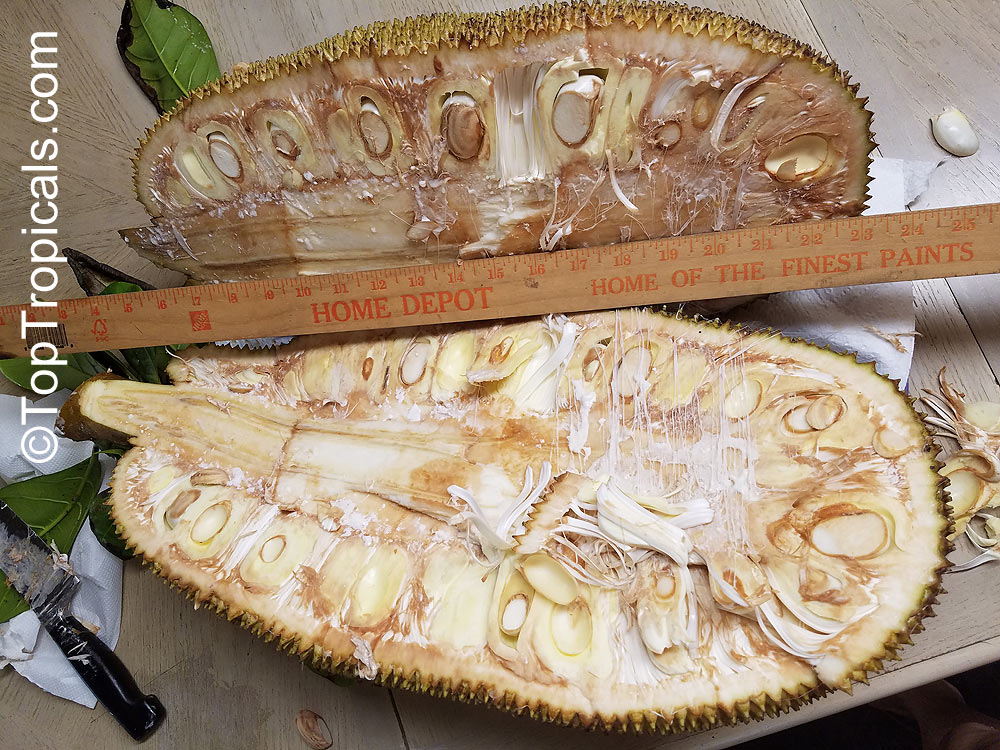
  • Jackfruit’s fibrous pulp makes it another standout - it’s so meaty, it’s even used as a plant-based substitute in savory dishes.
  • Sapote fruit (Mamey, Canistel) and Sapodilla add fiber with a smooth, custard-like texture.
  • Adventurous tropical varieties like Annona (custard apple, soursop) may not top the charts in fiber numbers, but their soft, fibrous flesh still adds value: about 1.3 grams of fiber per 100 grams of fruit.
  • Bananas contain both soluble and insoluble fiber; the soluble part (mainly pectin) helps control blood sugar and appetite, while the insoluble fiber aids regularity.
  • Mulberries are rich in insoluble fiber, especially in their skin, supporting digestion and promoting healthy bowel movements.
  • Dragon fruit offers a mix of soluble fiber in its juicy flesh and insoluble fiber from its tiny edible seeds, which help support gut health and feed good bacteria.

These fruits aren’t just delicious - they help you meet your daily fiber needs in ways that are far more enjoyable (and sustainable) than taking supplements. And when home gardeners, farmers, or tropical communities grow and share them, it’s a double win: nutrition and tradition hand in hand.

✔️ Tropical fiber power: tips for getting more fiber from tropical fruits

  • ⏺Eat whole, not juiced. Most of the fiber is in the pulp, skin, and seeds. Juicing removes much of that goodness.
  • ⏺Mix it up. Tropical fruits are great, but balance them with legumes, whole grains, nuts, and veggies for a full fiber range.
  • ⏺Take it slow. If your diet is low in fiber, increase gradually to avoid bloating or discomfort.
  • ⏺Drink plenty of water. Fiber works best when paired with hydration.
  • ⏺Mind the ripeness. Unripe fruits can have more resistant starch, another form of fiber.
  • ⏺Get creative. Toss tropical fruits into smoothies, salsas, breakfast bowls, or even desserts - a tasty stealth-fiber strategy.


🛒 Plant a fruit tree to harvest your fruit tomorrow

📚 Learn more:


Tropical fruit health benefits guide - what fruit and edibles can help with health issues and vitamin deficiencies, Part 1 and Part 2.

#Food_Forest #Remedies #Discover #How_to

🟢 Join 👉 TopTropicals

Date: 21 Oct 2025

Cassia vs Bauhinia: which is better as an everblooming container tree?

Cassia vs Bauhinia: which is better as an everblooming container tree?

🌈 Cassia vs Bauhinia: which is better as an everblooming container tree?
  • 🌸 Cassia (Senna) trees are very popular flowering trees - fast growing, free-flowering, relatively cold hardy, and they love the summer heat. Cassias come in several colors: yellow, orange, pink, red, and rainbow. Rainbow varieties (which are hybrids between yellow and pink cassias) are the most popular thanks to their multicolor blooms with swirls of yellow, pink, red, and orange. But while Rainbow Cassia is a spectacular flowering tree for southern gardens, is it a good choice for a container when you want color on your patio or pool deck?
  • 🌸 Some yellow-flowering cassias make attractive bushes that bloom most of the year and stay compact, so they can be grown as container specimens:
  • Cassia didymobotrya- Popcorn Cassia
    Senna alata - Empress Candles
    Cassia fistula - Golden Shower (a compact size winter blooming tree)
  • 🌸 When it comes to Rainbow or pink cassias such as Cassia javanica - Apple Blossom Tree or Cassia grandis- Red Cassia and other species and hybrids (Cassia marginata - Rainbow Shower Tree, Cassia roxburghii - Ceylon Senna, Cassia x nodosa - Pink Shower), these are usually more vigorous trees that may take several years to bloom. Their flowering season lasts from a few weeks to a couple of months. These trees grow moderately fast but typically need to reach about 10 feet before they start flowering.
  • 🌸 So, the answer is: if you want rich, deep color year-round from a container tree, go with Bauhinias - Orchid Trees. Most varieties grow well in pots, stay compact, and reach blooming maturity within just one season. The following varieties are everblooming and can produce flowers for up to 10 months of the year:

  • Bauhinia madagascariensis - Red Dwarf Orchid Tree. Blooms from winter through fall, up to 10 months a year. The most cold-hardy of all.
  • Bauhinia blakeana - Hong Kong Orchid Tree. A large tree in the ground, but compact in pots if trimmed. Grafted trees flower right away. Winter bloomer, cold hardy to light frost.
  • Bauhinia tomentosa - Yellow Orchid Tree. Flowers from Winter through Summer, cold hardy to light frost.
  • Bauhiniamonandra - Napoleon's Plume Orchid Tree. Almost everblooming with the longest flowering period (less cold hardy than the first three).
  • Bauhinia acuminata - Dwarf White Orchid Tree. Blooms from summer through winter (also less cold hardy than the first three).


🛒 Explore Cassia trees and Bauhinias (Orchid Trees)

📚 Learn more:


#Container_Garden #Trees #How_to

🟢 Join 👉 TopTropicals