Photo above:
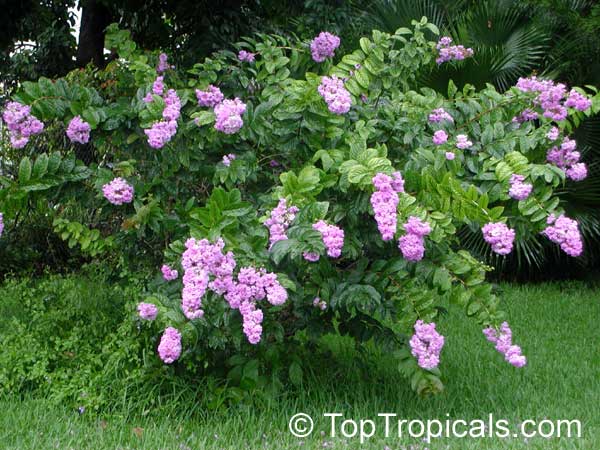
Lagerstroemia speciosa - Queen Crape Myrtle. Gorgeous flowering tree with
cascades of lilac flowers. One of the most popular trees in Southern
gardens.
Q: It's spring, finally! I can't wait to plant my
paradise garden with lots of tropical flowers. We moved into a nice new
house but the yard has nothing but grass. Where do I start?
A: When you start your garden from scratch, you
need to plant your trees first. It's a perfect timing!
Getting tropical
flowering trees now is really important for making your garden strong and
beautiful. Trees are like the bones of your garden, giving it shape and shade.
If you plant them in spring, they have enough time to grow strong roots
before winter. This helps them survive better.
Trees also give shade to other plants so they can grow well too. It's like
building a house - you need to start with the frame before adding other
parts. So, it's a good idea to get those trees now before moving on to shrubs and
vines.
Remember to provide regular fertilizing program which is the most important
during season of active growth. The more food your tree gets, the stronger
and faster it grows! For flowering trees, we recommend Sunshine Boosters Megaflor formula.
Photo above:
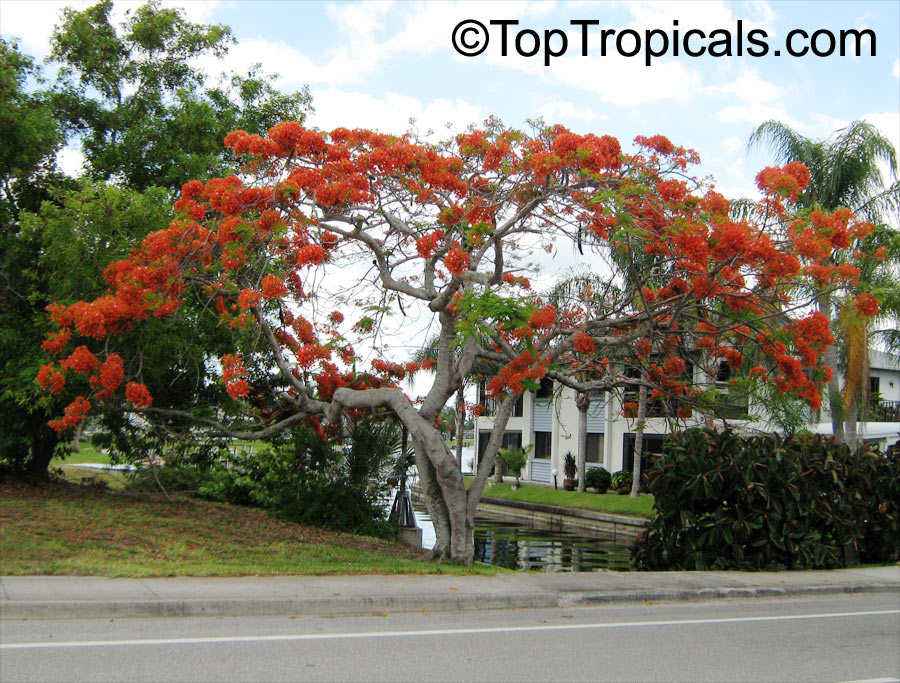
Royal poinciana, Flamboyant tree - Delonix regia."The Royal Poinciana
is one of the most spectacular flowering trees in the USA, and probably
among the top 10 on this planet. In full bloom, it is like a regal elephant
caparisoned in red and yellow brilliance."(Larry M. Schokman, The Kampong,
National Tropical Botanic Garden)
Date: 3 May 2026
3 Olive Trees Worth Planting in Your Yard Right Now
3 Olive Trees Worth Planting in Your Yard Right Now
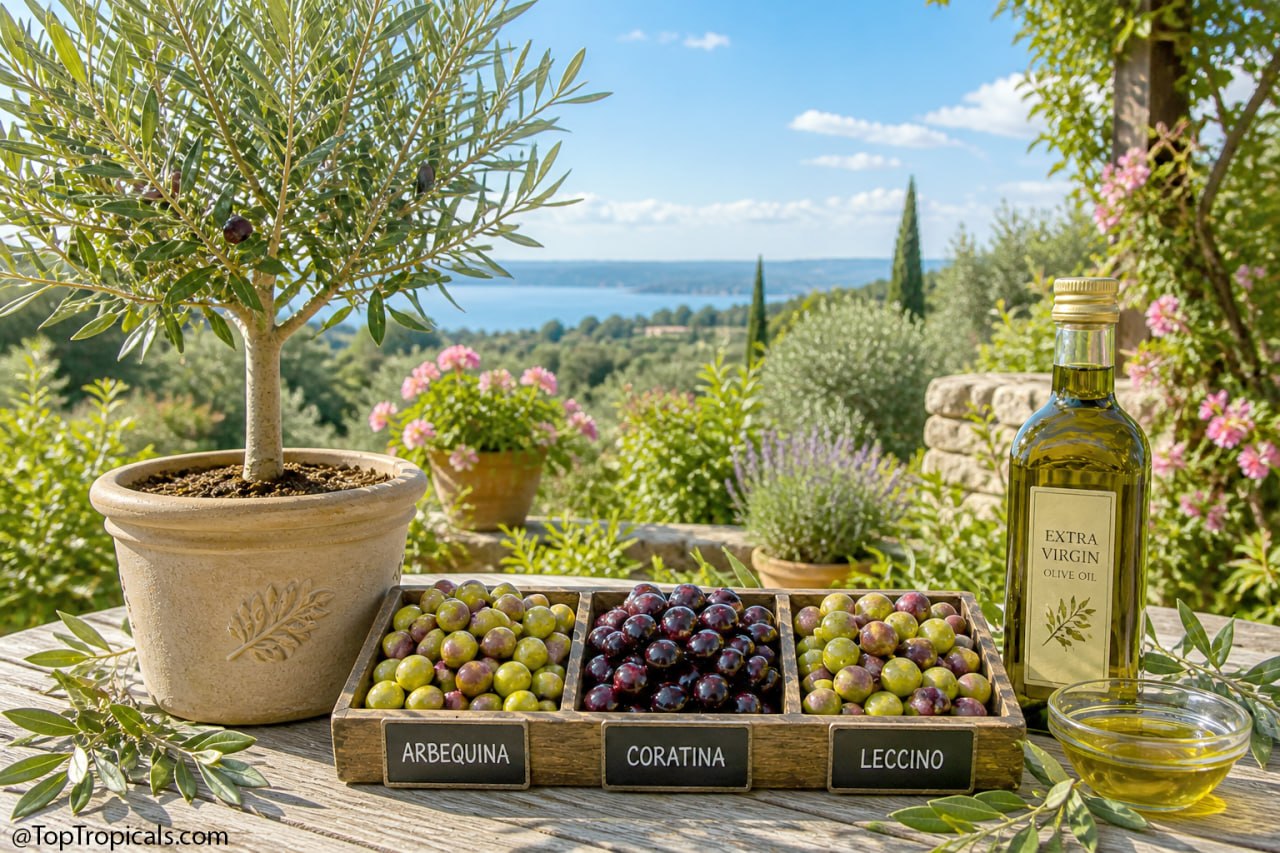
Olive trees aren’t just for the Mediterranean anymore. In warm parts of the U.S. - including much of Florida - certain varieties handle heat, humidity, and even occasional cold better than people expect. If you’ve been thinking about adding something useful, low-maintenance, and long-lived to your garden, olives deserve a spot on your list. Here are three varieties that actually make sense to grow.
1. Arbequina: Compact, Productive, and Beginner-Friendly
Arbequina is one of the easiest olives to grow, especially if space is limited. It is naturally compact, which makes it great for containers or small yards. It starts producing early compared to other olives, handles heat well, and adapts to different soils. The fruit is mild, buttery, and excellent for oil. If you want an olive tree that behaves well and produces without much fuss, this is the one. More...
2. Coratina: Bold Flavor and Strong Growth
Coratina is a completely different type of olive - vigorous, tough, and known for intense flavor. It is fast-growing and very hardy once established, and it produces heavily under the right conditions. The fruit is high in oil content with a flavor that is strong and peppery, making it prized for premium olive oil. This is a great choice if you want a more traditional, high-performance olive tree with character. More...
3. Leccino: Reliable and Cold-Tolerant
Leccino is known for consistency and is one of the most widely planted olives for a reason. It is more cold-tolerant than many other varieties and is a reliable producer year after year. It has a medium growth habit that is easy to manage, and the fruit works well for both oil and curing. If your area gets occasional cold snaps, Leccino is a safer bet. More...
Why olives make sense in your garden
Olives check a lot of boxes most fruit trees don’t. They are drought-tolerant once established and don’t need rich soil; average or even poor soil is fine. They are long-lived trees that can produce for decades and have low pest pressure compared to many tropical fruits. They’re not high-maintenance, and they don’t demand constant attention.
What to know before you plant
A few practical points make all the difference. Full sun is non-negotiable, and drainage matters because if water sits, the roots suffer. Light pruning keeps trees productive and manageable. Some varieties produce better with cross-pollination. In Florida conditions, airflow and avoiding overly wet soil are key.
If you want a tree that looks good, produces something useful, and doesn’t need babysitting, olives are hard to beat. Choose Arbequina for small spaces and ease, Coratina for strong growth and bold oil, or Leccino for reliability and cold tolerance. Plant one - or plant all three - and you’ll start to see why olive trees have been grown for thousands of years.
You always wanted an avocado tree. Not in Miami - right there in Central
Florida, in your own yard. You planted one, it grew well for a few years,
and it felt like you finally figured it out. Then 2026 hit. A few cold
nights, temperatures dropped below what your area usually sees, and the tree
was gone.
Avocado Plant Facts
Botanical name: Persea americana, Persea gratissima Also known as: Avocado, Alligator Pear, Aguacate, Abacate
USDA Zone: 9 - 11
Highligths
Here is the part most people miss: USDA zones are based on average minimums,
not the worst freezes. One bad night can erase years of growth.
That does not mean avocado will not work. It means you planted the wrong
variety. Cold hardy avocados are built for exactly this kind of
surprise.
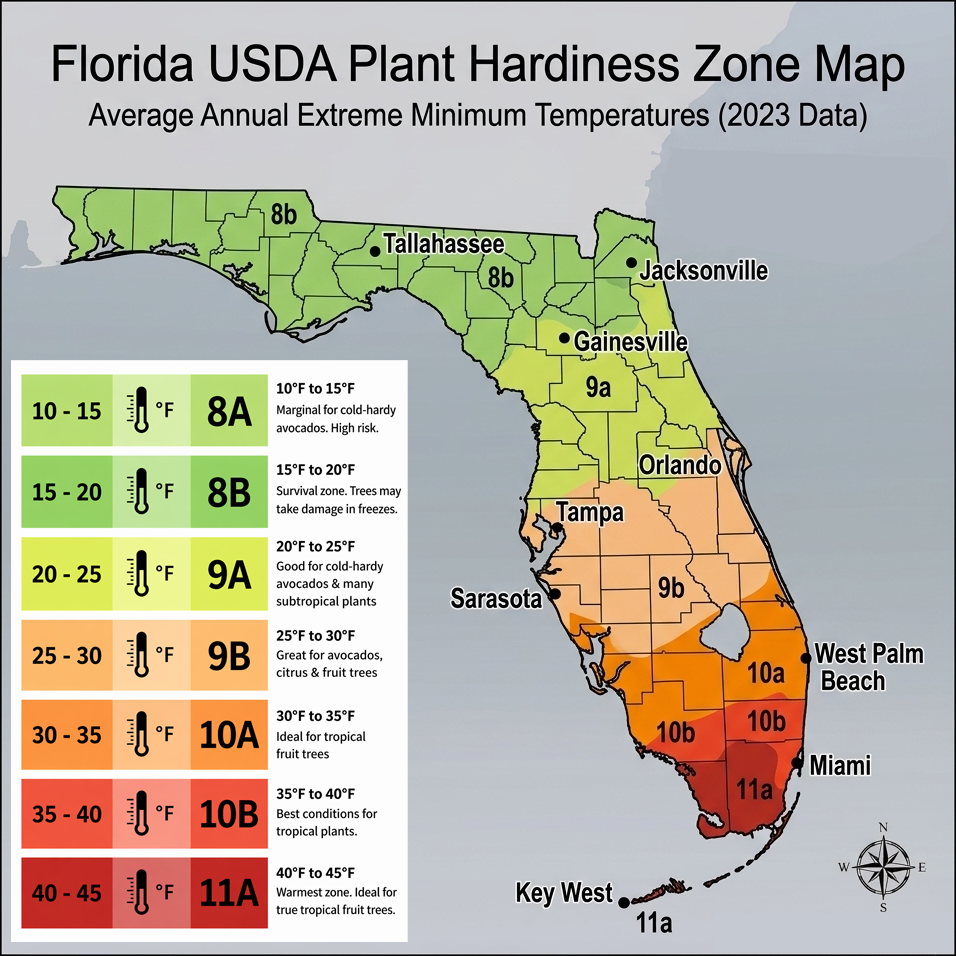
USDA zone map
This USDA Zone map makes one thing clear: all of Florida can grow
avocado. The question is not if - it is which variety. From North Florida
(8b) to South Florida (11a), there is always an option that fits your
conditions.
If you are outside Florida - in Texas, Louisiana, California, or anywhere
else - the same rule applies. Start with your USDA zone, then choose the
right type of avocado for it. You can check your local zone here
So what does this mean for your yard? It is not about trying again and
hoping for a warmer winter. It is about choosing a tree that actually
matches your zone.
Cold Hardy Avocado Varieties for Reliable
Harvests
Swipe left/right to see all data <->
🌡️ Threshold
🛡️ Resistance Profile
Primary Varieties & Type
Culinary Profile
📍 Geographic Best Fit
15°F+
High Resistance: Mexican-type selections. Short freezes
near 15°F are
survivable with minor leaf burn.
Microclimate matters more than your zone. The same yard can have warm and
cold pockets. Plant near a south-facing wall, under light
canopy, or in a spot protected from wind, and you gain a few critical
degrees on cold nights.
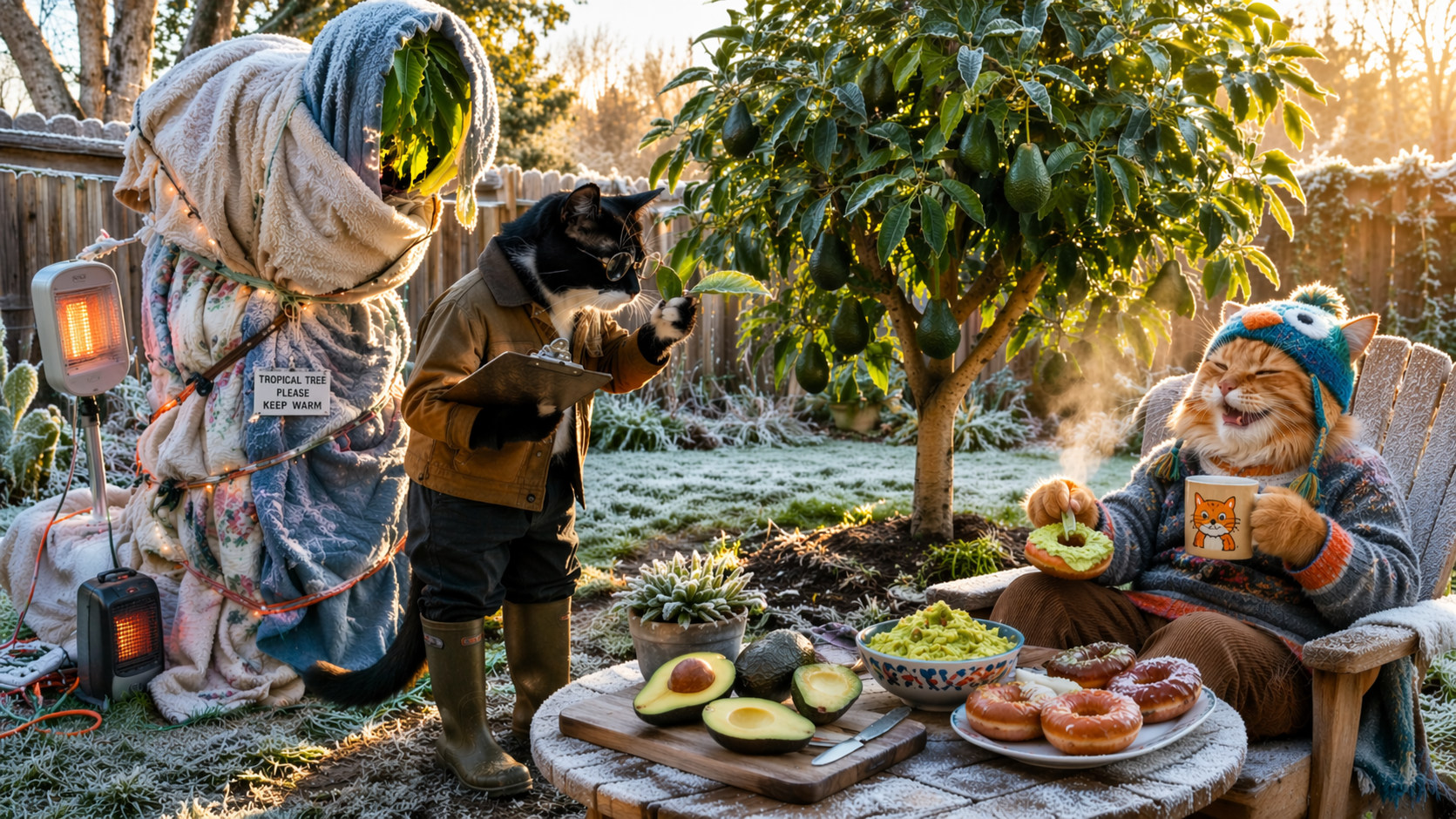
Young avocado trees need protection during their first winters. They have
not built enough wood or root strength yet, so even a short cold snap can
damage them. Simple steps like frost cloth, wind protection, or temporary
covers can make the difference between a setback and a
loss.
You may see avocados labeled as Type A or Type B. This refers to how the
flowers
open, not cold hardiness. Some people mix both types to improve pollination,
and while a single tree can still produce fruit, having two different types
is beneficial and can increase your harvest.
Practical Planting Advice
Plant on a mound
Raise the root zone 4-8 inches for fast drainage.
Avoid low spots
Standing water is worse than drought for avocados.
Full sun
Maximum light = stronger growth and better recovery.
Use microclimate
South-facing wall, light canopy, or wind protection adds critical
warmth.
Do not overwater
Let the top layer dry slightly between watering.
Protect first winter
Cover young trees during cold nights.
✅ Stop Guessing. Plant What Works.
Cold hardy avocados are not theory - they are proven to handle real
conditions. Choose the right variety for your zone, plant it correctly, and
you stop replacing trees after every cold snap.
Get
10% off when you buy 2 or more 3 gal avocado trees. Mix
varieties, combine Type A and Type B, and set yourself up for better
pollination and bigger harvests.
Offer valid through 04/15/2026. No code needed - discount
applied automatically at checkout.
Discount
applies to 3 gal avocado plants only. Not valid on previous purchases and
cannot be combined with other promotions or discounts. Offer subject to
change without notice.
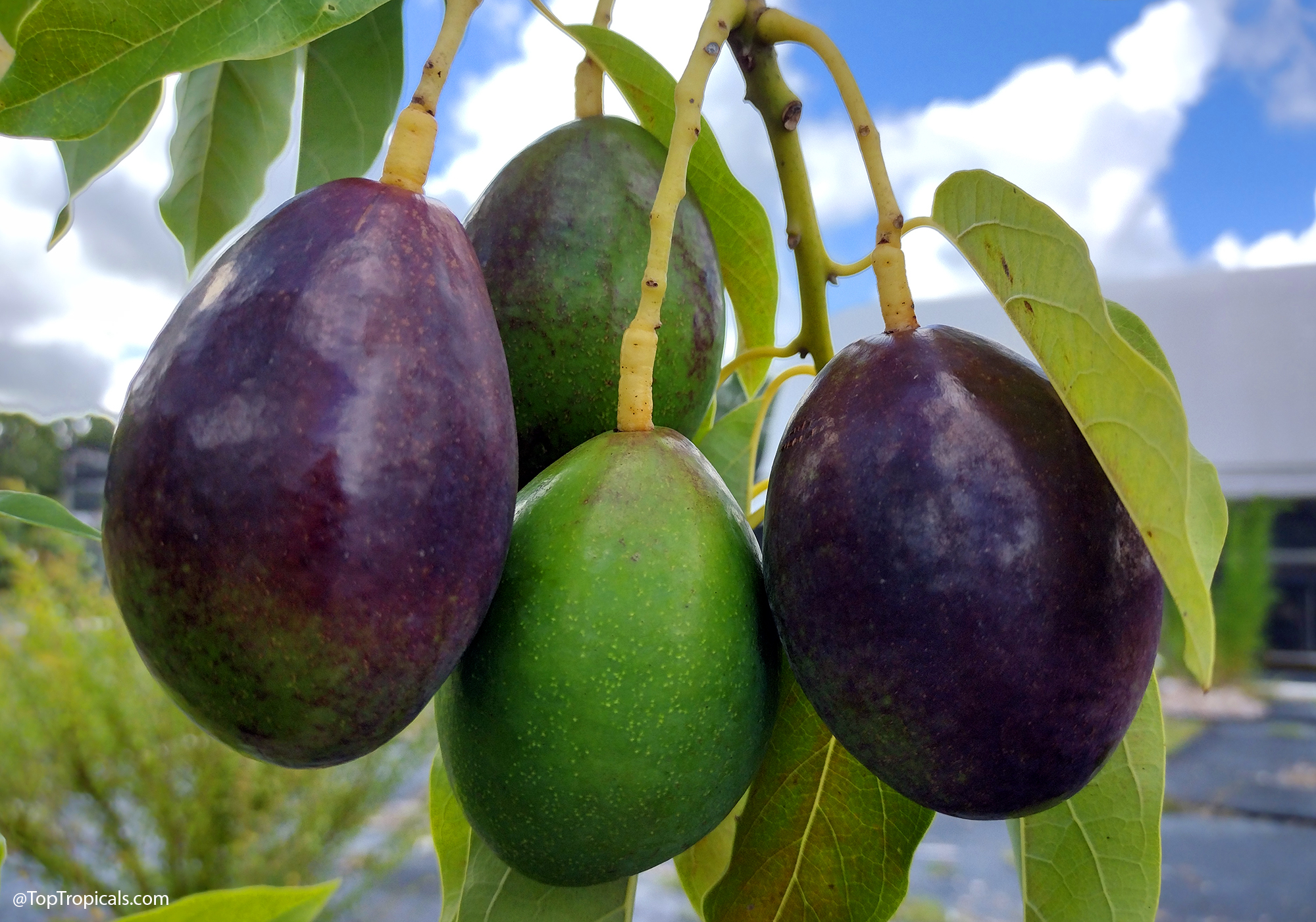
Joey is one of the most cold hardy Avocado trees with
a compact habit and very pretty fruit. The flesh is nutty, smooth, and
mildly sweet.
Date: 2 Apr 2026
Stop Fixing Your Soil: 15 Bulletproof Fruit Trees for Tough Ground
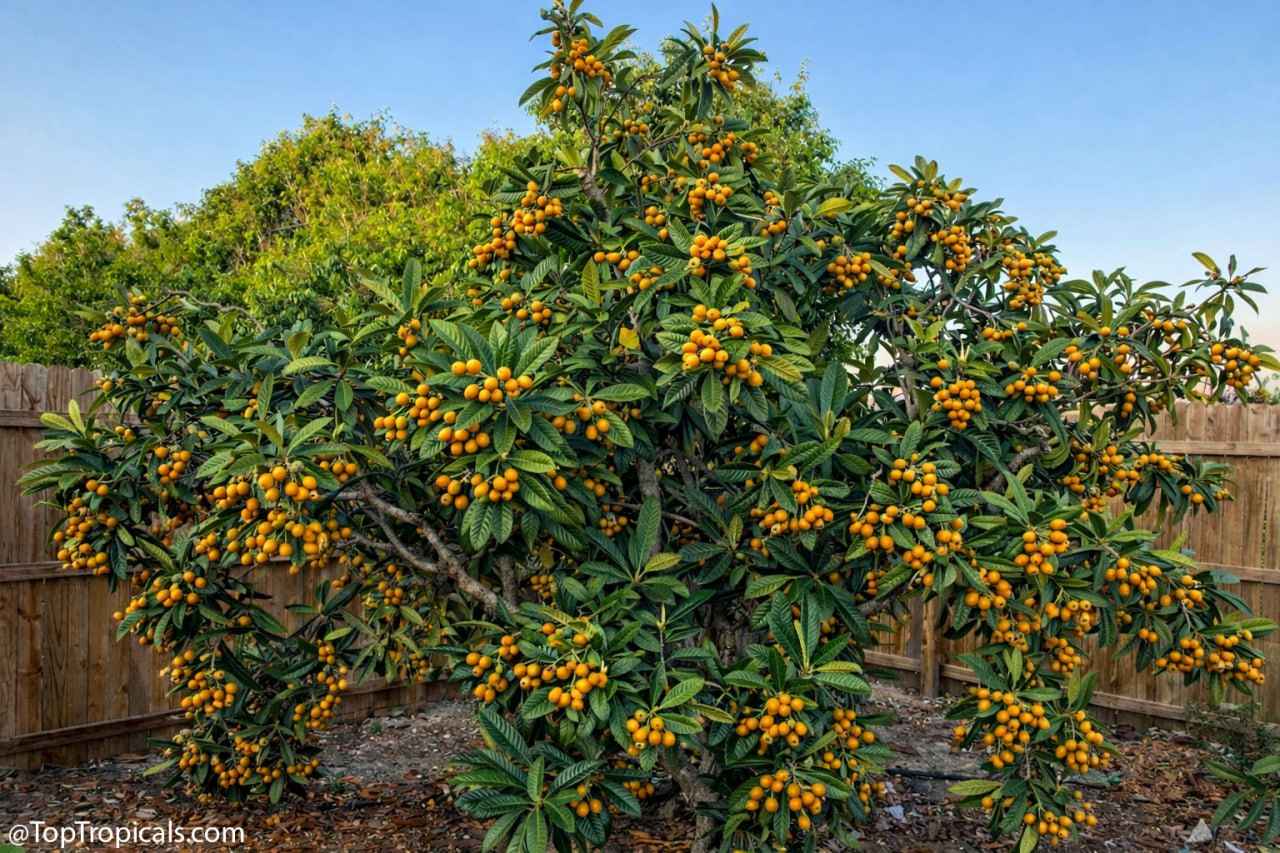
Loquat (Eriobotrya japonica) fruiting
Stop Fixing Your Soil: 15 "Bulletproof" Fruit Trees for Tough Ground 💩
Not everyone starts with a lush, loamy paradise. In many parts of Florida and the South, "soil" is just a polite word for sand, limestone rock, or depleted clay.
The biggest mistake new gardeners make? Spending hundreds of dollars on soil amendments before they ever put a tree in the ground.
The secret the pros know: You don't need to change your land to fit your plants; you need to choose plants that love your land. Some of the most delicious fruits actually thrive on neglect - and a few even produce better fruit when the soil is "poor."
🌳 The "Big 5" Toughest Fruit Trees
If your yard is a dry, sandy lot or a rocky outcrop, start with these. They are the ultimate "survivors."
Jujube, Chinese Date (Ziziphus jujuba): Arguably the toughest fruit tree on earth. It laughs at drought, poor soil, and neglect. The fruit is crisp like an apple when fresh and sweet like a date when dried.
Loquat (Eriobotrya japonica): A Southern staple. It’s evergreen, beautiful, and produces honey-sweet fruit in early spring when nothing else is ripe.
Mulberry (Morus alba): If you can’t grow a Mulberry, you might be gardening on the moon. It grows in sand, clay, or sidewalk cracks with equal enthusiasm.
Fig (Ficus carica): Figs actually prefer not to be pampered. In overly rich soil, they grow lots of leaves but little fruit. Give them well-drained, mediocre soil and they’ll thrive.
Pomegranate (Punica granatum): These trees are "stress-lovers." Rocky, alkaline soil is no problem, and a bit of soil stress often results in a higher sugar content in the fruit.
Pomegranate Plant Facts
Botanical name: Punica granatum Also known as: Pomegranate, Granada, Grenade, Pomegranate, Granada, Anar, Granaatappel, Pomo Granato, Romeira, Melo Grano
USDA Zone: 8 - 11
Highligths
🌳 Tropical Flavors That Don't Need "Perfect" Dirt
You don’t need a rainforest to grow tropical treats. These species are surprisingly resilient once they get their roots established.
🌟 The Sand-Lovers:
Mango (Mangifera indica): While young trees need a little babying, a mature Mango is incredibly drought-tolerant and handles Florida’s sandy "sugar sand" like a champ.
Mango Plant Facts
Botanical name: Mangifera indica Also known as: Mango
USDA Zone: 9 - 11
Highligths
Sapodilla (Manilkara sapota): A rugged, wind-resistant tree that produces fruit tasting like brown sugar and pear. It is a top-tier choice for coastal or sandy areas.
Tamarind (Tamarindus indica): It’s slow-growing but patient. Once it’s in, it’s there for a century, regardless of soil quality.
🌟 The Low-Maintenance Stars
Longan (Euphoria longana): If you’ve struggled with finicky Lychee trees, try Longan. It’s more cold-hardy and much less picky about its soil.
Citrus: While they need regular feeding (fertilizer), Citrus trees are naturally adapted to the sandy ridges of the South.
🌟 The "Quick-Win" Berry & Shrub Layer
If you want fruit this year, don’t wait for a tree to mature. Add these hardy producers to your edges. And here is why it works:
Dragon Fruit (Hylocereus undatus). It’s a cactus! It literally prefers poor, fast-draining soil over rich potting mixes.
Barbados Cherry (Malpighia glabra). A vitamin C powerhouse that handles low-nutrient soil with ease.
Grumichama (Eugenia brasiliensis). Slower grower, but steady and tolerant once established.
Surinam Cherry (Eugenia uniflora). Virtually indestructible. Often used as a hedge because it grows so vigorously in poor soil.
Pineapple Guava (Feijoa sellowiana). A beautiful silver-leafed shrub that is salt-tolerant and drought-resistant.
🌳 The Strategy: "Plant First, Improve Later"
In the South, the "dig a $100 hole for a $10 tree" rule doesn't always apply. Trying to completely re-engineer your soil often leads to drainage issues (the "bathtub effect").
Try this instead:
1. Select a species naturally adapted to your pH and texture.
2. Plant it at the correct height (never too deep!).
3. Mulch heavily with wood chips. This improves the soil from the top down over time, mimicking a natural forest floor.
📅 Do Not Miss: March 21
- Spring Equinox Plant Market
🍩 Saturday, March 21, 2026: 9 am - 4 pm
Sunshine: Smokey, look at me! See what I can do on my bike? I'm
practicing to give people what they like: coffee and donuts.
Smokey: You'd be perfect for a Gulf beach cafe. But gardeners don't
come here for donuts.
Sunshine: Really? Then why do they come?
Smokey: Some gardeners lost plants to the freeze. Others want trees
that will handle winter better. Cold-hardy avocados. Macadamia. Grumichama.
And some just come for fun - to see the PeopleCats. Sunshine: And my charm... and my donuts will make it more fun.
🐱King is
back on gate duty - inspecting every vehicle for proper
plant-hauling capacity.
😺Paisley
is rearranging freeze survivors and new arrivals like a design
consultant.
😼Snitch is
supervising recovery efforts from a comfortable chair.
😸Persephone
is checking under tables for "hidden spring energy."
😻Sushi and
Loki are
preparing for guided garden tours - recovery edition.
This is not just a plant market. This is the spring reset.
👍 Why You Should Come
It is finally warm in Florida. After several nights of hard freeze, some
plants survived - and some didn’t. This event is your chance to see
real freeze champions in person.
If you lost plants, you are not alone. If you are ready to plant
smarter, this is your moment.
Walk the gardens.
See proven winter survivors.
Discover cold-hardy fruit trees and resilient ornamentals.
Get practical advice about replanting after freeze. This is rebuilding -
Florida style.
♥️ What Makes This Event Special
We are featuring:
Verified freeze survivors
Cold-hardy fruit trees
Tough flowering trees and shrubs
Replacement plants for damaged landscapes
Smart layering ideas for frost-resilient gardens
You will see which species handled 25F with wind and multiple nights of
freeze - with no protection.
Real-world test. Real results.
Cold hardy fruit favorites include:
Cold-hardy Avocado varieties, including varieties, which are cold hardy
to 15-20°F: Joey, Fantastic, Mexicola, Poncho, Brogdon and more.
Botanical name: Caesalpinia mexicana Also known as: Mexican Bird of Paradise, Dwarf Poinciana
USDA Zone: 9 - 11
Highligths
🎉Event Highlights
30% OFF online prices
FREE plants with purchase
$5-10 specials
Exciting raffle prizes
🌳Don't just mow - grow!
Start your food forest, beat rising prices, and plant a future your
family will thank you for.
🌿 Friendly Reminder
Just a quick reminder before we go: Sunshine Boosters are still
shipping free.
If you were thinking about stocking up for the season, now is a
great time to do it while the offer is still active.




 Practical Planting Advice