Garden Blog - Top Tropicals

Date: 24 Aug 2019

How to keep iguanas away?
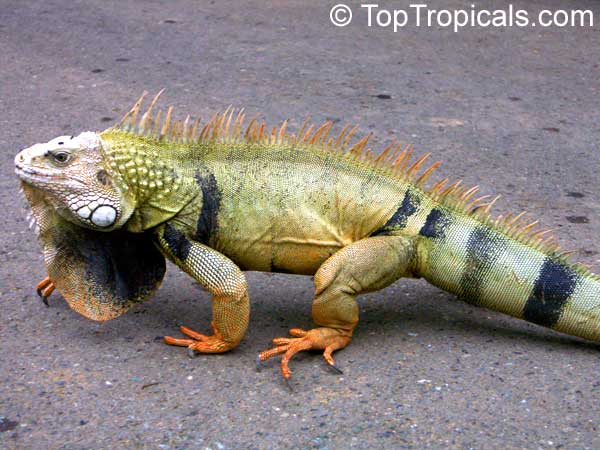
Q: Really enjoy all the plants that I have got from you, but having a hard time keeping iguanas eating everything! We are not on the water, any solution to keep them out?

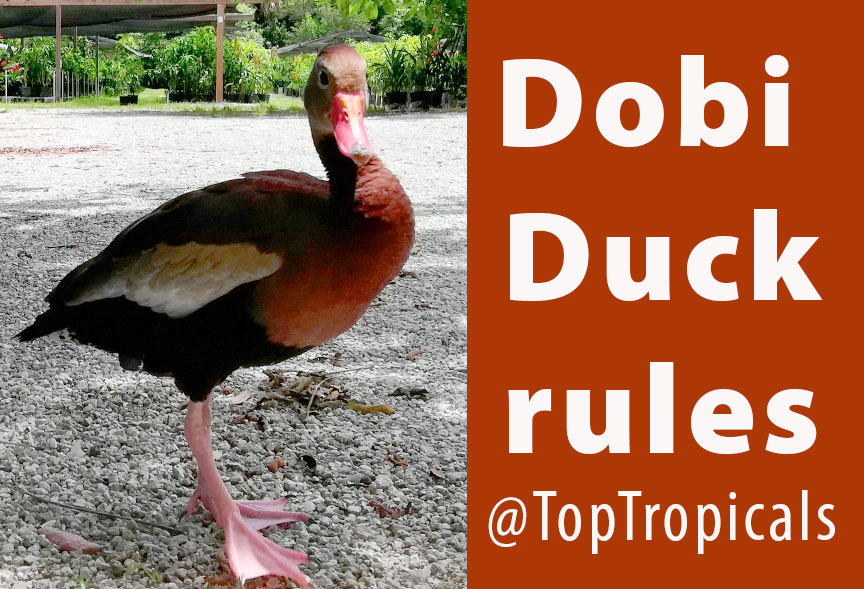
A: Iguanas may become quite a problem in the garden. Our first suggestion would be - get a Duck as we have (Duck Dobi), she is so dominant and keeps any wild animals away from the property, including gators... and cats! They are scared of her! Dobi thinks she owns the place.

Here are a few other ways to control iguana problem in your backyard:

1. Rid your lawn of dropped fruits. Iguanas love fruit. And they love low-hanging fruit or fruit that's easy to get to. If you have fruit trees, take the time to pick up your yard and dispose of any dropped fruit.
2. Keep a lid on a garbage can. Put your garbage cans in a place they can't get to, or put a cinder block on your can lid.
3. Do not leave pet food out. If you're putting a bowl of dog food or a plate of cat food out for your pets, you're inviting iguanas into your yard.
4. Fill iguana holes. Iguanas like to dig. Wherever you see a hole, fill it. Stuff rocks into the hole first, then fill it with dirt and top it with sod. The iguana may return to dig again, but he won't dig through large rocks.
5 Do NOT feed the iguanas. Don't be friendly with them, so they won't come back.
6. Wire netting around plants. You can use wire netting or screens to prevent iguanas from entering plants and shrubs.
7. Spray them with a hose. When you see an iguana in the yard, spray them with the hose. They also hate loud noises. Constant harassment can keep them from returning.
8. Keep your yard clean. Excessive overgrowth or yard storage are great places for iguanas to hide.
9. Do not leave food out, unattended. Iguanas are mainly herbivores but that doesn't mean they won't smell something good and want to eat it. They will TRY anything.

Hopefully these tips help keep your iguana problems to a minimum.
Date: 14 Jul 2019

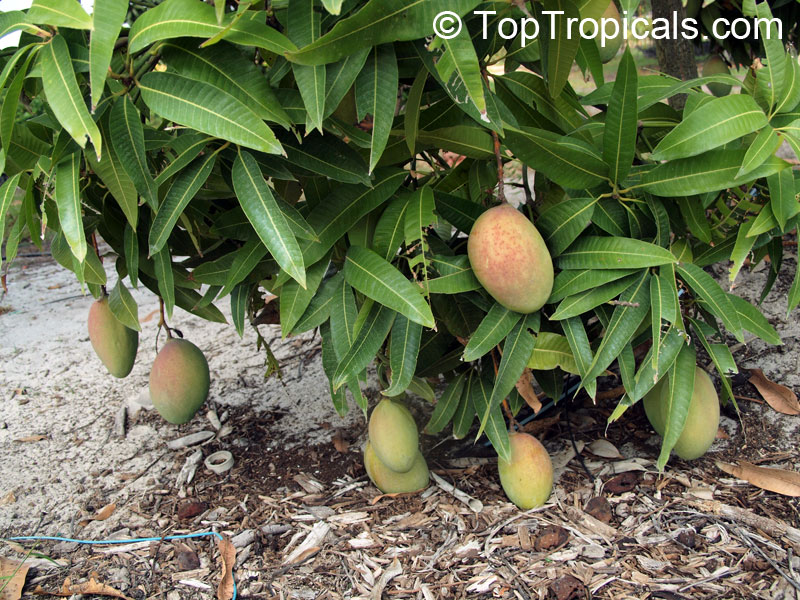
Dwarf and Condo mangoes - easy mangoes

Q: We leave in zone 6a, could you tell us what is the list of different types of mango plants that could be planted indoor and that they can bear fruits?

A:There is a large group of mangoes called "Condo Mango" - they literally can be grown in your apartment! Those are dwarf varieties that can remain compact in containers with minimal pruning and successfully bear fruit providing bright light and proper care, including plant food.

The best dwarf and semi-dwarf varieties are: Carrie, Cogshall, Cushman, Fairchild, Graham, Ice Cream, Julie, Mallika, Nam Doc Mai, Pickering, Irwin, Jahangir, Juliette, Lancetilla, Little Gem, Manilita, Sia Tong, Torbert, Pim Seng Mun, Super Julie.

They produce juicy, fiberless sweet fruit. Julie is also a very popular dwarf variety, however, it is very cold sensitive and not the easiest to grow. If you get a 3 gal size mango, step it up to 7 gal when the plant reaches 4 ft; you may use a bigger container as the root system grows, up to 15 gal or even 25 gal, space permitting. Trim the tree under 6-8 ft after production season is over (summer-fall).

See more information on growing condo mangoes

RECOMMENDED FERTILIZERS:

Mango-Food - Smart Release Fruit Tree Booster
Fruit Festival Plant Food - Super Crop Booster
For sweeter fruit, use SUNSHINE-Honey - sugar booster

Date: 17 Apr 2019

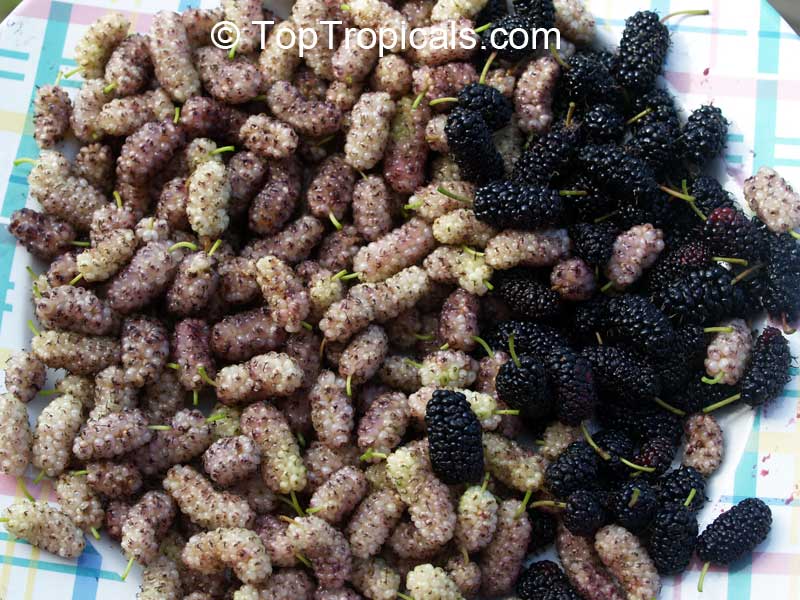
Mulberries - biggest, sweetest, and compact...

TopTropicals.com

Q: What is the difference between Pakistani and Australian Mulberry plants? Would one be better suited for South Florida backyard? Can one be maintained/pruned to be a tall shrub vs a large tree? Which one has the sweetest fruit? Thank you for the previous plants we've purchased from you. They're all doing great.!

A: These two varieties are very similar indeed. Both fruit are very large. Var. Pakistani fruit is a little longer than var. Australia and the tree is a more vigorous grower, but they both are very sweet, even before the fruit fully ripen. Both trees are a good choice and start fruiting at a young age.
We've had Australia in the ground in our garden for 4 years by now and for some reason, it has been very slow growing which is normally not the case with Mulberries. Maybe it is not fully happy with FL humid conditions.
There are two Mulberry varieties that can be maintained as bushes: Issai and Dwarf Everbearing. However, even vigorous Mulberry trees respond well to pruning and can be kept compact for easy harvesting. Just make sure to prune before the flowering season starts; here in S Florida Mulberries start flowering in March, and fruit start ripening during April-May.

Check out our Mulberry trees.

Date: 28 Mar 2019

Hawaiian Dwarf is a True Star!

TopTropicals.com

By Mark Hooten, the Garden Doc

Q: I live in Southern Ohio and love growing lots of tropical plants. In the warm months, they all go outside under the protection of tall trees, but in the cold months, they all come inside in a snug but very brightly lit sun-room. For many years I have successfully kept a dwarf Meyer's lemon which amazes my friends, and I am wondering if you could suggest some other dwarf tropical fruit tree which I might be able to grow that would amaze them even more?

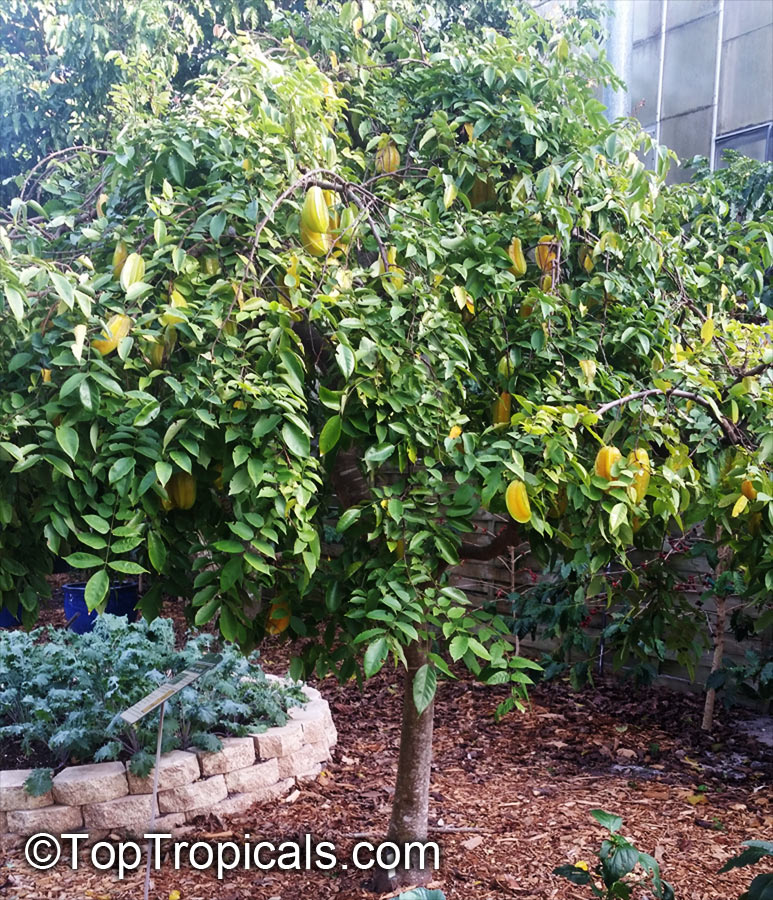
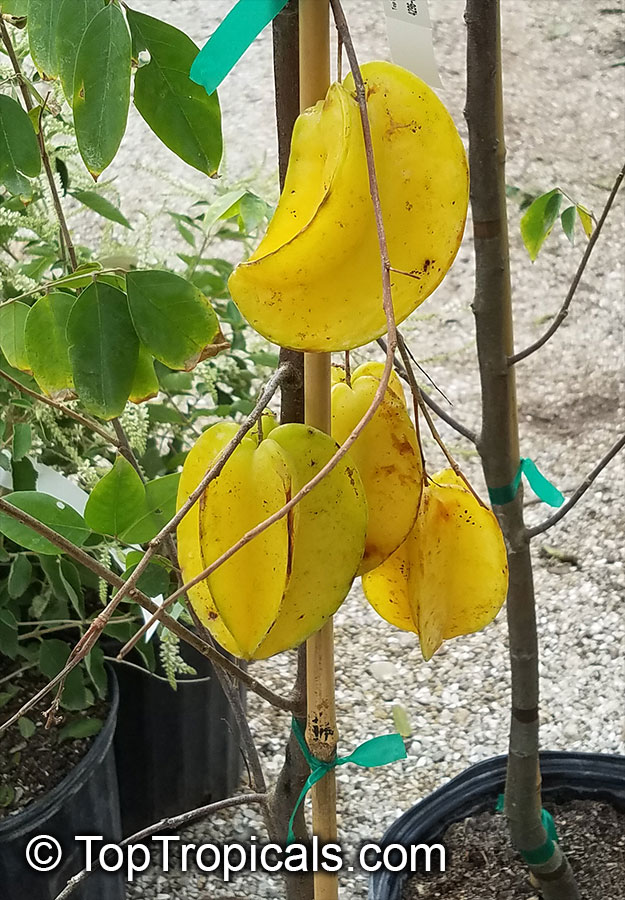
A: Without hesitation, I would strongly suggest a particular variety of carambola (star-fruit) called Dwarf Hawaiian, as it is truly special as tropical fruit trees go. First and foremost, they begin fruiting at a very young age, often while only in a one-gallon pot, and even less than a couple of feet tall with a very little trimming. Better even is that they are perfectly happy living perpetually in a pot. I have one myself which is content in a 12 inch pot and which fruits freely throughout the year. Also, even though it should be too much to be expected, the fruits are of the highest quality and are as sweet as candy. I also like the fact that the fruits hang decoratively on the tiny tree for quite some time before finally ripening, rather like ornaments. One of these little trees in-fruit is an amazing sight and ought to make anyone take notice, especially in a sun-room in Ohio! They really are very easy to grow, and if you have a Meyer's lemon which does well, you'll certainly have no particular issues with a Dwarf Hawaiian carambola.

However, I have found that in order for them to remain extra dwarf and fruit especially precociously, this variety needs to be grafted and not cutting grown. Fortunately, Top Tropicals has recently obtained a number of these extra wonderful grafted trees which are of the highest quality I have seen in some time, all of which will likely begin fruiting very shortly. They simply are wonderful little trees! Check them out...

TopTropicals.com

Date: 20 Nov 2024

Thanksgiving Sale starts today!

Giving Thanks is Giving Peace

Thanksgiving  cat  and  turkey

"Gratitude makes sense of our past, brings peace for today, and creates a vision for tomorrow." - Melody Beattie

Happy holiday season! To our wonderful customers, thank you for your support throughout the year - we are truly grateful! We wish you peace, health, and beautiful gardens filled with abundant fruit and ever-blooming flowers.

As a token of our appreciation, enjoy 10% off plants, seeds, and garden supplies with the code below. Let's make your gardens even more fruitful and vibrant this Thanksgiving!

THANKS24

Min order $150. Excluding S/H. Exp. 11/29/24

Bunchosia  argentea  -  Peanut  Butter 
 Tree

Photo above: Bunchosia argentea - Peanut Butter Tree. One of the most fascinating exotic fruit, as amazing as Miracle fruit, Peanut Butter Fruit is loved by both kids and adults. Yes, it tastes exactly like peanut butter! Sweet, soft pulp with peanut flavor. The tree is small in size, grows 10-15 ft max, or can be kept as a bush. Starts fruiting within 2-3 years from seed! Keep it in a pot if you have limited space, can be grown indoors, too. Very rare in cultivation.