Australia Planting 1 Billion Trees To Fight Climate
Change
Australia plans to plant 1 billion new trees to fight climate change, by
the year 2050. That is a lot of trees and is the first real effort the
country has made toward combating climate change. The only real problem is finding
enough space to plant that many trees...
A billion trees is a billion trees, and even with a team of 30,000
people planting a tree per day for the next 31 years, the final tally would still
only be 339,450,000 trees. Australia will need a tree army to get that many
trees planted by 2050... Read the whole story...
How about planting just one tree today and save the World one step at a time?
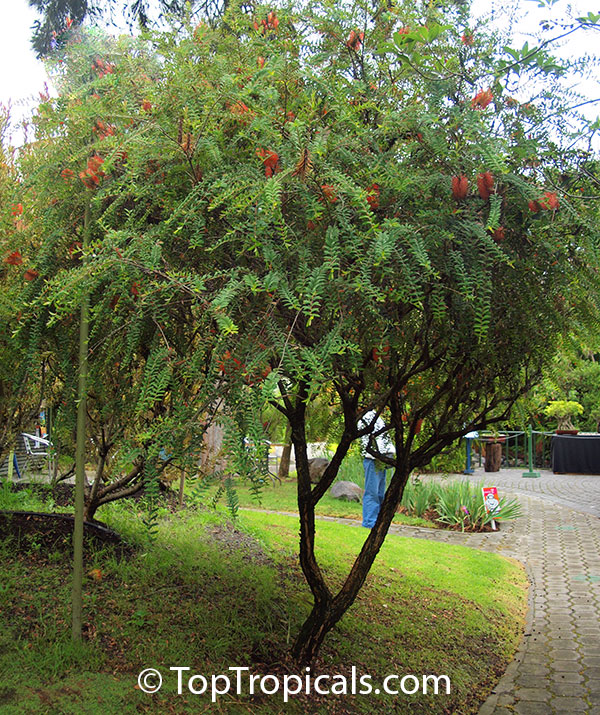
On the photo: Callistemon, Australian native tree.
Date: 29 Jan 2026
How to make Sapodilla fruit profusely?
Sapodilla - Manilkara or Achras zapota, the Brown Sugar Fruit
🍊 How to make Sapodilla fruit profusely?
Sapodilla - Manilkara or Achras zapota), the Brown Sugar Fruit is a warm-climate evergreen fruit tree that can produce a lot of fruit once conditions are right. So why do so many sapodilla trees grow beautifully, flower heavily, and still refuse to set fruit?
Sapodilla Fruit Production - What Really Matters
1. 🌳 Choose the Right Tree
Grafted or air-layered trees fruit much sooner - typically in 1-2 years - and more reliably than seedlings, which may take 6–8+ years.
Some varieties are more profuse producers than others. For example, Silas Woods is virtually everbearing, Hasya is commercial prolific producer, Oxkutzcab (or Ox) -is also heavily productive (learn more about varieties).
2. ☀️ Environment: Heat, Sun & Water Balance
Temperature and Humidity
Excessive heat above 90F and low humidity can cause flowers to dry up and fall before setting fruit.
Solution: Provide filtered light or shade during the hottest part of the day to reduce heat stress on blossoms.
Water
Sapodillas are drought tolerant, but consistent moisture during flowering and fruit set improves fruit retention.
Avoid waterlogged conditions - soggy soil can stress roots and reduce yield.
Sun Exposure
Full sun is best for growth and flowering - but for hot climates, protection during peak afternoon heat helps reduce flower drop.
Young trees can also suffer sunburn.
3. Fertilization: Feed for Fruit, Not Just Foliage
Good nutrition is critical for flowers to turn into fruit. Apply a routine feed through the growing/flowering season - contolled-release (Green Magic) or liquid (Sunshine C-Cibus) both work.
Balanced fertilizer with trace elements like Boron (B), Molybdenum (Mo), Iron (Fe), and Copper (Cu) is essential for fruit set and development. Boron & Molybdenum deficiency as a frequent cause of flower/fruit drop in container-grown trees (nutrients get depleted quickly in pots).
Micro-nutrient sprays 2-3 times per year help improve fruit retention and quality. Some growers use sugar boosters (Sunshine Honey) or micronutrient blends that include Mo & B to help fruit set (Sunshine Superfood).
4. 🐝 Pollination - Often Overlooked
Sapodilla flowers are small and often require pollinators for best fruit set.
In some regions, small insects like thrips are key pollinators.
In places with low insect activity, hand pollination dramatically increases fruit set - brushing pollen from one flower to another with a small paintbrush during peak bloom times can help.
Placing fruit scraps (apple peels/banana peels) under the tree to attract beetles is an inexpensive way to boost insect activity.
5. ✂️ Pruning and Tree Structure
Moderate pruning can help open the canopy for better light penetration and air circulation, which supports flowering and reduces stress. Training young trees promotes a strong branch structure that can carry more fruit later. Sapodilla flowers on young growth (tips of the branches).
6. Pot vs Ground: Size Matters
If your sapodilla is in a container, root bound trees struggle with fruit set because roots run out of space and nutrients - stepping up to a larger container or planting in the ground can help.
Root-bound trees often bloom but fail to develop fruit.
7.
📅 Patience & Timing
Even healthy trees can take years to start fruiting well.
Trees often flower repeatedly but only set fruit when environmental conditions and pollination align - especially important for young or newly planted trees.
📌 Summary Checklist for Better Sapodilla Fruiting
✔️ Choose a grafted variety (faster, more reliable fruit).
✔️ Manage heat & humidity - shade during hot hours.
✔️ Water consistently but avoid waterlogging.
✔️ Fertilize balanced NPK + micronutrients (include B & Mo).
Cold-hardy avocado survival groups - what the numbers really mean
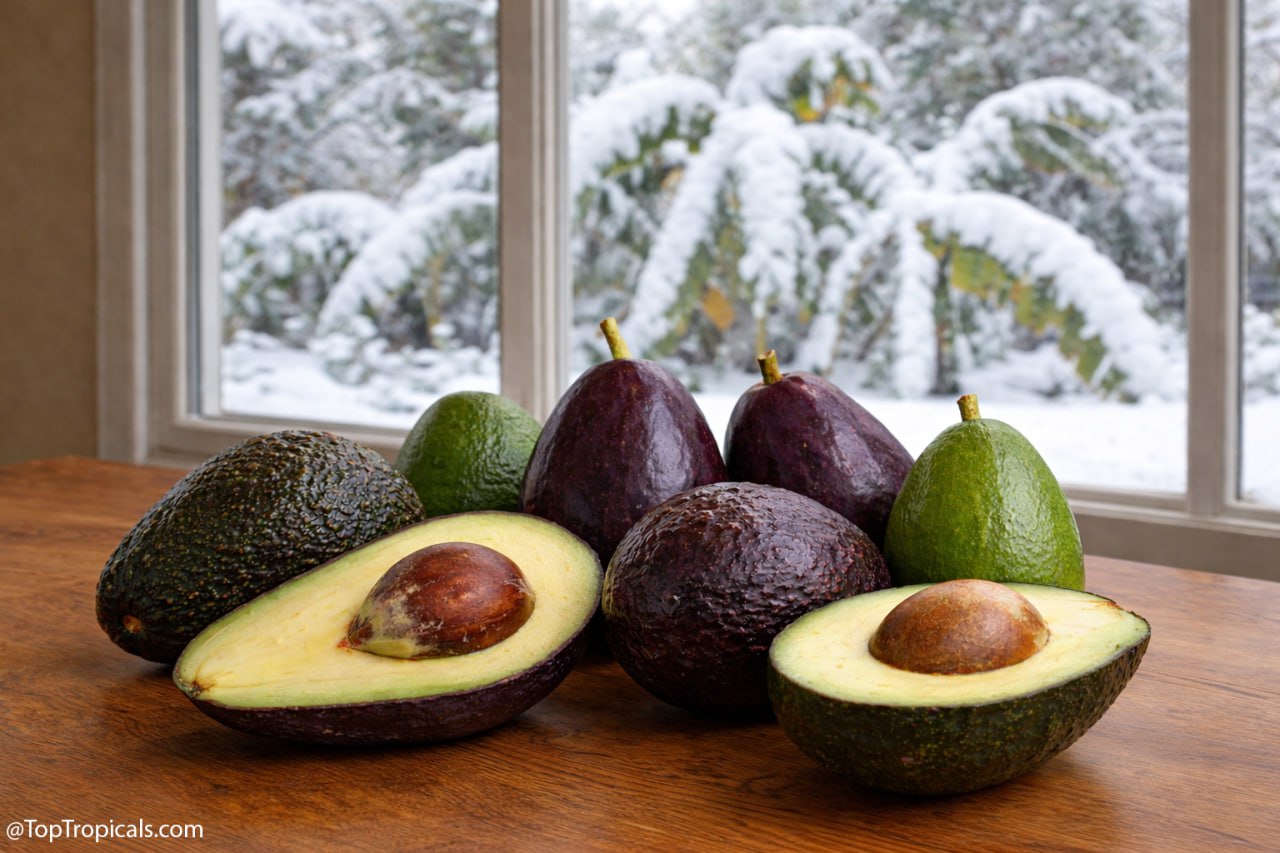
Different varieties of Avocado fruit on a table
Cold-hardy avocado survival groups - what the numbers really mean
Avocado cold hardiness is often misunderstood. Temperature numbers do not mean a tree stays untouched - they describe survival, not appearance. Leaf burn, twig dieback, and temporary setbacks are normal even on hardy varieties. The difference is whether the tree recovers.
Below are cold-hardy avocado varieties grouped by minimum reported survival temperatures, along with what growers typically observe after a freeze.
🌡 Hardy to 15F:
Brazos Belle (Wilma), Fantastic, Joey, Lila (Opal), Day.
Best freeze survivors. Minor leaf burn possible, but trees usually recover quickly with little structural damage. These are among the most cold-tolerant avocado varieties when fully established and exposed to short-duration freezes. What to expect: Trees in this group often survive temperatures near 15F with little to moderate leaf damage. Some tip dieback is possible, but major limb loss is uncommon. Recovery is usually strong once warm weather returns, especially in dry winter conditions.
🌡 Hardy to 20F:
Bacon, Brogdon (Brogden), Fuerte (Dwarf), Mexicola, Miguel, Ulala (Super Hass), and Waldin.
Reliable survivors in cold-prone areas. Expect leaf damage and some setback, but established trees typically rebound.
These varieties perform well in marginal climates and are commonly grown where freezes are expected but not extreme. What to expect:
Leaf burn is common at or below 20F, and young shoots may be damaged. Trees typically survive, but may need a full growing season to regain canopy density. Established trees usually rebound well with good drainage and protection from wind.
🌡 Hardy to 25F:
Black Prince, Choquette, Hall, Hardee Red, Lula, Marcus Pumpkin, Mexicola Grande, Nishikawa, Oro Negro, Poncho (Pancho), Tonnage, Winter Mexican, Wurtz (Dwarf) and Yamagata.
Moderate cold tolerance. Leaf drop and branch dieback are common after freezes, though trees usually survive.
This group includes moderately cold-tolerant avocados that handle light freezes but are more easily damaged during prolonged cold. What to expect:
Expect noticeable leaf drop and some branch dieback when temperatures fall near 25F. Trees usually survive but may look rough for weeks or months. Proper placement and drainage greatly influence recovery speed.
🌡 Hardy to 30F:
Bernecker, Catalina, and Florida Hass (Haas).
Frost-tolerant only. Damage occurs quickly, and repeated freezes can cause serious stress without protection.
Actual results depend on tree age, freeze duration, wind, moisture, and microclimate. Lower numbers do not mean damage-free - they mean the tree lived to grow again.
These avocados are best suited to areas with only occasional frost and minimal freeze exposure. What to expect:
Leaf damage occurs quickly near 30F, and unprotected trees may suffer significant canopy loss. Survival is possible during brief cold events, but repeated freezes can cause lasting damage. These varieties benefit most from proactive protection.
❗️ Important reminder
All temperature figures are approximate and experience-based, not guarantees. Survival depends on tree age, duration of cold, wind, moisture, and microclimate. Cold tolerance improves significantly as trees mature, while young trees remain vulnerable across all groups.
Understanding the difference between survival and damage is the key to choosing the right avocado for colder climates.
Helping Citrus and other fruit trees with Nutritional
Supplements
Q: Can you recommended a product to help with my citrus?
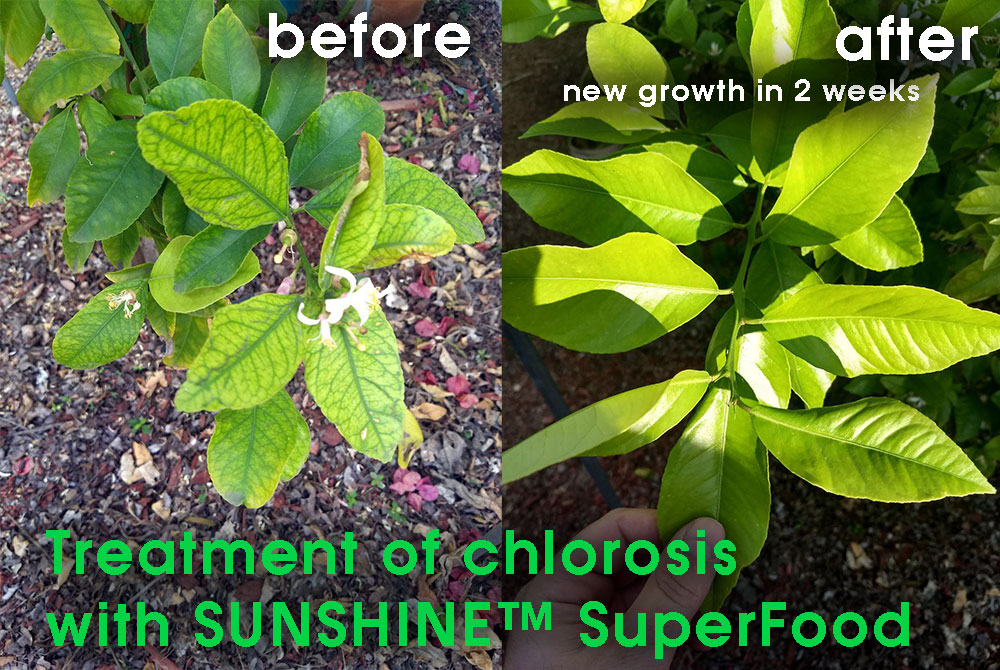
Combating greening and chlorosis.
A: Citrus greening is spread by an insect called the Asian citrus
psyllid. The psyllid feeds on the stems and leaves of the trees, infecting
the trees with the bacteria that causes citrus greening. Florida Citrus
growers dedicated the last decade to researching citrus greening. Officially,
currently there is still no cure, however, some Nutritional solutions have shown
promising results. To slow the progression of citrus greening in infected
trees, nutrients are applied to the leaves and to the roots. Providing better
nutrition helps trees fight against citrus greening and enables them to continue
to produce quality fruit.
We recommend the following products for use on regular basis:
SUNSHINE Epi is a natural Brassinosteroid plant hormone and a
bio-stimulant that may be very effective as citrus greening treatment. It works
through plant's immune system and shows amazing results of recovery of weak and
sick plants.
SUNSHINE Superfood, a complex micro-element supplement, maintains
plant's health and provides vigorous growth.
SUNSHINE-Honey is a basic nutritional complement, it contains essential
plant micronutrients Boron (B) and Molybdenum (Mo). These elements are essential
to vegetative and reproductive growth, cell expansion, tissue growth, and
fertility. A very common problem for most unimproved garden soils is lack of
Molybdenum and Boron as soil micro-component. This results in underdeveloped /
low quality fruit and/or premature fruit drop. Applying SUNSHINE Honey on your
fruit trees will fill that gap and help a fruit tree to form a healthy
fruit.
Macro-nutrients should be applied in combination with micro-nutrients on
regular basis:
Mango-Food - Smart Release Fruit Tree Booster (works great for all
tropical fruit trees)
Fruit Festival Plant Food - Ideal blend designed to improve fruit trees
health and vigor, and increase crop yield.
How to grow tons of fruit in limited space - its incredible!
100 Papaya trees in 6"x100" strip
💥 How to grow tons of fruit in limited space - it's incredible!
🍊 Yesterday we planted 100 Papaya trees in 6"x100" strip of the garden. That’s right - 100! This year, we’ll have BILLIONS and BILLIONS of fruit. Unbelievable! You should do it too. And here's how.
🍊 Want to grow more fruit trees? Different varieties? But look at your space - it's never enough! What can you do? Most people have no clue. But we do.
🍊 "Fruit cocktail trees" - great idea, right? Different varieties grafted onto one tree. Used to be very popular, especially citrus. But guess what? Doesn’t work well. The strongest variety takes over, dominates - very unfair.
🍊 The best solution? It's called "One Hole Planting." Genius! Just plant several varieties in the SAME hole. Each variety gets its own root system - no fighting, no losers. Just winners.
🍊 The absolute best candidates? Papaya Trees! (Carica papaya). They grow tall, straight, strong - just like a palm tree!
🍊 Here’s the trick: plant several varieties together. Both male and female trees (you thought male papaya was useless? Plant it in, and watch what happens!). It's the best way! Saves space, supercharges pollination, maximizes fruit production. You get different flavors, non-stop harvests.
🍊 Watch the video - 14 huge holes, 100 trees! It’s going to be HUGE! And guess what? We'll be back in just a few weeks - showing off the harvest! Stay tuned!