Garden Blog - Top Tropicals

Date: 27 Feb 2025

What Fertilizer to Use Now and How?
Five important keys to healthy plants
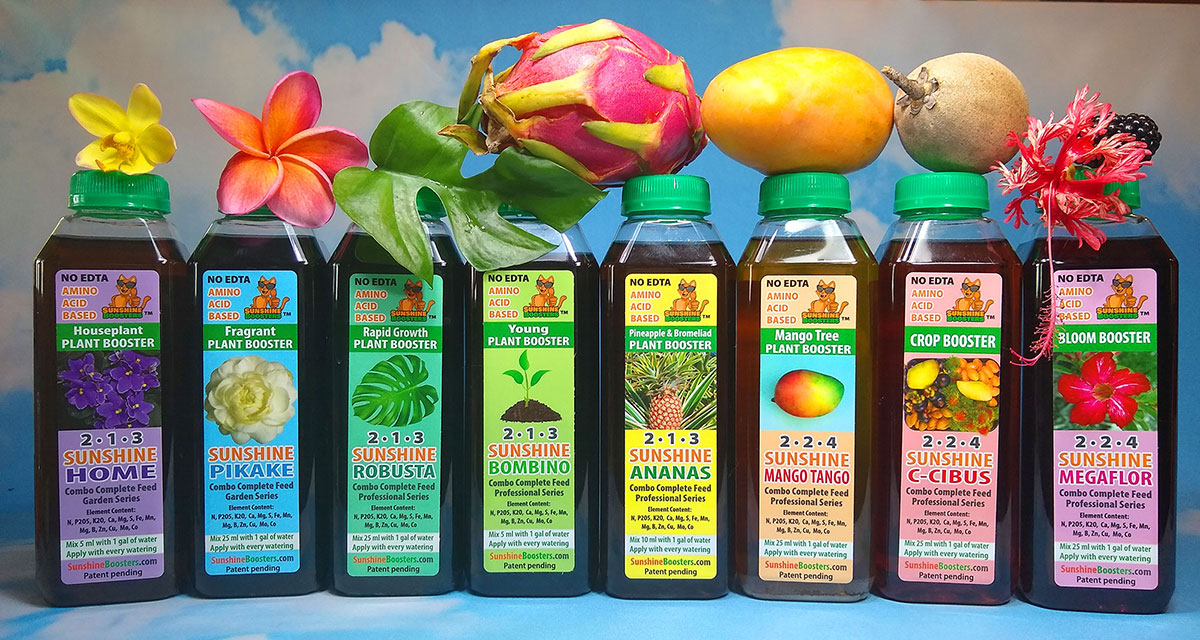
Sunshine  Boosters  Selection

Q: It's early Spring this year. Should I start fertilizing my plants sooner than usual?

A: Most fertilizer instructions recommend fertilizing tropical plants from March to November. This is because plants don't need as much food during the cooler months when many go dormant, and excess nutrients can burn the roots if not absorbed. However, for the most effective fertilizer program and healthy plants, consider these points:

1. Sunshine Boosters Year-Round

Liquid amino-acid-based fertilizers like Sunshine Boosters are safe to use year-round. Since watering is reduced in cooler weather, the intake of water-soluble fertilizer is also lower, providing plants with just the essential nutrients for their minimal needs.

2. Dry Fertilizer Schedule

Be cautious with dry fertilizers. Apply them only during active growth in the hot season.

3. Temperature Is Key

If March is still cold, delay dry fertilizer use. However, if nighttime temperatures in February stay above 65F, you can start a dry fertilizer program using slow-release, granulated plant food.

4. What Fertilizers to Use and How

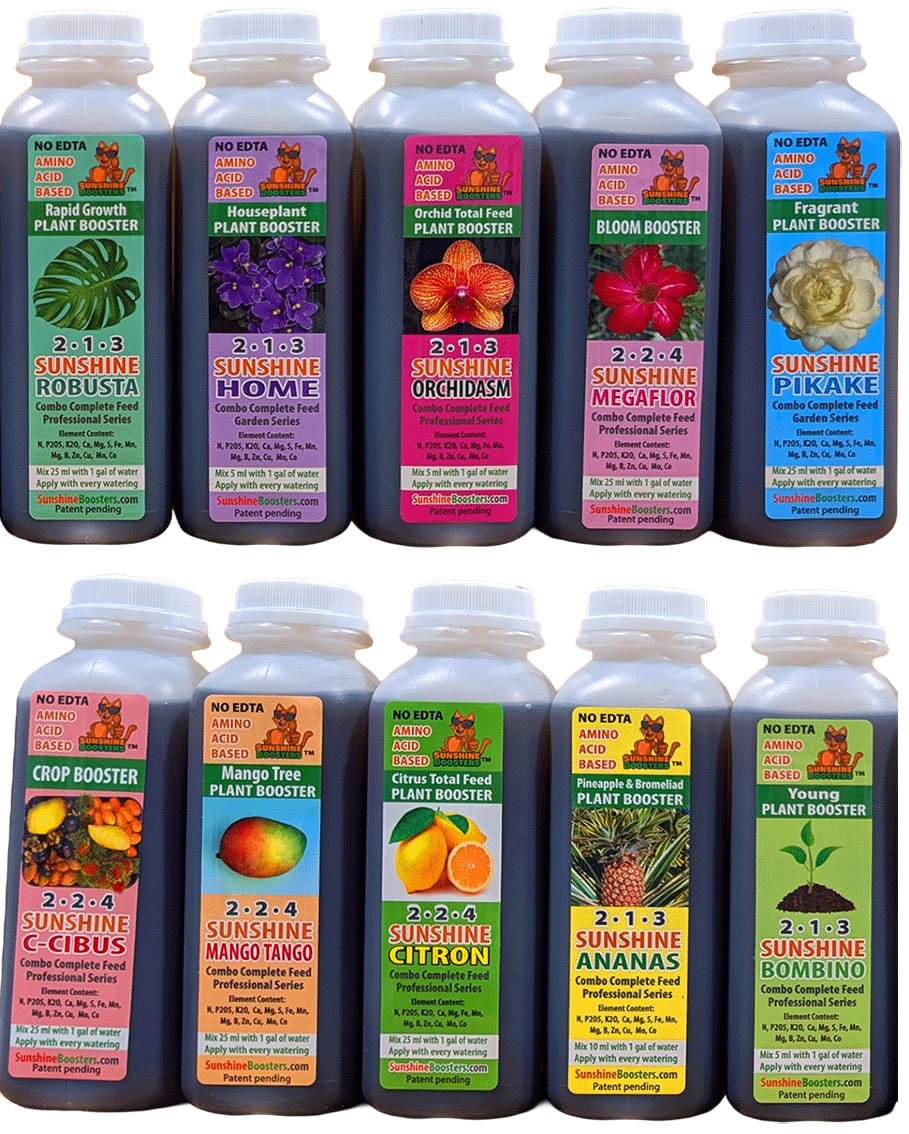
Check out our Sunshine Boosters selection for different types of plants and choose the right type for your needs. These can be applied as often as with every watering:

For Rapid Growth
Sunshine Robusta - Rapid Growth Booster: general fertilizer for both foliage plants and small starters that need an extra boost.

For Flowers
Sunshine Megaflor - Bloom Booster: boosts flowers on established plants; and Sunshine Pikake - Fragrant Plant Booster: best for fragrant flowers.

For Fruit Trees
Sunshine C-Cibus - Crop Booster: contains all necessary elements for fruit trees and their production. Sunshine Mango Tango - specifically formulated for Mango and Avocado trees, and Sunshine Citron - ideal for citrus trees.

For Tender Perennials
Sunshine Orchidasm - Orchid Total Feed and Sunshine Ananas - Pineapple and Bromeliad Booster: mild formulas for these tender perennials.

5. Microelement Supplements Are a Must

Besides macronutrients, plants need additional microelements, just like humans need vitamins. Be sure to apply these supplements along with your regular plant food:

For Green Leaves and Health
Sunshine SuperFood - Complex Microelement Supplement: a must for healthy plants. Apply once a month.

For Stress Relief
Sunshine-Epi - Brassinosteroid Plant Hormone: essential for plants recovering from stress (shipping, transplanting, drought, insect damage, cold stress, etc.). Apply as needed.

For Sweeter, Bigger Fruit
Sunshine Honey - Fruit Sugar Booster: application on fruit trees will make fruit bigger and sweeter by directing sugars to the fruit from other plant parts, and helps to prevent bud drop. Apply 4 times a year: at bud setting, flowering, fruit setting, and after harvesting.

For Better Resistance
Sunshine Power Si - Silicon Protector - enhances resistance to insects, diseases, drought, and frost, while boosting growth. Apply once a month, along with Sunshine SuperFood.

Need Help? Our Plant Experts Are Ready to Assist!
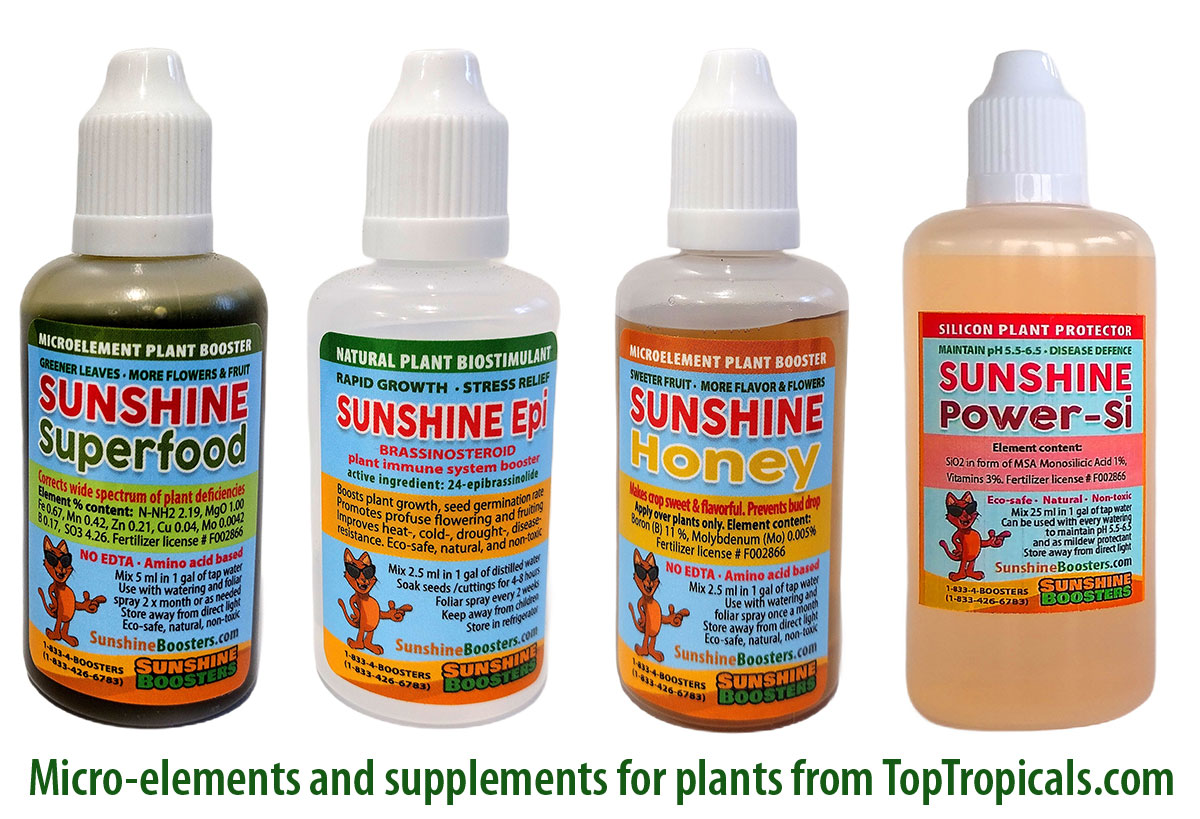
Microelements  and  supplements  for 
 plants

Date: 11 Nov 2025

Fruits with the most vitamin E, according to dietitians

Fruits with the most vitamin E

Fruits with the most vitamin E

🥭 Fruits with the most vitamin E, according to dietitians

  • 🔛 Vitamin E works as an antioxidant that helps fight inflammation throughout the body. While nuts and seeds top the charts, some fruits quietly add their share to your daily needs - especially when eaten with a bit of healthy fat. According to New York City Nutrition, vitamin E anti-inflammatory action supports heart, brain, and skin health.
  • 🔛 Vitamin E is a fat-soluble vitamin that acts as an antioxidant, meaning it fights inflammation in the body. Because of this anti-inflammatory role, vitamin E is beneficial for immune health, heart health, eye health, brain health, and skin health.
  • 🔛 Adults need about 15 milligrams a day, according to the National Institutes of Health. Deficiency is rare, but it’s smart to get vitamin E from a variety of foods. Fruits alone don’t provide large amounts, but they can complement vitamin-E-rich foods like almonds or sunflower seeds.
  • 🔛 Since vitamin E needs fat for absorption, pair fruit with something creamy or crunchy - like yogurt, olive oil, nuts, or seeds - for best results.
  • 🔛 Here are some fruits that naturally offer vitamin E:

  • 🍊 Sapote 1 cup = 3.7 mg vitamin E. A tropical favorite with rich orange flesh and a flavor somewhere between pumpkin pie and sweet potato, with hints of honey and almond, Sapote is great fresh, blended in shakes, or scooped over ice cream. It also packs calcium, iron, potassium, and vitamins A and C.
  • Blackberries 1 cup = 1.7 mg vitamin E. Deep color, bold flavor, and plenty of antioxidants, Blackberries are high in fiber and low in calories. Dietitian Keri Glassman calls them her top fruit for fighting inflammation.
  • 🥭 Mango 1 cup = 1.5 mg vitamin E. The “king of fruits” brings more than tropical sweetness, Mango supports digestion, helps you feel full longer, and delivers both vitamin A and E in one juicy package.
  • 🍉 Guava 1 cup = 1.2 mg vitamin E. This fragrant fruit has a flavor that lands between strawberry and pear, Guava is also one of the highest-fiber fruits and surprisingly rich in protein for a fruit.
  • 🍑 Persimmon 1 fruit = 1.2 mg vitamin E. An autumn favorite that looks like an orange tomato but tastes sweet and mellow, Persimmons are rich in vitamins A and C and make a colorful, fiber-filled snack or dessert.
  • Avocado 1 fruit = 0.9 mg vitamin E. Creamy, mild, and versatile, Avocado’s healthy fats help your body absorb vitamin E while protecting heart health. Try it on toast, in salads, or as a smooth butter substitute in baking.

🛒 Plant more remedies in your food forest

📚
Learn more:
#Food_Forest #Remedies #Discover

🟢 Join 👉 TopTropicals

Date: 10 Aug 2025

Tuxedo  cat  planting  tropical  tree  with  Sunshine  Boosters  bag,  orange  cat  waving  to  kitten  with  backpack  by  school  bus  in  sunny  garden 
 scene.

🌺 Back to School and Back to Planting – Cats in the Garden

Back to School, Back to Planting – Why August Works for Tropicals

Planting Season Isn't Over Yet

August is still a good month for planting tropicals in warm climates. The soil stays warm enough to push root growth, and late-summer weather gives plants time to settle in before winter. In drier areas, regular watering will keep them moving along just fine.

Tropicals in warm climates aren't usually harmed by cooler Winter weather, but as days get shorter, growth may slow down. This is why planting in late Summer-Fall lets roots grow during this last warm stretch, so the plant enters winter already established.

By spring, those roots are ready to drive new shoots, flowers, and fruit. There's no lost time to transplant shock - plants can get straight to blooming and fruiting earlier in the season.

August Planting FAQ

How can heat be prevented from harming new tropicals?

Water in the morning so plants start the day hydrated. Warm soil is good for root growth, but don't let it dry out.

How should new plants be protected from strong sun?

For the first couple of weeks, use a shade cloth or even a white bed sheet to soften midday sun and prevent leaf scorch.

What fertilizer works best for planting in summer heat?

Controlled-release types are best. We use professional grade Green Magic. You may pair it with Sunshine Boosters for steady, gentle feeding through the warm months.

Which tropicals grow best when planted in August?

Most tropical plants do well when planted in warm end-of-summer conditions, including Mango, Avocado, Guava, Jackfruit, Annona, Bananas, Orchid Trees, Jasmines, Allamanda and most of flowering trees, shrubs and vines.

Can tropical trees planted in August produce fruit next year?

Many can, especially fast growers, since they have established roots by the time spring growth begins.

How can tropicals be kept healthy when planting in August?

Mulch around the base to help prevent soil from drying out too quickly. Water deeply in the morning to help plants handle the heat.

Shop Flowering trees

Shop Fruit trees and edibles

Date: 25 Apr 2026

♥️ Mother’s Day: More Than a Gift

Smokey  cat  with  glasses  showing  mango  tree  to  mother  cat  in  garden
Mom: You grew this… for me? You remembered my favorite…
Smokey: I did.
Mom: You never forget what matters. It’s beautiful.
Smokey: Not as much as you. Happy Mother’s Day.
Sunshine: You raised him right. It shows.

Some things stay with you from your mom.

A favorite fruit. A smell from the garden. The way she showed you how to care for something and stick with it.

At the time, it felt small. Later, you realize it wasn’t. It turns into something real - a tree, a habit, a way of doing things you still follow.

Mother’s Day is simply a reason to tell your mom you remember. To say thank you for what she taught you, and to show your love.

It does not have to be complicated. Just something that makes it clear you were paying attention.

If you are thinking what to give, start simple.

A fruit she loves. A plant she will enjoy watching grow. Something alive, not just something that sits on a shelf.

It does not have to be big. What matters is that it means something to her.

And maybe, years from now, it becomes one of those things that stays.

We put together a few plants that make good Mother’s Day gifts.

Fragrant flowers. Fruit trees she can enjoy year after year. Easy growers that do not require much effort.

If she has a favorite, start there. If not, pick something simple and reliable.

🛒 Shop Gift plants

Date: 8 May 2026

How to feed the right formula at the right time

How to feed the right formula at the right time

How to feed the right formula at the right time


Most plants don’t need more fertilizer - they need the right one at the right stage. Growth, flowering, and fruiting all require different support. Once you match feeding to what the plant is actually doing, everything starts to improve.

  • ☘️ One system for every plant and stage


The Sunshine Boosters system includes different formulas for different stages of growth or plant types. Some are designed for young plants, some for vegetative growth, and others for flowering and fruiting. This allows you to match feeding to what your plant is doing without changing the overall system. All formulas, including additional supplements, remain compatible and can be used together when needed.

  • ☘️ Build structure and foliage


Sunshine Robusta supports vegetative growth. It is useful for building strong structure, adding foliage, and helping plants recover after stress or damage.
Sunshine Bombino is a gentle formula for young plants, seedlings, and cuttings. It supports early root development without stressing tender growth.
Sunshine Home is made for indoor houseplants. It is mild and balanced for regular feeding of sensitive plants grown indoors.

  • ☘️ Feeding for flowers

Sunshine Megaflor is a bloom booster. It helps plants produce more flowers, improves flower size, and supports strong pollen development.
Sunshine Pikake is designed for fragrant flowering plants. It increases the number of blooms and improves flower fragrance.
Sunshine Orchidasm is a complete feed for orchids. It supports steady growth and encourages longer and more frequent blooming cycles.

☘️ Feeding for fruit and yield


Sunshine C-Cibus is a crop and fruit booster. It is used during flowering and fruit development to improve yield and plant vigor.
Sunshine Mango Tango is designed for mango trees. It helps improve flowering, fruit set, and reduces flower and fruit drop.
Sunshine Citron is a complete formula for citrus trees. It supports healthy leaves, strong growth, flowering, and fruit production.
Sunshine Ananas is made for bromeliads and pineapple. It supports healthy growth and improves fruit quality in these plants.

  • 👉 To be continued - next we’ll cover the additional boosters that take your plants from good to exceptional. 👉 More...


🛒
Get your plants real food

📚
Learn more:
📱 What are Sunshine Boosters

#Discover #Fertilizers #How_to
🟢 Join 👉 TopTropicals