Garden Blog - Top Tropicals

Date: 27 Feb 2025

What Fertilizer to Use Now and How?
Five important keys to healthy plants

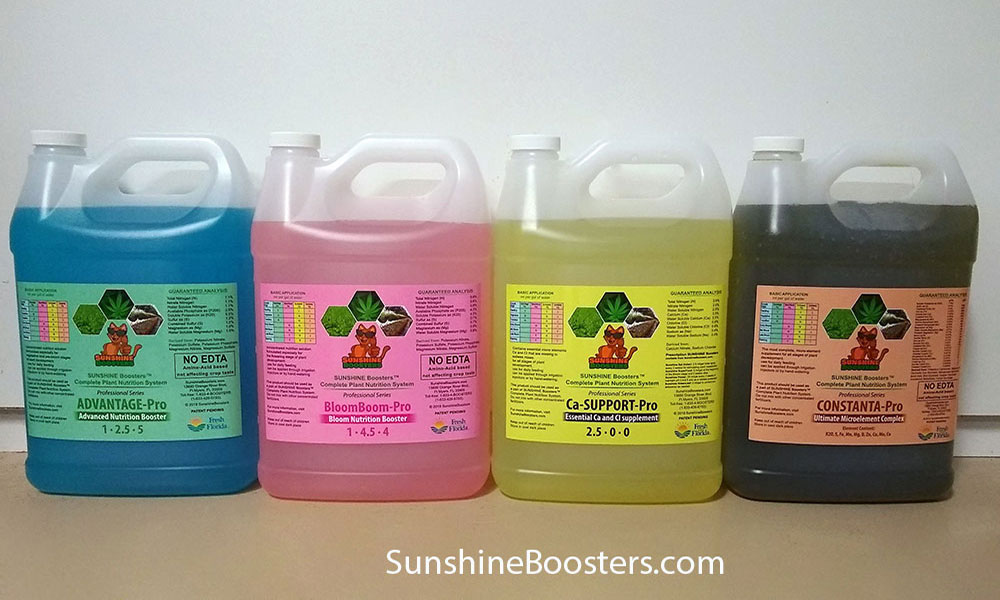
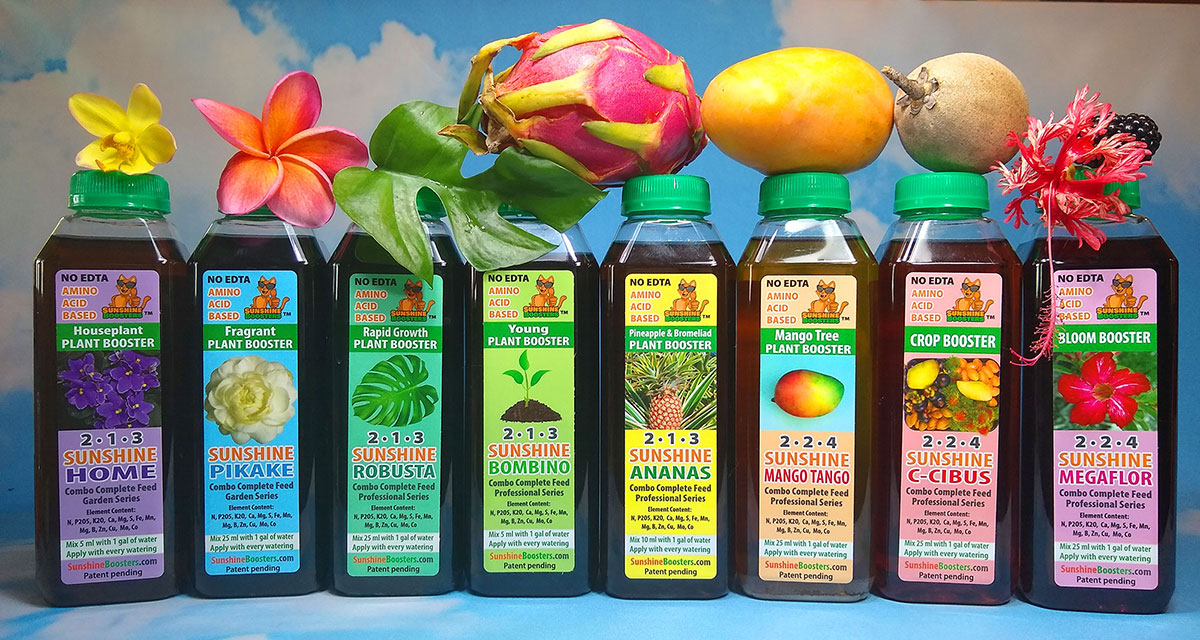
Sunshine  Boosters  Selection

Q: It's early Spring this year. Should I start fertilizing my plants sooner than usual?

A: Most fertilizer instructions recommend fertilizing tropical plants from March to November. This is because plants don't need as much food during the cooler months when many go dormant, and excess nutrients can burn the roots if not absorbed. However, for the most effective fertilizer program and healthy plants, consider these points:

1. Sunshine Boosters Year-Round

Liquid amino-acid-based fertilizers like Sunshine Boosters are safe to use year-round. Since watering is reduced in cooler weather, the intake of water-soluble fertilizer is also lower, providing plants with just the essential nutrients for their minimal needs.

2. Dry Fertilizer Schedule

Be cautious with dry fertilizers. Apply them only during active growth in the hot season.

3. Temperature Is Key

If March is still cold, delay dry fertilizer use. However, if nighttime temperatures in February stay above 65F, you can start a dry fertilizer program using slow-release, granulated plant food.

4. What Fertilizers to Use and How

Check out our Sunshine Boosters selection for different types of plants and choose the right type for your needs. These can be applied as often as with every watering:

For Rapid Growth
Sunshine Robusta - Rapid Growth Booster: general fertilizer for both foliage plants and small starters that need an extra boost.

For Flowers
Sunshine Megaflor - Bloom Booster: boosts flowers on established plants; and Sunshine Pikake - Fragrant Plant Booster: best for fragrant flowers.

For Fruit Trees
Sunshine C-Cibus - Crop Booster: contains all necessary elements for fruit trees and their production. Sunshine Mango Tango - specifically formulated for Mango and Avocado trees, and Sunshine Citron - ideal for citrus trees.

For Tender Perennials
Sunshine Orchidasm - Orchid Total Feed and Sunshine Ananas - Pineapple and Bromeliad Booster: mild formulas for these tender perennials.

5. Microelement Supplements Are a Must

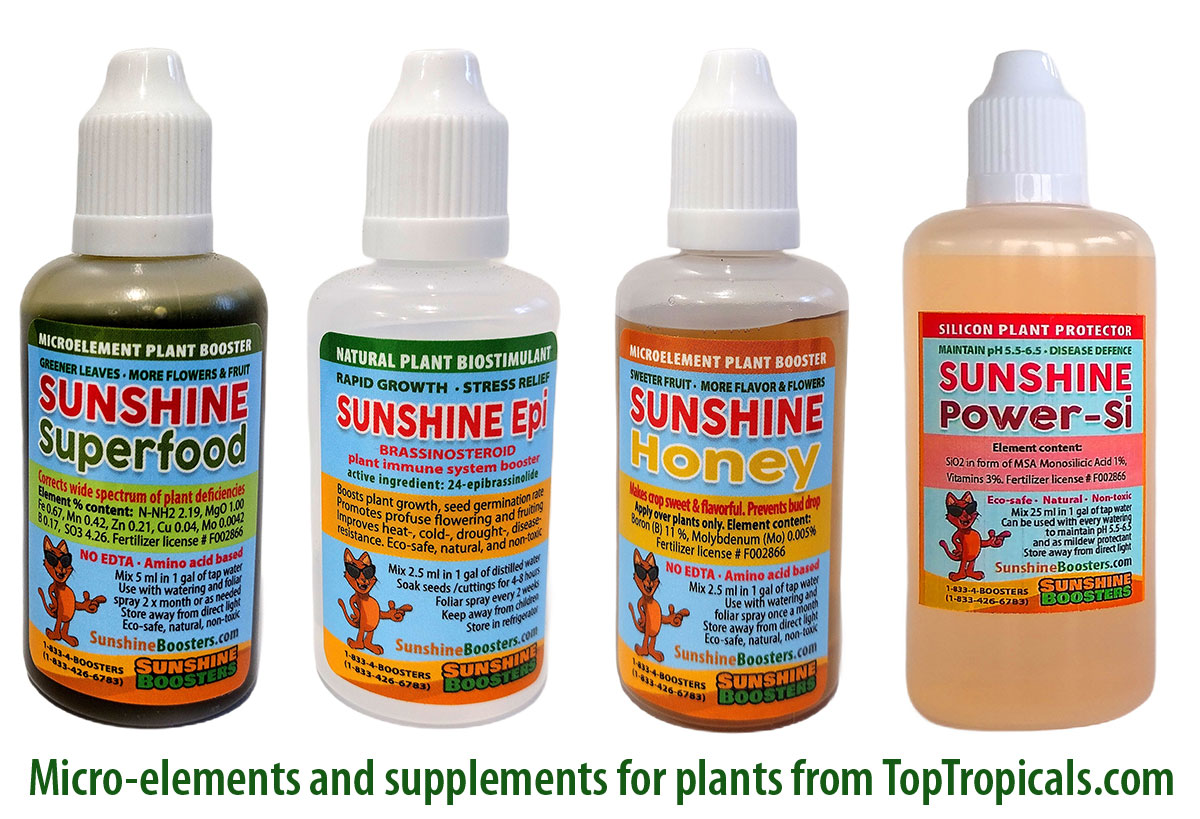
Besides macronutrients, plants need additional microelements, just like humans need vitamins. Be sure to apply these supplements along with your regular plant food:

For Green Leaves and Health
Sunshine SuperFood - Complex Microelement Supplement: a must for healthy plants. Apply once a month.

For Stress Relief
Sunshine-Epi - Brassinosteroid Plant Hormone: essential for plants recovering from stress (shipping, transplanting, drought, insect damage, cold stress, etc.). Apply as needed.

For Sweeter, Bigger Fruit
Sunshine Honey - Fruit Sugar Booster: application on fruit trees will make fruit bigger and sweeter by directing sugars to the fruit from other plant parts, and helps to prevent bud drop. Apply 4 times a year: at bud setting, flowering, fruit setting, and after harvesting.

For Better Resistance
Sunshine Power Si - Silicon Protector - enhances resistance to insects, diseases, drought, and frost, while boosting growth. Apply once a month, along with Sunshine SuperFood.

Need Help? Our Plant Experts Are Ready to Assist!

Microelements  and  supplements  for 
 plants

Date: 15 Jul 2025

🌱 Bigger Trees, Bigger Benefits

Fruiting  Mango  and  Avocado  Tree  Installed

Why Choose a 15 or 25-Gal Tree?

These are not starter trees — they’re mature, fruiting specimens that give you a head start in your garden or orchard. You’ll enjoy faster harvests, fuller canopies, and a more immediate impact on your landscape.

Top Reasons to Choose a Bigger Tree:

  • Already fruiting – enjoy your own mangos or avocados right away
  • Pre-trained and shaped for strong structure and balanced growth
  • Instant results in the yard – no years of waiting
  • Thicker trunks and stronger roots make transplanting easier

We make it easy for Florida gardeners:

  • Pickup available at two South Florida locations
  • Local delivery and installation services offered – just ask!
See installation and delivery details
Read More Garden Tips

Date: 24 Jun 2018

Our honest advise on Holiday Gift Plants

Q: Any suggestions on gift plants? With Holidays around the corner, I've been thinking of getting a present for my grandma, she lives in FL and is an experienced gardener. I also have a friend that lives in CA, also warm climate, but she doesn't have a green thumb. Any "easy" plants I can try for her?

A: Live plant is a perfect gift, as we all know. However when ordering a plant online as a present, for a happy experience, you should have three things to consider:
1) Gardener's experience. Planting instructions are included with every order, and usually success is there if you follow them. But all plants go through shipping stress (some more, others less) and need time, patience and love to recover. Also, a plant will need a new home after shipping: a pot and a good soil mix. It would be wise if you add potting mix with a gift order; the plant should be planted in a permanent pot as soon as possible, but normally can wait a day in a packing bag until its new owner gets a pot, if it is not ready yet.
2) How easy the plant is? If buying a plant for a beginner, chose something easy, as well as showy. Adeniums - Desert Roses, Jasmines, Clerodendrums, Cordylines are always a good choice. Calatheas, Gingers and Heliconias are always showy, even when not in bloom. Spice trees and herbs are fun, easy to grow and one can enjoy their aroma right away without waiting on them growing bigger. Miracle Fruit is an awesome present, it comes with detailed instructions how to grow the Miracle!
3) How easy the plant ships? Some plants can be easy in cultivation, but they don't take shipping well. After being in a dark box for a few days, most plants usually recover well in experienced hands. When making a present, you want something showy, not just a stick to arrive. Besides Adeniums and Jasmines, many fruit trees usually take shipping without a problem - such as Mango or Sapote trees. You may not want to start with Avocado, Papaya, Carambola, or Cacao - unless they go to an experienced grower - these may take some time and skill to etanblish. Fig trees are super easy in shipping, but figs may drop leaves in Winter - for this same reason, you may think twice about deciduous plants like Sugar Apples, Grapes, Mulberries or Persimmons to be sent as gifts. On the other hand, if you are sending a deciduous tree to a gardener who can appreciate the variety, this may be a good choice - dormant plants take shipping with less stress!

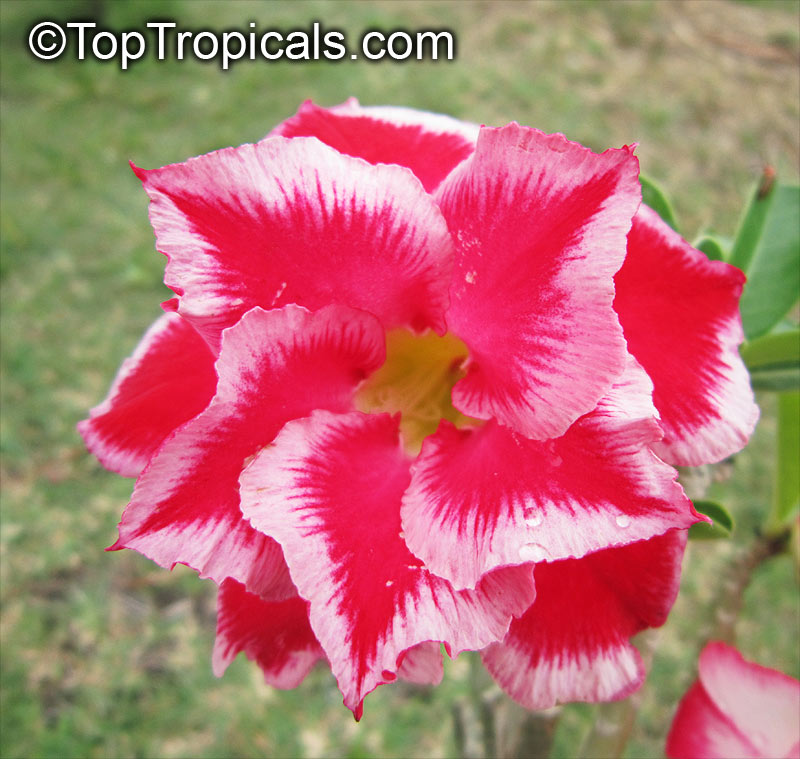
Holiday special: On the picture: Adenium Xmas Santa. A Holiday Special Desert Rose with Christmas-colored flowers - deep-red and white.

Still not sure which plant to choose? You may buy a Top Tropicals Gift Certificate

Date: 24 Jun 2018

TopTropicals

Fruitful Fruit and SuperFood...

Q: I have a large fruit garden here in Florida with many mango trees, avocadoes, guavas, and other tropical fruit. Last year hurricane Irma and flooding killed a few avocado trees, but mangos and guavas survived OK, but the sad part is, very few flowers this year and almost no fruit setting. I noticed on your website your Superfood and Sunshine-Honey boosters that supposedly help fruiting? But I am afraid it is too late now as your instructions say first application must be in early Spring? I wish I discovered earlier that my trees wouldn't want to fruit this year...

A: First of all, it is never late to give the food! You may start applications of SUNSHINE products at any time of the year. The best results will be achieved once you treat your plants on regular basis throughout the whole year cycle of metabolism.
Couple weeks ago we started harvesting our 2 guava trees. These two are the same variety (Variegated Honeymoon), planted within 20 ft from each other and growing in the same conditions. The only difference was, one was treated with SUNSHINE-Honey and SUNSHINE-SuperFood, and another one didn't get any treats in order to have a control plant.
Results are very interesting, see the picture. Both trees were heavily covered with fruit. However the one with treatments developed fruit that is much larger, much sweeter and juicier, and the most interestingly - with less seeds, almost no seeds!
To answer your question: yes, you can start feeding your fruit trees right now. It is still a Springtime. Many mango varieties have late season; even early varieties may delay their fruiting if flowering triggered by miscro-elements. Guavas have very long season and most varieties can have multiple crops throughout Summer-Fall.
Here is a simple and affordable feeding schedule to help your fruit garden recover from last year hurricane stress, and establish reliable production:
1) SUNSHINE-E - for boosting metabolism - once a month
2) SUNSHINE-Honey - for bringing sugars to the heart of the tree and boosting fruit sweetness and quality - now and in 2 weeks
3) SUNSHINE-SuperFood - for overall health, recovering from hurricane and fixing root damage from flood - now and every 2 weeks throughout warm season.
4) You may apply regular balanced fertilizer NPK as usual (we apply once a month, a handful per in-ground tree)
It's that simple. Just try and watch your trees produce again!

Check out all SUNSHINE boosters... We offer FREE shipping on them, so you can make your plants happy!

Date: 26 Oct 2025

Plant a fruit tree - and breathe easier: fruit might be the surprising key to healthier lungs

Plant a fruit tree - and breathe easier: fruit might be the surprising key to healthier lungs

🍒 Plant a fruit tree - and breathe easier: fruit might be the surprising key to healthier lungs


  • 🥭 Fresh fruit doesn’t just taste good - it can literally help you breathe better!

  • 🥭 A new study presented at the European Respiratory Society Congress found that women who ate at least four portions of fruit a day had slower declines in lung function compared to those who ate less. Researchers believe antioxidants in fruit may help protect the lungs from the damaging effects of air pollution.

  • 🥭 Air pollution is everywhere, and more than 90% of people worldwide are exposed to levels above safe limits. But the good news is, your diet can make a difference. Fruits are packed with antioxidants and anti-inflammatory compounds that help your body fight off the oxidative stress caused by tiny airborne particles.

  • 🥭 The study showed that women who ate plenty of fruit had stronger lungs despite being exposed to fine particulate pollution (PM2.5) from cars and industry. The difference wasn’t small either - their lung capacity dropped significantly less over time than in those with low fruit intake.

  • 🥭 So planting fruit trees isn’t just about homegrown flavor or saving a trip to the store. It’s about protecting your health in a polluted world. Whether it’s mangoes, avocados, guavas, or starfruit, every harvest brings you cleaner nutrition and a cleaner breath of life.


🛒 Grow fruit - grow your health

📚 Learn more:
#Food_Forest #Remedies #Discover

🟢 Join 👉 TopTropicals