Garden Blog - Top Tropicals

Date: 6 Nov 2018

Shopping for gifts is not an easy chore!

6 important steps for successful Holiday Gift Plant Shopping

1. Make a list of friends and family members that absolutely require your special plant attention. Obviously, a live plant is the best present!
2. Set deadlines for shipping gift plants. Remember good timing is 50% of a good surprise!
3. Set a budget and call our Customer Service to help you pick the right plant that fits your needs and finances. Check out current sales and deals to get more for your dollar, and low cost offers.
4. Buy plants for plant lovers, or simply for those who appreciate the Nature, and the Beauty. Check out fragrant gift plants, fruit, and spice plants - these are always win-win! A gift certificate can be a great option so they can pick what they like, and it is not time sensitive!
5. Prepare. Remember that live plant requires some attention. Prepare pots, soil, and planting instructions beforehand so your beloved ones can enjoy a happy plant for a long time.
6. Don't forget about yourself! Take advantage of BOGO deals to get One for Present, One for Me! Personally, here at Top Tropicals, we all buy at least one plant for ourselves for each holiday!

Happy Holidays!
Date: 2 Nov 2018

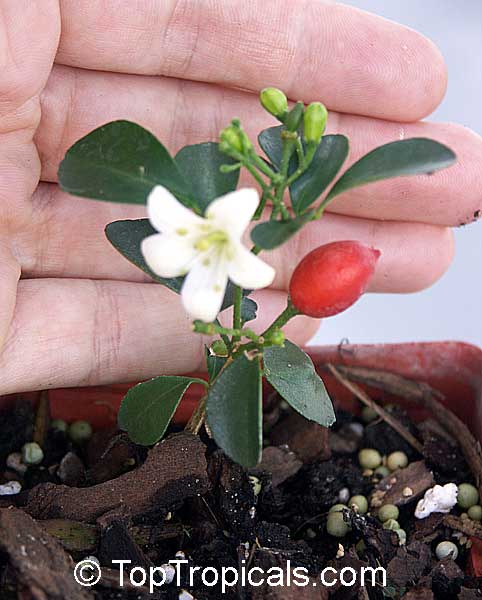
Happy Hobby: growing tropicals from seeds

TopTropicals.com

Q: What is the best time to start tropical plants from seeds? Should I wait till spring?

A: If you want to feel happier, get into gardening. If you want to feel God, start plants from seeds and watch New Life grow from a tiny grain. Fall is a perfect time to start tropicals from seed.
Traditionally, people prefer sowing seeds in Spring, especially temperate species for a vegetable garden: tomatoes, peppers, cucumbers... My grandmother up North started them in early Spring in paper cups on a windowsill, then once the temperatures went just above freezing, she planted them out in the garden beds, and that early start always helped her to have the best early crop in the neighborhood.
When we deal with tropical plants, "just above freezing" is not warm enough. Which means you have to grow small babies indoors for quite a while, providing additional heating when needed. Heating pads always work best. If you keep your living space around 75F (ideal for many species), this is a perfect temperature to get your seeds started. Tropical plants are not like annual tomatoes that try to grow through the season as fast as possible. They take time. So the sooner you start, the more chances to get small seedlings just in time when Spring air outside is "warm enough" for those tropicals - at least in 70's.
A great advantage of starting tropical seeds indoors is controlled temperature and moisture. In the plant world, environment extremes are not good for the germination process. Mild conditions of your home or a greenhouse create better chances for successful growth. Seeds won't get overheated in the hot Summer sun, and won't rot because of a sudden heavy rain. Just keep in mind that some species require light for good germination.
For the best seed germination:
- Use only well-drained mix - we recommend special Seed Germination Mix #3, professional grade. Put seeds not too deep (1/2 inch deep or less) to allow air circulation
- Soak large seeds for a few hours with Sunshine-S solution
- Keep warm (75-85F) and in bright light
- Keep soil slightly moist but not soggy
- Apply micro-element booster SuperFood to baby seedlings for vigorous growth

Date: 20 Jul 2018

How to get shade quickly... and stay away from oaks

TopTropicals

Q: I just moved from Tennessee into a new house in Florida and there are no trees on the property, the yard is brutal hot. What can I plant so I have some shade real quick? I like Florida shady oaks, how long will they take to grow?

A: First of all, do not rush into oak solution. Oaks are beautiful shade trees, however they have at least 2 problems:
a) Oaks are slow growers and unless you are willing to wait some 20 years... you won't get that desirable shade that quickly.
b) We have hurricanes in Florida... sometimes. A hurricane can damage any tree, however with oaks it may be the worse case scenario - the branches of those giant trees are huge, hard and heavy and in unfortunate situation when you need to remove or trim a broken tree, it may cost you... a few thousand dollars.

These are solutions that are more economical and practical:

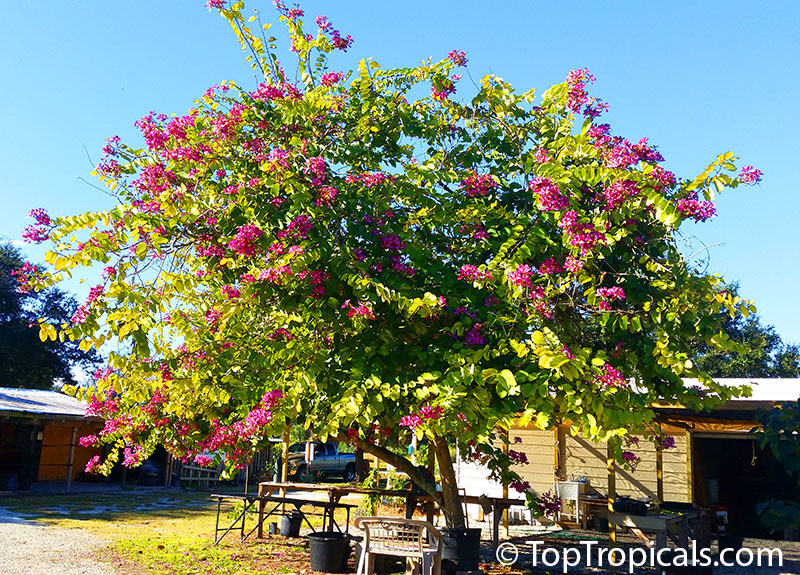
1) Selection. If you have room, get one of these most popular Florida shade trees: Royal Poinciana, Golden Shower, Hong Kong Orchid Tree, Red Kapok, Bottlebrush, and many others. See full list of fast growing shade trees. Or simply get a Mango Tree and have delicious fruit too! Many varieties of Mangos are very large and fast growing.

2) Do it right. Even if you are planting a smaller tree, 1-3 gal size, it may become a nice shade tree within 2-3 years and start providing your driveway with desirable shade. The keys for fast growth are -
a) Good soil. Dig as big hole as possible and fill it with good rich soil containing compost. See planting instructions PDF.
b) Water. Do not rely on sprinklers and rains. Water your tree daily for the first week, then at least twice a week for another month. After that, irrigation system will be enough.
c) Fertilizer. Put a few handfuls of fertilizer in a planting hole. Then fertilize once a month during warm season. Apply micro elements for even better results and faster growth.

3) Ask experts. Contact our office for advice. We will suggest the most suitable shade tree for your yard based on features of your property: location, soil, exposure, etc.

Check out fast growing shade trees

Date: 24 Jun 2018

Care for ultra-tropical plants

TopTropicals

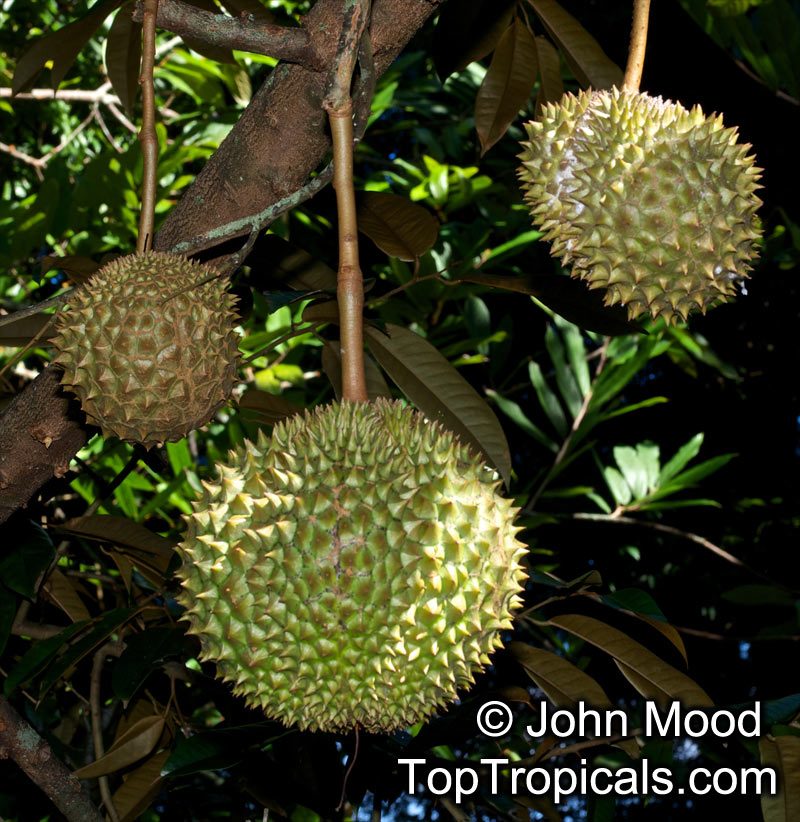
Some tropical plants like Durian, Breadfruit, Cacao are rare in plant collections and require true tropical environment for successful growing and most likely greenhouse conditions unless you live in mild tropical climate like Hawaii. These plants are hard to find and are not cheap. They can be shipped to you in original containers via Express mail and usually take trip well as long as there are no delays or overheating (or cold) during transportation. To enjoy your rare plant collection gem, please make sure to follow these recommendations:
- Keep your eye on delivery, track the shipment and make sure package is not left outside in the heat or cold.
- Unpack immediately and put plant in humid, warm environment with filtered light. Remember, "warm" for tropical plant means 78-85F.
- If a plant is wilted, put clear plastic bag over leaves to increase humidity for a few days. Keep the branches covered with clear plastic, in shade only - to avoid overheating.
- Keep soil slightly moist and don't let dry out. These plants like water as well as good drainage.
- Keep plant in original container until recovers from shipping stress. If necessary, re-pot in 2-3 weeks in bigger pot with rich organic potting mix, containing a lot of peat moss, and perlite or bark for good drainage.
- Grow these plants in warm and mild conditions, in filtered light, high humidity, with no temperature extremes. Remember to keep these plants at temperatures above 50F at all times.

Date: 24 Jun 2018

TopTropicals

How to make a Mango tree bloom and fruit

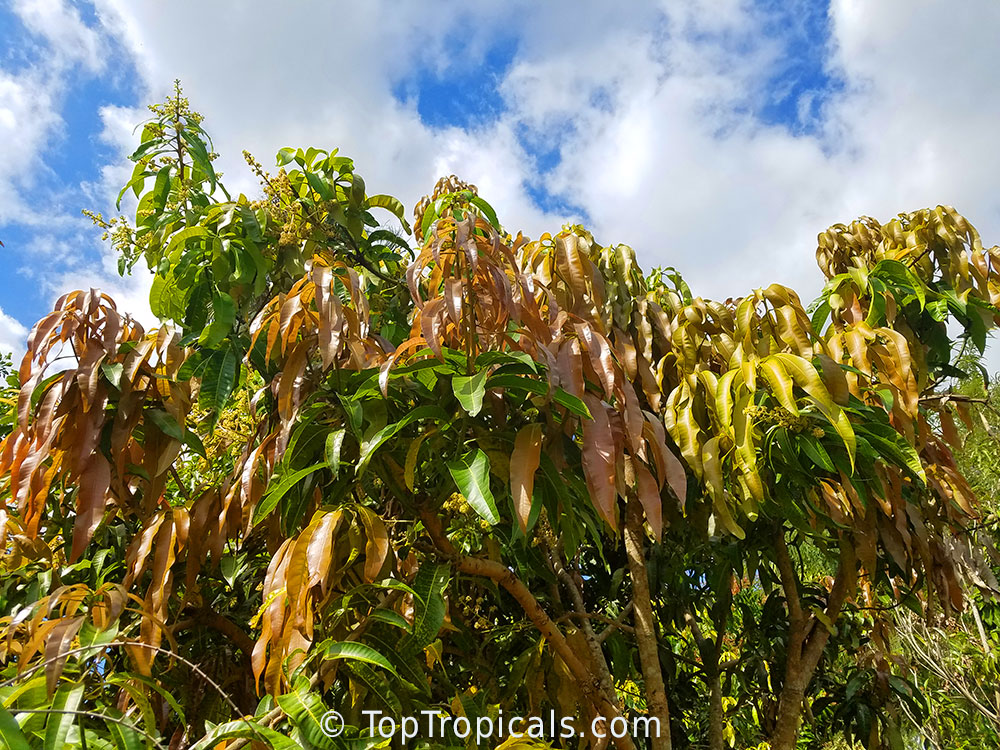
Mango trees are especially beautiful during spring time when they flush out multi-color new leaves! But you want your mango be not only beautiful but fruitful as well. Here are some tips:

1) Fertilize Mango tree with a balanced slow release fertilizer starting March. Use 1 tsp of granulated fertilizer per 1 gal of soil, or a handful or two for an in-ground tree. You may add one application of foliar spray of a water-soluble bloom booster fertilizer (the one for Roses or Azaleas will work). This will give your tree a good macro-nutrient kick-start.

2) Spray entire tree with SUNSHINE-Superfood solution. This will provide all necessary micro-elements and keep the plant healthy and strong throughout the season. Repeat treatment once a month until harvest time.

3) For sweeter fruit, apply SUNSHINE-Honey solution several times:
- early spring before flowering
- at setting buds
- right at the beginning of setting fruit
- after harvesting, to provide the tree with all good micro-nutrients before resting season.