Garden Blog - Top Tropicals

Date: 26 Feb 2026

Stop Sugar Crashes: 5 Tropical Fruit Hacks for Healthy Dessert
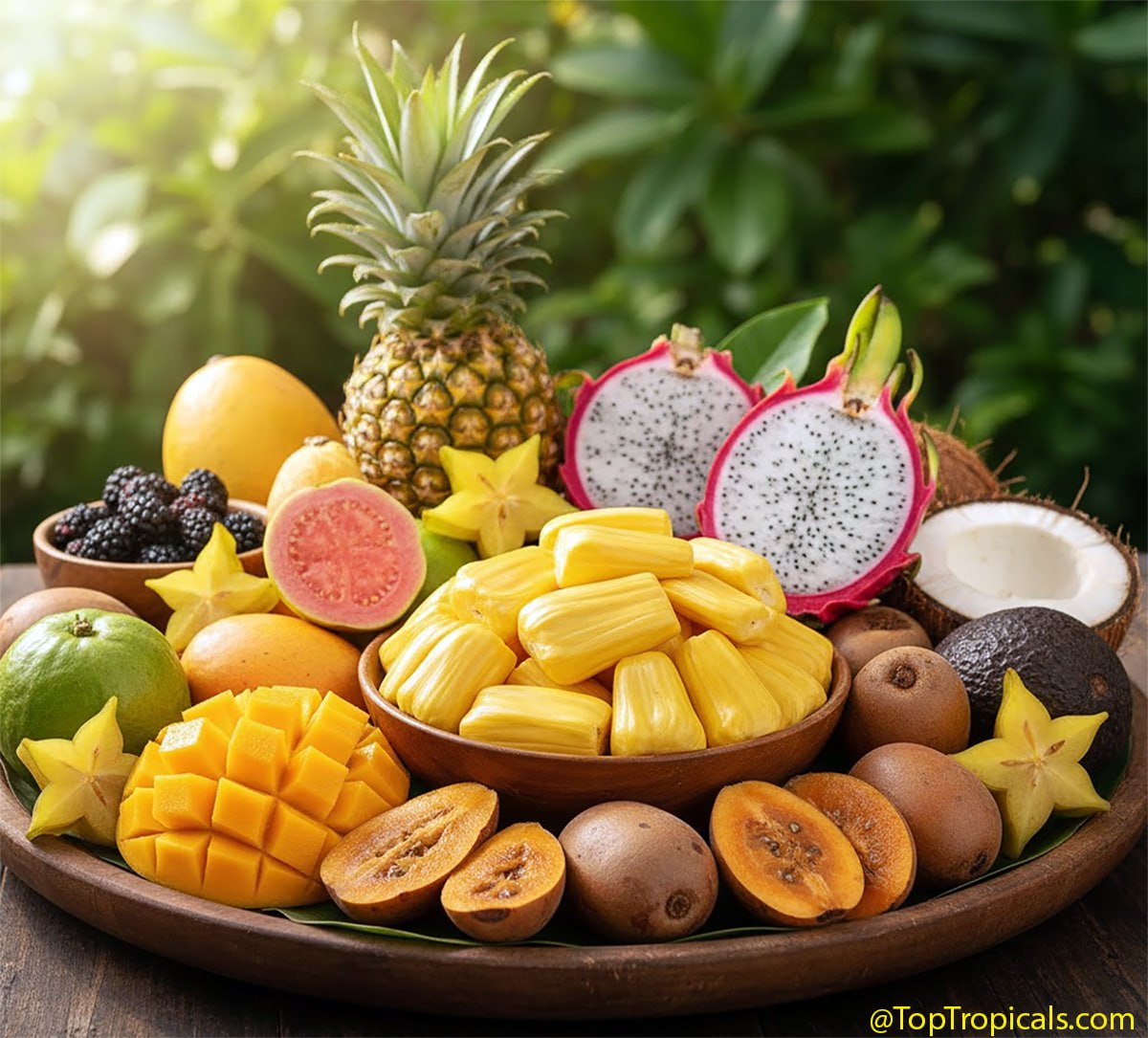
Exotic Tropical Fruits for Blood Sugar Management. Stop the sugar crash cycle. Learn how to manage glucose levels and insulin spikes using tropical fruits, healthy fats, and metabolic hacks for healthy dessert.

Exotic Tropical Fruits for Blood Sugar Management. Stop the sugar crash cycle. Learn how to manage glucose levels and insulin spikes using tropical fruits, healthy fats, and metabolic hacks for healthy dessert.

🍨 Stop Sugar Crashes: 5 Tropical Fruit Hacks for Healthy Dessert


The smarter way to handle sugar cravings - no restriction required

Tired of the post-cookie slump? Sugar cravings are a physiological response to blood glucose fluctuations, not a lack of willpower. Refined sugars trigger an insulin spike followed by a hypoglycemic crash, trapping you in a cycle of fatigue and hunger.
The secret to metabolic health is managing glycemic load. By choosing nutrient-dense tropical fruits, you satisfy your sweet tooth while maintaining stable energy homeostasis.
The solution is not to give up dessert. It is to change what dessert means. Here is how to use tropical horticulture to hack your biology and regulate insulin:

🍭 1. Choose fruit that comes with fiber


Whole tropical fruits deliver sweetness wrapped in fiber, water, and nutrients. That slows sugar absorption and keeps energy steady.
Try:
· Mango, chilled and sliced

Mango Plant Facts

Botanical name: Mangifera indica
Also known as: Mango
USDA Zone: 9 - 11
Highligths Large tree taller than 20 ftSmall tree 10-20 ftFull sunWatering: Moderate. Water when top soil feels dryYellow, orange flowersPink flowersEdible plantSeaside, salt tolerant plant
Get personalized tips for your region

· Sapodilla - naturally caramel-sweet
· Mulberries by the handful
· Loquat halves straight from the fridge
· Dragon Fruit for light, clean sweetness Same pleasure. Less crash.

🍭 2. Pair sweet with fat to blunt the glucose spike


Healthy lipids are a biological hack for your metabolism. Fats slow gastric emptying, ensuring a steady glucose release rather than an inflammatory spike. Furthermore, lipids trigger cholecystokinin (CCK) - the hormone that signals satiety to the brain - effectively "turning off" cravings at the source.
· Avocado blended into a chocolate-style mousse: The monounsaturated fats create a creamy texture while blunting the sugar response.

Avocado Plant Facts

Botanical name: Persea americana, Persea gratissima
Also known as: Avocado, Alligator Pear, Aguacate, Abacate
USDA Zone: 9 - 11
Highligths Large tree taller than 20 ftSmall tree 10-20 ftFull sunWatering: Regular. Let topsoil dry slightlyEdible plantSubtropical plant. Mature plant cold hardy at least to 30s F for a short time
Get personalized tips for your region

· Banana with nut butter: Combining fast-acting fruit sugars with dense protein and fats.
· Pineapple with raw nuts: The bromelain in pineapple aids digestion, while the fats in nuts provide long-lasting satiety.
· Mango mixed into full-fat yogurt: The combination of probiotics, protein, and lipids turns a simple fruit into a complete, low-glycemic snack. When fruit is balanced with fat, cravings calm down instead of escalating.

🍭 3. Use naturally rich fruits in place of sugar


Some tropical fruits taste like dessert already.
· Jackfruit has candy-like sweetness
· Sapote is creamy and custard-like
· Guava brings floral depth
· Cherries add brightness
· Mash Banana into baking instead of white sugar.
· Blend Mango into yogurt instead of syrup.
· Top oatmeal with Mulberry instead of brown sugar. Dessert stays. The crash disappears.

🍭 4. Balance sweet with tart


Adding contrast reduces the urge to overeat sweetness.
· Carambola adds crisp tang.
· Pineapple brightens the palate.
· Loquat gives gentle acidity. Balanced flavors satisfy faster.

🍭 5. Start the day right


Skipping breakfast increases late-day sugar cravings.
A morning smoothie with Avocado, Banana, and Mango prevents the afternoon energy dip. Hydration also matters - thirst often disguises itself as a sweet craving.

🍭 In essence


Dessert is not the enemy. Refined sugar is.
When sweetness comes from nature's bounty, it nourishes instead of draining energy.
You do not need to quit dessert.
You just need to let nature handle it.

Consult with a healthcare professional before making significant dietary changes, especially if you have diabetes or metabolic conditions

🛒 Start your tropical fruit journey

Annona · Guava · Mango · Sapodilla · Mulberry · Pineapple · Avocado · Banana · Loquat · Dragon fruit · Jackfruit · Sapote · Cherries · Carambola

📚 Learn more:


A leaf you grow, not a pill you buy: Insulin ginger - the plant people actually use
How to lose weight naturally with tropical fruit and plants
What's for breakfast? Guava versus Banana
11 tropical fruits to eat instead of taking a fiber supplement
How to make lots of Insulin Ginger plants quickly and get more health benefits
Truth about which fruit helps you lose weight faster: Mango or Papaya?
Five best tropical fruits to naturally boost your energy
Finally: a sugar that’s good for your health

#Food_Forest #Remedies #Discover

🟢 Join 👉 TopTropicals

Date: 23 Feb 2026

Macadamia Tree Care

By Tatiana Anderson, Horticulture Expert at Top Tropicals with Smokey & Sunshine help

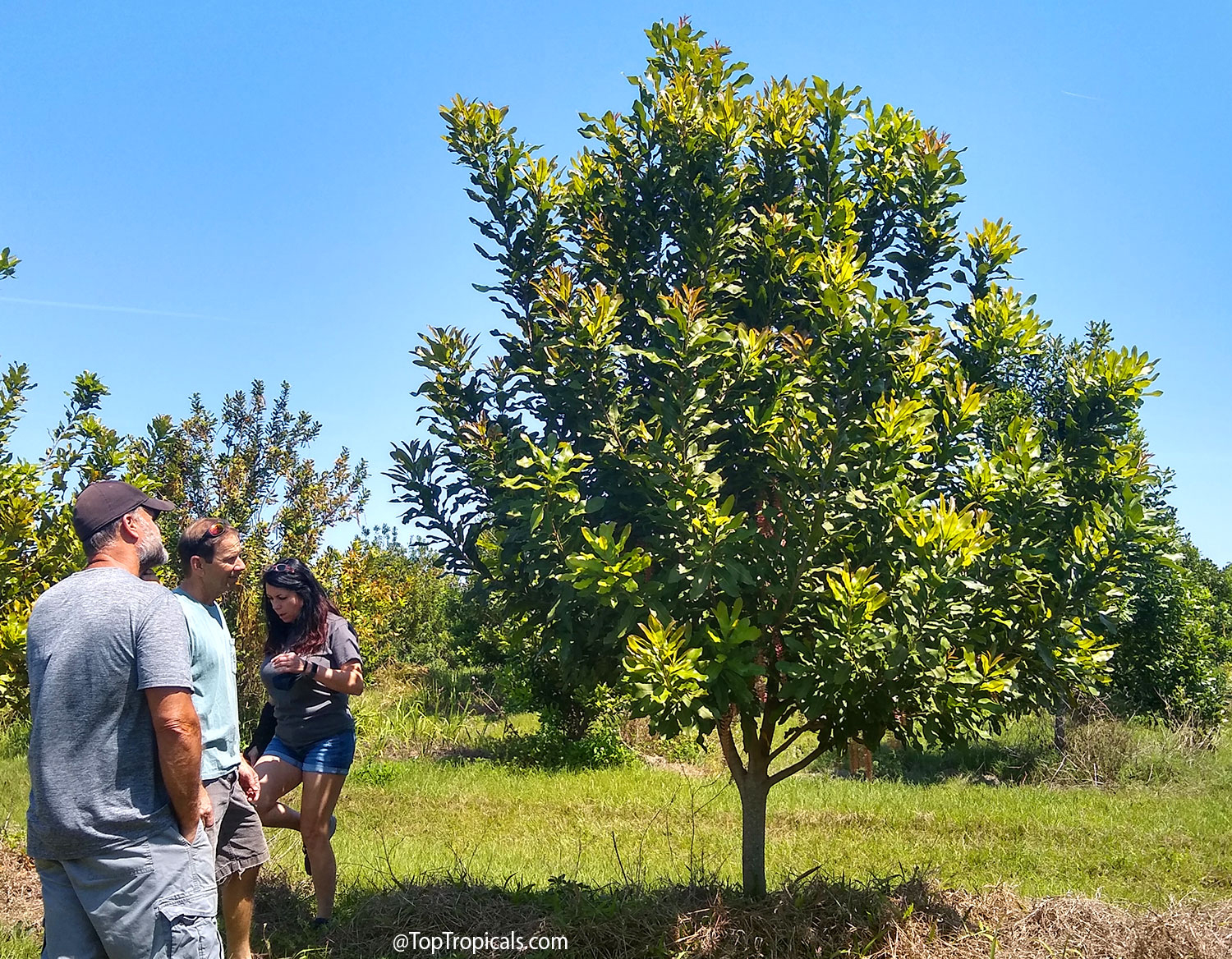
Mature  macadamia  tree  with  well-shaped  canopy  growing  in  Florida 
 orchard.

Macadamia tree maturing into a productive, manageable canopy.

🌳 Growing Macadamia Tree

Macadamia is not a fragile tree, but it does have preferences. If you respect them from the beginning, the tree rewards you for decades.

  • Start with the site. Drainage is everything. Macadamia will tolerate cool weather better if planted in a well-drained area. Avoid low spots where water sits after rain. If your soil is dense or clay-like, build a mound or improve drainage before planting.
  • Choose full sun whenever possible for the best nut production.
  • Planting location matters. A south or southeast exposure near a wall can create a warmer microclimate that buffers cold nights. Freeze plus wind is more damaging than temperature alone. Macadamia handles cold better when protected from winter wind.
  • Dig a hole about twice as wide as the container, but no deeper than the root ball. Set the tree level with the surrounding soil. Do not bury the trunk.
  • Water regularly during the first three months while the tree establishes roots.
  • Fertilize lightly. Macadamia does not respond well to over-fertilizing. Macadamias prefer mild liquid fertilizers, SUNSHINE Boosters Robusta is ideal for it. You may also use controlled release Green Magic every 6 months, it is especially formulated for hot climate. To keep leaves healthy deep green without yellowing, micro elements must be applied on regular basis, we recommend to always have handy Sunshine Superfood micro nutrients complex.
  • Young trees should be protected if temperatures drop below freezing. Once established, they become far more resilient.
  • Harvest timing: Nuts mature 6-7 months after flowering. Husk splits naturally when ready. Fallen nuts should be collected quickly.
  • Flower and Nut Drop: Many gardeners panic when they see flowers or small nuts drop, but Macadamia naturally sheds excess fruit. It does not mean failure; the tree simply keeps what it can afford to feed.
  • Macadamia is relatively low-maintenance, but watch for squirrels and rats. They love the rich nuts as much as humans do, so be sure to collect fallen nuts quickly.
  • Root Sensitivity: Macadamia roots dislike disturbance. Transplant carefully. Avoid root damage.
  • Macadamia is not a fast-return crop. It begins producing a few years and increases gradually. But once mature, it becomes a steady, reliable part of your garden.

Learn more: Macadamia - Hard Sweet Nut and Hardy Tree

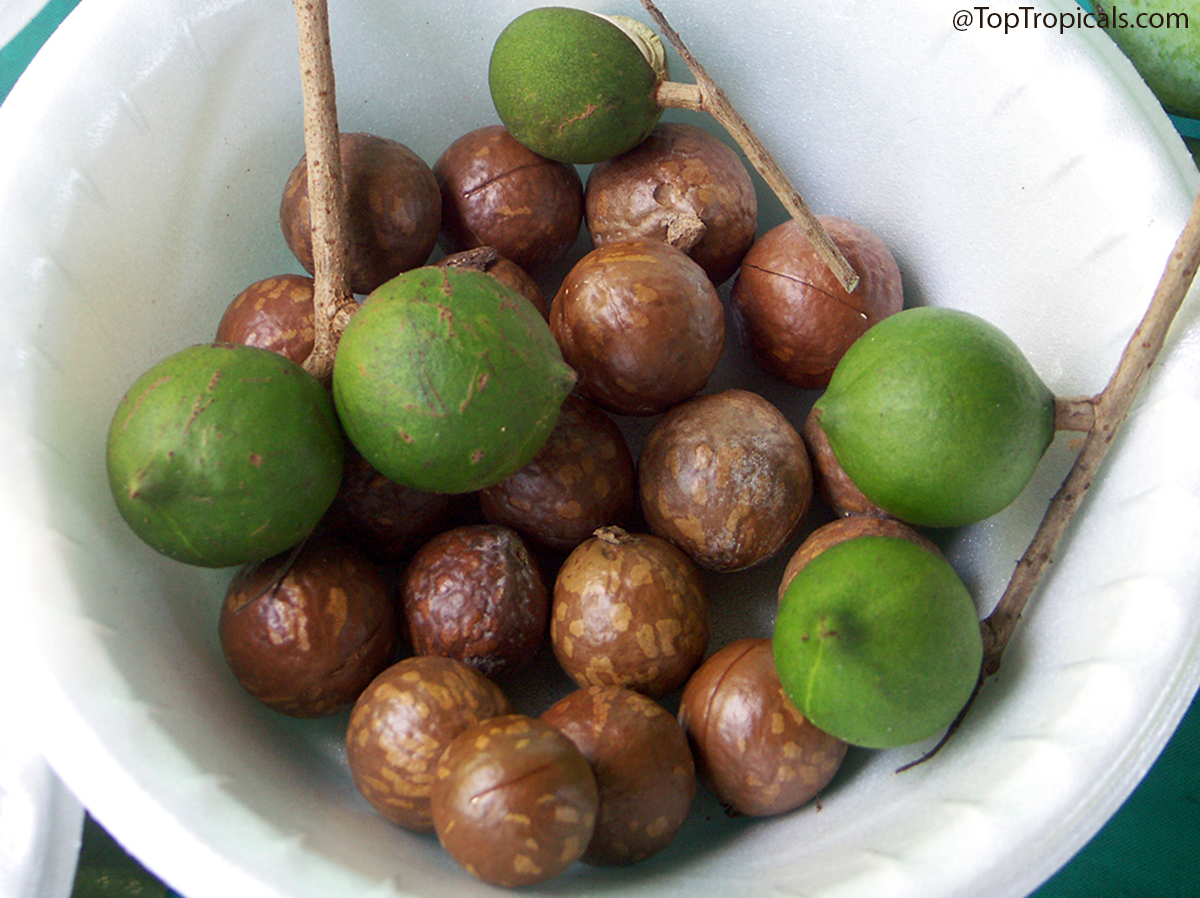
Fresh  green  macadamia  fruit  and  brown  hard-shelled  nuts  collected  in  a 
 bowl.

Macadamia fruit showing green outer husk and mature brown shell inside.

🌱 Growing Macadamia in a Pot

  • Container size: Start large. A 15-25 gallon pot is ideal for long-term growth.
  • Drainage: Critical. Use a container with multiple drainage holes.
  • Soil mix: Use a high-quality, well-draining container mix. Avoid heavy garden soil. Top Tropicals Abundance soil-less mix is specially formulated for pot growing
  • Light: Full sun is best. Strong light improves flowering and nut production.
  • Watering: Water deeply, then allow the top layer to dry slightly before watering again. Avoid constant saturation.
  • Feed lightly and consistenly. SUNSHINE Boosters Robusta liquid fertilizer is safe to use with with every watering. During hot season you may add controlled release Green Magic every 6 months. It is essential to apply micro elements on Macadamias: Sunshine Superfood micro nutrients complex.
  • Cold protection: If temperatures drop below freezing, move the container to a protected area such as a garage or greenhouse.
  • Pruning: Prune lightly to control size and maintain airflow within the canopy.
  • Expectations: Container trees may produce fewer nuts than in-ground trees, but they offer mobility and climate control.
  • Smokey says: Container trees offer mobility and climate control so you never have to worry about a freeze!

✍️ More About Macadamia from Garden Blog

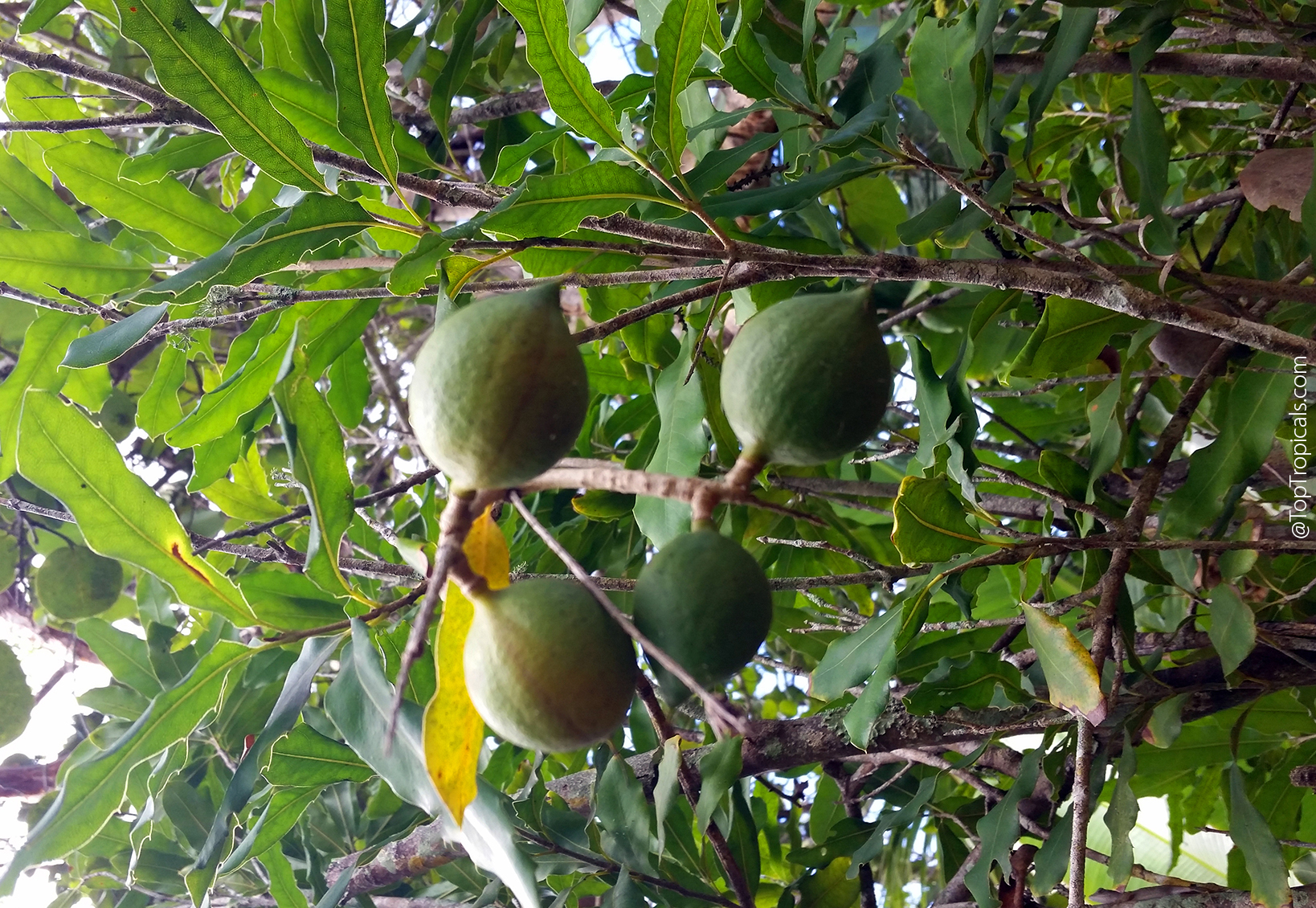
Green  macadamia  nuts  developing  on  tree  branch  among  glossy  leaves.

Macadamia nuts developing on the tree before the husk splits.

🚫 Common Mistakes When Growing Macadamia

  • Planting in poorly drained soil:
    The most common mistake. Macadamia will decline quickly in heavy, waterlogged ground. If drainage is questionable, plant on a mound.
  • Overwatering young trees:
    Newly planted trees need consistent moisture, not constant saturation. Wet roots lead to root problems.
  • Over-fertilizing:
    Too much fertilizer causes weak growth and nutrient imbalance. Feed lightly and avoid heavy nitrogen applications.
  • Planting too deep:
    The top of the root ball should sit level with or slightly above the surrounding soil. Do not bury the trunk.
  • Ignoring micronutrients:
    Macadamia is very prone to iron, zinc, and copper deficiencies. Yellowing leaves may signal a micronutrient issue. Applly Sunshine Superfood on regular basis.
  • Expecting instant production:
    Macadamia takes time. Early years build structure. Patience is part of success.
  • Skipping cold protection for young trees:
    Established trees are tougher, but young plants should be protected below freezing.

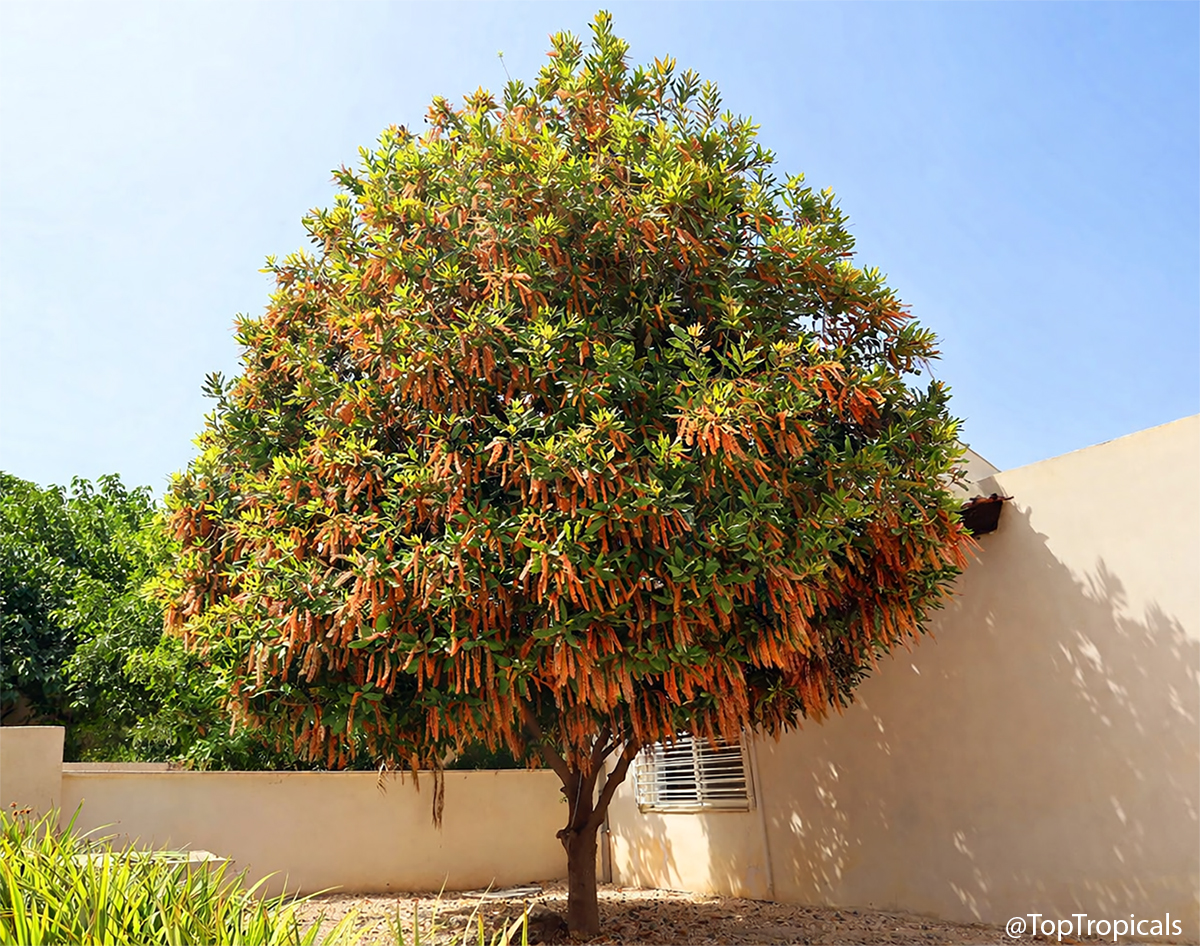
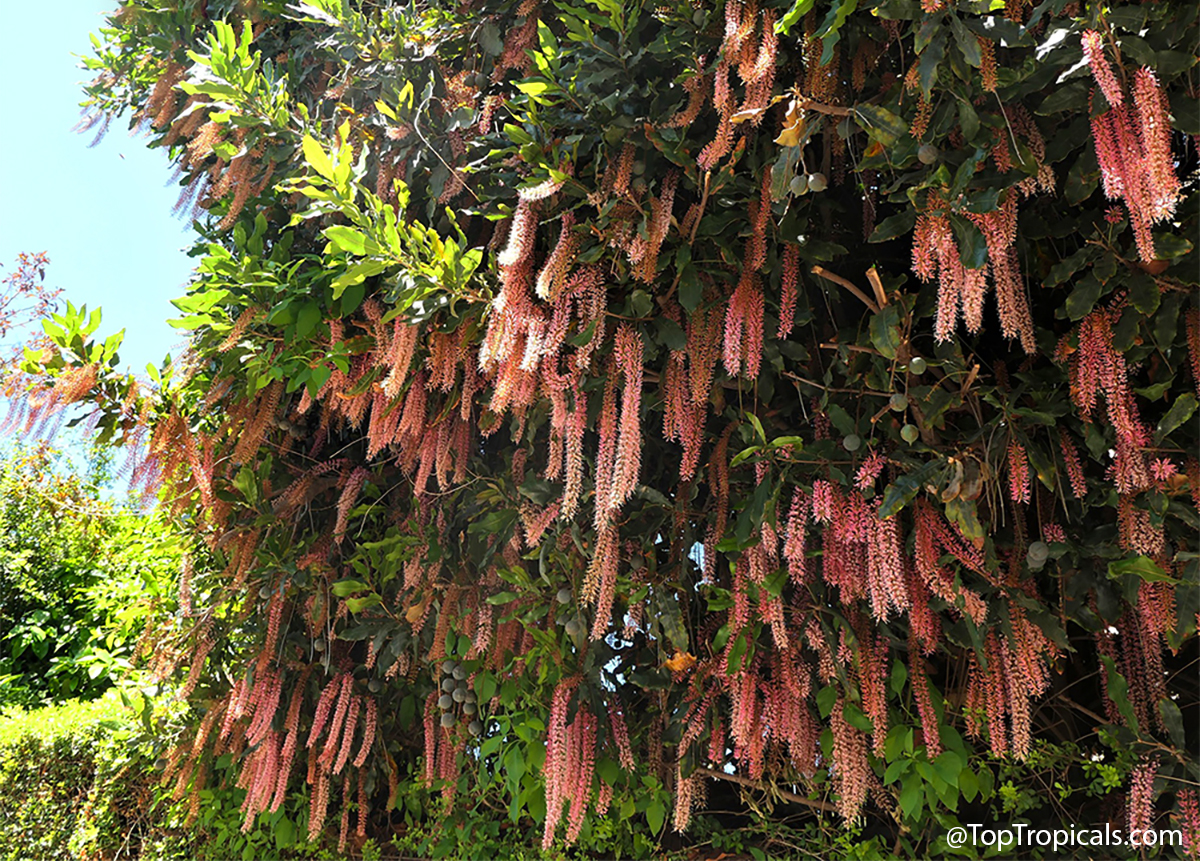
Macadamia  tree  in  full  bloom  covered  with  long  orange  flower  racemes.

Macadamia tree in full bloom with abundant flower clusters.

❓Frequently Asked Questions (FAQ)

  • Is Macadamia toxic to pets? While the nuts are a superfood for humans, they are toxic to dogs. If you have a dog that tends to forage in the garden, ensure you harvest fallen nuts promptly or fence the base of the tree during the drop season.
  • Which varieties are best for the "Survivor" garden? Look for Macadamia integrifolia (smooth-shell) or hybrids like 'Beaumont' (M. tetraphylla x M. integrifolia). Hybrids often show slightly better cold tolerance and more consistent "home garden" production.
  • How tall will my tree get? In the ground, an unpruned Macadamia can reach 20–30 feet. However, they respond very well to "heading back" (pruning the top) to keep them at a manageable 12–15 feet for easy harvesting.
  • Do I need two trees for cross-pollination? Macadamias are self-fertile, meaning one tree will produce nuts. However, planting two varieties near each other often results in a significantly heavier "nut set" due to cross-pollination.
  • Why are the leaves on my Macadamia prickly? Don't panic—this is normal! Some species, particularly M. tetraphylla, have serrated, holly-like leaves. This actually makes them a great "defensive" hedge against intruders or deer.
  • When exactly should I harvest? The tree tells you when it's ready. Don't shake the tree; wait for the nuts to fall naturally. In Florida, this usually happens between August and November. If the green outer husk hasn't split yet, let them sit in a shaded, dry spot until they do.
  • My tree has "clusters" of flowers but no nuts. What happened? Macadamias produce long racemes (flower spikes) with hundreds of tiny blooms. It is normal for 90% of these to fall off. The tree only keeps what it can afford to "feed." Boost your success by using a combination of Sunshine C-Cibus liquid fertilizer and SUNSHINE Superfood micro element supplement during the flowering stage to help the tree retain more fruit.
  • Can I grow them from a nut I bought at the store? Unlikely. Commercial nuts are usually roasted or dried at high heat, killing the embryo. Even if a raw nut sprouts, it may take 10–12 years to fruit and the quality is a gamble. Buying a grafted tree saves you a decade of waiting.

We don’t just sell plants; we test them. The data from this February freeze proves that with the right selection and proper drainage, 'tropical' doesn’t have to mean 'fragile.' Don’t wait for the next cold front to find out what in your garden is vulnerable. It is time to replace those empty spots with proven survivors that offer both beauty and a premium harvest. If it can stand up to 25F in our fields, it’s ready for your backyard.

Coming in Part 2...

Smokey is already crunching the numbers on our next survivor, and Sunshine found another tree that stayed perfectly green in the wind. Stay tuned to see which fruit tree made the cut!

Macadamia  tree  covered  in  long  pink  flower  racemes  during  peak  bloom.

Macadamia flowers forming long cascading racemes before nut set.

🎥 More Macadamia videos from our channel

🛒 Add Macadamia Tree to your garden

Date: 14 Feb 2026

🍭 From Vine to Bean: A Practical Guide

Vanilla  planifolia  vine  climbing  a  support,  close-up  of  vanilla  flower,
   and  cured  vanilla  beans

Vanilla planifolia Vine, Flower, and Cured Vanilla Beans

Madagascar Bourbon Vanilla Bean Plant Facts

Botanical name: Vanilla planifolia, Vanilla fragrans
Also known as: Madagascar Bourbon Vanilla Bean, French Vanilla, Vanilla Orchid
USDA Zone: 9 - 11
Highligths Vine or creeper plantSemi-shadeWatering: Regular. Let topsoil dry slightlyYellow, orange flowersEdible plantSpice or herb plantFragrant plantSubtropical plant. Mature plant cold hardy at least to 30s F for a short time
Get personalized tips for your region

How to Grow Vanilla: quick how-to

Vanilla is not complicated, but it does have preferences. Start with a pot and regular, well-draining mix. It does not need anything exotic. Give it:

  • Bright, indirect light
  • Warm temperatures
  • Good humidity
  • Air movement

Most importantly, give it something solid to climb. A wooden trellis, a log, or a burlap-covered board works well. The surface should be porous so the aerial roots can grip.

As it grows, guide the vine gently. You can prune it to control size. Vanilla is slow to mature. That is normal.

The Bloom Secret

Vanilla does not bloom just because it looks healthy. It blooms when it feels secure.

This is a climbing orchid. It must attach firmly to a solid, porous support such as a wood log, trellis, or burlap-covered board. When the aerial roots grip and the plant reaches maturity, flowering becomes possible.

Once the flowers appear, they usually need to be hand pollinated to produce pods. Each flower stays open for only a short time, so timing matters.

How to pollinate vanilla: In this video, we show you exactly how to pollinate vanilla step by step

❓Vanilla care: quick FAQ

  • Does Vanilla planifolia really produce vanilla beans?
    Yes. Vanilla planifolia is the commercial source of vanilla. After flowering, it can form long green pods (vanilla beans). The aroma develops later during curing.
  • What is the secret to getting vanilla to bloom?
    Let it climb. Vanilla is a climbing orchid and usually will not bloom until its aerial roots attach firmly to a solid, porous support like a wood log, trellis, or burlap-covered board.
  • Do I need to pollinate vanilla flowers?
    Yes. In most home growing conditions, vanilla flowers must be hand pollinated to produce pods. Each flower is open for only a short time, so timing matters.
  • Can I grow vanilla indoors?
    Yes, if you can provide bright, indirect light, warmth, humidity, and a support to climb. A sunny room with filtered light and a trellis or log can work well.
  • What should I use for support?
    Use a sturdy trellis, a wood log, or a burlap-covered board. The key is a porous surface that aerial roots can grip. Avoid chemically treated wood. Check out this very unusual way to grow Vanilla Orchid over a wall.
  • What potting mix should I use for Vanilla plant?
    Start in a pot with a regular, well-draining potting mix such as Sunshine Abundance. As the plant matures, it relies more on its support and aerial roots than the soil.
  • What fertilizer should I use?
    Sunshine Boosters Orchidasm is formulated specifically for orchids and will work perfecty for Vanilla orchid as well.
  • How big will it get?
    As big as you let it. Train it and prune it. Vanilla grows according to the structure and space you provide.
  • How long until it flowers?
    Typically a few years. Vanilla is a long-term project, but it is very rewarding once established.

For Collectors and Enthusiasts:

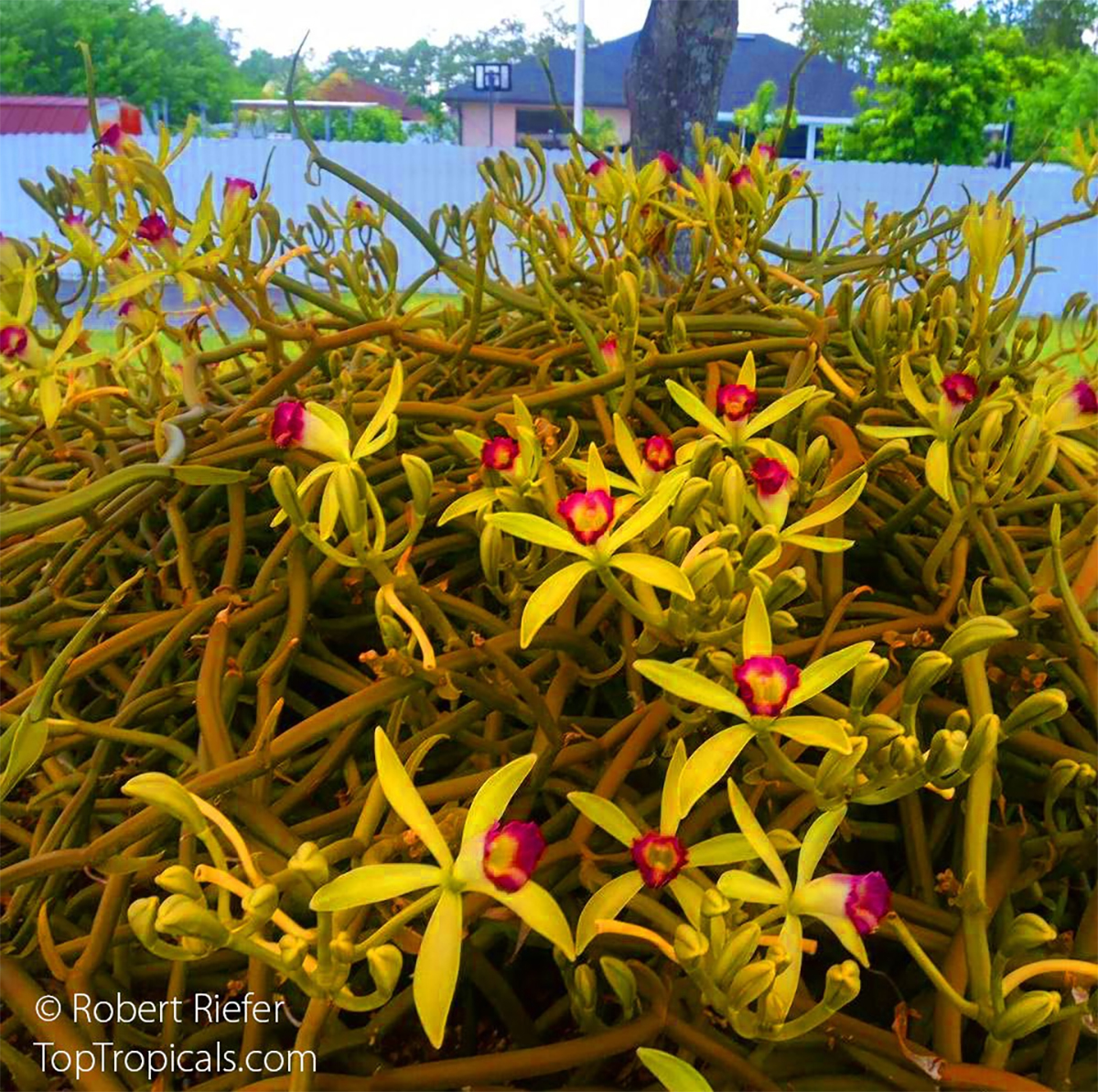
Vanilla  dilloniana  vine  covered  in  yellow-green  flowers  with  red 
 centers  growing  outdoors  in  100  gal  pot

Vanilla dilloniana in Bloom - Rare Florida Native Orchid

Leafless Vanilla Orchid Plant Facts

Botanical name: Vanilla dilloniana
Also known as: Leafless Vanilla Orchid, Dillons Vanilla
USDA Zone: 9 - 11
Highligths Vine or creeper plantSemi-shadeShadeWatering: Moderate. Water when top soil feels dryEpiphyte plantWhite, off-white flowersPlant attracts butterflies, hummingbirdsSpice or herb plantSubtropical plant. Mature plant cold hardy at least to 30s F for a short time
Get personalized tips for your region

We also offer Vanilla dilloniana, a rare Florida native species with distinctive flowers.

One remarkable specimen of this species, grown by our friend Robert Riefer, became so vigorous over many years that it outgrew a 100 gallon container and was eventually moved into a 250 gallon pool on wheels.

The plants we offer are propagated from that very specimen:

That kind of growth reflects deliberate cultivation and ideal conditions - not something that happens unintentionally.

Vanilla grows according to the space and structure you provide.

For gardeners focused on producing real vanilla beans for the kitchen, Vanilla planifolia remains the right place to start.

✍️ More About Vanilla Orchids from Blog

🎁 Shop Vanilla Orchids

Date: 12 Feb 2026

Hoa Mai and the Year of the Horse - why yellow flower Ochna is the luckiest plant of 2026?

Ochna integerrima - Vietnamese Mickey Mouse plant, Hoa Mai - seeds

Ochna integerrima - Vietnamese Mickey Mouse plant, Hoa Mai - seeds

Ochna integerrima - Vietnamese Mickey Mouse plant, Hoa Mai tree

Ochna integerrima - Vietnamese Mickey Mouse plant, Hoa Mai tree

Ochna integerrima - Vietnamese Mickey Mouse plant, Hoa Mai flowers

Ochna integerrima - Vietnamese Mickey Mouse plant, Hoa Mai flowers

🔥 Hoa Mai and the Year of the Horse - why yellow flower Ochna is the luckiest plant of 2026?


Ochna integerrima - Vietnamese Mickey Mouse plant, Hoa Mai has seeds and sepals that resemble the face of Mickey Mouse, hence the common name.

Vietnamese Mickey Mouse Plant Facts

Botanical name: Ochna integerrima, Ochna thomasiana
Also known as: Vietnamese Mickey Mouse Plant, Hoa Mai, Mai Vang, Hoang Mai
USDA Zone: 9 - 11
Highligths Large shrub 5-10 ft tallSemi-shadeFull sunWatering: Moderate. Water when top soil feels dryYellow, orange flowersWhite, off-white flowersPlant attracts butterflies, hummingbirdsEthnomedical plant.
Plants marked as ethnomedical and/or described as medicinal, are not offered as medicine but rather as ornamentals or plant collectibles.
Ethnomedical statements / products have not been evaluated by the FDA and are not intended to diagnose, treat, cure, or prevent any disease. We urge all customers to consult a physician before using any supplements, herbals or medicines advertised here or elsewhere.Fragrant plant
Get personalized tips for your region


💖 On February 17, 2026, the Lunar New Year begins - welcoming the Year of the Fire Horse


And if there is one plant that perfectly captures the bold, bright energy of a new zodiac cycle, it is Ochna integerrima, known in Vietnam as Hoa Mai. This cheerful yellow bloomer is not just decorative. In Vietnam, it is the flower of Tet - a living symbol of luck, prosperity, and fresh beginnings.

💖 Does Vietnamese New Year start on a different date in 2026?


No. In 2026, Tet - the Vietnamese Lunar New Year - begins on the same day as the Chinese Lunar New Year: February 17. Tet follows the lunar calendar, just like Chinese New Year, so both celebrations align this year.
Tet, officially called Tet Nguyen Dan, marks the arrival of spring and is the most important holiday in Vietnam. And nothing represents Tet in southern Vietnam more than Hoa Mai in full bloom.

💖 Why Hoa Mai is the flower of Tet


Hoa Mai literally means "yellow blossoms". In southern Vietnam, these bright yellow flowers open right around Lunar New Year, often covering the entire plant.
The color yellow symbolizes:
· Wealth
· Prosperity
· Happiness
· Good fortune

Families display flowering Hoa Mai trees in homes, courtyards, and businesses during Tet. The more blossoms, the more luck the coming year is believed to bring.

💖 Why it is called the Mickey Mouse plant


After flowering, Ochna integerrima produces glossy black berries that sit on bright red sepals. The combination looks surprisingly like a tiny cartoon face - two black "ears" and a round head - which is how it earned the nickname Vietnamese Mickey Mouse plant.

It is playful, unusual, and a total conversation starter.

💖 A perfect plant for Year of the Fire Horse energy


The Fire Horse year is associated with:
· Passion
· Independence
· Bold action
· Fast movement
And honestly? A plant that explodes into golden blooms in the middle of winter feels exactly right for that kind of year!
If you have been waiting to start something new - planting a rare shrub, reshaping your garden, training a miniature tree - this zodiac cycle carries that "go for it" momentum.

💖 Can you grow Hoa Mai outside Vietnam?


Yes - and that is part of its appeal. Ochna integerrima - Hoa Mai - is:
· A slow-growing, medium shrub
· Trainable into a small tree or bonsai form
· Suitable for containers
· Relatively tolerant of light frost
It blooms in winter, when many tropical collections feel quiet. That alone makes it valuable in warm-climate gardens like Florida.

To encourage winter blooms, steady feeding before and during the cooler season helps stimulate bud formation. Consistent light, good drainage, and balanced fertilization are key.

💖 A living symbol of luck for 2026


Every Lunar New Year carries its own theme. The Year of the Fire Horse is about bold growth, forward motion, and courage.
Hoa Mai blooms exactly at the moment when people reset intentions, clean their homes, and welcome fresh energy. It is not just a plant - it is a seasonal signal that a new chapter has begun.

And if you want to invite a little more golden luck into your garden this February, few plants say "new year, new beginning" better than Hoa Mai in full bloom.

🛒 Plant your own lucky Mickey Mouse Plant

📚 Learn more:


Ochna integerrima in Plant Encyclopedia
What is Mickey Mouse Plant?
2026: Year of the Fire Horse - time to grow bold, live free, and plant lucky
Year of the Fire Horse - what should you grow in 2026?
More #Horoscope info for plants and cats

#Horoscope #Hedges_with_benefits #Nature_Wonders #Fun_Facts

🟢 Join 👉 TopTropicals

Date: 8 Feb 2026

How to grow Chinese Hat Flower

Holmskioldia sanguinea - Chinese Hat Flower

🎩 How to grow Chinese Hat Flower - when winter colors most needed


The Holmskioldia sanguinea, better known as the Chinese Hat Flower, gets its name honestly. Each bloom looks like a tiny hat or parasol - a little tube backed by a flat, round disc. Once you notice it, you cannot unsee it!

Chinese hat Plant Facts

Botanical name: Holmskioldia sanguinea
Also known as: Chinese hat, Cup and Saucer, Parasol Flower, Mandarins hat
USDA Zone: 9 - 11
Highligths Large shrub 5-10 ft tallVine or creeper plantSemi-shadeFull sunKeep soil moistRed, crimson, vinous flowersPlant attracts butterflies, hummingbirdsSubtropical plant. Mature plant cold hardy at least to 30s F for a short timeSeaside, salt tolerant plant
Get personalized tips for your region


What really makes this plant special is when it blooms. While most gardens slow down, Chinese Hat Flower kicks into gear from winter through early spring. The branches fill with flowers first, and the leaves follow later. It is one of those plants that quietly steals the show when everything else is taking a break.

More than one color


Most people know the classic red form, but there are several color varieties worth mentioning:
🔴 Red - the most common and bold
🟡 Yellow - Holmskioldia citrina, bright and cheerful, harder to find
🟠 Bronze / orange-bronze - warm tones that glow in winter light
Having different colors makes it easy to mix them or use just one as a winter focal point.

How it grows and where it works best


Chinese Hat Flower is a fast-growing, scrambling shrub. It is not stiff or formal. Think loose, graceful branches that like support. It does great when trained on:
· Trellises
· Fences
· Arbors
· Large containers with a support
· You can also let it grow as a free-form shrub and lightly prune to keep it tidy.

Care, the practical version


· Light: Full sun to light shade
· Water: Regular watering, especially while establishing
· Soil: Well-drained, not picky
· Pruning: After flowering to shape and encourage new growth
Once established, it is easygoing and forgiving.

Bonus points


· Blooms when the garden needs color most
· Attracts butterflies and hummingbirds
· Works as a flowering screen or accent plant
· Looks tropical without being high-maintenance

If you like plants that earn their space and do something interesting in winter, Chinese Hat Flower is one to keep in your garden.

🛒 Explore varieties of winter-blooming Chinese Hats

📚 Learn more:


· Holmskioldia - Chinese Hat - in Plant Encyclopedia
· This is the bush you should let flower for you: Chinese Hat is in bloom
· Why is it called Chinese Hat Flower
· Colorful varieties of Holmskioldia sanguinea - Chinese Hat Flower
· 13 festive shrubs with bright flowers that bring color to your Winter Garden when everything else is dormant
· Ten shrubs you need to have for winter colors

#Butterfly_Plants #How_to #Hedges_with_benefits

🟢 Join 👉 TopTropicals