Easter Lily Vine creates a fragrant privacy fence of virtually unlimited size
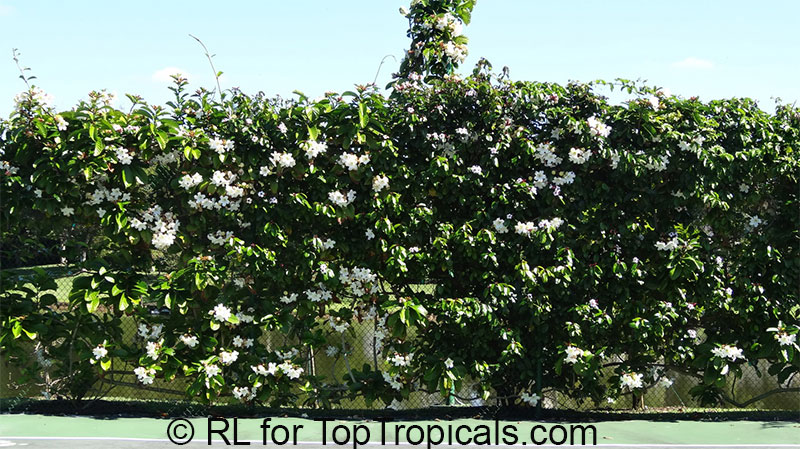
By Ron, South Florida.Easter Lily Vine (Beaumontia grandiflora) is a magnificent woody evergreen climber of unlimited growth potential. A branch of this vine will grow simply until you cut it. I have branches of up to 30 ft. and longer.
I've used two plants to turn a chain-link fence into a privacy screen that is 40 ft. wide by 10 ft. tall, but even a single plant can cover a much wider space if trained properly.
Easter Lily Vine's growth rate is moderate, so it doesn't require constant pruning to keep under control like other vigorous vines. I bought mine in 7 gallon pots, and planted them in the ground immediately. It took about 2 years to completely cover the fence. Since then, I prune it 3-4 times a year.
Keep in mind that these plants are heavy and require a solid structure as support. They twine by nature, but only around items with 3†diameter or more. Mine twined around a near-by lighting pole!
The absolute key in training Easter Lily Vine is to force it to grow horizontally. I recommend planting a young 3 gallon size vine in the ground diagonally, so it grows horizontally. Tie it no more than a foot above ground and let it grow a single branch until the end of the space you want to cover. Then force it to make a U-turn and let it grow the other way. See the following diagram for illustration..
Stop Fixing Your Soil: 15 Bulletproof Fruit Trees for Tough Ground
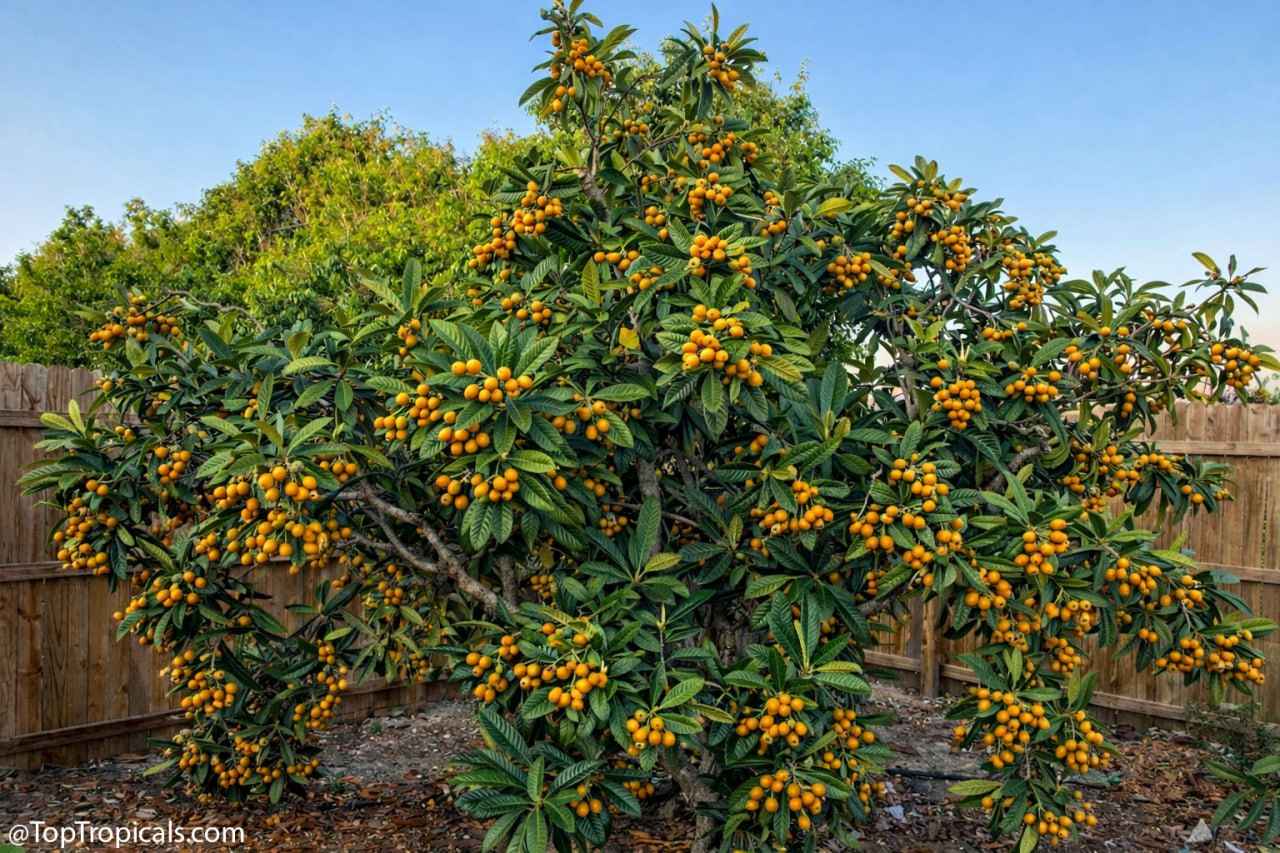
Loquat (Eriobotrya japonica) fruiting
Stop Fixing Your Soil: 15 "Bulletproof" Fruit Trees for Tough Ground 💩
Not everyone starts with a lush, loamy paradise. In many parts of Florida and the South, "soil" is just a polite word for sand, limestone rock, or depleted clay.
The biggest mistake new gardeners make? Spending hundreds of dollars on soil amendments before they ever put a tree in the ground.
The secret the pros know: You don't need to change your land to fit your plants; you need to choose plants that love your land. Some of the most delicious fruits actually thrive on neglect - and a few even produce better fruit when the soil is "poor."
🌳 The "Big 5" Toughest Fruit Trees
If your yard is a dry, sandy lot or a rocky outcrop, start with these. They are the ultimate "survivors."
Jujube, Chinese Date (Ziziphus jujuba): Arguably the toughest fruit tree on earth. It laughs at drought, poor soil, and neglect. The fruit is crisp like an apple when fresh and sweet like a date when dried.
Loquat (Eriobotrya japonica): A Southern staple. It’s evergreen, beautiful, and produces honey-sweet fruit in early spring when nothing else is ripe.
Mulberry (Morus alba): If you can’t grow a Mulberry, you might be gardening on the moon. It grows in sand, clay, or sidewalk cracks with equal enthusiasm.
Fig (Ficus carica): Figs actually prefer not to be pampered. In overly rich soil, they grow lots of leaves but little fruit. Give them well-drained, mediocre soil and they’ll thrive.
Pomegranate (Punica granatum): These trees are "stress-lovers." Rocky, alkaline soil is no problem, and a bit of soil stress often results in a higher sugar content in the fruit.
🌳 Tropical Flavors That Don't Need "Perfect" Dirt
You don’t need a rainforest to grow tropical treats. These species are surprisingly resilient once they get their roots established.
🌟 The Sand-Lovers:
Mango (Mangifera indica): While young trees need a little babying, a mature Mango is incredibly drought-tolerant and handles Florida’s sandy "sugar sand" like a champ.
Sapodilla (Manilkara sapota): A rugged, wind-resistant tree that produces fruit tasting like brown sugar and pear. It is a top-tier choice for coastal or sandy areas.
Tamarind (Tamarindus indica): It’s slow-growing but patient. Once it’s in, it’s there for a century, regardless of soil quality.
🌟 The Low-Maintenance Stars
Longan (Euphoria longana): If you’ve struggled with finicky Lychee trees, try Longan. It’s more cold-hardy and much less picky about its soil.
Citrus: While they need regular feeding (fertilizer), Citrus trees are naturally adapted to the sandy ridges of the South.
🌟 The "Quick-Win" Berry & Shrub Layer
If you want fruit this year, don’t wait for a tree to mature. Add these hardy producers to your edges. And here is why it works:
Dragon Fruit (Hylocereus undatus). It’s a cactus! It literally prefers poor, fast-draining soil over rich potting mixes.
Barbados Cherry (Malpighia glabra). A vitamin C powerhouse that handles low-nutrient soil with ease.
Grumichama (Eugenia brasiliensis). Slower grower, but steady and tolerant once established.
Surinam Cherry (Eugenia uniflora). Virtually indestructible. Often used as a hedge because it grows so vigorously in poor soil.
Pineapple Guava (Feijoa sellowiana). A beautiful silver-leafed shrub that is salt-tolerant and drought-resistant.
🌳 The Strategy: "Plant First, Improve Later"
In the South, the "dig a $100 hole for a $10 tree" rule doesn't always apply. Trying to completely re-engineer your soil often leads to drainage issues (the "bathtub effect").
Try this instead:
1. Select a species naturally adapted to your pH and texture.
2. Plant it at the correct height (never too deep!).
3. Mulch heavily with wood chips. This improves the soil from the top down over time, mimicking a natural forest floor.
How to get Canistel tree to produce
without dropping flowers and fruit
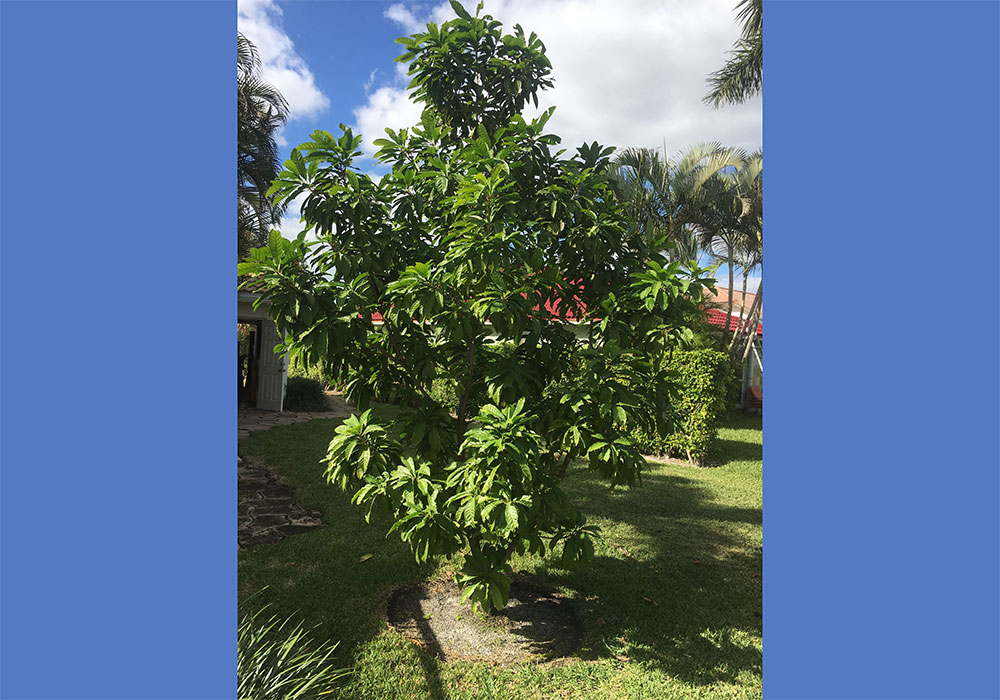
Q: My Canistel tree is 3 1/2 years old and is growing very well, see the
picture below. It gets hundreds of pea sized "berries" but then they fall off. No
canistel fruit. What's wrong?
A: You have such a nice looking tree, it is a shame you can't get
any fruit to ripen.
In our experience, Pouteria trees dropping fruit prematurely is a very common problem.
There may be one of the following reasons, or a combination of them:
- Cold winters may affect production, and while Canistel is generally
pretty hardy tropical plant that can easily withstand short periods of chill, the
fruit may never form properly if it had a cold winter.
- Lack of water. Canistel tree is pretty drought tolerant, but for the
proper production cycle it needs regular irrigation. Especially during hot
summer.
- The tree may be not strong enough; young trees drop fruit very often when
they don't have enough "fruiting energy" built up in their system.
Your tree looks well established and vigorous, however, flower/fruit drop
is often a sign of insufficient nutrients of particular kind, usually Boron
(B) and/or Molybdenum (Mo): either when a tree is too young and not strong
enough, or because of poor soils and lack of necessary elements.
Here is what can be done, considering you live in a warm, frost-free
climate.
1. Provide regular fertilizing program. We recommend liquid
fertilizers Sunshine Boosters that are safe to use with every watering and year
around. It is beneficial to switch plants from traditional "slow-release"
fertilizer to the liquid one because it makes a huge difference in plant growth
and flower/fruit quality and quantity. See also:
- Why liquid fertilizers are better than dry
- Article about benefits of liquid fertilizers.
2. Apply micro-element remedies that are very effective for
improving fruit production, especially when flower or fruit drop occurs:
SUNSHINE Honey - promotes more efficient blossoming and pollination, makes
flowers bigger and reduces bud drop. SUNSHINE SuperFood - improves plant vigor and quality and size of
flowers
These are all natural, eco-friendly supplements that work great for fruit
trees and other edibles.
Date: 25 Apr 2026
♥️ Mother’s Day: More Than a
Gift
Mom: You grew this… for me? You remembered my
favorite… Smokey: I did. Mom: You never forget what matters. It’s beautiful.
Smokey: Not as much as you. Happy Mother’s Day. Sunshine: You raised him right. It shows.
Some things stay with you from your mom.
A favorite fruit. A smell from the garden. The way she showed you how to
care for something and stick with it.
At the time, it felt small. Later, you realize it wasn’t. It turns
into something real - a tree, a habit, a way of doing things you still
follow.
Mother’s Day is simply a reason to tell your mom you remember. To
say thank you for what she taught you, and to show your love.
It does not have to be complicated. Just something that makes it clear
you were paying attention.
If you are thinking what to give, start simple.
A fruit she loves. A plant she will enjoy watching grow. Something
alive, not just something that sits on a shelf.
It does not have to be big. What matters is that it means something to
her.
And maybe, years from now, it becomes one of those things that stays.
We put together a few plants that make good Mother’s Day gifts.
Fragrant flowers. Fruit trees she can enjoy year after year. Easy
growers that do not require much effort.
If she has a favorite, start there. If not, pick something simple and
reliable.
Vanilla planifolia Vine, Flower, and Cured Vanilla
Beans
How to Grow Vanilla: quick how-to
Vanilla is not complicated, but it does have preferences. Start with a
pot and regular, well-draining mix. It does not need anything exotic. Give
it:
Bright, indirect light
Warm temperatures
Good humidity
Air movement
Most importantly, give it something solid to climb. A wooden trellis, a log,
or a burlap-covered board works well. The surface should be porous so the
aerial roots can grip.
As it grows, guide the vine gently. You can prune it to control size.
Vanilla is slow to mature. That is normal.
The Bloom Secret
Vanilla does not bloom just because it looks healthy. It blooms when it
feels secure.
This is a climbing orchid. It must attach firmly to a solid, porous
support such as a wood log, trellis, or burlap-covered board. When the
aerial
roots grip and the plant reaches maturity, flowering becomes possible.
Once the flowers appear, they usually need to be hand pollinated to
produce pods. Each flower stays open for only a short time, so timing
matters.
How to pollinate vanilla: In this video, we show you
exactly how to pollinate vanilla step by step
❓Vanilla care: quick FAQ
Does Vanilla planifolia really produce vanilla
beans?
Yes. Vanilla planifolia is the commercial source of vanilla. After
flowering, it can form long green pods (vanilla beans). The aroma develops
later during curing.
What is the secret to getting vanilla to bloom?
Let it climb. Vanilla is a climbing orchid and usually will not bloom until
its aerial roots attach firmly to a solid, porous support like a wood log,
trellis, or burlap-covered board.
Do I need to pollinate vanilla flowers?
Yes. In most home growing conditions, vanilla flowers must be hand
pollinated to produce pods. Each flower is open for only a short time, so
timing matters.
Can I grow vanilla indoors?
Yes, if you can provide bright, indirect light, warmth, humidity, and a
support to climb. A sunny room with filtered light and a trellis or log can
work well.
What should I use for support?
Use a sturdy trellis, a wood log, or a burlap-covered board. The key is a
porous surface that aerial roots can grip. Avoid chemically treated wood.
Check out this very unusual way to
grow Vanilla Orchid over a wall.
What potting mix should I use for Vanilla plant?
Start in a pot with a regular, well-draining potting mix such as Sunshine
Abundance. As the plant matures, it relies more on its support and
aerial roots than the soil.
What fertilizer should I use? Sunshine
Boosters Orchidasm is formulated specifically for orchids and will work
perfecty for Vanilla orchid as well.
How big will it get?
As big as you let it. Train it and prune it. Vanilla grows according to the
structure and space you provide.
How long until it flowers?
Typically a few years. Vanilla is a long-term project, but it is very
rewarding once established.
For Collectors and Enthusiasts:
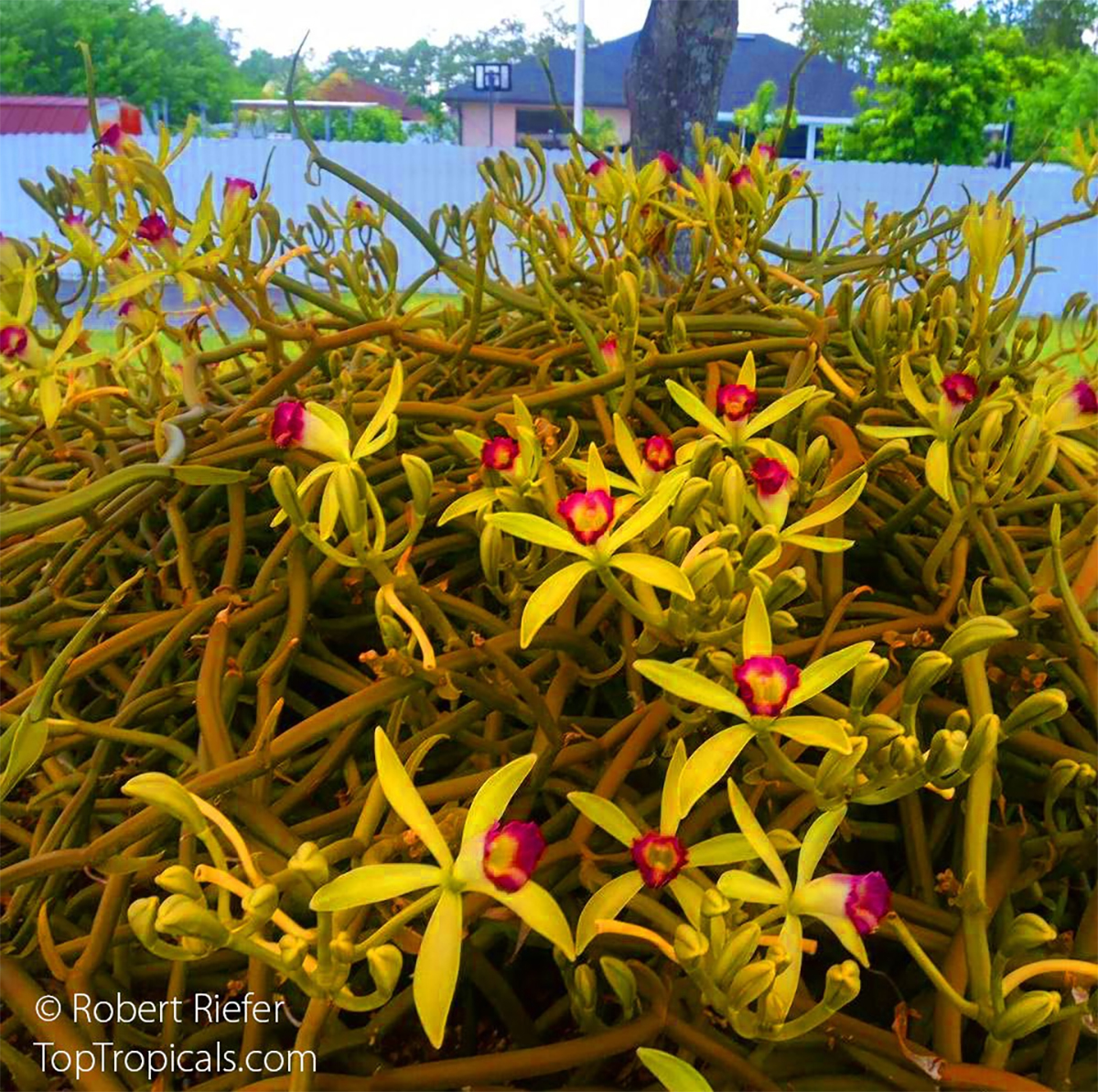
Vanilla dilloniana in Bloom - Rare Florida Native
Orchid
We also offer Vanilla dilloniana, a rare
Florida native species with distinctive flowers.
One remarkable specimen of this species, grown by our friend Robert
Riefer, became so vigorous over many years that it outgrew a 100 gallon
container and was eventually moved into a 250 gallon pool on wheels.
The plants we offer are propagated from that very specimen:
That kind of growth reflects deliberate cultivation and ideal conditions
- not something that happens unintentionally.
Vanilla grows according to the space and structure you provide.
For gardeners focused on producing real vanilla beans for the kitchen,
Vanilla planifolia remains the right place to
start.