Garden Blog - Top Tropicals

Date: 13 Apr 2021

Healthy Plants: Q&A from Mr Booster

Why my Avocado is not flowering?

Q: I have 5 avocados. Three of your cold hardy varieties and two others that have all flowered and set fruit in the past. The last two years including this year, not a single one of them has put out any flowers. I am getting lots of new growth like one would expect on a tree too young to flower. The last two years have been very mild with out any damaging frost where in previous years they lost all their leaves due to frost yet started putting out flowers once winter was over. I am confused because they have all flowered and set fruit previous years. Any ideas would be appreciated.

A: From information you provided, and considering the trees get lots of full sun and cold was not an issue, the only explanation is - lack of nutrients. Here is an example.
Very common situation: you get a small 2-3 ft Avocado or Mango tree in 3 gal pot (or even smaller) from a nursery, full of flowers, and sometimes even a small fruit. You bring it home, plant it in the ground or a bigger pot, it looks happy and grows like crazy. Then next year - oops, no fruit, sometimes not even flowers. What happened?
When the tree lived in a nursery, it was provided with all necessary nutrients through the injector systems (continuous feed); or some nurseries may use top dress smart release on regular schedule. Regardless of fertilizer type, professional grower's set up delivers plant food non-stop, on regular basis, with balanced formulas. Plants are not only growing fast but also ready to produce, since nutrients are always available for a full growth cycle.
When you plant a tree in the ground (or larger pot), conditions change. They may be beneficial for the plant: lots of room for roots to establish, hence lots of vegetative growth. Even if you planted it using good quality fertile soil, this soil may contain mostly nutrients responsible for vegetative growth (branches and leaves). Chances are, your soil may be rich in Nitrogen (good for green growth), but poor in other elements responsible for flowering and fruiting (Phosphorous, Potassium, and many important micro-elements such as Molybdenum, Boron, Iron, etc.). Besides, existing soil gets exhausted quickly, and within a year a two, if you don't add fertilizer, flowering and fruiting may be reduced or even stopped. This is why fertilizing program is very important for fruit trees that are expected to bring a crop soon.

We recommend:

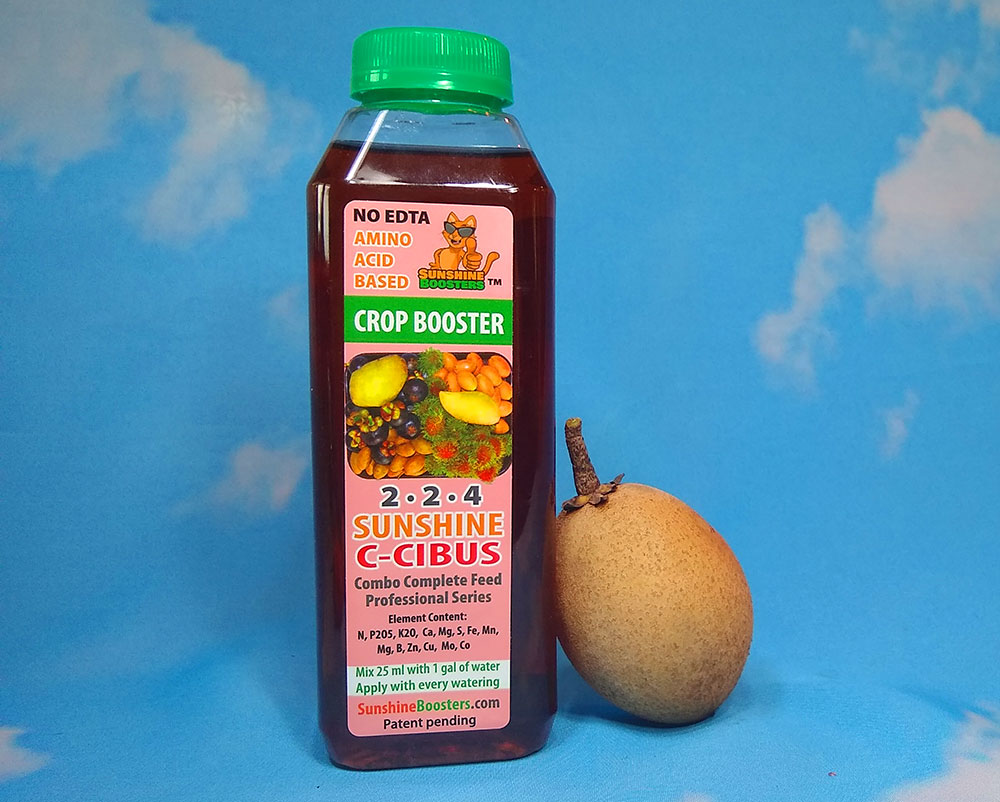
- SUNSHINE C-Cibus - Crop Nutrition Booster - balanced food for fruit trees
- SUNSHINE-Honey - sugar booster - promotes more efficient blossoming and pollination, makes flowers bigger and reduces bud drop
- SUNSHINE SuperFood - for improving fruit trees production

Also keep in mind that some fruit trees have a habit of "skipping" a year and may either produce less or not produce at all every other year. In any case, balanced nutrition program can help to fix this "bad habit".

Date: 28 Dec 2020

Healthy Plants: Q&A from Mr Booster

How to grow a happy Red Jade Vine?

Q: My Red Jade Vine has the leaf tips turning brown. I water this plant four times a week and I am using a half a teaspoon of miracle grow bloom booster 15-30-15 per 2 gallons, every two weeks. In the beginning I had to water this plant off city water in South Fort Myers. Over the last two months I picked up a dechlorinator buggy plus threw that on my hose and I've been watering it with that but it didn't seem to make a difference. I put this plant in the ground last September. It has three shoots that run into the top of the tree, so it is growing but leaves seem to drop off down low at the base of the vine and the brown tipping running into the top of the plant. But not the newest shoot its leaves are solid green all the way at the top. Thanks for any advice.

A: Mucuna benettii - Red Jade vine - is not the easiest plant to grow, and we are glad your vine is growing well. For those who love this plant but not ready to face all challenges, we recommend its cousin - Camptosema grandiflora - Dwarf Red Jade Vine, which is much hardier and easier plant.
We looked at the photos and these are our thoughts.

1) The top of the plant with green fresh leaves definitely indicates that the plant is generally healthy and vigorous.
2) Dry tips of the old leaves may indicate excess salts in soil, in combination with the summer heat that it went through. Based on your feeding program description, that fertilizer may create a problem. Water soluble traditional fertilizers are EDTA-chelated which often causes nutrients lock up in soil and leaf drop. Try to stay away from that fertilizer for a month and let the rains and/or irrigation water flush the soil for a couple of weeks.
3) Red Jade vine is a very sensitive species. Normally, during hot season it is safe to use traditional fertilizers, especially slow-release granulated. However, with this plant we recommend you to switch to more delicate formula and use only liquid fertilizer.
SUNSHINE Megaflor - Bloom Nutrition Booster will be the best. It is safe to use it as frequent as with every watering! It is amino-acid based, and will be totally consumed by the plant without nutrient lockup.
4) Another cause of dry leaf tips may be micro-element deficiency.
Megaflor booster already has all necessary micro-nutrients in it, plus you may apply some extra: SUNSHINE Superfood.
5) You may continue using regular water for watering (including city water) as long as you use amino-acid based plant food and supplements: they improve soil acidity (what tropical plants like is acidic soil, and Florida soils are alkaline). Additionally, to improve soil acidity which can be critical for this Mucuna species, you may add 1" layer of pure peat moss on top of the soil around the plant. Please keep us in loop how the plant is doing. It is pretty rare species in cultivation and we will be happy to help you to keep it thriving.

Date: 13 Aug 2020

Healthy Plant Food

Q&A from Mr Booster

Establishing Avocado Tree

Q: I received my avocado Wurtz tree yesterday. Per instructions I have put the tree in a pot first. However I am having difficulty deciding what to trim off. Yesterday I removed obvious damaged leaves. However as you can see, the leaves are lighter in some areas and contain yellow and red in some spots. What would you advise? Given this is a critical state as I do not want to shock the tree after the trip, I would like to do everything possible to protect it and ensure viability.

A: Your Avocado tree looks great and healthy overall. You've done excellent job planting it. Wurtz is a good, vigorous variety, while the tree is somewhat dwarf, great for containers.
You are right, it is the best for the tree to leave it alone and do not trim or remove leaves any more, until it starts showing new growth. Then it will be obvious what needs to be trimmed. Reddish/orange color of young leaves is normal. If any spots or dots - no need to remove those leaves yet. Wait until the plant grows more leaves. It needs them for photosynthesis, in order to become stronger.

Keep the tree in bright shade and gradually move from filtered sun to full sun. Water daily. Within a week or two after planting, you can start applying mild fertilizer and micro-elements. We recommend at this growth stage:
SUNSHINE C-Cibus - Crop Nutrition Booster
SUNSHINE SuperFood - Micro-element Plant Booster

SUNSHINE C-Cibus - Crop Nutrition Booster from Garden Series, or Combo Total Feed Collection - all nutrients in just one bottle, for fruit trees and edibles.

Date: 18 Feb 2021

Healthy Plants - Q&A from Mr Booster: Feeding Avocado Tree

Q:We bought one of your avocado grafts and it's doing great, lots of buds for fruit. It's still in a pot and fertilizing with the Sunshine Boosters. Should we continue with this product? We'll plant it in the ground in March. Thought you'd enjoy pictures of our wonderful tree. No freezing temperatures in Riverview, but when it got down into the 30s, the plant came in. One good thing about growing in the pot. I'll be buying some more Sunshine Boosters. This stuff is working great on all our plants.

A: Congratulations with a good job on growing avocado over winter. Avocado trees are not easy, we are happy to hear that your plant is ready for production, this is amazing! We've noticed that Sunshine Boosters perform miracles. Here are some suggestions for you:
1) Continue fertilizing with Sunshine Boosters according to the feeding chart
2) When ready to plant, dig a large hole and fill it with good soil full of organic matter (compost mixed with existing sandy soil will be good). Make sure to plant the tree on 3-4" high elevation, like on a little hill. Avocados need perfect drainage and can't tolerate wet feet. See more info on planting and planting instructions (pdf).
3) Water daily with a hose, do not rely on sprinklers. Avocados like water (considering perfect drainage)
4) Continue applications of Sunshine Boosters at least until the tree is established and starts growing new branches with lots of leaves. After that, you can switch to slow-release fertilizers once a month if it makes it easier, but if you can, continue Sunshine Boosters at least on weekly basis - they really boost plant growth!

Date: 31 Oct 2023

How to establish Tabernaemontana
and get more fragrant blooms

abernaemontana  australis  flowers

Q: I purchased Tabernaemontana australis from you back in June of this year and it recovered just fine, but the new growth got some chlorosis.   Older leaves still look normal.   The flowers also look normal but lack fragrance.   Since I live up north, I have it in a heated greenhouse for the winter, with a grow light to compensate for the short days.   I have it in a 10 inch clay pot in a mix of equal parts standard indoor potting soil, peat moss, and perlite.   It gets fed with half strength 10-10-10 about once a month on average.  Is there some specific culture that you would recommend for this plant ? I really love it and want it to thrive.

A: Tabernaemontana is a plant that may take some time to establish itself, and leaf chlorosis often becomes a common issue when the root system is not well-established. This symptom is indicative of Iron deficiency, and possibly other micro-element deficiencies, such as Boron or Molybdenum, which become more apparent when the plant receives excessive water. This problem tends to intensify as temperatures drop, particularly when a combination of cool and wet conditions prevails. It's worth noting that your potting mix seems to be appropriate for this plant.

In light of these circumstances, we recommend the following steps:

1) Reduce watering during the cooler season, especially when daylight hours are shorter. Allow the top layer of the soil to dry before watering again.

2) Consider supplementing with microelements using a product like   Sunshine Superfood. You can apply this as a foliar spray and mix it with your watering can.

3) Maintain your regular fertilizing program throughout the winter months, but ensure that you use only liquid amino-acid fertilizer, such as   Sunshine Megaflor. Follow the instructions on the label for the correct dosage and apply it with each watering, even during the winter. Since you will be reducing amount of water, the amount of fertilizer also will be adjusted accordingly.
Important: do not use any dry fertilizers during winter months (Nov-March).

Regarding the fragrance of the flowers, they typically emit a mild, sweet scent, although it may not be as potent as that of gardenia or jasmine. The strongest aroma usually becomes more prominent during warm (but not excessively hot) and humid conditions, particularly in the morning hours. As the plant grows larger and healthier, the fragrance should become more intense because the flowers produce more essential oil when the plant is robust. You may also apply Sunshine Honey supplement to improve flower quality and fragrance strength.

abernaemontana  australis  bush