Garden Blog - Top Tropicals
Date: 10 Nov 2026
Indias legendary plant of fire
🔥 Scarlet Plumbago: India's flower named after fire
Everyone knows Blue Plumbago. But have you seen its spectacular red relative? Plumbago indica (syn. P. rosea), or Scarlet Leadwort, produces long, graceful spikes of brilliant scarlet flowers that look like a fountain of miniature fireworks!
Unlike the familiar blue and white varieties, this tropical beauty is more demanding. But what a reward!
In India, Scarlet Plumbago is known as Rakta Chitraka (Red Chitrak) or Lal Chitra. Its ancient Sanskrit names include Agni (fire), Dahana (burning), and Dipika (illumination).
These fiery names have a fascinating explanation. The roots contain plumbagin, a powerful compound that can irritate skin.
For centuries, Chitraka has appeared in Ayurvedic traditions, where its roots were used in preparations associated with digestion and other ailments. Ancient texts distinguish red Chitraka from its white-flowered relative, Plumbago zeylanica.
- Shri Dhanwantry Ayurvedic College - Rakta Chitraka
No wonder this plant is so familiar to Indian gardeners! Its cultural significance extends far beyond its ornamental beauty.
Instead of the rounded flower clusters of Blue Plumbago, P. indica produces slender, elongated racemes packed with vivid red to rose-scarlet blooms. Its graceful, somewhat scrambling branches create a spectacular display, especially when multiple flower spikes cascade together.
In warm climates, flowering can extend through autumn and winter, bringing brilliant color when many summer bloomers are resting.
Here's the surprise: although they share a genus, Scarlet and Blue Plumbago behave very differently!
Blue Plumbago (P. auriculata) loves sunshine and recovers after Florida freezes.
Scarlet Plumbago is much more cold-sensitive, best suited to frost-free zones 10-11.
But here's a big advantage: Scarlet Plumbago is a compact plant, perfect for container culture! Unlike its sprawling blue relative, it fits beautifully into small gardens, patios, and even balconies.
It loves warmth, moisture, well-drained soil, and bright partial shade, especially protection from Florida's intense afternoon sun.
In cooler regions, simply grow it in a pot and bring it indoors before temperatures drop. A bright, warm sunroom or greenhouse makes an ideal winter home.
Scarlet Plumbago can be trained into a graceful, compact shrub or grown in a container, where its brilliant flower spikes become a stunning tropical accent.
It's not the toughest Plumbago in the family. But sometimes the most extraordinary plants deserve a little extra attention.
A plant named after fire, with flowers to match!
🛒 Grow India's Fiery Beauty


• Plumbago indica in Plant Encyclopedia
• Why Red Plumbago is so wanted for shade gardens
• Four best low-growing perennials that bloom all summer
#Shade_Garden #Container_Garden #Discover
🟢 Join 👉 TopTropicals
Everyone knows Blue Plumbago. But have you seen its spectacular red relative? Plumbago indica (syn. P. rosea), or Scarlet Leadwort, produces long, graceful spikes of brilliant scarlet flowers that look like a fountain of miniature fireworks!
Unlike the familiar blue and white varieties, this tropical beauty is more demanding. But what a reward!
🔥 India's legendary plant of fire
In India, Scarlet Plumbago is known as Rakta Chitraka (Red Chitrak) or Lal Chitra. Its ancient Sanskrit names include Agni (fire), Dahana (burning), and Dipika (illumination).
These fiery names have a fascinating explanation. The roots contain plumbagin, a powerful compound that can irritate skin.
For centuries, Chitraka has appeared in Ayurvedic traditions, where its roots were used in preparations associated with digestion and other ailments. Ancient texts distinguish red Chitraka from its white-flowered relative, Plumbago zeylanica.
- Shri Dhanwantry Ayurvedic College - Rakta Chitraka
No wonder this plant is so familiar to Indian gardeners! Its cultural significance extends far beyond its ornamental beauty.
🔥 A fountain of scarlet flowers
Instead of the rounded flower clusters of Blue Plumbago, P. indica produces slender, elongated racemes packed with vivid red to rose-scarlet blooms. Its graceful, somewhat scrambling branches create a spectacular display, especially when multiple flower spikes cascade together.
In warm climates, flowering can extend through autumn and winter, bringing brilliant color when many summer bloomers are resting.
🔥 The beautiful but delicate relative
Here's the surprise: although they share a genus, Scarlet and Blue Plumbago behave very differently!
Blue Plumbago (P. auriculata) loves sunshine and recovers after Florida freezes.
Scarlet Plumbago is much more cold-sensitive, best suited to frost-free zones 10-11.
But here's a big advantage: Scarlet Plumbago is a compact plant, perfect for container culture! Unlike its sprawling blue relative, it fits beautifully into small gardens, patios, and even balconies.
It loves warmth, moisture, well-drained soil, and bright partial shade, especially protection from Florida's intense afternoon sun.
In cooler regions, simply grow it in a pot and bring it indoors before temperatures drop. A bright, warm sunroom or greenhouse makes an ideal winter home.
🔥 Worth the extra care? Absolutely!
Scarlet Plumbago can be trained into a graceful, compact shrub or grown in a container, where its brilliant flower spikes become a stunning tropical accent.
It's not the toughest Plumbago in the family. But sometimes the most extraordinary plants deserve a little extra attention.
A plant named after fire, with flowers to match!
🛒 Grow India's Fiery Beauty
📚 Learn more:
• Plumbago indica in Plant Encyclopedia
• Why Red Plumbago is so wanted for shade gardens
• Four best low-growing perennials that bloom all summer
#Shade_Garden #Container_Garden #Discover
🟢 Join 👉 TopTropicals
Date: 9 Nov 2026
Smokey and Sunshine Have Fan Mail
💌 Smokey and Sunshine Have Fan Mail
Thank you to everyone who wrote after our latest Smokey and Sunshine newsletter. We loved reading your notes. You noticed the jokes, the pictures, the sprinkler watering the driveway, and what one reader called our "barely-disguised absolute truths."
You also noticed the missing donuts. We'll get to that.
We have a lot of fun putting these newsletters together, and it means a lot to hear that you enjoy them.
We shared your compliments with Smokey and Sunshine.
🍩 A Matter of Intelligence
One reader described the newsletter as creative, humorous, and intelligent:
✍️ "Just wanted you to know how much I enjoy your newsletter. Very creative, humorous and intelligent all at the same time. Thank you!"
Naturally, the cats had to discuss how to divide the credit:
Sunshine: A reader called us creative, humorous, and intelligent!
Smokey: A reader with excellent judgment.
Sunshine: Should we ask which one of us is intelligent?
Smokey: Must we fact-check every compliment?
🍩 Breakfast Under Inspection
Another reader spotted something missing from Sunshine's dance scene: his usual coffee and donuts. That reader happened to be a compliance inspector. Of all the mornings to forget breakfast.
Smokey: A compliance inspector noticed your missing coffee and donuts.
Sunshine: Are we in trouble? I just got carried away dancing!
Smokey: Apparently, your breakfast is now subject to inspection.
Sunshine: Finally, someone who takes it seriously!
🍩 For Future Reflection
One lovely note suggested saving these episodes so we could enjoy them with friends and family later. The reader used the word "gloat." Smokey preferred a more scholarly description.
Sunshine: A reader says we should save our columns so we can gloat later!
Smokey: An archive, Sunshine. For future reflection.
Sunshine: Is that different from gloating?
Smokey: Yes. You need glasses and a better chair.
A lot of work goes into these little episodes, and your messages make us glad we put in the time. It's especially lovely to hear that you've come to know the cats well enough to notice when Sunshine misses breakfast.
Thank you for reading, writing back, and keeping an eye on the donuts!
👍 Check out Top Tropicals Newsletters
📚 Learn more:
• About Smokey & Sunshine
• Smokey & Sunshine interview
#Smokey_Sunshine #PeopleCats
🟢 Join 👉 TopTropicals
Date: 9 Nov 2026
Three Tropical Pepper Plants You Can Grow and Eat
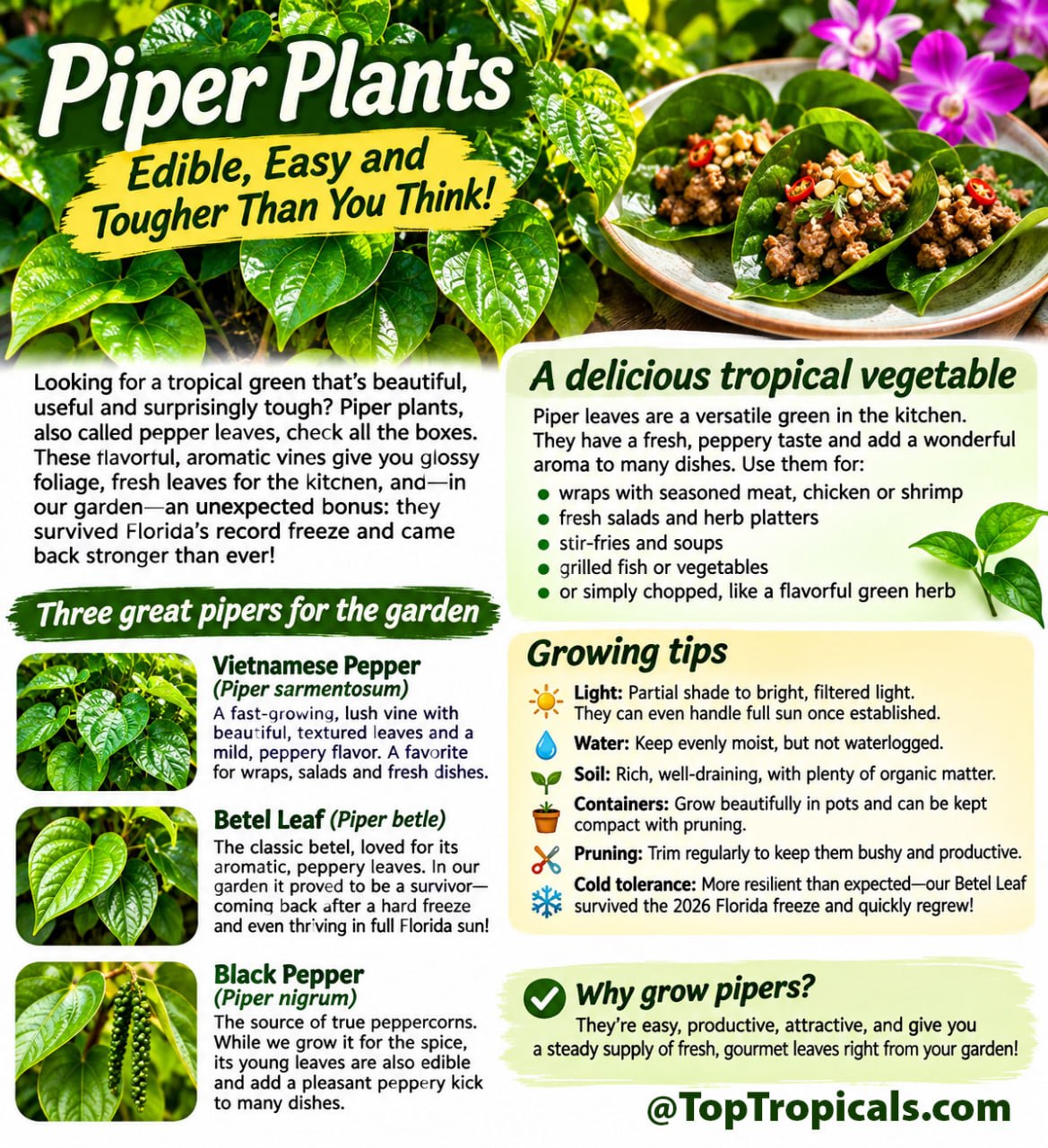
🍃 Three Tropical Pepper Plants You Can Grow and Eat
🛒 Grow Piper plants for tasty, peppery recipes
📚 Learn more:


• Piper sarmentosum in Plant Encyclopedia
• Grow Your Own Pepper Leaves: Three Tropical Vegetables Worth Discovering
#Food_Forest #Recipes #Container_Garden #How_to #Discover
🟢 Join 👉 TopTropicals
Date: 9 Nov 2026
Grow Your Own Pepper Leaves: Three Tropical Vegetables Worth Discovering
🍃 Grow Your Own Pepper Leaves: Three Tropical Vegetables Worth Discovering
Why buy exotic greens when you can pick them fresh from your garden? Pepper leaves are among the most useful edible plants we grow at Top Tropicals. They're beautiful, productive, easy to harvest, and bring wonderful flavors to everyday cooking.
Three favorites belong to the genus Piper, but each has its own personality.
🌿 Vietnamese Pepper – Piper sarmentosum
Also called Wild Betel or Lolot, this vigorous, low-growing plant produces beautiful, glossy, heart-shaped leaves.
The leaves have a distinctive peppery, aromatic flavor. They're especially delicious wrapped around seasoned meat and grilled, a popular Vietnamese preparation known as bò lá lốt.
It's an excellent edible groundcover for shady tropical gardens. It also grows beautifully in containers. Give it warmth, moisture, rich soil, and regular feeding for lush foliage.
🌿 Betel Leaf – Piper betle
Betel Leaf has glossy, heart-shaped leaves with a bold, spicy flavor, perfect for meat wraps and Asian dishes.
Normally a shade lover, our Betel Leaf gave us two surprises! It survived Florida's record February freeze without protection and regrew vigorously. Then we had to remove its shade tree that was damaged.
Now it's thriving in full Florida sun!
🌿 Black Pepper – Piper nigrum
Yes, the plant that produces ordinary black peppercorns also has edible leaves!
Unlike the other two, Black Pepper is a climbing vine. Give it a trellis, post, or tree for support.
Its young leaves can be used as an aromatic seasoning in cooked dishes, although peppercorns remain its main culinary attraction.
Grow it in warm, humid conditions with filtered sunlight and well-drained, organically rich soil.
🌿 Growing pepper leaves successfully
All three appreciate warmth, moisture, and fertile soil. A few simple rules help:
Light: Partial shade is the safest starting point. Established plants may tolerate more sun with sufficient moisture.
Water: Keep soil evenly moist, never constantly waterlogged.
Feeding: Regular light feeding encourages lush, flavorful foliage. Our Green Magic fertilizer produces beautiful, deep green growth.
Containers: All three grow in pots, although Piper nigrum needs climbing support.
Cold: Protect from frost, especially young plants. Our Betel Leaf's survival was an encouraging exception, not a guarantee.
Harvest: Pick healthy leaves regularly, leaving enough foliage for continued growth.
🌿 A vegetable that grows right outside your kitchen
Pepper leaves aren't just ornamental greenery. They're fresh, fragrant vegetables you can harvest whenever you need a handful.
Wrap them around meat, add them to cooked dishes, or experiment with traditional Asian recipes.
And unlike many vegetables that require constant replanting, these tropical perennials can provide repeated harvests for years in suitable climates.
💡Explore our Pepper Leaf recipes below, growing experiences, and individual plant guides.
🛒 Grow Piper plants for tasty, peppery recipes
📚 Learn more:
• Piper sarmentosum in Plant Encyclopedia
• 10-minute recipe Bo La Lot with a leaf you’ve never cooked before!
• 7 delicious ways to cook with Vietnamese Pepper - La Lot: Quick-n-Fun exotic recipes
• Lalot beef wraps: Quick-n-Fun exotic recipes
• Vietnamese Pepper - Lalot food wraps BBQ recipe
• Betel leaf bites: quick-n-fun exotic recipes
• Cooking with black pepper leaves
• How to grow your own Pepper plants. Five most valuable Pipers
• 9 tropical vegetables to grow indoors, or how to have garden-fresh produce all year
• How to to get Pepper leaves large and green
#Food_Forest #Recipes #Container_Garden #How_to #Discover
🟢 Join 👉 TopTropicals