Garden Blog - Top Tropicals
Date: 12 Sep 2026
What Makes a Great Potting Mix Recipe? The Best Ingredients and Why They Matter
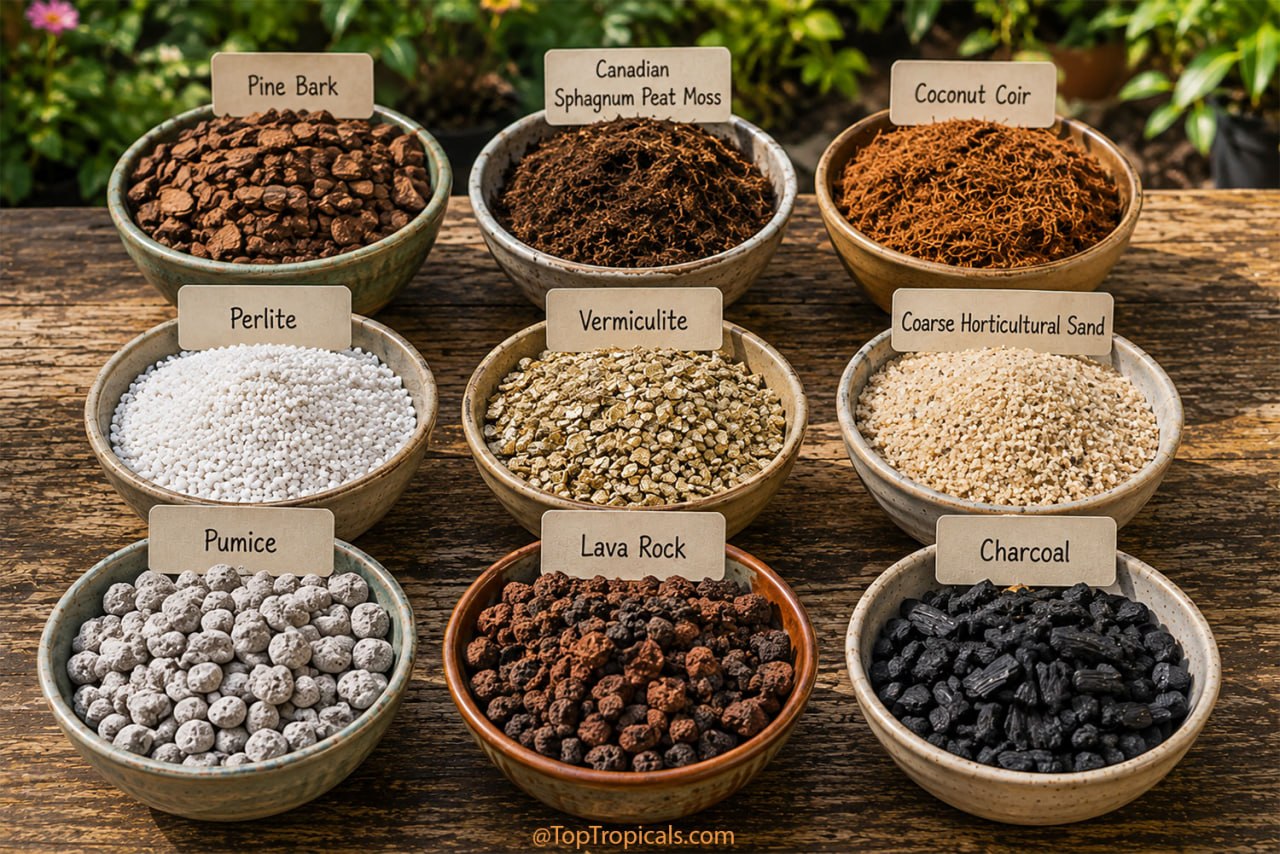
🍩 What Makes a Great Potting Mix Recipe? The Best Ingredients and Why They Matter
Walk into any garden center and you'll find dozens of bags labeled "potting soil."
Most look similar. They're not.
A professional potting mix isn't chosen because it's dark, rich, or cheap. Every ingredient has a specific purpose: creating healthy roots.
What makes a great potting mix?
A quality potting mix should:
✓ Drain quickly
✓ Hold enough moisture
✓ Contain plenty of air
✓ Stay loose for years
✓ Resist compaction
✓ Encourage healthy roots
✓ Be lightweight
✓ Be easy to re-wet
Remember: roots don't just absorb water - they breathe. Air is just as important as water.
Most tropical plants also prefer a slightly acidic potting mix (pH 5.5-6.5), which is one reason pine bark, Canadian peat moss, and coconut coir are widely used by professional growers.
The ingredients and what they do
Pine bark
The backbone of many professional mixes. Provides:
· structure
· drainage
· air pockets
· long-lasting texture
Excellent for tropical plants, fruit trees, orchids, and aroids.
Canadian peat moss
Provides:
· moisture retention
· light texture
· natural acidity
High-quality Canadian peat is preferred over heavier Florida peat (muck).
Coconut coir
One of our favorite ingredients. Provides:
· moisture retention
· aeration
· long-term structure
Advantages:
· re-wets easily
· stays evenly moist
· decomposes more slowly than peat
· excellent for seeds and rooting cuttings
· cleaner than ordinary soil
At Top Tropicals, we combine coconut coir with Canadian peat moss because each contributes something different to the mix.
Perlite
Expanded volcanic rock. Provides:
· drainage
· aeration
· permanent air spaces
Lightweight, sterile, and long-lasting.
Contrary to popular belief, perlite does not feed plants. Its job is to improve the physical structure of the potting mix.
Vermiculite
Best for:
· seedlings
· seed-starting mixes
· moisture-loving plants
· It holds more water than perlite, making it less useful in very airy tropical mixes.
Coarse horticultural sand
Useful for Plumerias, Adeniums, Cacti and Succulents
Never substitute coarse sand with beach sand or fine play sand.
Pumice or lava rock
Adds:
· permanent drainage
· permanent air space
Unlike shell rock or limestone, pumice and lava rock have very little effect on soil pH, making them excellent additions for tropical plants.
Other professional ingredients
Small amounts of wetting agents help fresh peat-based mixes absorb water evenly.
Dolomite lime helps balance the acidity of peat-based mixes.
Our proven potting mix - Abundance
The following formula has been proven in commercial production for decades.
At Top Tropicals, we've been growing tropical plants in containers for decades, and this is the mix we've found consistently produces healthy roots and vigorous growth.
Top Tropicals "Abundance" Mix key ingredients
50% pine bark
25% perlite
20% coconut coir
5% Canadian sphagnum peat moss
Excellent for most container-grown tropical plants
Why it works:
· Excellent drainage
· Excellent root aeration
· Holds enough moisture without becoming heavy
· Lightweight
· Long-lasting
Other mixes for special plants
Aroids and Epiphyllums
35% pine bark
30% coconut coir or peat moss
20% perlite
15% pumice
Adeniums and Plumerias
30% coarse horticultural sand
30% pine bark
20% perlite
20% coconut coir
The bottom line
Professional growers don't choose a potting mix because it looks rich.
They choose it because it grows healthy roots.
Every ingredient has a purpose.
When those ingredients work together, roots stay healthy, plants grow faster, and container gardening becomes much easier.
🛒 Get Our Proven Professional Potting Mix
📚 Learn more
· The complete guide to potting mix
· Potting Mix Explained: Why Garden Soil Kills Container Plants
· The #1 Rule for Mail-Order Plant: Don't Disturb the Roots
· How much water is too much?
· How to re-pot a plant properly
#Fertilizers #How_to #Discover
🟢 Join 👉 TopTropicals
Date: 11 Sep 2026
Daily Cat Lesson: Your Cat Smells a World You Cant

🐾 Daily Cat Lesson: Your Cat Smells a World You Can't
Your cat doesn't just smell better than you do. Smell is one of the main ways cats understand their world.
That nose is powerful.
Cats have tens of millions of odor receptors, far more than humans. They use scent to identify food, territory, other animals and familiar individuals.
🐾 Cats have a second scent system.
Cats also have a vomeronasal (Jacobson's) organ in the roof of the mouth. It helps analyze chemical signals, especially those left by other cats.
💡 Ever seen your cat sniff something, then freeze with his mouth slightly open?
That's the flehmen response. He's drawing scent molecules toward that special organ.
It may look like:
"WHAT is that horrible smell?!"
But he's actually conducting a very sophisticated chemical analysis.
🐾 Cats recognize you by smell, too.
Your scent is part of how your cat identifies you and decides that you belong in his familiar, safe world. That's also why cats rub their cheeks and bodies against people and objects: they're depositing their own scent.
So when your cat spends five minutes intensely sniffing one tiny spot on the floor - don't interrupt.
There's apparently a whole story there, and your primitive human nose missed all of it!
🐈📸 Top Tropicals rescued cat Snitch at PeopleCats.Garden.
🐈 Stay with us for your Daily Dose of Cat! #DailyCatLesson #PeopleCats
🟢 Join 👉 TopTropicals
Date: 11 Sep 2026
Miracle Fruit Loves Florida Heat - Why Is It Fighting the Soil?
Miracle Fruit Loves Florida Heat - Why Is It Fighting the Soil?
This small tropical shrub - Synsepalum dulcificum is captivating Florida gardeners with a bizarre botanical trick: eat a single red berry, coat your tongue in its pulp, and bite into a raw lemon. Instead of a sour shock, your taste buds experience pure sweetness.
While Florida’s humid weather seems ideal for the Miracle Fruit (Synsepalum dulcificum), many gardeners discover a frustrating obstacle hidden right beneath their feet.
💊 The Chemistry Behind the Flavor Trick
The magic behind Miracle Fruit comes down to a specialized glycoprotein called miraculin.
When consumed, miraculin binds tightly to the sweet receptors on your tongue. At a neutral pH, it does nothing. However, the moment an acidic food - like a lemon, lime, or grapefruit - enters your mouth, the acidic environment changes the physical shape of the miraculin molecule.
This structural shift forces your brain to register sour foods as intensely sweet. The chemical composition of the food hasn't changed - only your perception of it.
💊 The Florida Soil Problem: An Alkaline Trap
Native to tropical West Africa, Miracle Fruit thrives in heat and high humidity, making sunshine-state weather a natural fit. However, the plant faces a severe underground conflict with South Florida's geology.
Miracle Fruit is strictly acid-loving, requiring a soil pH between 4.5 and 5.8. Much of South Florida rests on alkaline limestone bedrock, raising ground pH levels above 7.0.
In high-pH soil, essential micro-nutrients like iron and manganese lock up chemically. Even in fertile soil, the shrub's roots cannot absorb these locked nutrients, leading to yellowing leaves (chlorosis) and stunted growth.
💊 The Solution: Growing Miracle Fruit in Containers
Because in-ground soil modification in limestone regions can be a constant battle, container growing offers a far simpler solution. Potting the shrub gives you full control over the root ecosystem.
For soil mix, aim for an acidic pH between 4.5 and 5.5 by mixing 50% peat moss with 50% perlite or pine bark. Sunshine Abundance Mix with extra perlite works perfectly.
Use rainwater or distilled water if your municipal tap water is hard and alkaline. Provide morning sun with protection from intense afternoon heat, and apply water-soluble fertilizers: Sunshine C-Cibus, otherwise any liquid fertilizer for azalea or camellia at half strength.
Because Miracle Fruit is a naturally slow-growing shrub, a single container can comfortably house the plant for years. Better yet, even compact plants measuring under two feet tall can produce abundant harvests of brilliant red berries.
💊 And that's when the real fun starts
Pick a ripe berry and eat the pulp around the seed. Then start experimenting.
✅ Try a Miracle Fruit berry followed by:
🍋 lemon or lime
🍊 grapefruit
🍓 tart strawberries
🍒 tart cherries
🍍 pineapple
🍊 calamondin
other naturally tart fruits
Half the fun is experimenting. Suddenly your garden has become a laboratory!
💡 Safety Lab Tip: Transforming sour citrus into sweet treats makes garden tasting fun, but keep one detail in mind: miraculin neutralizes flavor, not acid.
Limes and lemons retain their full citric acid content regardless of how sweet they taste.
💊 Miracle Fruit never gets boring
It's a tropical fruit you can grow in a pot, a fascinating lesson in soil chemistry, and one of the few plants capable of making you seriously question whether you can trust your own tongue.
You absolutely can grow Miracle Fruit - just don't assume Florida dirt is tropical-plant dirt.
🛒 Plant your own Miracle Fruit
📚 Learn more:


Synsepalum dulcificum in Plant Encyclopedia
The complete guide to potting mix
It's a miracle: Miracle Fruit messes with your tongue
Why does everyone want a Miracle fruit plant?
What is the miracle behind the Miracle fruit?
Everyday Miracle - Grow the Dream!
#Food_Forest #Nature_Wonders #Remedies #Discover #How_to
🟢 Join 👉 TopTropicals
Date: 10 Sep 2026
Remember. Begin Again. Plant Something.
Twenty-five years ago, September 11 changed America.
We remember the people who were lost. We remember the firefighters, the police officers, the first responders, and the ordinary people who ran toward the danger instead of away from it.
And there is something else. For a little while, we seemed to know that we belonged to one another.
Twenty-five years is a long time. Children born that year are grown now. The saplings planted in 2001 are trees you can sit under. Gardens have been planted, lost to storms, cleared away, and planted again.
This year the calendar does something unusual. At sunset on September 11, Rosh Hashanah begins - the Jewish New Year, a time for reflection and for beginning again.
One day asks us to remember. The evening asks us to begin again.
Gardeners know something about this. A garden is never finished. Storms come. Branches break. Plants die. We clear away what was lost, protect what survived, and decide what to plant next. We cannot change what happened yesterday. We do have some say over what grows tomorrow.
And that question reaches well past the garden. What do we want to grow in the year ahead? More trees. More shade. More places where people can sit together. More kindness. More things that will still be alive after today's arguments are forgotten.
To plant something is to bet on a future you may not see. You put a young tree in the ground knowing that someday someone else may sit in its shade. You plant knowing the storms will come.
So on this September 11, we remember what was lost. As a new year begins at sunset, we are grateful for what remains. And then we begin again.
Smokey: Maybe not. But that was never the reason to plant it.