September 11th remains one of the darkest days in our
nation’s memory, a tragedy that touched every life in some way. More
than
two decades later, we may come from different places, hold different views,
and
see the world through different lenses — but on this day, we stand
together in remembrance.
Like a young tree reaching toward the sky, we find strength
in renewal. Nature reminds us that healing takes root quietly and grows over
time. A branch in bloom, a sunrise after storm clouds, the steady rhythm of
the seasons — all speak of life’s resilience. As we honor the
lives lost, may we also honor the life that continues around us.
And we will keep remembering, together.
For us, trees and gardens are daily reminders of resilience. That’s
why we grow them, and share them with others who find hope in nature.
Explore our plants.
When northern gardens fade into gray, our tropicals wake up. Winter is
color season here - and even if you live up north, you can still enjoy these
same flowering trees indoors or on a sunny patio.
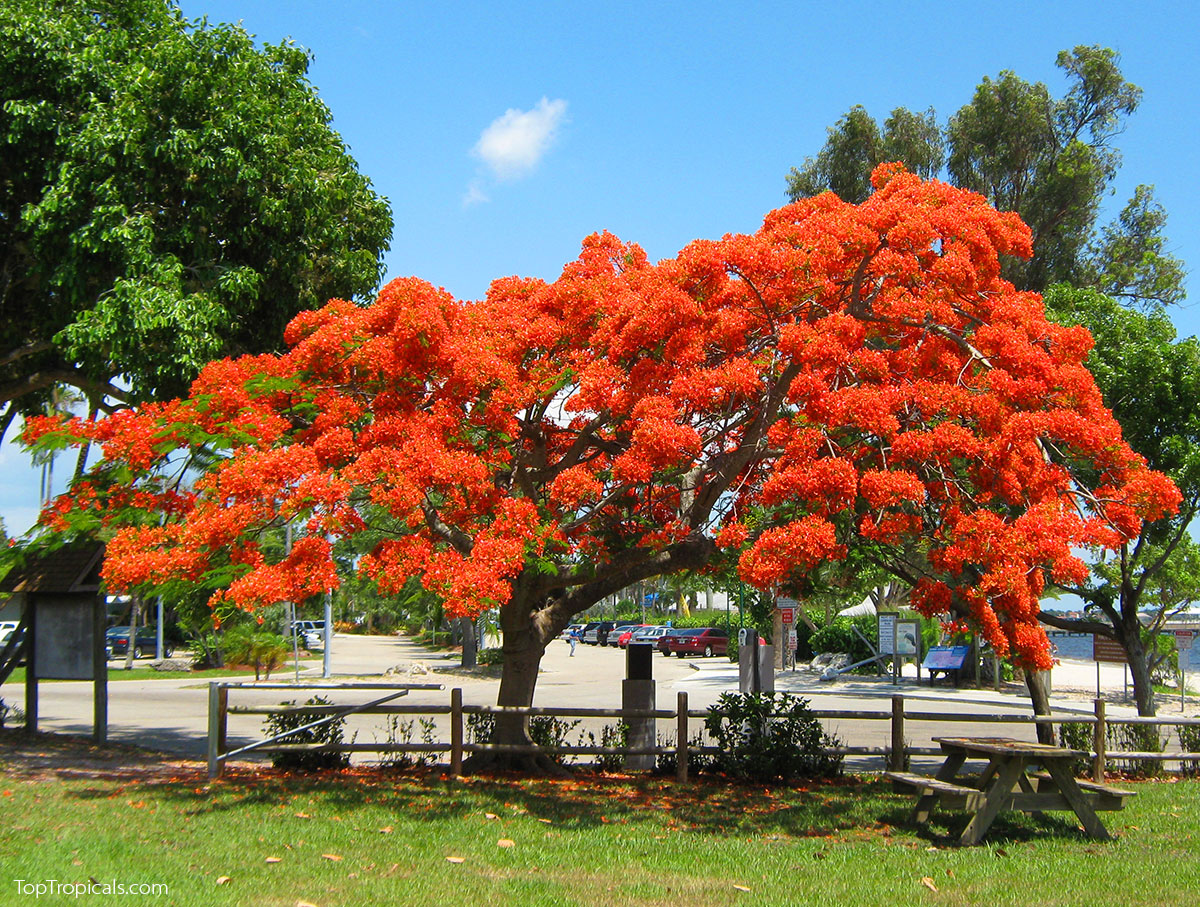
From the fiery Royal
Poinciana to the golden Tabebuia and
violet Jacaranda,
these eight trees prove that winter can bloom anywhere
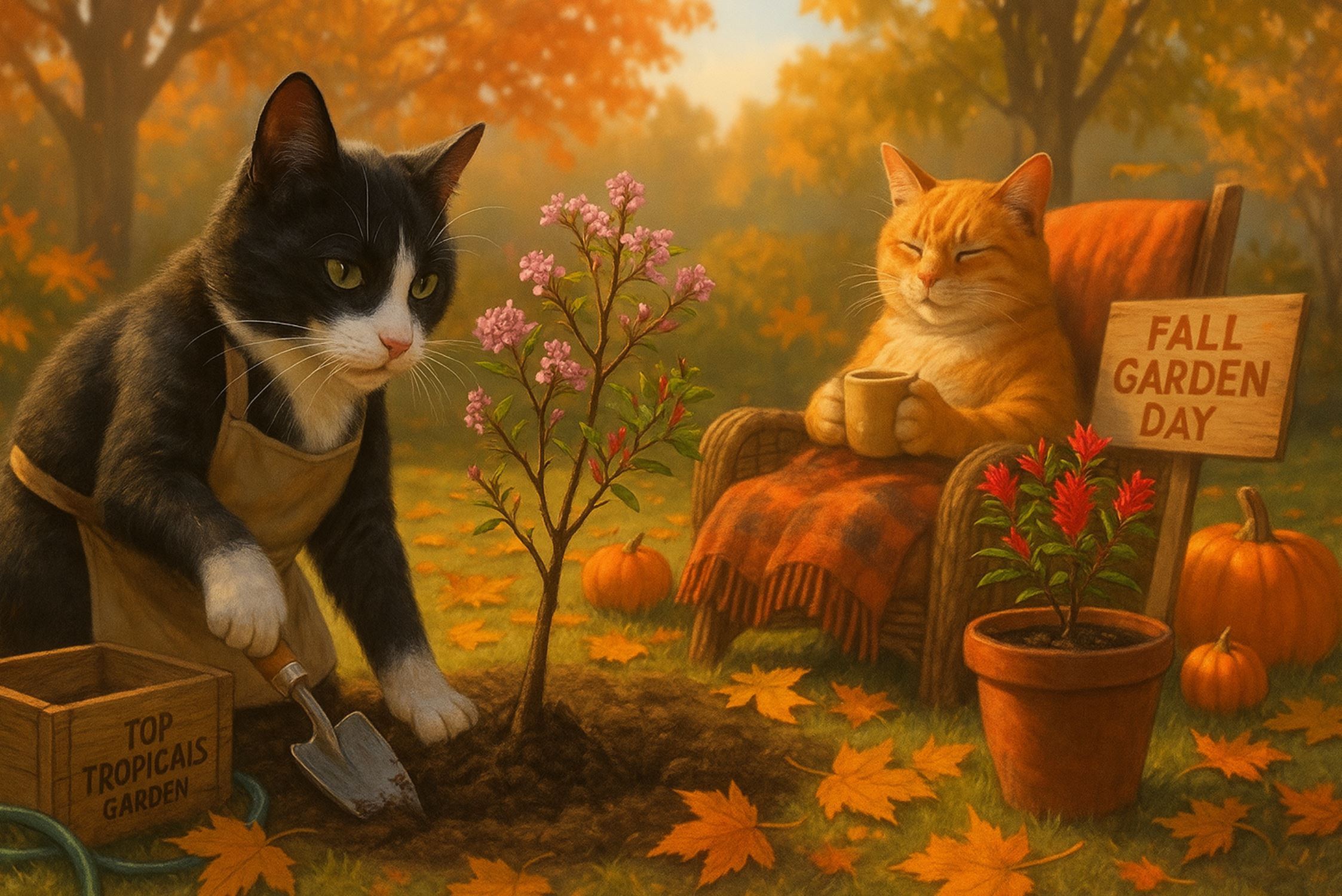
How to Care for Winter-Flowering Trees
We're often asked, at Top Tropicals, “Can I really grow tropical
trees in winter?”
Yes — with the right light and care, you can.
Here’s what works best both outdoors and indoors, according to our
expert, Tatiana Anderson.
🌡️ Fall Planting Guide
Let’s talk about timing, because that’s the part most people
get nervous about.
Everyone asks: “Isn’t it too cool to plant now?” —
and the answer is no!
Fall and early winter are actually the best months for tropicals in Zones 9
to 11.
Here’s why: the air has cooled off, but the soil is still warm.
Roots love that combination. They quietly spread underground while the rest
of
the plant takes a break.
By spring, those roots are ready to feed a burst of new growth — and
that’s when you’ll see the first big flush of flowers.
Pick a sunny spot that gets plenty of light — six to eight hours
if you can.
Loosen the soil and mix in compost or pine bark so it drains well.
Dig a hole about twice as wide as the pot and just as deep.
Set the plant level with the ground, backfill, and water it deeply to
settle everything in.
Then add mulch — two or three inches is plenty — but keep it
away from the trunk so it can breathe.
Tatiana’s tip: “Fall planting builds roots while everyone
else is resting. By spring, your tree wakes up ready to grow.”
🌳 Outdoor Care (Warm Climates Zones 9–11)
Now, let’s talk about what happens after planting — because
real gardening starts once the plant is yours. Tropical trees thrive on
routine: steady sunlight, deep watering, and just a bit of attention.
Water them about once a week when the weather is mild, more often if
it’s dry or windy.
Always check the soil first — if it feels dry two inches down, go
ahead and water.
Mulch helps more than most people realize — it keeps roots cool in
summer and warm in winter, and it saves you from watering as often.
Now, for those of you in Zone 9, here’s the truth: your trees can
take a chill, but they don’t love surprises.
A quick night in the upper 20s F won’t hurt mature plants, but young
ones appreciate a little help — a frost cloth or being planted at the
south side.
And don’t underestimate the wind. Cold, dry gusts can burn leaves
faster than frost.
Use fences, hedges, or taller shrubs as windbreaks, and take advantage of
microclimates — those warm pockets next to the house, brick patios, or
corners that get extra afternoon sun.
Tatiana’s tip: “A tropical garden in Zone 9 isn’t
about fighting nature — it’s about cooperating with it. Find the
warm corners, protect from the cold wind, and your trees will thank you with
flowers all winter.”
🏚️ Indoor & Patio Care (Cooler Climates)
For our northern friends — yes, you can grow tropicals indoors!
You just need good light, warm air, and a little attention.
Pick a large pot, with drainage holes and a light tropical soil mix.
Place it in a bright window — south or southwest if you can —
or under grow lights for about 12–14 hours a day.
Keep temperatures between 65 and 85 F, and water when the top inch of soil
dries out.
Misting helps keep leaves clean and adds humidity.
Rotate the pot every couple of weeks so all sides get sun. In summer, move
your plant outdoors gradually so it can enjoy real sunlight — then
bring it back in before nights drop below 40 F.
Tatiana’s tip: “Don’t be afraid of growing trees in
pots. They adapt beautifully — just select the right trees and pay
attention to their needs.”
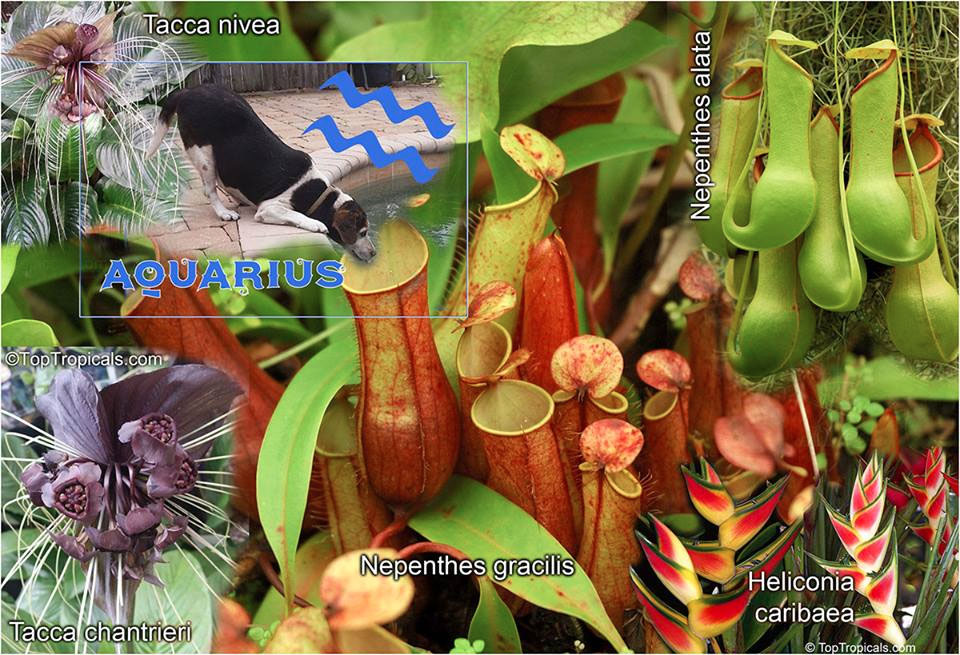
Aquarius - 1/22 -
2/18.
Aquarius is an AIR sign ruled by odd-ball Uranus.
The water-bearer's plants will often grow in unusual places and may vary in
appearance. They often have purple or blue flowers, or may have unusual
colors.
The most healing and beneficial plants for Aquarius are the ones that help
circulation, relax the nervous system, or promote inspiration. When Uranus
was discovered, it replaced Mercury as ruler of Aquarius. Physiologically,
Uranus rules the bioelectrical impulses that power the body's nervous system
(nervous tension and nervous exhaustion brought on by powerful changes in the
environment are related to both Mercury and Uranus). Physically, Aquarius
rules the lower legs, the calves, and the ankles, and the electrical impulses
that travel through the body's nervous system. The nervous system itself is
ruled by Mercury, and Uranus is said to be a "higher octave" of Mercury. Since
Uranus was discovered after the correspondences with plants had been
established, the herbs used in Aquarius are Mercury herbs. Always difficult to
pinpoint, quirky Aquarius appreciates the unusual and complex flavor of star anise. Use this star-shaped spice when you wish to bring happy
surprises into your life.
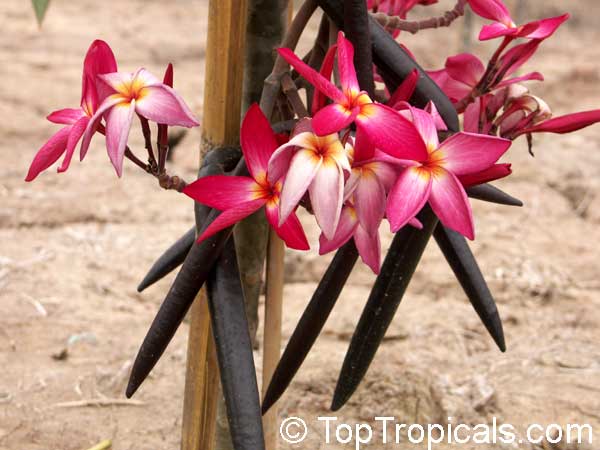
Q: I
purchased a Plumeria from your company. It has done quite nicely and now has
produced a seed pod. Please forward me information on how to care for it and use
the seeds that may be inside to propagate another plant.
A: Wait
until seeds are ripe (seed pod turns brownish). Soak seeds overnight. Use only
well-drained soil. The ideal mix is Adenium mix that we use for desert roses and Plumerias. Insert the
heavy end of seed 1/4" into the soil, leaving feathered end exposed. Place the
pot in direct sunlight. Don't allow the soil to completely dry out, but don't
let it be soggy. Germination occurs usually within three to four weeks. Do not
overwater.
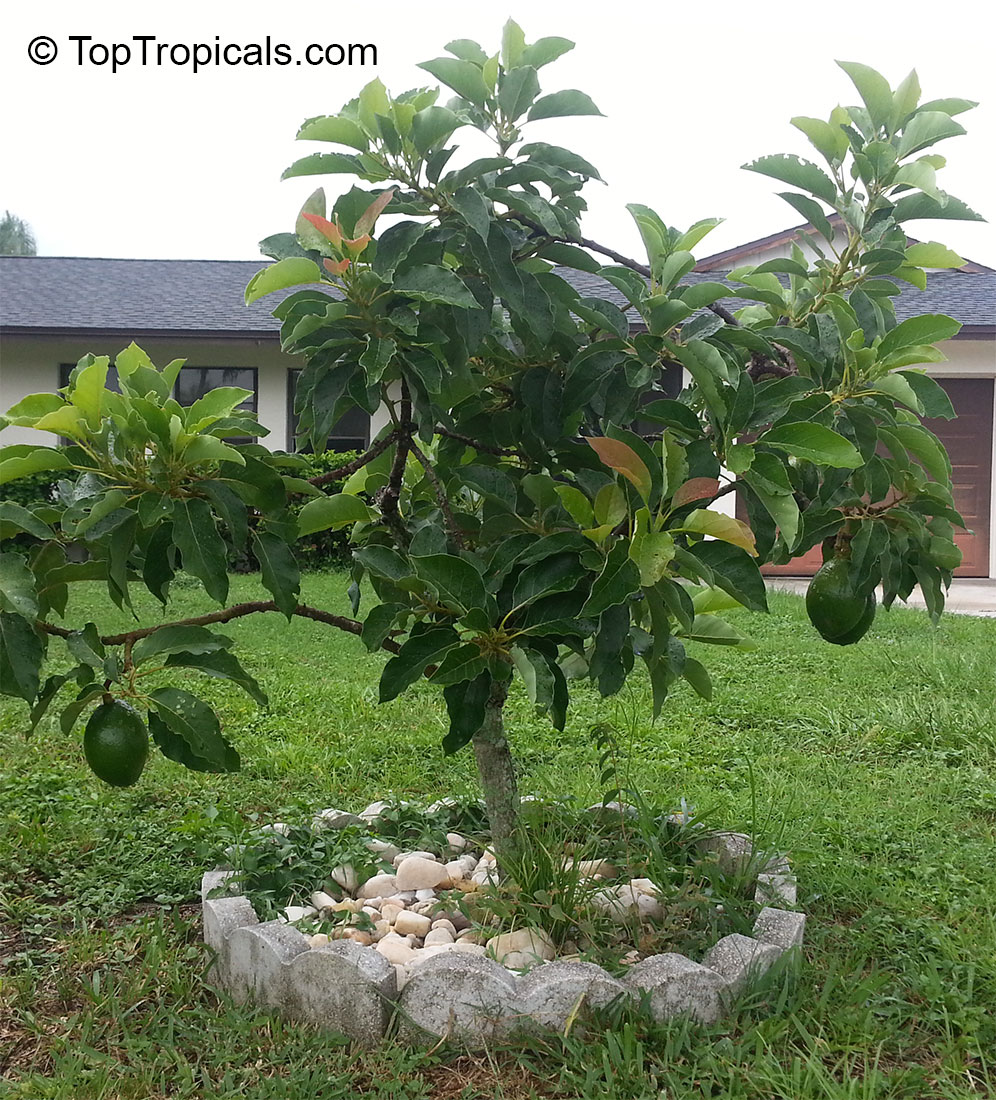
Q: I
intend to gift three avocados, at least one type A and one type B, to a friend who
lives in an area where the temperature never goes below 25F. The idea is to
give them a ripening season as long as possible. Which combinations do you
suggest, and which are the A and B?
A: When
talking about "A" type and "B" type in Avocados, we are referring to the
flowers. An avocado will produce both male and female flowers on the same plant.
"A" type means that the flowers are female in the morning and male at
afternoon. "B" type means that the flowers are male in the morning and female in the
afternoon. If you plant to start a commercial growth, then it's important to
create a proper mix of both types. However, in hot and humid climate a single
tree produces flowers of both types, so it is NOT necessary to have both A-
and B- types planted together in the backyard. Even a single tree produces
enough fruit for a home gardener.
It is also important to know that while there are "more cold hardy"
avocados (hardy to as low as 15F), it refers to a full grown established tree.
Young trees still need protection from the cold until they are bigger and more
established. One can not expect a small tree planted in June to survive the
first winter with a hard freeze. It'll take a few years until the tree is
strong enough.
These a few rare varieties that may be of your interest.
Poncho Avocado Very cold hardy variety. Produces medium to large green fruit. It
survived temperatures around 10F near San Antonio, Texas (Zone 8b). Mature trees
can take temperatures down to 15F for short period of time without significant
damage.
Anise Avocado This avocado has strongly scented leaves that smell like Anise. Very
rare variety. Fruit is of excellent quality, creamy and buttery.
Catalina Avocado Catalina is a very nice mid-season pear-shaped fruit that is especially
rich and creamy. It is an extremely popular variety in South Florida in the
Cuban Community. The Story of this variety says...
...Catalina is an amazing avocado floated across from Cuba, 60 years
ago just before Fidel Castro took over the Island Nation. Wise Cubans jumped
into the ocean to escape the Castro regime and tossed in some favorite scions
for us to enjoy here in the States. We owe a great debt to poor old Don Miguel
Cruz de la Santa Maria Espinoza Sanchez Alvarez Jr. who sadly was lost at
sea. His amazing scion wood, wrapped in cellophane and aluminum foil floated
over, washing ashore on Miami Beach. His shiny little package was miraculously
picked up on the shoreline and immediately grafted and cared for by keen-eyed
avocado lovers in Miami...
So be sure to think about this story every time you eat a Catalina!
These three Avocados will provide you with fruit ripening during the
whole warm season.
See more information on avocado varieties and the most cold hardy
cultivars.

 How to Care for Winter-Flowering Trees