Garden Blog - Top Tropicals

Date: 7 Oct 2018

Multi-flowering Hoyas:
from Mark, the Garden Whiz

TopTropicals.com

Q: A few months ago, i was given a Hoya vine. At the time, I was told to not cut-off the flowers but was never told why. However now that it IS flowering, they are so wonderful I would like to. Is there really a reason to not clip them off?

A: Actually, that was very good advise. Unlike most plants we encounter, hoyas develop perennial flower spikes. This means that each spike flowers more than just once! In other words, after the flowers on such a spike have gotten old and fall off, the knobby ended spike remains. Then, after a period of time, that same spike will develop another ring of flower buds. Depending on what kind of hoya it is, these perennial flower spikes may continue to periodically make more flowers for several years! And while the plant will continue to make more of these perennial spikes its whole life, the flowering display becomes better all the time as more and more spikes grow. (By the way, these are technically called "flowering spurs"). So every time a spur might be cut for ornamental purposes, it'll be one less place the vine can flower from in future years.

See our selection of Hoyas...

Date: 1 Oct 2018

Information on new exotic fruit variety:
Artocarpus x integer (Jackfruit x Chempedak), Cheena cv. TopTropicals

TopTropicals.com

FRESH SEEDS! Grow exotic Chempedak from seeds and you will have the trees for only $1 each!

Check out a short video of the opened fruit.

Cheena is a natural hybrid between jackfruit and chempedak. Comes true from seed. This highly recommended variety has grown in TopTropicals garden from a seedling of Cheena (Jackfruit x Chempedak) that fruited within 3 years from planting. The fruit (20-25"size) is probably the best we ever tasted! It is super sweet, crunchy and has a rich, pleasant, excellent flavor. It has very little latex which makes it easy to handle when cutting up. The tree produces at the very base of the trunk, so you can prune it as short as you want. Our tree survived light frosts as well as 48 hours of 3ft flooding, with no damage!
The tree has an open, low and spreading growth habit and can be maintained at a height and spread of 8 ft with annual pruning. It is very easy to grow and is not as cold hardy as we thought for a Jackfruit x Chempedak types of plants. The only two recommendations are - good fertilу soil with a high content of compost and regular watering.
Cheena is a consistent producer. The fruit is up to 5 lbs, long, narrow and uniform in size and shape. The skin is green, with blunt spines that yellow and open slightly upon maturity.

Check out Chempedak Cheena seeds - FRESH - FRESH - FRESH
Check out Chempedak Cheena plants - special offer $30 OFF!

Date: 30 Aug 2018

6 Things to Do on Labor Day Weekend

TopTropicals

1. Plant a tree... or a shrub, even just a small perennial will do. This plant will make you feel good and accomplished for the whole year, until next Labor Day (or even longer!). You will always see this fruit of your work and remember your motivation, so things are not that bad with you!

2. Pull 66 weeds. Needless to say, you have plenty of those in your yard at the moment. Why 66? Just do it and see what happens. If you don't see any happy results, pull another 66.

3. Fertilize all plants in your garden or potted collection with slow release fertilizer and microelements. Remember, this is the last chance to give them food and strength to survive, before winter. Starting October, all leftover fertilizer goes to storage, even in tropical gardens.

4. Apply SUNSHINE booster to protect your plants from cool temperature, help to go into dormancy and rest without stress.
Remember, there are products for all your pre-winter needs: Sunshine-T for improving cold tolerance, Sunshine-BC for caudex and bonsai plants, Sunshine-H for houseplants, and general booster Sunshine-E to cover all occasions... 50 and 100 ml bottles available for large plant collections.
Sunshine-Honey should be applied on all fruit trees to ensure their next year successful crop.

5. Add extra mulch in those areas where it was washed off with summer rains or broke down. One day of mulch work will provide 6 months of safe overwintering for your plants.

6. Have a BBQ or simply a nice meal with your friends or family. Enjoy your holiday relaxation after hard work weekend and recharge your Happiness for many days to come.

Date: 24 Aug 2018

When and How Much to Water?

TopTropicals

Q: I have an automatic sprinkler system that waters my lawn. I purchased a tree from you and want to plant it in the middle of the back yard where sprinklers cover that area very well. Will it be enough water? Is there any specific time of the day I should set up the sprinklers and for how long?

A: Do not rely on sprinkler system until the tree is established and starts growing. Right after planting, saturate the soil around the root ball really well. If the weather is hot, water with a garden house daily for at least a week. Once the tree starts new growth, you may rely on sprinkler system.
Twice a day usually is enough, with 10-15 min of zone duration. As far as start times of your irrigation system, water first time in early morning (as early as 4-5 am in Summer time), and second time in late afternoon, when it cools down a little bit. It is important to give leaves a chance to dry before plants go to bed. This will help to eliminate fungus problems as fungus develops in dark moist environment. Usually 4-5 p.m. is a good time for second watering in Summer. As days get shorter, reschedule second watering time to earlier hours.

Date: 15 Aug 2018

Care for a Baobab Bonsai

TopTropicals

Q: How to grow Baobab bonsai properly? How long does it take to shape a nice little bonsai tree?

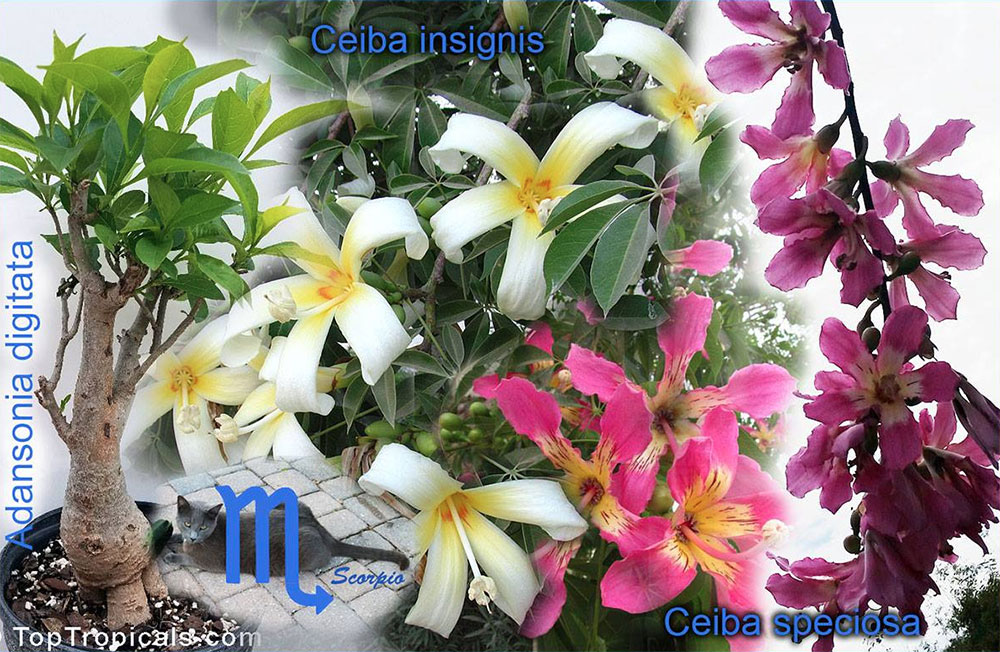
A: Baobab, or Adansonia digitata, is a unique addition to a bonsai collection. Native to Africa, it has an unusual structure and appearance. Some legends say that the tree was cast down from the heavens and landed upside down, where it began to grow. This story is no doubt a result of its appearance in the winter, when the upper branches of the tree look more like roots than treetops. The Baobab has some specific needs, but if you pay careful attention to its requirements, this tree is not difficult to grow and makes an excellent bonsai specimen.
1. Keep Baobab warm, it is sensitive to freeze.
2. Place Baobab in a bright, sunny window. Baobabs need at least six hours of full sunlight per day, so a window with a western or southern exposure is best. If your house doesn't get enough light, supplement natural light with artificial grow lights. See article Indoor lighting for tropical plants.
3. Water Baobab regularly during the growing season whenever the soil is dry. Never water the tree when it is dormant (dropped leaves).
4. Feed Baobab a good-quality fertilizer about once a month. Apply micro-element solution SUPERFOOD once a month, as well as SUNSHINE-BC plant booster for Bonsai and Caudex plants.
5. Prune the branches of your Baobab bonsai as often as they need it to give the tree the shape you desire, pruning or pinching off branches that are growing at odd angles or are too long. Trim early in the spring before new growth appears.
6. Repot the baobab bonsai every year in Spring. Remove it from pot and trim the roots back by one-third of their length, completely removing any that are damaged or dead. Place it in a container that is twice the size of the root ball and fill the pot with a well-drained soil like Adenium Mix.

It is believed that it takes forever to form a nice shaped tree, up to a few years. However if you provide warmth and bright light, branches grow very quickly, and an experienced bonsai hobbyist can make a unique specimen within 2-3 years. And then, the tree will stay with you for 5000 years - it can be passed from generation to generation!

Check out this plant... with FREE shipping to all states!
Se also Baobab Bonsai Kit and save more!