Garden Blog - Top Tropicals

Date: 14 Jul 2019

Dwarf and Condo mangoes - easy mangoes

Q: We leave in zone 6a, could you tell us what is the list of different types of mango plants that could be planted indoor and that they can bear fruits?

A:There is a large group of mangoes called "Condo Mango" - they literally can be grown in your apartment! Those are dwarf varieties that can remain compact in containers with minimal pruning and successfully bear fruit providing bright light and proper care, including plant food.

The best dwarf and semi-dwarf varieties are: Carrie, Cogshall, Cushman, Fairchild, Graham, Ice Cream, Julie, Mallika, Nam Doc Mai, Pickering, Irwin, Jahangir, Juliette, Lancetilla, Little Gem, Manilita, Sia Tong, Torbert, Pim Seng Mun, Super Julie.

They produce juicy, fiberless sweet fruit. Julie is also a very popular dwarf variety, however, it is very cold sensitive and not the easiest to grow. If you get a 3 gal size mango, step it up to 7 gal when the plant reaches 4 ft; you may use a bigger container as the root system grows, up to 15 gal or even 25 gal, space permitting. Trim the tree under 6-8 ft after production season is over (summer-fall).

See more information on growing condo mangoes

RECOMMENDED FERTILIZERS:

Mango-Food - Smart Release Fruit Tree Booster
Fruit Festival Plant Food - Super Crop Booster
For sweeter fruit, use SUNSHINE-Honey - sugar booster

Date: 19 Jan 2021

Healthy Plants: Q&A from Mr Booster

Fertilizing in Winter

Q: I have many tropical plants in my garden, both in the ground and in pots. I realize it is wintertime and some of them, the Hydrangea, Hibiscuses, and roses are in bloom but the rest of them seem wilty and droopy. Is it alright to fertilize them now, or should I wait for a few days? I have an all purpose tropical fertilizer and a 20-20-20 also. Please advise what to do.

A: During wintertime, tropicals may suffer from low temperatures and lack of sunshine which causes droopy leaves, and leaf loss.
Regardless of the cause and plant condition, you should NEVER apply traditional dry fertilizers during cool months. When cold, dry fertilizers (EDTA-chelated) may create nutrient lock up in soil and damage the roots. Dry fertilizers (both granulated and water-soluble) can be used only during hot season - when min temperatures stay above 65F for at least a week in a row, and daytime temperatures are over 75-80F. During hot, active growth season plant metabolism increases. This provides less chance for a chemical root burn, as the nutrients are used up quickly.

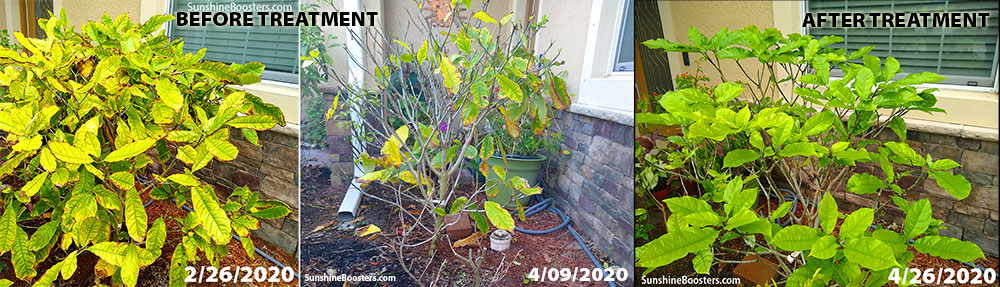
However, liquid fertilizers, as long as they are amino-acid based, can be used year round. From our own experience last winter, we discovered that fertilizing sickly looking plants (with signs of cold damage and root issues) with Sunshine Boosters actually revived those plants. Sunshine Boosters even brought back to life some hopeless specimens. Take a look at this gardenia that grows in our garden (picture above). See full article.
In your case, it would be beneficial to use a mild formula of liquid boosters in combination with Sunshine Epi -a natural plant hormone that boost their growth and helps to cope with cold-, temperature- and low-light-related stress.

These are the products we recommend:
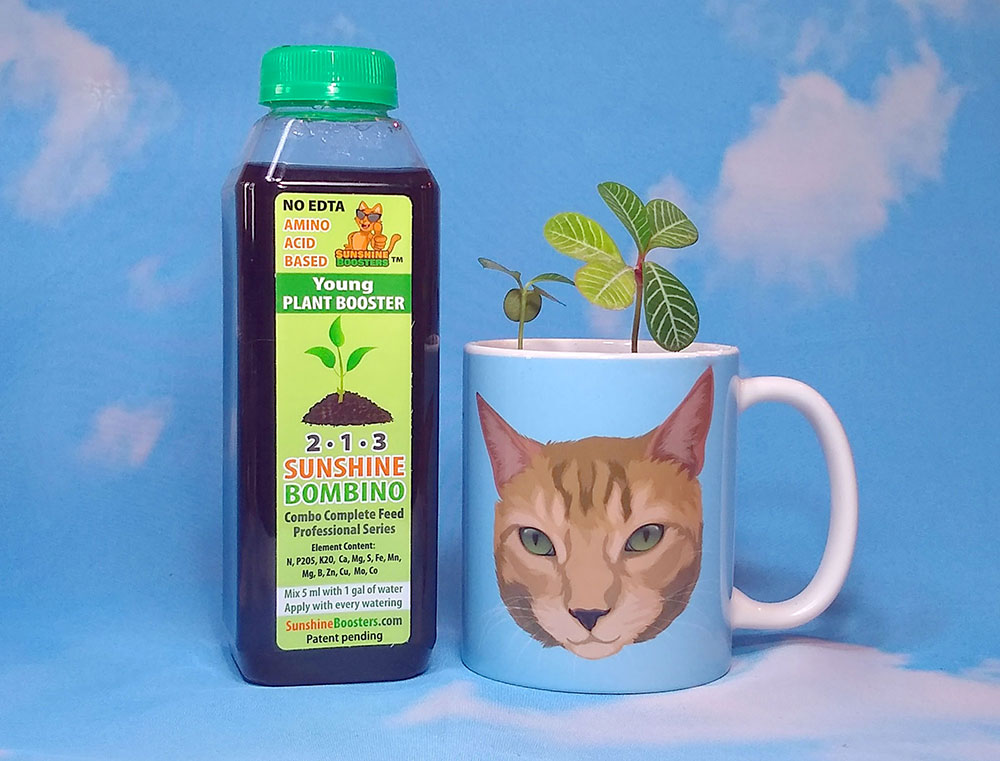
- Sunshine Bombino - add to every watering
- Sunshine Epi - twice a month as foliage spray

Since you grow plants in pots, feeding program is especially essential, because plants are limited with a container size where roots can't reach out to more food in the outer soil. In professional nursery set up with injector irrigation systems, container plants are fed daily (depending on season, more than once a day) with every watering. This is why greenhouse plants are so healthy looking.
So feel free to give your plants Sunshine boosters with every watering, dozing according to the label. During cold period, plants need less frequent watering, so fertilizer input will be balanced accordingly, it will depend on temperature and plant metabolism.

Sunshine Bombino - mild, "pampering" formula for young and tender plants, as well as plants recovering from stress and/or winter damage.

Date: 26 May 2026

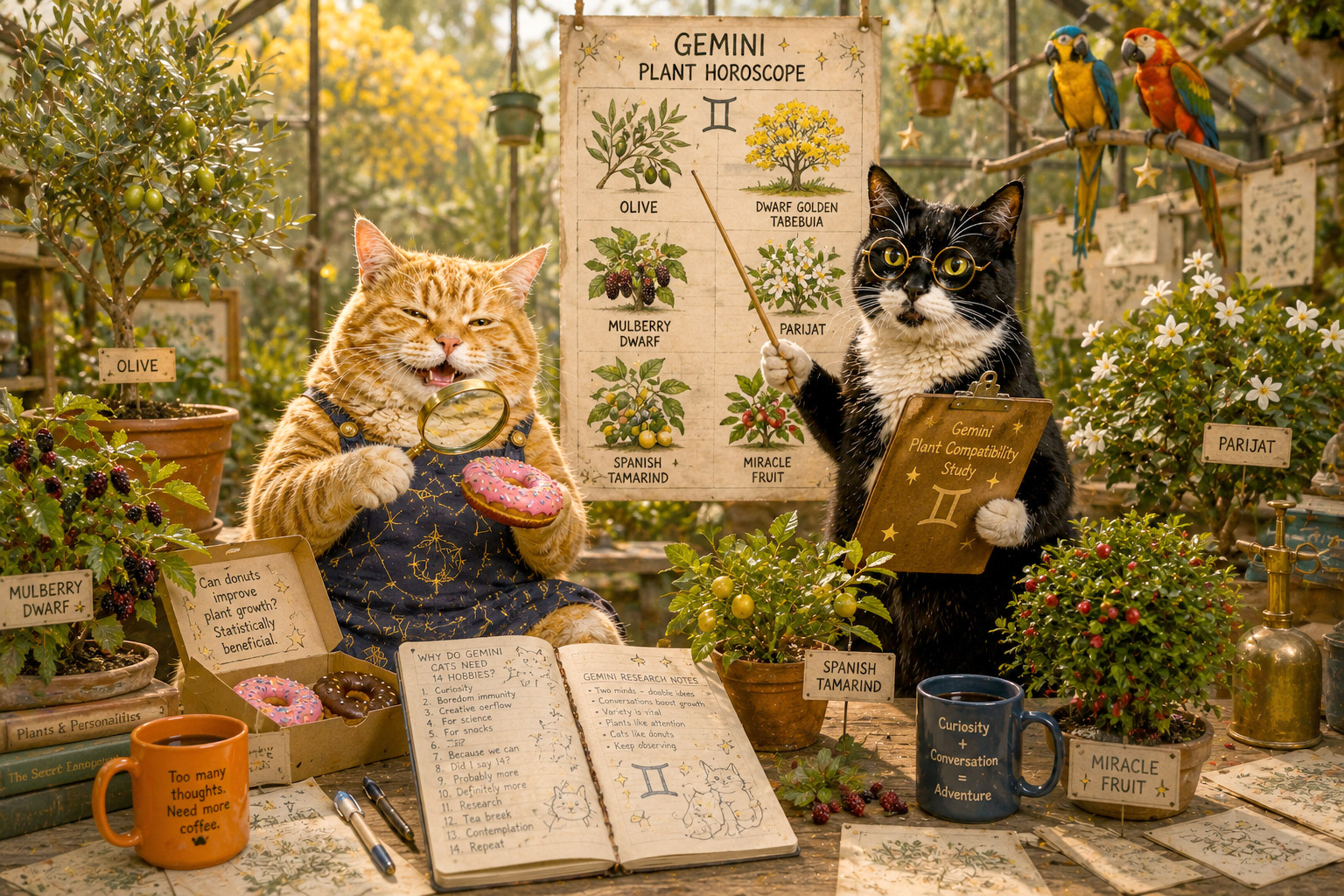
♊ Gemini Season Starts. We Are Five Days Late. Very Gemini.

Smokey  and  Sunshine  with  Gemini  tropical  plants  in  a  whimsical 
 greenhouse
Sunshine: I once met a girl and asked what she does. She said she assembles gyroscopes. I told her I don't believe in gyroscopes.
Smokey: You meant horoscopes.
Sunshine: That is what I said.
Smokey: You said gyroscopes.
Sunshine: Same thing.
Smokey: One predicts your future. The other stabilizes aircraft.
Sunshine: I don't believe in aircraft either.
Smokey: She left, didn't she.
Sunshine: She said she had to go assemble something.

♊ Gemini season started on May 21. Today is May 26 But honestly? That is not a problem. That is actually very Gemini. Gemini probably got distracted, opened three browser tabs, started a new hobby, forgot what it was doing, and came back five days later with a notebook full of ideas and zero apologies. So here we are.

Why these plants and not others

No, there is no scientific proof that olive trees belong to Gemini. We checked. The olives refused to comment. But if you are going to assign plants to zodiac signs — and we are — then Gemini deserves plants with intelligence, motion, surprise, fragrance, and a little chaos. Gemini is the sign of curiosity, conversation, and dual natures. It gets bored easily and talks to everyone at the party. These plants were picked because they fit that energy. And also because they are genuinely good plants worth growing, which Smokey insisted we mention.

Olive (Olea europaea)
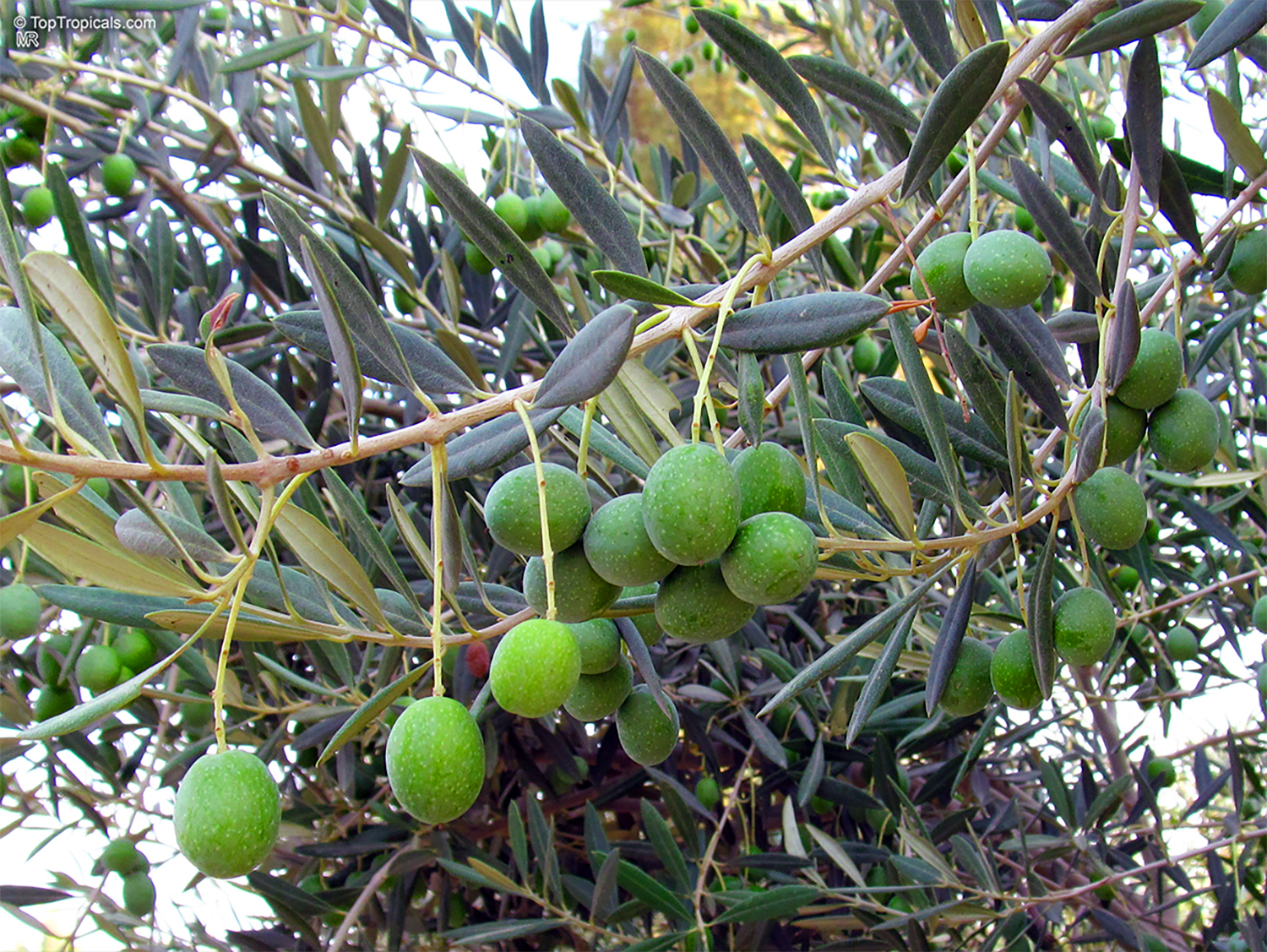
Close-up  of  an  olive  tree  branch  laden  with  clusters  of  green  olives 
 among  narrow  silvery-green  leaves.  The  fruit  is  ripening  on  the  tree  and 
 hanging  from  slender 
 stems.

Clusters of green olives developing on an olive tree branch. Olive trees are evergreen, drought-tolerant, and have been cultivated for thousands of years for both their fruit and the oil produced from it.

Olive is the thinking plant of this group. Ancient, silver-leaved, and quietly dramatic, it belongs to Gemini because Gemini loves history, long conversations, and plants that look like they know something you don't.

If you are growing olive in a container — which works very well — give it full sun, fast-draining soil, and a firm commitment to not overwatering it. Olive does not want wet feet. It wants to think in dry conditions, like a philosopher in a warm courtyard.

Smokey: Olive represents thousands of years of cultivation and human civilization.
Sunshine: And snacks with much better branding than they get credit for.

📚 More from garden blog

🛒 Shop olive trees

Dwarf Mulberry (Morus sp.)
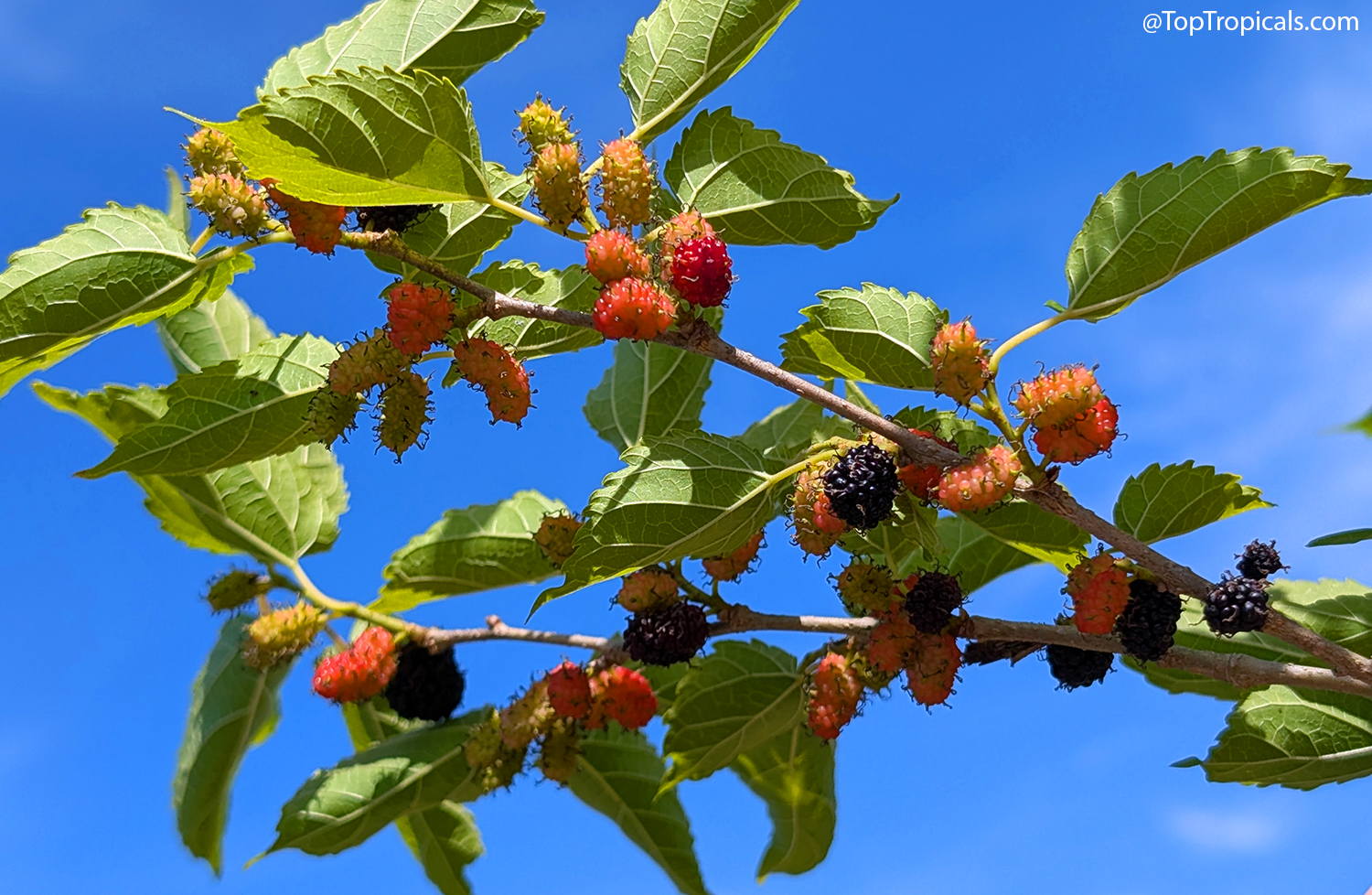
Branch  of  a  Dwarf  Everbearing  Mulberry  tree  displaying  fruit  in  various
    stages  of  ripening,  from  pale  green  and  pink  to  deep  purple-black,  against 
 a  bright  blue 
 sky.

Dwarf Everbearing Mulberry produces fruit over an extended season, often carrying berries in multiple stages of ripeness at the same time. The sweet, blackberry-like fruit is a favorite of both gardeners and wildlife.

Mulberry is Gemini in motion. It grows fast, produces generously, and absolutely refuses to be boring. A standard mulberry will take over your yard before you finish reading this sentence. A dwarf mulberry, however, is patio-friendly, container-happy, and still delivers fruit, birds, and mild garden chaos on schedule.

Prune after fruiting to keep the shape. Full sun. Large pot if you're growing in a container. This is the plant for people who want results and do not enjoy waiting.

Smokey: Efficient growth rate. Edible output. Compact habit. Reasonable choice.
Sunshine: Finally, a tree with a snack schedule.

📚 More from garden blog

🛒 Shop mulberry trees

Parijat (Nyctanthes arbor-tristis)
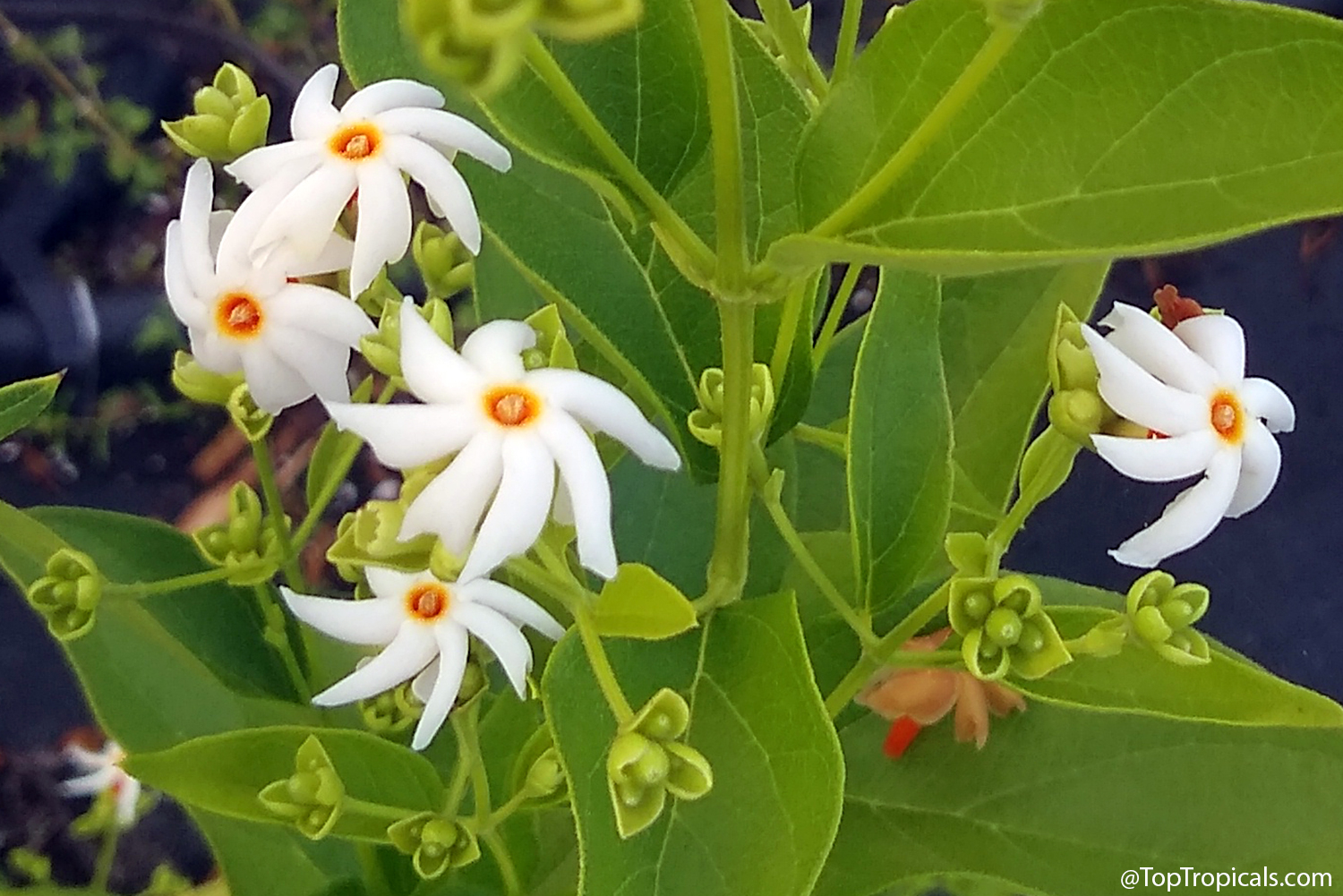
Close-up  of  Parijat  flowers  (Nyctanthes  arbor-tristis)  with  white 
 pinwheel-shaped  petals  and  bright  orange  centers  surrounded  by  fresh  green 
 leaves  and  unopened  flower 
 buds.

Parijat, also known as Night-Flowering Jasmine, produces fragrant white flowers with vivid orange centers that open at night and often carpet the ground beneath the tree by morning.

Parijat belongs to Gemini's quieter, more poetic side. It blooms with small fragrant white flowers — orange centers, delicate petals — often at night. By morning, the flowers have fallen. They drop like little messages from the universe, which Sunshine finds meaningful and Smokey finds botanically interesting.

This one is for the gardener who wants something to actually stop and look at. Good in containers, good on a warm patio, needs decent light and warmth to do its best work.

Smokey: Night-blooming pattern. Fragrant ornamental. Grows well in warm climates.
Sunshine: It's a tree that leaves notes.

📚 More from garden blog

🛒 Shop parijat

Dwarf Golden Tabebuia (Tabebuia chrysotricha)
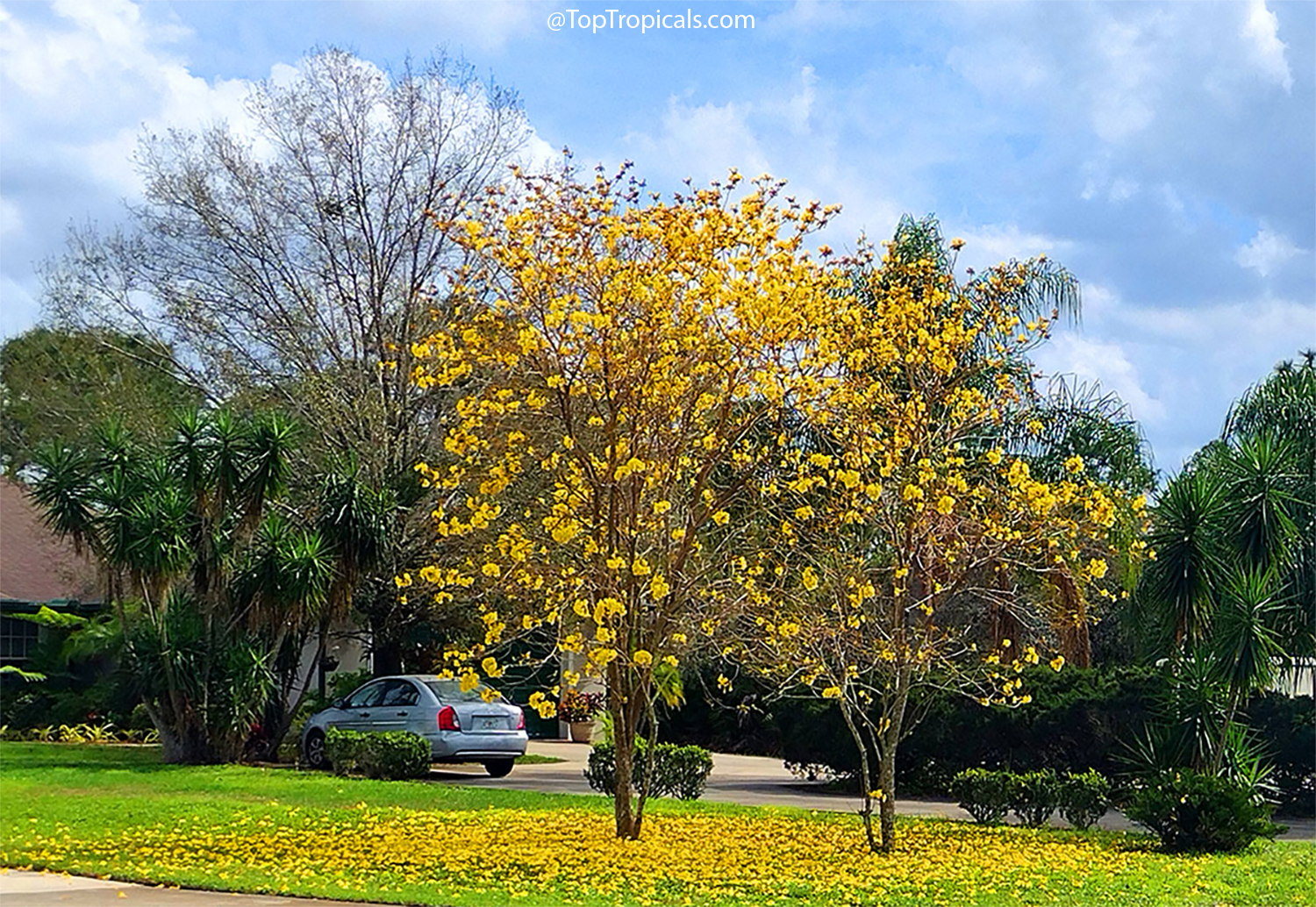
Dwarf  Golden  Tabebuia  tree  covered  in  bright  golden-yellow  flowers, 
 standing  in  a  lawn  beneath  a  blue  sky,  with  a  carpet  of  fallen  blossoms 
 surrounding  the 
 trunk.

Dwarf Golden Tabebuia puts on one of the most spectacular spring displays, covering its branches with brilliant golden flowers before the leaves emerge. The fallen blooms create a striking yellow carpet beneath the tree.

This is the Gemini show-off. Quiet for most of the year, then suddenly covered in golden yellow flowers like it just remembered it has an announcement to make.

Dwarf Golden Tabebuia is compact enough for a large container or a sunny entrance, but it needs strong light to bloom well. Give it sun. Give it room. Then step back and let it perform.

Smokey: Seasonal flowering response triggered by environmental conditions.
Sunshine: Botanical applause.

📚 More from garden blog

🛒 Shop Dwarf Tabebuia

Miracle Fruit (Synsepalum dulcificum)
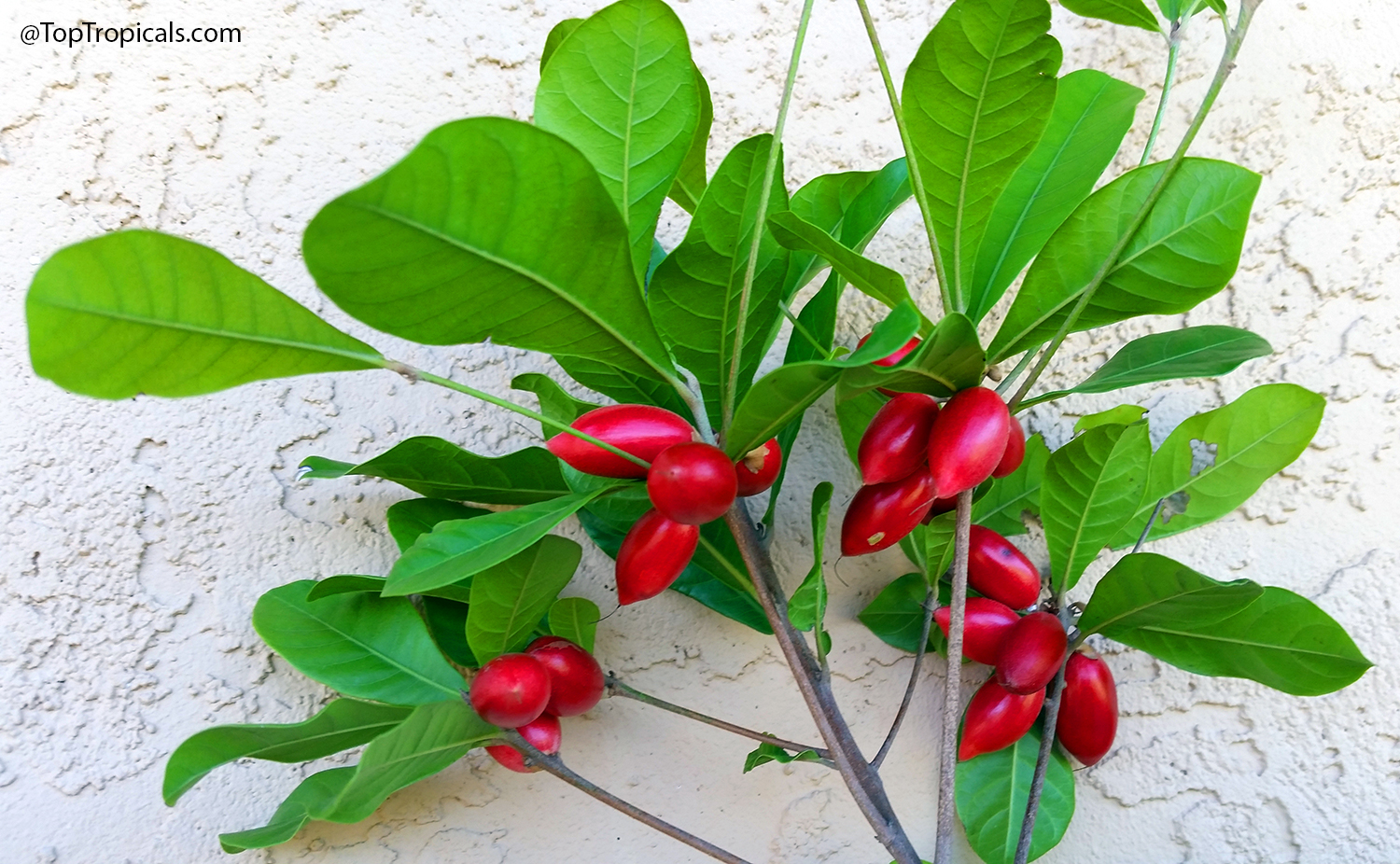
Clusters  of  bright  red  Miracle  Fruit  berries  growing  among  glossy  green
    leaves  on  a  compact  shrub.  The  elongated  fruits  stand  out  against  the  lush 
 foliage.

Miracle Fruit is famous for its unique berries, which contain miraculin - a natural compound that temporarily makes sour foods taste sweet. The attractive evergreen shrub produces bright red fruit and is well suited to containers and small gardens.

Miracle Fruit belongs on this list because it is, without argument, the most Gemini plant in existence. It does not taste like much on its own. But eat one berry and everything sour suddenly tastes sweet. Lemons taste like lemonade. Lime juice tastes like candy. A plain piece of sourdough becomes something you would pay extra for. The fruit literally changes how you experience everything that comes after it.

If that is not Gemini energy — dual nature, transformation, making you see the same thing two completely different ways — nothing is.

Miracle Fruit is a slow grower that likes warmth, humidity, acidic soil, and protection from cold. It does well in containers, which is good news because it genuinely hates frost. Keep it in a pot, bring it in when temperatures drop, and give it filtered light or morning sun rather than harsh afternoon exposure.

Smokey: The active compound is miraculin. It binds to taste receptors and distorts sour perception at low pH. Temporary effect, roughly thirty minutes to an hour.
Sunshine: It's a fruit that lies. Beautifully.

📚 More from garden blog

🛒 Shop Miracle Fruit

Spanish Tamarind (Wild Medlar, Vangueria infausta)
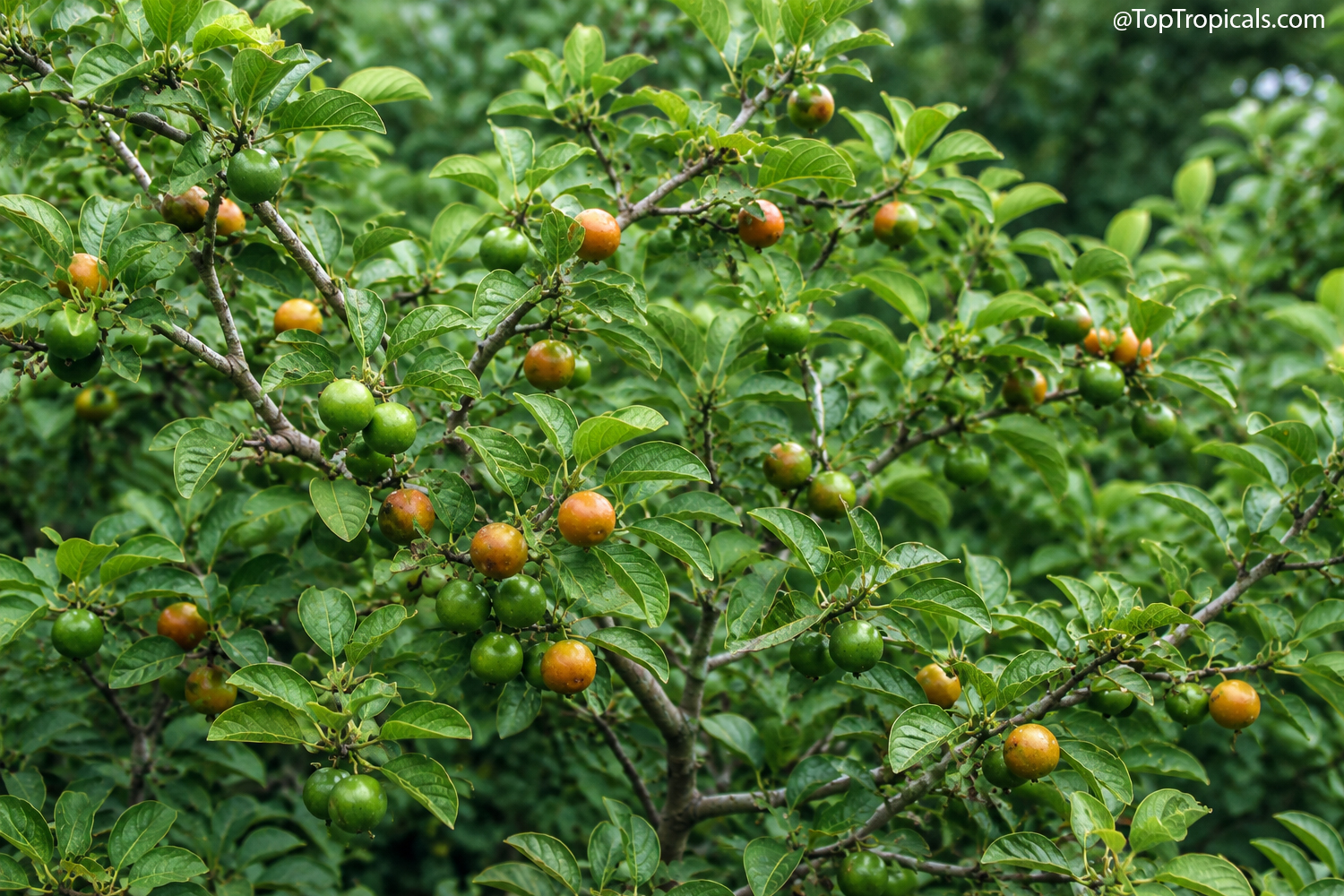
Spanish  Tamarind  (Vangueria  infausta)  tree  with  glossy  green  leaves  and
    clusters  of  round  fruit  in  various  stages  of  ripening,  from  green  to 
 golden-brown,  growing  on  branching  stems  in  a  lush  tropical  garden  setting.

Spanish Tamarind (Vangueria infausta) may be grown for its unusual fruit, but it also brings beauty to the garden with its lush foliage and heavy crops of ripening fruit. Green and golden-brown fruits often appear together on the tree, creating a colorful display.

Spanish Tamarind belongs to Gemini because it is unusual enough to start a conversation before anyone even knows what it is. The name alone does it. People will ask. You will explain. The fruit changes color as it ripens, the plant has collector appeal, and the whole thing feels like something you found in a book about plants that don't get enough attention.

This one needs warmth, sun, good drainage, and patience. It can live in a container with pruning. It rewards the gardener who is genuinely interested in something a little different.

Smokey: Tropical fruiting curiosity. Suitable for collectors.
Sunshine: Sounds like something I would order at a restaurant without reading the description.
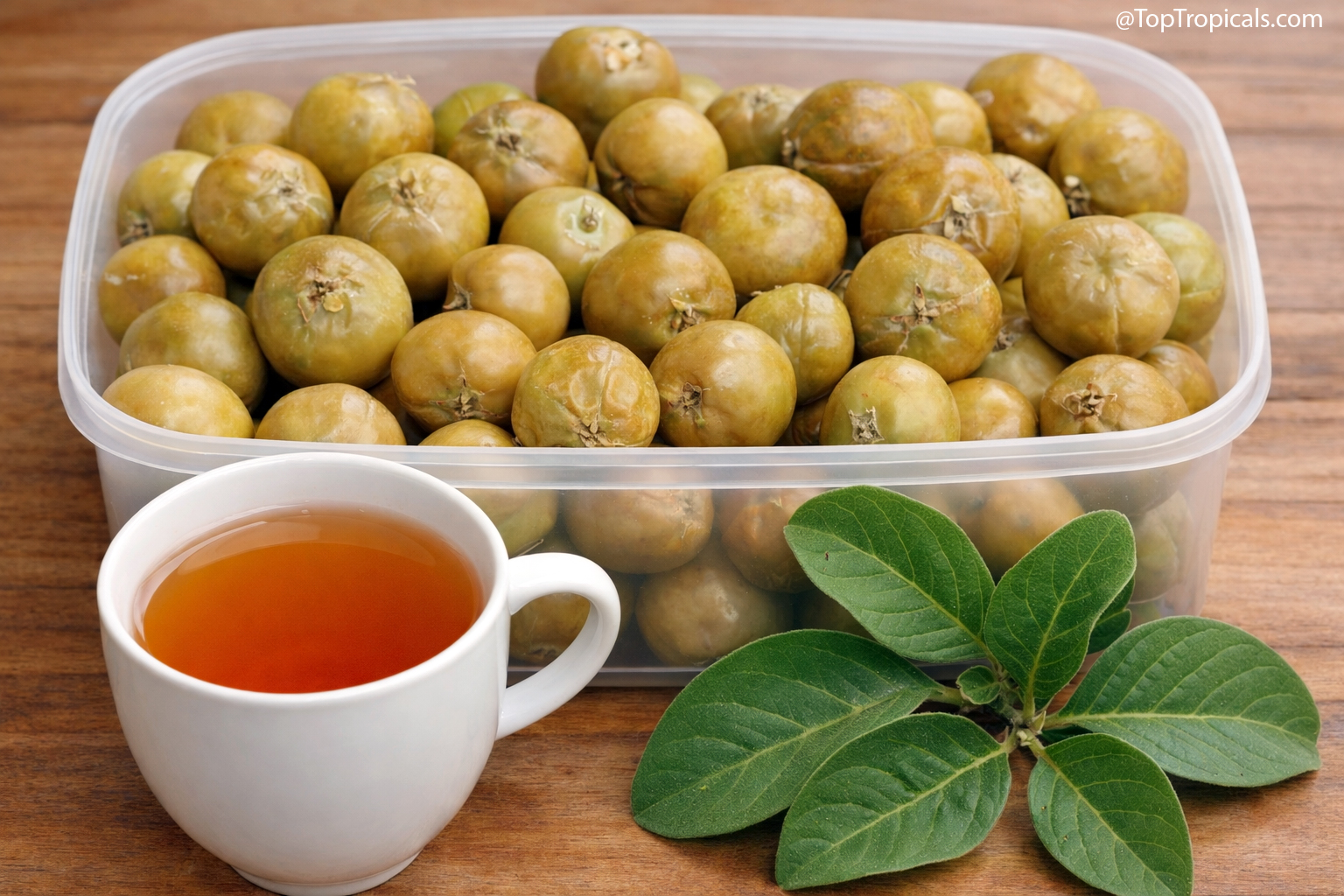
Container  filled  with  ripe  Spanish  Tamarind  (Vangueria  infausta)  fruit 
 on  a  wooden  table  beside  a  white  cup  of  amber-colored  fruit  tea  and  a  sprig 
 of  velvety  green  leaves.

One of the traditional uses of Spanish Tamarind (Vangueria infausta) is fruit tea. The ripe fruit can be dried and steeped to make a mild, refreshing drink rich in natural flavor, while the soft, velvety leaves have long been used in traditional herbal infusions.

📚 More from garden blog

🛒 Shop Spanish Tamarind

Horoscope aside — why these plants are actually worth growing

Even if Gemini energy has nothing to do with your garden, these plants offer real value: fruit, fragrance, flowers, container growing, and something interesting to look at or talk about.

  • Olive — full sun, excellent drainage, don't overwater, thrives in containers. Tropical varieties: USDA Zone: 8-10. Cold hardy to 15-20°F.
  • Dwarf Mulberry — full sun, large pot, prune after fruiting, fast results. USDA Zone: 8-11. Cold hardy to 20-25°F. Most mulberry varieties can be grown in USDA Zone 5-6 to 10 and cold hardy to 5°F.
  • Parijat — warmth, good light, patio or container, fragrant and ornamental. USDA Zone 9-11. Tolerates light freezing to about 30°F for short periods (mature plants). Young plants must be protected.
  • Dwarf Golden Tabebuia — strong sun, large container or sunny ground spot, compact but dramatic when it blooms. USDA Zone 9-11. Protect young plants from frost. Best flowering in full sun.
  • Spanish Tamarind — warmth, sun, drainage, patience, collector interest. USDA Zone 9-11. USDA Zone 10-11, possibly warm Zone 9b in protected microclimates. Protect from frost, especially young plants.
  • Miracle Fruit — warmth, humidity, acidic soil, filtered light, protect from frost. Best in containers. USDA Zone 10-11. Cold hardy only to about 40°F — bring it in well before first frost, not after.

Can you grow them in pots?

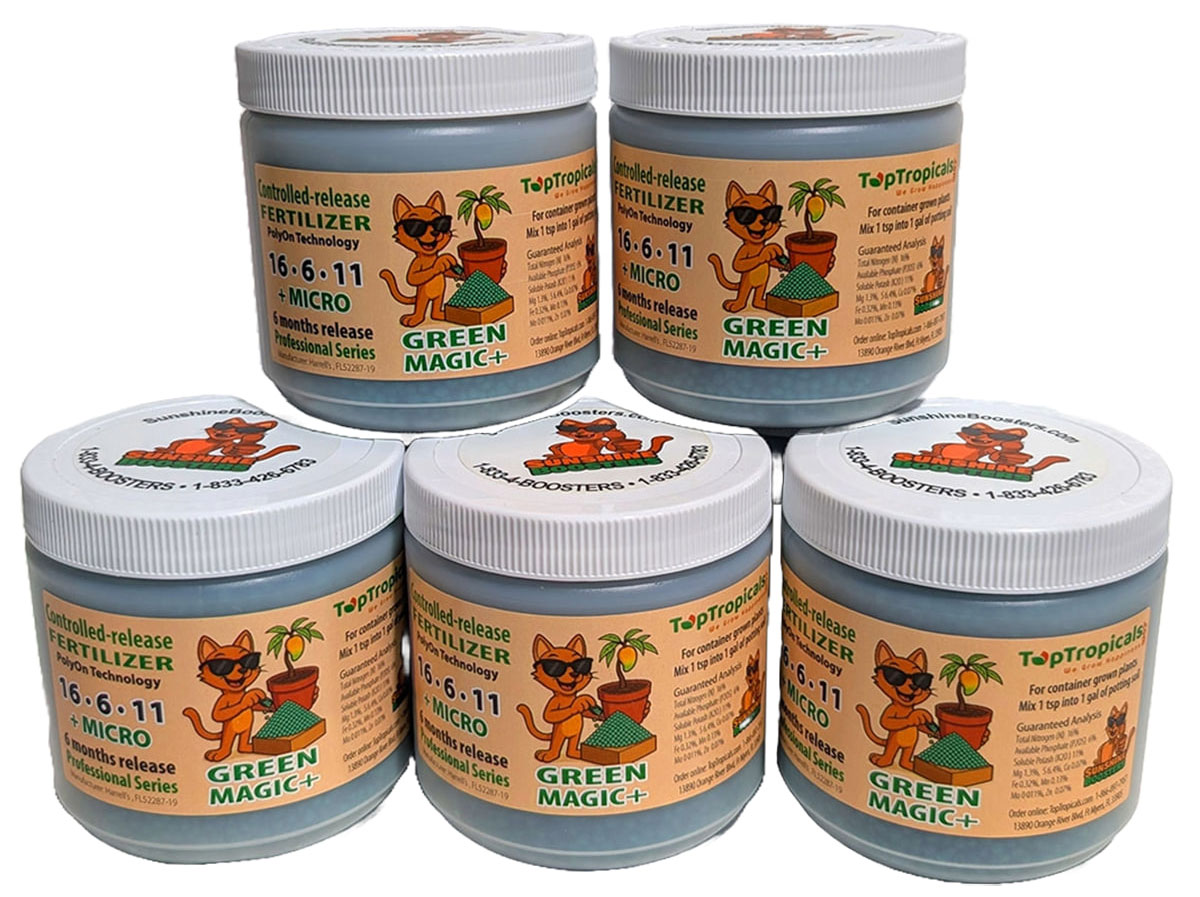
Yes. With the standard warning: a pot is not magic. Use a large container, fast-draining soil, full sun where the plant wants it, regular feeding with Green Magic conrolled-release fertilizer every 6 months and Sunshine Boosters - safe to use with every watering. Apply a bit of pruning when things get out of hand.

Smokey: A pot is just a smaller universe.
Sunshine: A pot is a drainage system with ambitions.

📅June gardening reality check

June is a good time to establish tropical and subtropical plants. The soil is warm, the days are long, and actively growing plants will take root faster than they would in cooler months.

👉 A few things to keep in mind:

  • Containers dry out fast even when rain increases. Check them. Don't assume rain did the job.
  • Don't let pots sit in standing water. Root rot is quiet until it isn't.
  • Feed actively growing plants. They are working hard and they need the input. We recommend Green Magic controlled release fertilizer during active growth (twice a year) and Sunshine Boosters for spray and daily watering year around.

    📚 More about fertilizers from our garden Blog

  • Watch new growth for pests. Tender leaves are the first target.
  • Prune lightly to shape if needed, but don't do heavy cutting in peak heat. Save that for after flowering or early in the season.
  • Mulch around in-ground plants to hold moisture, but keep mulch away from the trunk.

🌠 The stars don't care? Grow anyway!

Maybe the stars do not care whether your garden is a Gemini garden. Maybe olive trees are not receiving transmissions from Mercury. But a garden full of fruit, fragrance, flowers, and strange little stories is still a very good idea.

Smokey: That is the first reasonable conclusion in this entire article.
Sunshine: Second. The donut research was also important.

Happy Gemini gardening season from all of us!

🛒 Shop tropical fruit and flowers

🎤 NEW: Interview With Smokey & Sunshine
Date: 7 Feb 2017

After Super Bowl Sale

Chill out and relax by planting a tree! We just watched the most exciting Super Bowl ever... What a game! It was the greatest comeback in Super Bowl in history. Now it is time to let Top Tropicals help give your garden a great comeback too. Relax, have some peaceful happy time, and nothing can be better than planting a tree!

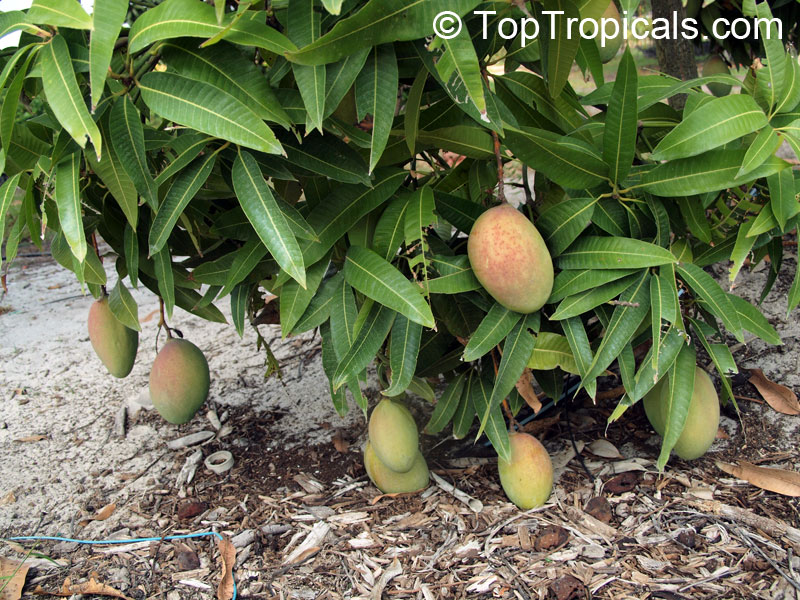
The best tree ever, by many features is a Mango tree. Here at least 5 reasons why:
1. Mango tree is good for beginners since it has low maintenance requirements, including low water needs.
2. Mango tree is easy to ship.
3. Mango tree is a great present.
4. Mango tree is a rewarding fruit tree that will produce fruit for you the same or next year - all our varieties are grafted and ready to bloom.
5. Mango tree produces the most delicious fruit in the world. The sweetest, flavorful, fiberless varieties can be only tasted from home gardens - they simply are not available from grocery stores due to transportation reasons (only fiborous low quality fruit can be safely shipped and stored).

Take advantage of this generous 25% off offer and get yourself a mango tree:
- Dwarf varieties, "Condo" mangoes, great for containers: Carrie, Cogshall, Ice Cream, Julie, Lancetilla, Lemon Meringue, Mallika, Nam Doc Mai, Pickering.
- Large, fast growing, vigorous trees that will quickly create shade and comfort in your garden: Bailey's Marvel, East Indian, Haden, Jakarta, Philippine, Southern Blush, Valencia Pride.
- Exotic collectibles that are hard to find and almost nobody has, be a proud owner of delicious exotic flavors: Alampur Baneshan, Alphonso, Choc Anon (Miracle), Heidi, Maha Chinook, Pim Seng Mun.

Happy planting, end enjoy your fruit soon! See all varieties (for backorder items, add to your wishlist and you will be notified when available, very soon!)

Hurry up, WHILE THE STOCK LASTS! Offer is valid 2 days only, and expires February 9. Offer not valid for previous purchases.

Date: 19 Jul 2025

☀️ When tropical plant takes a Summer break

Tropical  landscape

Why your plants might stop growing in mid-Summer
and what to do about it

Q: Why some tropical plants stop growing when it gets too hot? Aren't they supposed to like the heat? Should I use more fertilizer during hot Summer?

You've been watching your tropical tree thrive all spring. New leaves, steady growth, maybe even a flower or two. Then July hits, and… nothing. The heat cranks up, and your once-busy plant just sits there. No new shoots, no blooms, not even a twitch. If it feels like your plant ghosted you - but don't worry! It's not dying. It's just hot!

Q: What happens to tropical plants when it gets extremely hot?

When the heat hits, plants hit pause. In the peak of summer, especially with temperatures above 90F, many tropical and subtropical plants go into heat survival mode. Growth above ground may slow down or stop entirely. It's not because you forgot to water or skipped a fertilizer dose - it's just too hot. The plant's energy shifts underground, where roots may still be growing. Think of it like a tropical version of a siesta - less margarita, more mulch. This stage might last a few weeks or longer, depending on how intense the heat gets. But the important thing is: it's normal.

Q: What NOT to do?

  • Don't drown it in extra water. That leads to root rot.
  • Don't dump dry fertilizer on it. That can burn the roots or just get flushed away. Use controlled release or liquid fertilizer dozed proportionaly to the plant's water usage.
  • Don't prune aggressively, hoping to jolt it awake.

None of that helps - in fact, it can make things worse.

Q: What you CAN do?

  • Water deeply in the early morning, and let the soil dry a bit between waterings.
  • Add mulch to help keep the root zone cool and reduce evaporation.
  • Provide temporary shade for potted plants or young trees.
  • Hold off on pruning or heavy feeding until you see new growth.

Just like you wouldn't run a marathon in a heatwave, your plant needs a break too.

Q: Why you shouldn't fertilize stressed plants with dry fertilizer?

Fertilizing seems like the obvious solution when a plant stalls, but in the heat of summer, it can backfire. When temperatures soar, roots slow down, and absorption becomes inefficient. You might pour in nutrients, but your plant can't use them - and what's worse, any tender new growth that does emerge can get scorched or sunburned before it has a chance to harden.

Feeding a plant with strong fertilizers during a heatwave is like telling someone to sprint in a sauna. It's not just unhelpful - it's risky. That's why you need a fertilizer that’s engineered for hot weather - not just any slow-release formula.

Liquid Sunshine Boosters mild formulas are safe to use year around. Controlled release fertilizer like Green Magic are safe as well, just make sure to follow directions and dosage.


Q: Why Green Magic fertilizer works in heat better that Osmocote?

Green  Magic  controlled  release  fertilizer

Not all slow-release fertilizers are built for hot summer. Some popular brands might seem like a good choice - but they’re optimized for soil temperatures around 70-75F. That's a mild Spring day in the South, but in real-world Florida or Arizona heat? Not even close.

Here's the problem: Osmocote releases nutrients based on moisture, not temperature. When it's hot and humid - or worse, when you water heavily - it can dump too many nutrients at once. That nutrient surge can:

  • Burn your plant's roots
  • Force tender new growth that gets fried in the heat
  • Leach straight out of the pot, wasting both fertilizer and money

It's unpredictable, especially in containers that heat up faster than ground soil. What you think is "slow-release" can behave more like a fertilizer bomb.

Green-Magic, by contrast, uses a temperature-sensitive polyurethane coating that responds gradually and consistently as the soil warms. That means:

  • No sudden nutrient spikes
  • No wasted runoff
  • And no risk of heat-triggered burn

It's designed to feed steadily and predictably - even when temps hit 90F and stay there. For potted tropical plants, that kind of control is the difference between stressed and thriving.

Q: How does Sunshine Boosters help with daily plant recovery in summer?

Once your plant begins to show signs of life again - maybe a new bud, or evening perkiness - it's safe to resume feeding. But skip the salts, and reach for something gentler: Sunshine Boosters.

These amino-acid based liquid fertilizers are designed for daily use, even in containers during the hottest days. They enhance nutrient uptake, even when roots are stressed or sluggish. Unlike synthetic chelators like EDTA, Sunshine Boosters won't bind nutrients or burn root system. They stay gentle, available, and effective. Learn more from this short video.

Use SUNSHINE Robusta for foliage support, or Ca-Support PRO for strong structure and recovery. It's like hydration and nutrition in one - perfect for tropical plants fighting through summer heat.

Q: How can I help my plants during extreme heat?

Don't fight the heat - work with it. If your tree looks stalled this summer, don't panic. It's following a rhythm older than all of us. Support it with smart watering, the right fertilizer combo, and a little patience. Before long, you'll see buds again - and know your plant made it through the heat.


Shop fertilizers and garden supplies


Read more plant care tips in Garden Blog