Most people drink coffee every day but not all of them realize where this delicious drink comes from. It comes from a Coffee tree!
Coffee is the best gift plant and perfect container fruit tree. It grows into a beautiful dark green shrub or small tree. Coffee tree prefers filtered light which makes this plant a perfect house plant.
The white, fragrant, star-shaped flowers are clustered and resemble gardenias to which they are related. The whole fruit is edible, it is a small fleshy berry changing in color from green to yellow to red. The seeds are the actual "coffee beans" as they called, and can easily be dried, roasted and ground at home. The most common coffee is Coffea arabica; related species are Coffea robusta (Robusta Coffee) and Coffea liberica (Liberian Coffee).
Get a Coffee tree and it will keep you happy with the favorite beverage at all times!
Enjoy this video and your morning coffee.
Stay updated with TopTropicals Videos by subscribing to our channel at YouTube.com/TopTropicals and get our latest video news of what's fruiting and blooming!
Date: 31 Aug 2016
Hardy avocados
Q: I intend to gift three avocados, at least one type A and one type B, to a friend who lives in an area where the temperature never goes below 25F. The idea is to give them a ripening season as long as possible. Which combinations do you suggest, and which are the A and B?
A: When talking about "A" type and "B" type in Avocados, it is referring to the flowers. An avocado will produce both male and female flowers on the same plant. "A" type means that the flowers are female in the morning and male at afternoon. "B" type means that the flowers are male in the morning and female in the afternoon. If you plant to start a commercial growth, then it's important to create a proper mix of both types. However, in hot and humid climate a single tree produces flowers of both types, so it is not necessary to have both A- and B- types planted together in backyard. Even a single tree produces enough fruits for home gardener.
It is also important to know that while there are more cold hardy avocados, it refers to a full grown established tree. They will still need protection from the cold until they are bigger and more established. One can not expect a small tree, which was planted in June, to survive the first winter. It'll take few years until the tree is "harden" enough.
Wurtz Avocado: Fruits from May to Sept.
Dwarf hybrid. It is very compact and slow growing, reaching only about 8-12 feet at maturity. Distinctive weeping growth habit. Suited for planters, containers, patios, greenhouse use. Great for dooryard or container growing. The tree can handle temperatures to 25(F) degrees. Production is good and it is a consistent bearer.
Day Avocado: Fruits July to Sept.
Day avocado is green, smooth skin and is shaped like a club. The fruit is of very good quality and has a nice buttery consistency. The slender tree is relatively cold tolerant and produces July through September.
Fuerte Avocado: Fruits Nov to June.
Relatively cold hardy variety. Green fruit, elongated,flavor excellent, buttery. Vigorous compact tree with decidedly alternate year bearing habit. Ripens November to June.
These three will provide you with fruit ripening during the whole warm season.
For the most cold hardy avocado varieties, see this info sheet.
Date: 15 May 2024
What does a dragon taste like? Does Dragon Fruit come from a monster cactus? Learn why you need to grow your own
Hylocereus and Selenicereus Dragon Fruit or Pitaya
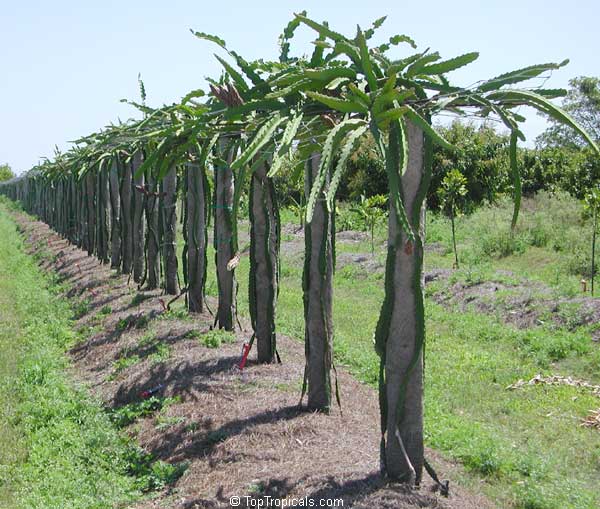
Hylocereus and Selenicereus Dragon Fruit or Pitaya trees on trellis
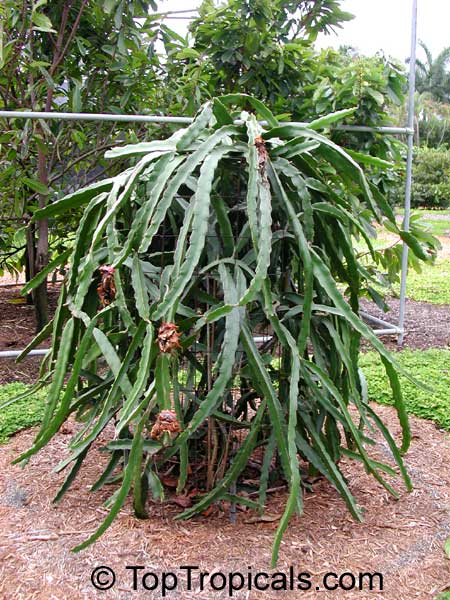
Hylocereus and Selenicereus Dragon Fruit or Pitaya on trellis
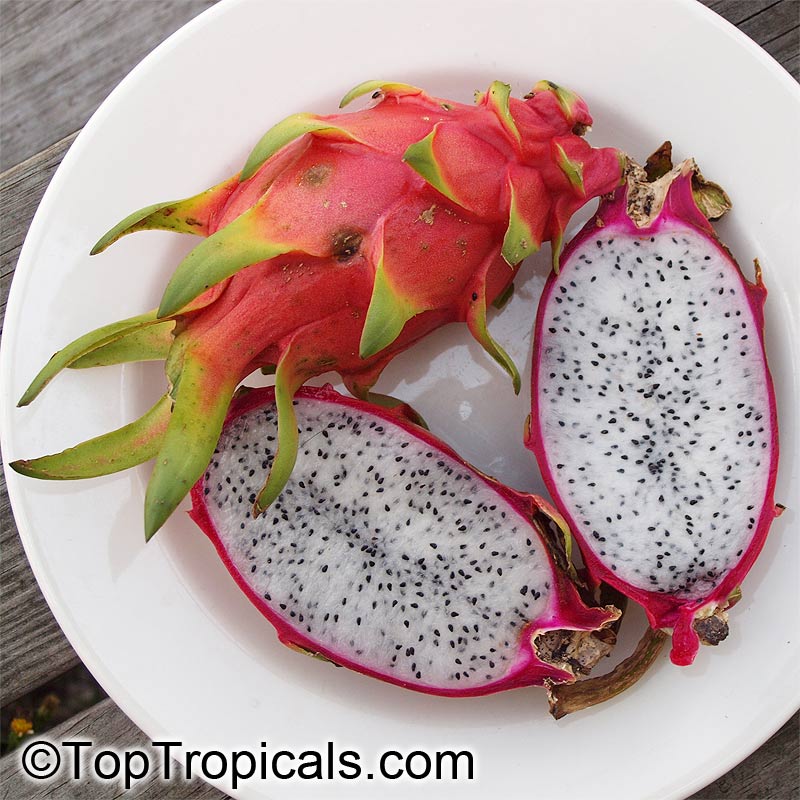
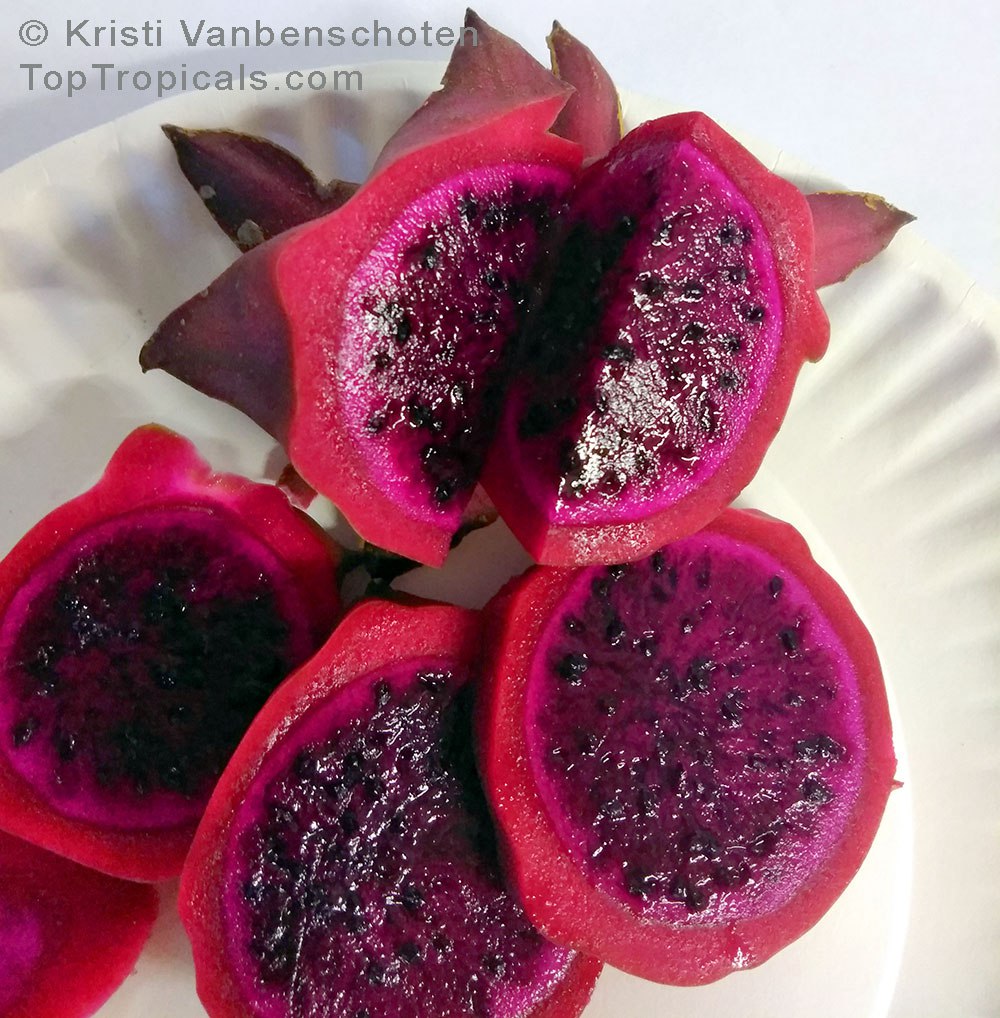
Hylocereus and Selenicereus Dragon Fruit or Pitaya red fruit
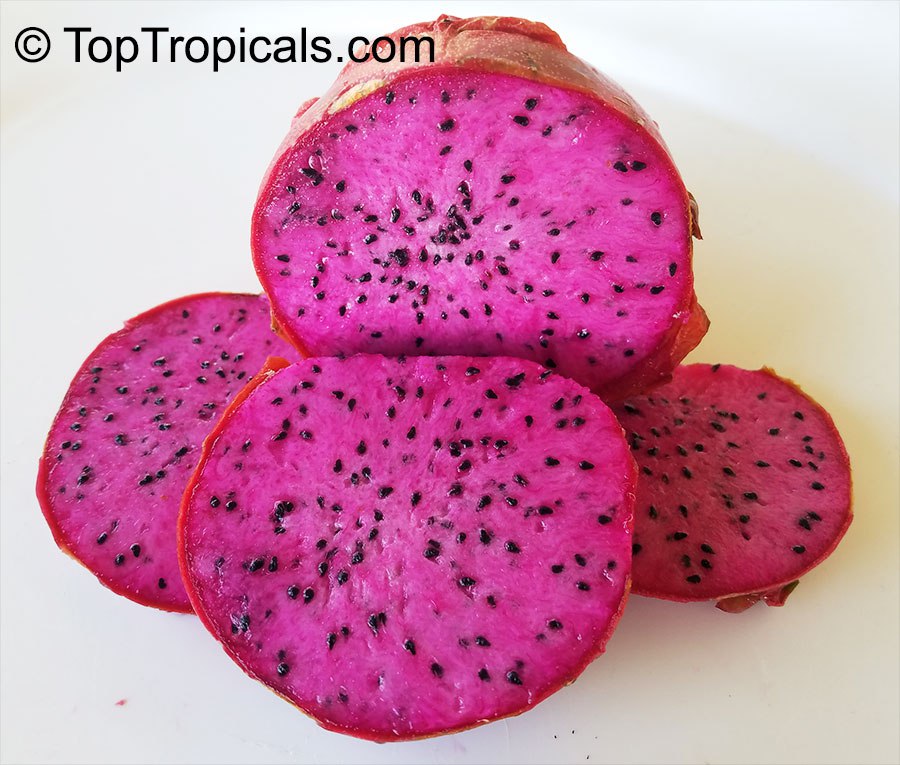
Hylocereus and Selenicereus Dragon Fruit or Pitaya purple fruit
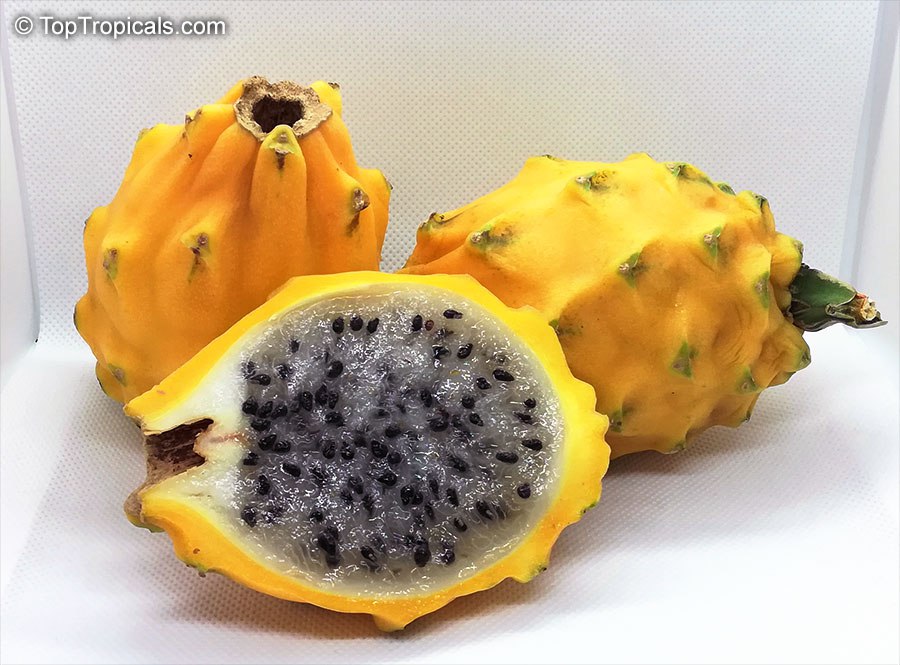
Hylocereus and Selenicereus Dragon Fruit or Pitaya Yellow Parlora
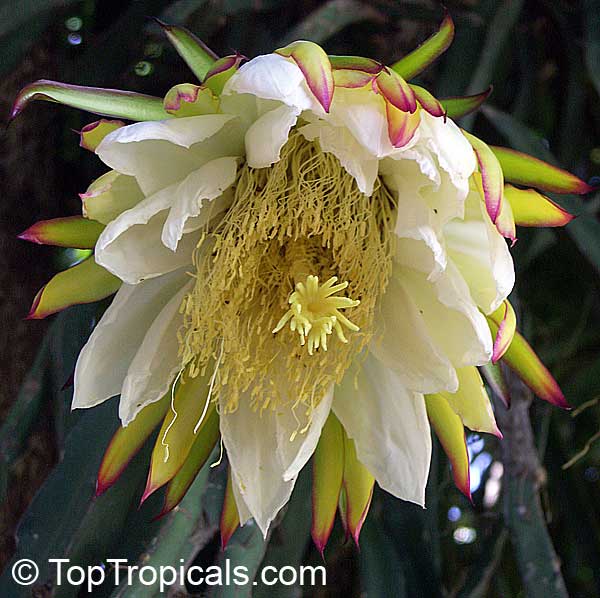
Hylocereus and Selenicereus Dragon Fruit or Pitaya flower
🐲 What does a dragon taste like? Does Dragon Fruit come from a monster cactus? Learn why you need to grow your own. 🌵
🔴 You may have tried a Dragon fruit from the store l, but do you know how it grows? On a cactus tree!
🔴 Names: varieties of Hylocereus and Selenicereus - these fruit bearing cactus plants are also called Dragon Fruit or Pitaya.
🔴 Commercially grown fruit sold in a grocery store may be tasteless. You need to grow your own good variety to have tasty, sweet, flavorful fruit!
🔴 Dragon fruit comes in many varieties. Colors of flesh differ: white, pink, dark red and even purple. The outside of the fruit can be red/pink or yellow.
🔴 In commercial groves, Pitayas grow like cactus trees, over a strong support - big "umbrella frames" ☂️
🔴 It is an easy plant, with low water needs, takes both sun and semi-shade.
🔴 Our favorite variety is Yellow Dragon Fruit Palora, (Selenicereus megalanthus). It is the sweetest and has the most flavor of all. We shared some recipes earlier.
🔴 Can be grown in container with a wooden trellis. And the flower is beautiful, too!
How to tell the difference between Jasmine Sambac Varieties
Jasminum Sambac varieties
⏳ How to tell the difference between Jasmine Sambac Varieties
💮 Jasminum Sambac is hands down the most fragrant jasmine in existence - and the most popular among tropical gardeners and plant collectors.
💮 Native to India, it's the source of jasmine perfume oil and the signature ingredient in jasmine tea.
💮 This plant comes in several varieties, each with unique flower size, shape, and growth habit - ranging from compact shrubs to vigorous bushes and climbing vines. It takes both sun and shade and makes a perfect container plant and indoor plant favorite.
💮 All varieties of Sambac are equally fragrant. To get more flowers, just use Sunshine Pikake plant booster and enjoy the perfume all day long!
💮 At Top Tropicals, we grow every known variety of Jasminum sambac in cultivation:
Arabian Nights - compact slow growing shrub with small delicate flowers
Belle of India - compact vine with long elegant petals, shade lover
Looking for a small tree that blooms like fireworks but still fits on
your patio? We hear this question all the time at Top Tropicals: Cassia or
Bauhinia? Both are tropical showstoppers, but they shine in very different
ways.
🌞
Cassias: Sunshine Fireworks
Cassia trees
are some of the most rewarding tropical bloomers you can
grow. Fast-growing, free-flowering, and surprisingly cold-tolerant, they
thrive in full sun and summer heat. Their bright clusters come in shades of
yellow, orange, pink, red, and even multicolor blends. The famous Rainbow
Cassias
show swirls of coral, gold, and rose on the same tree, creating a living
fireworks display.
Cassias can also be grown in pots with pruning and
patience. Once mature, they reward you with breathtaking color that turns
any patio
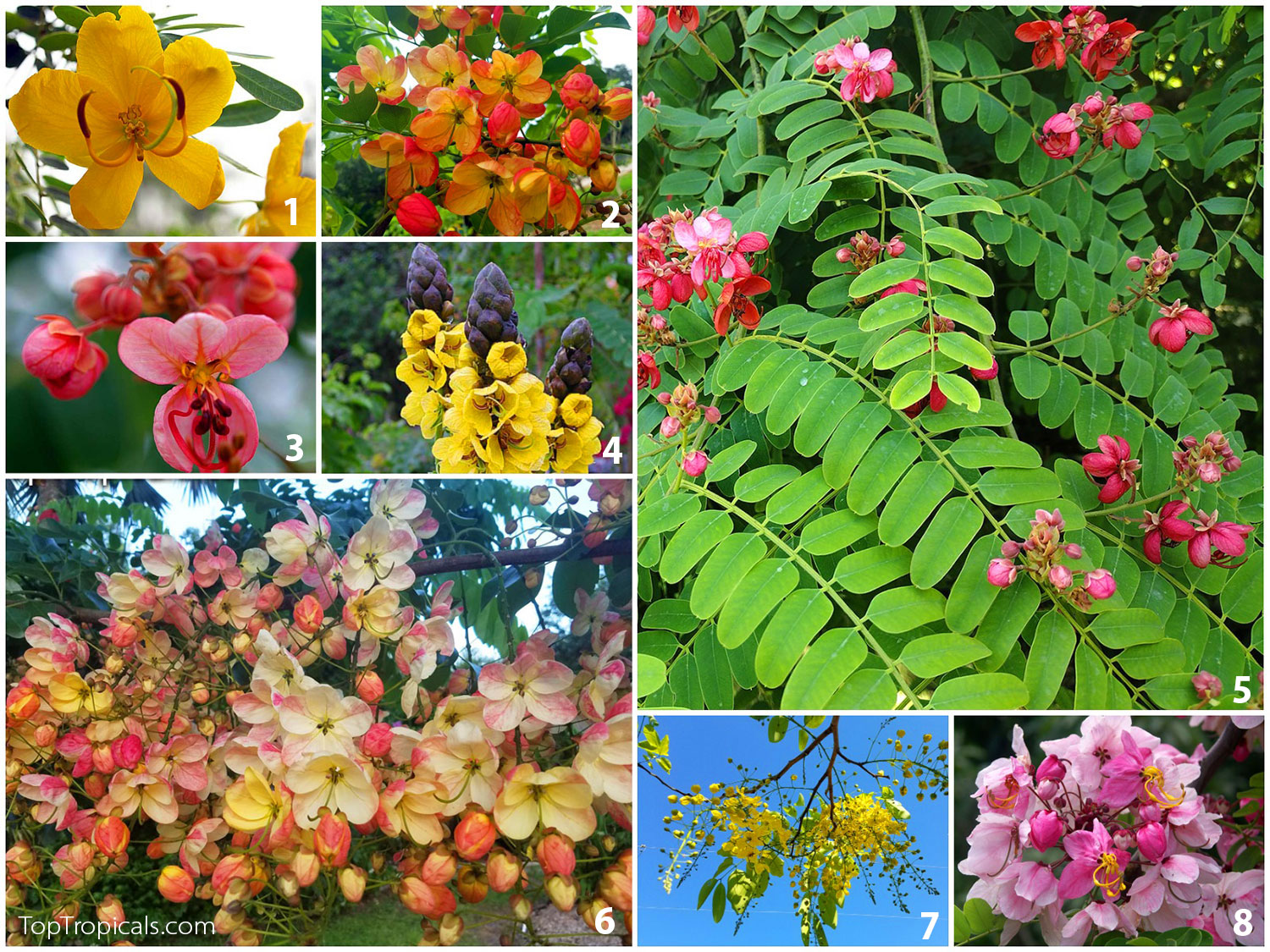
or pool deck into a tropical show. Most showy cassias (numbers correspond to
the photos in the collage above):
Cassia
bicapsularis (Butterfly Bush) - is a fast-growing,
low-maintenance shrub covered in bright yellow, butterfly-like blooms from
fall
through winter.
Cassia roxburghii (Ceylon Senna) - graceful tree with spreading,
drooping branches appearing to be overweighed by its wealth of clustering
red
blossoms.
Cassia
x nodosa (Pink Shower) - is a spectacular medium-sized, fast-growing
tree with cascading clusters of fragrant pink-and-white appleblossom blooms
in spring and summer.
Cassia fistula (Golden Shower) - to many tropical gardeners, the
most beautiful of cassias with masses of bright gold flower clusters appear
on
almost every branch.
Cassia javanica (Apple Blossom) - dazzles with dense clusters of
pink-to-white blossoms that change shades as they bloom, creating a
spectacular
display that lasts for months.
"Cassias love the heat and sunshine," says Tatiana
Anderson, Top Tropicals Plant Expert. "They are perfect for anyone
who wants big
bursts of color and doesn’t mind giving them space and light to grow."
Bauhinia Magic: Orchid-Like Blooms in a Compact Size
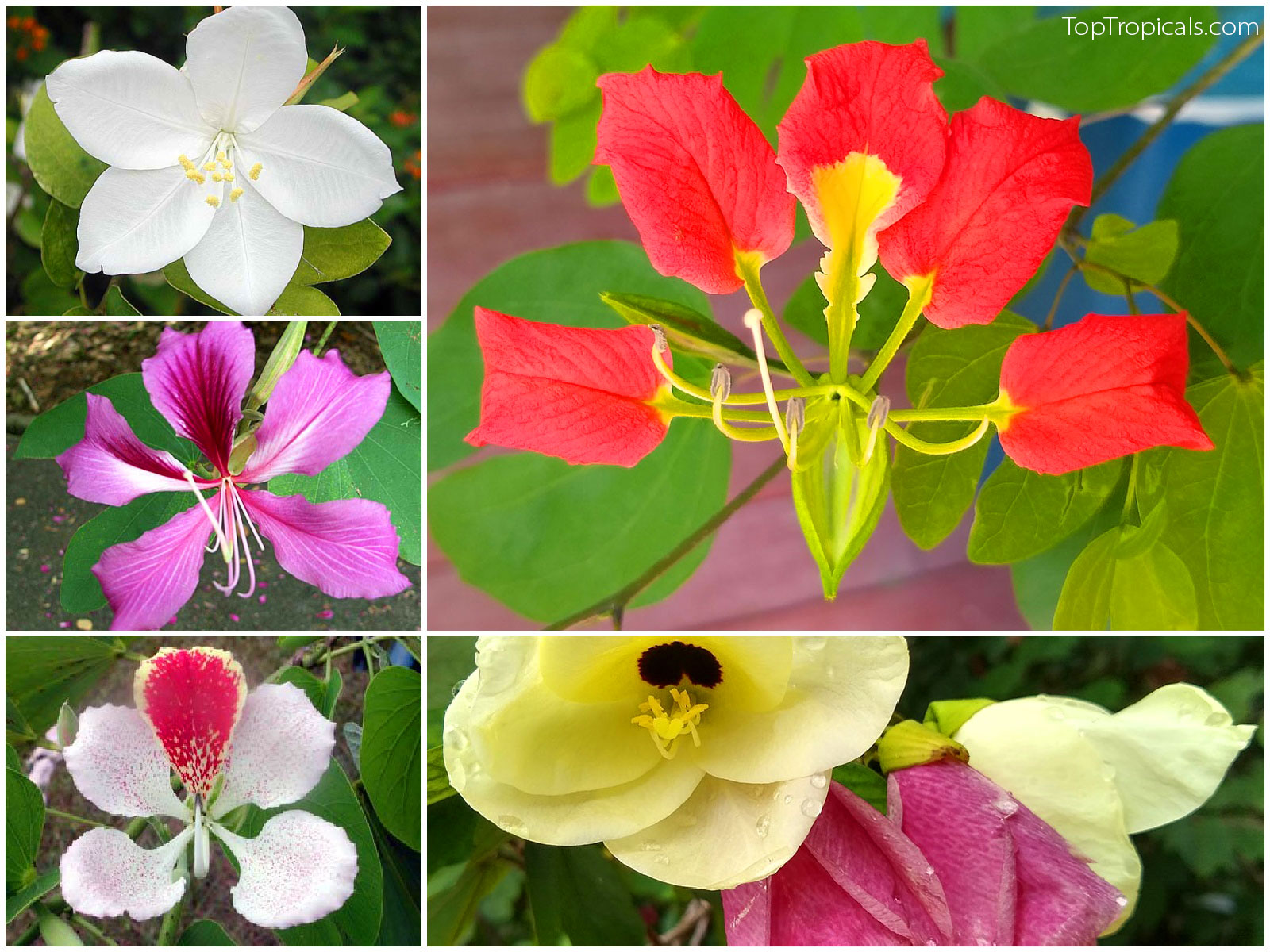
Bauhinia orchid trees: top left
– Bauhinia acuminata (Dwarf White Orchid Tree), middle left –
Bauhinia blakeana (Hong Kong Orchid Tree), bottom left – Bauhinia
monandra
(Napoleon’s Plume Orchid Tree), top right – Bauhinia
madagascariensis (Red Dwarf Orchid Tree), and bottom right – Bauhinia
tomentosa
(Yellow Orchid Tree)
Bauhinia trees
known as Orchid Trees, bring a touch of tropical luxury
to any space. Their butterfly-shaped leaves and orchid-like blossoms appear
in shades of red, pink, purple, white, and yellow, often lasting up to ten
months a year. Bauhinias are ideal for gardeners who want nonstop color in a
manageable size. Most species grow well in large pots and bloom young, often
within the first season.
The following compact varieties stay neat and flower almost
continuously in warm weather:
Bauhinia blakeana (Hong Kong Orchid Tree). A large tree in the
ground, but compact in pots if trimmed. Grafted trees flower right
away.
Winter bloomer, cold hardy to light frost.
The Hong Kong Orchid Tree is especially prized because it
is sterile and produces no messy seed pods, keeping patios clean. Grafted Buhinia
blakeana trees begin blooming while still small, making them perfect for
containers or tight spaces.
"Bauhinias are generous bloomers," Tatiana explains. "They respond
beautifully to regular feeding and full sun. If nights turn too cold, just
move the
pot to a sunny porch - they’ll keep their tropical charm most of the
year."
Give them full sun, regular fertilizer, and a well-drained
mix such as Sunshine
Abundance, and they will reward you with months of vivid
blooms. When nights turn too cold, simply move the pot to a sunny porch or
bright
window. Bauhinias adjust beautifully and keep their tropical grace year
after
year.
🎥
Watch Short Videos:
💲
Special Offer – 20% off Cassias and Bauhinias!
Get 20% OFF Cassias and Bauhinias with code
RAINBOW2025
Min order $100. Excluding S/H, valid online only,
cannot be combined with other offers.