Garden Blog - Top Tropicals

Date: 26 Oct 2018

Improving cold hardiness before winter: fertilizer and micro-elements

TopTropicals.com

Q: I live in New Jersey and it is getting cool here, with temperatures in the upper 40s, but my tropical plant collection is in a heated sunroom (still around 70s). Should I continue fertilizing my plants? And if yes, my second question about deciduous Sugar Apple tree. Should I continue fertilizing it until it drops leaves?

A: First of all, even though you live outside tropical climate, your plants enjoy warm temperatures year round, and can be treated like if they were in a Southern garden.
Plant nutrients, both macro-elements (regular fertilizer) and micro-elements (such as iron, manganese, magnesium, copper, and other elements) play an important role not only in overall plant health but also in plant hardiness.
The rule of thumb is, even in warm climates we cut off any fertilizer by the end of October. You still have time for the last treatment this year (next will be in March, or when your plants start showing new growth). You may apply just a bit of slow-release granulated fertilizer, or water-soluble by foliar spray, diluted 1/2 of label strength, to all evergreen species in your collection.
The most important application before winter is micro-elements and other plant boosters that will help you plant collection survive winter months with a shorter daylight and cooler temperatures. Now it is a perfect time to make these simple steps:

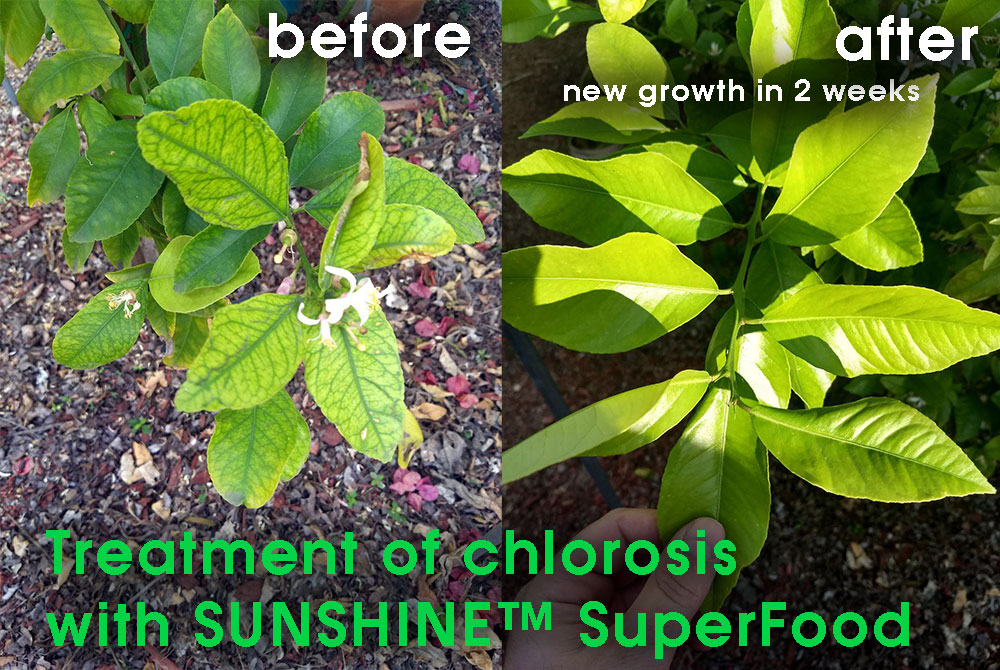
1) Miscro-element applications, any one of: Superfood, Iron Supplement, Greenleaf.
2) Sunshine-T application: for improving cold hardiness, plus immune system resistance to insects and deceases.
3) Sunshine-Honey application for all fruit trees to encourage bigger and sweeter fruit next year.

Regarding your second question. Deciduous tropical plants like Annonas, Adeniums, Plumerias, etc - do not need regular fertilizer at this time, however, go ahead and apply microelements Superfood complex, as well as Sunshine-Honey, while leaves are still green. These two will give a kick-start to provide better flowering in spring, and production of sweeter fruit later.

Check out SUNSHINE boosters - all with free shipping!

Date: 6 Jan 2024

Sunshine Boosters
Winter use... and discount!

Sunshine  Boosters  different  formulas

Do you remember that Sunshine Boosters fertilizers can be applied year-round?

As natural fertilizers, their scientifically created formulas provide perfectly balanced nutrition for your plants throughout the year. Follow the instructions on the labels and apply Sunshine Boosters with every watering. Give your plants extra boost during winter months! The fertilizer amount is balanced, adjusting proportionally to the water amount, which is tailored to the plant's winter needs. Unlike dry fertilizers, Sunshine Boosters can be used all year without fear of burning plants with excessive nutrient lockup.

Take advantage of the winter sale and stock up on this perfect plant food. You'll need plenty by Spring when your plants begin active growth! Use the code below for 20% off all Sunshine Boosters products. Hurry up, the sale will end in a few days!

SBOOSTERS20

Min order $20, excluding S/H. Exp. 1-12-24

Sunshine  Boosters  effect  in  the  garden

In the photo above: This picture was taken on Christmas Eve, December 24, 2023. The little garden by our B-farm office, irrigated automatically with Sunshine Boosters using the Robuster injector, is thriving in spite of cool nights. Look at this crazy banana, it is taller than the building, we honestly have never seen a banana of that size! The solution we are using there is Sunshine Robusta; now available for pick up in 2.5 gal jugs!

Date: 31 Dec 2016

New Video: SUNSHINE Plant Boosters

TT Laboratories presents: SUNSHINE In A Bottle!

Check out this video: SUNSHINE In A Bottle


SUNSHINE is a new generation of a plant booster, formulated specifically for tropical plants. SUNSHINE intention and direction is towards the general health of the plant and boosting its immune system; helping plant to recover from stress, increase flower and fruit production, improve cold hardiness, disease resistance, seed germination and much more!
TTLaboratories is offering the following products:
- SUNSHINE E - for general applications, stress relief and growth boosting
- SUNSHINE T (Thermo) - for better cold tolerance
- SUNSHINE BC - for bonsai and caudex
- SUNSHINE S - for seeds germination
- SUNSHINE H - for house plants
All of the SUNSHINE products come in an easy to use dropper for small to large application use.

Get some SUNSHINE!...

Stay updated with TopTropicals Videos by subscribing to our channel at YouTube.com/TopTropicals and get our latest video news of what's fruiting and blooming!

Date: 27 Apr 2020

How to feed a Mango tree...
and to grow a Dwarf Mango

How to fertilize a Mango tree

Q: My mango trees that I bought and planted last august now have fruit. I bought 2 types of fertilizer from you and never used it. Should I use your fertilizer now?

A: It is a perfect time now to fertilize your plants as they start active growth. For mango trees, we recommend liquid fertilizer Sunshine Booster - Mango Tango. It is formulated for Mango trees, especially for container grown. It improves quantity and quality of flowers and ability to set fruit, reduces bud-flower-fruit drop. Can be used as often as with every watering. For best results, use in combination with Sunshine Honey and Sunshine Superfood plant supplements. Its scientifically-balanced stable formula is organic Amino-acid based and has NO EDTA chelators to eliminate nutrients lockup; it does not affect crop taste.
Additionally, you may use slow-release granulated fertilizer Mango-Food once a month during hot season only. Dosage: 1 teaspoon per each gal of soil. Water-soluble fertilizers can be also used, however, those are usually EDTA-chelated which is not as efficient as Amono-acid based Sunshine Boosters and may create nutrients build up, especially if overdosed in containers.
For in-ground mango trees, you may use all the above, and slow-release granulated fertilizer can be applied in larger quantities: spread a handful around the drip line.

Remember that only liquid Sunshine Boosters can be applied year around. With other fertilizers, you need to be careful not to overdose, and apply only during hot weather (when night temperatures are steadily above 65F).

How to grow a Dwarf Mango tree

Q: I received the Ice cream mango tree in great condition (thank you for the ingenious packing job) on Wednesday and have planted it in a pot slightly bigger than the root ball. I plan to grow the tree on my front porch, so how big a container should I ultimately use when the tree outgrows this pot? How big a container does it need to fruit? I hope to keep it around 6-7 feet high, if possible. I live in Hawaii.

A: Ice Cream mango is a perfect variety for container culture, and it should be happy in Hawaii. You did everything right. Keep it in this small pot for now and wait until it starts vigorous growth in Summer. Once it starts growing (and you will notice roots growing too, sometimes they try to grow through the holes in the bottom of the pot), then it's time to step up into a bigger container (7-10 gal). Eventually you may use container size as large as 15 gal. Ice cream mango is slow growing and compact, and you will be able to maintain it under 7 ft with very minimal pruning if any.

Date: 22 Nov 2025

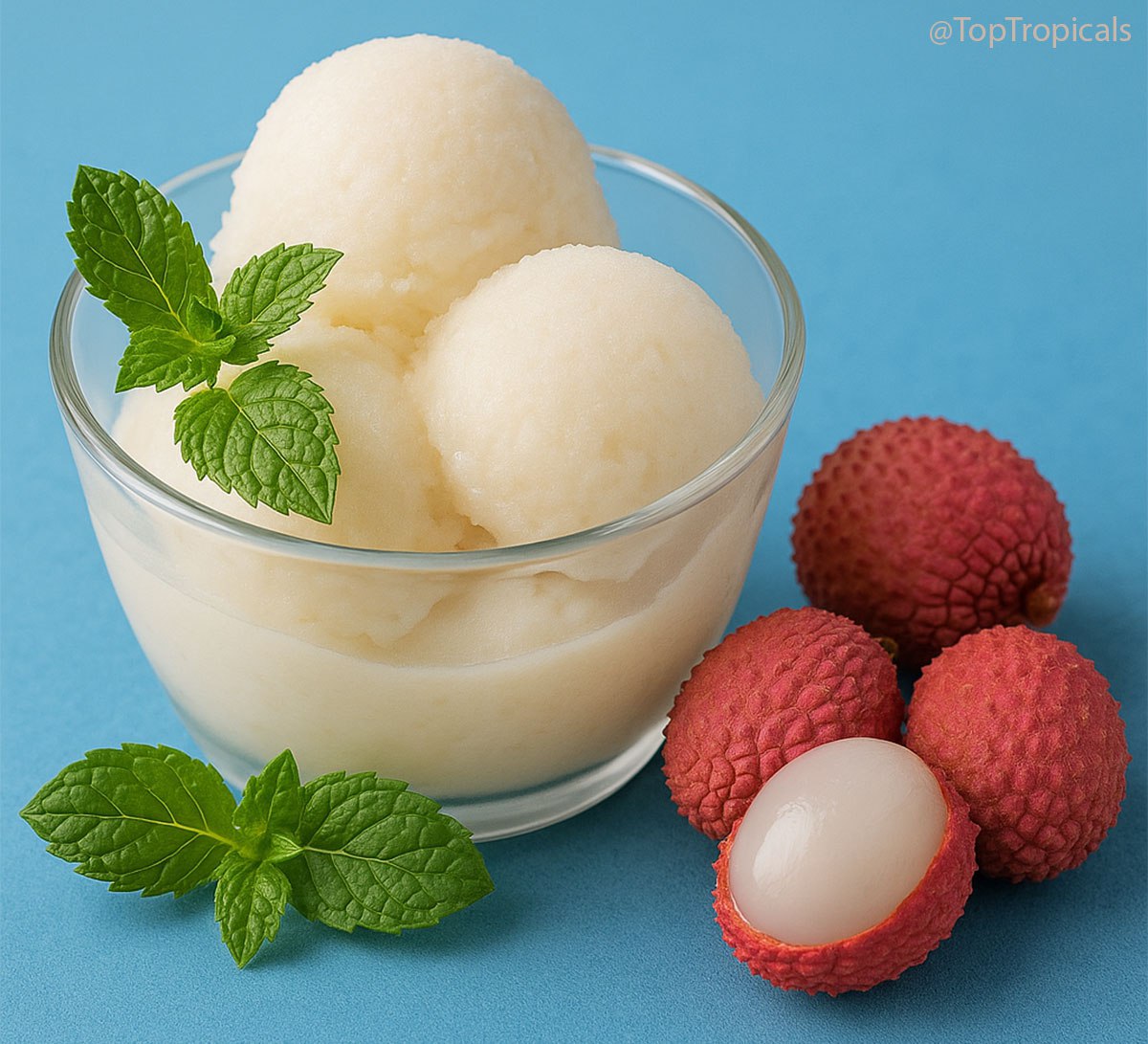
Lychee sorbet: quick-n-fun exotic recipes

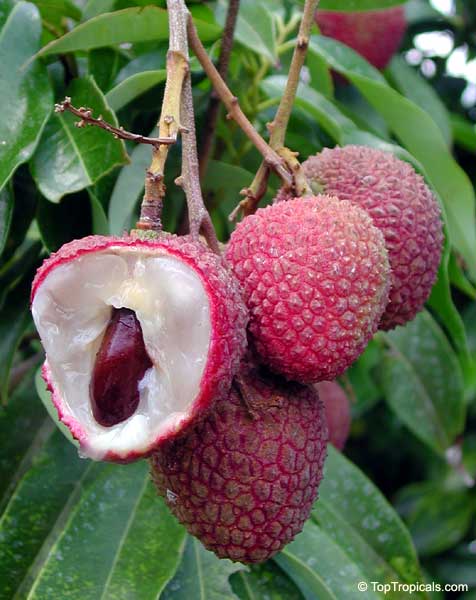
Lychee - Litchi chinensis

Lychee - Litchi chinensis

Lychee sorbet

Lychee sorbet

🍴 Lychee sorbet: quick-n-fun exotic recipes

  • 🔴Blend Lychee pulp with lime juice, freeze until firm.
  • 🔴A refreshing tropical ice treat.

Lychee Sorbet Recipe

Ingredients

  • 3 cups fresh lychee flesh, peeled and seeded (or canned lychees, drained)
  • 1/3 cup sugar or honey
  • 2 tablespoons fresh lime juice
  • 1/4 cup cold water, as needed for blending
  • Fresh mint leaves for garnish (optional)

Instructions

  1. Prepare the lychees by peeling them, removing the seeds, and collecting the white flesh. If using canned lychees, drain them well.
  2. Place the lychee flesh, sugar or honey, lime juice, and 2 tablespoons of the cold water into a blender.
  3. Blend until completely smooth. If the mixture is too thick to move easily, add a little more water, 1 tablespoon at a time.
  4. Pour the mixture into a shallow freezer safe container. Cover tightly.
  5. Freeze for 2 to 3 hours, stirring with a fork every 30 to 45 minutes, until the sorbet is firm but scoopable.
  6. Scoop into bowls and garnish with fresh mint leaves and extra lychee fruit if desired. Serve immediately.

🛒 Plant your Lychee tree - Litchi chinensis

📚 Learn more:


#Food_Forest #Recipes

🟢 Join 👉 TopTropicals