Date: 12 Dec 2018
Six ideas for the best Christmas gift plants

It's this time of the year again when a million dollar question arises: "What do I get them for Christmas?" It's an easy task to buy a gift for a gardener - because we always have a long wish-list! But what to get for everybody else? The answer a simple - buy a live plant... that can bring: Surprise, Love, Joy, Meaning, Convenience, and an Action into their lives! Below are a few wise suggestions.
1. Surprise for Tradition. Everybody knows Ponsettia. Everybody buys it. Every house has it... Red, yellow, white,
and even purple... unusual? No, simply dyed with a paint. Ahh. Go RARE!
Ponsettia is Euphorbia, get a rare Euphorbia. It has indestructible nature,
almosts zero maintenance, and FREE shipping!
Euphorbia leucocephala - Snows of Kilimanjaro
Euphorbia
geroldii - Thornless Crown of Thorns
Euphorbia Exotic Thai Candyland, variegated leaves
Euphorbia Pink Cadillac
2. Love. Gardenia Aimee Yoshioka First Love. With a dramatic history behind this cultivar, it is a perfect expression of Love that one can bring to another for Christmas...
3. Joy of Miracle. Miracle fruit. It speaks for itself and is one of the greatest container plants.
4. Meaning. Symbol of Long Life! Adansonia digitata - Baobab, also called the Tree of Longivity, can live for 5000 years. Pass this remarkable plant in your family from generation to generation! Regarded as the largest succulent plant in the world, the Baobab tree is steeped in a wealth of mystique, legend and superstition wherever it occurs in Africa, being a tree that can provide food, water, shelter and relief from sickness. FREE shipping and easy to maintain bonsai.
5. Convenience. A gift card will give your loved ones a chance to browse amazing wonderland of Tropical Plant World, pick something they like and have it shipped to them weather permitting. The gift card (certificate) has no expiration date!
6. Action. Coffea arabica - Coffee. Want to give your kids a project to drag them away from their smartphones? Have them grow a Real Coffee tree. It is a rewarding plant that is happy indoors and gives you a feeling of Creator - for your care, it will bloom for you with fragrant flowers and fruit for you with real coffee beans!
Check out the full list of plants that are great gifts!

If you need further advice on great looking gift plants for Christmas, contact us!
Date: 14 Nov 2018
Recovering Soursop after shipping and cold
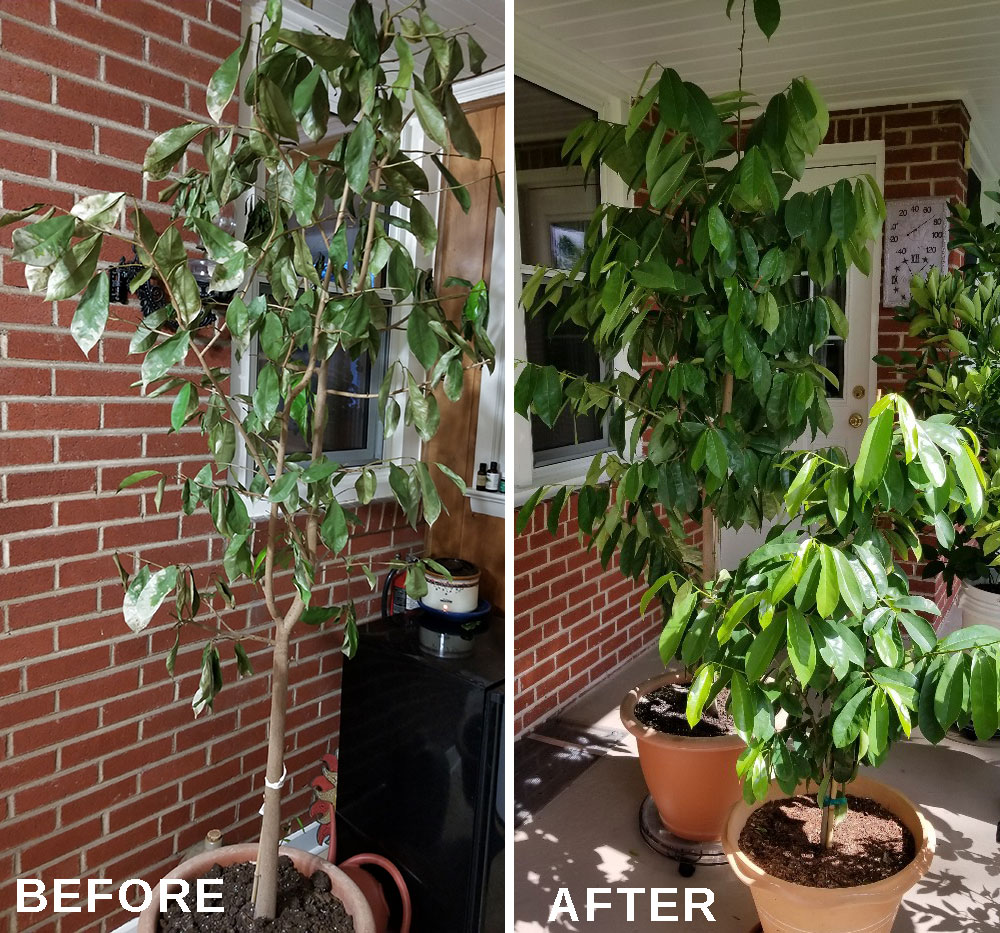
From Irene &
Marjorie, PA: We wanted to share our pics with you (after Summer). I
attached also the photo of the way the tree looked before your advice (back in
April). The big is the one we almost lost and you gave us these instructions and
it came back. These were your instructions:
"The soursop is one of my favorite fruits and I was so sad to hear
yours may be dead. Good news - the tree looks great! Yes, it does have some cold
damage but I'm surprised it still has leaves on it at all! In cooler weather,
they typically drop all of their leaves and stay that way until spring. You
can remove the damaged leaves and it will resprout new growth with the warmer
temperatures."
Taking care of
Soursop after shipping
Soursop - Annona muricata trees are very sensitive to temperature drops. This
always causes leaf loss. After shipping, do not water until the soil gets
slightly dry; keep it in bright shade. No fertilizer until the plant shows active
new growth. Be patient with your plant, and it should recover soon.
Soursop is an ultra-tropical tree and doesn't take any freeze. If you
live in a cooler climate, keep the plant in a pot (the good news is, Annonas,
in general, have a compact nature and are perfect for container culture).
Bring the tree indoors during the cold period, providing bright light.
We have a very interesting article about growing and fruiting Soursop
in an apartment. Check out 4534 Tropical Treasures Magazine # 7
Date: 19 Sep 2018
A Sacred Earthworm: benefit or damage?
by Mark Hooten

Q: We have lots of earthworms in our soil. I've heard they are beneficial for the plants, it it true? Or should I try (and how) to get rid of them at least for container plants?
A: From my earliest childhood, I remember learning that "earthworms" are wonderful, beneficial creatures for our gardens. I had heard that they improved the soil by both aerating it via the tiny tunnels they dig from burrowing activities, AND leaving their droppings which act as fertilizer. However, both my personal experiences and studies have shown otherwise. The truth is that the vast majority of earthworms we encounter in our daily horticultural practices are not even native to North America. In fact, they were introduced from Europe, beginning with the colonial period, mostly accidentally in things like the ballasts of ships, and from soil from around the roots of plants being imported. However, once they arrived here, they began to irreparably alter the natural eco-systems of our forests... Continue reading...
Date: 24 Jun 2018

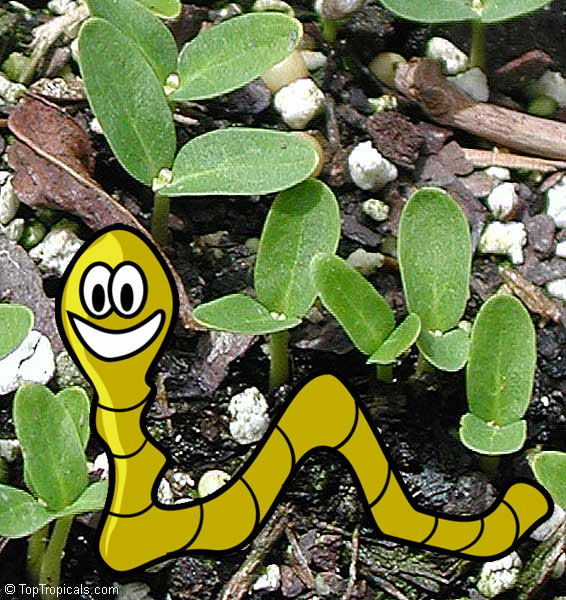
Growing tropicals from seeds.
From Kristi the Wizard of Rose: I grow many plants from seeds, both for my personal collection, and for TopTropicals. I receive many questions from customers who want to grow tropical plants from seeds. Some of them live in colder climates and try to extend growing season of their tropical collections by starting new varieties early in the year from seeds. These are a few tips that may be helpful.
Q: What do I need to do to speed up germination process?
A:
Many factors affect germination. Considering you get fresh
seeds (for example from TopTropicals) and Mother Nature
gives them a good kick start, there are a few things that
may speed up germination:
1) Scarification. Large seeds with a hard outer
shell can be slightly sanded down just enough for moisture
to get inside to wake up the seed during the pre-soaking.
Be careful not to damage the seed. See example of Lotus seed
scarification.
2) Pre-soaking. We recommend pre-soaking most of
the seeds for only a few hours (3-8 depending on species.
Some seeds are very sensitive to moisture and may start
rotting if stay wet without air circulation. Small seeds,
especially tiny ones like dust, should not be soaked.
3) SUNSHINE-S treatment. Adding a few drops of SUNSHINE-S booster when
pre-soaking seeds increases their germination rate 3-5
times.
4) Temperature. Warm temperatures help germination.
If grown indoors, put seeds containers or trays in the
warmest spot of your house; you may use heat pads.
Outdoors, putting them in full sun helps a lot, just don't
let soil to dry out.
Use only special porous seed germination mix
Date: 24 Jun 2018

Avocado, Lychee and Mango setting fruit... give them some FOOD!
Q: Do I need to fertilize tropical fruit when they set fruit?
A:
It is traditionally believed that mango and other tropical
fruit shouldn't be fertilized during fruiting period. It
is true to an extent: you don't want fruit to burst from
fast excessive growing. Instead, try to feed fruit trees
wisely, because they still need proper nutrition to
produce flowers and fruit.
Our spring specials of Lychee, Avocado and Mango are full of buds and
some already set tiny fruit (see examples on the photo).
Here is the feeding plan for these plants once you receive
your mail order:
1) Once received the plant, pot it into container size of
the root ball and let establish for couple weeks. Use SUNSHINE-E to help the plant
recover from shipping stress and establish root system.
2) Apply SUNSHINE-Honey right before
flowering, and next time at setting fruit, to provide
sweeter and bigger fruit, eliminate fruit cracks and help
resist fungus and other fruit diseases.
3) Use balanced granulated fertilizer,
1 tsp per each gallon of soil. Apply once a month during
Spring-Summer season. This gives the plant balanced
macro-elements (NPK) necessary for overall plant health.
Do not use on fruit trees fertilizers with high Nitrogen
content.
4) Apply SUNSHINE SuperFood
micro-element booster to keep fruit trees vigorous,
develop strong root system and avoid deficiencies.
5) In case of signs of chlorosis (yellowing leaves with
darker veins), give the tree SUNSHINE-GreenLeaf and watch
the leaves turning green quickly.
After harvesting, don't forget to make another treatment
of SUNSHINE-Honey