Garden Blog - Top Tropicals

Date: 30 Oct 2025

Before you open a bottle of wine,

Jaboticaba (Myrciaria cauliflora)

🍷Before you open a bottle of wine, meet the Secret Wine Tree from Brazil
  • 🍷Jaboticaba (Myrciaria cauliflora) grows grapes right on its trunk! It's one of Brazil’s most fascinating and beloved native fruits. Its name alone sounds exotic, but wait until you see it in fruit: shiny, grape-like berries bursting straight from the bark!
  • 🍷 Jaboticaba is the source of the famous Brazilian wine Vinho Tinto de Jabuticaba. The fruits are small, dark purple, with a thick skin and a sweet, melting pulp that tastes a lot like black currant. They can be eaten fresh, made into jams, or fermented into homemade wine with an incredible aroma and rich color.
  • 🍷 Jaboticaba tree is slow-growing and compact, often used as a bonsai because of its small leaves and graceful shape. But patience pays off - mature trees covered in purple fruits are absolutely stunning! The fruiting habit, called cauliflory, means the fruits grow directly from the trunk and main branches, creating a truly one-of-a-kind look.
  • 🍷 Jaboticaba trees can handle some cold (down to mid-20's once mature), don't mind wet rainy seasons and can be grown in containers in cooler areas. They make beautiful landscape trees and conversation starters wherever they’re planted.
  • 🍷 If you've ever dreamed of making your own wine from fruit grown in your backyard, this is the tree for you. Jaboticaba isn’t just a plant - it's an experience, a piece of Brazil's culture, and a living work of art that rewards patience with magic.


🛒 Grow your own wine from Jaboticaba Tree

📚
Learn more:


#Food_Forest #Nature_Wonders #Container_Garden
🟢 Join 👉 TopTropicals
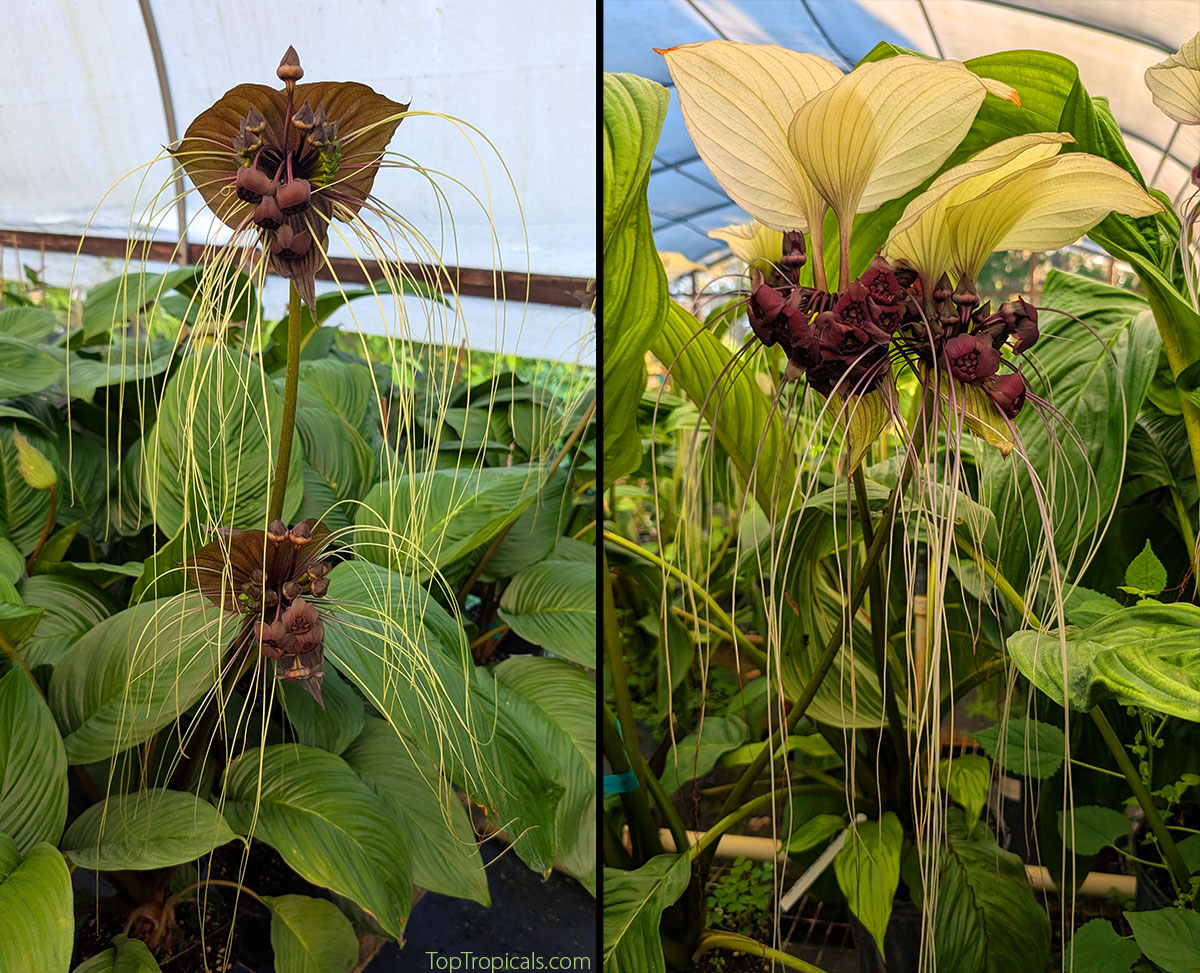
Date: 31 Oct 2025

Black  Bat  Lily  and  White  Bat  Lily  plants  blooming  together  in  the  Top 
 Tropicals  greenhouse,  showing  contrast  between  dark  maroon  and  ivory  bracts 
 with  long  trailing 
 whiskers.

Black and White Bat Lilies (Tacca chantrieri and Tacca nivea) side by side in bloom

How to Care for Bat Lilies

by Top Tropicals Plant Expert Tatiana Anderson

🌞 Light

  • Bright, filtered light. Morning sun or dappled shade is perfect.
  • Avoid direct midday sun outdoors — it can scorch the leaves.
  • Indoors, place near a bright window with sheer curtains or use a grow light.

🌡️ Temperature

  • Warm and stable, ideally 70-85 F during the day.
  • Protect from cold drafts or sudden chills.
  • Ideally, do not let temperature drop below 45 F, although Taccas can tolerate short period of upper 30's.

💧 Watering

  • Keep soil evenly moist but not soggy.
  • Water when the top inch feels barely dry.
  • Use lukewarm water.
  • Avoid letting the pot sit in water.

💨 Humidity

  • High humidity (60-80%) is key.
  • Mist leaves often, use a humidity tray, or keep near a humidifier.
  • In greenhouses or bathrooms with a skylight, it thrives naturally.

🌱 Soil

  • Use rich, loose, well-draining mix
  • Combine bark, peat, and perlite for ideal airflow around the roots.
  • Best mix for growing tropical Tacca in pots - soilless potting mix Abundance . It provides perfect drainage and has a texture similar to a jungle rainforest media.

🍽️ Feeding

  • During growth season (Spring through Fall), feed with Green Magic controlled release fertilizer every 6 months. For even better results, you may apply liquid fertilizer Sunshine Boosters Rubusta.
  • Stop feeding dry fertilizer in cooler months when growth slows. Liquid Sunshine Boosters are safe to use with every watering, year around.

🏡 Indoor Growing

  • Great for bright bathrooms, sunrooms, or any warm, humid corner.
  • Rotate pot occasionally for even growth.
  • Keep away from heating vents and AC drafts.

🌴 Outdoor Growing (in warm climates)

  • Partial shade or filtered light under trees.
  • Excellent in large containers that can be brought inside for winter.
  • Shelter from heavy rain and wind.

Sunshine: "So… it’s a diva?"
Smokey: "Exactly. But take care of it - and it rewards you with wings!"
Smokey and Sunshine: "Happy Halloween!"

🎥 Watch Short Videos:

🛒 Grow your own gothic masterpiece:
Shop Bat Head Lily Tacca

Date: 5 Nov 2025

How to protect Avocado from cold and how hardy is it?

Avocado tree fruiting indoors

Avocado tree fruiting indoors

❄️ How to protect Avocado from cold and how hardy is it?


Growing Avocado trees in cooler regions is possible with the right variety and care. By choosing Cold Hardy types and protecting them during cold spells, you can successfully grow avocados outside tropical climates. The more mature your tree, the better it handles the cold.
  • ❄️ What is Avocado cold hardiness?


    Most Avocados are sensitive to frost, but some Mexican varieties can survive lows around 15°F once established, and brief dips near 10°F with good care.


👉 Cold tolerance depends on:

  • Duration of cold: Short freezes are easier to survive.
  • Sun exposure: More sun means better cold resistance.
  • Wind protection: Wind can do more harm than temperature alone.
  • Tree health: Regular fertilization, such as Sunshine Boosters, helps strengthen plants.


❄️ How to protect avocados from cold

  • Bigger is better: Mature trees resist cold better than young ones.
  • Wind protection: Plant on the south or southeast side of a building for warmth.
  • Good fertilization: Healthy trees are stronger and more resilient.
  • Watering: Water less in winter; overwatering in cold weather can cause root rot.


❄️ Protection for young plants

  • Cover and mulch: Before a freeze, mound mulch around the base and cover with a blanket. Add Christmas lights or a small heater for extra warmth (use caution).
  • Use microclimates: Plant near walls or buildings where it’s warmer and wind is reduced.


With a little planning and protection, you can enjoy fresh avocados even in cooler climates!

✔️ Check outAvocado Variety Guide interactive chart. Sort them by flower type A or B, tree habit, fruit shape and quality, cold hardiness, origin, season and more!

🛒  Shop Cold Hardy Avocados

📖 Our Book: Avocado Variety Guide, Snack or Guacamole?

📚 Learn more:


#Food_Forest #Avocado #How_to

🟢 Join 👉 TopTropicals

Date: 24 Nov 2025

One fruit on this tray always stumps people

Tropical fruit on a tray

One fruit on this tray always stumps people

  • 🍉 Another day, another fruit tray from the garden! Even at the end of November, something is always ripening here in Florida. This tray turned out especially fun - a mix of familiar fruits and a couple that always make people guess twice!
  • 🍉 Today’s harvest includes: sweet Persimmons, Star fruit, a few different dragon fruits: yellow Palora and white with red skin - this is Seoul Kitchen. There's also Cocoplum, which makes great drinks. And - ta-da! - the little showstopper of the day: Curly Locks Orchid Cactus fruit (Epiphyllum guatemalense Monstrosa). It looks wild, but it's edible and tastes like a tiny dragon fruit.
  • 🍉 If you live in Florida or any warm climate, growing your own fruit is one of the best gifts you can give yourself. Tropical fruit trees are generous plants - they don’t wait for a season, they give you something month after month. Some days it’s a handful, some days it’s a whole tray, but there’s always a fresh treat waiting. Once you start growing your own food, you realize how easy and rewarding it is to fill your garden with flavor.
  • 🍉 Every tray has a new surprise. Come along and see what the garden gives us next!


🛒 Explore rare tropical fruit

📚 Learn more:
#Food_Forest #Discover

🟢 Join 👉 TopTropicals

Date: 18 Dec 2025

How to have fruit year around from Everbearing Mulberry

🍇 How to have fruit year around from Everbearing Mulberry


📱

💗 Dwarf Everbearing and Dwarf Issai - Compact, container-friendly varieties perfect for small spaces. These dwarf trees (6-10 ft tall) are disease and drought resistant, with multiple crops year-round, even from the first year! Ideal for patios and small yards..

🛒 Plant hardy Mulberry year around

📚 Learn more:


#Food_Forest

🟢 Join 👉 TopTropicals