Garden Blog - Top Tropicals

Date: 7 Jan 2019

Three interesting varieties of Avocado

TopTropicals.com

Q: I intend to gift three avocados, at least one type A and one type B, to a friend who lives in an area where the temperature never goes below 25F. The idea is to give them a ripening season as long as possible. Which combinations do you suggest, and which are the A and B?

A: When talking about "A" type and "B" type in Avocados, we are referring to the flowers. An avocado will produce both male and female flowers on the same plant. "A" type means that the flowers are female in the morning and male at afternoon. "B" type means that the flowers are male in the morning and female in the afternoon. If you plant to start a commercial growth, then it's important to create a proper mix of both types. However, in hot and humid climate a single tree produces flowers of both types, so it is NOT necessary to have both A- and B- types planted together in the backyard. Even a single tree produces enough fruit for a home gardener.

It is also important to know that while there are "more cold hardy" avocados (hardy to as low as 15F), it refers to a full grown established tree. Young trees still need protection from the cold until they are bigger and more established. One can not expect a small tree planted in June to survive the first winter with a hard freeze. It'll take a few years until the tree is strong enough.

These a few rare varieties that may be of your interest.

Poncho Avocado
Very cold hardy variety. Produces medium to large green fruit. It survived temperatures around 10F near San Antonio, Texas (Zone 8b). Mature trees can take temperatures down to 15F for short period of time without significant damage.

Anise Avocado
This avocado has strongly scented leaves that smell like Anise. Very rare variety. Fruit is of excellent quality, creamy and buttery.

Catalina Avocado
Catalina is a very nice mid-season pear-shaped fruit that is especially rich and creamy. It is an extremely popular variety in South Florida in the Cuban Community. The Story of this variety says...
...Catalina is an amazing avocado floated across from Cuba, 60 years ago just before Fidel Castro took over the Island Nation. Wise Cubans jumped into the ocean to escape the Castro regime and tossed in some favorite scions for us to enjoy here in the States. We owe a great debt to poor old Don Miguel Cruz de la Santa Maria Espinoza Sanchez Alvarez Jr. who sadly was lost at sea. His amazing scion wood, wrapped in cellophane and aluminum foil floated over, washing ashore on Miami Beach. His shiny little package was miraculously picked up on the shoreline and immediately grafted and cared for by keen-eyed avocado lovers in Miami...
So be sure to think about this story every time you eat a Catalina!

These three Avocados will provide you with fruit ripening during the whole warm season. See more information on avocado varieties and the most cold hardy cultivars.

Check out our full selection of avocado varieties. They are 15% OFF today!

Date: 1 Jan 2019

NEW VIDEO:

Dwarf Barbados Cherry

Malpighia punicifolia - Dwarf Barbados-Cherry, Dwarf Acerola. This dwarf form of Acerola makes a wonderful low-growing shrub or beautiful bonsai tree with edible fruit. Profuse bloomer, it is also a nice ornamental! Due to its shallow and smaller root system, Acerolas can be interplanted with other crops more closely than many trees. Acerolas grows in marl, limestone, clay and other heavy soils as long as it drains well. Has the highest vitamin C content of any fruit. 1 Cherry is equal to 12 oranges. Used in jellies, jams, freezes without losing its vitamin C content. The plant is drought tolerant and easy to grow.

Malpighias are available from our store

Stay updated with TopTropicals Videos by subscribing to our channel at YouTube.com/TopTropicals and get our latest video news of what is fruiting and blooming!

Date: 6 Dec 2018

Seven rules of cold protection for tropicals

TopTropicals.com

Q: I was always wondering how you guys manage to grow true tropical trees in Florida? I live in Puerto Rico and we have Breadfruit trees growing here in a wild... but my sister lives not far away from you, in Orlando, which is much colder, and I wonder if I can get her a Breadfruit tree for Christmas?

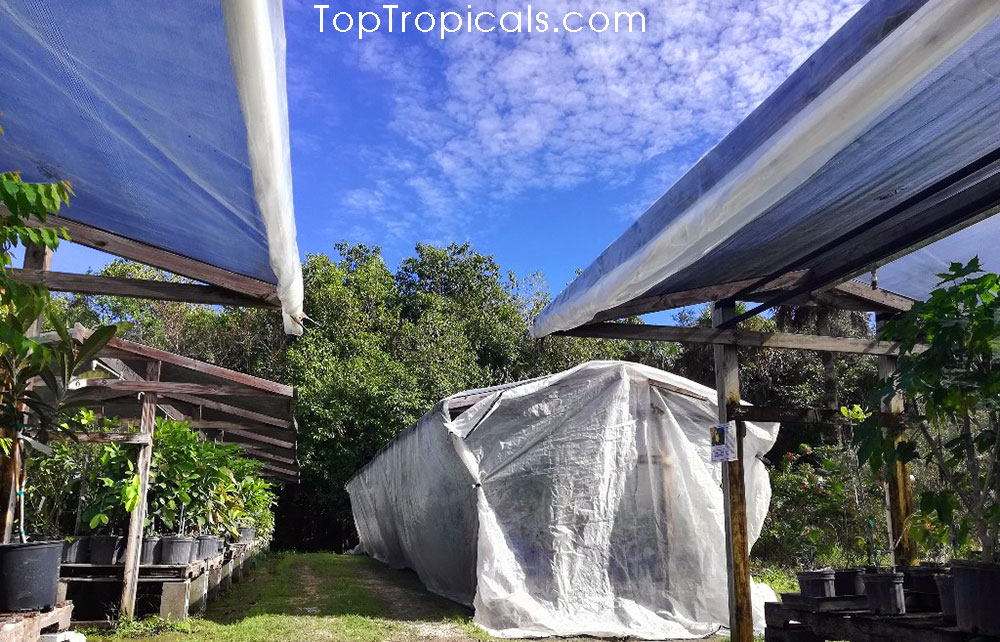
A: Your sister can grow a Breadfruit tree in Orlando either in a pot (and bring it indoors during cold periods) or in the ground inside a structure (an elclosed conservatory with heating system). See our customer's Greenhouse in Virginia. Cold protection of tropical plants is a lengthy subject and we have many interesting publications about it in our managine Tropical Treasures and on the website. In a nutshell, when growing tropicals outside of tropical climate, you need to follow these 7 rules:
1. Cut watering to a minimum. Cold+wet kills tropical roots.
2. Water thirsty plants before a cold night. Jucy leaves have fewer chances to be cold-zapped.
3. Wind protection is more important than a temperature drop. Plant tropicals close to a house or surrounded by other trees.
4. Duration of a cold period is more critical than the cold itself. If expecting long cold hours, bring up all available protection resources. Christmas lights or propane heaters - as long as there is a heat source, everything helps!
5. Remove plastic covers during the daytime so plants don't get "cooked" in the sun. Fabric covers are better than plastic.
6. Grow ultra-tropicals in containers and bring them inside the garage or even indoors during the cold.
7. Use SUNSHINE plant boosters and feed your plants well during Summer to improve cold hardiness.

Related topics:
About Cold Protection
Cold protection - winter action for your plant collection
Improving cold hardiness before winter: fertilizer and micro-elements
Cold hardy tropical fruit trees

Date: 6 Dec 2018

Why starting tropicals from seed indoors is better than outside?
TopTropicals.com

Q: I am in Texas, it is getting cold, but I bought these seeds the last two packs, as I didn't want to miss them, was looking for a long time and found you had them. Should I wait until spring to plant them?

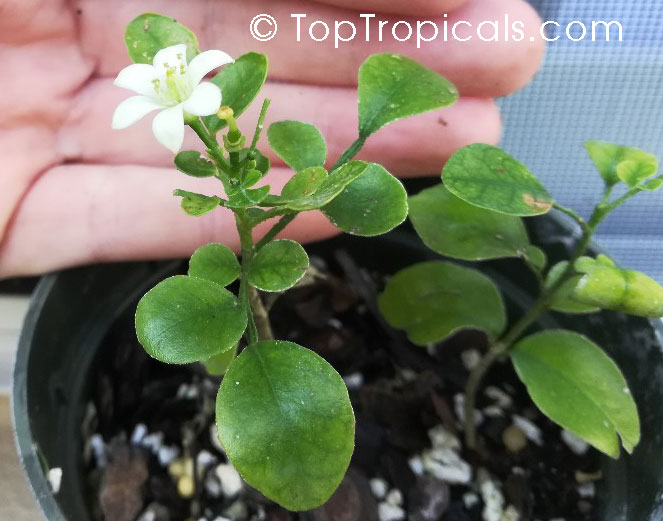
A: You can grow tropical plants from seed year round and don't have to wait until warm weather outside. It is, in fact, beneficial to start tropicals indoors in a controlled temperature, moisture and humidity. Seeds of some species are very sensitive to excess water and/or require a certain range of temperature for germination... Besides, it's so much fun!
First, read the basics: Happy Hobby: growing tropicals from seeds

Advantages of indoor growing from seed

It is easier to keep under control indoors:

1) Temperature and Light. Although many tropical seeds require higher temperature and bright light for germination (hot sun may help), it may be hard to avoid overheating and drying out when you put trays in full sun. Using heat pads and additional lighting indoors makes germination smooth, even may take a little longer than in hot sun.
2) Soil moisture. If you ever lost your seeds or tiny seedlings to a heavy summer rain, you sure will appreciate your own moisture-controlled environment! Just make sure to use the right soil mix.
3) Air humidity. Indoor air is drier than outside. It may not be best for some tropical plants, but definitely perfect for seed health - they will never get moldy considering you keep your eye on the plantings.
4) Pre-treatment. Some seeds require scarification (sanding down hard shell), others stratification (cold treatment), but all seeds will benefit from SUNSHINE-S soak before planting. It is easier to do in your home lab. Based on our experience, using Sunshine pre-treatment reduces the risk of fungal damage and improves germination from 30 to 65%.
5) After germination culture. Watching seedlings closely in your home environment and giving them all that is needed for healthy, fast growth - miscroelements and first fertilizer - will help to establish young plants just in time before planting them out in Spring-Summer.

Read more: From Kristi - how to grow tropicals from seed.

Check out our seeds selection...

Date: 20 Oct 2018

Featured Plant. Bilimbi, Cucumber tree, Tree Sorrel

TopTropicals.com

Bilimbi, Cucumber tree, Tree Sorrel

Ethnic names are: Kamias, Belimbing Asam, Belimbing Buloh, Bimbiri. This rare exotic fruit is very popular in Thailand, Malaya and Singapore. In India, where it is usually found in gardens, the bilimbi has gone wild in the warmest regions of the country. Outside native habitat, Bilimbi is hard to find plant, very few growers produce them, although it is not so hard in cultivation.
The bilimbi is closely allied to the carambola but quite different in appearance, manner of fruiting, flavor and uses. The only strictly English names are "cucumber tree" and "tree sorrel". "Bilimbi" is the common name in India and has become widely used. Many people are more familiar with the close ralative - Averrhoa carambola - Star Fruit, which foliage looks very similar to bilimbi. The bilimbi leaves and taste of fruit are quite similar to those of the Phyllanthus acidus - Otaheite Gooseberry), although these plants are not related. Continue reading...

Check out this plant...