Garden Blog - Top Tropicals

Date: 10 Oct 2016

Cold protection - winter action for your plant collection

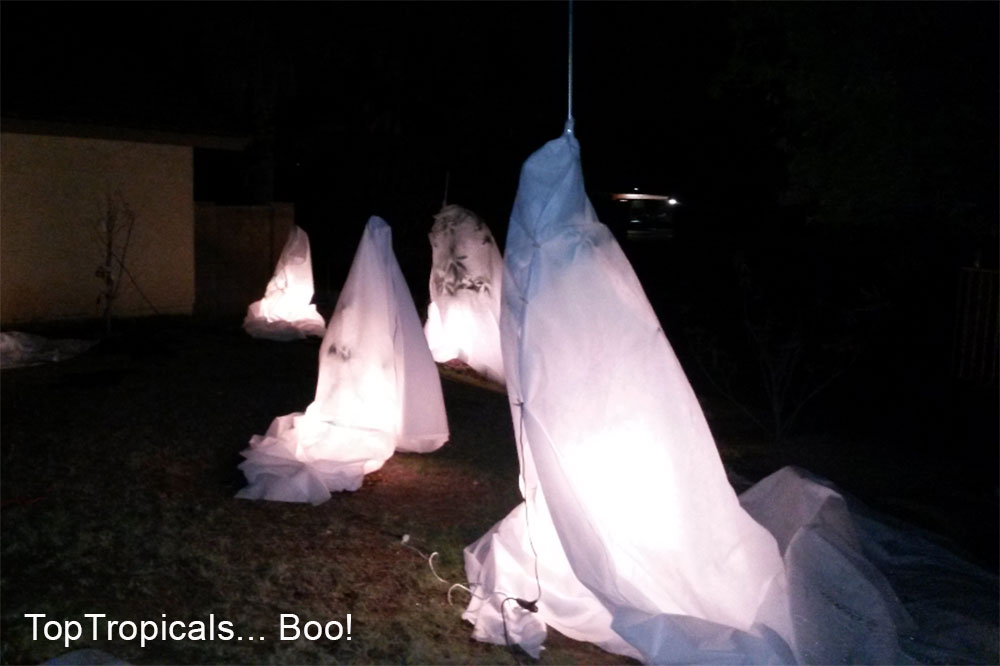
A note from our customer: Last winter was very cold here in Arizona, lower 30's. I used white synthetic sheets (called frost cloth, it is very light and yet effective) to cover my fruit trees, and kept simple light garlands on for the whole night. Sending you couple photos so you can share with others. It worked pretty well for my plants and no cold damage!

With winter approaching, it is time to take some actions to protect your rare plants from cold stress and damage.
If you live in a mild climate, you still need to get ready for the cold nights. When expecting a cold night, individual plants and trees can be wrapped with sheets, or blankets, to protect them from the wind chill. Christmas lights is a good idea for an additional warm up.

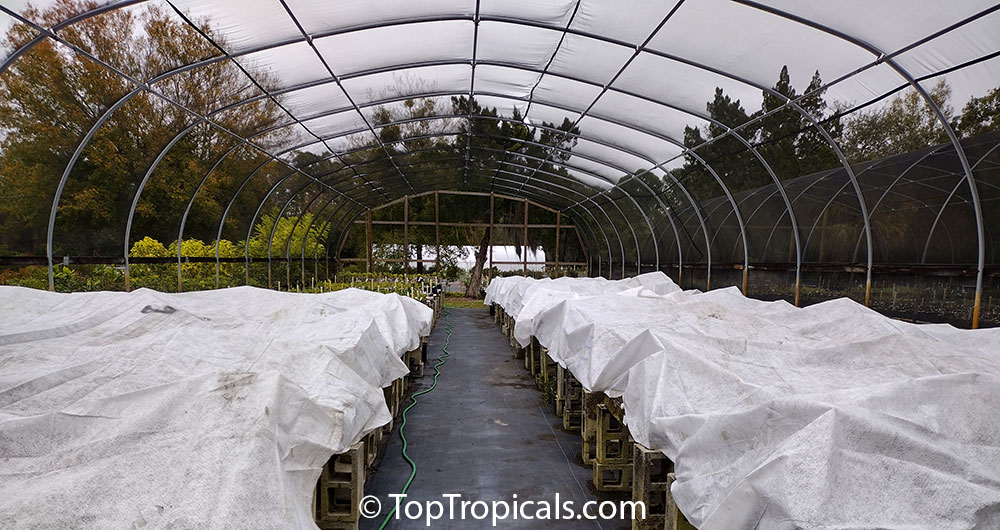
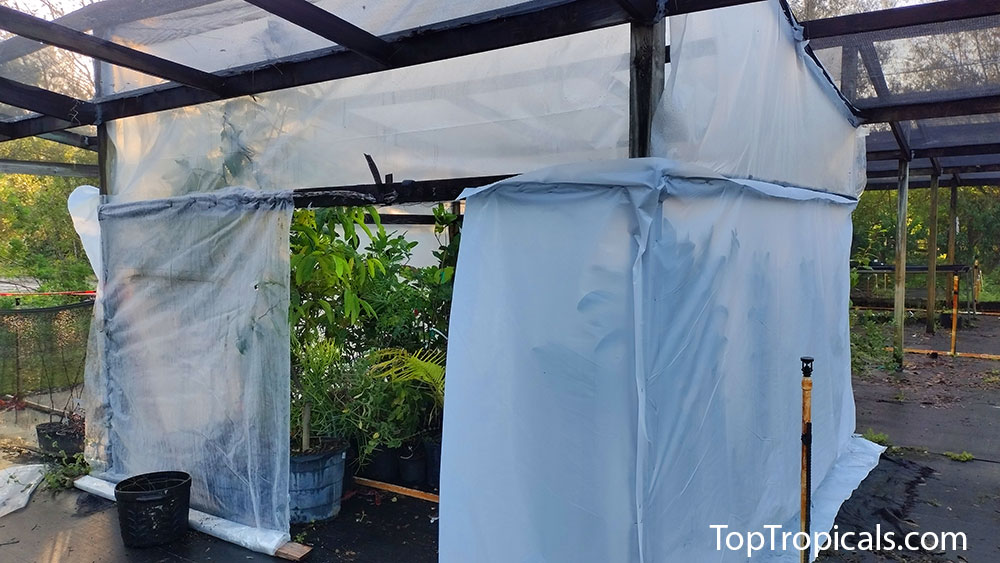
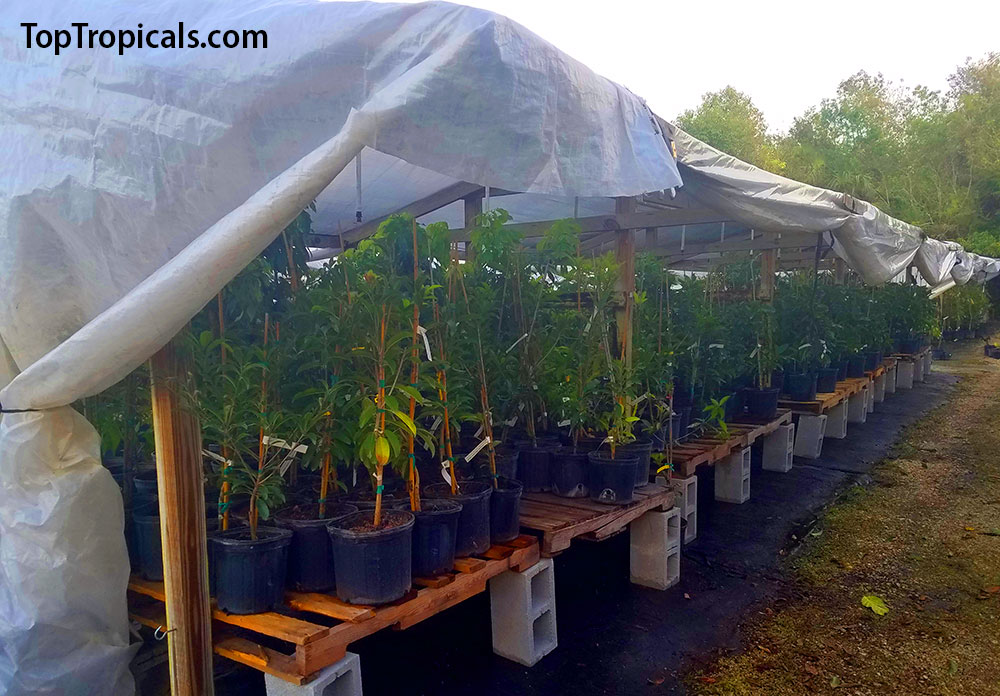
For large collections of tropical plants, temporary winter greenhouse doesn't have to be expensive. An easy-assembly mobile carport from a hardware store covered with a plastic or fabric will cost you $100-200. It can fit a hundred plants or more!

If you live in area with a hard freeze, Southern exposure windowsill will work for most of the compact tropicals providing proper care. Larger collections may also move into your garage for a few cold nights, or for longer periods if the garage has a bright light source.

Factors affecting tropical plant winter survival:

1. Duration of cold period. Tropical plants can't stand long periods of cold. A few days of even upper 30's may kill a tropical plant. A few hours of frost may cause leaf drop but the plant will recover.
2. Minimum temperature - of course, the warmer the better. But see 1) - if cold is not for too long, it may be OK.
3. Wind-chill can be more dangerous than low temperatures.
4. Exposure. Southern slopes get warm during daytime and stay warm longer.
5. Protection with a house, fence, larger trees - where a "pocket" of warm air forms and stays - is beneficial.
6. Humidity. A lake or a river nearby (especially ocean) will mild the micro-climate.
7. Individual species hardiness. Don't try to grow Orchid Tree outdoors in New York.
8. Plant maturity and health. A well-established plant with developed root system has more chances to survive cold. If a plant had a good change to develop during warm season (bright light, enough water, fertilizer), it will be more cold hardy. Healthy plant can withstand lower temperature, so proper nutrition is important, including micro-element applications. Large specimens, even ultra-tropical, may survive cooler winter than they normally do in their natural habitat. The Nature provided plants with better hardiness level than it is normally used. To boost plant immune system and improve cold tolerance even more, use SUNSHINE plant boosters. SUNSHINE-T - thermo-protection booster, is specially formulated for winter protection of tropical plants. To improve cold hardiness, spray 1-2 days prior to cold with 5 ml/1 gal solution and continue applications with 2.5 ml/1 gal solution every 10-15 days throughout winter period.
9. Gradual temperature decrease is less dangerous than a sudden drop since it gives a plant a chance to adjust. One sudden freeze in December with prior warm fall may create more damage than a gradual temperature adjustment. If it starts to get cold early in the Fall, plants slow down their metabolism, and the new tender growth won't get hurt later in winter, since the plants are "expecting" the cold.
10. Do not fertilize plants during cool months. Not only because they don't need much food beyond growing season, but also because fertilizer (especially Nitrogen) encourages rapid tender growth that will be damaged by cold and this will stress the whole plant.

Stay warm!

Date: 18 May 2021

Healthy Plants: Q&A from Mr Booster

Healthy Heliconia Leaves?

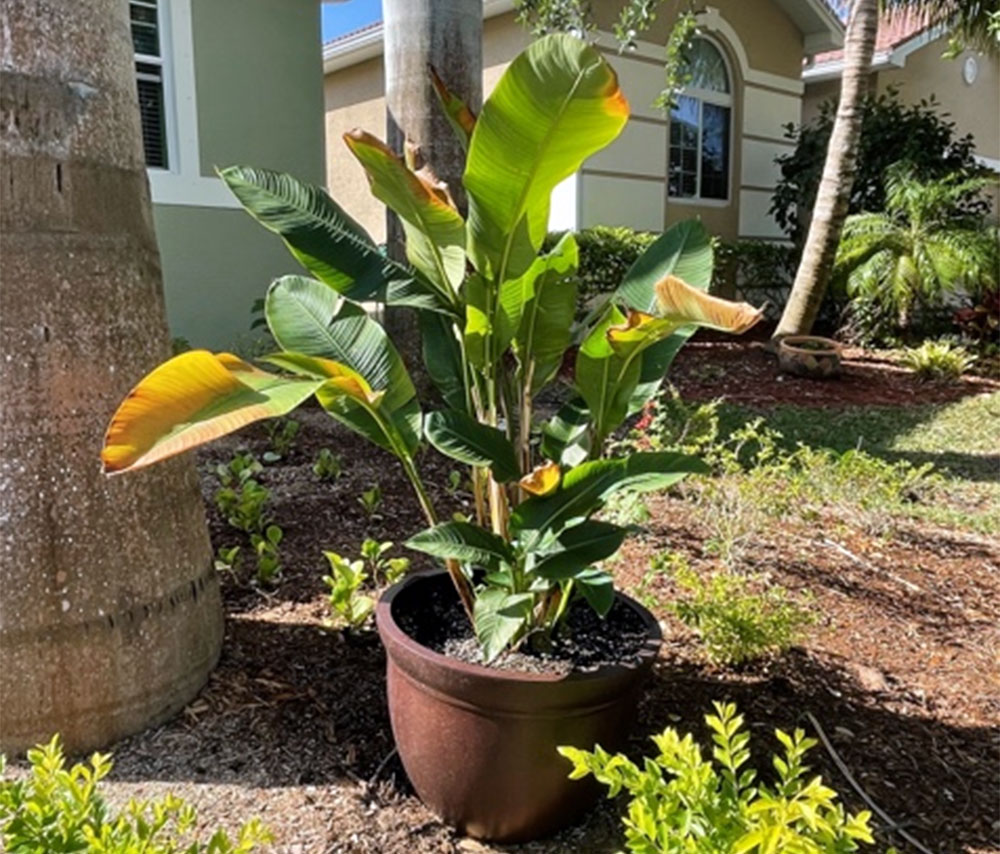
Q: I purchased a heliconia from you a couple months ago. The new growth seems to be doing fairly well, however some of the larger leaves are discoloring around the edges then drying up. It's potted in a large pot with potting soil with 3 holes in the bottom to help with drainage in partial sun under a Royal Palm facing northwest. I'm here in Ft Myers. I was previously watering it every other day with your rapid growth fertilizer 1 tbsp per gallon but I have cut that back to once or twice a week. Please let me know your thoughts.

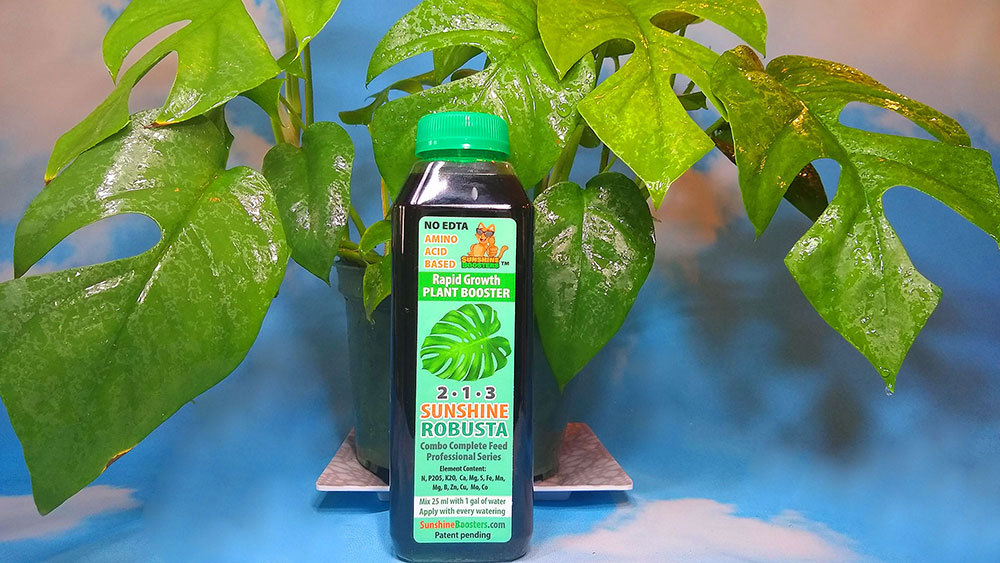
A: Heliconias and Gingers tend to develop dry leaves if grown in pots, especially ceramic or clay pots, because soil in such pots dries out too fast. These dry leaves are not caused by fertilizer, and you can see lots of new healthy green growth. The plant overall seem to be healthy. Continue fertilizing it with liquid Sunshine Robusta that is great for all wide-leaf tropical species, promotes green, lush foliage, and do not use any additional dry fertilizers!
Another suggestion, try to move the plant in more shady spot. Right now it sits in pretty bright light, this may be OK for established plants in the ground, but potted heliconias are very sensitive to hot sun. They get leaf burn easily.

Date: 20 Aug 2020

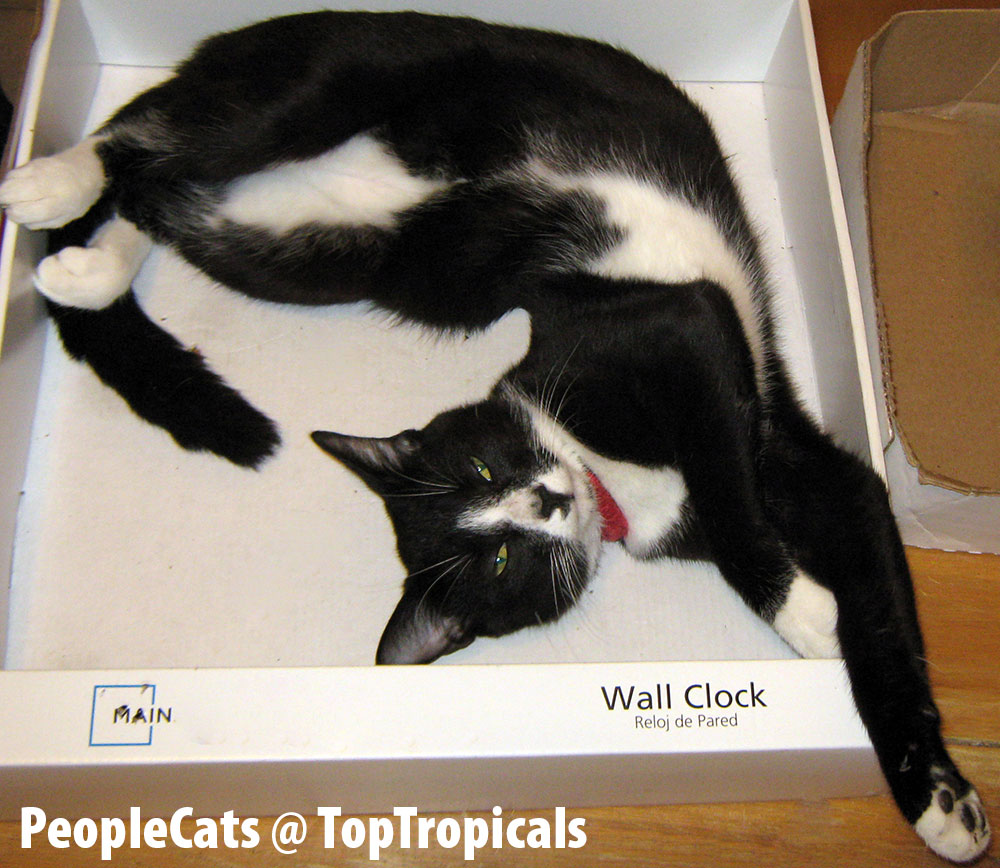
PeopleCats of TopTropicals. Cat of The Month: Greenhouse King

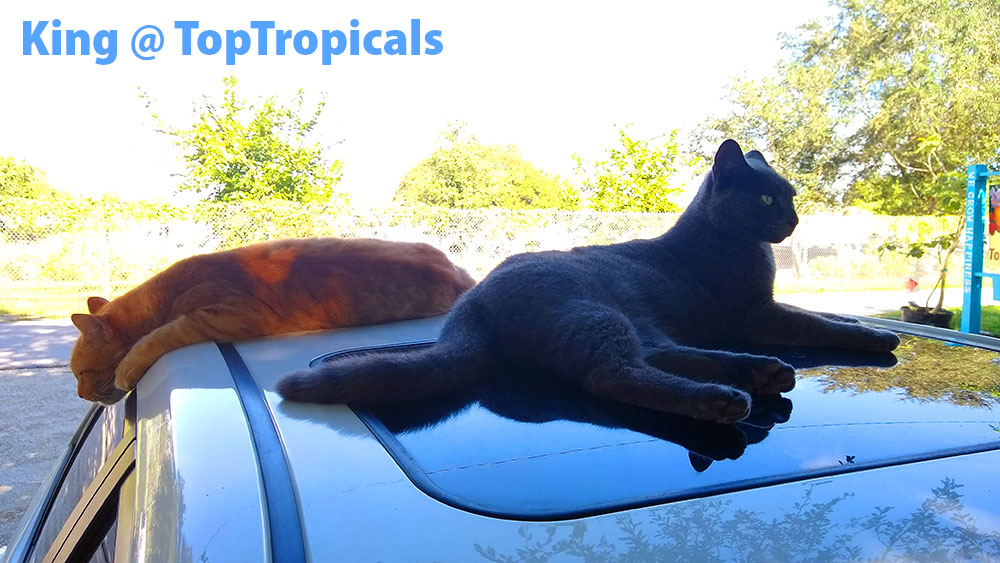
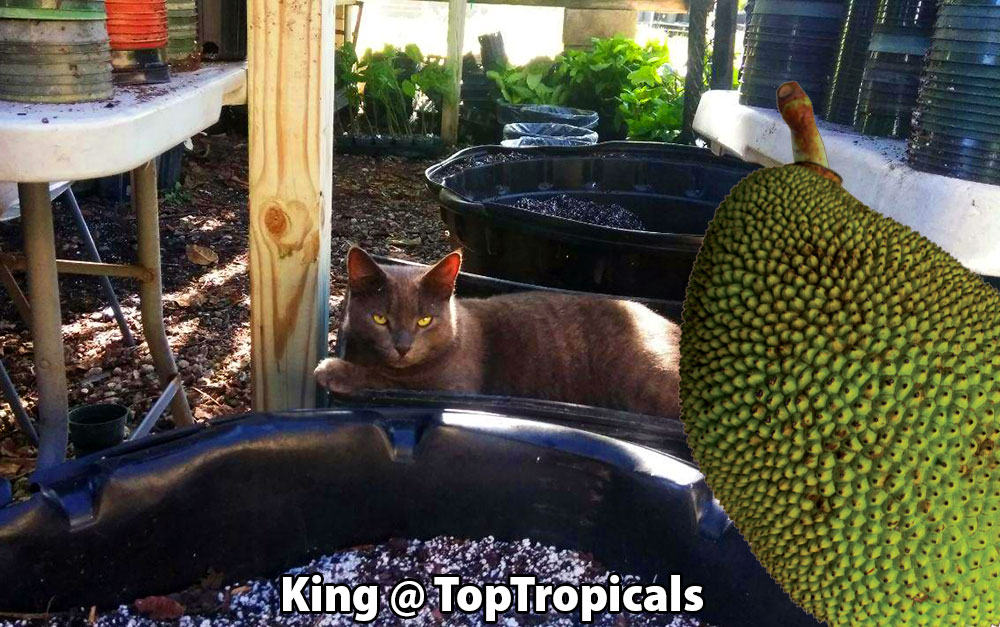
King continues being on top of the poll... thanks to his adventurous nature. This Purrrson just loves to travel! He likes driving and biking. How many times we pulled him out of customer's car or delivery truck!
Sure thing, he just did it again, joining contractor's team. Luckily he was noticed hiding in the back of the truck before the driver hit the highway!

ATTENTION VISITORS!

We are reminding you, please check your vehicles for cats before you leave!

On a bright side, King has been very helpful, helping to plant newly arrived plant shipment from Thailand.
For those of you who has been waiting for rare plants, after a long delay due to airlines lockdown, we finally got lots of rare stuff and it will be ready for shipping soon.
Please make sure to add to your wish-list these coming-soon rare plants, this is the only way we can ensure you will get notified when they are available for sale, on first come first serve basis.
These are limited quantities, high demand plants!
Don't miss your dream plant! Just click on "Notify me when available" and add your email to waiting list.

Limited quantities - will be ready soon
(planted with King's help)

- Amherstia nobilis - Pride of Burma
- Artabotrys siamensis - Climbing Ylang-Ylang
- Barringtonia acutangula - Indian Putat
- Barringtonia asiatica - Fish Poison Tree
- Bauhinia aureifolia - Fragrant Gold Leaf Orchid Vine
- Brownea ariza - Rose of Venezuela
- Brownea grandiceps - Scarlet Flame Bean
- Cananga fruticosa - Dwarf Ylang-Ylang
- Couroupita guianensis - Cannonball Tree
- Cyrtostachys lakka - Lipstick Palm, Red Sealing Wax
- Desmos chinensis - Ylang Ylang Shrub
- Dillenia philippinensis - Katmon, Philippines Elephant Apple
- Garcinia mangostana - Mangosteen
- Ixora congesta Thai Flame
- Melodorum fruticosum - Hot Lips Ylang-Ylang
- Monstera variegata Thai Constellation (available now for pick up only)
- Gustavia augusta - Heaven Lotus
- Posoqueria longiflora - Needle Flower Tree
- Rauwenhoffia, Melodorum siamensis
- Saraca declinata - Red Saraca
- Terminalia catappa - Tropical Almond
- Vallaris glabra - Bread Flower
- Wrightia vietnamensis - Dwarf

TopTropicals PeopleCat Club and Zoo

Thank you for supporting us in helping PeopleCat Community!
Make your kind donation today and receive a surprise gift from us! Every little bit helps. Thank you and God bless you and your pets!

Date: 17 May 2019

Persimmons - seedlings or grafted?

TopTropicals.com

Q: Do all persimmons take roughly 6 years to fruit if grown from seed?

A: Persimmons, like most of the cultivated fruit trees, are recommended to be grafted to ensure a certain variety, although they may also come true to seed. And unfortunately, you are right - it will take a few years (depending on growing conditions) until the seedling will start fruiting. So your best bet to get a quality fruit right away is to obtain a grafted plant. You may check out persimmons (tropical and subtropical) that we carry in stock. If you are interested in any of the varieties that are currently sold out, just add your email to wishlist by clicking on link Notify me when available and you will be notified as soon as we have it back in stock.

Date: 12 Mar 2019

Spring tips

TopTropicals.com

Once temperatures stay above 65F, growing season starts for tropical plants.

1. Increase watering as soon as you see new buds opening and new leaves growing

2. Trim all dead or damaged wood 1-2 inches above new growth

3. Apply the following treats to make your plants happy:

- granulated balanced fertilizer

- SUNSHINE Superfood microelements as foliar spray for healthy growth, profuse flowering, and disease/bug resistance

- SUNSHINE-E to help plants come out of dormancy faster and increase metabolism. 100 ml bottles and 50 ml bottles available for large plant collections.

- SUNSHINE-Honey to fruit trees so you can enjoy sweeter and bigger fruit later this year

4. If nights are still chilly, take potted plants outside to enjoy the afternoon sun and bring them back indoors for the night.