Garden Blog - Top Tropicals

Date: 18 Sep 2016

About Cold Protection...

Q: I have a question, if I'm in Okeechobee Florida zone 9b are there any plants that you sell that would have to be protected at all? I have a lot that I've purchased from you and don't want to lose any of them winter.

A: Sometimes it is hard to guarantee if certain plants are hardy enough in certain area. From our experience, tropical plant performance in non-tropical areas depend on many factors; a lot of times plants appear to be hardier than they are believed to be. Other times, an obviously hardy plant doesn't survive winter. So there always will be a chance of risk involved, while nice surprises are not an exception. We have been testing many tropical species throughout many years of our nursery experience. Wind protection in many cases is more important than temperature. Enclosed sections of your garden provide better chances to survive cold snaps. Generally speaking, here is the list of some plants (not complete list, just examples) that in our experience have been surviving light freezes without significant damage.

Q: I live in San Jose,CA. Got Mango Alphonso 2 yrs back and protected it for a year in a pot during winter. Last spring I planted it and during winter I put a freeze cloth to protect it but it died. How can I make sure it wont die if I buy this time plz?

A: Mango trees are tolerant only to light frost, once established. If it gets below freezing in your area for more than a few hours, and especially if you have numerous nights with frost throughout winter, we recommend to keep mango tree in a pot. This way it can be moved to protected area during cold night. The more established the tree, the more chances to survive colder temperatures.
We also use plant booster Sunshine to increase plants cold tolerance
Cold protection is a lengthy subject. You may also use propane heaters during cold nights.
Here is some more information on cold protection.
Also, we recommend to check out our magazine Tropical Treasures (about pushing the limits of tropical gardening) for a detailed article on cold protection.
These are specific articles on Zone-Pushing in different issue #s regarding dealing with cold. See downloadable issues:
(#1) Growing Tropicals in Nontropical Climate, Three Freezing Nights in Southwest Florida
(#2) Temperature drops - an alert or a rehearsal?
(#5) Dealing with cold snaps, Cold hardy beauties
(#7) When winter is around the corner, Growing exotic Cordyline in colder climate
(#8) When the weather outside is frightful
(#9) Winter champions
(#11) Ready-for-winter checklist for in-ground plants
(#13) Winter checklist
(#18) Dealing with cold damaged plants
You may also order hard copies.

If temperatures drop below freezing in your area, remember to add Heat Pack to your order!

Date: 12 Apr 2016

Hot novelty plant for hot Arizona

Q: What plants would you recommend for very hot and dry spot in front of my house that gets full sun all day long? I live in AZ, we recently had a couple good rains but this is going to be it for a long time. It gets so hot during the day that every plant I tried didn't make it. We have a few nice orange trees growing well but I would like to plant something compact, colorful and hopefully fragrant if there is such plant.

A: There is a perfect small size plant for you that is extremely fragrant and yet will be thriving in these conditions. It is the famous Jasmine sambac. It will appreciate dry air of Arizona and will bloom profusely for you in full sun or in partial shade. It doesn't mind heat at all.

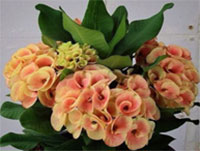
For colorful accents, a proven winner is Crown of Thorns - Euphorbia millii. New giant size flower varieties were recently selected in Thailand, and we just received a great selection, look at the colors! These plants don't mind hot sunny location at all. The more sun, the better the bloom! Small plants need regular watering until establish, then once they start developing, they will require less water.

Giant Euphorbia flowers from Thailand are 4-5 times bigger than regular flower euphorbia. Diameter of the flower is around 2". Compare giant flower to normal size - picture on the right.

See full list of plants for hot and dry spots.

Date: 2 Apr 2016

Erblichia or Flor de Fuego - Apricot fragrance and sunny color

Q: I saw this wonderful flower Flor de Fuego on your website and I would like to buy this plant. I am wondering how big this tree will grow and how long will it take until I can smell the lovely flowers? I have a big garden and not much space left, but I still have a few spots available for smaller trees. Also any special care info will be appreciated.

A: Flor de Fuego is a small tree and will fit in any small yard situation. It is very rare in cultivation. This is the newest, most exciting tree to be introduced in the last decade. It said to be one of the most beautiful flowering trees in Central America. It has long narrow leaves and large flowers 6-8" across that smell like apricots. It blooms from late fall through early winter and sometimes through spring. Normally it starts blooming in 2-3 years after planted in the ground. Surprisingly for such a delicate plant, it tolerates poor soils. Once established, it doesn't require any special care other than regular watering and fertilizing during hot months. It does take some effort sometimes to make the tree happy in its new habitat. After planting in the ground, keep your eye on irrigation schedule and do not let soil stay wet, young trees don't like wet feet. In natural habitat, the plant prefers to have a dry period that is beneficial for profuse blooming.

See full size picture of Erblichia tree in full bloom

Click here to buy Flor de Fuego

Date: 30 Mar 2016

Spring time fun: fertilizing and pruning

Q: When is a proper time to start fertilizing my garden in Spring? Also, when can I cut back cold damaged branches? Should I wait until end of April?

A: As a rule of thumb, fertilizer can be applied during period of active growth, when a plant needs additional nutrients. With indoor plants, you can fertilize pretty much year round as long as the plant continues growing and not dormant. For in-ground tropical plants, start fertilizing when new growth appears. In subtropical areas, with cooler winter months, most tropical plants slow down their metabolism when temperature drops below 65F. Many of them become dormant, and may even lose leaves (especially deciduous plants like Annona, or Peaches/Plums). In spring, tropical plants wake up as soon as outside temperature stays above 65F for at least one week (including night time). Once you see new growth, this is a signal for you to start fertilizing.

As far as trimming dead branches - wait until you see new leaves completely opened up. This way you won't cut too much, as some parts of the plant may take longer to re-leaf than others.

Date: 10 Mar 2016

Do-It-Yourself Support Structure for Dragon Fruit

This interesting do-it yourself project was sent to us by our customer from South Florida. Many tropical gardeners want to grow fascinating Dragon Fruit, and their most common question is - what kind of support I should use for this amazing fruiting cactus? We hope you find this information very useful. Happy Gardening!

Dragon fruit is a terrestrial/epiphytic fruit baring cactus, which may grow fleshy stems up to 30 ft high, given sturdy support. However, downward hanging or horizontal branches stimulate production of flowers at the tips of the branches. Commercial groves in different parts of the world use different method to achieve this. The traditional Vietnamese way is to train the plant into a “fountain”, which consists of a vertical central trunk about 8ft tall and a horizontal structure, such as a wagon wheel on top of it to support the horizontal branches (see picture on the right).

This picture served as my inspiration to build my own structure. I used five 4”x4” 10ft wood beams as the trunk, shaped as a cross. I attached the beams to each other with 10” long screws.

I dug a 2 ft deep 12”x12” hole in the ground and positioned the trunk inside, such that about 8ft are above ground. I covered it with several layers of burlap top to bottom.

The horizontal structure on top is made of four 4ft long 2”x2” wood beams and two 12”x12” wood plates to hold them together. I attached this structure to the top of the trunk.

I used old watering pipe to form two rings around the trunk to support the branches. Here is the result!... See step-by-step full size pictures and the rest of the article...