Garden Blog - Top Tropicals

Date: 8 Aug 2016

Growing mango in hot Arizona

By Mike D, Mesa, AZ. Despite to what you may think, mango can be successfully grown in desert Arizona climate. It has good heat and drought tolerance. It's possible providing the following:
1) Winter protection of a young plant when temperature goes around or below freezing. Try to plant trees in locations where they're protected from cold wind. Minimal temperatures vary widely. Areas which are closer to downtown are few degrees warmer, while outskirts can be very cold.
2) Some people are lucky enough to live in areas with good soil. However, most of us will have a so-called hardpan (extremely compacted desert) or caliche (layers of soil cemented together by calcium carbonate). Check with your local county extension office to determine how to deal with such conditions. Gypsum is usually used to loosen compacted soil.
3) When planting, dig a large hole making sure it has good drainage. Plant tree as usual, add mulch around it. It helps to conserve moisture.
4) Best time to plant is late Fall or early Spring, so mango can get established before Summer heat.
5) Plant where tree gets few hours of sun.
5) Water a lot until established. Once established, water when soil is dry.
6) Small plant may need protection from summer heat. Use shade cloth.
7) Mango requires very little nitrogen fertilizer. In hot climate, overdosing nitrogen may result in quick plant decline. Use balanced low nitrogen slow release fertilizer or avoid nitrogen completely. If you use mulch, then decomposing mulch provides enough nitrogen. Foliar spray of micronutrient solution is recommended during active growing period. Read more...

Date: 1 Apr 2026

Happy Passover!

Cats Smokey and Sunshine celebrating Passover

Cats Smokey and Sunshine celebrating Passover

Happy Passover!

Sunshine: I fixed the donut problem. And I brought mango.
Smokey: Non-traditional. Compliant. Happy Passover.
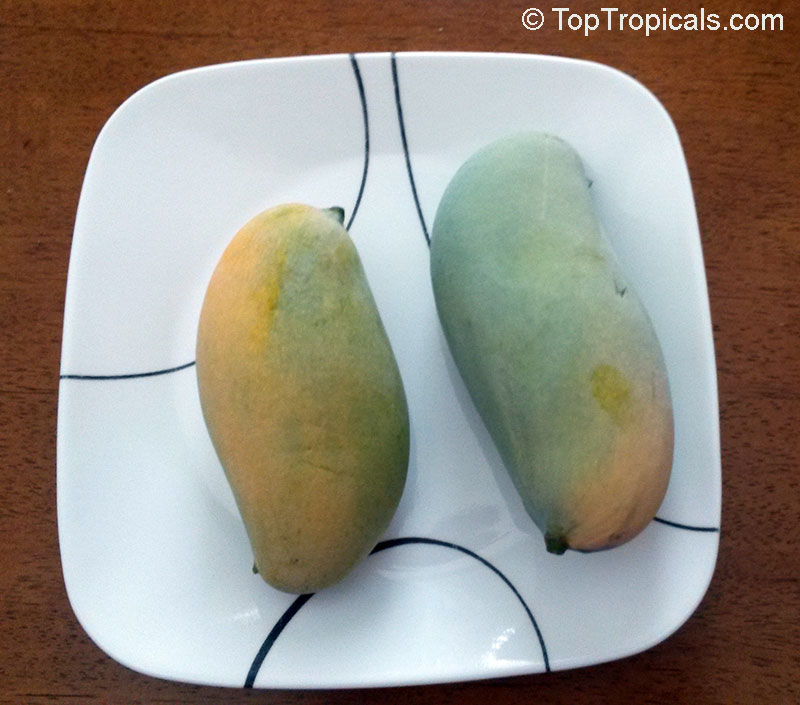
  • 🥭 Some traditions stay exactly as they are. Others - adapt. On our patio this Passover, Smokey kept things properly grounded (wine in hand), watching closely as the table filled with familiar symbols. Sunshine, meanwhile, solved a practical problem the only way he knows how: creatively. No leavened donuts allowed? Fine. Matzah donuts it is. And since no celebration should be short on sweetness, a plate of fresh mango quietly found its place at the table.
  • 🥭 That is gardening in a nutshell. You respect the rules, but you work with what grows, what thrives, and what brings joy. A tropical garden teaches the same lesson every day: conditions change, but abundance is always possible if you choose the right plants.
  • 🥭 This season, whether you are planting something new or enjoying the fruits already within reach, take a note from Smokey and Sunshine. Stay within the rules - but do not be afraid to make them work for you.


🛒 Explore Mango varieties · Shop fruit trees

#Mango #Food_Forest

🟢 Join 👉 TopTropicals

Date: 22 Sep 2025

Dragon Fruit Plant Care – Tips from the Garden Expert
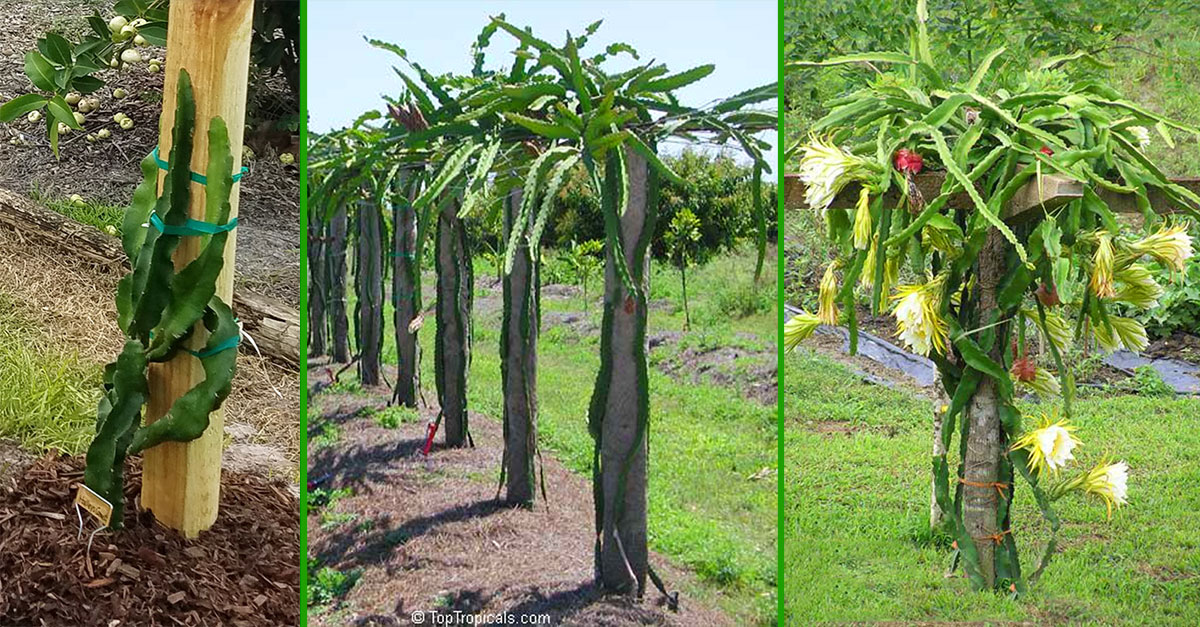
Stages  of  dragon  fruit  pitaya  plant  growth  and  trellis  support 
 system

Dragon fruit is one of those plants that look exotic but are surprisingly easy once you know the basics. Here is what works best in the garden:

  • Soil: They hate wet feet. A sandy, fast-draining soilless-mix is your friend. If water sits around the roots, rot comes fast.
  • Watering: Deep watering is better than frequent sips. Let the soil dry between waterings. In rainy season they cope well, but in pots you need to be careful.
  • Sunlight: Full sun is great, but in very hot places a touch of afternoon shade keeps them happy.
  • Support: They are natural climbers. A wooden post, concrete pole, or trellis will give them something to grab and makes harvest easier.
  • Fertilizer: Feed lightly but often. A gentle liquid like Sunshine C-Cibus liquid booster with every watering, or Green Magic controlled release fertilizer every 5-6 months. It encourages strong roots, lush growth, and lots of flowers.
  • Pruning: Trim off tangled or weak stems. This guides energy into strong branches that will flower and fruit.

Think of it as training a cactus vine into a small tree. Once it settles in, it almost takes care of itself — and pays back with fruit you can’t buy in stores.

🌱 Dragon Fruit Plant Care – Outdoors and Indoors

Outdoors: Dragon fruit thrives in USDA Zones 10–11 year-round. In warm regions like Florida, Texas, California, and Hawaii, you can grow it outside in the ground. Give it fast-draining soil, full sun with a little afternoon shade in the hottest months, and a sturdy trellis or post to climb. Deep watering with drying periods in between keeps roots healthy. A yearly pruning shapes the plant and boosts flowering.

Indoors or Patio Pots: Gardeners in cooler zones can still enjoy dragon fruit in containers. Use a large pot with sandy, well-draining mix or soilless-mix and a pole for support. Place the pot in the brightest spot — a greenhouse, sunroom, or patio that gets 6+ hours of light daily. Move pots inside when temperatures drop below 40F. Even indoors, a healthy plant can bloom and fruit if it has enough light and warmth.

❓ Dragon Fruit FAQ


How soon will a dragon fruit start producing?

Cuttings can flower and fruit in as little as 2–3 years. Seed-grown plants take longer, often 4–6 years. Large developed specimens can start flowering and fruiting within a year or even the same season.

Do I need more than one plant for pollination?

Some varieties are self-fertile, others need a second plant for cross-pollination. Even self-fertile types usually set more fruit with a partner nearby.

How big do they get?

In the ground, dragon fruit can climb 15–20 ft if you let it. With pruning and a trellis, you can keep it shaped like a small tree, 6–8 ft tall.

Can I grow it in a pot?

Yes. A large container with sandy mix or soilless-mix and a pole for climbing works well. Indoors it will need bright light or a grow lamp.

What does a dragon fruit taste like?

Sweet and juicy, like a blend of blackberry and raspberry. Varieties differ: flesh can be white, pink, deep red, or purple, wrapped in skins of red, pink, or yellow. White flesh is mild and refreshing, red flesh is sweeter, and yellow flesh is the sweetest with a honey-pineapple flavor.

What zones can I grow dragon fruit outside?

USDA Zones 10–11 are best for year-round outdoor planting. In cooler areas, grow it in containers and bring inside for winter.

How often should I water?

Deep water, then let the soil dry. Too much water causes root rot. Think “desert cactus with a taste for rain.”

Is dragon fruit easy to grow?

Yes. Pitayas grow like cactus trees on strong supports, but they are easy to care for — little water, sun or semi-shade, and they thrive.

How long do they live?

A healthy dragon fruit cactus can produce for 10 years or more with proper care.

What are the health benefits?

Dragon fruit is high in fiber, supports digestion, and is low in calories. It is rich in antioxidants and vitamin C, making it good for immunity and overall wellness. Many gardeners enjoy it as a healthy snack or in smoothies.

Explore Dragon Fruit varieties
Date: 21 Feb 2020

When plants are ready for a meal?

Q: We have an early Spring here in Florida. All plants in my garden flushing out new leaves and buds opening. Can I start fertilizing? I have Mango, Avocado, Peach trees, many medicinal herbs and flowering shrubs: Angel trumpets, plumerias, bromeliads. I prefer mild organic fertilizers; can you suggest something that is safe for edibles and butterflies?

Q: As a rule of thumb, tropical gardeners start regular fertilizing when the minimum temperatures (at night) go above 65F. Keep in mind that Sunshine Boosters fertilizers can be applied year around because they have mild formulas and used with every watering; during cooler period, you water less frequently, so feeding is reduced accordingly. Another advantage of Sunshine Boosters - they are natural (derived from organic amino acids which is the basics of Life). They are safe for edibles as well as pollinating insects.

Here is the feeding plan for your plants:
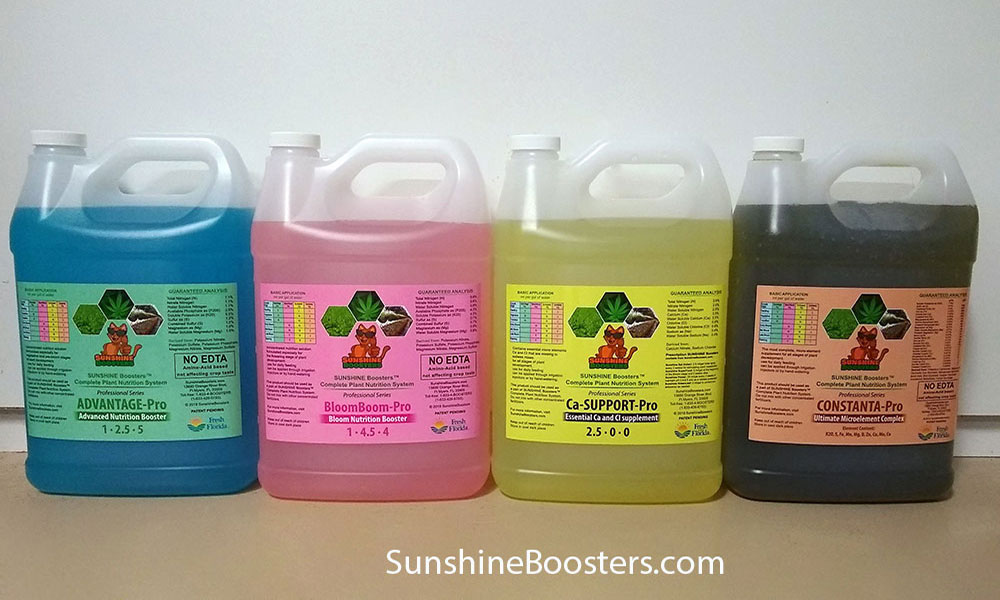
1. The most universal solution for all plants (both potted and in-ground): get a complete set of Sunshine Boosters Pro system: Advantage-Pro for vegetative growth, BloomBoom Pro for flowering stage, and Ca-Support-Pro + Constanta-Pro as necessary daily supplements. You will need all these 4 components for your garden.
2. Start adding these liquid boosters with every watering according to dozing directions and you will notice amazing growth boost within a week.
3. Apply Sunshine Epi plant hormone every 2 weeks as a foliar spray to boost immune system and metabolism of plants and protect them from diseases. Epi makes plants (especially young plants and those "waking up" from dormancy) grow twice faster! It also enhances effect of fertilizers by increasing plant metabolism.
4. After cool winter temperatures, some plants may develop element deficiencies like chlorosis (yellowing leaves). Additional microelement boost can be provided with Sunshine Greenleaf (iron supplement) and Sunshine Superfood (micro-elements).
5. For additional boosting of flowering and setting fruit, use the following individual boosters:
Sunshine Robusta - for foliage plants and when you need rapid vegetative growth
Sunshine TotalFeed - for Plumerias and other fragrant plants
Sunshine Megaflor - for Brugmansias and other flowering heavy feeders
Sunshine C-Cibus - for improving fruit production and quality
Sunshine Honey - for sweeter fruit (must be applied 4-5 times a year)
6. For young/small plants (seedlings, rooted cuttings) as well as tender tropicals like bromeliads, and orchids - Sunshine Bombino is a perfect choice due to its mild formula.
7. To save money, order complete sets rather than individual boosters; you will be able to safe up to 40%! Sunshine Complete Nutrition System Kits: Combo Kit, and Pro Kit.

If you are a fan of organic gardening, do not use dry fertilizers. While water-soluble and granulated (smart-realease) fertilizers are popular choice in plant nurseries due to their convenience, they are not as safe as liquid boosters because they create salt build-up in soil and have a high risk of overdosing/burning plant roots, especially potted plants, plants at breaking dormancy, at establishing, and at early stages of plant development. Besides, dry fertilizers may affect the taste of your fruit and herbs. See advantages of liquid boosters over dry fertilizers.

Learn more about Sunshine Nutrition System - a Natural solution for your garden.

Date: 24 Jun 2018

TopTropicals

Cleanest fruit?

"Dirty" fruit: According to the Environmental Working Group research, Strawberries are top the list of the 12 "dirtiest" fruits and vegetables grown commercially. Spinach is the second, followed by (in order of contamination) nectarines, apples, grapes, peaches, cherries, pears, tomatoes, celery, potatoes and sweet bell peppers. Each of these foods tested positive for pesticide residues and contained higher concentrations of pesticides than other produce. This causes of course chronic health implications. Children are of special concern as younger bodies have greater susceptibility to pesticides than adult bodies, the report emphasizes. Pesticides may induce chronic health complications in children, including neuro- and behavioral problems, birth defects, allergies, asthma, and even cancer...

"Clean 15": Avocados lead 2018's clean fruits and veggies list, that also includes: mangoes, papayas, pineapples, kiwi, sweet corn, cabbage, onions, frozen sweet peas, asparagus, eggplant, honeydew melon, cantaloupe, cauliflower and broccoli.
Obviously, home grown fruit and vegetables are even better. Such fruit as Custard Apples, Sapodilla, Sapote, Jackfruit, Dragon Fruit, Passion Fruit and other rare varieties of tropical fruit, are even better for you because they are not grown commercially, and the choice from your own organic garden is the healthiest for yourself and your family!
Plant them today and get your cleanest fruit tomorrow!

Check out all tropical fruit trees and all tropical spice plants.