Date: 24 Jun 2018
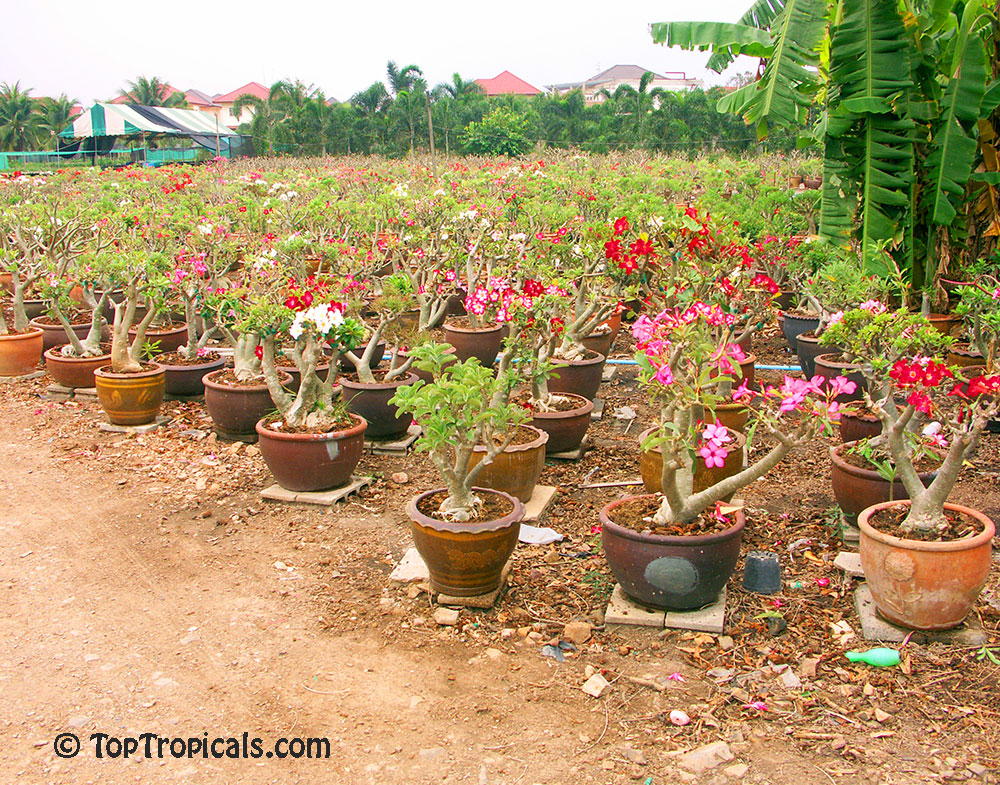
What you need for successful growing Adeniums
1) Adenium plants - from TopTropicals Endless selection of
Adeniums. We have double flower, red, purple, yellow
and even black flowers!
2) A small pot with excellent drainage is a must.
Position the plant in a pot, size of root system.
3) Adenium soil mix. TopTropicals Adenium Soilless Mix.
Use only well-drained soil.
4) Lots of light. Adeniums need lots of light for
heavy flowering. However from our own experience, in super
hot climates, they look healthier in filtered bright
light. After initial planting, once the plant is
established and starts growing new leaves (may take a few
weeks), gradually move it into brighter light.
5) Little water. Adeniums like a neutral to hard
water. Acidic water tends to sour the soil too fast and
may cause root rot. Water plants preferably in the early
morning, and allow them to drink up throughout the day.
Watering can be done daily to every few days. Do not water
again until soil dries on surface. Never allow your plants
to sit in a saucer of water, but don't let them to dry out
too often - this causes adeniums to go into early
dormancy. Adeniums do not like both over-watering or
drying-out.
6) Fertilizer. To make your plant develop a large
swollen base/trunk, you'll need a good quality fertilizer.
Use slow-release granulated fertilizer
for overall plant health, and liquid water soluble
fertilizer for swelling up trunks that is also used to
increase flowering. It shouldn't be too high in nitrogen,
the middle number should be the highest (similar to
10-50-10). Never apply fertilizer directly on roots and do
not liquid feed when a plant is thirsty: always water
first slightly to avoid root burn and leaf drop. Do not
wet leaves.
7) SuperFood micro-elements. Besides
macro-nutrients provided by fertilizer, Adenium needs
micro-elements for balanced development of root system and
especially caudex: Sunshine-SuperFood.
8) SUNSHINE-BC. Spray leaves with SUNSHINE-BC once a month to
encourage young growth, profuse flowering and large
caudex.
9) Growing caudex. There is a secret how to create
a large swollen caudex: raise the plant a bit every time
you re-pot it, so that the upper part of roots will be a
little exposed. The plant will form more roots that will
go down.
Date: 24 Jun 2018
Growing Bougainvillea and Plumeria in Florida
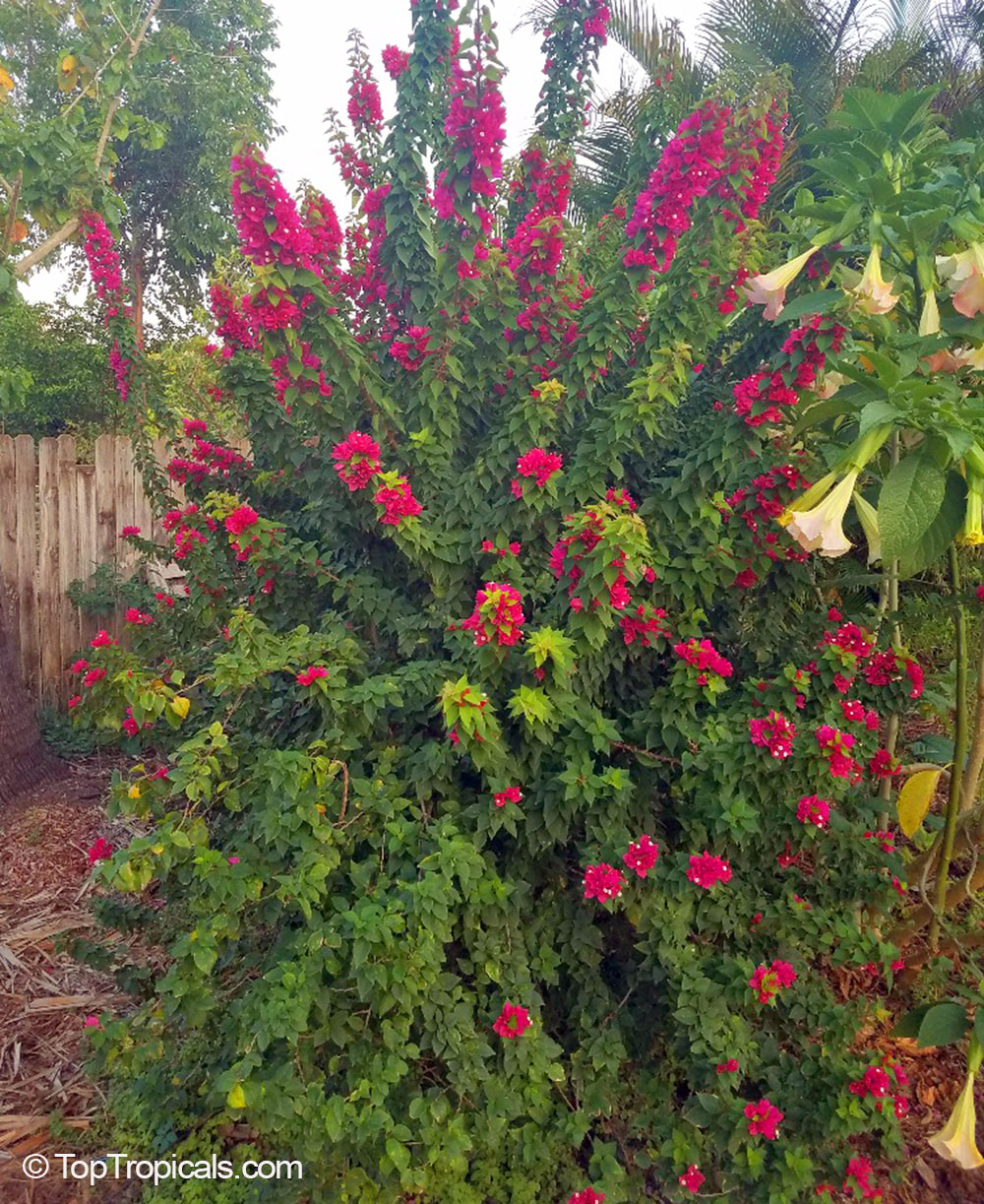
Q: I have recently moved from New Jersey to Florida (Orlando area) and I am so excited to start my own Tropical Paradise Garden! A few years ago I visited Hawaii and saw many beautiful colorful Bougainvilleas as well as fragrant Frangipani. Do they grow well in Florida? These are flowers of my dream!
A:
Both Bougainvillea and Plumeria grow well in most
parts of Florida, especially South and Southwest.
Bougainvillea can tolerate some light freeze and can be
seen in the streets of Central Florida (young plants
require some cold protection for the first year), so it is
a very good candidate for your new garden. Keep in mind
that unlike in Hawaii, where they bloom year around,
Bougainvilleas tend to have a distinctive flowering season
which in Florida is winter time - these plants enjoy dry
weather that triggers their bloom. To enjoy Bright
bougainvillea flowers for a long time, apply balanced fertilizer, prune
regularly (this promotes flowering on new growth) and keep
established plants on a dry side. Dwarf cultivar Pixie is super compact and
can be grown in pots or in a small garden without any
pruning! See photo of Pixie on the left.
Plumerias, all-time perfume
favorites and symbols of Hawaii, are also residents of
many gardens and collections throughout state of Florida.
Their cold hardiness is close to the one of Bougainvillea,
however keep young plants protected from frost. There are
also many new exciting cultivars including multiple
"rainbow" colors, and several dwarf varieties, some of
them are evergreen - Plumeria obtusa
Date: 24 Jun 2018
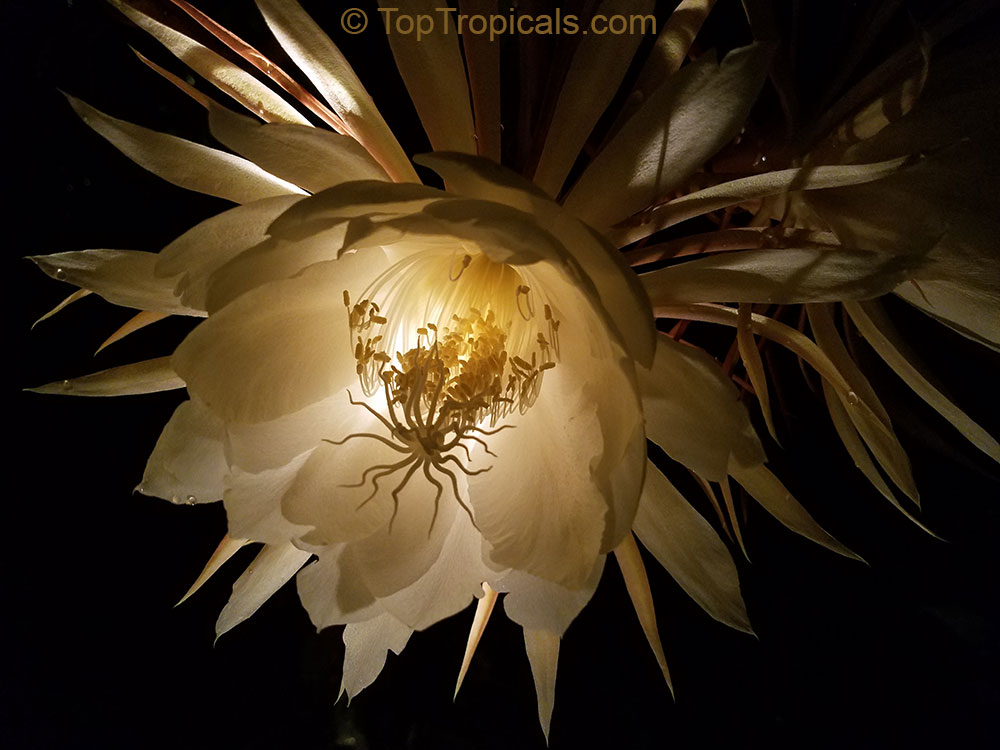
Mysterious Night Blooming Cactus - Epiphyllum. How to grow it?
Q: My friend has a huge Queen of the Night Cactus, and the blooms are so gorgeeous! She gave me a cutting but I am not sure how do I plant it? How long will it take till it starts blooming? Is it true that it has only one flower once a year and only at night?
A:
Queen of the Night is a very popular and yet mysterious
plant. The flowers open once a year after sunset for one
night. However the flowering period can last a month or
two during the warm season. So each flower lasts only one
night, but there will be more flowers to come! In the
Nature, Epiphyllum oxypetalum - Queen of
the Night - grows on trees in the jungles of Central
and South America. It is actually very easy to grow as an
indoor plant in colder climates. Here is South Florida we
grow them outside in hanging baskets. This is how to start
Queen of the Night from a cutting:
1) Put the cutting in a dim, dry place for three days,
with no soil and its base exposed to the air, so it will
form a callus.
2) Fill a 4-6-inch pot with slightly damp potting soil or succulent mix. Insert the
cutting 1 or 2 inches into the soil and tamp the soil
around its base.
3) Place the pot where the cutting will get bright light,
but no direct sun. Spritz it occasionally with a spray
bottle of water to keep the soil only slightly moist. It
should root in couple weeks.
4) Keep the plant on an east- or west-facing windowsill
where it will receive direct sunlight only in early
morning or late afternoon. Water the cactus until water
runs out of the pot's drainage holes. Dump the excess out
of the pot's saucer immediately, and wait until the
surface of the soil is dry to the touch before watering
your cactus again.
5) Fertilize once a month from March through October with
a balanced plant food, and
apply micro-elements once a month
for a healthy vigorous growth. Refrain from feeding the
plant in December and January.
6) Position the cactus in partial shade under a porch roof
or tree, if you decide to move it outdoors during the
summer. This plant likes summer humidity!
7) Repot the cactus only once every two years or so, to
keep it slightly root bound. Wait until after it flowers
in summer, and repot it after it blooms. Prune off any
damaged growth at that time as well.
8) Move the plant to a cooler room over the winter months,
one that remains dark during the evening hours with
temperatures above 45 degrees. Reduce the frequency of
watering, waiting until its soil is dry. Resume regular
watering in March.
If grown from cutting, it may take 2-3 years until the plant starts blooming, so if you don't want to wait that long - just get a blooming size plant from our store!
We only have a few plants... if sold out, add to wish list and we will have more soon!

Date: 20 Sep 2025
How to make lots of Insulin Ginger plants quickly and get more health benefits
Costus igneus (Chamaecostus cuspidatus) - Fiery Costus or Spiral Flag
💚 How to make lots of Insulin Ginger plants quickly and get more health benefits
- Costus igneus (Chamaecostus cuspidatus) - Fiery Costus or Spiral Flag is believed to help lower blood glucose levels naturally and managing diabetes.
- Have you heard of Insulin Ginger? Everyone wants to have it in the garden!
- Gardeners in India grow it not just for its pretty spiral leaves, but for what those leaves do. People with diabetes often chew them fresh or brew them into tea, saying it helps keep their blood sugar under control.
- Researchers have found something interesting: the leaves contain an insulin-like compound, along with antioxidants and anti-inflammatory properties. In animal studies, extracts from the plant lowered blood sugar, protected the liver and kidneys, and even made the body more sensitive to insulin.
- The way folks use it is simple. You can chew a leaf right off the plant, steep dried leaves for tea, or find it in powders and capsules. It's one of those plants that shows how tradition and science sometimes meet in the garden.
- Its lush, turmeric-like leaves spiral around upright stems, with a glossy dark green top and a striking light purple underside. In warm months, it produces bright orange, cone-like flowers that stand out beautifully in the garden.
- Beyond its beauty and natural insulin effects, the insulin plant is credited with aiding digestion, reducing cholesterol, boosting energy, improving skin health, supporting weight loss, relieving stress, and promoting heart wellness. A real botanical multitasker!
🎥 In this video, we’ll show you how to multiply Insulin Ginger fast, so you’ll have plenty of plants for yourself and even extras to share with friends and family.
✅ Don’t forget to use Green Magic fertilizer for the best results. Gingers absolutely love this plant food - they thrive on it and respond better than any other plant, with vigorous growth, lush foliage and loads of leaves you’ll need for all the benefits.
🛒 Grow your own sugar-fighter - the Insulin Ginger
📚 Learn more:
#Food_Forest #Remedies #Shade_Garden #Discover
🟢 Join 👉 TopTropicals
Date: 22 Jan 2023
Cat
Zodiac:
Capricorn Cats 12/22-1/19

By Alex Butova, the Witch of Herbs and Cats
The astrological sign of a cat can be determined by either their date of birth or adoption, as adoption is often considered a second birth for cats. With this information, one can discover the astrological traits that describe the cat, such as their independence, diva-like tendencies, sense of humor, intelligence, and more. Additionally, it's also important to consider the astrological relationship between cats and plants...
The Capricorn cat is a busy feline. They are known for climbing curtains
and scaling ladders in the garden with ease. No fear of heights here! As
they age, Capricorn cats become wise and practical, they are cautious and
consider their options before acting impulsively. It is easy to see the wheels
turning in their head when they are faced with problems. Capricorn cats take
daily necessities like grooming and litter box etiquette seriously. They are
skilled hunters, companions, bodyguards, nurses, and box-inspectors, and they
love their jobs. Similar to Capricorn humans, Capricorn cats have a love for
plants that grow outdoors in gardens or patios...
CONTINUE READING>>
Find out the best plants for a Capricorn Cat...
Plant Horoscope for Humans: Capricorn