Garden Blog - Top Tropicals

Date: 31 May 2026

🔮 The Search for Enchanted Incense
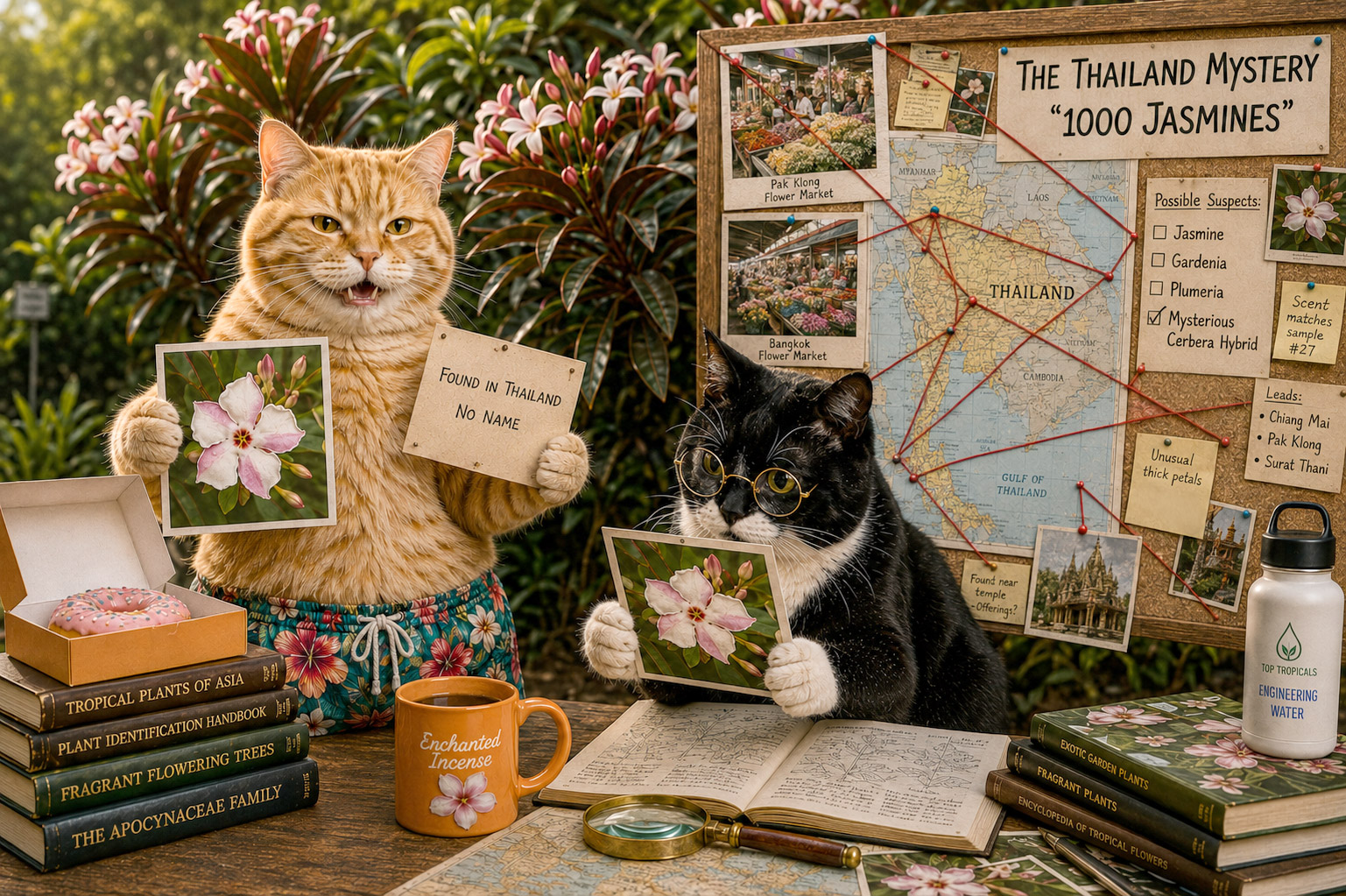
Smokey  and  Sunshine  investigate  the  mystery  of  Enchanted  Incense,  a 
 fragrant  Cerbera  hybrid  from  Thailand,  using  photos,  maps,  and  botanical 
 clues.
Sunshine: John said it smelled like a thousand jasmines.
Smokey: And somehow that's all the information he brought back from Thailand.
Sunshine: He brought a photo, too.
Smokey: Excellent. We can begin our international manhunt.

Well, Smokey and Sunshine have closed the case and found the mystery plant. The cork board is coming down, the magnifying glass is back in the drawer, and the "Enchanted Incense" mug is finally empty. Now let's talk about the plant itself.

🌸 Some plants arrive with a label. Some arrive with a story.
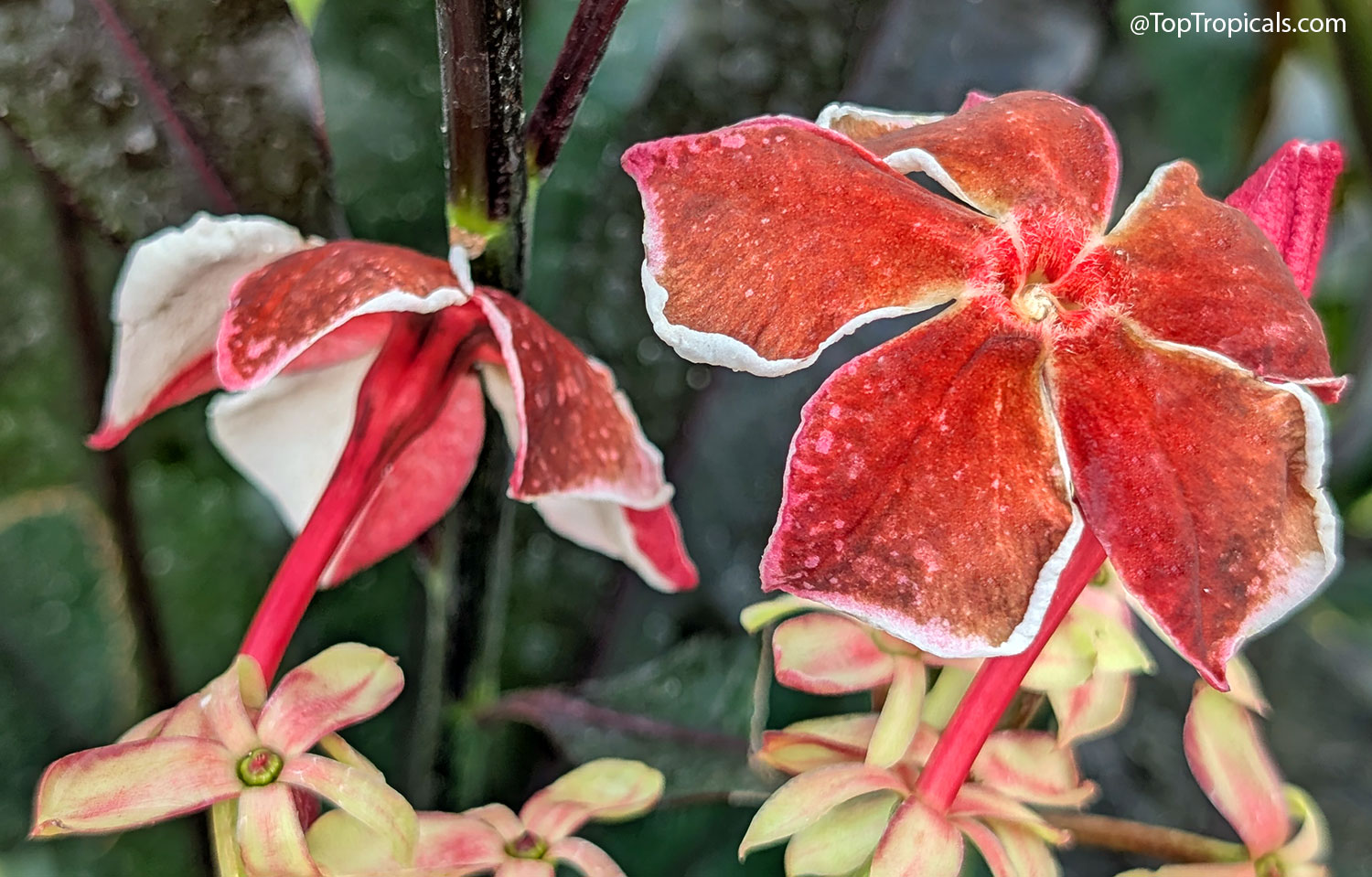
Close-up  of  Cerbera  x  manghas  Enchanted  Incense  flowers  showing  rich 
 reddish-brown  petals  with  soft  white  edges  and  bright  pink  flower  tubes.  The
    unusual  blooms  are  displayed  against  dark  foliage,  highlighting  their 
 exotic  shape  and  velvety  texture.

Cerbera x manghas - Enchanted Incense - produces some of the most unusual fragrant flowers in the tropical garden. Its velvety reddish blooms, outlined in white and carried on vivid pink tubes, create an exotic display that looks hand-painted.

When our good friend John Mood returned from a plant conference in Thailand, he did not bring us a plant. He brought us a mystery.

John had spent decades growing and collecting rare tropical plants. When he said he had found something special, we paid attention.

On a visit to Chatuchak Market, one of the most famous plant markets in Asia, something stopped him. Not the flowers. The fragrance.

"I found a plant that smells stronger than a thousand jasmines," John told us.

That one sentence stayed with us for years.

He had photographs. He had his memory of that scent. What he did not have was a name. No tag. No seller information. Just the photos and the certainty that he had smelled something genuinely unusual.

So we started looking.

We showed the photographs around. We asked collectors. We compared flowers. Every lead turned into another question. But eventually, after years of searching on and off, we found it.

The mystery plant turned out to be an unusual Cerbera unlike anything we had grown before. Today we call it Enchanted Incense. Fragrance lovers recognized immediately what John had recognized in that Bangkok market. This was not just another pretty tropical flower.

🌸 The Plant
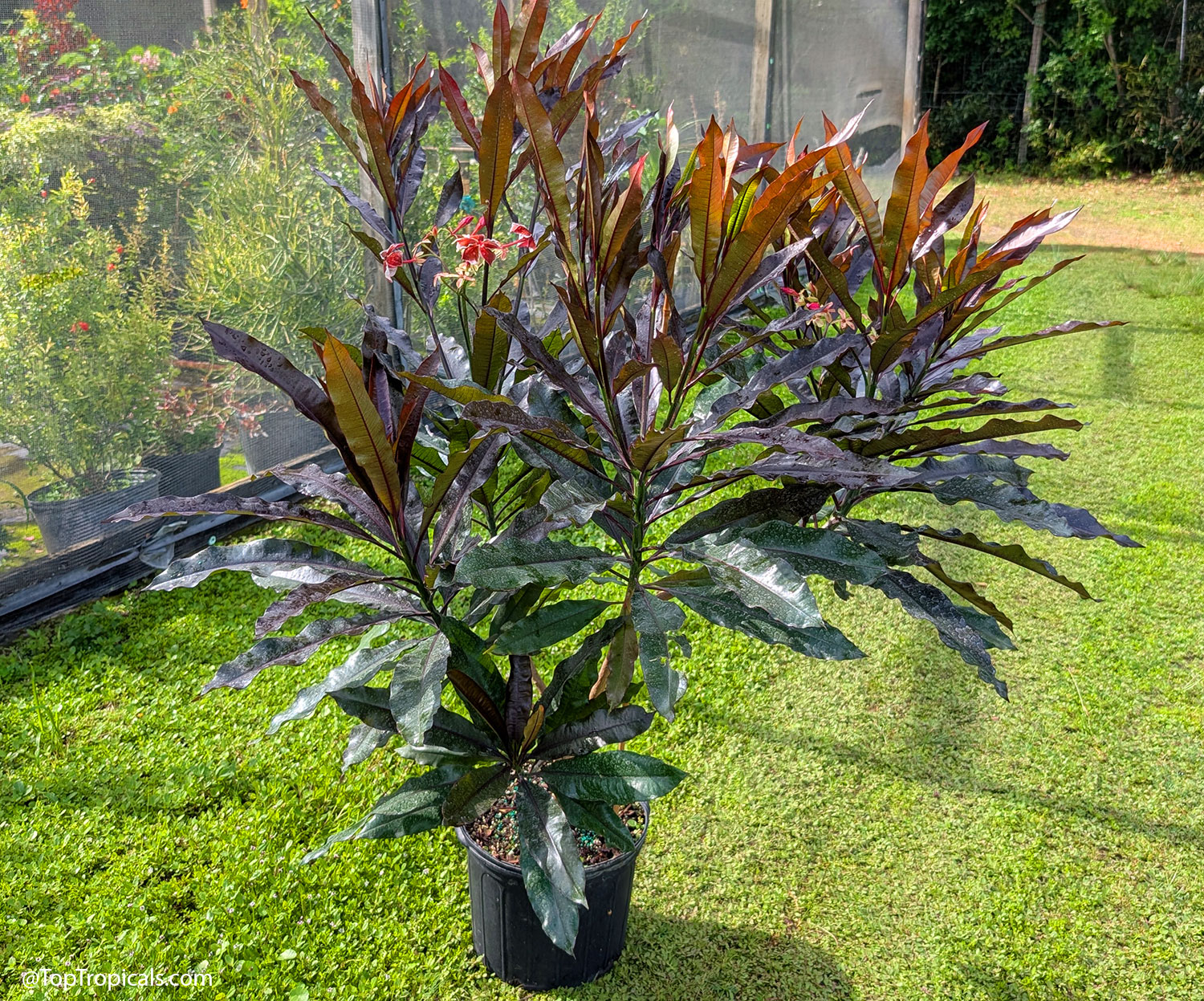
Full  view  of  Cerbera  x  manghas  Enchanted  Incense  growing  in  a  nursery 
 container,  displaying  dramatic  dark  burgundy  foliage  with  wavy-edged  leaves 
 and  clusters  of  unusual  reddish-pink  flowers.  New  growth  emerges  in  rich 
 bronze  tones,  creating  a  striking  tropical  appearance.

Even when not in full bloom, Cerbera x manghas Enchanted Incense is a standout plant. Its glossy, deep burgundy foliage and bronze new growth create a bold tropical presence, while the unusual flowers add an extra layer of intrigue.

Visitors at our nursery still walk past it and stop. Not because they noticed the plant. Because they noticed something in the air and could not figure out where it was coming from.

The flowers start soft pink and white, then deepen to rich red and auve as they mature. They come in clusters, four to five inches across, and the fragrance they produce does not stay close to the flower. It moves. It fills the space around the plant. On a warm morning it can perfume an entire patio.

The foliage is worth mentioning too. Deep green leaves with burgundy and mauve tones that make it attractive even when it is not blooming. The growth habit is slow and slightly weeping, similar to plumeria, which is no coincidence since they are close relatives. Unlike plumeria, Enchanted Incense stays evergreen in warm climates.

It is a compact, slow-growing small tree that is happy in a container. That makes it practical for gardeners in colder climates who need to bring it in for winter, and for anyone who wants a fragrant plant near a seating area rather than somewhere across the yard.

🌸 Why We Grow It
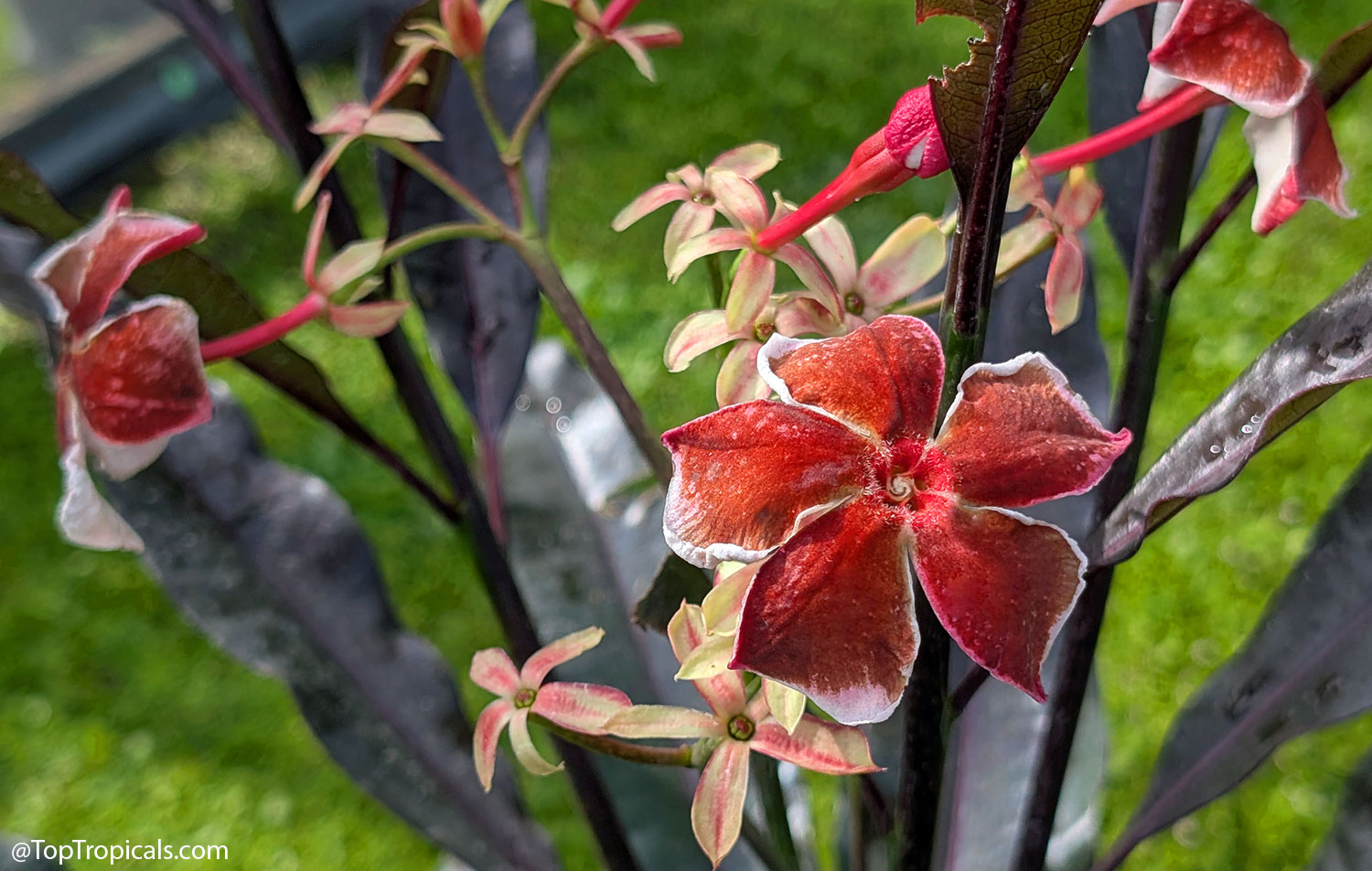
Close-up  of  Cerbera  x  manghas  Enchanted  Incense  flowers  nestled  among 
 dark  burgundy  foliage.  The  unusual  blooms  feature  velvety  reddish-brown 
 petals  edged  in  white,  emerging  from  vivid  pink  flower  tubes  and  surrounded 
 by  pale  star-shaped  calyces.

The flowers of Cerbera x manghas - Enchanted Incense - look otherworldly. Deep reddish petals, bright pink tubes, and contrasting white edges combine to create one of the most distinctive fragrant blooms.

We grow thousands of plants, and most can be described in a sentence or two.

This one cannot.

A large Enchanted Incense grows right outside our office. Every year it reminds us why we spent so much time searching for it.

Visitors stop beside it and ask the same question: "What is that smell?"

They usually notice the fragrance before they notice the plant.

Some follow the scent across the nursery. Others stop in the middle of a conversation and start looking around. Nearly everyone ends up standing next to the tree trying to figure out where that incredible fragrance is coming from.

In a world full of beautiful tropical plants, Enchanted Incense remains one of the few that announces itself before you even see it.

That is why we love growing it.

Feature Description
Common Name Enchanted Incense
Botanical Name Cerbera x manghas
Origin Thailand
Flowers White to soft pink, deepening to red and pink
Fragrance Exceptional, far-reaching
Container Friendly Yes
Cold Tolerance USDA Zones 9-11 (Low 30s°F with caution)
Growth Habit Slow, compact, slightly weeping

🛒 Add Enchanted Incense to your collection

Growing Tips

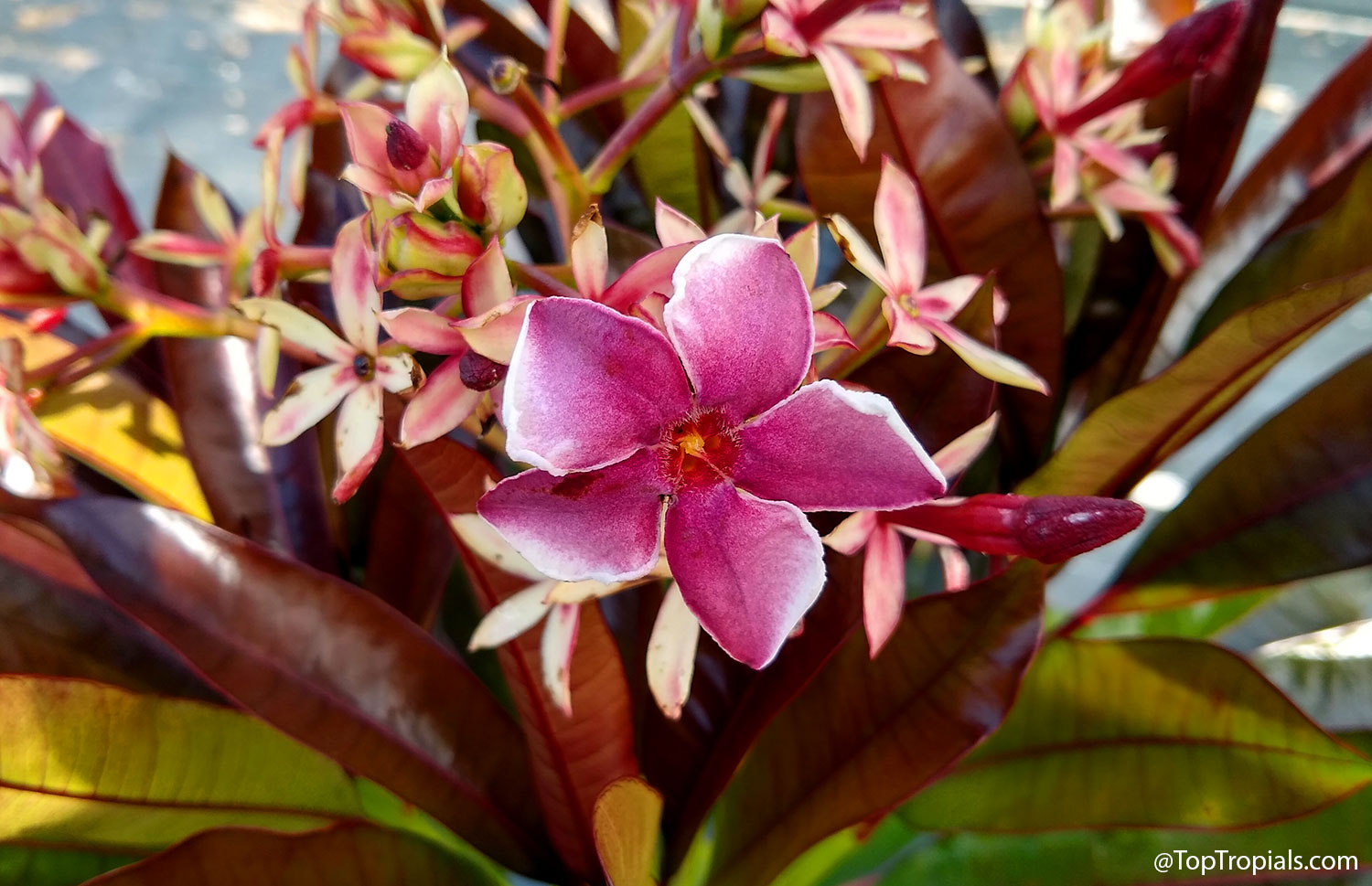
Close-up  of  a  pink-flowering  form  of  Cerbera  x  manghas  Enchanted 
 Incense,  featuring  velvety  rose-pink  petals  with  crisp  white  edges.  The 
 flower  is  surrounded  by  burgundy  foliage,  red  flower  buds,  and  pale  pink 
 star-shaped 
 calyces.

Cerbera x manghas - Enchanted Incense can display remarkable variation in flower color. This form combines soft rose-pink blooms with white-edged petals and rich burgundy foliage, creating a striking contrast throughout the plant.
  • Light: Full sun is best (at least six hours daily). It will tolerate partial shade but blooms much more generously in good light.
  • Watering: Water regularly during warm weather. In cool weather and winter, keep the soil on the drier side. Overwatering when temperatures are low is the most common mistake.
  • Soil: Use a well-draining mix. This plant absolutely does not want wet feet.
  • Fertilizer: Feed with a Green Magic controlled-release fertilizer for flowering plants in spring, supplemented with occasional liquid fertilizer through the summer. For non-stop blooms without the risk of salt build-up in containers, we highly recommend Sunshine Boosters™. Read our Guide to Sunshine Boosters™ and Green Magic fertilizer
  • Winter Care: Bring it indoors when temperatures approach the mid-30s°F. The rootstock is fairly tough, but the foliage is not. Cold and wet conditions combined are the real risk.

One Last Thing
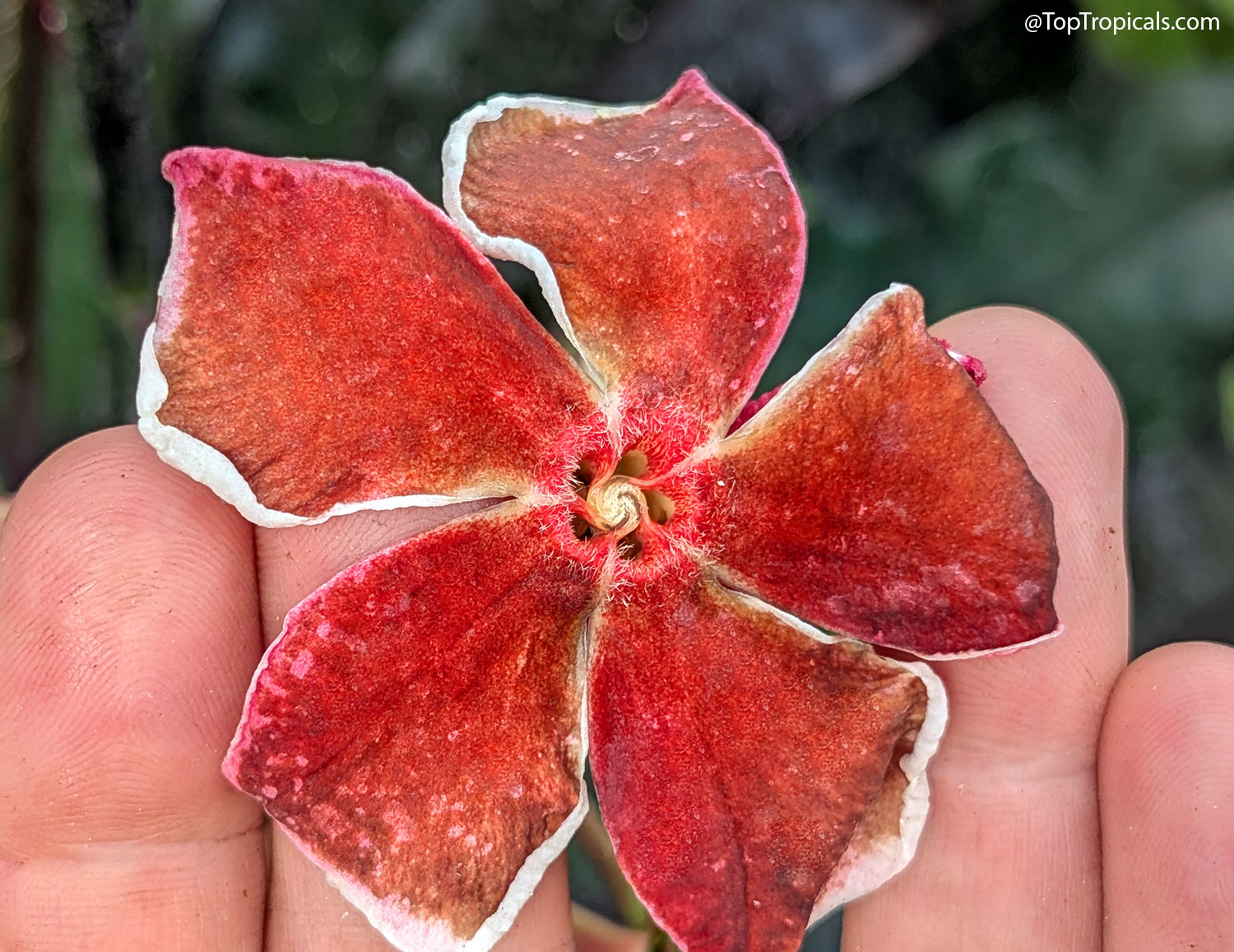
Macro  close-up  of  a  Cerbera  x  manghas  Enchanted  Incense  flower  resting 
 against  a  person's  fingers  for  scale.  The  bloom  features 
 velvety  reddish-brown  petals  with  narrow  white  margins  and  a  fuzzy  bright 
 pink 
 center,  revealing  the  intricate  details  of  this  unusual  tropical  flower.

A closer look reveals the remarkable details of Cerbera x manghas - Enchanted Incense. The velvety petals, crisp white edging, and fuzzy pink center give the flower an appearance unlike anything else in the garden. And then comes the scent...

John came back from Bangkok with a few photographs and a fragrance he could not forget. It took us years to track down the plant behind that memory. We have never regretted a single minute of the search.

Sunshine: So after all those years, what's the answer?
Smokey: Stand next to the plant.
Sunshine: That's it?
Smokey: The fragrance explains the rest.
🛒 Grow Enchanted Incense

📚 Learn more from our Blog

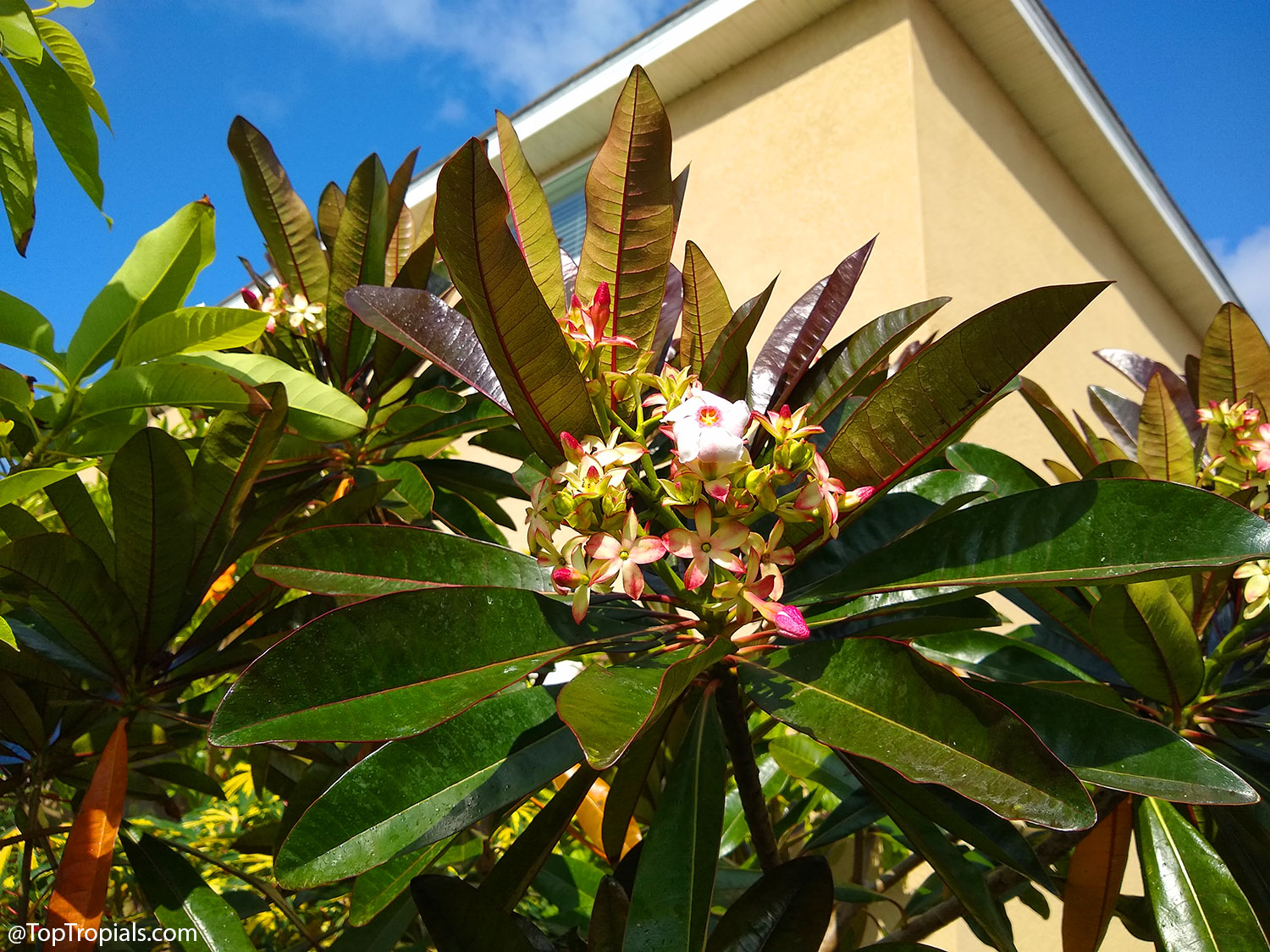
Mature  Cerbera  x  manghas  Enchanted  Incense  growing  as  a  landscape  tree 
 beside  a  house.  The  plant  displays  glossy  dark  green  leaves,  bronze-toned 
 new  growth,  and  clusters  of  flowers  and  buds  against  a  bright  blue 
 sky.

A closer look reveals the remarkable details of Cerbera x manghas - Enchanted Incense develops into an attractive small tree with lush evergreen foliage and colorful new growth. In the landscape, it combines year-round structure with clusters of bright redding-pink fragrant flowers that stand out beautifully against the glossy leaves.

Date: 4 Jun 2026

Mango Rainbow - Van Dyke

Mango Van Dyke

Mango Van Dyke

Mango Rainbow - Van Dyke 🥭🌈

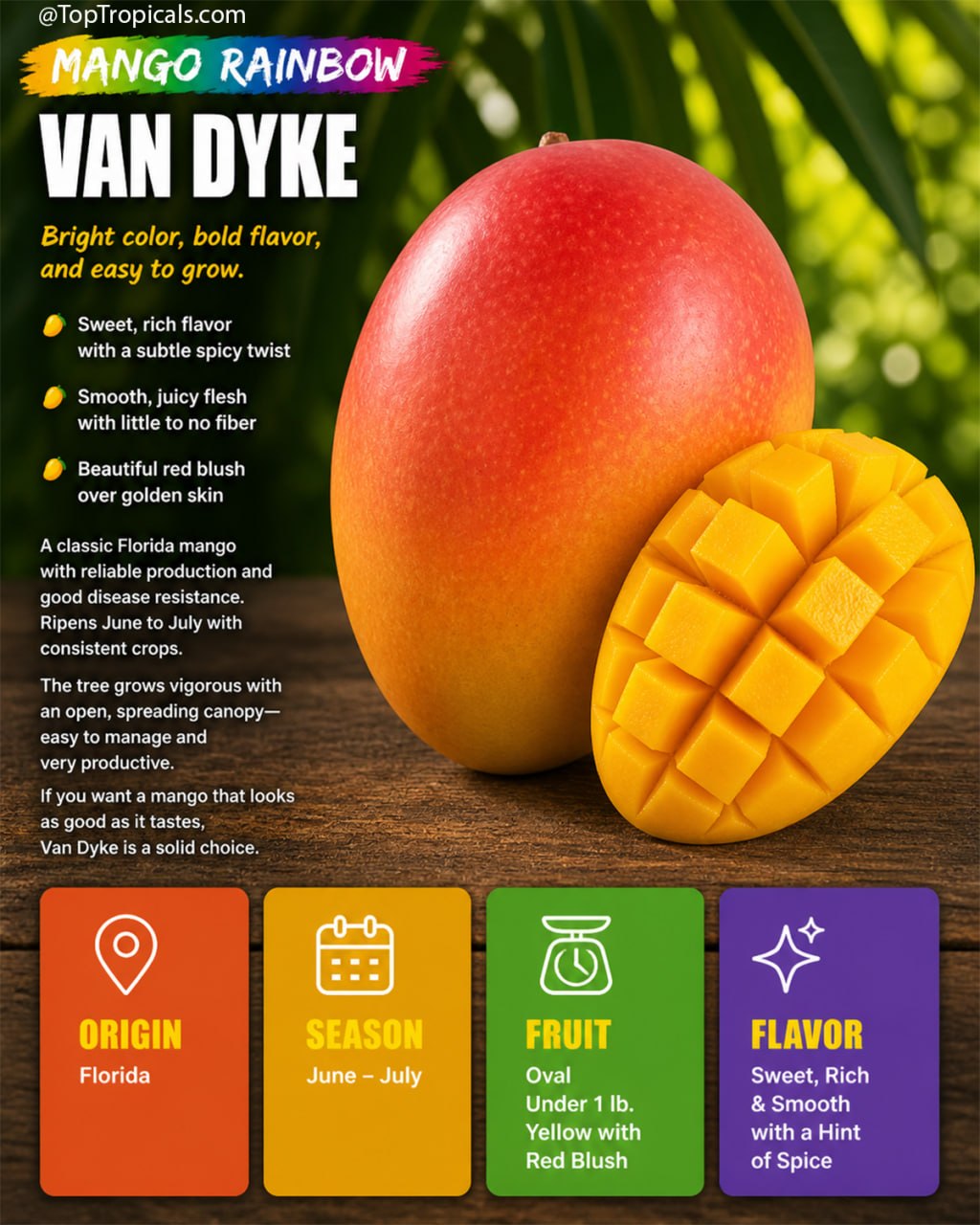
🥭 Van Dyke: bright color, bold flavor, and easy to grow.

🔸Sweet, rich flavor with a subtle spicy twist
🔸Smooth, juicy flesh with little to no fiber
🔸Beautiful red blush over golden skin

A classic Florida mango with reliable production and good disease resistance.
Ripens June to July with consistent crops.
The tree grows vigorous with an open, spreading canopy - easy to manage and very productive.

If you want a mango that looks as good as it tastes, Van Dyke is a solid choice. More 👉

🛒 Shop Mango varieties

📚 Learn more:
Mango Tree - Mangifera indica - in Plant Encyclopedia
#Mango_Rainbow - varieties you should try

#Food_Forest #Mango #Mango_Rainbow

Mango Plant Facts

Botanical name: Mangifera indica
Also known as: Mango
USDA Zone: 9 - 11
Highligths Large tree taller than 20 ftSmall tree 10-20 ftFull sunWatering: Moderate. Water when top soil feels dryYellow, orange flowersPink flowersEdible plantSeaside, salt tolerant plant
Get personalized tips for your region
🟢 Join 👉 TopTropicals

Date: 16 Jun 2026

💜 The Tree Everyone Stops to Take Pictures Of

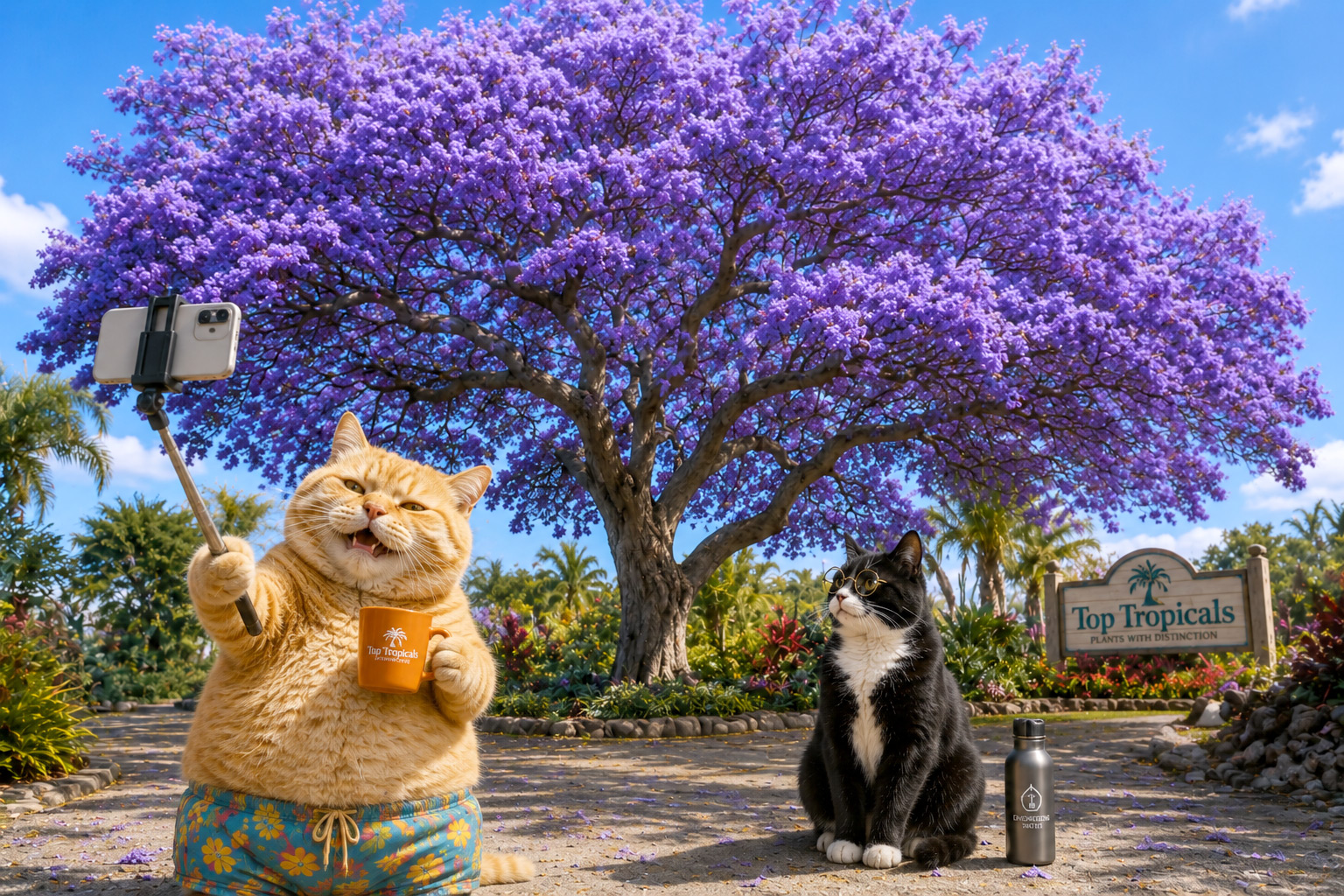
Sunshine,  an  orange  tabby  cat,  takes  a  selfie  beneath  a  blooming  purple
    jacaranda  tree  while  Smokey,  a  tuxedo  cat  wearing  glasses,  watches  nearby 
 at  Top 
 Tropicals.
Sunshine: Every angle looks good.
Smokey: That's because you're photographing a Jacaranda at peak bloom.
Sunshine: I think the purple brings out my orange.
Smokey:The Jacaranda makes everything look better.

There's a moment, if you've never seen a mature Jacaranda in full bloom, that stops you completely.

You're driving down a street, or walking through a neighborhood you've passed through a hundred times, and suddenly there it is — a tree that looks like someone painted it from memory rather than from life. The canopy spreads wide and low, covered so thoroughly in lavender-blue flower clusters that you can barely see the branches beneath. People are already stopped on the sidewalk. Someone has their phone out. A couple is standing beneath it, looking up.

You understand immediately why they stopped. You stop too.

That first encounter with a Jacaranda mimosifolia in bloom is the kind of thing gardeners remember for years. It's also, for many of them, the moment they decided they needed one.

👉Plant Your Purple Jacaranda

💜 The Tree That Turns Cities Purple

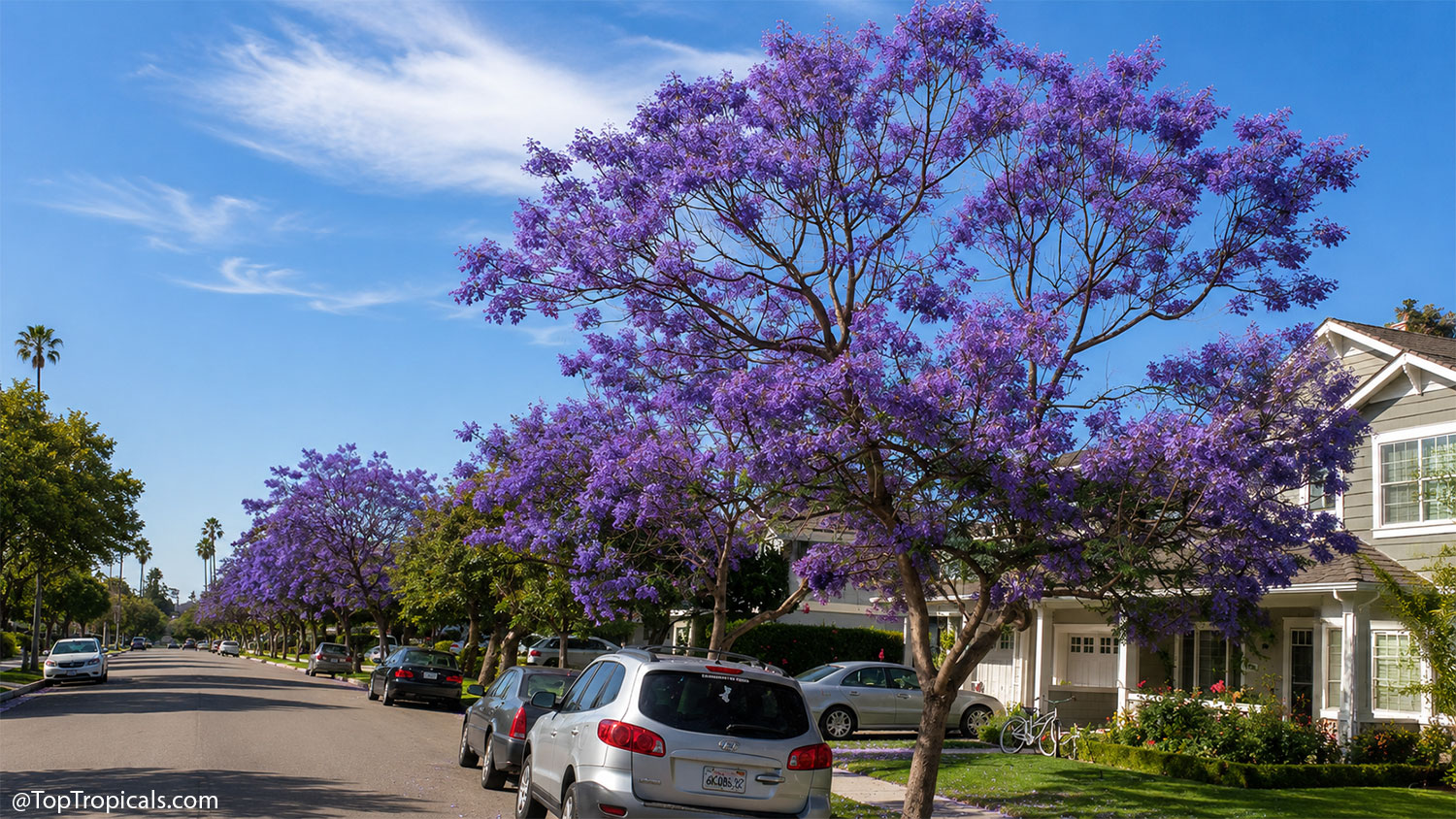
Residential  street  lined  with  blooming  jacaranda  trees  covered  in 
 vibrant  purple  flowers.  A  large  jacaranda  shades  parked  cars  and  front 
 yards,  while  additional  flowering  trees  create  a  stunning  purple  avenue 
 beneath  a  bright  blue 
 sky.

When jacarandas bloom, entire neighborhoods are transformed into rivers of purple. Their spectacular floral display turns ordinary streets into some of the most photographed landscapes of spring and early summer.

Most flowering trees get admired. Jacarandas become events.

Pretoria, South Africa is known worldwide as "Jacaranda City." During bloom season, entire neighborhoods seem to disappear beneath a haze of lavender-blue flowers.

Buenos Aires, Sydney and Brisbane have their own Jacaranda traditions. In Southern California, mature Jacarandas are so anticipated that bloom season regularly fills social media with photos of purple-lined streets and neighborhoods.

People don't merely grow Jacarandas. They wait for Jacaranda season. There's something unusual about a tree that generates that kind of anticipation. Most ornamental trees are appreciated in passing. Jacaranda creates a ritual.

💜 A Tree Surrounded by Legends


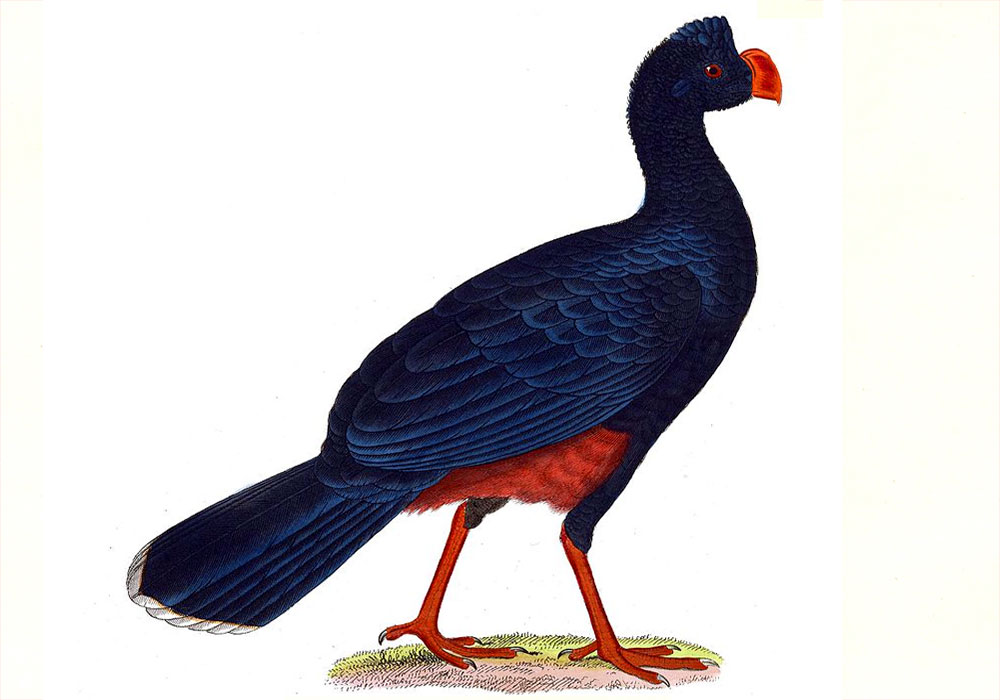
Mitu  mitu  bird  (Alagoas  Curassow)  -  adult  male.  Illustration  from 
 Nouveau  recueil  de  planches  coloriées 
 d'oiseaux,  1838

Mitu mitu — the bird of the Tupi-Guarani legend (Wikimedia Commons)

In Tupi-Guarani tradition, Mitu, a great forest bird, carried the Daughter of the Moon from the heavens and placed her in a flowering Jacaranda tree. She descended among the people, bringing wisdom and knowledge before returning to the sky.

Few trees become part of local folklore. Fewer still become part of everyday life across multiple continents.

💜 Beautiful Beyond Bloom

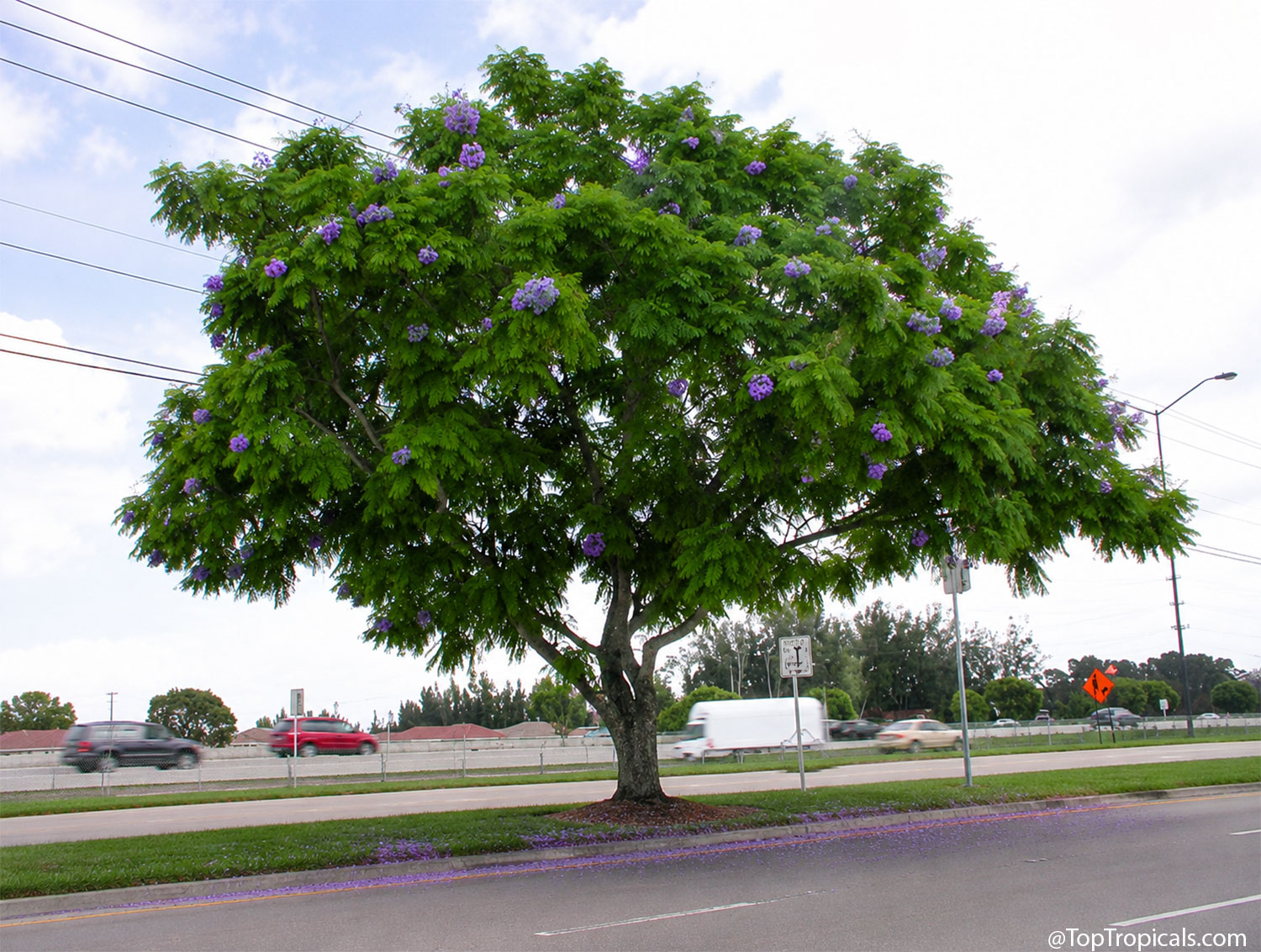
Young  jacaranda  tree  with  lush  fern-like  green  foliage  and  scattered 
 clusters  of  purple  flowers  growing  along  a  roadside.  The  broad  canopy  forms 
 a  graceful  umbrella  shape,  showing  the 
 tree's  attractive  structure  even  when  not  in  peak  bloom.

Jacaranda is beautiful even outside its main flowering season. Its finely divided, fern-like foliage creates a soft tropical canopy, while occasional clusters of purple blooms offer a preview of the spectacular display that transforms the tree into a cloud of lavender each year.

Here's what surprises people who plant their first Jacaranda: they love it even when it isn't flowering.

The foliage is finely divided and fern-like, giving the tree a delicate, airy texture that softens any landscape. The branching structure is naturally graceful, spreading wide with a canopy shape that looks considered rather than accidental. The light that comes through the leaves is gentle and dappled — the kind of shade that doesn't feel heavy, that lets enough brightness in to make the space beneath feel pleasant rather than dim.

💜 Mature Size

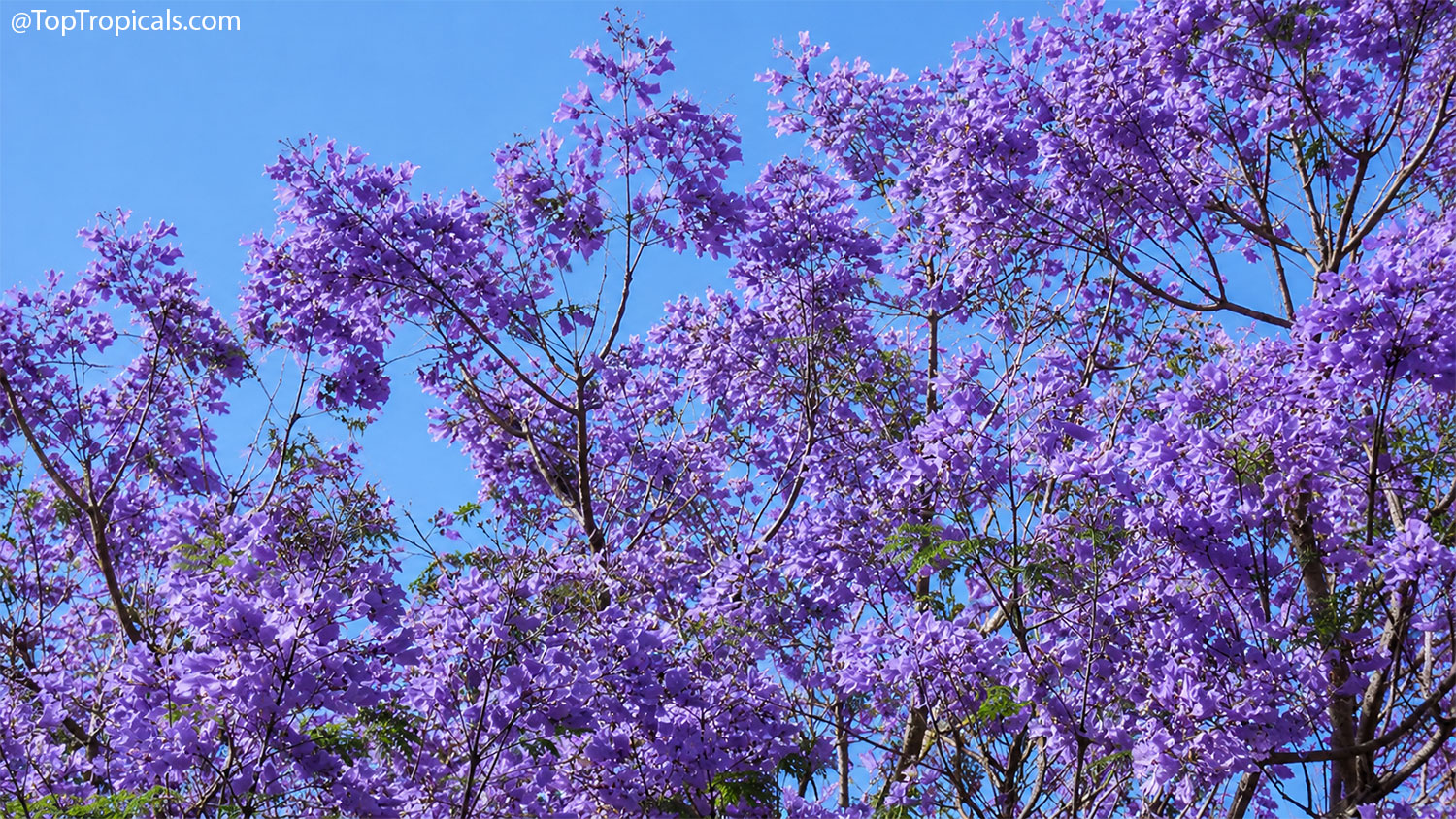
Upper  canopy  of  a  blooming  jacaranda  tree  filled  with  thousands  of 
 lavender-purple  flowers  against  a  clear  blue  sky.  The  delicate 
 trumpet-shaped  blossoms  create  a  soft,  cloud-like  effect  among  the 
 tree's  fine  branches  and  sparse  fern-like  foliage.

At peak bloom, jacaranda trees appear draped in purple clouds. The airy canopy of lavender blossoms creates a breathtaking display that has made this tree famous in gardens, parks, and city streets around the world.

A mature Jacaranda typically reaches 25 to 30 feet tall with a broad, spreading canopy of similar width. Given room to grow, it becomes a true focal point in the landscape.

That size is the point. A Jacaranda works beautifully as a specimen tree where you have room to let it express itself fully. It makes an excellent lawn tree, its canopy casting light shade over a wide area. Planted where it can be seen from a distance, it becomes a focal point in any season and a spectacle during bloom.

If you want a tree that will grow into something people notice — something that will still be there and still be blooming long after you've finished planting the rest of the garden — Jacaranda delivers.

How to Grow Jacaranda

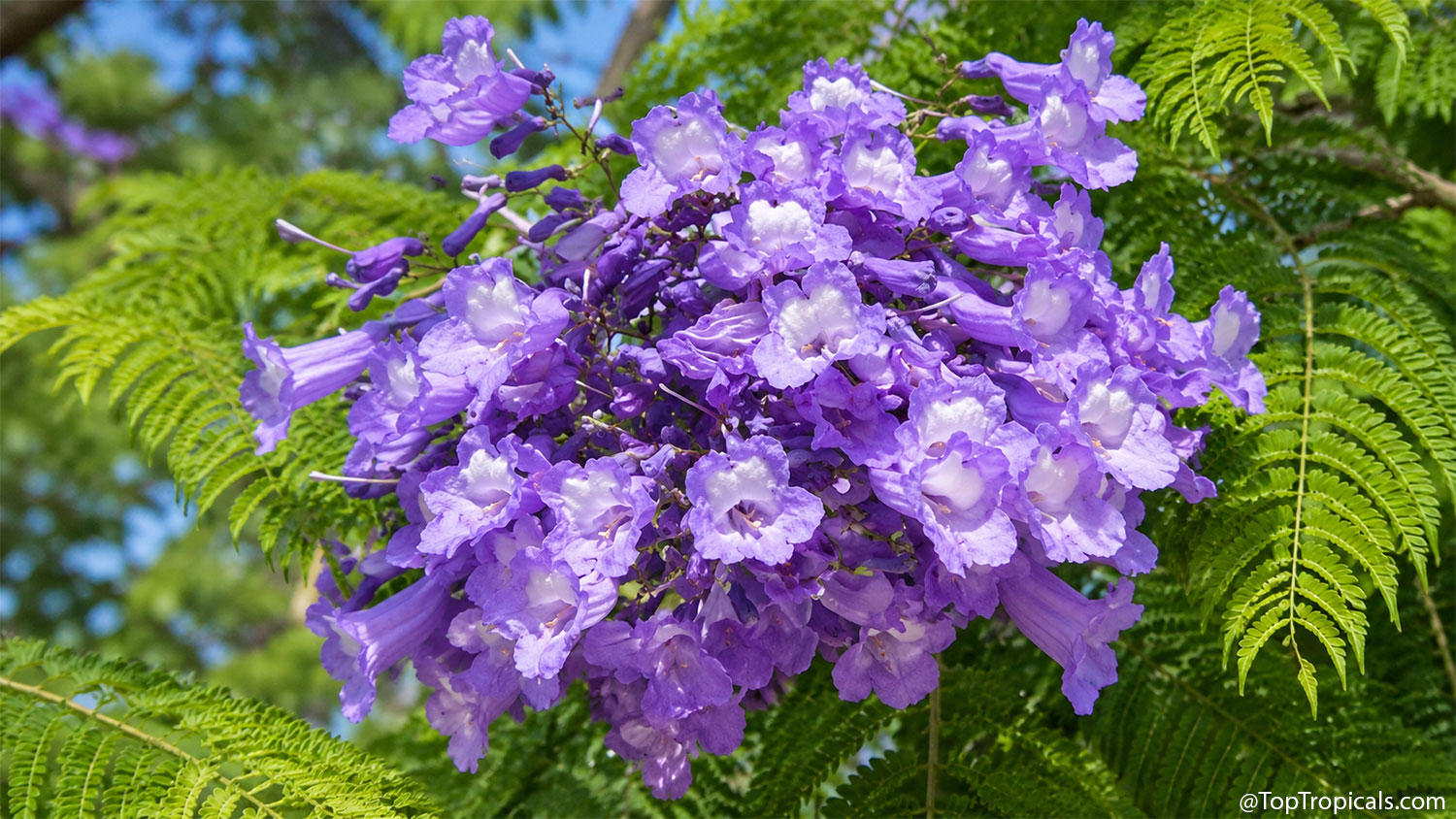
Dense  cluster  of  lavender-purple  jacaranda  flowers  surrounded  by 
 delicate  fern-like  green  foliage.  The  trumpet-shaped  blooms  are  packed 
 tightly  together,  with  pale  white  throats  creating  a  striking  contrast 
 against  the  vibrant  purple 
 petals.

The beauty of jacaranda is not only in its massive floral display but also in the individual flower clusters. Each bouquet combines dozens of delicate trumpet-shaped blooms framed by soft, fern-like foliage, creating a perfect balance of texture and color.

For best results, provide:

  • Full sun
  • Best planted away from sidewalks and driveways
  • Well-drained, sandy loam; highly sensitive to waterlogged or heavy clay soils
  • Regular watering while establishing
  • Moderate watering once mature
  • A balanced fertilizer during the growing season
  • USDA Zones: 9B – 11. Can tolerate brief, light frosts once mature. Protect from cold while young

Bloom season: Late Spring to Early Summer (Main flush), occasional light scattered bloom in Fall. As the flowers fall, they often create a colorful purple carpet beneath the canopy, extending the display from the branches to the ground below.

In warm climates such as South Florida, coastal Southern California, and Hawaii, Jacaranda can become a long-lived landscape tree that provides shade, beauty, and spectacular seasonal blooms for decades.

Top Tropicals Tip:
To help young trees get established quickly, consider using Sunshine Boosters Green Magic when planting or transplanting. During the growing season, regular feeding with Sunshine Boosters Megaflor can help support vigorous growth and a healthy canopy.
To maximize the bloom density for next season, ensure the tree receives consistent micronutrients during the late summer growth surge.

Read Top Tropicals Guide to Sunshine Boosters™

Jacaranda can also be grown in large containers, where its size may be managed through container culture and occasional pruning. This is a useful option for gardeners in colder climates or for those who wish to enjoy the tree on patios and terraces.

📚 More About Jacaranda on the Top Tropicals Garden Blog

💜 Why Gardeners Fall in Love With Jacaranda

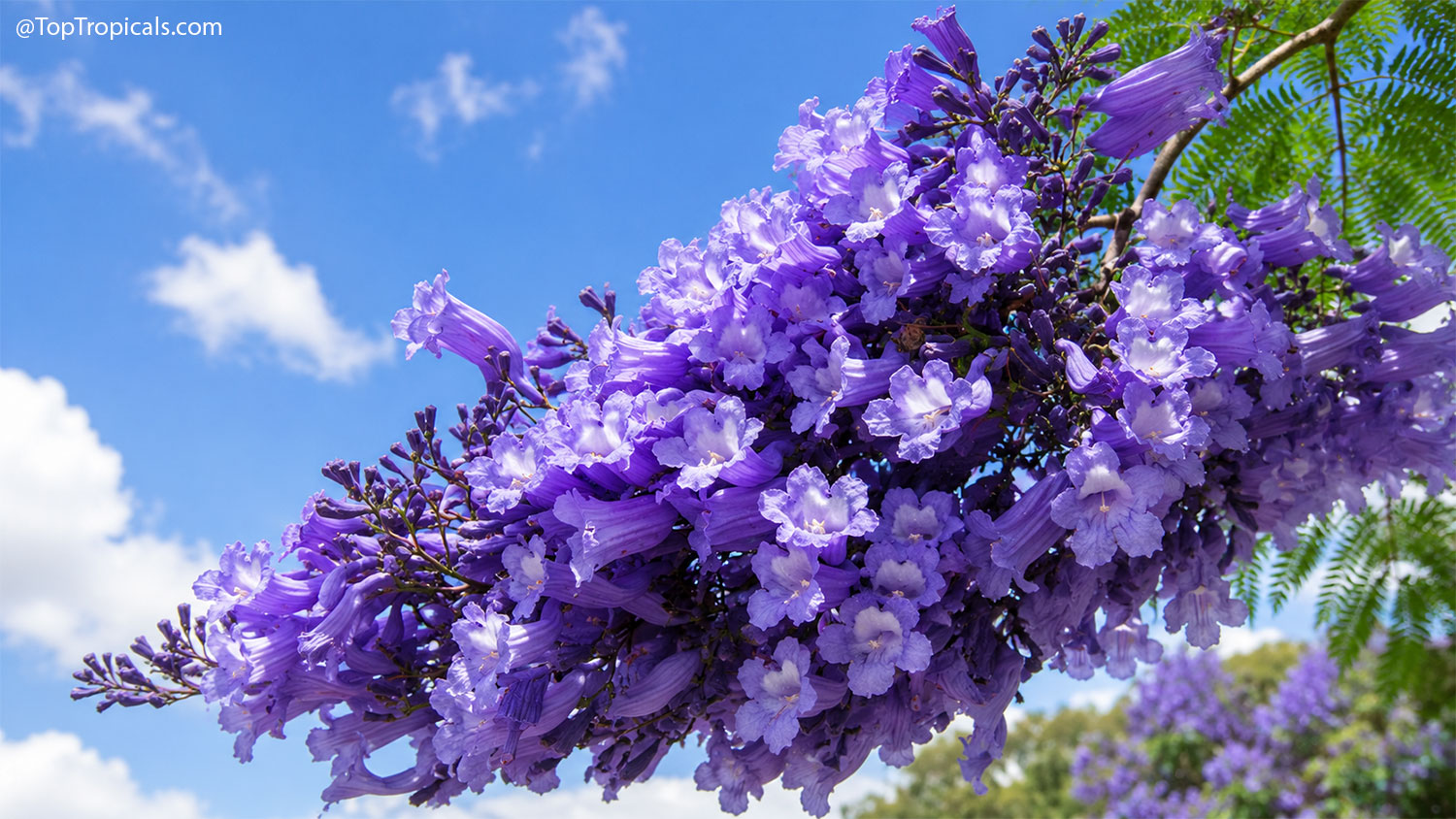
Large  cluster  of  lavender-purple  jacaranda  flowers  hanging  from  a 
 branch  against  a  bright  blue  sky  with  white  clouds.  The  trumpet-shaped 
 blooms  are  packed  tightly  together,  creating  a  spectacular  display  of  color,
    while  delicate  fern-like  foliage  frames  the 
 scene.

Jacaranda flowers bloom in dense clusters of lavender-purple trumpets, creating one of the most spectacular floral displays in the tree world. Against a clear blue sky, the blossoms seem to glow, giving the tree its famous "purple cloud" appearance.

Ask someone with a mature Jacaranda in their yard what it's like when it blooms, and they'll usually smile before they answer.

There's a particular pleasure in seasonal anticipation - in knowing that something beautiful is coming, in watching for the first flower clusters to appear, in the morning you walk outside and realize the tree has finally opened. Jacaranda delivers that pleasure reliably, year after year.

Mature trees become landmarks. "Turn left at the purple tree" is a surprisingly common way to find a house during Jacaranda season. They become the reason people slow down while driving past your house. They become the tree your kids remember.

Few landscape trees combine beauty, shade, elegance, and seasonal drama quite the way a Jacaranda does. Long after the flowers fade, the tree remains a graceful presence in the garden. And when bloom season returns, it reminds you exactly why you planted it.

Some trees provide shade. Others provide flowers. Jacaranda provides both.

That's a rare thing in a garden, and it's worth planting.

Sunshine: What happens when the flowers are gone?
Smokey: Then you enjoy the tree.
Sunshine: And when the flowers come back?
Smokey: Then you remember why you planted it.

👉Shop Jacaranda Trees

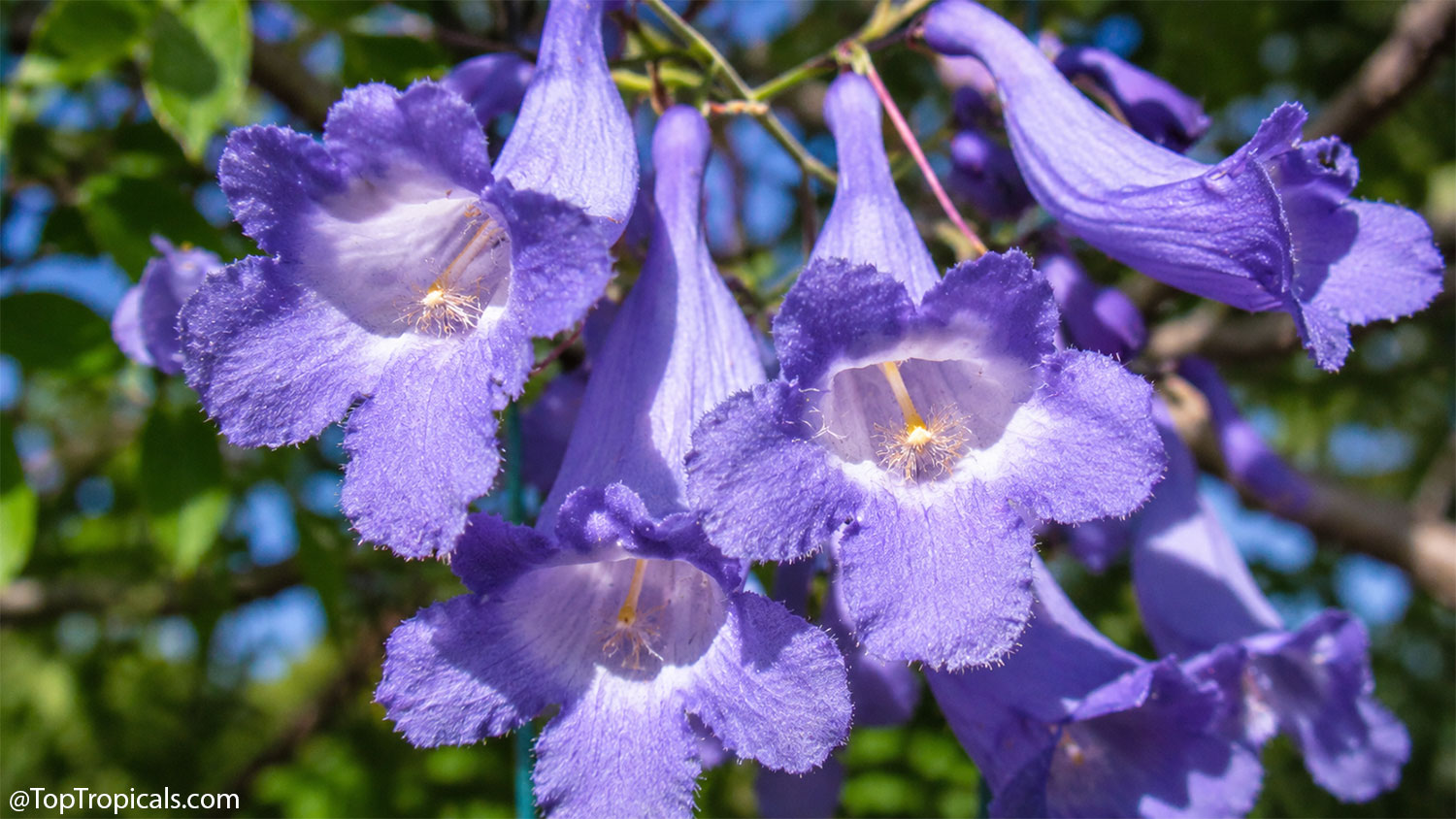
Close-up  of  pale  lavender  jacaranda  flowers  showing  the  distinctive 
 trumpet-shaped  blooms  with  soft,  velvety  petals  and  fuzzy  white  throats. 
 Sunlight  highlights  the  delicate  flower  texture  against  a  softly  blurred 
 background  of  green 
 foliage.

A close-up look at the intricate flowers of the Jacaranda tree (Jacaranda mimosifolia). Each velvety trumpet-shaped bloom combines soft lavender tones with delicate textures that make this tree one of the most recognizable flowering trees in the world.

Date: 14 Apr 2025

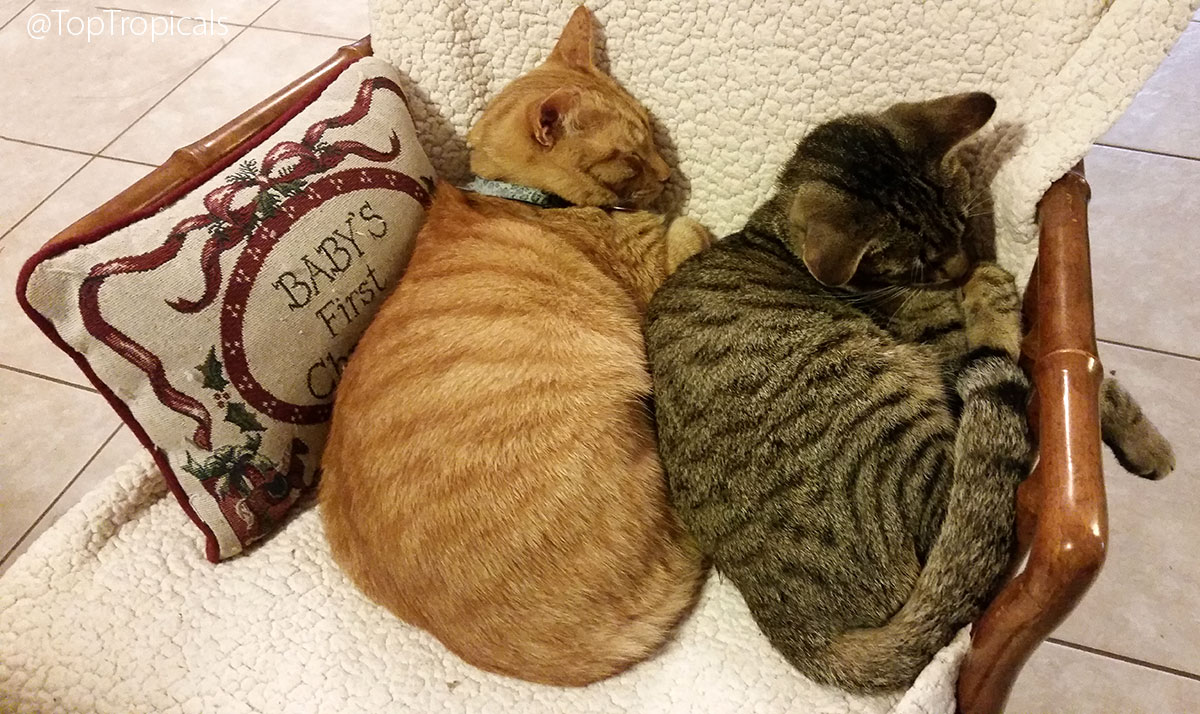
Spooning

Spooning

🍴 Spooning


"Spooning is always a good idea, unless you're a fork."

🐈 PeopleCats.Garden 
#PeopleCats

🔴 Join 👉 TopTropicals

Date: 23 Apr 2024

Cat of the Day - Bob

Cat of the Day - Bob
🐈 Cat of the Day - Bob.

Bob will watch the refrigerator tonight so we can watch out diet. Have a good night! 🌜

📸 😺 👇 Share your cats in comments!

🐾 More #PeopleCats in our Garden:
PeopleCats.Garden

TopTropicals.com

We Grow Happiness