Date: 30 May 2019
Selecting the right jasmine
Q: Would you please help me select the right jasmine? I want to find a jasmine that smells like lily of the valley or honeysuckle or roses, not the one that smells like gardenia. I'm in Missouri, zone 6, so I want a jasmine for my deck for the summer, so I want it to bloom this season.
A: There are 3 major types of tropical flower fragrances - Sweet, Fresh, and Fruity (including Lemony). Below are the most interesting fragrant tropical flowers, excluding Gardenias (which are sweet type). These are all same-year bloomers, so you can enjoy the fragrance this year assuming proper care and bloom booster feeding.
* - The fastest growers that can be treated as annuals. Others can be grown in a pot and brought inside for winter, and be enjoyed every year.
Sweet
*
Aloysia virgata - Almond Bush
*
Cestrum diurnum - White Chocolate Jasmine, Day Blooming Jasmine
*
Cestrum nocturnum - Night blooming jasmine
*
Heliotropium peruviana - Turnsole, Cherry Pie
Portlandia Cubanola domingensis - Cubanola (Warm white Chocolate)
Portlandia grandiflora - Glorious Flower of Cuba (Warm white Chocolate)
Fresh
Beaumontia grandiflora - Easter Lily Vine
*
Brugmansia Jean Pasco - Yellow Angels Trumpet
*
Brugmansia Variegated Orange Angel Trumpet
*
Brunfelsia americana - Lady of the night
*
Brunfelsia lactea - Lady of the night
*
Brunfelsia nitida - Lady of the night
Crinum Queen Emma - Spider lily
*
Eucharis grandiflora - Amazon Lily
*
Hedychium coronarium - Butterfly Ginger
Hiptage benghalensis - Helicopter Flower
Hoya odorata - Fragrant Hoya
Ixora hybrid Sea Green
Ixora odorata - Fragrant Ixora
*
Jasminum azoricum - River Jasmine
*
Jasminum Molle - Indian Jui
Jasminum nitidum - Star Jasmine
*
Jasminum officinale Flore Pleno - French Perfume Jasmine
*
Jasminum polyanthum - Pink Winter Jasmine
*
Jasminum sambac Belle of India
*
Jasminum sambac Grand Duke
*
Jasminum sambac Maid of Orleans
*
Polianthes tuberosa - Tuberose
*Sclerochiton harveyanus - Blue Lips, Mazabuka (Lavender-violet-like)
Fruity
Aglaia odorata - Chinese Perfume Plant (Lemony)
Artabotrys siamensis - Climbing Ylang-Ylang (Lemony)
Cananga fruticosa - Dwarf Ylang-Ylang
Carissa grandiflora - Natal Plum
Cerbera x manghas hybrid - Enchanted Incense
*
Jasminum dichotomum - Rose Bud Jasmine
*
Lonicera japonica - Japanese Honeysuckle
Magnolia figo - Banana Magnolia (Banana-like)
Magnolia x Alba grafted (Bubble-gum-like)
*
Mirabilis jalapa - Four oclock plant
Oxyceros horridus, Randia siamensis
*
Quisqualis - Rangoon Creeper
*
Radermachera Kunming - Dwarf Tree Jasmine
*
Stephanotis floribunda - Bridal Bouquet
Strophanthus gratus - Climbing Oleander
Telosoma cordata - Pakalana vine (Lemony)
Fertilizers for profuse flowering:
Pink N Good Daily Plant Food - Flower Booster
Tropical Allure - Smart-Release Booster
SUNSHINE-Superfood micro-elements
Date: 12 Mar 2019
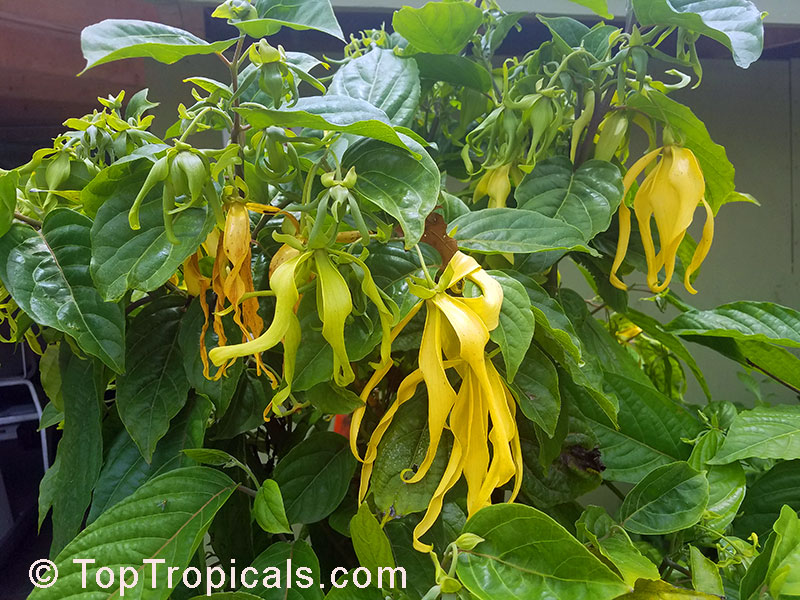
Fertilizing Ylang Ylang
Q: What fertilizer should we be using for ylang ylang?
A: Ylang Ylang is a free-flowering tropical plant that requires regular
feeding during active growth period (March through November in Florida). We use balanced granulated fertilizer that contains micro-elements. Apply once a month 1 tsp per 1 gal of
soil. For in-ground plants, 1/2 cup once a month.
We also apply additional micro-element treat SuperFood as foliar spray which dramatically increases
growth rate and promotes flowering.
Check out our fertilizers, plant boosters, and garden supplies:
Date: 2 Jan 2025
New Year with New Plants:
Choose from 17 Tropical Paradise Resolutions!
"A garden is never so good as it will be next year..." - Thomas Cooper.
Happy New Year, dear fellow gardeners! As we step into a fresh new year, it's the perfect time to think about what exciting, special, and life-changing plants we can add to our gardens. The days are getting longer, and spring is just around the corner, so now's the time to make a plan and prepare for the season ahead. Let's take small steps each year to create the garden of our dreams. This winter, consider these fun resolutions:
- Hang a bird feeder and install a rain barrel
- Order some tropical plant seeds for an early start
- Ask your grandparents about their favorite garden plants
- Build a raised bed for succulents
- Plant a fruit tree or two to have some crop this year
- Start a compost pile
- Switch to organic fertilizers and plant boosters
- Fill empty spaces with flowering trees, shrubs, and vines
- Add butterfly attractors to your garden
- Provide water for bees and butterflies to help them thrive and pollinate your fruit trees
- Get a bonsai starter to try bonsai art
- Enjoy meals outside as often as you can
- Teach a child how to plant a tree
- Plant berry-bearing shrubs like Tropical Cherries to feed the birds
- Rake up leaves for winter mulch
- Add a few exotic plants to your indoor collection or container garden
- Share plants as gifts all year long
Happy gardening in 2025!
Date: 4 Sep 2018
Date: 24 Jun 2018
SUNSHINE-SuperFood for your plants health
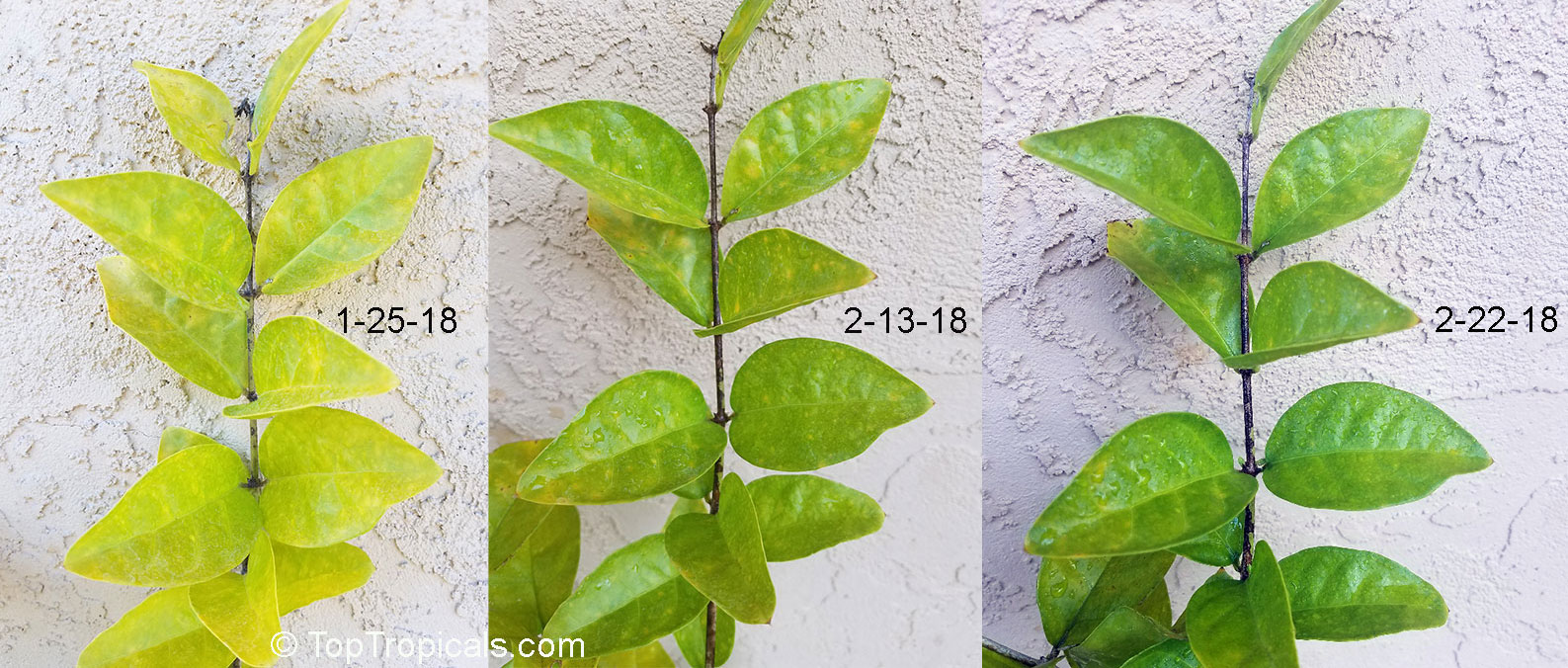
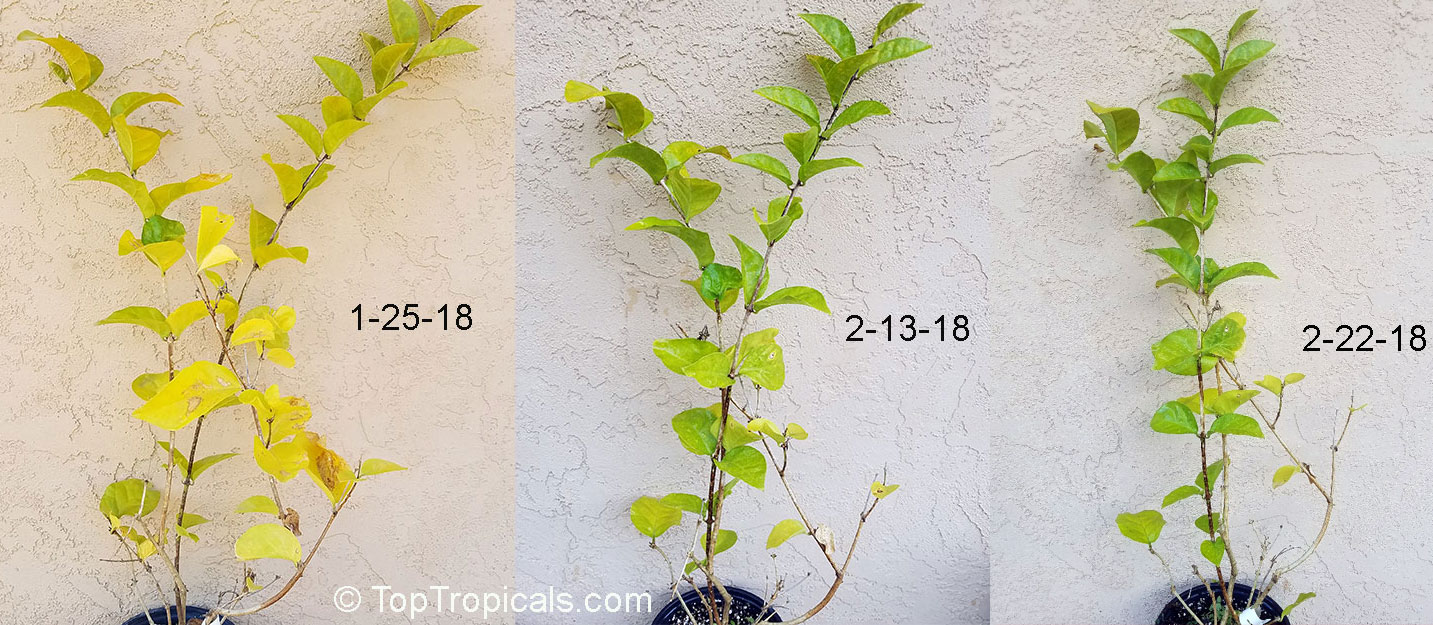
We are getting very high interest from our customers to our new plant booster SUNSHINE-SuperFood as well as many questions. We continue experimenting with the Jasmine that you saw in our previous newsletter, that had pale yellow leaves and numerous deficiencies. Right now, after only 2 applications, it looks healthy green again. Click on the picture to zoom in and see leaves turning from yellow to green within less than a month. See also full plant photo of this jasmine.
Q: Is SUNSHINE-SuperFood a fertilizer?
A: Traditionally we call a fertilizer macro-elements (NPK - nitrogen, phosphorus, and potassium). Technically, SUNSHINE-SuperFood is a complex of micro-elements that are essential for plant's health. It provides such elements as Mg, Fe, Mn, Zn, Cu, B, Mo, S, and Amino-acids that our soils are usually poor of. These elements are responsible for proper development of leaves, roots, flowers, and overall plant vigor. Read more about role of these micro elements.
Q: Can I just get these additional elements in a dry form and add to soil like a fertilizer?
A: No. Some of these elements must present in extremely low concentrations (this is why they are called micro-). SUNSHINE-SuperFood is a liquid substance with very high bioavailability that has very complicated formula; it is not just a mix of the elements. The formula is developed with the maximum efficiency for a plant to absorb through leaves and a root system.
Q: Is it better to spray leaves or water the plant with the solution?
A: Foliar applications are always most efficient in regards of seeing a quick result. However, we recommend to also drench the root ball with SUNSHINE-SuperFood solution to deliver the necessary elements evenly to all parts of the plant through its natural metabolism.
Q: My gardenia looks very sad after winter - most leaves are yellow and some have pale spots. Should I use SUNSHINE-SuperFood more often and in higher concentrations?
A: We recommend to apply SUNSHINE-SuperFood once a month to maintain a general plant health. In difficult cases like with this jasmine on the photo, you can do twice a month. However do not exceed recommended concentration. The rule of thumb is, you can apply water soluble fertilizers and supplements more often, but with lower concentrations - this way a plant will be more responsive. Plant metabolism in general is rather slow, changes take days and weeks - don't try to speed it up. Your patience will be rewarded.
Try SUNSHINE SuperFood on sick looking plants, especially with leaves that are yellowing, deformed or have spots (see photos of different deficiencies). There are no miracles, but this one works like a Miracle! All you need is a few drops of SUNSHINE SuperFood - item 6000! We also have bottles 50 ml and 100 ml for large plant collections and yard/landscape applications. Read more about SUNSHINE SuperFood...