Garden Blog - Top Tropicals

Date: 27 Apr 2020

How to feed a Mango tree...
and to grow a Dwarf Mango
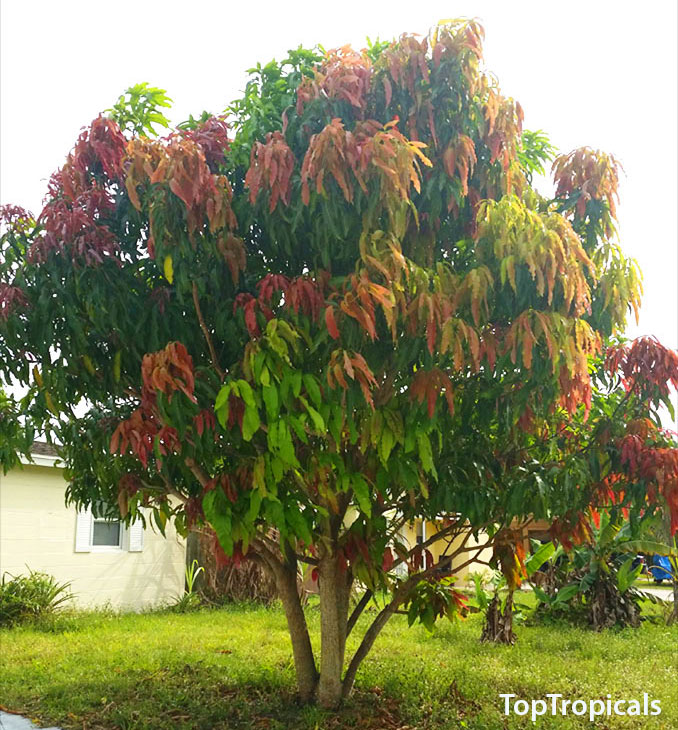
How to fertilize a Mango tree

Q: My mango trees that I bought and planted last august now have fruit. I bought 2 types of fertilizer from you and never used it. Should I use your fertilizer now?

A: It is a perfect time now to fertilize your plants as they start active growth. For mango trees, we recommend liquid fertilizer Sunshine Booster - Mango Tango. It is formulated for Mango trees, especially for container grown. It improves quantity and quality of flowers and ability to set fruit, reduces bud-flower-fruit drop. Can be used as often as with every watering. For best results, use in combination with Sunshine Honey and Sunshine Superfood plant supplements. Its scientifically-balanced stable formula is organic Amino-acid based and has NO EDTA chelators to eliminate nutrients lockup; it does not affect crop taste.
Additionally, you may use slow-release granulated fertilizer Mango-Food once a month during hot season only. Dosage: 1 teaspoon per each gal of soil. Water-soluble fertilizers can be also used, however, those are usually EDTA-chelated which is not as efficient as Amono-acid based Sunshine Boosters and may create nutrients build up, especially if overdosed in containers.
For in-ground mango trees, you may use all the above, and slow-release granulated fertilizer can be applied in larger quantities: spread a handful around the drip line.

Remember that only liquid Sunshine Boosters can be applied year around. With other fertilizers, you need to be careful not to overdose, and apply only during hot weather (when night temperatures are steadily above 65F).

How to grow a Dwarf Mango tree

Q: I received the Ice cream mango tree in great condition (thank you for the ingenious packing job) on Wednesday and have planted it in a pot slightly bigger than the root ball. I plan to grow the tree on my front porch, so how big a container should I ultimately use when the tree outgrows this pot? How big a container does it need to fruit? I hope to keep it around 6-7 feet high, if possible. I live in Hawaii.

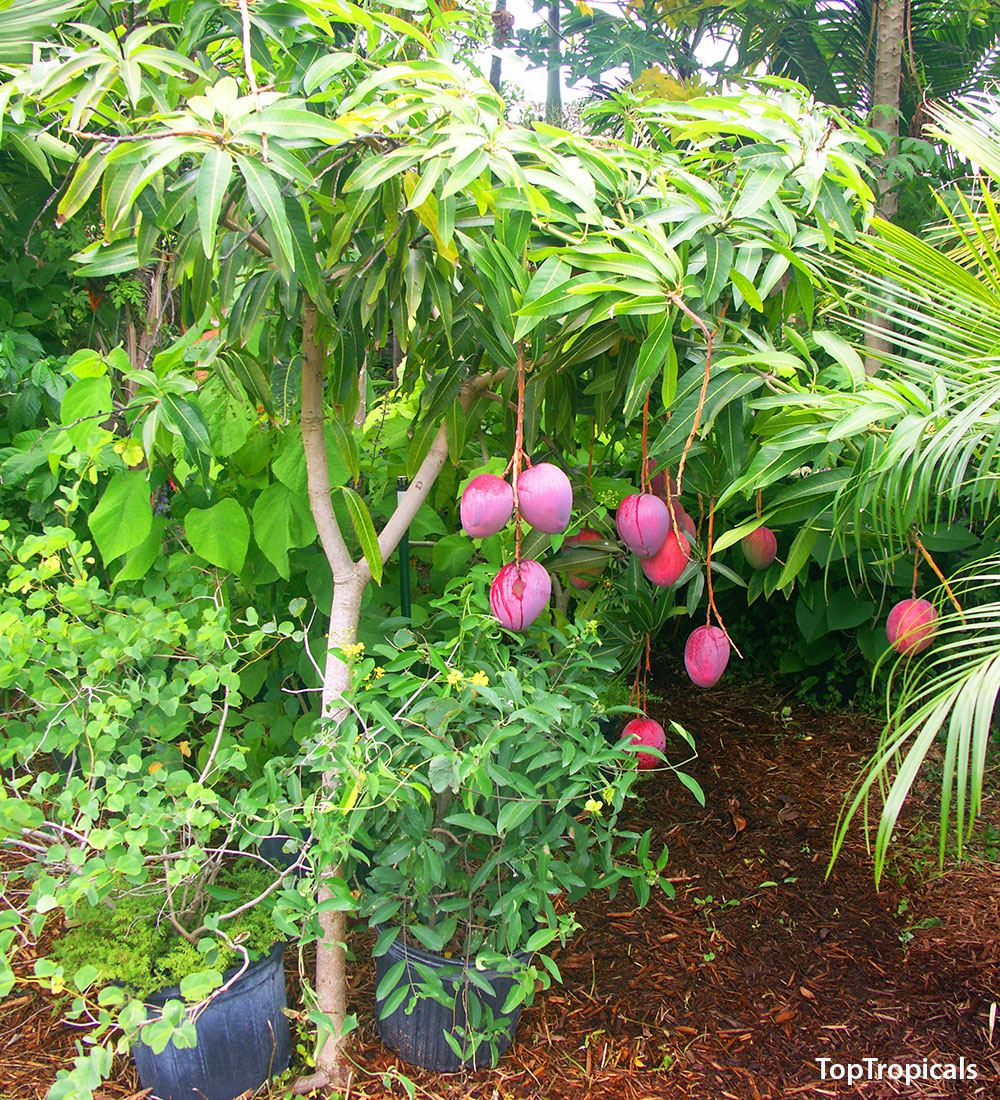
A: Ice Cream mango is a perfect variety for container culture, and it should be happy in Hawaii. You did everything right. Keep it in this small pot for now and wait until it starts vigorous growth in Summer. Once it starts growing (and you will notice roots growing too, sometimes they try to grow through the holes in the bottom of the pot), then it's time to step up into a bigger container (7-10 gal). Eventually you may use container size as large as 15 gal. Ice cream mango is slow growing and compact, and you will be able to maintain it under 7 ft with very minimal pruning if any.

Date: 21 Feb 2020

When plants are ready for a meal?

Q: We have an early Spring here in Florida. All plants in my garden flushing out new leaves and buds opening. Can I start fertilizing? I have Mango, Avocado, Peach trees, many medicinal herbs and flowering shrubs: Angel trumpets, plumerias, bromeliads. I prefer mild organic fertilizers; can you suggest something that is safe for edibles and butterflies?

Q: As a rule of thumb, tropical gardeners start regular fertilizing when the minimum temperatures (at night) go above 65F. Keep in mind that Sunshine Boosters fertilizers can be applied year around because they have mild formulas and used with every watering; during cooler period, you water less frequently, so feeding is reduced accordingly. Another advantage of Sunshine Boosters - they are natural (derived from organic amino acids which is the basics of Life). They are safe for edibles as well as pollinating insects.

Here is the feeding plan for your plants:
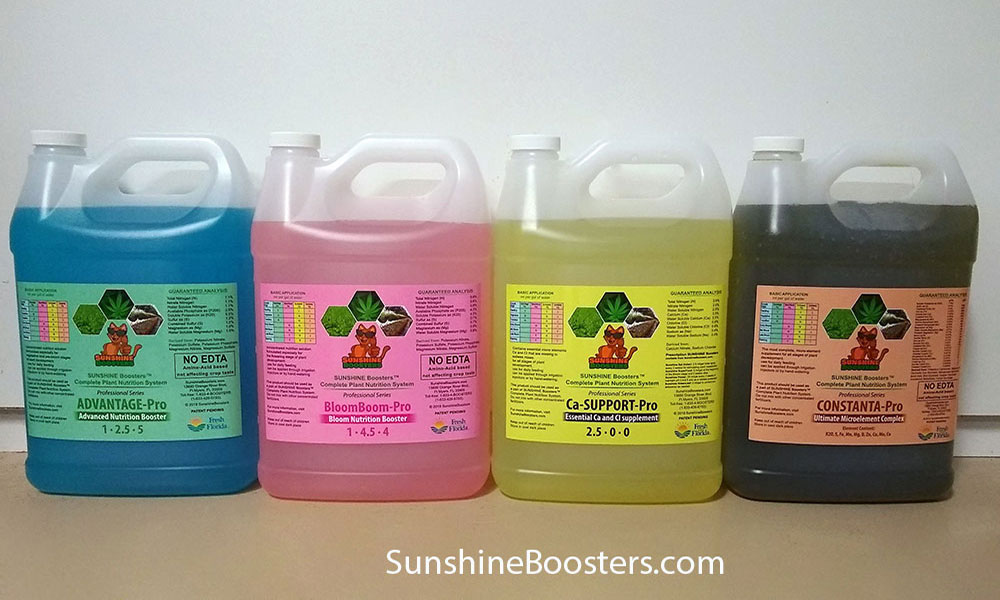
1. The most universal solution for all plants (both potted and in-ground): get a complete set of Sunshine Boosters Pro system: Advantage-Pro for vegetative growth, BloomBoom Pro for flowering stage, and Ca-Support-Pro + Constanta-Pro as necessary daily supplements. You will need all these 4 components for your garden.
2. Start adding these liquid boosters with every watering according to dozing directions and you will notice amazing growth boost within a week.
3. Apply Sunshine Epi plant hormone every 2 weeks as a foliar spray to boost immune system and metabolism of plants and protect them from diseases. Epi makes plants (especially young plants and those "waking up" from dormancy) grow twice faster! It also enhances effect of fertilizers by increasing plant metabolism.
4. After cool winter temperatures, some plants may develop element deficiencies like chlorosis (yellowing leaves). Additional microelement boost can be provided with Sunshine Greenleaf (iron supplement) and Sunshine Superfood (micro-elements).
5. For additional boosting of flowering and setting fruit, use the following individual boosters:
Sunshine Robusta - for foliage plants and when you need rapid vegetative growth
Sunshine TotalFeed - for Plumerias and other fragrant plants
Sunshine Megaflor - for Brugmansias and other flowering heavy feeders
Sunshine C-Cibus - for improving fruit production and quality
Sunshine Honey - for sweeter fruit (must be applied 4-5 times a year)
6. For young/small plants (seedlings, rooted cuttings) as well as tender tropicals like bromeliads, and orchids - Sunshine Bombino is a perfect choice due to its mild formula.
7. To save money, order complete sets rather than individual boosters; you will be able to safe up to 40%! Sunshine Complete Nutrition System Kits: Combo Kit, and Pro Kit.

If you are a fan of organic gardening, do not use dry fertilizers. While water-soluble and granulated (smart-realease) fertilizers are popular choice in plant nurseries due to their convenience, they are not as safe as liquid boosters because they create salt build-up in soil and have a high risk of overdosing/burning plant roots, especially potted plants, plants at breaking dormancy, at establishing, and at early stages of plant development. Besides, dry fertilizers may affect the taste of your fruit and herbs. See advantages of liquid boosters over dry fertilizers.

Learn more about Sunshine Nutrition System - a Natural solution for your garden.

Date: 28 Sep 2019

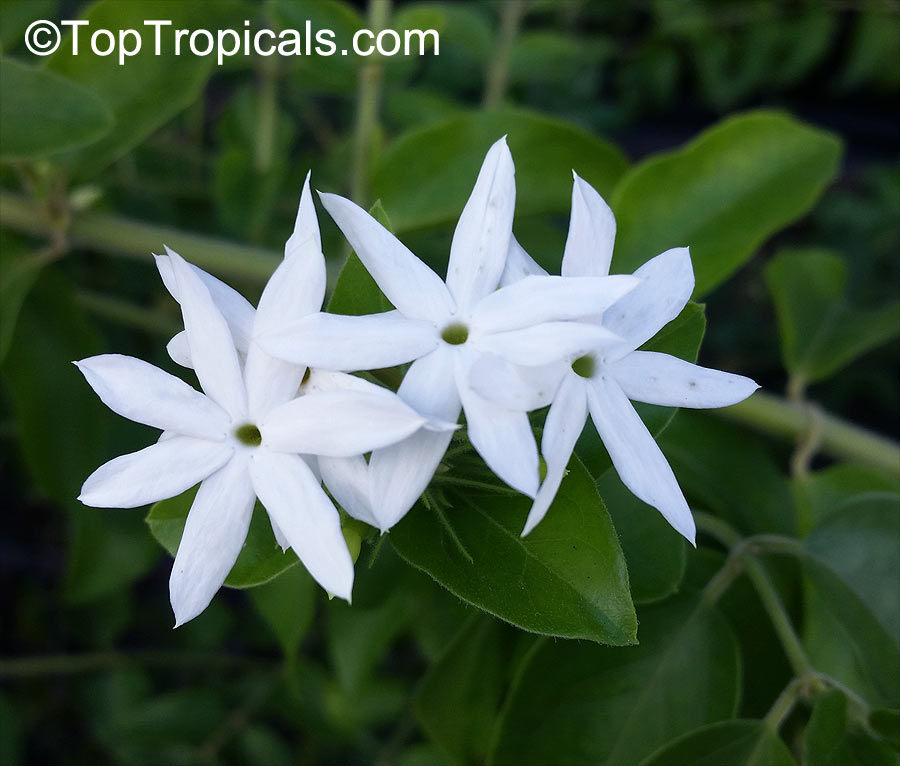
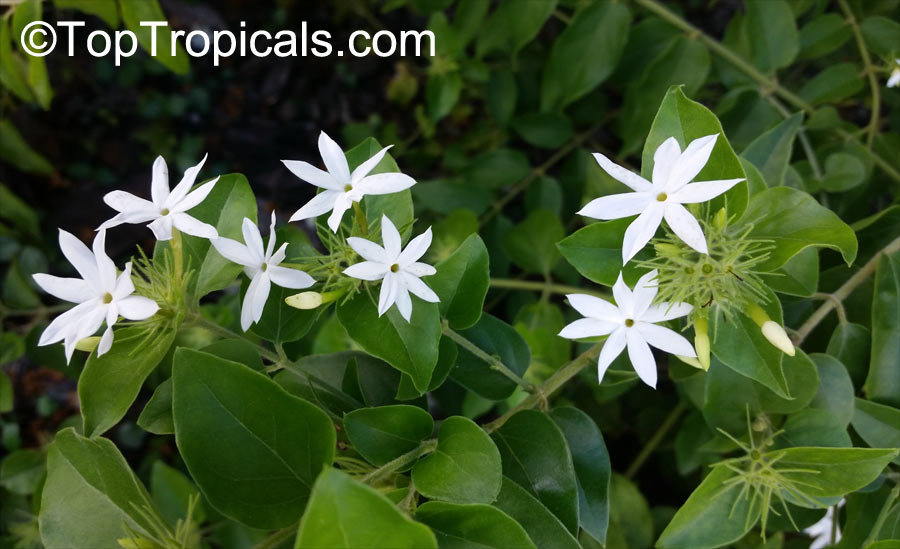
Fragrance of Angel Hair Jasmine

Q: I got angel hair jasmine, it started flowering, but it does not have any smell. What can be done?

A: Jasminum pubescens - Angel Hair Jasmine has very fine fragrance. It is not as strong as some other jasmines like Sambac for example. However flowers do have a sweet scent especially in the early morning hours, as long as the plant is well-established, grows in a warm and humid environment. Keep in mind that flowers on young small plants that do not have a developed root system, may not be as fragrant as on mature vigorous specimens. Also, this jasmine needs a full sun location and regular fertilizer for profuse flowering.
We recommend the following fertilizers to boost flowering energy:
- Pink N Good Daily Plant Food - Flower Booster
- Plumeria Top Dress - Smart-Release Booster
Use microelements at least once a month to improve plant vigor and quality of flowers

Date: 13 Aug 2019

Caring of Soursop in container

Q: I have ordered dozens of trees from you and have a question about Soursop. I have a Soursop in a container and ants and aphids are under new leaves. Do Soursop like little water? I water almost everyday living in southern Los Angeles it's been around 76-80F. I spray the aphids and ants off with a mist setting on my hose. They come back every day. They're only on new leaves...

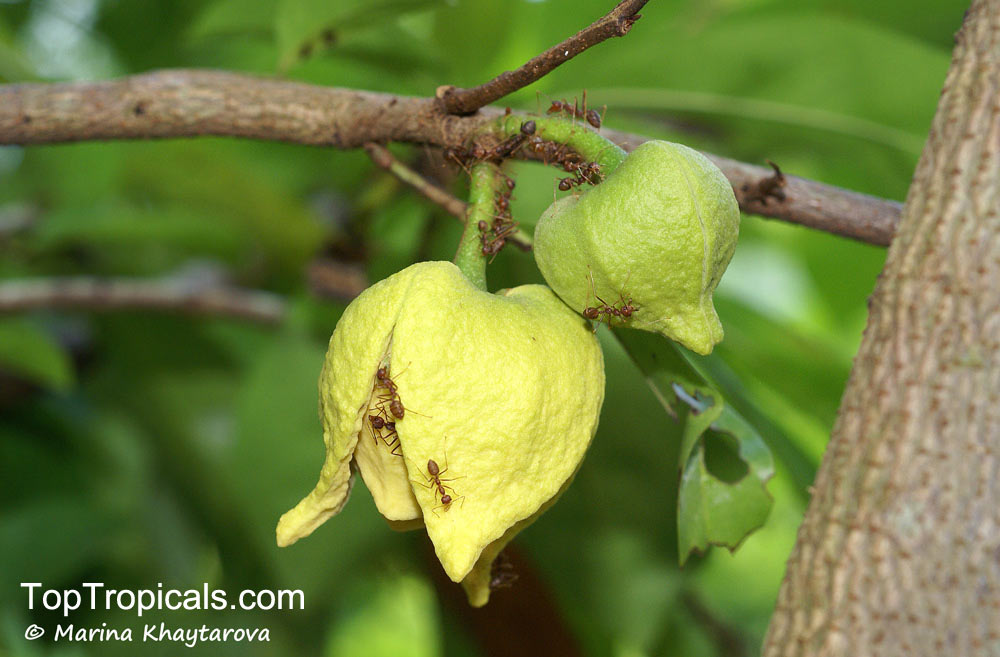
A: First of all, you don't have to remove the ants iа they don't bother you. Ants are good insects, they do not harm plants; most likely they are attracted by a sweet sap - aphid by-product. Ants clean up a plant, and they may even take care of some bad insects.
It is not difficult to get rid of aphids. Use a safe treatment: in a small spray bottle, mix 1 cup of warm water, 1 teaspoon of dish soap and 2 tablespoons of any cooking oil (if you have Neem oil or Horticultural oil - even better, but prepare, they are pretty stinky). Spray the leaves with this solution to a dripping point. Repeat in a few days if needed. This simple remedy will take care of the aphids.
Daily water may be ok for the plant during hot weather, as long as the soil is not constantly moist. Let the surface of the soil get a little dry between waterings.

Recommended fertilizers for fruit trees:

Fruit Festival Plant Food - Super Crop Booster
Mango-Food - Smart Release Fruit Tree Booster
SUNSHINE-Honey - for sweeter fruit
SUNSHINE SuperFood - microelement supplement

Date: 3 Aug 2019

Grafted or seedling?

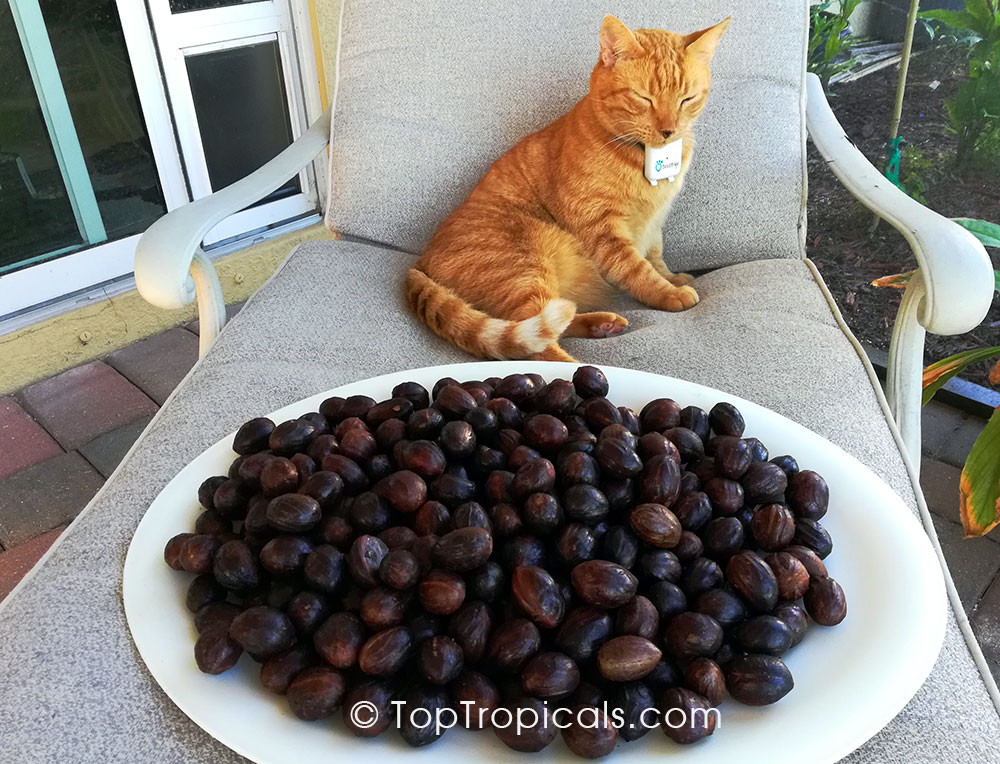
Photo: Mr Barcy meditating before planting Nutmeg seeds

Q: I planted an avocado seed and it sprouted quickly, it has been only a couple months and I already have a small plant. How soon will it produce fruit? Can I grow other tropical fruit from seed?

A: Unfortunately, some fruit trees, including varieties of avocado, mango, lychee, as well as apples and peaches - must be either grafted or air-layered in order to produce, for 2 main reasons:
- seedlings may take a very long time until fruiting, up to 10-15 years
- seedling gives no guarantee on the quality of the fruit or variety
These fruit trees should be propagated as "clones" - both grafted material or cuttings are actually copies of the mother plant and will keep the same fruit qualities. Grafted trees usually start producing immediately.
However there is a number of fruit trees that come true from seed, and take a very short time to start flowering. Jackfruit, Annonas (Sugar Apple, Guanabana, etc), Papaya, Icecream Bean, Eugenias start producing at a young age (3-4 years from seed).

Recommended fertilizers for fruit trees:

Fruit Festival Plant Food - Super Crop Booster
Mango-Food - Smart Release Fruit Tree Booster
SUNSHINE-Honey - for sweeter fruit
SUNSHINE SuperFood - microelement supplement